googlee7ea825f63edb3f6.html

Saturday, 27 August 2022

JOHN FRANCIS FLYNN/ SOUND PLOTTING (GIG-GOING ADVENTURES GO AL FRESCO)

JOHN FRANCIS FLYNN
Rooftop, De La Warr Pavilion, Bexhill-On-Sea
Sat 15th Aug


I confess that the notion of a summer rooftop gig at the De La Warr is what first took my fancy. So, while I had of course checked out Irish folk singer John Francis Flynn on-line before clicking ‘Buy’, I had a less-than-full idea of how he’d be live.

Despite there being no house lights to dim, there was no audience announcement or any other sign the show had started. Instead he eased leisurely into his first number. So small were the beginnings I don’t think many were aware he’s started for some while. Now Flynn looks remarkably like a ’Lord of The Rings’ character. In particular, the one who looks like a warrior prince and, in the second hour of the third film, turns out to be a warrior prince. But rather than some full-throated roar, he sings in an understated, intonatory, gentle-giant fashion, barely moving.

And most of the set, rather than attention-grabbing, was longish numbers which spun a slow magic on you. He plays acoustic guitar, alternating with tin whistle. (Or, as he proudly pointed out, two tin whistles taped together. I expect they call that the Jimmy page tin whistle in the trade.) And was joined by a clarinetist and a droney/ambient keyboardist who doubled on drums. A Dublin base usually means traditional Irish instruments which no English tongue can possibly pronounce. Not here.

The instruments were, at points, looped and treated. But never in an ostentatious, show-off fashion. Had you asked any of the songs whether they were modernised or traditional, I think they’d have shrugged the question off without interest and just carried on. Which always seems the best way.

Then, when you started to think he might have overplayed the slow and mesmeric card, they shifted into a full-voltage rocked-up version of ’My Son Tim’, complete with whoops if not full-throated roars. The clarinetist even swapped to electric guitar, without any shouts of Judas.

My one complaint would be that the drums at times felt mixed too loud, as if they were what we’d come to hear. When they first broke in, I almost jumped!

Support act Iona Zajac had a richly evocative voice, fairly built for folk singing. But her songs only at times lived up to that voice. The best number was a traditional, saved for the finale, where she was accompanied by droney squeeze-box.

Having attended because of the open-air setting, it was something for those surroundings to melt away and be replaced by the world of the songs. There’s the sense with folk music that it’s all still steeped into things, and if we find a way to tune out the workaday world we’ll start to hear it again. I am probably getting carried away now, so had better stop.

A different version of ’My Son Tim’. They got a violin, but we had a rooftop…


Then from one outdoor gig…

SOUND PLOTTING
Stanmer Organics, Falmer, Sussex
Sat 20th Aug


“Set in the verdant sprawling plots of Stanmer Organics”, it says here, “Sound Plotting will be a day of site specific sound art, interactive installations, deep listening, sound walks, improvised music and pop-up performances.” It’s by Lost Property, the collective who previously took over a Napoleonic fort in Newhaven to stage similar shenanigans.

The idea, they confess, first struck them during lockdown when outdoor settings were literally the only show in town. But it’s a good one, which has you running about like a white rabbit, amid a host of other rabbits, dipping your expectant head down a whole bunch of holes. Pretty soon you become almost accustomed to the sight of laptops perched on tree trunks, or speakers hanging from branches. And if not every rabbit hole took you to a Wonderland, then these things are always more than the sum of their parts. Wandering, exploring, is a large part of the fun.

Venturing to see Gagarin in what the programme called ‘the willow dome’ I discovered it to be a dome of willows, which you entered like a teepee. As they swayed in the breeze they created a dappled light show on the ground, nature’s instillation piece. I often contend that ambient electronics work best when you’re not sure whether they’re sourced from natural sounds or not, it seems to create a sweet spot. And the set worked better for me the nearer it got to that sweet spot.

Paul Khimasia Morgan’s set was similarly slow-moving and ambient, but (from what I saw) more based around picking up tones from contact mikes. It’s music which always seems to slightly elude you. The more you try to focus on it, the more it drifts away just past your reach, as if floating on the summer breeze. Which of course only makes it more involving to listen to. (Older readers may remember Morgan put on the Aural Detritus concert series.)

In the midst of all this knob-twiddling and miking-up of things, Jo Burke stood up and sang some a cappella folk songs. And, for that matter, sang them well. Somehow she combined the best elements of professionalism with amateurism, the sense that this stuff is our common property. Much of being a good folk singer may be holding the notes just long enough, so you get the choral-like semi-drone effect without it feeling affected. While at the same time you could feel the old songs doesn’t require reinvention or rejuvenation, that people are simply still singing them, the way they always have.

Baby Hair have a name that sounds like a folk remedy and offered, according to the programme, “minimalist trance pop and ritualistic performance”. They reminded me of the old Marc Bolan adage about pop songs being like spells, as they recited words, struck triangles and blew haunted recorders, until you didn’t know whether to find it charmingly enthralling or sinisterly enchanting. Lyrics were reduced to a few babble phrases, repeated until they became mantras. It took us all somewhere, even if I couldn’t really tell you where.

However, while it’s clearly part of their mission that things have to go on too long, past the three-minute pop-song limit like exceeding the stated dose, they still went on a touch too long. Always leave ‘em wanting more!

So, where will Lost Property be found next? Inexpertly taken photos by me, including the culminating procession by Thee Bald Knobblers.


Saturday, 20 August 2022

‘MUNCH: MASTERPIECES FROM BERGEN’

The Courtauld Gallery, London


From Daylight To Twilight (How Munch Became Munch)
The Munch paintings in this smallish two-room show more normally reside in a dedicated museum in Bergen, in fact they haven’t been seen outside of Norway before. Perhaps unusually, they come from all stages of Munch’s career. Let’s start at the start…

The prime example of Expressionism, we soon discobver, started out as an Impressionist. That may be like discovering a Punk musician originally played Blues. It may be the more surprising thing that those early works hold up so well. To get here you need to walk through the Courtauld’s impressive Impressionist collection, Monet, Manets and Degas on all sides. Yet they don’t particularly pale in this fine company.


Take ’Morning’ (1884, above) with its captured moment in time, casual pose of the figure, precise play of light and the floorboards and side of bed seeming to extend out past you. It’s immediate, involving, like the painting’s not here but we’re there. It was a good enough stab at the style to flummox the Norwegian critics, who soon dubbed him ‘Bizarro’.


Or take ’Inger in Sunshine’ (1888, above), which manages to convey the sunshine despite being painted in Norway, and with what the show calls “shimmering colours”. Only the model’s impassive expression seems a departure.


But then try ’Summer Night: Inger On the Beach’ (above). It’s from 1889, only a year later. It takes the same model (one of his sisters), in a fairly similar outfit. But everything is now different, and Munch as we know him has arrived. She doesn’t look out but off, as if in a reverie.

The colours are flatter and more sombre. But two things stand out most of all. The lack of horizon line, the water extending past the edge of the frame. And that white dress makeing her the focus of the image, even though she’s not centred.

She isn’t placed before a setting, it’s built around her. This isn’t a slice of life but a psychodrama, a moodscape. Shoreline setting and twilight combine to create a liminal space, aids to help us guess what her pensive thoughts might be. As I said over the British Museum show of his prints: “Munch is perhaps the default example of an Expressionist artist, who painted not what he saw but what he felt.” In fact, the show is keen to say that it’s with this exact work that the shift occurred.


And he didn’t stop there. ’House in Moonlight’ (1893/5, above) is almost a series of theatre flats, where we work out what’s in front of what by placement, not perspective, the gate behind the woman, the house behind the gate and so on. (Only the very foreground, with the falling shadow, breaks from this.) And the greens look too green, the browns too brown, to be naturalistic. Everything we see here looks like a symbol.

Trapped In A Timeline

And ‘Woman in Three Stages’ (1894,) from the series ’The Frieze Of Life’ merely uses pictorial space as a backdrop to a light-to-dark timeline. Let’s get the obvious said first. The three stages of women, already referred to like points on a production line, are not-yet-ready-for-sex, ready-and-up-for-it and then past-her-sell-by. Just as with nature, Munch’s only interest in women seems to be what they can offer him. It shouldn’t be contentious to say this.


But let’s look more at how the theme recurs in other works on show here. At first glance, ’At the Deathbed’ (1985, above) more resembles the better-known ‘The Sick Child’ (1885/6). Both are inspired (if that’s the word) by the early death of his sister Sophie. Both split the frame, placing the sickly child on the left, the grieving adults on the right.

Yet in this work he inverts the figure and places her prone under a white sheet, as if already in her coffin. Which makes for a strong contrast to the assembled family, a cluster of black which extends beyond their mourning clothes to take up almost all the right section.

So we are almost back to the light-to-dark timeline of ’Woman In Three Stages’, merely with the middle figure removed. Sophie was fifteen when she died, but truncation makes this figure seem smaller. It’s as if she died before gaining the full awareness of death the adult figures are lumbered with, innocence your only possible protection against this world. It’s like the classic Larkin line amended: “Get out as early as you can, before the possibility of having any kids yourself has even arisen.”


’Four Stages of Life’ (1902, above), as the title suggests adds a stage. Though probably more significant is his arranging of the figures behind one another. The young girl isn’t just pushed to the front and given a red hat (with echoing flecks of red in her coat), she looks out at us, and so becomes our focus. She may even be pleased to see us.

While the figures receding along a receding road look progressively gloomier, and meet our gaze to lesser and lesser degrees, the third already seeming to wear a mask. With life reduced to a timeline, we can only focus our attention on the short-lived part that’s liveable.


’Evening on Karl Johan’ (1892, above) resembles the print ’Angst’ (1896) from the British Museum show, and indeed Munch had fixations he’d repeatedly hammer on. But there’s an irony here that the deep perspective and pushing of figures to the foreground, almost out of the frame, is an Impressionist device that almost takes us back to the start.

Except with them it would convey the vim and bustle of street life. While he uses it to get us eyeballed by that dead-eyed clump of black, with their identically blank expressions. This is like the mourning family from ’At The Deathbed’ transplanted. Last time I used an Eliot phrase to describe the pallor of those ghoulish faces, “the skull beneath the skin”. Let’s add another one, “I had not thought death had undone so many.”

As we saw in the British Museum show, Munch was very much a Bohemian who associated with other Bohemians and (at least at times) exulted in shocking polite society. Yet as we also saw, rather than any of the libertinism and hedonism we associate with Bohemianism, he gives us very much the reverse.

His family background was Pietist, an uber-Protestant group who saw little good in this world other than a way out of it, via connection to God. And he doesn’t upend or challenge any of that. He simply cuts the connection, leaving us marooned and bereft. Chesterton famously said “When a man stops believing in God he doesn't then believe in nothing, he believes anything.” Munch proves this wrong. He very much believed in nothing.

Right at the end are a few works by later Munch where, taking on a more optimistic perspective, he sought to portray human vitality. Which seems the opposite to what you tend to expect, that people start out full of vigour and drive to change the world, and as they age feel mortality slowly closing around them.

But it must be said these works are simply less involving to look at. Whether this is because he was faking the look, like giving a wan smile, because he was built to glower in the gloom, or simply because optimism is a harder look to pull off than pessimism… there’s probably no way of knowing. Whichever it is, Munch’s home ground was the liminal spaces.

Saturday, 30 July 2022


Maybe come back to this blogging business in the Autumn...

Saturday, 23 July 2022

DON’T TRUST THE TELEPHONE (ANOTHER SPOTIFY PLAYLIST)


My latest Spotify playlist is up, for your listening pleasure! Our journey starts on the mystic shores of sweet Iona. After which David Bowie muses the relative merits of sanity and its alternatives, The Body Lovers (Swans' Michael gira under another name) get both instrumental and numerological, Inner City Unit (Nik Turner's too-little-known post-Hawkwind outfit) discover the Bigfoot, the ever-mighty Ex embark on a blindfolded sword dance, Faust defy sense in three langauges at once, Can forge their way uphill as if no force can stop them, while Two Lone Swordsmen (feat. Andrew Weatherall) feast on fire. Plus more! (Illo by Louis Soutter)

Mike Scott: Iona Song
Pentangle: No More My Lord
Nick Drake: Parasite
David Bowie: All The Madmen
PJ Harvey: Send His Love To Me
The Body Lovers: Part V
Inner City Unit: Big Foot
Githead: Over The Limit
The Ex: Pigs & Scales
Faust: Chlorophyl
Can: Uphill
Neu!: Lila Engel (Lilac Angel)
Two Lone Swordsmen: Taste Of Our Flames 

https://open.spotify.com/playlist/31WBzvitBIBmzMQxobv7AR?si=593a60bc9ee2413c

“We who were right all along
“Will then read out your names
“Those who stole secrets will pay
“With a taste of our flames”

Saturday, 16 July 2022

HEY COLOSSUS (GIG-GOING ADVENTURES)

The Hope + Ruin, Brighton, Fri 15th July


Hey Colossus’ return to our shores was twice delayed by the dread C-word and, soon as they’re on stage, they gleefully tell us in that time they’ve become “progressively worse”.

They kid, of course. But they do differ from the way they were last I saw them, admittedly back in 2015. They’re still about unleashing the full force of three guitars at once. But there’s less of a noise punch, and more of those pulsing riffs. (We need a portmanteau term for music pitched between riffs and pulses. Which probably shouldn’t be ‘priffs’.) At times it got so trancy I came to think of Neu!

Which is better? Despite my love of all things Neu! I think maybe before was better. But the new stuff’s so good it’s almost arbitrary to classify. It’s not even like awarding gold and silver, more like separating silvery gold from goldy silver.

Like previous gigs, for the second half of their set they shifted to heavier stuff. Though a little internet sleuthing suggests all tracks were from their last two releases, apart from one all-new number. Then for the finale they effectively combined the two, with a long, mesmeric piece. Which more internet sleuthing suggests might be called ’A Trembling Rose’. We may still be in the honeymoon period where just getting to see these long-delayed gigs feels blissful in itself. But this would have counted as a great gig at any point.

…and special mention for Brighton noise metal band Pascagoula, who ensured the support slot was nothing to skip. Powerful bass and drums ran the riffs, leaving the guitar free to go off, to unexpected and yet complementary places. If you went to the bar for them, you missed out.

and, speaking of that new number, though from Nottingham…


Saturday, 9 July 2022

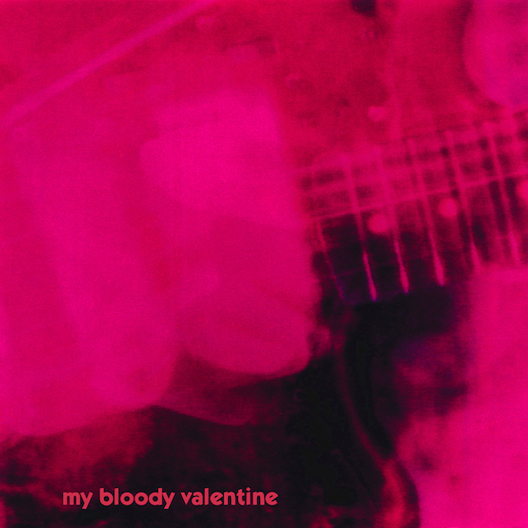
“TURN MY HEAD INTO SOUND”: MY BLOODY VALENTINE’S ‘LOVELESS’ (TOP 50 ALBUMS)


Noise Will Set Us Free

My Bloody Valentine are now chiefly known for two things. The Brian-Wilson—like quixotic quest that lead to the recording of ’Loveless’, which nearly bankrupted their label. (Alas not entirely succeeding, leaving Creation still able to release Oasis albums.) And their tooth-rattling live performances, particularly on ’You Made Me Realise’.

And, at least in part, fair enough. The one time I saw them in their original incarnation they played a shortened set as part of a package tour. And still had time to play the extended version of ’You Made Me Realise’, with it’s mid-section of free-form noise. Though I probably got off lightly. There were nights where, no lie, the track would stretch out for half an hour and do structural damage to the venue.

And it was in noise the band found itself. They were originally just another clutch of Indie no-hopers, much as Joy Division before them had started out as second-rate punks. Figuring they were going nowhere they booked a final tour where they resolved to turn up the volume. Which they may well have originally meant purely as a fuck-you gesture. Guitarist and main man Kevin Shields has subsequently spoken of a desire to kill their own songs. They had, in the words of a later song, Nothing Much To Lose.

But noise seemed to offer possibilities. Because volume doesn’t just amplify the sound, even if that’s what it’s intended for. Inevitably, it changes the sound. You can treat those changes as interference, and try to minimise them, like people normally do. Or you can play into them.

And Shields then devised a style of tremolo playing which worked with this, soon dubbed ‘glide guitar’. Some say it came about after he’d needed to borrow a guitar, which happened to have a tremolo arm on it. Musos can ready about this here should they want. Suffice to say that, by bending and distorting the notes, it worked well with volume.

It’s true enough they came to be as influenced by others who had taken up noise before them, such as Sonic Youth and the Jesus and Mary Chain. But discovering the possibilities of noise for themselves, that may have been vital.


The ’You Made Me Realise’ EP in ’88 marked this change-over, handily marked by being their first release on Creation. (All that was before can really be regarded as juvenalia.) And from that point to this day reactions inevitably split into two contrary camps: “Is it supposed to sound like that?”, and “Who cares, when it sounds so awesome?”

Except, crucially, they never entirely tore up those Indie roots. It was like a swoony Dream Pop outfit and the most abrasive noise guitar band had been carelessly double-booked, but somehow still found a way to get along. Tracks sported Dream Pop titles, such was ’Blown a Wish’ or ’(When You Wake) You’re Still In a Dream’. 

And as ever there’s more to Pop that music snobs make out. Though music journos sooner reached for Sonic Youth comparisons, Phil Spector’s lush, epic soundscapes are as much an influence. Even now there are those who insist ‘masculine’ Rock is superior to ‘feminine’ pop. While Shields’ and Bilinda Butcher’s vocals, sometimes swapping, at others never quite overlaid, sailed over such restrictive distinctions.

Shields would insist he was influenced by Hip-Hop, despite never using Hip-Hop beats and at a time when any Hip-Hop/Indie crossover was effectively nil. What he borrowed, I suspect, was Hip-Hop’s habit of pushing disparate elements together and watching them collide, like fitting together pieces from different jigsaws. Making ‘wrongness’ work for you.

As an example listen to the opening of ’Soft As Snow’ and try and guess where and how the backing vocals will come in. Which you can’t do. They’re crazily, creatively counter-intuitive.

A great deal of great music doesn’t stake out the extremes (“the heaviest album evah” and all that), but mixes up the colours until new shades are made. And MBV would be a prime example, blissed-out and blistering all at once. Sometimes their music would be fragile wisps of things, murmured vocals floating past your ears. At others it was like getting wired up to the mains. And they’d jump from one to the other mid-track or, fairly often, do both at the same time.

It was delirious and intoxicating, like getting the punch and seeing the stars simultaneously. If we need a soundbite description, let’s go with ‘woozy noise with tunes’. Shields was after “the most beautiful songs with the most extremeness of physicality and sound.”

Though I doubt it was ever consciously intended, the music epitomised the philosophy that nothing is ever truly solid, essentially itself, separate from the rest of the world, but everything is fluid, changing and morphing. Brutal noise will eventually become serene, dreams are never so distinct from nightmares, love turns to heartbreak, and so on.


Now musically speaking, I’d come of age in the early Eighties. When Post-Punk had been stridently forward-looking, disdainful of the done-before. Which was inevitably succeeded by its polar opposite, music which was quite happy to have its roots showing. And as the Sixties had been the era most effort had gone into walling-off, it became the most brought-back, in scenes such as the Paisley Underground. To water the roots or cut yourself loose from them, that had come to seem music’s inevitable divide.

Then MBV came along and managed to look back as a way of looking forward. That Sixties psychedelic sound had in its day not been quaint or retro but been pushing at the limits. So now was the time to take up that baton and push harder.

A classic example would be vocals. Sixties beat groups were forever battling old-school engineers, who were insistent on making vocals prominent and distinct so listeners could hear the words. Whereas the bands wanted them to be made part of the rhythm. So MBV pushed down the vocals even further, setting them amid the other instruments, just another sound source.

Leading on from which, could you claim their sound was psychedelic? It’s not something you’d say of the bands which most influenced them. And, inevitably enough, Wikipedia labels them as Shoegaze, plus the charmingly oxymoronic Noise Pop. But psychedelic music plays with loss of form, epitomised by those liquid wheel light shows, in order to project a disorientating sense onto the listener. Which tended to work best when there was some semblance of form left to attack. Relatively straightforward song structures and simple tunes were bent and twisted, almost beyond recognition but never quite. Which sounds very much like… well, you may be ahead of me.

Abandon All Spatial Metaphors


What was effectively their first album, ’Isn’t Anything’, came out later in ’88. Later described by Mark Fisher as “a great album, for sure, but it's the sound of a band still escaping from rock. No doubt that gives the album a sense of drama that is absent from the anti-climax that is ’Loveless’. ‘Isn't Anything’ has more jagged edges, a terrain whose variegation makes it more palatable to rock tastes. ’Loveless’, by contrast, is a world with no edges, a world of deceptive similarity in which it is easy to become lost (for to locate yourself here you must lose yourself)… everything is smeary, bleary, blurred, slurred. Listening, you're drawn towards images of what is neither solid nor liquid, but viscous: honey, molasses, clotted blood…”

And Simon Reynolds was just as right to say it sounded “the same as before, only more so - more lustrous, languorous, inchoate, phantasmic… They've never been more them.” Escaping from planet Rock? After take-off, achieving orbit is simultaneously a complete breakthrough and a logical next move.

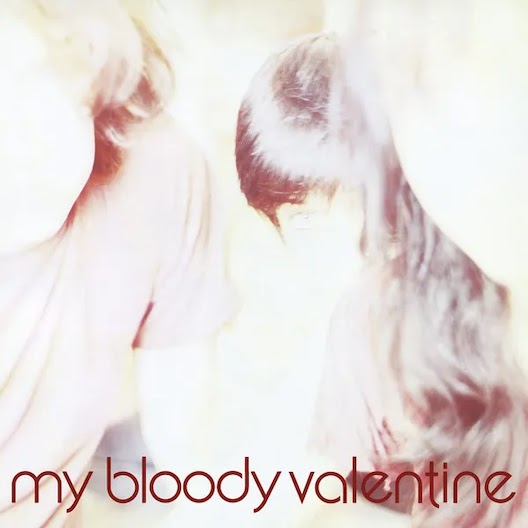
’Isn’t Anything’ still has semi-coherent lyrics (well some of the time) and a semi-recognisable band photo on the cover (albeit already blurring at the edges). But the band had already been replacing choruses with hummed vocals or instrumental breaks. Now, they were doing away with with such things altogether.

Similarly, the standard hierarchy of instruments of the traditional rock band is simply jettisoned. The album should come with a warning - “abandon all spatial metaphors all ye who enter here.” (i always associated that with the way the sleeve was in unassuming lower case, much like this sentence, something carried through to their track listings on i-tunes today.)

Fisher went on: ”Rock's propulsion and compulsion, its scurrying towards release, is suspended, perpetually deferred, captured in a dilating tension… regular sonic laws do not hold (you find yourself unable to say whether the album is trebly or bassy; the sonic geography of high and low is smoothed into indifferentiation).”

While Reynolds called in “[not] 'rock' so much as magma, a plasma of sound that barely conforms to the contours of riff or powerchord.” Fisher compared it to Turner’s squalls of brushwork.

And if that doesn’t sound much like a band album, we were to discover later it wasn’t. Shields wrote as much as he had on the predecessor, all tracks bar one. But by this point he was also recording almost all the instruments himself, so fixated on getting things down the way he wanted. Debbie Googe doesn’t seem to have played any bass, despite getting credited. Moreover, Shields would often leave months between his laying down one instrument and another, a long way from Rock notions of immediacy and band tightness.

Further, ’Isn’t Anything’ is a series of tracks which combine to make up a great album. ’Loveless’ is more a great album which doesn’t really reduce to a series of tracks. There’s often interludes which seem to belong to neither one track nor the next, more to the album as a whole, working like conjunctions in a sentence. The result is, it’s one of my most-loved albums and I’d be pushed to name half the tracks from it. And very few of the words.

In short, ’Loveless’ is the album where the band most got to sound like themselves, which should surely be the aim of every band. But all this means its achievement is heard best in the context of its predecessor. Listening to ’Loveless’ alone would be like watching ’2001’ by jumping straight to the Stargate sequence. Of course you can, and in one sense you’re cutting the chase to get the goodies. But in foreshortening the journey, what do you miss? And most creators are like that. Each new work can stand alone. But it’s so much richer when seen as part of an ongoing narrative, and you’re so much poorer to wrench it from that narrative.

As the band brought out two innovative albums with a hefty gap between, and then (for the longest time) no more, this seemed to create a space for others to occupy. Pretty soon their wake had spawned a whole genre, soon dubbed Shoegaze. With most of the bands as cluelessly copyist as the original my Blood Valentine had been with Indie.

But as ever with genuinely innovative bands, their actual influence radiated wider, happened more slowly and wasn’t always so transparent. There are for example few Post-Rock outfits who don’t bear the MBV DNA. Like those live performances of 'You Make Me Realise', this could be an album whose influence never actually ends…

It even sounds good played backwards at half speed. No, honest!

Saturday, 2 July 2022

SHOW ME THE BODY (GIG-GOING ADVENTURES)

Green Door Store, Brighton, Sat 26th June


Show Me the Body hail from New York City, and mix hardcore punk with noise rock and sludge metal. (Wikipedia adds Hip-Hop to the mix, but my ears heard less of that.) A combination handily demonstrated by the visual aid of the singer’s close crop and guitarist’s multi-follickled locks. Effects pedals, often the preserve of Post-Rock, are used as a de facto keyboard. Though their sound is also achieved, rather wonderfully, with the aid of the banjo.

Given that those styles work by marshalling the force of repetition, this outfit switch things up with some alacrity. It gives the music a skittering quality, like it can’t quite be grasped. Like that Kung-Fu master who’s struck you in three separate places before you’ve even moved. But at other points they go in for the slow fuse, tracks building in intensity before plunging into the riff. At which moments the mosh-pit stands poised, awaiting the Sword of Damocles to fall.

Yes, the mosh pit… In one of his few audience comments, the singer remarks that last time they were here no-one else was. Whereas tonight I became afeared the mosh-pit would fill the venue, with no far wall left for us frail Fifty-somethings to flee too. But while there’s mosh-pits which seem Ian arena sport, to which the actual music is incidental, here everyone seems to know each track by heart. The singer often passes out the mike, with pretty much everyone singing their assigned line then obligingly handing it back. (Their early gigs were apparently held not only in basements, but alleys and under flyovers.)

Lyrics fly by you, as they will normally do with this sort of thing. But less than penning rebel anthems they seem more concerned with bottling and then uncorking pressure-cooker urban angst. Which of course has a rich history with New York bands. Going back to the famous Suicide quote: “People were coming in off the streets… where they were hoping they’d be escaping and all we were doing was shoving the street back in their face again.”

Even disregarding the lockdown impasse, this must have been one of the most high-energy gigs I’ve been to in recent years. Possibly since Death Grips. (Now nine years ago. Bloomin’ Ada!)

After the most recent Godspeed gig, I commented on how Punk can often feel a poor fit for our era. It’s not that there’s less to be angry about, but that there’s too much. As things degenerate further and further, Punk becomes stuck in an arms race of outrage, which inevitably leaves it outpaced. Reagan-level outrage no longer seems inadequate in the Trump years. What makes this trio different? 

Partly by mixing Punk with other styles, creating a kind of cocktail effect. But mostly, it’s not because they play louder or faster, or any of the usual things. It’s that they sound more volatile, as if held together mostly by trajectory, like extemporised incendiary devices just about going off in the right place at the right time, like incandescent fury barely turned into music. They somehow seem at perpetual risk of fizzling out, even though they never do.

Forty-five minutes on onslaught later, they abruptly announce the show over. Like a summer storm which came out of nowhere, then finished just as fast.

From Detroit, rather than Brighton. But near in time, okay…


Thursday, 30 June 2022

'FANSCENE' TIMES TWO!


News for comic fans! Not one but two new issues of ‘Fanscene’ have just dropped! And they contain not one but two pieces by me! Respectively ‘Cometh The Hour, Cometh The Zine’, about the Eighties incarnation of the comics zine ‘FA’. (A biiiiig influence on my thinking about comics, back in the day.)

Plus ‘We Come To Bury High Culture, Not To Praise It’, recollections of the small press comics scene of the Nineties and Noughties. Not to mention a whole bunch of other, and no doubt better, stuff, courtesy the tireless efforts of compiler David Hathaway-Price.

In these cash-strapped times, PDF versions are free to download, via this link. These are likely to be the last issues, and I myself am semi-retired from comics. In fact I’ve even forgotten how to spell ‘sequential’.

Saturday, 25 June 2022

‘SURREALISM BEYOND BORDERS’

Tate Modern, London


“In a world defined by territorial control Surrealism has demanded liberation and served artists as a tool in the struggle for political, social and personal freedoms.” 
- Opening quote from the show

Not All Roads Lead From Paris

At the Arts Desk, Sarah Kent faulted this show for ”focusing on the periphery rather the epicentre… on followers rather than originators”, complaining about the lack of Ernst or Dali paintings. (She specifies paintings presumably because Dali has an art object here, and was too busy fulminating to spot the Ernst.)

Okay, critics don’t tend to be a preceptive bunch, so perhaps we shouldn’t fault her for not taking in all three words of the show title. But this centralist, hierarchical mindset is telling, and self-perpetuating. She and her fellows have hardly been starved of what they want. Let’s look at the London Tates alone… The Last Ernst show was ’91, perhaps a while ago. But the stultifyingly orthodox ’Surrrealism: Desire Unbound' was 01/02, then the uneasy mishmash ’Dali And Film’ ’in 07, then a (genuinely great) solo Miro show in ’11.

But this doesn’t stop with the Tate. Sarane Alexandrian’s book ’Surrealist Art’ dedicates a chapter to ’Surrealism Around The World', in which the only non-European country it visits is Japan. Small world, it seems.

In truth, Andre Breton, self-appointed Pope of Surrealism, has for too long dominated the story, with his slew of blessings and excommunications. Even if it weren’t so over-familiar, his is too narrow a map to navigate by. Following it in negative, taking up those he cast out, as the Hayward’s ’Undercover Surrealism’ did in ‘06, is better. But that still adheres to the same damn map, when it needs throwing out altogether.

Surrealism wasn’t a holy order or an exclusive members’ club. And it didn’t appear fully formed from a few lofty brows. Far from all roads leading from Paris it sprang up in a great many places, because the need for it was there. Despite its less-than-unblemished relations with colonialism in its Parisian guise, it was taken up by many anti-colonial groups. Senegalese artist Leopold Senghor commented “we accepted Surrealism as a means, but not as an end, as an ally, not as a master.” This show starts with an enlarged copy of a Surrealist map from 1929, centred on the Pacific and resizing nations according to their level of interest.

And the official reaction might suggest they were on to something. You lose track of the times you’re told of groups being suppressed, or artists getting banged up or going on the run. As one example, Eugenio Granell (more of whom anon) first fled Francoist Spain, then the Dominican Republic, this time to escape Stalinists, before settling in Puerto Rica.

What Do We Want? The Liberation Of Desire! 


One of the many places the show discovers an enduring influence is the radical America of the Sixties. The Chicago Surrealist Group were involved in the well-known protests against the Democratic National Convention in ’68, while the Students For a Democratic Society journal ’Radical America’ put out a special issue called ’Surrealism In the Service of the Revolution’ (Jan. ’70, above). Another news-sheet was titled ’Surrealist Insurrections'.


This rekindled interest spurred old guard artist Jean Miro to respond with ’May ’68' (1968/73, above). It’s dominated by a huge splat of black paint as if hurled by a projectile. The subdued colours beneath suggest a nicer, more staid painting has had its graphic style wrested from it by those wild black strokes, one system yielding to another. As if he couldn’t agree with events readily enough, the artist had added his own handprint nine times.

And this is both more accurate and better to hear than the Surrealism we’re so often told of, aesthetes dreaming limpidly of other worlds while ignoring the one they’re actually in. But while Dada, or at least strands of Dada, lent itself easily to political agitation Surrealism has a more involved relationship. For example, Kamel el-Telmissany’s ’Wound’ (1940) is a hard-hitting visual image, but too straightforward, too readily comprehensible to be called Surrealist. (Despite being in this show.)


Let’s take something we can all agree looks the part. Helen Lunderberg’s ’Plant and Animal Analogies’ (1933/4, above). What are all these things doing within one frame? Both the title and those white dotted lines make it clear we should be looking for connections between these objects. As an example, the cut cherry on the left leads to a cutaway diagram of it.

But what about when it then connects to the belly of that torso? Well, analogies can suggest themselves. The cherry stone might suggest pregnancy, that would be a plant/animal analogy. Okay then, what about the line on the right? What sense can be made of that? Perhaps the white network it points to (veins?, nerves?) could be compared to the tree behind it. But no white lines there.


Next let’s look at something with the guidelines taken out - Magritte’s ’Time Transfixed’ (1938, above). Trains come out of tunnels, and hence apertures. And we associate trains with timetables, and hence time. (An association which may have been stronger back then.) So put a timepiece on top of the aperture of a fireplace and what do you expect to happen but summon a train? There’s the visual parallel between the front of the engine and face of the clock. It may also be a play on the way paintings are frozen while still depicting moving objects. (Echoed in the title, though Magritte himself disliked it.) It would have worked better with an actual model train, thrust through a hole cut into the canvas.

Except here it resolves a little too neatly. Surrealism’s primary aim, after all, is to disrupt. With Surrealism, the more you can reduce the cake back to the recipe, the less delicious it will taste. The show describes this rather well, as art which needs to “both suggest and subvert logical connections.” The game is to entice you into a maze of signs, then lose you there. Lunderberg’s the better Surrealist, even if Magritte’s more of a name.

Consequently, Surrealism can sometimes divide between the art that’s good and the art’s that it’s possible to write about, which can be a bit of a problem when writing about it. As I said after the DPG’s show on British Surrealism: 

“Its credo should be ‘never knowingly understood’, and not just by the know-nothings of the dominant culture. It should be inexplicable even to Surrealists, with artists surprised by what springs from their own hands.”

A Hallucinatory Metamorphosis


Marcel Jean’s ’Surrealist Wardrobe’ (1941, above) features multiple apertures semi-obscuring a view. What we see of the view is pretty view-like, and it’s tempting to think that we should treat this as a kind of tantalising peepshow onto freedom. If we can’t cross this barrier we should at least look through it as much as we can, into the bucolic delights of whatever enchanted Narnia that lies beyond. The wooden blockade might be said to stand for dominant ideology, the wardrobe the restrictive roles thrust upon the self by social conformity, or some such. Hanging it in the very first room might subliminally push you towards this reading, as we’re here to see what lies ahead.

However, despite the title it resembles no actual wardrobe. It’a a crazy accumulation of apertures, some lying recursively inside others, and including letterboxes - which don’t get added to wardrobes much. As seen in the recent Dorothea Tanning show, Surrealist art has apertures aplenty. Jean has gone as far as to screw actual metal plates around the key holes. Because they’re the point of the picture, more so than the view beyond. This is the liminal place Surrealism occupies, between dream and waking, conscious and unconscious. It stands at the interchange, and invites us to stand there too.


Similarly, the Portuguese artist Artur Cruzeiro Seixas made the assemblage ’No Longer Looking At The Earth, But Keeping Feet Firmly On the Ground’ (1953, above). A buffalo hoof combined with what we take for a bird’s head, one of many ‘spliced’ Surrealist assemblages which stick together two seemingly irreconcilable objects. Yet we shouldn’t see this as a sight to stir our contemplation, like the proverbial Buddhist listening to the sound of one hand clapping.

Again, we should say “this is us”. We are not integral creatures, we are wing and hoof. We are these things even if they contradict, feet on the ground the same time as head in the clouds. And the fact that these elements are spliced, not bolt-ons added to a more recognisable body, emphasises this.


If the alter ego and animal familiar were frequent Surrealist devices, this is part of the reason why. Birds are commonly employed, perhaps most famously with Ernst’s Loplop. For they allow the bird part of us to stretch away as the rest of us stays moored, at least conceptually. So you’d scarcely need to be an initiate to guess that Leonora Carrington’s ’Self-Portrait’ (1937/8, above) is a triple self-portrait. Her mane of hair, her pointing hand, the anthropomorphised face on the hyaena don’t hide any of this.

Though more interesting is the white horse, the way it’s in two places. The rocking horse inside the room, overlapping with Carrington-as-herself, and the wild horse running free outside the window even have identical poses. To return to Jean’s metaphor, only her familiar can both be in the wardrobe and go to the lands beyond. And it can only do it by being both sides of the barrier at the same time.

So, you may be asking, just how does this perspective translate to radical politics?

Hear the title of Mayo’s ’Baton Blows’ (1937), then get told by the indicia that it was a time of great civil unrest and (its inevitable corollary) police violence in his home city Cairo, and you immediately build a mental picture. But it’s probably not of the picture he’s painted (below).


There’s a picture plane, with trees on a distant horizon line. But the figures are pushed right up into the foreground, like they haven’t noticed. And rather than ordering themselves into two opposed camps the figures are inter-twisted irresolvably. To the point they don’t look like they’ll ever be separable again. If they’re differentiated it’s into pink versus off-white, with nothing to clue us in which side is which. Mayo’s signature is in the bottom right corner, just below the lolling tongue of one collapsed figure. Just like Turner turned his back on narrative painting to present just the storm, Mayo shows us just the battle.


And this isn’t unusual. Raoul Ubac’s exposed print ’The Battle of the Amazons’ (1939, above) is a similar composition. It’s if anything still more ambiguous. Composed of cut-up photos, re-shot and over-exposed, are its figures fighting one another, or merging together? (Some accounts claim the original photos were all of the same model.) While the Mosambiquan artist Malangatana Ngewnya’s ‘Untitled’ (1967) arguably goes further in absolutely filling the foreground, with barely a scrap of negative space.


Lee Miller’s 1941 photo of a fallen, damaged statue (above) is part of her series ’Grim Glory: Pictures of Britain Under Fire’. It could perhaps be seen as war propaganda, an inventory of cultural treasures the Nazis cruelly destroyed. Yet in that case why would it be titled ’Revenge On Culture’?

Roland Penrose, quoted in the show, says Surrealism aims “to provoke a hallucinatory metamorphosis”. And, as much as Dadaism, Surrealism was born of war. Which does a very similar thing, blasting holes in accepting norms, literally and metaphorically turning things over. If anti-fascist, they were not necessarily anti-war. War could be seen as cousin to revolution, a kind of liberating catharsis, which allows art to rebel against its originally programmed purpose, to become something new. It plays the same role in the real world as the collage artist’s bond-slipping scissors do for workaday images.


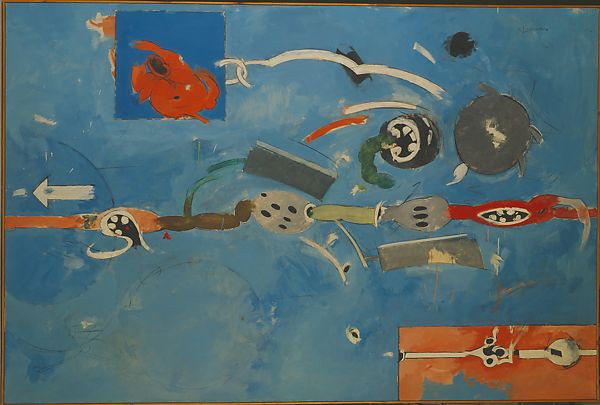
’The Guide’ (1862, above) by Cuban artist Herve Telemaque, combines a diagrammatic style with elongated forms. Until it’s quite hard to work out what is an object and what are motion lines. With the result that there’s something slightly anthropomorphised about those shapes. With an arrow pointing off the canvas it’s about as near to animation as a canvas can be. Other shapes are roughly sketched in, perhaps emerging or fading. Art, even a painting, should not be seen as a fixed thing. Metamorphosis, transformation, these are not incidents but the inherent state of things.

The Charged Object Strikes Again! 

Bluffer’s tip! Should you want to sound like you know something about Surrealism, don’t say sagely “mmm, the dream.” (And still less “the fish”.) Instead, use “ahh, the charged object.” Regular readers, should they exist, will remember me waxing lyrical on this after both ’British Surrealism’ and the Academy’s ‘Dail Duchamp‘ show. And, as the show reminds us, 1936 saw the Surrealist Exhibition Of Objects.

The show has the smarts to place two objects next to one another - Joyce Mansour’s ’Nasty Object’ (1965/9) against Dorothea Tanning’s ’Pincushion To Serve As Fetish’ (1965). Mansour has driven nails and other shards of metal into a sponge ball, until the ball itself invisible is no longer visible. While Tanning called hers “a superstitious if not actually shamanistic object, and yet to my mind it’s not so far from a pincushion.” , Both recall the way primitive magic works, where fetishes must be pierced for their power to be released. Art is taken as having transformative powers, but these will only work for those who interact with it.

An over-emphasis on painting is one of the many ways Surrealism gets misrepresented and disempowered. Film and photography weren’t just present, there were arguably *more* useful because we so readily ‘accept’ them, take them for real. Happily, the show makes efforts to include both.


Take for example the short from Czech film-maker Jan Svankmajer, ’The Flat’ (1968, still above), which brings these elements together. The indicia, and seemingly every review, seemed determined to read the Prague Spring into this, without ever specifying how that’s supposed to work. In fact, I don’t think it does.

A while back, looking at Sartre’s novel ‘The Age Of Reason’, we found that for the lead character to be free his possessions must become “no longer his accomplices” but “anonymous objects... mere utensils”. Things must be seen as things, tools for use, make sentimental attachments with them and they will tie you down.

Surrealism could scarcely take a more opposite view, its perspective comes from recognising objects as entities; to be recognised, to enter into accordances with, the most humble modern objects seen as possessing spirits. Svankmajer’s hapless protagonist attempts to use a bed just as a bed, a door just as a door, a tap a tap. Naturally, they take offence and resist. If we do not see such objects as charged things, if we don’t make connections to them, their magic will work not for but against us.

But there’s an exacerbating factor at work. As with Sartre, our protagonist is youthful, his life still for him to make. And this is demonstrated through the furniture of a rented room. These things are not his, but strangers to him. By the end he’s able to sign his name beneath the “was here” graffiti of the previous tenants, and the accord is struck. (Ever gone back to a shared house and seen someone else living in your old room. Just as you did, but them? There’s a strangeness to it like little else.)

We might wonder what this is all about. And ask, if we’re to be interested in Surrealism, do we now need to believe beds are sentient? No small part of the answer is that it brings artistic benefits. As the Swiss-American artist Kurt Seligmann commented:

“Magic philosophy teaches that the universe is one, that every phenomenon in the world of matter and of ideas obeys the one law which co-ordinates the All. Such doctrine sounds like a program for the painter: is it not his task to shape into a perfect unity within his canvas the variety of depicted forms?” (NB Seligmann is in the show, but not this quote.)

But also, when decrying the consensus reality the Western world has built around it, its natural to look for counter-models. Chesterton, not much of a Surrealist in the main, said: “The whole object of travel is not to set foot on foreign land; it is at last to set foot on one's own country as a foreign land." Your aim is always to look at what you were always looking at, just from a new angle.

And Modernist artists had already used the form of tribal art as a means to counter Renaissance conventions, most famously with Picasso and his African masks. To now incorporate the content, as part of a much wider programme of disruption, seemed a natural next step. And Freud, as ever their go-to guide, yet again seemed to have written a handbook for this.

In ’Objects That Can Speak For Themselves’, Chris Fite-Wassilak identifies two poles for this kind of animism in art. At one end, an object’s “power was, for the surrealists, more like a mirror – one that could reflect the hidden, interior mind of the person who chose that object.” This way, objects became akin to Rorschach tests, the point is not the thing itself but the reactions it stirs in you. (The alert reader will have spotted this essentially re-objectifies objects, turns them back into our servants. The non-alert reader will have spotted the same thing.)

Then at the opposite pole he places Paul Nash, who had his own Tate show, where the artist can only borrow objects which retain their inscrutability. (“Nash’s attitude is one of a more direct animism, where the object isn’t a reflection of the artist, but might be placed in a position to speak for itself, as it were.”)

You could probably go on and on with this. But best not to…

Style As Means

Instead let’s ask, how do you get that over? Surrealism wasn’t a style in art, like Cubism or Constructivism. It was first and foremost an approach, one that didn’t necessarily require artistic means of expression at all. And when it did, that’s all they were - means. Artists who don’t have remotely similar styles can be - and are - Surreal. It’s hard to think of another art movement where the works could be so stylistically different as they are here, and yet still belong together.


Danish artist Wilhelm Freddie is represented by ’My Wife Looks At The Petrol Engine, The Dog Looks At Me’ (1940, above). And that flatly descriptive title carries over into the work. Each brick and coloured ball is diligently detailed, then that deadpan style carried over into the strange dog creature. It’s not presented fantastically, but as if it all makes sense to someone, even if that person isn’t us. From the ’Dali Duchamp’ show, we saw Dali did just this. And there’s a choice quote from him here, about “materialising… with maximum tangible reality, ideas and fantasies of a delirious character.”


While ’The Sea’ (1929, above) by Japanese painter Harue Koga combines naturalistic styles and pseudo-scientific cutaway diagrams. It’s a collage which looks like it should be resolvable, but isn’t. The cutaways suggest we should see things two-dimensionally, we’re not looking back but down. In which case the submarine’s directly beneath that sailboat, but then the bird’s about the same size.

And where does the woman swimmer fit in either way? Unless she’s a colossus, we’re supposed to see her in terms of pictorial depth. Perhaps she, and the right quarter of the frame, might be a separate unit from the rest? That would explain why the sea’s at two levels, not something it commonly does. But then they’re made to overlap. And those horizontal-striped fish still look suspiciously large. And, after the original confusion over the horizon line, why does the lighthouse float just above it? It’s like one of those sentences which obey all grammatical rules while making no sense.


But conversely, the Haitian Hector Hyppoliyte’s ’Ogun Feray’ (c.1945, above) could scarcely be in any more a naive style. It doesn’t dramatise the objects so much as flatten the human figure, turns him into an object as much as them. Until there’s such an equivalence it scarcely seems surprising they’ll jump up and dance the way they’re doing.


While New Zealander Len Lye took a similar approach, but with a film - ’Tusalava’ (1929, still above). Initially we could just be watching the filmstrip run past the projector. First, abstract shapes emerge. And it’s remarkable how soon we start to anthropomorphise these. (With me, literally a few seconds in.) These turn into cellular creatures, then develop into totemic forms, as if up to now they’ve been gestating. Crucially these forms aren’t articulated, they don’t ‘come alive’ in the conventional sense, they stay as moving shapes. But it simply doesn’t feel that way to watch.

And much of this comes from Lye using the warm imperfections of filmstrip, the graininess, the blotches and streaks. The shapes pulse with life in a way smooth vector art would not.


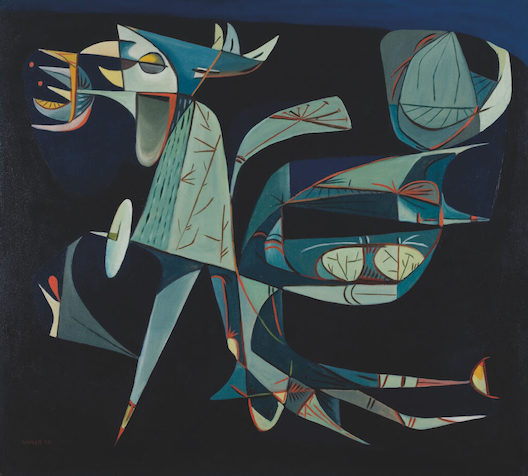
So Surrealist art had to occupy one pole or the other - hyper-real or naive? Not really. Eugenio Granell’s ’The Pi Bird’s Night Flight’ (1952, above) is sharp and realised, but iconic in look. The bird creature is laid out in two dimensions, against a flat black background. Does such a bird really exist? No use asking me. But even if it does, it’s immediately clear that Granell isn’t interested in capturing the outer look but it’s spirit, as if enlisting it as some form of totem.

Romance Is Dead?

Modernism was intended as a reaction against Romanticism. It’s something which Dada would simply have spat at. (Brecht hung banners behind his plays stating “Don’t stare so Romantically”.) But Surrealism’s relationship is more complicated. At its worst it simply inherited. Romanticism’s reaction to the Enlightenment, a headlong rush to escape the confines of reason, had at the time been something current. But Surrealism could pick up on this many generations later as if it was still a live debate. Which it did by simply transferring the sublime from out there, in nature, to in here, the human mind. Which, as we’ve seen before, wasn’t even that much of a switch. But what about when it was at its best?


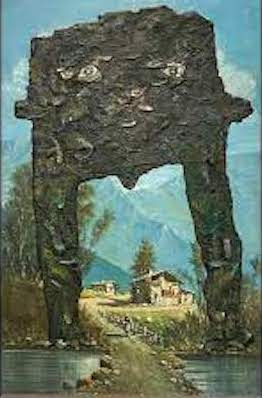
The Italian artist Enrico Baj created ’Body Snatcher in Switzerland’ (1959, above) by taking an existing kitsch Romantic landscape and painting that monstrous monolith figure over it, part graffiti, part provocative cartoon, part Lovecraftian clash of reality systems. Note how its bulging lower regions hover over that poor peasant woman. It works partly by taking Romanticism at its own game and upping it. For Romanticism often depicted nature just this way, dark, animate, inscrutably strange.


While Remedois Varo’s 'The Flight’ (1960, above) took the familiar Romantic image of a figure ascending the heights of remote, craggy, cloud-strewn peaks and simply added a female figure to the mix. We are, I think, supposed to see them a sailing on a cloud boat, a brilliantly delirious notion. (It’s part of a triptych representing her, all done in that sharply precise illustrational style, belying the strangeness of the subject matter, and all superb.)


’Nudes’ (1945, above) by Egyptian artist Samir Rafii of course dates from the end of the war, into which others have read significance. But there’s a timeless ‘folk apocalypse’ feeling to this work that’s more Bosch-like. We’re used to art that shows the sombreness of the aftermath of a massacre. Just as we’re used to art that presents the revenge of nature. But, well, not really this

All the figures are, I think, female. And women are of course often victims of war. Except here I think they’re victims of a nature which is itself feminised. The hunting birds set us up to see the figures as victims of the trees. In Romanticism Nature is seen in terms of the sublime; which is, by definition, depersonalised, a remote and overpowering force, the storm that tosses your boat without noticing you’re there. Here it is anthropomorphised and monsterised simultaneously.

And that foreground tree, all spikily protruding branches, isn’t just pinning that poor foreground figure. It seems to replace her upper half, that hairy birds’ nest the nearest thing to a head, as if some symbiotic creature. It also seems to echo her pubic hair, making another connection. It’s as if one part of our nature was at war with another, to the point of massacre. (Ignorant of Arab names, with no many female figures, I first assumed this must be by a female artist. Wrongly, as it happens.)

Discovery Not Invention

Surrealism’s sometimes presented as individualised, furiously dreaming Bohemians, like prospectors of their own private subconscious, hoping to come back up with some artistic gold. In fact it was always a group effort. The show acknowledges this throughout, talking of ‘convergence points’ and quoting Simone Breton on “images unimaginable by one mind alone.”

Sadly then, despite it being so related a concept, automatism (creating art without conscious direction) becomes an afterthought. Literally so, as it’s mostly consigned to the last room. And it mostly focuses on automatist techniques, as if it was all a means to an end, not a source of artworks in itself. Whereas, to quote Michael Richardson:

“The real importance of automatism lay in the fact that it led to a different relation between the artist and the creative act. Where the artist had traditionally been seen as someone who invents a personal world, bringing into being something unique to his own 'genius', the surrealists conceived themselves as explorers and researchers rather than 'artist' in the traditional sense and it was discovery rather than invention that became crucial for them.”

At the least it should be said that, much as with the debate over abstract art, the notions weren’t rigidly exclusionary. The artist could slip between both, as they chose.


Due to the dearth of good examples on show here, we need to break protocol and look at a work which appeared in an earlier post. Which is not even hung in the automatist section. Gordon Onslow Ford’s ’A Present For the Past’ (1947, above) appeared in the DPG’s ‘British Surrealism’ exhibition. After which I said: “With its birds and that central egg form, it doesn’t seem composed so much as grown…. creativity doesn’t work by logical progression but is more akin to morphogenesis.” As the artist said himself of painting without a plan, “in venturing into the inner worlds, nothing was lost.”

(NB There is a flaw running right through all of the above. To present Surrealism as a cohesive political and philosophical movement requires a whole lot of forcing the pieces. This was a movement, not a regiment. With a cast list so culturally and geographically disparate, it’s better seen as sketching in some of the through lines.)

This show is simultaneously uneven and overwhelming. There are misfires, and works which don’t even belong here. But there’s a high hit rate, higher than I could possibly cover. Much like Post-war Modern’ at the Barbican, I was struck between the eyes, again and again, by artists I’d no prior knowledge of. With the double-whack of these two shows, gallery-going has resumed in earnest!