googlee7ea825f63edb3f6.html
Showing posts with label Bob Dylan. Show all posts

Saturday, 1 February 2025

‘A COMPLETE UNKNOWN’

(Another in a series of not-proper reviews of films)


“I’ve always preferred mythology to history. History is truth that becomes an illusion. Mythology is an illusion that becomes reality.”
- Cocteau

’A Complete Unknown’ works well, if taken just as a film. It rips along, tells its story well. I’ve no idea if early Sixties Greenwich Village was anything like the way its shown, but it feels like a real place captured. From the little I know about the main characters (Dylan, Pete Seeger, Joan Baez, Stand-In Suze), they were pretty much as depicted here. 

But of course its not just a film. Its a dramatisation. ’A Complete Unknown’ is completely known to us, that is what attracts us. And therein lies the problem.

Dylan essentially mythologised himself, not only in his music. In interviews and general behaviour, he was a character played by the method actor Robert Zimmerman. Or more accurately, a series of characters. He built an elaborate mythology, but that’s long since condensed down to a single legend - the Judas incident, the Bob-goes-electric saga at Newport. This has become as much What Dylan Is About as any song he ever wrote.

It’s been raked over enough what degree of truth there is in this. (Go here or here if you hadn’t already.) But the point isn’t that what actually happened wasn’t much like its shown here. The point is that this is what people want to believe happened. They believe it the way other people believe Boris Johnson saved us from Covid.

And to be believed myths need to be re-recited. Just like Church-goers can’t only attend once and tick salvation off the to-do list, believers need to be fed more documentaries and dramatisations like this. The first draft of history, that didn’t work out quite the way it should, so now we need a reconstruction to correct.

I’m not a great fan of biopics, and this may be partly why. The advantage of fiction is… well, it's fictional nature. You can devise and arrange incidents and symbols as you choose, to convey what you’re conveying. Your imagination can go free range. Conforming to actual events pens it in. But also, real lives are never so neat as to compress into the required running time. So biopics tend to reach for the myth just because it's more manageable, while at the same time feigning authenticity.

Let’s remember Dylan gave his approval. Someone who never approves of anything much. It’s true that when Baez calls him “kind of an asshole” and “completely full of shit”, the film more-or-less backs her up. Yet his assholeness is considered necessary. You can either please other people or be yourself. Its an either/or choice, like the acoustic and electric guitars which get repeatedly held out for him.

In perhaps the most telling exchange, he contradicts Stand-In Suze about the Bette Davis film they just watched. “She didn’t ‘find herself’, like a lost shoe. She made herself into something different, what she wanted to be in that moment.”

Later, walking away from… well, you know what, an infuriated Lomax yells at him: “Do you even remember folk music, Bob?” He snaps back “no, what’s that?” It’s not just a put-down. It means, I am no longer the person you think you are talking to. I have moved on to my next me. Your call cannot be redirected.

Significantly, he never seems to have his own place. He crashes on Seeger’s couch, he stays in Stand-In Suze’s apartment, bangs on the door of Joan Baez’s hotel room… the nearest we get is his own motel room at Newport. Literally on the move.

So, instead of being examined, the myth is fed. The offered acoustic vs. electric guitar becomes something like the blue and red pill in ’The Matrix’, uncritical conformity versus you becoming you. It’s simultaneously a straight choice and an evolutionary path. Electric trumps acoustic, right? It’s more modern, and anyway its louder and stuff.

Electric Dylan fans tend to believe that when he gave up protest music he actually made better protest music. He went from the particular to the general, not tackling wrongs one-on-one but as a bunch. And by then there were too many wrongs to do things any other way. The film essentially sides with this, though it places most of it in the mouths of his associates. It’s silly stuff, better alluded to than spelt out. It is, to drag up a term from my day, Rockist.

Rockism comes down to the notion that all other music forms are fake, tainted by commercialism, confined by genre rules, while Rock is real - free, unmediated expression. As that doesn’t sound like the sort of thing likely to be brought to you by corporate conglomerates, in place of arguing for it they fetishise aspects of Rock. Chief among which is the electric guitar. In other words, it bestows the same talismanic significance as Folk purists do to the acoustic. (The other signifier he dons are a permanently affixed pair of sunglasses. Which arguably mean something slightly different. While the electric guitar’s an avowal, they’re a deflection of scrutiny.)

And this explains the standard stopping of the story here. Because it conveniently ignores an obvious fact - within the next few years he did the same thing again, this time burning his bridges to his Rock fans, and for pretty much the same reasons.

’I’m Not There’ (2007) was a much less literal take, featuring multiple Dylans all running round at once, with no interest in one another. Which was much more effective because it was explicitly about the Dylan myth, examining rather than regurgitating it. I said at the time, “the film actually feels like a Dylan song rather than some prosaic account of events surrounding its recording. It feels like one of his sprawling mid-Sixties electric numbers, packed with hallucinogenic images and allusions.”

It would be neat to now say this film is like one of the more literal acoustic songs, the ones it claimed got so gazzumped. Perhaps one of the more auto-biographical ones like ’Ballad In Plain D’. But to the degree that’s true, its like one of those songs played by somebody else.

Let’s remember that, when Blues guys went electric, they saw no big deal in it. Some had already played electric at Newport. Others, realising the money came from white folk purists, had by then switched back. (For which I don’t blame them.) Whereas Dylan did see the deal, had the same values as Lomax. They were just arguing about which way up they went. His credo of change prefigured the Beatles and Bowie. Its taken that he didn’t just change into a Rock star, because Rock music is held to embody change.

But 1965, that was a white ago now. How on earth can this still be held to, sixty years down the road? This is the general problem with Rock now, it hasn't done much a-changin' lately. Elements which had once been attached to some purpose are being kept around out of habit. Dylan’s was a time of greater social conformity, a jobs-for-life culture where your future lay between tramlines ahead of you. You deciding on you derailed the tram. Now we live with a volatile jobs marked which involves regularly reinventing yourself just to stay fed and housed. Tom Peters gave the following life coaching:

“Starting today you are a brand. You're every bit as much a brand as Nike, Coke, Pepsi, or the Body Shop. To start thinking like your own favourite brand manager, ask yourself the same question the brand managers ask themselves: What is it that my product or service does that makes it different?”

Another way of saying this is – there are multiple yous, but in none of them do you get to actually be you. Its no longer enough to sell your labour, now you need to sell your self into the bargain. Of course its true that Dylan rebranded himself not to get hired but precisely to get fired, to burn his bridges to one set of fans so that another could be built. But this isn’t the distinction you might think. How will we learn this lesson, us non-geniuses, us regular beings? Thinking “my brand isn’t Pepsi but Bob Dylan” doesn’t help you, it just rephrases the problem.

The film ends with Joan Baez left standing as Dylan motorbikes off. She never abandoned either the Folk world or the notion of music associating itself to movements for social change. Perhaps its time we switched this story round. In a world which has since filled itself with Bob Dylans, be a Joan Baez. She wasn’t such as asshole. 

Saturday, 9 November 2024

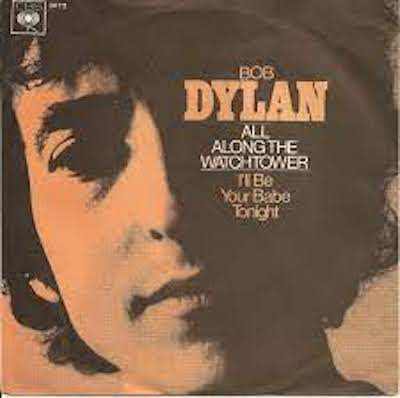
“SO LET US STOP TALKING FALSELY NOW”: BOB DYLAN’S ‘ALL ALONG THE WATCHTOWER’


(A sequel of sorts to my take on ‘Visions Of Johanna.’)

’All Along the Watchtower’ (from ’John Wesley Harding’) is is one of those Bob Dylan songs that has a general theory attached to it. It's held to be about his declining relationship with his then-manager, Albert Grossman. The Joker and Thief are them, respectively. So we’re told.

Well, there may well be other songs from this period which that explanation works for. (Dylan himself, who normally resisted analysis like his livelihood depended on it, said he hadn’t been thinking of any of that when he wrote ’Dear Landlord’, but okay, it did seem to fit.)

But does it work for this song? No, not at all.

In fact I suspect people just get as far as the word ‘Thief’ and cry “aha, he’s calling Grossman a thief, also some Biblical stuff to fancy it up.” David Stubbs, who perhaps propagated this theory the most, describes their relationship as “a stand-off.” Yet in the song they seem to get along. And, provided we accept the (more likely) theory that Dylan sings the verses in the wrong order, the Thief gets the last word. Which isn’t snake-oil spiel, in fact it sounds like sage advice. We, who have been through so much, can outlast this.

Let’s look somewhere else, then.

Was anything else on curly-locks’ mind at the time? There was, something pretty big in fact. He'd change his sound with the regularity others changed their sheets. But this time there had been something more to it…

He’d grown sick of being taken as a spokesman for a generation, or some kind of prophet whose every utterance required the utmost scrutiny. (Pithily epitomised by a scene from the 2007 film ‘I’m Not There’ where everybody, from music journalists to the Black Panthers, is desperately trying to figure out who Mr. Jones is.) Not being a job you could just quit, he decided he had to get himself fired.

It’s like trying to rid yourself of overstaying guests by putting on the music they most dislike. Except in this case he had to write that music. So be it. He’d make records so removed from anything his fan base wanted to hear that they’d desert him in droves, and finally he’d be left in peace.

All this is well enough known. But just in case that wasn’t enough sometimes he’d even spell it out in the lyrics.

Bluffer’s tip, when someone as egocentric as Dylan writes two characters into a song - assume they’re both him. He said of himself: “when I used words like 'he' and 'it' and 'they,' I was really talking about nobody but me.” But this comes with a twist. The Joker is Old Dylan, still looking for some way out of the situation he’s in. “Businessmen they drink my wine” may well be a reference to Grossman, though probably more a collective noun for music industry types. But “ploughmen dig my earth” sounds much more about those self-professed Dylanologists who’d scour his lyrics for buried meanings, sometimes literally rifting through his trash, naturally enough missing “what any of this was worth”.

While New Dylan tells the hipster nihilist that, while he might once have thought life is but a joke, they have now been through that - they can see the other side. In a song dripping with religious imagery, it’s about revelation.

(For this reason, I think the talk about the track being ‘circular’ sails past the point. Yes, what should be the first verse comes last. Yes, earlier songs like ’Stuck Inside Of Mobile’ or - for that matter - ’Visions Of Johanna’ had been about entrapment. Here the song is more a roadmap outta here. I’d guess rather than being up to anything clever Dylan just reordered the verses because that gave the song a better opening line. (If so he was right, most people must know it by now.)

Often analysts of the song reflect on how Biblical the imagery is, particularly the Book of Isiah. But this is almost entirely confined to the third verse (as sung). Few seem to consider how this relates to the song as a whole. Let’s detour into it…

One of the most annoying aspects of the “Dylan’s a poet” business is that actually he was a songwriter. There’s fairly strong evidence, in fact, that he recorded some of those songs. And a songwriter combines words and music for an overall effect. (Dylan himself was often frustrated his music was so overlooked.)

And the point these two come together most clearly is in the singer’s voice. And New Dylan even sounded different, dropping the nasal jeer famously liked by Bowie to “sand and glue”. For something quieter, more plainspeaking.

Elsewhere on the album, such as ’Frankie Lee And Judas Priest’ he strikes a conversational tone. But here he does something different. Truly grand things you don’t intone like a Hollywood voice-over, you have to speak of them softly, in a kind of hush. And the music does something very similar. The sound’s so ominous because it suggests at impending events that could only be alluded to, never fully described. (Those who only know the bigger sound of the Hendrix cover are often surprised by the original.)

I can remember being taught at school that, shortly after the crucifixion, many believed Jesus would return soon and usher in the end times. Which made for strange heady days to walk through, where each step might be your last. It’s something that has stayed in my head all my life. And this song has a similar mood of quiet apocalypse.

It’s known Dylan regularly read the Bible through this time. Solipsistic as ever, he seems to have associated his plan to remake himself with a parallel tumultuous change to the world. And, this being the late Sixties, there was plenty of evidence for that if you were to go looking. This quite possibly borders on a personality disorder. But it made for a good song.


Let’s go a bit more nitty-gritty…

You can see why the Joker might be called the Joker. He’s a Dadaish figure, not just writing songs without literal meaning but furiously denying there is a meaning to things. But why is the Thief the Thief? What’s he nicking exactly? Other song titles on the album mention a Drifter, a Hobo and an Immigrant, while the title track’s about a folklore outlaw. We’re on outsider to society here. Was Thief just the next line in the Thesaurus?

Perhaps, but let’s remember a slightly earlier song, ’Tears Of Rage’, had the repeated line “why must I always be the Thief?” If ’Watchtower’ flirts with confusion by being sung in the wrong order, this one gives us two characters without telling us. To the point that many simply didn’t notice. The only clue is in the use of ‘We’ and ‘I’, given to verses and choruses respectively. (Disclaimer: I seem to be the only person in the world who thinks this.)

‘We’ would seem to be parents vexed by a child asserting their independence. As many have been quick to point out, Dylan was by this time a parent. And it may be that he wouldn’t have written this song had he not been. But it isn’t credible that it’s *about* his experiences as a parent. The oldest, his step-daughter Maria, was six at the time. A little young for that sort of thing.

Instead I’d suspect ‘We’ to be those troublesome fans and Dylanologists, cast in the guise of controlling parents, sternly admonishing their charge over his change in direction. (“It was all pointed out the way to go’ means something like “What’s this? A country album? You are so grounded!”) And Dylan as the less-than-dutiful daughter, unwilling to conform to the plans made for her. What the ‘Thief’ is stealing is her own agency.

And like ‘why a thief’, we might want to ask ‘why a daughter?’ Why not a son? Dylan firmly associated himself with artistic genius stereotypes, which are highly gendered as male, and was effectively a misogynist. Why associate with a female character here? It may be because a daughter’s rebellion is seen as more a betrayal than a son’s. But also, ‘daughter’… it may simply have scanned better.

So to summarise, ’All Along the Watchtower’ by Bob Dylan isn’t about Albert Grossman. No, like many Bob Dylan songs it’s all about Bob Dylan. Have a great day!

(Those of an unusually obsessive nature may want to know I wrote something about the whole ‘John Wesley Harding’ album a while ago.)

Saturday, 2 November 2024

“WHAT SALVATION MUST BE LIKE AFTER A WHILE”: BOB DYLAN'S 'VISIONS OF JOHANNA'


“Johanna may not even be real. But she is an addiction”
- Rolling Stone

The finest songs are not always the most immediate. I doubt if anyone in 1966, on first hearing Bob Dylan's new album  'Blonde On Blonde’, thought of 'Visions of Johanna' as the stand-out track.

First you needed to cope with yet another of Dylan's turns of direction, from the abrasive electric sound and venomous in-your-face surrealism of the previous year's 'Highway 61 Revisited'. That had been definitively Northern – urgent, brimming with attitude – while the Nashville-recorded 'Blonde' could not have sounded any more Southern, languid and brooding. Some tracks even gave woozy New Orleans jazz a look in.

But even then 'Johanna' must have sounded strangely closely to the country station it disparaginly describes, the one that “plays soft, but there's nothing really nothing to turn off”. It couldn't be any further from the epic swoops and rolls of the next number 'Sooner Or Later', the only track on the album to have survived from the original New York sessions. And yet what didn't arrive with a fanfare lingered, and is now one of Dylan's most celebrated songs. 

Perhaps that could be something to do with the air of mystery which Dylan characteristically stirs up. “Inside the museums, infinity goes up on trial”; “Jewels and binoculars hang from the head of the mule.” You could probably throw a dart at the lyric sheet and come up with something similar. It all sounds so vivid, like it should mean something, but trying to figure out precisely what can result in a whole load of headscratching.

Perhaps to try and pin down the cascade of images is a kind of category error. Robert Shelton wrote in his Dylan bio ’No Direction Home’ “the nonsequential visions are like a swivelling camera recording a fractured consciousness”, and he went on to quote Fowlie on Rimbaud, on a poet “bent upon subordinating words to their sounds and colours”. Dylan himself had earlier written: “To understand you know too soon/ There is no sense in trying” and was scornful of those who thought themselves able to interpret him.

Would the facts help any? Dylan almost certainly wrote the song while on honeymoon with Sarah Lownds in New York in the winter of 1965/66. And yet this isn’t exactly a love song. Which has tempted some to speculate that he wrote it pining for an earlier paramour, Joan Baez. The present Louise in the song thereby becomes a stand-in for Sara, contrasted against the absent but longed-for Johanna, aka Baez. (Though some claim the earlier ’Like A Rolling Stone’ was a put-down of Baez.)

Of course I have no more idea than anyone else whether this is true or not, but there may well be something in it. Firstly, when you hear sections of Dylan fandom hating on Baez so badly, in a manner reminiscent of Beatles fans on Yoko, you almost want to take it up just to spite them. But more importantly, Norman Mailer's theory of Picasso was structured around his relationships, embarking on new styles to capture each new lover, then all over again to decry them as he tired of them. And Dylan is in many ways the Picasso of music. For example, his earlier break into his trademark 'protest songs' came at least in part through the influence of an earlier girlfriend, Suze Rotolo. (Pictured with him on the cover of the 'Freewheelin' album of 1963, which launched that style.)

Except, as ever, the main problem with this biographical reading is that its just that – a biographical reading. Your interest flickers to hear the line “the ghost of 'lectricity howls in the bones of her face” after finding out that New York had that winter suffered a power blackout. Or that the song was originally called <i>'Freeze Out'</i>. But really, where does it take you? It's a bit like finding out where a film director used for a location shoot, or an artist for a painting. At most you're describing the impetus of a work, rather than the work itself. Ultimately, reducing “the ghost of electricity” to a power cut seems... well... reductive

As Andrew Rilstone has said “I don't think that Bob set out to tell a naturalistic story... but decided, for some reason, to present the story in the form of a riddle.” To which we might add, when Dylan had earlier broken up with Suze Rotolo he didn't think himself as above writing a perfectly straightforward account of the whole affair in 'Ballad in Plain D'. (Much to the disdain of her sister, who'd been savaged while virtually named outright.)

Okay, you might well ask, so what is going on?

A common theme of the album was 'strandedness', referred to specifically in many tracks such as 'Temporary Like Achilles' or 'Stuck Inside of Mobile With the Memphis Blues Again', and ever-present in the more languidly paced music. But the theme is perhaps at its most developed here. Note the two separate references to keys, jangling uselessly in this inescapable situation. Note the second line “we sit here stranded, though we're all doing our best to deny it”.

“All” makes it seem a crowded song. But, befitting the feeling of confinement, I contend there's only three characters to the story – and one of those is conspicuous by her absence. All the others – the ladies and the watchmen, the pedlar and the countess – merely collapse in on one another, like alter egos invented to distract you from your loneliness. (Or perhaps bystanders, a watchman seen through the window who has a character projected onto him. It scarcely matters which.)

Before we get to Louise and Johanna, let's start with the third-named character:

”Now, little boy lost, he takes himself so seriously 
He brags of his misery, he likes to live dangerously”

Remind you of anybody? Little Boy Lost is starting to sound like a straw-man parody of Dylan himself. And after slagging off pretty much everybody he knew, plus a fair few innocent bystanders, why not give himself a turn?

Now the alert reader at this point is probably thinking there's a fourth character in the song.I f Little Boy Lost is Dylan, then just who is the unnamed narrator? And I'll concede things might seem that way.

”Just Louise and her lover so entwined 
And these visions of Johanna that conquer my mind”


Then again, perhaps not. Little Boy Lost most likely is the lover getting it on with Louise. But I'm suggesting Dylan is simultaneously the body entwined with Louise and the mind thinking of the absent Johanna. He feels so disconnected from the picture he's in that he conceives of himself as two entities – the present body and the removed, preoccupied mind.

Johanna is a religious name – it means the grace of God. If you look Louise up, it means warrior. But you might as well go and forget that second part, for it's not really got much to do with the song. I suspect Dylan just picked the most regular and the most out-of-ordinary names he could think of. I must have met many Louises in my time, I'm not sure I've known one Johanna.

And the distinction between them is all there in that early line...

”Louise, she’s all right, she’s just near... 
But she just makes it all too concise and too clear
That Johanna’s not here”


Something many people seem to miss is that, unlike many a Dylan song, he's not actually disparaging about Louise. “She’s alright... she's delicate and seems like the mirror.” He quotes her saying “Ya can’t look at much, can ya man?” as if she's being perceptive. But the point about Louise is that she's merely present, just as Johanna is defined by her absence. They divide much as Little Boy Lost and the narrator are split.

Clinton Heylin has suggested that Dylan, suffering from writer's block at this point, has made Johanna his absent muse. And lines about Mona Lisa with “the highway blues” would seem to go along with that. But this seems only marginally less prosaic than the earlier romantic triangle notion. Dylan may have got there through cold feet about a marriage, or deciding to write a song about not being able to write a song. In the end, the how of it doesn't really matter.

In a word, it's purgatorial. The song is about separation, about the body being exiled from the spirit. At the end of the song, rather than having Johanna show up, everything else goes away – leaving only her absence.

”And Madonna, she still has not showed 
We see this empty cage now corrode...
...the harmonicas play the skeleton keys and the rain
And these visions of Johanna are now all that remain”

Coming soon! While we're on the subject of Dylan...

Tuesday, 25 November 2008

"TOLD BUT THESE FEW WORDS": JOHN WESLEY HARDING (TOP 50 ALBUMS)

Bob Dylan, 1967


Despite being another reprint from Ye Olde Print Days, this is also part of an occasional series where I eulogize some of my favourite albums. (Or, for younger readers, CDs.) Content may therefore be more celebratory and less analytical than usual. Despite this being the first entry labelled as such, I really started the series here without knowing it.

I‘m currently in the habit of borrowing my flatmate’s CDs to take into work. Thing is, I can only ever fit one in my jacket pocket. Marooned for a day with a single CD, I’ve learnt the wisdom of choosing wisely. But this is an album I’ve always liked which I haven’t heard in a while, so I should be okay.

As it turns out, listening to it again serves to confirm my view that the highpoint of Dylan’s career is either this or Basement Tapes. (Though admittedly you do have to mentally edit out the lesser Band tracks from Basement Tapes.) This was a realization that came over me slowly. I spent many angry teenage years playing the electrified hallucinogenic grotesquery of Highway 61 Revisited as loud as the volume dial would let me, until my Dad would rush in and accuse me of damaging my hearing. Admittedly, the more subdued sound on display here doesn’t generate that instantaneous antagonistic reaction in Dads, but that just obscures its true worth.

I wonder if the switch had a strange disconcerting effect on the rock audience, who had assumed Dylan was now their mascot after plugging in and turning off his original folk followers. The songs from those albums have been the subject of many a rocked-up cover, from Hendrix’s almost instantaneous cover of Watchtower to Patti Smith’s more recent Wicked Messenger - like they wanted to drown out and extinguish the unamped originals.

Though Highway 61 may have marked a step away from the literalism of the original protest songs, this era makes for even more of a sideways leap – into the allusive land of parable. Much of the appeal lies in the way the songs take place inside some mythic past, what Greil Marcus called “the old, weird America”. After the frenetic modernity of Highway 61, John Wesley follows more leisurely trails. Telephones that don’t ring become telegraphs and steamboat whistles, passports become messengers and horsebacked strangers, cars become churches and Napoleon in Rags transforms into St. Augustine.

Alongside the old, weird West we also have the old, weird Victorian England and no shortage of the old, weird Bible either. John Wesley Harding, Tom Paine and St. Augustine all inhabit the same imaginary neighbourhood. Befitting Dylan’s new quietism, all this is assumed rather than paraded, there’s no “long-time-ago-in-galaxy-far-away” style bookends.

(Though of course Dylan’s just foregrounding tendencies he had earlier. Back in ’65 he was already enthusing how folk music was “just based on myth and the Bible and plague and famine and nothing but mystery. Roses growing right up out of people’s hearts and seven years of this and eight years of that and it’s all something that nobody can really touch”.)

The music’s similarly unassuming, a pick-up band of Nashville session men just clock in and do their job. His voice itself is almost unrecognizable from the nasally whine set to wind up Dads, instead it’s deep, gruff and gospelly. He sings distrustingly of the Wicked Messenger “whose mind it multiplied the smallest matter”.

His language is effective through being unassuming, a line like “all across the telegraph his name it did resound” resounds more for its apparent lack of effort. Such simple, direct language is more redolent of folksong than the bogus “these” and “yees” that make most such attempts sound like a bad issue of the Mighty Thor. Writing is about building up a picture gradually through accumulating small and seemingly innocuous words, not painting broad and grandiose flourishes that just flake off in the memory.

But what really makes the album linger in the mind is its beguiling quality. Underneath the simple surface lie pithy parables you never quite get to the bottom of; “nothing was revealed” as he deadpans at the end of Frankie Lee. I was surprised to see so many of these allusion-stuffed songs clocking in on the CD display at under the three-minute mark. Dylan apparently complained at the time that simple was harder to write, but the extra effort was worth it.

There’s a distinction between the gospelly first-person songs which mostly inhabit the second side, which seem to feed from Basement Tapes, and the symbolist character encounters which open and eventually dominate the album. The two final tracks stand out by being as simple and direct as they appear. After the “too much confusion” of all the cryptic allusions, I’ll Be Your Baby Tonight is a song about being your baby tonight. These songs offer the “way out of here” longed for on Watchtower, a redemptive coda to send us home happy and satisfied. But ahead lay Nashville Skyline and Self Portrait where, extended to album length they wouldn’t maintain interest. Dylan dipped and, while he rose again eventually, he’d never recapture what he manages so effortlessly here.

Postscript: When first writing this piece I seem to have somehow overlooked Blonde On Blonde entirely. Not sure why, as between them those four albums are surely Dylan’s most essential.

Tuesday, 8 January 2008

I’M NOT THERE


1. An Antidote to Biopics
Only recently I was bemoaning the paradox that while technology has made it so much easier for us to re-watch films, what’s being churned out is less and less worth even a single viewing. The growth of the rock biopic is a classic case in point. We pretty much know the parade of clichés and anecdotes before we even buy our tickets; in fact we wait for them to reassuringly appear, like children being re-read their favourite bedtime stories. The auspicious first meeting, the early rehearsal where everything just clicks, the later ‘creative differences’… Of course urban myths always cluster around culturally important figures but biopics seem to do to them what collectors like the Brothers Grimm did to folk tales – emaciating them, not just cutting out the good parts but ossifying them, weighing them down with literalism and pinning them to one definitive version.

So I was interested to hear of this far less literal approach to the life of Bob Dylan, in which he’s played by six different actors who look neither like him nor even each other. I was doubly interested to hear that the director was Todd Haynes, whose earlier glam rock picture Velvet Goldmine (1998) had been a favourite of mine. Even if turns out to be a complete white elephant, as have so many of Dylan’s own forays into film, I reasoned better a white elephant than a regurgitating parrot like Oliver Stone’s toecurling take on the Doors.

Impressively, the film actually feels like a Dylan song rather than some prosaic account of events surrounding its recording. It feels like one of his sprawling mid-Sixties electric numbers, packed with hallucinogenic images and allusions like an over-wired fusebox ready to blow… In fact, it feels more than that, it feels like several key Dylan numbers from different eras, spliced together by an remixer so audaciously they now feel like a new work. It would be as absurd to review this film after a single viewing as it would for such a song after a single playing, but it’s what’s going to happen anyway…

In fact, as far as its relationship to the prosaic goes, it lays its cards on the table almost straight away by killing its central character and sticking him on the slab. Most of us know Dylan didn’t die in his 1966 motorbike accident, in fact the most likely story is that it never even took place – it was already mythologised. We’re being tipped off the film intends to take the overly familiar elements of Dylan’s story and screw with them, like a poet or painter referencing folk-tales and legends. But the image of an autopsy (intercut with ‘another’ Dylan sat in front of a McCarthyite hearing) is the film’s verdict on conventional biopics - cutting someone’s life down to a recognisable set of elements, killing the subject of interest via the very process of examining it.

2. From Basements to Backwoods
This has led to a common WTF response, particularly on film message boards - with frequent carping that none of the six characters are actually called ‘Bob Dylan’. The critical response has generally been kinder, normally praising Cate Blanchett’s cross-dressing performance as ‘Jude’ (mid-Sixties Dylan) while scratching their heads over Richard Gere’s later role as ‘Billy’. ‘Jude’s “going electric” (and alienating his original folk fans) is perhaps the most famous Dylan story, being captured on film almost immediately with Pennebaker’s documentary of the ’65 tour Don’t Look Back.

Ironically, the ‘Jude’ incarnation of Dylan lasted for a mere two years while the lesser-known ‘Billy’ hung around for the best part of a decade. Admittedly, there are exacerbating factors which separate this section not just from ‘Jude’ but all the others in the film and can make its presence jarring. For one thing, the otherwise consistently frenetic pace is suddenly dropped to a slow amble. Also, the other strands all pack an array of cinematic references. Though ‘Billy’ refers to Dylan’s role in Peckinpah’s 1973 film Pat Garrett and Billy the Kid, there are few visual references to this film. (Indeed, it’s more naturalistic style would make it harder to borrow from than the ‘artier’, less linear examples elsewhere, such as Godard, Bergman and Fellini.) It does at times feel reminiscent of Jodorowsky, but mostly the imagery comes straight from Dylan - particularly the Basement Tapes album, and it’s evocation of the “old, weird America”. Indeed, it often feels as if the cover of Basement Tapes had been made a window and we’ve stepped through it.

While other sections are interwoven, this leads straight on from Jude. Jude’s (now fatal) motorbike crash is morphed with the legend that Billy the Kid faked his death and lived his life out in anonymity and seclusion. Billy is the Jude who has given up on staring the world in the eye and got as far away from it as possible. There’s a convention that when a films portrays several different levels of ‘reality’, there’s always one that turns out to be ‘really real’. Here it’s the reverse. It’s as if the other strands have occurred in some kind of reality but here Dylan has become a hermit inside his own imagination.

But having been living in retreat there for some time, he’s now decided to sell up. He leaves his rural hideaway to go into town, but even there he meets not stand-ins from reality (Joan Baez, Edie Sedgwick) but characters from his own songs (Mrs. Henry). His ‘imprisonment’ by Pat Garrett is but his sublimated lingering wish to remain, which he rejects to jump a boxcar. He finds a guitar there left by ‘another’ Dylan, his talisman to re-enter the world. The soundtrack jumps from the languid Basement Tapes track Going to Acapulco to the later One More Cup of Coffee, a song about a journey.

(Disclaimer: I may simply be biased here as this has long been my favourite Dylan era. But my candidate for least memorable strand would be the pedestrian marital problems undergone by Heath Ledger as actor ‘Robbie’. Or perhaps the underdeveloped ‘Pastor John’ strand, representing Dylan’s born again era. This felt somewhat tokenistic, like it was being included solely so no-one could claim it hadn’t been.)

3. “I is Another”
Nevertheless we won’t always find such linkages and the critics are correct to find Blanchett’s Jude central. However the crucial line is said early on by ‘Rimbaud’ (the Dylan on trial), when he quotes the real Rimbaud’s line “I is another”. Many accounts of this film quote this while failing to recognise its importance. They tend to see the six faces of Dylan as facets which the viewer combines into a multifaceted portrait, like a 3D object being built up in a Cubist painting. Indeed, even one of the film’s own posters seemingly gives credence to this idea with a composite image of Dylan’s like a police photofit – see above. Yet the same accounts almost all refer to the centrality of Cate Blanchett as Jude. Blanchett’s performance is universally praised, but with few seeming to ask why a woman would be cross-cast in such a role to begin with. Partly it serves to underline the theme of Dylan’s misogyny, whenever ‘he’ says for example “just like a woman” we’re reminded it’s actually a woman who’s saying this. But there’s more…

Dylan’s electric ‘betrayal’ of the outraged earnest folkies is of course covered here. But while one of these even tries to assassinate him, everyone he comes across seems out to get a piece of him. A more important character is the challenging BBC interviewer constantly out to pin him down, work out his allegiances, at one point triumphantly announcing his parentage to the world. He typifies everyone else out to access the man beneath the act, the haircut and collection of mannerisms propelled into life by Blanchett. But the very casting of Blanchett reminds us there is no real Dylan underneath the disarming non-sequiters and cryptic put-downs – the act is all there is. I’m not there, remember?

While Blanchett’s been praised for her acting what she’s really doing is impersonating. (The style is similar to, yet greater than, her version of Katherine Hepburn in The Aviator.) In fact, fully half of Dylan’s personas are named after other people, Woody Guthrie, Arthur Rimbaud and Billy the Kid… or more than half if we accept the obvious Jude/Judas comparison. Meanwhile, many of the Dylan songs on the soundtrack are actually performed by others.

One of Dylan’s famous dictums was “a poet tells you what you feel.” Part of his disenchantment with the folk scene came from the didactic, literal interpretation of that statement, the sense that his job was to neatly summarise and sloganise stock notions of oppression. But an artist who can intuit, regurgitate and flatter his audience’s expectations is just a politician who can rhyme. As Jude, Dylan consequently takes the opposite tack of refusing to confirm or deny any interpretation of himself or his music. “You just want me to say what you want me to say,” he complains to the BBC reporter. (Recalling Sillitoe’s “whatever you say I am, that’s what I’m not.”) In the Ballad of a Thin Man scene the reporter obviously imagines the sneering song to be about him, visualizing it as a cage built to trap him. But we immediately cut to the Black Panthers, arguing over their own quite different interpretation. We write the song by the act of hearing it, the process of recording and releasing it is nothing more than the process of turning some meaningless splodgy inkblots into a Rorschach test.

Jude is a kind of anti-messiah or devil clown, his hurtling life becoming like the speed pills he continually necks. He’s living off all the negative energy (the hostile press, the angry crowds, screwed –up sexual encounters), at the same time as it’s killing him. Though Jude most epitomises this aspect of Dylan, it’s prevalent throughout. ‘Rimbaud’ warns us never to create anything, for the object will then get stuck in time and people will act as though you’re still beholden to it. The film starts and ends with scenes of different Dylans riding the boxcars, the blues image of escape. The artist’s job is to keep moving while leaving as short a shadow as possible, as if he’s perpetually behind enemy lines.

4. The Dylans They Aren’t Really A-Changin’
Praising the film in the Guardian, Peter Bradshaw comments it “addresses an unfashionable subject, the artists need to change in order to survive.” In some ways the earlier Velvet Goldmine dealt with a similar theme, with its focus on Bowie. But despite Bowie even writing a song called Changes, Dylan seems more associated with change - largely for the very reason you don’t get the sense of him playing out a set of characters. To say Ziggy was not ‘really’ Bowie, just a role, would be a banality. To say Dylan’s protest singing years were just a role would be quite another.

However, ten years into a New Labour ‘project’ almost entirely predicated upon the supposed intrinsic value of change, we might wonder just what Bradshaw finds so daringly unfashionable about this theme. It’s almost like the agenda of the most dated of Sixties films, opposing the ‘straight’ and ‘uptight’ to the ‘hip’ and ‘with it’. But more importantly, the term ‘change’ seems entirely the wrong one for what’s presented here. The only time Dylan ‘changes’ in the film is when Billy decides to abandon his hermitage and stand up for the townsfolk. What Dylan does the rest of the time is perpetually reinvent himself; when tired of one personality he doesn’t progress from it but burns it down and starts up another one. He transforms his way of being in the same way he transforms his way of dressing; he loses his old set of thoughts as fast as his last hat. He’s the ideological equivalent of a serial monogamist. (It even becomes one of Rimbaud’s ‘rules’ that no incarnation of Dylan must have any contact with any other.) Change is associated with growth, like coral building new shapes on top of the existing ones. Reinvention is what’s done to the wheel, oblivious to the fact that there’s already a wheel.

Blanchett takes over to the point where the film comes to feel like her performance; a cluster of mannerisms and smart remarks, a collection of allusions to and quotes from not only Dylan’s music but numerous other films– a stand-in for something else. Despite the film’ strengths there is something self-congratulatory about the way we’re asked to spot these allusions, in many ways as self-congratulatory as the sense of moral virtue found by the folkies from listening to ‘pure’ music. But there’s also something almost post-modern about its making its landscape from of a mere sea of allusions. In fact Sadie Plant has used this very metaphor to describe post-modernism:

“…we step into the postmodern with the same sense of giddiness and trepidation that accompanies the first step onto a boat. The deck shifts and sways beneath us; for a while there seems to be nothing to hold onto since everything is moving, and we look back with longing and fear as the land disappears. But after a while, we relax enough to turn our attention to the horizon, forgetting what dry land was ever like.” (The Most Radical Gesture, Routledge, 1992)

Admittedly this angle shouldn’t be pushed too far. Traditionally post-modernism in popular culture is reflected by a fixation upon the primacy of the media. Dylan may have many similarities to the media thus conceived – it’s ceaseless quest for novelty, it’s sacred right to contradict itself. Yet we shouldn’t forget the journalists or fans are not the subject here but Dylan, who is presented as something inscrutably outside the media – hardly a post-modern notion!

However at this point it may be worth asking, didn’t the folkies have a point? They may have had pathologically restrictive conceptions of ‘authenticity’ in art. They certainly had naïve enough notions of politics to venerate Castro’s Cuba. But they stood for something which was often worth standing for - and they kept standing. That’s what’s unfashionable. After years of standing for some ill-defined underdog, perhaps they have now become the underdog themselves.

And besides, how valid is this notion of ‘reinvention’? The idea Dylan woke up one day and was somebody else… it may feel compelling, indeed it may feel particularly compelling to Bob Dylan, but does it actually fit the evidence? Take Dylan’s second acoustic album, 1963’s The Freewheelin’ Bob Dylan. As well as featuring the protest classic Blowin’ In the Wind, it also features examples of the surrealistic urgency later taken up by the electric songs (A Hard Rain’s A Gonna Fall, Talking World War Three Blues or I Shall Be Free). Even his desire to upend and junk his folk following was prefigured on earlier acoustic songs such as Bob Dylan’s Dream (1963), It Ain’t Me Babe or My Back Pages (both ’64).

Of course realism is not the object here. But something vital is being missed. If Dylan’s mid-Sixties hallucinogenic albums were better than the earlier protest material (and I would agree they are), it’s largely because they better epitomized their era. Just as Dylan’s shield of semi-meaningless put-downs only makes sense in the context of earnest folkies and gormlessly literal BBC interviewers, his early electric material only makes sense in the context of the chaos and confusion that typified America in the Sixties. Dylan changed the way the surrounding society changed, not in sudden flashes of inspiration but in a slower process of development and modification – just the way it always is.

But we get very little sense of the surrounding era from the rarified atmosphere of this film. After dismissing his earliest incarnation as a Woody Guthrie copyist who needs to “find your own time”, this film about the guy who wrote The Times They Are A’ Changin’ seems disinterested in the whole question of time. It’s like each section has been built up like a cartoon; first the central character is sketched in, given a look and some mannerisms, then the surrounding world is built up radially around him. Even with the arch-antagonistic Jude, there’s a sense he’s made his world the way he wants it – lots of stuff to react against.

The very centrality of Blanchett’s role as Jude also presents a problem for the film’s main conceit. If we have one defining Dylan, is there any real reason to continue employing the other five? Worse, the goes-electric story is the central, most iconic Dylan myth of all. For example Scorcese’s 2005 documentary No Direction Home not only centered itself around this but continually returned to it, as if it were his ‘origin’, the point where he was bitten by his radioactive spider. Ironically, Dylan fans now seem as fixated upon his ‘electric’ self as the folkies were over his ‘acoustic’ one.

Dylan changed his style of music (plus his personal image) and went from playing solo to with a band. Perhaps the killer app was that his music became more confrontational just as it became more oblique and allegorical, turning his listeners into confused ‘Mr. Joneses’. But it’s interesting that it’s always the ‘goes electric’ part that is expected to stand for the rest of that. The central image of electricity (complete with apocryphal stories of Pete Seeger attempting to axe his power cables at Newport) carry connotations of progress, as if the folkies were the losers of evolution - akin to the guys who’d walk in front of the first motorcars with red flags. The film underlines this, with the electric guitar arrive limousines, celebrity cameos, speed pills, fancy visual effects - even machine guns! It epitomises something found elsewhere – all too often the devices used to portray Dylan’s mythologising are hyperbole and exaggeration. Motorbike accidents go from injurious to fatal, heckling folkies become assassins. Surely, particularly for myths coined as long ago as the Sixties, we need to consider some de-mythologising, over linear notions of progress in particular.

5. Down to One
At many points the film does leaves you wondering who precisely it might be aimed at. Those with no knowledge of Dylan’s mythology may be entirely mystified, like being handed a jigsaw puzzle with the lid missing. Perhaps its made for the Dylan obsessives, but planned in the same way his Newport Folk Festival performance was – purely to annoy them, and confound their notions of possessing privileged information they just need to assemble correctly. If so I suspect it’ll backfire just like John Lennon’s Glass Onion, they will merely use its goading for further fuel.

But despite often attempting to be as elusive as its subject, the film is shown in a clearer light if contrasted against Velvet Goldmine. Though loosely based on the characters of Bowie and Iggy, Velvet Goldmine was primarily a film about metamorphosis, about suburban kids escaping the humdrum life they’d seemingly been born into with nothing more than an act of will and some eyeliner. This is a film about mythologisation, an important distinction. But it’s not just that Velvet Goldmine adds up to something while this film determinedly dodges the bullet of interpretation. Velvet Goldmine had an ensemble cast, not all of them modelled on the famous. This employs an ensemble cast merely to present us with one man, and we react to his life as spectators. Even when ‘Rimbaud’ gives us seven lessons they’d be useless for us to follow, he’s telling us what he’s doing. Earlier we used the quote “a poet tells you what you feel”. But this film seems narrowly concerned with what we feel about Bob Dylan, like he’s some cultural beacon for the rest of us to orient ourselves around, rather than using his songs as a kind of correspondence, his music as a jumping-off point to look at the wider world.

However, it can’t be denied this approach does hit a moment of truth. A key part of the appeal of Velvet Goldmine is that it wasn’t made by a movie producer who’d well researched his subject – it was made by someone who instinctively knew and got glam. Similarly it often feels that Haynes instinctively gets Dylan in a way few others have, certainly not his fans or enthusiasts. It’s perfectly possibility that it’s a perfect photofit of Dylan, but all objections stem from the fact that the picture isn’t particularly pretty. Dylan became irritated by journos constantly asking him whether he was for or against the Vietnam War, but this could have had a simple reason – for him the real issue was who was for or against Bob Dylan. In his biography No Direction Home. Robert Shelton recalls how Dylan wouldn’t look back – he’d obsess over his current recording, only to lose all interest in it once it was released. However, there is a line between dealing with the mythology of Dylan and feeding Dylan’s mythologising of himself. That line gets terribly blurred here.

Despite all these caveats and criticisms, I feel I need to see this film again. As mentioned earlier it’s a film you simply need to take in more than once. Despite its length this review doesn’t really cover the film in enough detail, there’s little focus on ‘Woody’, ‘Jack’ or ‘Robbie’. But beyond that I feel I need to see it again – if only to see if I came out with a similar response. It’s in many ways an audacious antidote to the clichéd genre of biopics, which in many ways does show the way forward for portraying figures from popular culture on the screen. It’s the epitome of the film you might love or hate but can’t ignore. Even where I disagree with its approach I can’t pretend it’s bad, merely say I it falls out of my favour. It just didn’t tell me what I feel…