googlee7ea825f63edb3f6.html
Showing posts with label Ancient history. Show all posts

Saturday, 3 December 2022

NOT A PROPER REVIEW AT ALL OF THE BRITISH MUSEUM’S ‘HIEROGLYPHS - UNLOCKING ANCIENT EGYPT’ EXHIBITION


...in fact it teatures precisely one exhibit, a relief from the Karnak Temple, which depicts the defeat of the Libyans, photographed by my good self which characteristic ineptitude. 

The two figures are the sort of thing we expect to see in Ancient Egyptian art, standard hieratic profile view. Yet that rearing horse deominates the image. And more importantly both sets of its legs are doubled. The motion effect which adds to the sense of it rearing up mid battle.


It’s an effect mostly associated with Futurist art of the early twentieth century, for example Boccioni’s ’The Charge of the Lancers’ (1915, above). This image looks more eye-popping because the effect is used more extensively. In fact everything seems to lead out from the body of that horse, enhanced by the dark-to-pale colour gradation.

While at Karnak Temple the effect is never used anywhere else. It’s perhaps not clearly visible in my hurried photo, but it’s not used on those falling and feeling figures, which are all kept integral. Yet they’re such a jumble, you have to scrutinise the work quite hard to realise they’re not. (An effect possibly heightened by the contrast between them and the neat columns of hieroglyphs.) The whirlygig blur of battle looks very much the intended effect.

Art from this era is usually almost anti-dynamic, it’s impassive, ritualistic. To quote Wikipedia: “Artworks served an essentially functional purpose that was bound with religion and ideology. To render a subject in art was to give it permanence. Therefore, ancient Egyptian art portrayed an idealized, unrealistic view of the world. There was no significant tradition of individual artistic expression since art served a wider and cosmic purpose of maintaining order… It is also very conservative: the art style changed very little over time.” In short, it exists to say ”this is so”.

Here, not so much. A more dynamic art suggests a more volatile world. So how to explain this multi-legged horse? Options include

i) “A useful reminder not to over-generalise over the culture of an ancient civilisation, especially one which went on for so many centuries.”

ii) “It’s interesting, but you can’t extrapolate that much from a single example. For all we know popular reaction could have been befuddlement, and the artist firmly told to count the number of horse’s legs the next time.”

iii) “The answer’s obvious. A Futurist artist had a time machine, duh.”

iv) “Shut up Gavin, no-one cares about this sort of thing apart from you.”

Thursday, 24 May 2012

HAJJ – JOURNEY TO THE HEART OF ISLAM (2)

...the conclusion of a look into an exhibition on the Islamic pilgrimage to Mecca, at the British Museum


Unity: It's Ups and Downs

Perhaps one reason why Islam can seem controversial is it's insistence that religion should have a social dimension, that it's not sufficient to pop off for the odd prayer then get on with the rest of your life. (Though of course for much of it's history Christianity had a similar insistence, and only much more recently came the notion of religion being boxed off, a private matter.)

As anyone who's attended one of these British Museum blockbuster shows can confirm, they do tend to cram the crowds in. And, unsurprisingly, a goodly portion of the attendees are the 'ethnic Muslims' which UKIP and the EDL are always getting their knickers in a twist about. And it is quite striking how in such a logjam situation most Muslims are patient, considerate and scrupulously polite.

...which may seem merely an anecdotal point. But I don't doubt that, at least in part, being beholden to a religion enables that behaviour. It leads to your feeling part of some kind of a society, not that the world crushes people together but they're actually just in it for themselves. If that's regressive, if that's (to take one of the more pseudo-intellectual anti-Muslim arguments) “pre-Enlightenment”, then I simply prefer regressive and pre-Enlightenment to the alternative.

This communalising sense is often explicitly referred to by pilgrims. Michael Wolfe commented “everywhere else, every person looked out for himself. During the Hajj the people looked out for each other.” Ali Shariati internalises the experience: “you feel like a small stream merging with a big river. You have been transformed into a particle which is gradually melting and disappearing. That is is love at it's absolute peak.”

The show also quotes from Malcolm X's famous attendance in 1964 (“the people of all races, colours, from all over the world came together as one”), without mentioning explicitly that the experience led him to break from the black supremacism of the Nation of Islam. It would even be possible to argue that the root of Islam was the desire to end the tribal blood feuds, so prevalent in Mohammed's time, by emphasising human commonality.

Yet is there a downside to all of this? Islam practices unity but the word literally means submission. Unity is vital, but the cost shouldn't be conformity or intolerance of difference.

And it would be politically correct in the worst sense of the term to pretend Islam is free from problems of conformity, with the treatment of women is merely one. Among the (highly polite) crowds were classic examples of the mismatch couple, the man in designer jeans, branded T-shirt and sunglasses, with the woman in full burka. Perhaps I'm ill-practised in cultural relitavism, but I just see a double standard there.

So, how to square the ups and downs of unity? Let's start the next section with a disclaimer. Clearly despicable is any sort of New Agey approach, with it's consumerist, pick-and-mix approach to other religions and cultures. Let's purloin their art and listen to their oh-so-spiritual Sufi music, but not bother with all that tiresome business of praying several times a day! The far-right thugs of the English Defence League may want to destroy Islam, but at least they're not trying to help themselves to the pieces afterwards. (In one of those “know thyself” moments which writing stuff down can bring, I found myself at pains not to give any unnecessary offence to Muslims, then virtually relishing the idea of sticking it to those bleedin' New Agers!)

Religions and cultures should always be looked at wholesale, like those symbolic maps, with every element forming part of the picture. Nevertheless, I'd optimistically like to imagine a more considered view might be able to pinpoint and take up the best aspects of a religion. Otherwise we are stuck with a take-it-or-leave-it response, where the entire thing must be either an eternal truth or a total confidence trick.

It's become a commonplace to argue that communism is really a religion. (Admittedly, if you look at Trotskyism or Stalinism, not without reason.) But I would argue the opposite. Religion is a mis-representation of the sense of human community. Of course we can sense something bigger than you or me! But there's no need to go conjuring up supernatural deities. That something is actually us. It's the pilgrims, not the place, which make the Hajj. Others see things differently, of course. But to me religion is simply communism misspelt.

...one interesting feature of that argument is that in some senses it's the antithesis of the standard communist view of religion, as “the opium of the masses.” Which there may be much truth to, but equally it raises the question – shouldn't we need more opium right now, just when religion is in overall decline? If religion is a mis-representation of the social instinct, then it can also act as a barometer of the social. Hence, in our contemporary privatised world, its signal becomes weaker.

The last time I attended a British Museum exhibition where religion was so central was about Ancient Egypt. And of course few Egyptians today plan to be mummified after death, in preparation for their bodily resurrection. But many modern Egyptians are Islamic. The idea of then going on to attend a show where half the crowd believe fully in everything that's being reported... that's almost as fascinating as the show itself.


Sunday, 20 May 2012

HAJJ – JOURNEY TO THE HEART OF ISLAM (1)

British Museum


This one should start with a cluster of apologies! Not only is it a response to an exhibition which has already finished (on 15th April), it's one of the British Museum cultural exhibitions I promised faithfully to stop trying to review! And what's more, it's also a response to a TV show (Rageh Omaar's ' The Hidden Art of Islam') which has equally vanished into the ether! And as if all that wasn't enough, it's probably more polemical than analytical.

”If You Could Just See the Beauty...”

Partly I feel compelled to write about this exhibition because, while obviously it's about the Islamic pilgrimage to Mecca, it's perfectly possible to take it as an art exhibition. That would be true even if you removed the contributions of contemporary Islamic artists, for much of the historic art which is rich and astonishingly beautiful.

...which scarcely fits the stereotype of Islam as a rigid and austere sect, when not actually banning art then busily draining it's lifeblood through an army of restrictions. Omaar's documentary does a good job of unpicking the history here. In what is quite likely the world's most anti-idolatrous religion, representational art was distrusted as attempting a rival reality to God's creation. Inevitably the precise nature of these strictures varied over time and place. But it would be possible to generalise it into two styles, a kind of melding of abstract art with calligraphy, plus a style akin to naïve or folk art.

Remind you of anything? Where else do we see those two styles in semi-symbiosis, semi-competition? Modernism, right?

As I seem to say with excessive regularity, in art restrictions enable. These rules gave Islamic art more than they took away, much more. Art that is merely imitative of reality is a fool's errand. One Muslim scholar interviewed by Omarr commenting on the restrictions, pointed out you can't draw a duck then watch it fly away. “You can't win with God”, he summed up cheerily. We might say art can't hope to match reality, but we're winding up in the same place as him. There's Brecht's famous dictum, “art is not a mirror to hold up to society, but a hammer with which to shape it.” Art is a reducing and (often) an organising force, not reflecting a situation so much as striving to make sense out of it.


So it's perhaps significant that much of the work on display here are symbolic maps, and even the images which aren't still tend to look like them. Figures become like 2D symbols arranged along a flat, often plain white, plane - as if they're floating above it. They have a relationship with each other, but that is enhanced not diminished by avoiding placing them inside a little scene. In other drawings the ground is a flat baseline, like in a child's drawing.

But what of the calligraphic art? It's chiefly represented by the Kiswa, the hangings used for the Ka'ba (more of which anon), one of the most devout purposes in Islam. And as if the rules already imposed didn't seem restrictive enough they then employ a strictly limited palette – black, red, green and gold. And yet look how beautiful they are!

As any dabbler in calligraphy will tell you, writing is another form of drawing. This effect may be enhanced for those of us who can't read Arabic. Perhaps it's just over-familiarity with the Western alphabet, but surely those swoops and whirls more readily become abstract art than any of our own letters. I couldn't help but wonder if Arabic children more readily leapt to the words in a picture book than young Westerners, confronted by our unappealing squiggles.

I confess to be clueless over how the tale develops from here. Is this art slipping it's shackles, asserting itself instead of singing God's praises? Or would a Muslim see the skill and workmanship, the sheer aesthetic power, as indivisible from a testament to God's power? Perhaps similarly, I often reflect how art seems to be replacing religion in our lives, galleries upstaging cathedrals as the centre of some holy mystery. Which always seems to me misplaced.


The Sacred Heart

But for all the exquisite art on display, the most searingly memorable image is part of the Hajj itself. Tawaf (literally 'circumambulation') is the ritual where pilgrims circle the Ka'ba, the large granite block in the centre of Mecca. In one of many never-knew-that moments, the exhibition explains how the central part of the Hajj is not here but actually Wuquf (or 'stay') where pilgrims spend a day of contemplation in the desert. Nevertheless, Tawaf is so powerful an image that it's become the poster boy of the Hajj, in this exhibition and elsewhere.

What is it that makes this image so powerful? Perhaps it would be illustrative to contrast it with the central image of Christianity. Crucifixion can of course be displayed in a variety of ways. You can home in on the cross, without even the figure, and it's a recognisable icon. Or you can pull back into a crowd scene. There's variations in style between Churches and across time periods; Medieval images can look horrifically grisly, yet Victorian paintings romantic, barely different in tone from the Nativity.

Images of Tawaf are much more rigid. The Ka'ba, basically a black block, is at root an almost abstract image, a square surrounded by concentric circles. This makes it less susceptible to reworking. It's an image so elegant in its simplicity, it shrugs off elaboration. There's modern artworks here based around it, but they only really work when they duplicate it in another media. For example, Ahmed Mater's 'Magnetism' (below) reproduces it through an upright magnet and iron filings.


Which is fitting. One of the notable features of the exhibition is (contrary to the claims of fanatics at the fringes of either side) how rooted in Christianity Islam actually is. Tawaf and the other elements of the Hajj duplicate things not done by Mohammed but by Abraham, or his wife Hagar. (Pilgrims visit Mohammed's tomb, but they can skip this step and still claim to have performed Hajj.)

Yet Islam is, in the true sense of the word, stricter than Christianity. Christians are told to think of the poor, maybe even hand over a little money when they can. Muslims are given a fixed portion of their income to donate. The Bible is, at root, a mythopoetic history. The more antagonistic atheists read it as a rulebook, quote-mining it for ammunition. Christians, not without justification, tell them they're missing the point. The Qur'an, conversely, is much closer to being a rulebook. (Christianity of course grew in a time and place when monotheism had already been established by Judaism. Islam did not, which may go some way to account for its greater emphasis on strictures.)

Yet that would only explain what makes the image fitting for Muslims. But...just look at it!... it is clearly powerful in general.

A large part of this is fitting into a myth that's universal – the axis mundi. As children we tend to assume we are the centre of everything, and have trouble conceiving of events happening beyond our sight. As adults we learn better, but this can make the world seem disparate and rudderless. The axis mundi substitutes a place for this personal feeling, somewhere which is always here, no matter where we are in relation to it. Reaching it becomes like coming home, even if we have never been there before. Yusuf Islam (aka Cat Stevens), is quoted after his own Hajj: “I had come to the centre of the universe, where the physical and the metaphysical worlds meet.”


It's notable how many of the maps place the Ka'ba at their centre, often saving solid black for it to add emphasis. Even on their journey the pilgrims would re-enact this in microcosm, arranging themselves around the Mahmal (a kind of temple-like tent, which would house the Qur'an.) The exhibition itself duplicates this, it's centre has on one side a re-creation of a Mahmal, on the other a solid wall on which the Ka'ba hangings are displayed.

In the early days, pilgrims were commonly beset by bandits. I imagined the hordes spying them and becoming convinced the Mahmal must contain great treasure, then being nonplussed to only find a book. Similarly, you can enter the Ka'ba. But it's not part of the Hajj and, while a few photos exist of it, the exhibitors decided against showing them.

The very point of the axis mundi is to throw the emphasis back. What makes it the centre of everything is everything. Similarly, what makes images of the Ka'ba so striking are the massed ranks of pilgrims. Yet there's also the Muslim insistence on an insubstantial deity. If everything is pointing at either a book or an empty space, that's scarcely co-incidental. A book can have a grand cover, but that will still be a wrapper for its real essence. Notably, in the quote above, Yusuf Islam refers to the physical and metaphysical worlds meeting.

Thursday, 29 December 2011

END OF 2011 CATCH-UP 1: VISUAL ART

Time was, I used to pretend that these end-of-year reports were some comprehensive distilling of the year, like you get in proper blogs or quality papers. The truth is, I was only ever using them a memory-jogger for all the things I’d thought to write about over the past twelve months, but never got around to.

Particularly for visual art exhibitions, but in most other fields as well, this last year’s been a frenetic one. (If ‘Doctor Who’ went somewhat off the boil, that’s an exception to the rule.) And I’ve been busy with other stuff, so perhaps it’s no surprise I’ve got behind things.


So, despite the blog’s recent concentration on visual arts, there were still a few things which escaped comment. Perhaps not strictly to be listed as visual art, but I enjoyed both the British Museum’s ‘Afghanistan: Crossroads of the Ancient World’ and (particularly) ‘Journey Through the Afterlife: The Ancient Egyptian Book of the Dead.’ The Afghanistan show was perhaps a little scattershot, recounting different civilisations arranged along the silk route which had little in common, while the Egyptian had more of a focus - on how their myths and rituals concerning the afterlife had changed over time.

Generally, I enjoy such events but there’s not much scope for me to write about them. I’d love to imagine I could make erudite points, on how recent scholarship has challenged some of their hieroglyphic translations or something like that, but the chances seem remote to be honest with you. (I’m back to see their show on the Hajj next year, but short of becoming an Islamic scholar in the meantime shall probably stay quiet on the subject.)


I did consider writing something about the ’Out of Australia’ exhibition in their prints room (which seems to be fast becoming one of my haunts), but time was pressing and it was so wide-ranging (from the Forties to the present) it was hard to focus on.

I wasn’t always convinced by the emphasis on “Australian-ness”, I got the impression that rather than trying to capture Australian landscape or culture most saw themselves as modern artists who simply happened to be based in Australia. The Angry Penguins, for example, a self-styled Surrealist group, were hardly named after the most notable native animal, and seemed more concerned with imagination than nation. (In fact the precise phrasing of the title seemed to have it better, for most seemed to leave Australia as soon as their career kicked off. Perhaps in those days it didn’t have much of an indigenous art trade.) One exception was the European artists who’d been interned there during the war, such as Erwin Fabian (see below). Others became influenced by Aboriginal art...


I seem, for some reason, to be very bad at writing about Cartoon Museum exhibitions. I did intend writing something about their ’Doctor Who in Comics: 1964-2001’ show. Readers with exceptional memories will remember me writing something about Doctor Who and comics for the late, lamented ’Comics Forum’, longer ago than I care to admit. This exhibition did convince me I should go back and rewrite whole chunks of it, possibly not a very realistic prospect but surely a sign of a good show!

My main criticism would be the lack of material from the Sixties. This is probably something of a fait accompli, shows like this rely on comic fans and their private collections of original art. But before the Seventies there’s little of this, particularly in British comics. Without anyone intending such, it feels like a whole era of comics history is being written out. (Disclaimer: a fair amount of Doctor Who comic strips from the Sixties were admittedly awful, and nothing much to do with the TV show beyond affecting a fairly rough approximation of William Hartnell. But surely they’re still part of the history!)


’Capturing Colour: Film, Invention and Wonder’, at Brighton Museum, was a decent local exhibition. But it’s emphasis on the technology of early colour film (if interesting in itself) did make it rather insistent on “capturing” colour, as if any other kind of image was incomplete, rather than employing colour – as an aesthetic choice and key to emotional states. And this while showing clips from Powell and Pressburger films, whose lurid colour coding was surely anything but naturalistic! (see below)


(Brighton Museum also brought us ’George IV and His Friends’, a small-but-perfectly formed exhibition of caricatures and political cartoons from the Regency era, and ’Ragmala: Paintings From India’.

Despite my best intentions, I managed to miss the shows dedicated to Bridget Riley, Gerhard Richter, Lygia Pape and ’Infinitas Gracias: Mexican Miracle Paintings’. The last three of these are still showing into the New Year, but I almost certainly won’t be able to make them.

I was also absolutely gutted to realise I had missed Wild Thing, a Royal Academy show devoted to the sculpture of Eric Gill, Henri Gaudier-Brzeska and Jacob Epstein. (Which actually finished the year before last.) Anyone who read my review of the Vorticists will be familiar with the last two names, while (irony of ironies) I publicly grumbled about the smallness of a British Museum show given to Gill last year! Oh, to turn back time...

While this year may be pushed to match the last for quality (even if I’m very much looking forward to both the Munch and the Bauhaus shows), it seems more than a match for quantity. I already seem to have managed to commit myself to seeing at least one out-of-town exhibition a month, and counting.

As much of this is of course due to the accursed Olympics, a fair portion of what’s happening is blatant tourist bait. (Though I will probably be sad and obsessive enough to attend this one.) But others do seem intent on actually giving the crowds something worth seeing. You never know, I may even attend one or two shows not about Modernism...

Coming soon! First I shall endeavor to put together similar catch-up posts on films, theatre and gigs. Then, despite all this activity, there are still a few visual art reviews I should have posted last year which I will hopefully  catch up on in the next few weeks. (Yes, doing them now does officially qualify as a pathology). There’s also one I might even be able to manage to run in the nick of time, but please don’t hold me to that! After then things may go quieter on the blog from while I concentrate on other things for a bit. (Not always interesting or creative things, alas...)

Sunday, 17 May 2009

BEING WICKED IN THE LORD’S SIGHT

TWO GODS IN THE BOOK OF GENESIS?

God is here and there and everywhere
And his eyes, his eyes are watching you
- Junior Byles

It’s been a while since we had a Bible Study Class around here. So let’s get this story straight from the start...

“In the beginning God created the heaven and the earth. And the earth was without form and void... and the Spirit of God moved on the face of the waters.” (Genesis 1, 1-3)

We all got that? In Genesis, God pre-exists form and substance, a pretty strong hint that what we’re talking about here is an insubstantial deity. The reference to “the Spirit of God” could of course mean God sends out his Spirit, not necessarily that he is one, but it still creates an association. Looking back at the Old Testament through the prism of the New (or for that matter all those old school assemblies), this is the sort of God we expect to encounter by opening the Bible.

Except of course for that other famous line from Genesis, so good they tell us twice; “God created man in his own image; in the image of God he created him.” (Genesis 1, 27-28) A pedant might wonder, if man (a creature of form) is in God’s image how can God precede form? Perhaps by ‘image’ something less literal is meant, ‘God created something unlike the birds, something more akin to himself, complete with consciousness and free will’. Perhaps its that we’re supposed to be born with immortal souls.But from there things get slipperier...

“The man and his wife heard the sound of The Lord God walking in the garden... and hid from the Lord God among the trees of the garden. But the Lord God called to the man and said to him, ‘Where are you?’” (Genesis 3, 8-10)

Excuse me, walking in the garden? Unable to see someone because they’re hiding behind a tree? Has our all-knowing deity somehow become a Park Keeper, who can be avoiding by expediently ducking into the shrubbery? In fact the story of man’s disobedience relies upon God not being an omnipotent spirit. During creation, God knows exactly what he is doing – he says what he will make and then he makes it. (A theologian would probably insist his words cause it to be made, but the effect is the same.) But if God has foreknowledge of man’s disobedience, or (more strongly still) if he in any way makes man in order for him to disobey, things change quite fundamentally. If grabbing the apple isn’t a cosmic accident, if it stops being man’s fault but becomes God’s wish, the very point of the story of the Fall collapses. Whether God goes form Sunday strolls or not, here he needs to lack omnipotence. So are we talking about two separate conceptions of God, sandwiched between one set of covers? And, assuming the Good Book ain’t big enough for the both of them, when does the God-of-Spirit finally expel the anthropomorphised big guy?


The short answers are ‘yes’ and ‘awhile’. In fact the Spiritual Father all but vanishes for a good chunk of Genesis. In the Babel story for example, “the Lord came down to see the city and tower which mortal men had built” (11, 5-6) There’s also Genesis 18, where Abraham pleads to God for Sodom. Of course God may merely be taking on physical form to appear to Abraham. (He appears, after all, as a stranger). But he is not only characterised, at times we’re even told what he’s thinking! (17-18) As Abraham presses his case for the circumstances in which Sodom might be saved, the implication is that he is not teasing out God’s intention so much as plea-bargaining with him. God here is not all-knowing and inscrutable, but subject to being swayed by oratory. Here he has been made in man’s image, he weighs up options just as we would. (None of which makes any practical difference. The angels merely let Abraham’s in-laws go before smiting the rest of Sodom, rendering the whole argument redundant. But it still signifies a perception of God.)


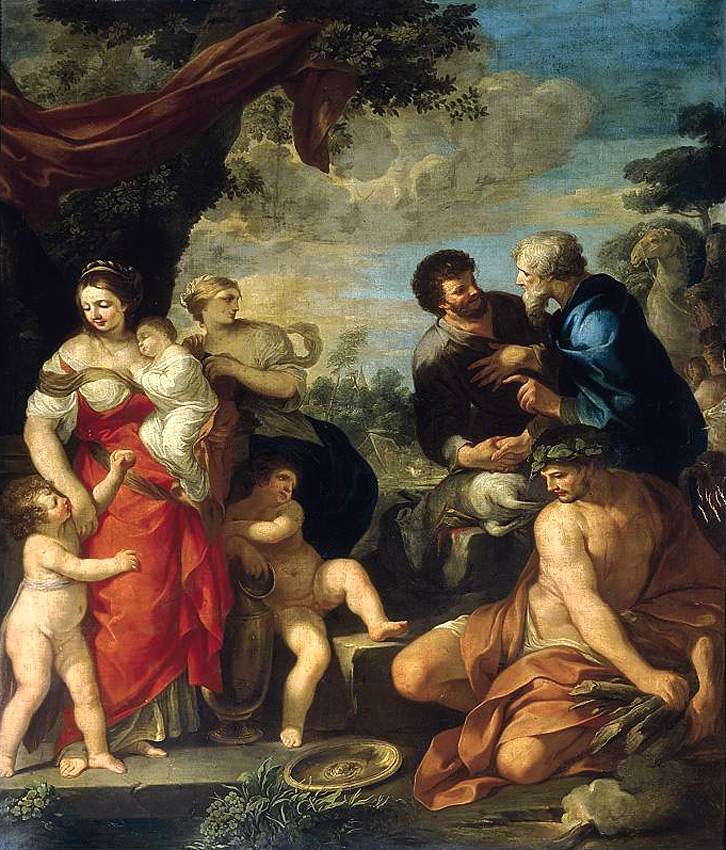
The pivot-point comes at an inauspicious moment, during the itself-inauspicious story of Jacob. If Jacob is considered much at all, it tends to be either for his vision of the ladder to heaven (28, 10-12) or his wrestling match with God (32, 22-32) – two scenes which seem incidental to the main thrust of his story. (The Ciro Ferri painting above does depict the moment I'll go on to describe, but fails to capture its signifcance.) Indeed, when we first read of him he seems a throwback even compared to the rest of Genesis. Born ‘smooth’, a classic trickster figure, he cheats his brother Esau out of his inheritance not even at the Lord’s instigation but at his mother’s. (Genesis 27) Fleering Esau, he then encounters Laban who proves much more his match.

But all changes when Jacob makes his agreement with Laban in Genesis 31/32, 43-2. (Which even Wikpedia’s summary refers to only as “a pact to preserve the peace between them.”) Up to now their relations have been highly ambiguous, alternating between a warm family relationship and trying to trick one another. It occurs to both that their common interest lies in suing for peace, but how can this agreement be kept when one is no longer in the other’s sight. Their answer is to build a cairn, which they call Witness or Watch-Tower.

“This cairn is witness and the pillar is witness: I for my part will not pass beyond this cairn to your side, and you for your part will not pass beyond this cairn and this pillar to my side and do an injury, otherwise the God of Abraham and the God of Nahor will judge between us.” (31, 51-53)

So far everything has been an action replay of an earlier oath sworn between Jacob’s father Isaac and Abimelech, in Genesis 26. But there his foes back off after recognising that the strength of the Lord is behind him. (“Swear that you will do us no harm, now that the Lord has blessed you.” 26, 29) Even with Jacob, ‘you stay your side, I stay mine’ is part of the resolution. But what about that second clause? Here God does not weigh in on one side, but acts as an arbiter over the affairs of men. (“May the Lord watch between you and me, when we are parted from each other’s sight.” 31, 49) He is specifically called upon to do what man cannot, act as an invisible omnipotent judge. You cannot cheat on your deal because you cannot hide yourself from him – no matter how thick the shrubbery. All this is invoked in the image of the cairn as a watchtower. After here the phrase “wicked in the Lord’s sight” will enter proceedings (for example 38, 7), and draw it’s meaning from this image.

It might even be possible to argue that it is not just the Spiritual God of the Old Testament who arrives fully here, perhaps the roots of the New Testament are being placed too. In the Old Testament, God is tribal – forever looking out for the interests of the Hebrews. In a book fixated with paternity he is not literally the All-Father, the patriarch who came even before Noah and Abraham, for he is specified as the creator of all there is (Hebrew and others alike). But the distinction between the two is fuzzy at best, and often entirely obscured. What he promises to Jacob during the vision of the ladder is typical:

“I am the Lord, the God of your father Abraham and the God of Isaac. The land on which you are lying I will give to you and your descendents. They shall be countless as the dust upon the earth, and you shall spread far and wide, to north and south, to east and west. All the families of the earth shall pray to be blessed as you and your descendants are blessed.” (28, 13-14)
(In other words: “I am the creator of all there is. But, out of all the world, I favour your tribe above all others. Because I say so.”)

He even warns Jacob to flee Laban, while warning Laban off harming him. Yet significantly it is Laban not Jacob who suggests the pact given above, while the Cairn of Witness is specifically named in both Hebrew and Aramaic. (31, 46) (Despite God “confounding” our language earlier in Genesis, references to actual language barriers are about as rare as in any fantasy novel – something which makes this detail stand out.) The fact that Laban is already established as much nearer Joseph’s match, in contrast to the gullible Esau, would seem to come into force here.

There’s perhaps a remorselessness to the logic. There’s a natural conceptual link between an insubstantial deity and an ominipotent one, and from there a universalised one. Unlike the rest of us, God is not trapped in one place at one time. So, as soon as God ceases to become a Tribal Father, as soon as it becones necessary for him to be invoked in bargains between the Hebrew and other races, the conception of him as the property of the Hebrews becomes eroded. He’s no longer the symbolic head of a warrior nation, whose neighbours are ‘others’, fodder for conquest or at best potential trespassers who need warning off. For they have now become potential trading partners, with whom we need concepts in common and mutually agreed sets of rules. Our relations with them are now by necessity ongoing.

Perhaps the root of this has already been laid. JM Roberts calls the Covenant between Hebrew and God (Genesis 15) “a master idea. Israel was assured that if it did something, then something desirable would follow.” Traditionally in myth, such covenants are made to be broken and lead to a Fall. (They ‘explain’ why we face death, disease and all the rest of it.) Of course this happens in the Pentateuch all the time. But it is not the only thing that happens, in Moses’ Exodus in particular punishment for the errant is often contrasted with reward for the devout. And once man’s relationship with God has become a contract, how long before that becomes the defining model in his relations with other men? The road would not be straight or even. But these are the first footfalls upon the path where he will become both omnipotent and universal – the God not of warring tribes but the great trading powers.

Postscript 1:
I’ve thrown up this theory without considering much how it sits with historical Bible study. In the widely recognised Documentary Hypothesis, researchers into Genesis usually distinguish between the two primary sources ‘J’ (for God-known-as-Jahweh) and ‘E’ (God-as-Elohim), with one of the signifiers whether God appears directly (‘J’) or via dreams and signs (‘E’). (Other sources, who were incorporated later and whose impact upon Genesis is more minor, need not concern us here.) In which case Jacob switches from a ‘J’ (trickster) to an ‘E’ (pact-maker.) (See this site for a breakdown which would confirm this.)

But the Documentary Hypothesis rests upon the two sources being stitched together as a pact in itself, between the then-separate Hebrew kingdoms of Israel (‘E’) and Judea (‘J’). Differences between the two sources, though as fundamental as the very name of God, are therefore glossed over. (This can even lead to formal redundancy. We get the story of creation twice, in Genesis 1 and 2, so neither group need miss out.) The aim was to smooth things over, not draw attention to the cracks and joins. But my argument rests upon a change which occurs within Jacob, an intentional juxtaposition, a new concept which is introduced in order to finalise a storyline. This isn’t something the Documentary Hypothesis conventionally allows.

PostScript 2:
It seems obvious that, in Britain at least, we now live in a post-Christian society. Of course people, groups and even Prime Ministers might choose to remain Christians, but we are no longer institutionally Christian. So perhaps it’s time we started taking that ‘post’ as something other than a synonym for ‘anti’. It’s like we’ve become locked in a debate where both sides see the Bible as an arms dump, which they rummage through for ammunition. (One context-free quote makes the whole thing sound a warlike cult, another all peace and love. As the saying goes ‘text without context is pretext’.) We need to start reading it as we would any other historical document, historically and holistically.

Christians might want to consider these two conceptions of God moralistically, which they are fully entitled to do. (Though frankly, it all sounds more like celestial CCTV to me.) But I tend to regard moralism as a means to avoid asking material questions, and so am more concerned with how things work historically. If man makes God in his image, it must surely follow that as society changes it will update him.

Sunday, 15 March 2009

ON TOPPLING TOWERS

A polemic disguised as a review of the recent ‘Babylon: Myth and Reality’ exhibition at the British Museum


When they say ‘Myth and Reality’, they mean things in that order. This recent exhibition is bookended by others’ views of Babylon, with the actual historical evidence the jam in the sandwich. But what follows shan’t dwell on the difference twixt those two, which was covered well enough by the show itself, but instead delve into those popular conceptions in order to probe their workings.


Right up to the Nineteenth Century Babylon was only known indirectly, and mostly through the eyes of its Hebrew enemies. As the Bible held a totemic influence in Western thought, Babylon couldn’t help but become a bogey in our minds. Yet the Greeks also knew of, and wrote about, the place without having any axe to grind, even owning up to what they owed their predecessors. Besides, Jewish antipathy alone merely gives us the opportunity to paint Babylon black, not in itself the motive. Moreover, as we’ll see, popular images may have been based on the Bible, but were not confined to it, and would often add their own motifs and embellishments.


I’m going to go on to argue here that Babylon is central to a number of interlocking myths which maintain a through-line down the centuries, and which we still hold in some ways today. Moreover, these myths are used to articulate something we feel about the nature of civilization itself.


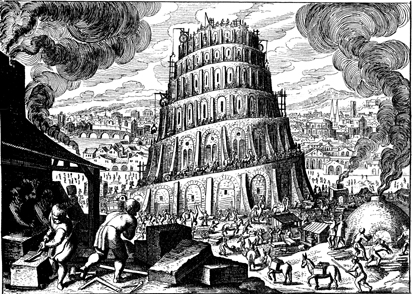
Of course (Hanging Gardens notwithstanding) the most popular image of Babylon is the Tower of Babel and this is the very thing which occupies those bookends – starting with a blow-up of Breugel’s painting, then moving to more modern depictions. Even the exhibition’s logo alludes to this, incorporating the outline of a ziggurat inside the A. And, unlike the Hanging Gardens, it seems the Tower legends did have a base in Babylonian reality. Herodotus and other historical accounts describe the giant ziggurat Etemakani (“the foundation platform of heaven and earth"), built as a single point for all around to look up to. Though no part of this building remains, we can locate it (and even know it’s size) through mapping its foundations. There’s even a scale model of it on show, presumably extrapolating from what we knew of similar buildings.


“Artists”, we’re told, “developed strong conventions for the Tower’s appearance”. While of course they’re selecting examples to suit their argument, their case does seem to be borne out. Take for example Escher’s woodcut Tower of Babel (1928). While this looks little like the squat model of Etemakani, it’s remarkably congruent with the Bible accounts. Though it appears to be built from stone, not the bricks specified in Genesis, it’s appropriately geometric in appearance. Moreover the crest of the Tower is looked down upon, an impossible angle for any human which suggests God’s perspective. God is not just the only named character in the Genesis passage, there’s even the suggestion he one day comes across the Tower. (“Then the Lord came down to see the city and tower which mortal men had built.” His omnipotence is actually quite sketchy in Genesis, with him frequently taken by surprise by things.)


But most important of all, there is no mighty smiting to behold. The Tower merely lies unfinished, the workers confused, the topmost figure throwing up his arms. For in Genesis God’s response is to ‘”confound their language, that they may not understand one another's speech”, thereby making any more co-ordinated building effort impossible. Hence we get both ‘Babylon’ and ‘babble’ from the Hebrew word ‘balal’, to confuse or confound. (Escher characterised some of his befuddled workers black and some white, to signify this division.) We’re told “from that place the Lord scattered men all over the face of the earth”, though the inference is this is the result of the loss of a common tongue, not the likes of a mighty wind. Escher’s etching could therefore be of the moment in Genesis where God spies the Tower and, in a mixture of outrage and alarm, sabotages its builders by tying their tongues.


Yet Escher’s Bible-based depiction is in many ways the exception to the rule on display here. Let’s look at some of the features which were characteristic enough to become traditional, without any scriptural derivation, then speculate (no more) on their basis.


The first thing to go is the square, geometric look, an inherent feature of a ziggurat. Having nothing much to go on with Babylonian architecture, artists based it instead on the round Colosseum. (Rome was not just depicted in the Bible as equally oppressive and decadent, but the Colosseum was seen as the ostensible centre of Christian persecution.) Of course this is just substituting a model which did exist for one which then didn’t. But there’s also points of departure from the Colosseum, and it’s with these that things get more interesting...


Unlike the Colosseum, the Tower not just starts to taper but becomes segmented, bisected at intervals by a narrow path like a screw thread. (As shown in Durer’s 1865 engraving above.) Let’s remember how early this passage comes in Genesis, these are intended as among the first people. With this motif the Tower comes to stand for a new conception of time, which arrives through the cultivation of surpluses which allowed for urban life. Linear time arrives, in which life is no longer a continuum or daily scrabble but we become consciously aware of our own past and future. The upper levels, always depicted as incomplete, stand for the more nebulous future. (Indeed Babylon had an eye on its own posterity, inscribing names into bricks and even burying clay barrels like Blue Peter time capsules.) The image of the Hanging Gardens also reflects this, suspending nature, displacing it to the sky.


However, as we’ll find happens often, this image may have antecedents in other parts of the Bible. For one thing, this curved and tapered tower contrasts with the squarer and squatter Jerusalem Temple. There is also Babylonian King Nebuchadnezzar’s dream of a statue in Daniel, divided into sections which stand for different periods of rule. The only difference here is that the image is the other way up, though representing the future it is the statue’s feet which are weak and unstable. Though the term ‘feet of clay’ has now become commonplace, this part-obscures the original meaning. The statue’s feet were weak because they were an amalgam, “part potter’s clay and part iron... so shall men mix with each other by intermarriage, but such alliances shall not be stable; iron does not mix with clay.” Like the apex of the Tower, they represent the impermanence of alliances between men.


It could also be argued that the successive levels also stand for calculation or accountancy, again something which would have grown in importance with the growth of urban life. This is enhanced by the way all the images portray the Tower as under construction, and so display the mechanisms of measurement as well as construction. (See the anonymous Bible illustration above, from Thirteenth Century Germany.) This is again echoed in Daniel. Consider the terminology used in the Writing On the Wall: “God has numbered the days of your kingdom and brought it to an end. You have been weighed in the balance and found wanting.” The very methods man was using to measure the world, to divide it up as it suited him, are now used by God upon man.


And of course the pyramid shape, with successful smaller levels, stands for the emergence of human hierarchy. This leads to a notable change. The Bible accounts mention no despot, name no King and it’s even emphasised the Tower is built by collective effort. (‘”Come’, they said, ‘let us build ourselves a city and a tower with its top in the heavens, and make a name for ourselves.’”) But the paintings commonly not only give the story a villain (normally Nimrod), but push him into the foreground. (See the anonymous French woodcut above, from 1670.)


With its fixation with lineage, the Bible seems inherently distrustful of cities. The first city is built by Cain, while Lot’s wife gets turned into a pillar of salt for just looking at one! But their problem seems to be their status as centres of teeming life, which tends to lead to mobs, loss of self-identity and makes them centres of collective sin. (“Abram settled in the land of Canaan; but Lot settled among the cities of the Plain and pitched his tents near Sodom. Now the men of Sodom were wicked, great sinners against the Lord.”) Perhaps, more used to city life, we throw the emphasis onto a conjured-up wicked despot.


But most striking of all, the Tower starts to topple (as seen spectacularly in Cornelis Anthonisz’s 1547 image above) Sometimes the surrounding city is shown on fire. (Already conflated by God looking upon “the city and tower.”) As with all the examples given above, exceptions can be found to this rule. Breughel the Elder makes his Tower an architectural folly, an impossible hodepodge of styles and angles, the physical embodiment of a failed attempt to speak Franglais. But there’s enough adherents to call it a rule.


It’s also notable how similar the image then becomes to the harshest card in the Tarot deck, the Tower. In fact, early versions of the Tarot (as shown below) can show a nude man and woman fleeing the door of a burning building, tying the image to the Bibles’ other great Fall myth - the expulsion from Eden. (Though of course we don’t have to assume the direct influence of one on the other. It could be the two images arose separately and later became conflated.)


Once we have the struck Tower, we also get the accompanying motif of attendant figures fleeing. These figures seem suddenly stripped of their hubris, reduced from architects and engineers to a terrified speechless horde. Again this is reflected in Daniel, with its tale of Nebuchadnezzer reduced by God to a bestial state: “He was banished from the society of men and ate grass like oxen; his body was drenched by the dew of heaven, until his hair grew long like goat’s hair and his nails like eagles’ talons.” (As shown in Blake’s 1805 print below.) It is hard not to associate the look of these hunched, fleeing figures with the description given above.


More Tower art for your perusal here

Tuesday, 25 December 2007

SEDUCED: ART AND SEX FROM ANTIQUITY TO NOW

Barbican Gallery, 12th Oct '07 - 27 Jan '08


1. Ligatures A Go-Go
The first thing you notice about these two floors crammed with erotic artwork is the typeface.

If you want an x-ray into the intentions of a movie, shut your eyes and listen to the soundtrack. The fact that we’re not supposed to do that means that’s where all the subliminal hijinks are actually located. Similarly, when looking at any kind of product, focus on the typeface.

Typefaces in museum signage are always sans serif (like the typeface used here), functionally maximizing readability, anti-ostentatiously pointing away from themselves to the exhibits. But this typeface is serify to the max, thick with twiddly bits and ligatures a go-go. It stands out partly through being such a contract to the Barbican’s standard blocky look.

Partly this is reminding us that sex goes beyond mere function; in fact you could argue that sex is almost the opposite of work, the ultimate thing you’d do for its own sake. However, there’s more. In typography serify fonts are considered ‘classical’, thereby tasteful and tend to get appended to luxury products. Boxes of chocolates or perfume tend to be serify, bin bags less often.

So do the serifs tell us this show will just turn out to be art as luxury product, some self-congratulatory “risqué” and “transgressive” attraction, despite all the sexualized billboards we walked past to get here, something to brag about seeing in a Soho wine bar that evening? Or, more hopefully, will it actually tell us something interesting?

2. Opening the Once-Locked
The first actual object we witness is a giant figleaf, built by Victorians to cover up Michelangelo’s David. (Allegedly to “spare the blushes” of Queen Victoria.) It represents, we’re encouraged to think, everything we can now throw off. The second section,titled ‘Under Lock and Key’, makes more of this feeling. It shows us artifacts from the ‘Secret Cabinet’, scenes of a sexual nature excavated from Pompeii but hurriedly locked away. But what's interesting here is that they weren’t hidden or destroyed but put into a kind of early ‘private shop’, viewable via appointment by gentlemen – and of course not by ladies or those of the lower orders. However, the underlying point is missed. This separation was not merely hypocritical but definingly modern, emphasising the emerging division between private and public spheres.

Instead of this, isn’t another schema afoot? Aren’t we not only being invited to distinguish ourselves from those stuffy Victorians, but assume that liberty and libido are intertwined, that sexual freedom is always a litmus test of political freedom? It might be inconvenient to point out, but Rome was a military dictatorship for most of its history and never less than a slave-powered, male empire. It would be a peculiar conception of liberty that would take Rome as its hallmark, even if they did carve statues with their willies out. (The show continues to have a similar, if less pronounced, blind spot over Eastern empires. And its perhaps curious why the clock stops at antiquity, when so much prehistoric art was eroticised.)

3. Eastern Promise Honoured
Another major weakness is given away by the opening line of the catalogue notes: “Sex is one of the great givens of human existence.” This seems a partuclarly peculiar statement for an exhibition selling Foucault in the bookstore. While the sex act could be considered merely a given, sexuality emphatically is not and to consider the aesthetics of sexuality as merely a given is absurd. The erotic is always culturally specific. 

But with such a line of enquiry ruled out, the show either categorises (gay sex, hetero sex, hermaphrodism etc) or measures via the blunt tool of explicitness. We’re told, for example, “the graphic arts of the Far East relished an explicitness” which ours lacked. Well Hustler magazine is pretty explicit too, but I wouldn’t particularly rate it for aesthetics.

This seems particularly a shame when the examples of Eastern art are so fabulous. Against them, those Roman marbles could be locked away forever for all I’d care. The Karma Sutra pages from India do look merely diagrammatic, but then they were intended more as instructional aid than artwork. But the Chinese and Japanese prints steal the show from everything else in the historical section, and possibly just from everything else. This superiority of erotic art from the East is something I’ve never heard convincingly explained, but there seems little doubting the evidence.

It’s interesting to contrast the Japanese examples against the Chinese. Both are eroticised not merely by their explicit nature but their sinuous linework. With those elegant, endlessly overlapping contours it’s often hard to tell one set of limbs from another – a neat visual analogy for the loss of self that comes with sexual release. The couples look like they’ve become single creatures, multitudinous and self-pleasuring. (There’s even an early example of the infamous genre of tentacle porn.)

Those contoured lines then continue outside the figure, rather than hiding their copulators away connecting them to nature. The Japanese are normally indoors, but by an open window or similar to allow a nature scene to be fitted in. But while they dominate their frame, the Chinese locate their figures in gardens; shrunk and de-centered, your eye doesn’t necessarily go to them first. And their environment is often rendered in more detail than they are themselves; trees don’t erupt phallically but sinuously flow across the frame, bark and leaves filled in with almost fetishistic detail.

The figures come to feel like creatures of their garden, as much like lovebirds upon the branches as human intruders. While nature's filled in so fully, they’re depicted with open lines and given stylised, almost inexpressive faces – the sheer opposite of the gurneying that normally indicates passion. They are kept as open as cut-outs so we can fill them in, project ourselves into them.

The Chinese pictures often contain an element of formlessness, not separated from but bordering and merging with the other elements - like something out of Ernst. In one case this was an elaborate delta-like arrangement of dripping candlewax, in others I couldn’t pin it to any explicable origin at all. If the interwoven figures were steadily losing themselves in each other, representing foreplay, this tipping point into the abstract stood for the orgasmic.

Of course there’s one figure that doesn’t get to disappear off – the viewer. These prints often featured observers, shocked servants innocently walking in on their amorous masters and the like. (Though oddly we’re not shown any examples of these. Maybe our own presence, clomping round the gallery, was supposed to be enough.) In a more effective example, a Medieval engraving shows a satyr creeping up on a fawn. Peering out the frame, he shushes us. Centuries before we tend to imagine it even being discovered, here the Fourth Wall is effectively blown down and we are implicated in his amorousness.

In fact, it’s hard to imagine erotic art existing without associations of voyeurism. You can enjoy a performance of Macbeth even if you’re lacking any inclinations to commit murder or seize any crowns. But erotic art is more functional – like a dance song it has to, at some level, stir in you the feeling to do something similar. 

Moreover, the voyeurism has an erotic charge all of itself. The downside of all this stuff about sex being a natural and normal act is that it stops it being such fun. As Tracey Emin asks in the show: “is legal sex anal?” We’re told (if not shown) of a Duchamp he created which was viewable only through a keyhole. After tearing off the figleaves and throwing open the locked rooms, we now feel the desire to lock them back up. Voyeurism liberates us from the need to always feel liberated about the erotic, and allows us to indulge in feeling pervy all over again.

4. A Touch of Form
But let’s go back momentarily to trace the linework of those Eastern prints. We’re told at one stage drawings made for better erotic art than paintings, as they were more suited to private enjoyment. Later we’re told how photography took over from drawing, as it offered a sense of faux realism. Particularly today, in our broadband-connected world, non-photographic porn seems almost quaint. Few websites offer porn novels on subscription. Nevertheless, and while I would say that, I would argue cartoons and animation are the media which can portray sex the best - for precisely the same reason. While as said above there’s nothing wrong with the merely voyeuristic, painting photography and film always struggle to get past that. As Duchamp (quoted in this very show) puts it, painting only shows “the surface of things”. Yet when photography liberated painting from record-keeping, it fell into its old cell. Cartoons are less bound to reality, and freer to show what sex feels like.

Reflecting on the superiority of the Japanese prints the Guardian’s Jonathan Jones comments: “European art from the Renaissance into modern times was obsessed with the delineation of reality in space and time. Japanese prints are instead decorative explorations of shape and colour: this makes for a much more tactile art.” So much sensation is encoded in the line that a good enough cartoonist could probably eroticise a rendering of a hoover. And the stages we see set up simultaneously in the Chinese prints could be sequential in an animation; figures could become more and more intertwined, then finally melt right into one another.

It’s of course equally true there are cartoonists who use their powers for ill, for example the fashion in Image comics for women whose physiques would literally leave them unable to stand up. But of course cartoons are not over-represented here, even when the candidates they offer are obvious. Jones goes on to ask: “why exclude sexually obsessed cartoonist Robert Crumb?”

However, the blinkers do not block off other directions. Perhaps its being part of a wider arts complex, but the Barbican does seem more willing to escape the fetish for canvas you find at the Tate. (When the Tate recently showed Dali’s films, it did so via often spurious points of comparison to his paintings.) The Voice of Sex area contained nothing but taped readings, none annotated, with instructions just to listen to the sound of the voices, to “explore another aspect of seduction: the sensuality of words and of the voice.” Unfortunately this splendid idea was poorly executed, the sound intrusively bled into surrounding rooms, then when you arrived you were merely in  a throughway with no inviting space to stop – so few did. 

Also, if a listening room why not a ‘feeling’ room – where you could put your hands through slot holes to stroke different textures? It could even reverse the standard signs you see in exhibitions – please do touch.


5. Everything’s Allowed Nowadays
At the Barbican’s recent Panic Attack show, (reviewed here) I successfully guessed the weakness before attending – the artists more removed from the punk milieu would be less interesting. At the earlier Future Cities show (reviewed in Lucid Frenzy’s ancient print days) I again intuited the weakness – as it progressed through time it would become progressively less interesting. I expected the very same weakness here – and I was wrong.

There’s low points, of course. But for example I’m now disappointed I didn’t go to see Noboyoshi Araki’s solo show (see his post-Bunel image above). And even when what might sound overly familiar comes up, it seems capable of pulling a rabbit out of a hat. A classic example is the Surrealist section, which contains a Sixties Sadean ‘happening’ which involved urinating on the audience and nearly saw its instigators locked up. (With the state of my memory I can remember the names of none of them now.) I also don’t remember Hans Bellmer’s drawings from the recent Undercover Surrealism exhibition, though that may merely be my poor memory as well.

Perhaps the downside of the contemporary works is they’re not particularly erotic, and consequently ill-placed to seduce you. (Or rather the examples that attempt the erotic are the least interesting… calling Marlene Dumas or Jeff Koons.) Given the period the works tend to the conceptual and, while the erotic is of course at root cerebral, conceptual art tends to the intellectual – quite a different thing. Duchamp’s presence is telling, while it’s always great to see some Duchamp it’s also a little odd to see so much of him in an erotic show. But the same remains true of the less conceptual works, Bacon for example paints more in the tradition of Munch than of Klimt.

But this downside is simultaneously the upside. There’s little Sixties-style revelling in some imagined sexual freedom, either in our ‘permissive’ society or in the liberated role of the artist. Often there’s quite the opposite. Thomas Ruff, for example, deals in blurry blown-up photos. They look ‘artistic’, the sort of thing metrosexuals would choose to go above their bed decks. Only when you read the serify notes do you realise they’re taken from porn sites, screwing with our easy distinctions ‘twixt tasteful art and sordid commerce. (Ruff does pull off a slight cheat, however. The notes suggest the blurring is but a side-effect of enlarging the images, a Duchamp-like minimising of the artist’s intervention. But unlike photos, such images pixellate when enlarged – quite a different effect.)

It’s not mentioned anywhere in the exhibition, but its notable how modern art and rock music are so associated with sex in the popular mind. Both are created by bourgeois-bohemians, and are never assembled by labour but always unleashed –exemplifiers of the spurt of ‘free’ uninhibited expression. They represent the ‘true self’ against the ‘uptight’ - of which sexual license is always the chief signifier. Of course such absurd notions merely lead to their very opposite. Rather than slip the restrictive shackles of dominant culture they then become loaded with so much baggage their backs cannot hope not to break. Fifty years past rock music and over a hundred past modernism, about now would be a good time to get over all that nonsense.

Perhaps Nan Goldin’s slideshows come in here. Slideshows inherently juxtapose images, but Goldin’s static shots are more inter-related than most films. Her simple uncrafted Polaroid-like images follow the lives of friends of hers; sometimes with children, sometimes cuddling together on sofas. They then break with the polaroids we are used to seeing by including sexual activity, part of the continuum of human relationships but rarely part of its recording. It’s more striking when they indulge in less ‘mainstream’ sex acts, with none of the surrounding iconography.The effect is similar to the famous scene in Roeg’s 'Don’t Look Now', when shots of a married couple making out are intercut with scenes of them dressing for dinner. In the sheer antithesis of faux-bohemiansim, you’re given a sense of sex as part of an overall relationship. In an era of internet porn and endlessly sexualized billboards, maybe that’s what’s become transgressive.

Gallery info here