googlee7ea825f63edb3f6.html
Showing posts with label Folk Tales. Show all posts

Sunday, 2 January 2022

‘BLOOD ON SATAN’S CLAW’

Townsfolk, beware! For both PLOT SPOILERS and discussions of sexual violence reside below


“Doctor, witchcraft is dead and discredited. Are you bent on reviving forgotten horrors?”


It seems we are.

’Blood On Satan’s Claw’ (1971) bombed on release but has come to be seen as a classic of British folk horror, forming an unholy trinity with ’Witchfinder General’ (1968) and ’Wicker Man’ (1973). But, for a moment, let’s compare it to something else, which we’ve already looked at here. ’Suspiria’ (1977) has completely the opposite aesthetic - lavish interiors in rainy nights versus the Spring light and verdant great outdoors. But however much their aesthetic varies they’re equally dominated by their aesthetic.

In fact, both can feel that the ‘plot’ is little more than a succession of images, a washing line over which that aesthetic can be draped. And both can feel like exploitation flicks inexplicably filmed in the style of an art movie, as if in some admin error the script got posted to the wrong director. (Try imagining a more garish film title than this, it isn’t exactly ’The Innocents’ or ’Dead of Night’.) This strange friction creates something rather giddyingly unique, leading to films that can’t be pinned to categorisation any more than they can be reduced to sense.

Dreams can involve an air of unease and foreboding, almost unattached to the images and incidents. Translate that into waking life, and the unease seems… well, uneasier for having no apparent focus, and thereby seeming so all-pervasive. Again, this is true of both films. But possibly truer here, where that air of dread attaches itself to - of all things - bucolic country settings.


But perhaps above all, that exploitation flick basis leads to problematic stuff which can’t just be wished away, industriously snipped out by virtuous censors to spare our sensibilities. That stuff’s built in, we’re kind of stuck with it.

Which doesn’t mean that the bad stuff isn’t bad. Dodgiest Depiction of Rape in Seventies Cinema is a much-coveted cup, but the infamous scene here is in the running with ’Straw Dogs’ and ’Clockwork Orange’. As this company might suggest the problem isn’t that its a rape scene, but how it’s a rape scene. Like all genuinely troubling things it seems unaware how troubling it is, rather it thinks it’s being racy and enticing.

Even if ‘fridging’ wasn’t a formal term yet, the interest is clearly not in the victim but the perpetrators. Officially, we may be supposed to disprove of them so getting off on it. But that hardly fits with the scene being so exultantly extended. It’s known that, originally unscripted, it was essentially improvised. And it feels like the crew were as carried away, as indulgent of their worst impulses, as much as the coven within the story. (Director Piers Haggard has subsequently conceded the scene goes too far.)

Then there’s the context, where it’s stuck in the same film as two voyeuristic nude scenes. (Even if, small mercies, there’s no explicit nudity in the scene itself.) Plus the bizarre combination of it and the scene of a man being falsely accused of rape, and immediately presumed guilty, like something out of Men’s Rights Advocate propaganda.

But as always with this taboo-busting stuff, the telling thing isn’t what’s told but what remains unthinkable. It less breaks new territory than shows up where the limits are. While women are raped and murdered to please the Devil, men are just murdered, and notably less lingeringly. Yes, he’s the Prince of Evil but that doesn’t mean he’s… you know… funny or anything.

Just like this troubling scene, the film both gains and loses from its eccentric narrative, so full of leaps and gaps its effectively comprised of them. This is partially because it was originally planed as a portmanteau of three short stories, with the decision to fold them in together made late. In Horrified Magazine, David Evans-Powell sums this up well:

“There is something of the country tale about the slightly meandering structure, the hint of a folktale told rather than history written… The looser plotting and structure also complement the sense of unease and foreboding…. while the focus of action shifts abruptly, hinting at a threat that is genuinely unknowable.”

Imposing order on it feels like something the Judge would do, an act of violence in its own right. (More of which anon.) But we need to cobble together some sort of narrative to fix on, or the film will simply slip through our fingers. Of the three tales, it’s the thing-in-the-attic tale which most shows up its original anthology origins and is effectively encapsulated - over and done with while the main plotline is still getting going. You could imagine it edited out reasonably easily, so let’s disregard it here. Which leaves us with…

Ralph, a stout-hearted farming lad stumbles upon some remains while ploughing. He’s alarmed to find they look non-human, he describes them as of “a fiend”. The skull is bare bones, but somehow still with an intact eyeball. Which, in a grisly affectation, has a worm crawling over it. (An image which I don’t think will ever leave my head.)


But when he shows them to the Judge, as is the way of these things, they’re gone. Except this isn’t some supernatural disappearing act. Other youths of the village have found them, and study their treasure when they should be paying attention in Bible class. (The bits of bone they have don’t seem to resemble anything Ralph found. But we’ll need to get used to that sort of thing.)

They then become rapturously possessed by dem bones, starting a cult under the charismatic and comely leadership of the ironically named Angel. While the ‘fiend’ is shown to have claws, there’s a a moment where Angel lasciviously sniffs the blood on a pointy murder weapon. My fan canon reading of which is that though this it’s her which is the Satan’s claw of the title, his implement, enacting his will.

Linda Hayden perfectly captures the combination of innocent maiden and alluring temptress. It’s unarguable she needs her looks to carry the role, but it’s her performance which sells it. There’s no point you question why she’d have followers. (She’s so good I looked up what other film she’s been in. Mostly it was ’Confessions Of a Window Cleaner’ and its sequels. Guess that was the Seventies…)


It’s suggested at points that this contagion is physical, like a werewolf’s scratch, and at others that it’s social and based around her anti-preacher charisma. She attempts to seduce the Reverend, and when he doesn’t succumb then has him arrested by claiming he molested her, both plans to disable the rival flock-gatherer.

Initiates soon become victim or perpetrator, in seemingly random order. Rape and murder gives the Devil (let’s assume it is the Devil) the power to re-constitute himself. Again this seems fuzzy. They have to be murdered. But also the victims have grown a patch of hair, referred to as “Satan’s skin”, which has to be flayed off them and (presumably) handed to him as if stitching someone together like a patchwork. “He had the Devil in him”, Angel tauntingly explains, “so we cut it out”. (The film has the sense to keep the Devil figure largely off-screen, implying such stuff while not inviting us to worry about the logistics.)

Like ’Suspiria’ the young people seem to be of some indeterminate, ever-shifting age, attending class, playing child games, yet old enough for betrothal. There’s not much point wondering what Linda Hayden’s full-frontal nude scene is all about, it’s about the ticket-buying public getting to see Linda Hayden nude. But it also shows us just how close this “Satan’s skin” is to female pubic hair. Its arrival is associated with bodily pains, like PMT.

Evil and puberty are essentially conflated, Angel sensualising and sexualising her subjects. Disciple Betty has her Devil’s skin cut from her in an attempt to make her goodly and innocent again, but it’s like shaving an adolescent’s nether regions hoping the child will come back. And this parable gains extra resonance in these fecund rural surroundings.

Angel’s antagonist is the Judge, who formally occupies the same role as Van Helsing in Dracula, bringing learning and authority to the problem. He first accepts the Devil’s existence not from the evidence of his own eyes but the authoritative pages of a book. But there’s little attempt to portray him sympathetically, in fact there’s every attempt to treat him as stern, authoritarian and indifferent to the suffering of others. We first see him denying the newly betrothed the chance to get together. And his followers can seem as bad as Angel’s, willing to drown an innocent woman in their search for a witch.


And he says this:

“You must have patience, even while people die. Only thus can the whole evil be destroyed. You must let it grow."

…after which he pops off to London for a while. As they say in film criticism, “you wot mate?” True he rustles up a pious posse while there, but that would hardly take long for a toff with the money to pay them. The standard interpretation of this seems to be: “I am heading off-stage now, the better to effect a dramatic entrance a bit later.” Which seems hard to argue with. But let’s try and engage with it a little.

Partly, it suggests the Devil has to take on some semblance of form to make himself a target to be aimed at. But perhaps the Judge goes to London for the same reason Angel takes to the fields, because that’s his place - the centre of his psychic energy. (His temporary residence in rural life is contrasted to the local Squire.)

Since industrialisation popular culture has tended to see the City as Babylonian, the centre of sin, while small towns and the country are the repository of good homespun values. If Haggard takes precisely the opposite tack, he’s said

“I grew up on a farm and it's natural for me to use the countryside as symbols or as imagery. As this was a story about people subject to superstitions about living in the woods, the dark poetry of that appealed to me.”


He’s also spoken of “the sense of the soil”, of how the film crew were forever digging pits to place the camera as low as possible. As if the Devil wasn’t just found in the raw earth, but generated by it, his buried remains simultaneously a seed. As Sparks in Electrical Jelly say: “It lends the impression that the surface of the world is provisional, a thin skin with deep, accreted layers, both geological and temporal, lying beneath. Forces long-buried and all-but forgotten spirits may worm their way to the surface and re-emerge.” Evil isn’t the losing force in some climatic conflagration but cyclical, like the soil which begat it, so can never be finally defeated.

Instead the characters your sympathies you go to are the villagers, like civilian casualties caught in a Manichean war, who inevitably end up shot by both sides. Ralph becomes our protagonist by default, even if he fails about every test of a hero - precisely none of his actions are successful. But perhaps the clearest example is Betty, unwillingly shorn of her devil’s skin, who ends up with a home in neither camp.

Which makes a good point. It’s often said that this film couldn’t have been made at any other time than the post-Manson-killings era, after Sixties optimism soured. But what about us, now? We hardly need be told over again that hippie thinking was over-romanticised. And if we limit ourselves to this as an explanation, as if it ‘solves’ the film… then, well, we’re limiting ourselves, aren’t we?

The provincial rural location in a pre-industrial time, the endless references to the earth, at the same time specify a time period and create a sense of timelessness. Perhaps it was always like this, life as a perpetual clash between id and ego, with regular folk such as you and I trapped betwixt and between.

This was not just a folk horror film, but the one whose release gave the name to the genre. And isn’t this the essence of folk horror? That the past, folk customs and nature (inasmuch as they’re separable things) are both incomprehensible and inescapable? It’s not Gothic castles in distant lands where the darkness lies, it’s the woods and fields which surround our semis.

Perhaps that’s why the ending feels so inconclusive, for wars without end don’t lend themselves to ending. Which of course raises the question “how would you have done it then, smart arse?” There are various answers, all of which fall under the heading ‘openly’. How about this? We see the melee between coven and pious heavies, which seems to be raging fiercely but inconclusively. Then the camera slowly starts to pan away, across open country, the battle cries subsiding, and finally focuses on a bird catching a worm. The eternal struggle.

Saturday, 27 November 2021

‘PAULA REGO’

Tate Britain, London


“I like to channel naturalist, abstract, ornamental, fetishist and childish images” 

- Paula Rego

Fighting Fascist Realism

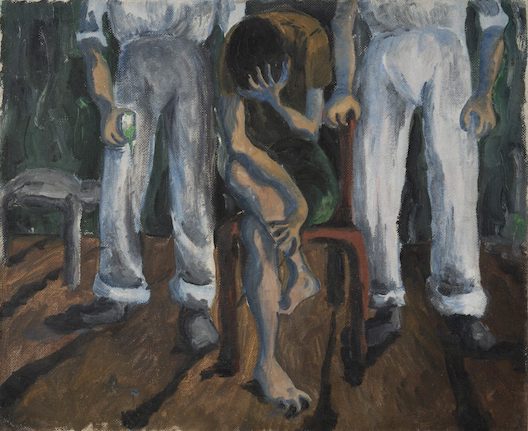
Paula Rego was born in 1935, in a Portugal still under fascism. Remarkably, she painted ’Interrogation’ (1950, below) while just fifteen. The - for want of a better word - purity of those interrogator bodies is emphasised by the echoing whiteness of their symmetry, and by their headlessness throwing emphasis onto their puffed-up torsos. Which contrasts with the poor figure in the chair, so twisted and contorted. It’s a remarkably assured work for someone so young. But if you were to pin it to a label you’d pick Expressionism.


Whereas ’Salazar Vomiting the Homeland’ (1960, below) is more indicative of her future direction. Its wild reductions and distortions of the human figure, its colours so vivid it almost looks like the work vomited itself into being, these are more reminiscent of Surrealism - particularly Miro. And, not unlike Miro, at the same time it keeps up the political themes. Salazar was Portugal’s dictator.


Surrealism, we should remember, emerged in opposition to fascism - aesthetically as much as politically. Propaganda art typically aims to appeal by making easy sense out of complex subjects. So, against its neat and tidy imagery of heroic male figures rendered in almost geometric anatomy, Surrealism twisted and stretched the human body until it was barely recognisable. And fascism, let’s remember, was perfectly able to recognise this in its enemy.

By 1951 Rego had been moved by her liberal-minded parents to England, the following year enrolling at the Slade. So it’s entirely possible that, with home censorship, the Portuguese artist only saw the work of the Spanish after arriving here. And there’s no denying her most impressionable years were spent under Salazar’s controlling maw.

Nevertheless, the show perhaps makes too much of these early years. It talks about the restrictive roles fascism forced women into, accurately and understandably. But it seems needlessly narrowing to confine her art into a response to this. If patriarchy was your prison, a move to Fifties England was a sure-fire way to discover its bars didn’t end at Portugal’s borders. In fact in ’57 she moved back there to have a baby out of marriage, after undergoing several abortions. And if we’re to take abortion as a barometer of women’s freedom it wasn’t legalised in England until 1968, then Portugal in 2007. Some while after Salazar had ceased vomiting.

Besides, that was scarcely the limits of it. One exhibition refused to display ’Salazar’, not in fascist Portugal but supposedly liberal London.


Added to which, if fascism held sway in her homeland until the shockingly late date of 1974, Rego was there to witness its end. The later work ’Madame Lupscu Has Her Fortune Told’ (2004, above) features the widow of the would-be dictator of Romania, who’d fled there. She’s pictured beside a seig-heiling statuette while attempting to get a blank palm read, fascism reduced to no more than a sick form of nostalgia for atrocity. (Oh to be back in the days when it seemed something consigned to the past!)

More widely, it risks mislabelling her art at agitprop. If ’Interrogation’ could have illustrated an Amnesty leaflet, ’Salazar Vomiting The Homeland’ requires you to read the title to get the context. And this is the vein in which she continues. In the accompanying filmshow she comments art should be as much about what’s inside you as what’s outside.


We see this in her collage works, which ran through the Sixties and much of the Seventies. (Though the term’s a little misleading here, as she chiefly collaged her own drawings.) ’The Firemen of Alijo’ (1966, above) was based on a sight she witnessed, the Portuguese poor barefoot in the show and huddled around a fire. But the finished work is so far from this that it’s more impetus than basis. In Rego’s hands, the scene becomes a phantasmagoria.

That green stripe is a horizon line, or perhaps the base of a wall. And the left-most figures do stand barefoot upon it. But from there they’re arranged in a grand sweep across the canvas, which trails out just before reconnecting to the ground. And the colour scheme becomes bolder and more varied as that sweep progresses. The result is such an accumulation it becomes an assault on the senses, which takes some while to resolve. Other works follow this arrangement, such as ’Manifesto for A Lost Cause’ (1966).

The ground-as-base is reminiscent of children’s art. But it also seems employed as a thin thread to perspective, and with it the naturalistic conventions of art. It’s there largely to show what is being left behind, try to stand on that seeming solid base and you’ll soon be yanked off our feet.

Painting With Children + Animals 

In 1974, for the first time, Rego illustrated some Portuguese folk tales. And there were not just more works to come in this vein, the themes would creep into her art more generally. (Yes this was the year the dictatorship fell, for those who like to make something of such things.) Perhaps the main thing is how little she has to change them to make them hers. It’s like she isn’t twisting or making use of them, they really were this sinister all along, just without us noticing. Take for example the print of ’Baa Baa Black Sheep’ (1989), below.


Slightly earlier, but in what seems a related move, she began making what she called ‘dollies’ - soft-form creations, something like home-made children’s toys. Though the show calls them ‘sculptures’, and though no article on her is complete without a photo of her studio festooned with them (see Wikipedia for an example) unlike Dorothea Tanning she doesn’t seem to have seen then as art objects in themselves, but as props to incorporate into her artwork. They were something like a Commedia Dell’arte troupe she could have on standby. From this point on her art is regularly rooted in the ‘types’ of folk tales, fables and fairy stories.


In the early Eighties she began a series of bold, thick-lined acrylic works, often on paper, largely featuring animals. Take for example ’Red Monkey Offers Bear a Poisoned Dove’ (1981, above). It looks so stark and bold, with everything handily labelled by that descriptive title, it must surely have a straightforward meaning. A poisoned dove is admittedly an easy enough image to read. But why a monkey, why a bear? We realise we’ve been looking at it for a while, waiting for this straightforward meaning to emerge, then a little later that it won’t.

A bunch of responses suggest themselves (countries in the Cold War?, characters in Rego’s life?, psychological archetypes?), yet none stick. And in this way it reflects the simple, direct prose which fables and folk tales are told in. In a Guardian interview she confirmed: “I always need a story. Without a story, I can’t get going.” But the story is often like the witnessed scene in the earlier collages, not something to illustrate but break off from.


Other works in this era are large-scale, and built up from the baseline like the earlier collages. However now they’re more mural than collage, a series of smaller pictures with linking devices. Some you even read by following a series of ‘lines’ across, like a piece of text. ’The Raft’ (1985, above) is the only one to be arranged around a central motif. And, while that blue dragon seems to personify the sea, the girl on a raft seems more adrift amid a sea of images. And she sits dispassionately through it all, a solid central block amid the pandemonium.


And this Girl character recurs frequently, as in ’Girl And Dog’ (1986) where she shown absurdly shaving the dog’s throat. There’s a biographical reading here, this was the year in which her husband Victor got Multiple Sclerosis and she inevitably became his carer. (Something we’ll see in other works.) But more important may be that impassive expression.

The show takes her as a feminist heroine. Perhaps partly, but she never seems wild and free. More accurately, as Laura Cummings pointed out in the Guardian: “The dogs have a whole range of expressions, but the girl… has only one. She is a vision of fixed determination.” She seems what we aren’t, calmly accepting of this absurd world. We should remember a child doesn’t have the same relationship to animals as an adult. And this Girl is shown either living in a world of animals, or morphing into one herself.


She comes closest to an expression with ’The Little Murderess’ (1987, above) where a trace of a smirk crosses her face. The standard reading seems to be that this is again about her Victor, perhaps the return of the repressed part of her psyche that could do without the constraints of caring for him. The Pelican, we’re told, can be a symbol of self-sacrifice.

But could it not also be a metaphor for growing up, the adult ‘murdering’ the child by replacing her? Look at the way she’s virtually emerging out of the picture frame, leaving her old world behind. The objects behind her, the toy cart and brightly coloured chair, look like something from a child’s room, a room she’s leaving. And we see a spectrum as if it’s a timeline. The most vivid red is in the chair to the very right, the most vivid green in the stretched-out ribbon to the left.

Into Tableaus 

But we’re getting ahead of ourselves, because in the late Eighties Rego pulls another switch. She embarks upon large-scape acrylics, which are set in recognisable pictorial space. Colours, once almost impossibly vivid, become more muted. And while animals still appear, in this era there’s less of the human-animal hybrids.

Yet at the same time as perspective opens there’s neither movement to the work nor naturalism to the figures. They’re beyond realist, in their smoothness they’re idealised, almost hyper-real, paintings with the sharpness of line drawings. They’re tableaus, as arranged as in any diorama, their poses and gestures feel weighted with meaning. Even when we’ve no real notion what that meaning might be. They can be like looking at a nativity scene with no knowledge of the Bible.


Take for example ’The Policeman’s Daughter’ (1987, above). There’s no reason why you couldn’t re-enact the scene in real life. But that pure white dress, for example, is too pristine to exist in the real world, let alone for the messy task of boot polishing.

The title gives away whose boot is being so dutifully shone, recalling the ever on-stage synechdocheal boot in Strindberg’s play 'Miss Julie’. And the arch-backed black cat, who we can safely assume is a Tom, effectively rhymes with the boot.

Just as the wilder, free-form style went with agitational content, so this aesthetic plugs into a politics. But quite a different politics. It’s an illustration of patriarchy more than an assault on it. It seems simply too ordered to allow for change. The style dictates the tone - “this is just how it is”. And perhaps the world feels more like that as we grow older, the things we once assumed we could mould have instead moulded us.

And it should also be said that folk tales and fables, inherently common property, are inherently subversive - but they’re also fatalistic. They’re not concerned with politics, with events in the world, but with the essential state of things. Their animal figures suggest we are simply born to live out our nature.


Except, as you may have guessed, things aren’t quite as neat as they look. In ’The Family’ (1988, above) a male figure is attended by two females - this time dressing him. But he’s both obscured by and sandwiched between the two. And as they exchange a glance a third looks on with clasped hands raised, like the criminal mastermind of the enterprise.

Unsurprisingly this is another Victor picture, illustrating the way care work determines an intimacy that’s inherently not between equals. But like the Portuguese poor this is more impetus for than meaning of the work. It’s based in the ironic relationship of the servant to the master, as they make him up they simultaneously wipe him out. Look to the diorama on the chest of drawers.


And ’The Maids’ (1988, above) follows along the same lines, based on a Genet play about servants who murder their mistresses. A Maid isn’t just the central figure, her extended limbs dominate the frame, shadows splaying out from her, while her Mistress is closed up on herself. There’s still a kind of fatalism here. But it’s a fatalism in reverse to the existing order, in which the servant will inevitably rise and the master fall.

There’s also… um.. a wild boar in the room. In fact a motif of Rego’s in this period is to incorporate such an element, nromally in the lower right foreground. In the two examples above, these are entirely explicable. But it’s as often jarringly incongruous, out of scale or - as here - something of both. Earlier, her base lines kept her work semi-anchored in realism. Now it’s the reverse, she stays linked to her Surrealist roots.

To quote Laura Cummings again: “The Tate wants to make an activist of Rego… But the artist is ill-served by this reductive brief. Her gift is for the exact opposite: for the deeply ambiguous and morally disturbing scenario.”


The ink-and-watercolour work ’Island of The Light’ (1996) is part of a general return both to mural style and fable-based content. It’s based on a scene from ’Pinocchio’ where children are stolen and forced into labour, causing their transformation into donkeys. (Nicely, Rego was inspired by watching the Disney film while a child herself, rather than researching folk tales at the British Library or some such. It suggests both a personal connection to the material, and that something in these tales survives even Disneyfication.)

Rego slips between every variant of this motif: two-legged donkeys, humans riding donkeys, humans riding humans, humans with donkey heads, even a donkey mounting and biting a horse. It suggests something compelling but irresolvable about the central image.

It’s a classic child fantasy, to transform into an animal in order to roam free, unbridled by the social conventions adults try to impose on you. But the concept is double-edged, for at the same time the child’s aware that animals themselves can be made beats of burden. So what should be a means of escape here becomes a form of capture. And the jumbled nature of the composition suggests no way out.


’War’ (2003, above) is again based on something Rego witnessed, though this time at one remove. It’s based on a newspaper photo of the invasion of Iraq, which featured a screaming girl in a white dress. It’s a starker image than 'Island of the Light’, but still elusive when you try to pin it down. It’s partly inverting the folksy kid-lit image of cutesy anthropomorphised figures, with the bloodied rabbit masks. But there’s more…

There are almost as many variations as ’Island of the Light', just within two figures. The main figure has a rabbit mask, but human hands and feet, while the child she carries sports paws. The adult’s ‘mask’, dead-eyed, could equally be an enlarged rabbit skull. (And the death figure with animal skull appears elsewhere in Rego’s work, for example ‘Scarecrow and the Pig', 2005.) Yet the child’s looks bent from shape, as if papier-mache. You can’t see this as actual rabbits. But neither as people figleafed by anthropomorphism, or actors in rabbit masks. You need some combination of all of them at once.

With all the twists and turns, ’The Raft’ may well be the central image, itself depicting being at sea amid a flood of images. Rego is simultaneously compelling and inscrutable. But perhaps best of all, this is not just a retrospective of a living and working artist but one whose more recent works are still well worth seeing. And, while the content of Rego’s art may often seem less than uplifting, that seems a reason for optimism…

Friday, 5 January 2018

‘THE COMPANY OF WOLVES’

The deep midwinter seemed the right time to post this. Beware, those who keep to this path, of eyebrows that meet and YE OLDE PLOT SPOILERS


Us aesthetes have all become somewhat used to leaving cinemas sagely proclaiming “of course it wasn’t as good as the book”. Because of course a book springs from a single brain, while by necessity a film reaches us through many cooks. But like any rule exceptions apply…

‘The Company of Wolves’ (1984) originated in three short stories written by Angela Carter, and published in ‘The Bloody Chamber’ (1979). And, despite lacking her strong prose style, rich without being flamboyant, it’s the film version which should be seen as definitive. For one thing Carter co-wrote the screenplay. (With director Neil Jordan, in his second ever feature.) Plus, rather than condensing down, it was able to extend and open up the original stories.

A 1980 radio version has already devised the nested structure; a reworking of Red Riding Hood (from which the film takes it’s title) becomes the main narrative, while the others are told diegitically by characters within it. The film then expanded the stories and built a framing device around this main narrative, where an adolescent girl in ‘our’ world is witnessed dreaming all this.

There’d been a spate of werewolf films at the start of the Eighties, mostly sparked by ‘American Werewolf in London’ (1981). But ‘Company of Wolves’ came later and was quite distinct from them. As the two titles suggest, one juxapositionally brought supernatural horrors into a recognisably modern world. While the other takes place within a fantastical world of forest-dwelling peasants. It’s unabashed symbolism and disinterest in realism is perhaps closer to films such as ‘Masque of the Red Death’ (1964). As Jordan put it: 
“The visual design was an integral part of the script. It was written and imagined with a heightened sense of reality in mind.”


But it doesn’t stop at such comparisons and often resembles fully fledged Surrealist films, such as Svankmajer’s ‘Alice’ (1988). And this is most obvious by the way the border between dream and waking worlds is not the neat airlock of the Narnian wardrobe but a porous and shifting hinterland. This is the very essence of what makes Carter’s work surreal, in fact it’s the very essence of Surrealism. Those floppy clocks and lobster telephones are merely its furniture.

As a primer of the film the FAQs on IMDB are surprisingly good, and can even be read through as an essay. But they also epitomise a common weakness. People rush to analyse the tales, as if the main story was merely somewhere to embed them.

Yet even the original stories are told with an active narrative voice, emulating folk tales, which already borders on metafiction. While this rush throws away the greater part of the film, which seems somewhat wasteful. Worse, it neglects a key question, in fact a key question whenever a story is being told – who is telling it and in what context. To quote Jordan again: 
“It's a film about storytelling, the central character being the grandmother [below]. It's about the use of stories.”


And who is this central character, and how does she use stories? She tells them to grand-daughter Rosaleen, dreamer Alice appearing in her own dream. Old she may be, but she’s no conservative. She’s frank speaking and distrustful of priests. Her wedding story, as with all her stories, is gender based - the wronged peasant woman made pregnant then ditched by the toff. But it’s also about class. The wedding party contains women beyond the obligatory bride. And, once they’re all transformed into beasts (below), the all-male servants bow courteously to the witchy peasant woman then open a bottle of bubbly for themselves. Here the predatory, animalistic wolves are the upper classes, their manners and fine ways a thin disguise for the most ravenous canines.


While the marriage story (above) might initially seem Freudian. We all know how horror films work, surely this writes itself. In his wedding bed, at the height of his ardour the amorous husband transforms into a savage beast. But not only is that not what happens, it’s strangely ambiguous when his transformation takes place. Ostensibly, he’s taken by wolves on the eve of his nuptials, when he nips out for a piss. Yet he’s played as a shady character from the get-go, skulking in the shadows rather than eager to get conjugal, pointedly described from the outset as “a travelling man”. His line about a “call of nature”, made after he spies the full moon, suggests he leaves the hut in order to become a wolf rather than have it happen to him. He is, in short, suspect from the start.


But perhaps most interesting is the story of the lad who meets the Devil (above). Here puberty isn’t a change which comes from within but is imposed from without. And, like any gift from the Devil, promises power but soon turns into something agonising. And of course puberty can feel like that to someone undergoing it; changes are sprung on you without you asking for them or even necessarily understanding what they are.

The through line is that Grandma’s stories, like her life, follow custom. She tells Rosaleen “never stray from the path, never eat a windfall apple and never trust a man whose eyebrows meet in the middle.” The peasant woman should have avoided getting pregnant, the husband stayed indoors and pissed in a pot, the lad not gone out and met the Devil.

While held in opposition to the Grandmother is the Mother. They’re in precisely two scenes together, the funeral and the church, and they interact in neither. Rosaleen comments to her Mother “she may not have a kind word for you, but she's always been good to me.” The oroginal script (published in ’The Curious Room’, 1997) spells out “she’s Daddy’s Mummy, and you took her beloved boy away from her.”

And, rather than tell any stories of her own, her Mother flatly warns Rosaleen not to believe in the things. “You pay too much attention to your Granny. She knows a lot, but she doesn't know everything…. If there is a beast inside every man, he meets his match in the beast inside of every woman."

It’s not a film which reduces to one reading. And one of those readings would be that it sums up the paradox of parenting by splitting it into two characters. The Grandma is protective, the Mother enabling. When at Grandma’s Rosaleen sleeps in her bed. When at home, she watches from her own bed as her parents make out. Grandma tempers the child’s natural curiosity with cautionary tales, the Mother literally demonstrates to her the facts of life. Carter has described the stories as “Granny’s strategy to keep the child to herself.”

But there’s another reading… Carter’s interest in folk tales later extended to compiling two collections for Virago. In her introduction to the first (1991) she points out “a European convention of an archetypal female storyteller, ‘Mother Goose’ in English, ‘Ma Mere L’Oie’ in French, an old woman sitting by the fireside, spinning...”

And Grandma, described in the script as “an anachronistic old lady”, is that archetype - the voice of folk tradition. The parents, the sister... all are dream counterpoints to real world characters. Even the wolf relates to the family dog. Whereas Grandma reduces to a doll in the child’s room, which smashes and reveals itself to be an empty vessel.

In Marina Warner’s introduction to the second collection (published the following year to the first and, sadly, after Carter’s death) she says of their compiler “she turns topsy-turvy some cautionary folk tales and shakes out the fear and dislike of women they once expressed to create a new set of values, about strong, outspoken, zestful, sexual women who can’t be kept down.” And indeed many of the tales do spell out the dire consequences of not following custom. The African ’Tale of An Old Woman’, for example, ends “she dwelt in poverty till she died, because she did not heed the instruction given to her by the tree.”

The film takes on the conceit of a modern adolescent girl encountering the old folk tales, and trying to make sense of them. (We’re to assume, I think, this is a fresh encounter. So she’s somehow skipped the emaciated Disney versions.) Naturally she does this by, through her imagination, entering their world. But she enters it not as a passive witness but with her own mind. Told early in the film that her sister had no-one to save her from the ravanous wolves she replies “why couldn’t she save herself?”


So she starts to tell her own stories. Which correlates to her going off the path. She’s already intuited a part of her lies out there in the forest. The first time she strays, we naturally expect a horror film scenario to ensue, akin to her sister’s earlier demise. Instead the film switches on us, from Freudian to Jungian, as she finds the nest of eggs (above). When they crack open to reveal mini-statues of human babies, she calmly takes one home to show her mother, unconcerned by the threat of wolves which has everyone else so exercised.


Then the next time, she does meet the wolf - disguised as a huntsman (above). While others follow the customary routes, he makes his own paths and boasts of the compass which allows him to do so. The film associates horror with modernity, the Devil is shown chauffeur-driven in a Rolls Royce. And the compass is presented, quite literally presented, as a novel object.

She doesn’t defeat the wolf by virtue, in fact she willingly burns the protective red shawl her Granny has knitted her. Nor doe she defeat him by ingenuity. (Or rather she does, then decides not to press her advantage.) But neither does the wolf corrupt her. Instead she tells it a story. 

There’s been a kind of transitional point where she tells a story to her mother, but repeats one of Grandmas. This one is hers. It both articulates her dilemma and accentuates the nature of a thing between. It’s about a she-wolf who attempts to return to “the world above”. But of course she can’t. Unrecognised, she’s shot at. Ironically only the Priest gets it. “Are you God's work, or the Devil's? Oh, what do I care whose work you are?”

In this, a fantasy scenario to explain her situation, inside a fantasy scenario to explain her situation, lies the central paradox of the film. Finding him a better option than the “clowns” of her village, she willingly corrupts herself. Rosaleen has hit on that ‘horror’ is really maturity. But she also knows the one aspect of it that is genuinely horrific, that it’s a one-way street. If she runs off with the wolf, there’s no coming back.

And adolescence is like this. Her bedroom (in the real world) mixes up make-up and dresses with teddy bears. Described in the script as “adolescent turbulence”, it’s itself a thing between. In the earlier radio version she describes herself: “I’m twelve going on thirteen, thirteen going on fourteen… the hinge of your life, when you’re neither one thing nor the other, not child nor woman, some magic inbetween thing, an egg that holds its own future.”

And the setting is like this. The original stories are all set in winter and frequently at the solstice, with provides the same metaphor. The radio version describes it as “the hinge of the year, the time when things don’t fit well together, when the door of the year is sufficiently ajar to let all kinds of beings that have no proper place in the world slip through”. And the film is like this, a mash-up of surrealist art movie with cheap horror flick. Carter had described it as “perpetually in flux”.

And werewolves are the epitome of this. Earlier the father chops a forepaw from a wolf, which becomes a human hand. Seeing more curious than afraid, Rosaleen asks him if it should be buried or thrown on the fire - and he responds by doing the latter. But this is clearly a get-out, a way of ridding yourself of the thing and thereby denying its uncategorisable nature. Later she asks the Huntsman essentially the same question:

“Are you our kind, or their kind?” 
“Not one kind or the other. Both.” 
“Then where do you live? In our world, or in theirs?” 
“I come and go between them. My home is nowhere.”

If Grandma’s cautionary tales always portray men in a negative light, the problem isn’t that this unfairly disparages the male sex. In this female-centred film, it’s that this world of custom becomes limiting to Rosaleen – and so she decides to leave. Normally, you need to qualify the distinction between female-centred and feminist. It may be refreshing and appealing that Katniss is the protagonist of ’The Hunger Games’ or Rey of ’The Force Awakens’, but that alone doesn’t make them feminist films. Here, quite happily, is one time you don’t.

The difference is that Rosaleen doesn’t just act heroically. In fact as she rejects the whole system of morality around her, arguably she doesn’t act heroically at all. But in a sense that’s the point. She takes herself as her subject, and refuses to accept a narrative which assigns her the role of innocent victim. In short, she liberates herself.

Yet at the same time there’s a sense of inevitability to it all. How could things have ended up any other way? It’s no hippyish celebration of ‘natural’ unbridled sexuality. In perhaps another echo of Surrealism sexuality is a form of power, which makes it transformative, but also a combination of dangerous and irrepressible. Rosaleen and the wolf take up a new life, which is not the same thing as living happy ever after.

Rosaleen comments sympathetically on the wolves howling because they’re out there in the cold, before she willingly goes to join them. And this seems to echo a passage in the original story:

“That long-drawn, wavering howl has, for all its fearful resonance, some inherent sadness in it, as if the beasts would love to be less beastly if only they knew how and never cease to mourn their own condition. There is a vast melancholy in the canticles of the wolves, melancholy infinite as the forest, endless as these long nights of winter and yet that ghastly sadness, that mourning for their own, irremediable appetites, can never move the heart for not one phrase in it hints at the possibility of redemption.”

Carter also says in her her Virago introduction “if many stories end with a wedding, don’t forget how many start with a death.” And this film starts with a death, then ends with a (sort of) wedding that also is a kind of death. As the Magnetic Fields sang on ’I Was Born’ “growing older is killing a child.”

And the closing sequence, with the avaricious wolves bursting into Alice’s bedroom in the real world, perhaps illustrates the inherent danger of sexuality while literalising the idea maturity kills the child. And giving Alice and Rosaleen different names does suggest Rosaleen is not Alice transposed into a dream world, but a projection, the person Alice would like to be. 

Alas, however, it also seems a retreat into more conventional horror film fare. Asked about this in an interview, Carter smiled and replied “you’ll have to talk to Neil about that”. For her original script had Alice diving from her bed, the floor turning to water as she hits it. Which, as well as echoing the well of the Wolf Alice story, sounds a much more nuanced and ambiguous ending. In that ending the ‘real’ world is not invaded but distorts, becomes dream. 

Yet this had to be abandoned through cost concerns, and perhaps what we got was a workaround inserted simply because it was workable. Certainly, when you first watch the film it doesn’t seem to jar. The problems arise more as you reflect on it after the credits have run.

Otherwise unattributed quotes from 
this vidclip.

Sunday, 23 June 2013

JULIA WOLFE'S 'STEEL HAMMER'

LSO St Luke's, London, Sat 11th May


”John Henry told the Captain
A man ain't nothin' but a man”

Much like 'Cruel Sister', the piece that me introduced me to the music of post-minimalist composer Julia Wolfe, this spins out an extended modernist composition from an old folk number. This time, in it's UK premiere, we're given the popular ballad 'John Henry' - the steel-drivin' man performed by Bang on a Can. Except there's an added dimension...

Much like comics or science fiction fans, folk purists like the idea that there was once a definitive version of something. It's probably inaccessible now, buried under the onslaught of a thousand updates, offshoots and commercialisations. But, in theory at least, the treasure lies intact - buried beneath the sand.

Now this is of course an even more absurd way of looking at folk music than it is for science fiction or comics. A comic character such as Superman, who is in many ways a cousin to John Henry, has definite authors we can trace him back to. They in no way occupy the importance that fans attribute to them, but they're there.

Folk tracks don't work that way at all. Each new iteration just adds to what's gone before. (You may well have heard me say all this already. You're probably expecting me to use the metaphor of growing like coral any time now.)

We don't know who wrote the original John Henry ballad, though it probably dates only as far as the 1870s. (Little more than a lad by folk's extended chronology.) And, though there's speculation over who the original John Henry might have been, even if we're to assume his existence it's at about the same level of importance as if Superman had been based on some real guy. What's significant is that he's a symbol of the working man. For the ballad to be effective, it has to work as a kind of template that can be applied to many actual faces.

Except this isn't so much a new take, nor even a restaging of one of the old takes. It's more like a taking up of all the old takes at once, a reframing which incorporates them all. It starts with an extended choral repetition of the original's phrase “some say...” before listing a slew of States.

In one sense it borrows a trick from Steve Reich's minimalist classic 'Different Trains.' Every word we use has a double existence, a label for something but also a set of sounds – a mini music score in the making. You hear “Ken-tuu-cky” and “O-hiiio” stretched by the singers, passing back and forth between the two states in our minds. Except Reich's work was based in highly personal memories. What's captured here is the broad swell of Henry's history. There are variants where he is black and others where he is white. Here he's black and white. It works like one of those motion capture photosnaps, which portray a person's limbs in a blurry assemblage of different positions. It's the sum total of those positions which make up Henry.


“Some say...” is of course picked up as a phrase precisely because it's such a staple of folk songs or tales. Yet for all its distillation of these, the piece ends up doing something folk songs never quite manage themselves. Tending to be narrative based, they tend to start “some say...” then follow one particular trail. You need the multiplied versions to see the multiple picture.

With it's changes in tempo and musical style, everything from simple stomping feet to the crash of a full ensemble, Wolfe's meta-textual version gives us a frame for the songs which the songs themselves would not. She's playing on something in this style of music which is transcendent, which is beyond specifics.

Which is of course all to the good. Single, unified versions are inherently to do with restriction, and very often with power. If in my town Henry is white and yours he's black, and if my town is larger with a bigger printing press, then he'll turn out white soon enough.

The only drawback may be that there's so much universalisation that there's not much room for the actual John Henry. Had you known nothing of the folk original, you'd probably have guessed 'Cruel Sister' involved murder by medium of water. I'm not quite sure you hear the steel hammer in quite the same way here. Would you have seen this piece and gleaned 'man versus machine... man wins... man dies'?, which seems the irreducible core of 'John Henry.' The frame perhaps gets cast too expansively, it ends up more like a template for a folk song than an example of one. (Much minimalist and post-minimalist music, including Wolfe's own compositions, involve a live player working with pre-recordings. That must intersect with the Henry tale somehow.)

But still, it's a modernist composer not cherry-picking from the folk tradition but enthused by what's unique to it, and keen to respond in kind - with material unique to composing. In the Q&A after the recent 'Repeating Patterns' New York Minimalism night, people were keen to know what it was like to be in that scene as it happened. And understandably so, for it was a momentous era. But, for those of us too late to the party, we have what it morped and developed into. And if her London excursions are anything to go by Wolfe seems to be right at the top of her game about now.

The bill also included... Terry Riley's 'Tread On the Trail'. Unlike Riley's normal transcendental compositions, this was like a dime bar jazz band listened to through a distorting mirror. Which is of course a good thing. Plus another UK premiere, Nico Muhly's 'Three Songs.' The event was part of a mini-festival curated by Muhly, 'A Scream and an Outrage. The piece didn't mean a thing to me if I'm honest...

A kind of best-of showreel of the piece...


..and just in case you've not heard the original, here's one version by Woodie Guthrie...

Sunday, 11 July 2010

ONCE UPON A TIME THERE WAS A FAIRY TALE WHICH KNEW ITSELF - LAST THOUGHTS ON STEVEN MOFFAT’S DOCTOR WHO (1)


“I’ll be a story in your head. That’s okay – we’re all stories in the end. Just make it a good one. Cause it was, you know. It was the best.”

When decriers of ’Old Who’ jeer about “wobbly sets”, what are they really saying?  Perhaps they consider it a fool’s errand to make a science fiction show on such a limited budget. The alien planets would always look like sand quarries, the spaceships like hairdryers and the result an inevitable shambles. But... surprise, surprise... they didn’t understand what they mocked. Its makers were abundantly aware you couldn’t build a convincing alien civilisation on thruppence ha’penny and some sticky back plastic – and so they didn’t try.

It’s significant that stories would often occur in the Land of Fiction or similar. The series wasn’t metafictional, exactly, but it was aware that it was in a sense always set in a land of fiction. Its storylines were like little fables which weren’t really attempting to sell Skaro as a believable setting, any more than they were police boxes as a feasible form of time travel. Instead it was allusive, a way of bringing up issues and concerns from an oblique angle. Refererntial names abound, Skaro itself is surely a riff on “scar” – emphasising the deadness of the Dead Planet. The show’s style was more similar to theatre than the ‘realism’ of TV; by it’s nature theatre does not try to convince you that you are looking at the actual Royal Court of Denmark or Roman Senate. Rather, the stage is a magic transporting space which is unconstrained by geography and free to allude elsewhere.

Frank Collins quotes Bakhtin in the context of ’Doctor Who’, “the use of the fantastic... to create extraordinary situations, for the testing of philosophical ideas.” Fables are not neat analogies, equations where one side always equals another, but throw themselves open to interpretation, like spurs to thought. (Okay, at other times it merely served up endless Nazi analogies. We’re really talking about the old show at it’s best here.)

This may be part of what lends ’Who’ to be written about. There’s plenty of other stuff that I enjoy as much, if not more, than the good Doctor. But it always seems to be ’Who’ which clocks up the column inches. (And, it would seem, the readership stats.) The sense that is always about something outside of itself, without ever quite specifying what, makes it a cup which will never run dry,

Davies’ ’Who’ took a slightly different tack – it was more of a cosmic soap opera. The Doctor’s line in ’Army of Ghosts’, “I’m burning up a sun just to say goodbye”, perhaps sums this up the best. Unlike the old show Davies seized science fiction’s scale, it’s opportunity to blow up events to a cosmic level, but then marshalled that imagery to bring something down to earth. We don’t know what it’s like to watch a sun die, but we do know what it’s like to say goodbye for the last time and how gargantuan that can feel. The burning sun is but a metaphor to show how much the Doctor wanted to see Rose again. It’s like watching a summer storm, which appears to be just a show in the sky, then being struck by lightning.

Of course the histrionic, convoluted world of soaps is unlikely to resemble our lives, and if it did those lives would be so frenetic that there’d be no time for watching the soaps in the first place. Yet, in the reverse of ’Star Trek’ soaps ask us to buy into the notion that they are in some way about life as we know it. Social themes (such as death or divorce) or issues of the day (such as gay adoption) are reflected, albeit through a monstrously distorting glass.

The peculiarity of Davis’ era was that he simultaneously leapfrogged the fable element and went for fully-fledged metafiction. He’d draw attention to something like the rules of coincidence which power a genre season, such as the Doctor and Donna meeting again. Yet, as the genre most coded as close to ‘real life’ soaps embrace metafiction least of all. (As in the famous dictum that no-one ever watches Eastenders on ’Eastenders’.)

It could be argued Moffat tried to square these. As just about everybody noted, he saw and sought to play up the fairy story aspects of the show. (Let’s not concern ourselves here with the distinction between fables and fairy stories.) He started his run with a little girl talking to her imaginary friend, a pretty hefty indication of the sort of thing that lay ahead. His stories are stories, and don’t feel the need to disguise themselves as anything else.

His characters don’t try to approximate psychological depth, they go more for breadth. Rose worked in a shop, Donna was an office temp. Yet Amy is a kissogram, in defiance of the fact that they don’t even make kissograms any more. (Even her other half gets a stripper for his stag do.) She dresses up and plays for a living. She’s the one who fixes things on her very first adventure. She takes to the Tardis like she was meant to.

But Moffat also incorporated a great deal of metafiction, albeit dressed up as time travel. Few modern dramas pay attention to the old Aristotelian unities of time and space, they flash-forward and back again, they intercut, they compress time. But the characters within them are usually innocent of this. The ’Doctor Who’ scripter may think how to get his hero out of the inescapable trap he’s just shoved him into, and hit on the idea of him passing his sonic screwdriver to an aide beforehand. He may then scroll back on his script, and insert that scene earlier. Or, to keep it a surprise he may instead use a flashback. Or he may have his hero use time travel to do it. Through this time travel motif, Moffat emphasises that his stories are doing things only stories can do – to both us his audience and to his characters.

This metafiction is most clear in the Davies-era ’Silence in the Library’, which I’m starting to think of as the start of Moffat’s second phase. There, a character becomes aware her apparent life is a fiction through the elliptical way that it passes. (The same story even features two guys named Dave, deliberately flouting the famous rule of drama that two guys named Dave can’t appear in the same story.)

But is there a downside to all this? In the old days, time travel was just a means to get the characters places and the show started. It had the same role as shaking a six in a board game. But then fans came to write the show. And fans have the same attitude to subtext or plot mechanisms that schoolboys have to farts – better out than in. If there is, for example, unresolved sexual tension between two characters in a show, fans will immediately want it played out – not stopping to think that the tension might have been more compelling than the resolution, that in is sometimes better than out.

The Doctor’s comment “you know fairy stories” becomes double-edged. It’s not just that we’re familiar with them any more, these days we are knowing about them. We tend to associate the two things because things happen in fairy stories which could only happen in fiction, and serve to remind us we are reading fiction. Yet within fairy stories, everyone accepts these rules without comment. When Sleeping Beauty succumbs to the Wicked Witch’s curse, no-one asks “how can such a thing be possible? As much as this story takes place in any genuine time or place, it is clearly centuries before cryogenics.” Instead they wail “who will break this terrible curse? Some way within the conventions of this sort of thing, that would be good.” We’re not the first people to notice those rules. We’re just the first people to think they need to be commented on.

Okay, the new show must do things the old show did, or else it isn’t the new show. And it must also do those things better, or at least more sophisticatedly, or else it isn’t new. And I like the way it's doing that, honest I do! But even so, haven’t we become rather hung up on sophisticated? Wouldn’t it be better to just make it like a fairy story? Do we really gain very much by perpetually being told that this story is actually a story? Didn’t it work better the way it was? Would ’Planet of the Spiders’ be a better story if the giant arachnid at the end started saying “by the way, Doctor, I’m a manifestation of your ego. It’s all quite clever really...” As Tyler Durden so memorably said: “Being clever, how’s that working our for you?”

Thursday, 18 March 2010

JOSEPH CAMPBELL DOESN’T NECESSARILY COME IN CANS

In a recent blog entry, Andrew Hickey tears into ‘comparative mythologist’ Joseph Campbell, for the negative and homogenising effect he’s had on genre fiction.

”If there is one person who I wish had never been born, it’s Joseph Campbell...
The concept of ‘the Hero’s Journey’ has done more to ruin fiction and popular culture than any other concept I can think of. What annoys me is that something that was intended as a *description* is instead increasingly being taken as a *prescription*.”

In short, Campbell to Andrew is the man who said the hero can have a thousand faces, but only one sodding story! This low level of esteem is commonly held in our circles. Andrew Rilstone, for example, has written of “the increasingly cancerous influence of Joesph Campbell”.

I would readily agree that there are many points where Campbell’s work can be criticised. But is it really him to blame every time you see a crap film? Hasn’t he just become a handy target, whereas really we know better?

In fact it’s in the gap between Andrew’s two comments above that I want to insert my two-penneth.

How did we get into this situation? Campbell is now inextricably caught up in the popular mind with Star Wars. It probably was George Lucas’ namedropping of his Hero With a Thousand Faces  that propelled him into the popular consciousness. Without this connection would they have made a popular TV series about him, The Power of Myth (even filmed on Lucas’ ranch) or brought out the accompanying (and refreshingly slim-line) book?

Yet Hero itself had actually been published back in ’48 and all his major works completed at least decade before Star Wars was released. Moreover, Campbell had been writing studies on myths and legends for those interested in history, culture or psychology. There’s no suggestion anywhere that any of it was intended as a practical guide for contemporary writers. When Lucas finally caught up with him and showed him the Star Wars films, he confessed to ignorance of them – for he rarely visited the cinema and didn’t own a TV.


But the real villain of the piece isn’t even Lucas - it’s Disney Exec Christopher Volger who wrote the 1992 ‘guide’ The Writer’s Journey: Mythic Structures For Writers, a book so appallingly autistic that burning would be too good for it.

Volger reduced Hero to the clod-hopping, meritocratic, evening-classes-for-all notion that it wasn’t even a guide but a manual. You just have to enroll in the course, read the set book with due diligence, follow the requisite sixteen steps and – hey presto! – your writing is mythic. That’s what it says on this here certificate, don’t it?

Volger made Campbell into cans, something saleable and consumable. It’s the difference between shamanic flight and a package holiday. It reminds me of the William Burroughs story Ah Pook Is Here about the wicked American capitalist who reads myths, but as if he were reading Moby Dick to know about whaling and having to skip all the bits about the white whale. If you wanted to make the mistake the other way up, you could read a recipe book then complain it was hard to relate to the characters. There’s no point wishing Christian Volger was never born because he already has been. But maybe there’s some way to fix the problem retrospectively...

For all their wooliness and New Age tendencies, the insight contained in Campbell’s works is that stories take on their own power. Any writer will tell you there’s some point where the story seems to surge ahead of him and write itself while he struggles to catch up. (Of course the operative word there is ‘”seems”. Stories are sentient life forms only in the worst of New Age mumbo jumbo.)

The point is that writing is a way of unlocking something, of accessing parts of your brain you didn’t know you had. The Surrealists fixated on automatic writing as a method of unleashing the subconscious. But in a sense all writing – at least all good writing – becomes automatic writing. As is said on www.jfc.org>the Joseph Campbell Foundation website:

“All myths are the creative products of the human psyche, artists are a culture’s mythmakers, and mythologies are creative manifestations of humankind’s universal needs.”

Of course the gormless literalists don’t even have the courage of their own convictions. They insist endlessly ‘all stories are one’. So if that’s the case, why do they even need this stupid manual in the first place? It’s like saying all roads lead to Rome, so I’d better bring a map. If they really believed what they say, wouldn’t anything they wrote take on that form, manual or not? Shouldn’t they even try to break from the mould, secure in the knowledge their story would reshape itself back into the one ideal form? Of course they would never do anything so edgy, so close to surrendering control! This is an essential part of colonising Campbell, that you can leave enough of a veneer to make your money-making seem somehow ‘spiritual.’

To re-iterate my main theme, the workaday hack writers don’t get it. So what else is new? You don’t judge a book by its slowest reader. The stupidest, klunkiest interpretation of something may well be the easiest one to get. It doesn’t mean it’s the only one. There’s a simpler reason for all the bad scripts out there. There’s bad writers.

PostScript: For those who haven’t yet had enough of this sort of thing, I posted some comments on Andrew’s blog about the relationship of Campbell to Structuralism. Given this description, I am not expecting an unseemly rush...