googlee7ea825f63edb3f6.html
Showing posts with label David Bowie. Show all posts

Saturday, 12 March 2022

“ALL THE STRANGERS CAME TODAY”: DAVID BOWIE’S ‘HUNKY DORY’

(Another instalment of Mutants Are Our Future, this time turning from comics and TV shows for some of that pop music the kids dig so much. You can read things from the top here, should you choose.)


”So I Turn Myself To Face Me…”

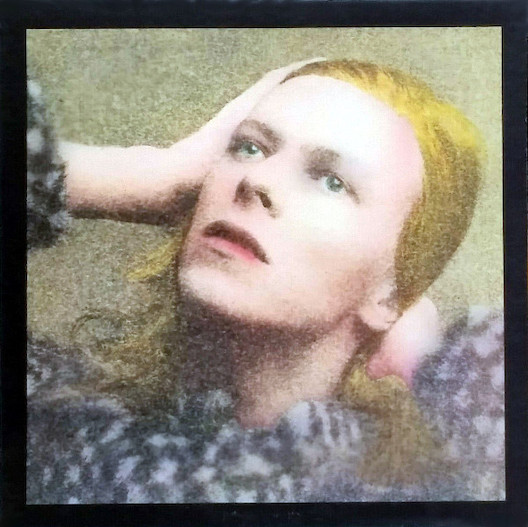
‘Hunky Dory’ (1971), David Bowie’s third album (depending how you count it) came between the mystic-folk-meets-primordial-heavy-rock of ‘The Man Who Sold The World’ and the snappy pop-rock of ‘Ziggy Stardust’. Each within a year of the next. But, bar odd tracks, and despite the Spiders From Mars being formed in all but name, it doesn’t sound like either. His voice is mostly accompanied by piano. Wrapped between a front close-up of a far-sighted Bowie and a handwritten back cover, it’s very much his singer-songwriter album.

Because of course those are all devices we associate with the personal voice, the raw unmediated truth, sung straight at us with no space for artifice. In ’Shock And Awe’ Simon Reynolds wrote “it resembled an existentialist Elton John”, and it often seems to be, in his own words…

“Written in pain, written in awe
“By a puzzled man who questioned
“What we are here for”

There’s even a direct tribute to the then-knighting King of singer-songwriters, Bob Dylan. Called, naturally enough, ‘Song For Bob Dylan’. Though it’s a mixture of tribute and barb, addressing him (as a disillusioned Lennon had) by his real name Zimmerman.

“We lost your train of thought
“Your paintings are all your own”


…was a none-too-subtle dig at his latest, underwhelming effort ’Self-Portrait’. In asking when we’d be getting the old Dylan back while knowing full well we weren’t, Bowie was clearly positioning himself as the great man’s successor. (Perhaps ironically, for an album which on release didn’t even chart.)

At this point Dylan’s run of late Sixties great electrified albums had only just happened. But Bowie skips over this creative peak, to go back almost a decade and focus on the righteous and dungareed spokesman for a generation with his Woody Guthrie cap and words of “truthful vengeance.”

Except Dylan performed those songs on guitar, the instrument of choice of protest singers, the one whose unadorned truth fascists were supposedly so allergic to. While Bowie’s on the piano. An instrument which can also signify ‘personal voice’, Joni Mitchell would swap between the two ambidextrously. But it’s as much associated with urbanity and verbal theatrics. (Perhaps because it’s less portable, or has a more dextrous sound.) And furthermore…

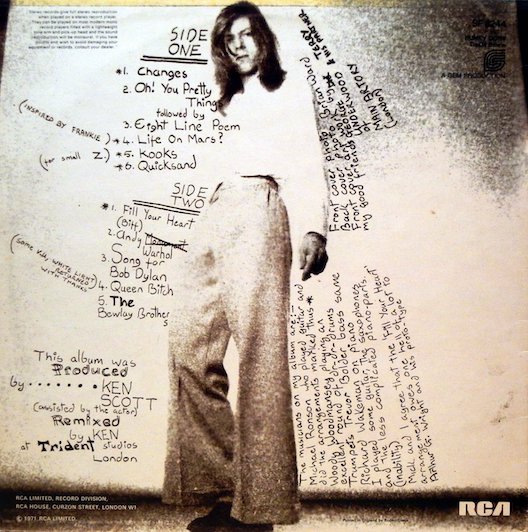
Audiences of the genre like singer-songwriters to be solo, or at least play the main instrument themselves, the way a painting is supposed to be all the artist’s own hand. They are even known to shout “Judas!” when they don’t think they’re getting this. But here even that piano is mostly provided by Rick Wakeman. (Who’d already played on ’Space Oddity’.) Bowie cheerfully conceded on that hand-written sleeve: “I played the less complicated piano parts (inability).”

And he plays into this, peppered the album with twists and turns on the theme. Even as he evokes “a voice like sand and glue”, he makes clear he’s as keen on greasepaint and glitter. “So I turn myself to face me”, could come from any singer-songwriter, making themselves their own inspiration. But Bowie quickly follows it with “but I’ve never caught a glimpse.”

’Quicksand’ refers to both Garbo and “the next Bardo”. Which could be, respectively, the wartime spy and Buddhist concept. Or perhaps the two glamorous actresses? People argue over which but… guys, really… twice in one song? Remember the sane/Seine pun from the previous album? He’s doing this deliberately, isn’t he?
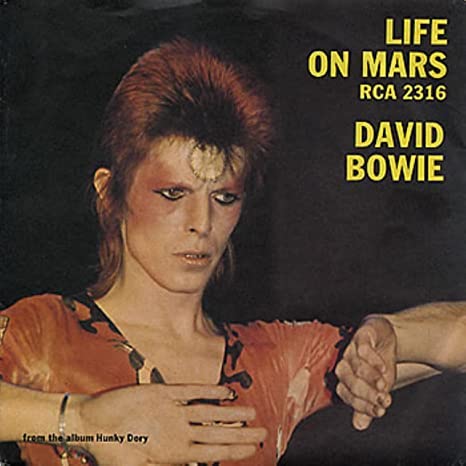

‘Life on Mars’ is clearly Bowie’s zigzagged, idiosyncratic version of a protest song. While the two opening tracks, ’Changes’ and ‘Oh! You Pretty Things’ would seem to be his take on the classic ‘Times They Are a-Changin’.’ (Perhaps the best-known early Dylan song after ‘Blowing in the Wind.’) Like their source they’re both ostensibly addressed disdainfully to an adult generation, telling them to get out our way (“don’t kid yourself they belong to you”), while of course they’re actually an anthem for marching youth. 

Except Dylan’s song is full of quite Biblical imagery, floods and tribulations (“The line it is drawn/ the curse it is cast”). It opens with the proclamatory line “Come gather round people wherever you roam”, like a town cryer. While Bowie begins with “wake up you sleepy head”. His tone throughout is more intimate, conversational not confrontational. Even when he spies “a crack in the sky and a hand reaching down to me” he doesn’t dramatise, in fact he could sing in the same voice about the postman having come.

While Dylan was always writing accusatory “you” songs (usually pronounced “yeeeeeew!”), the first personal pronoun on this album is inevitably “I”. It’s clear enough that here its inner change, personal transformation, that counts. Bowie sings “I’m much too fast to take that test”. The streets aren’t made for political protest, they’re there to be treated as a catwalk. The secret to life is realise that this is all a show. And those children that you spit on try to change their world, they don’t just bring change, they represent it. Don’t just change one thing for another, be change, swap fixity for fluidity.

Simon Reynolds also wrote:

“Bowie came along at a time when the idea of revolution or alternative ways of living proposed in the Sixties began to fade. The big trade-off that ensured was the shunting of ‘revolution’ out of the social-political domain and into the commercial-aesthetic zone, as well as into the private life… Bowie is the emblem for this individualised, privatised form of revolution.”

And the man himself said, two years later: “The revolution has been fought on an entirely different plane to the plane that I thought it should be fought on… For instance, like capitalism can be all right.” (Another reason, should we need one, not to treat the Tomorrow People trope as somehow inherently radical.) He’d reject in song “that revolution stuff” of the Sixties - “what a drag, too many snags.”

While, interestingly, the chorus to ‘Song For Bob Dylan’ makes Sandy Glue’s adversary not Mr. Jones or some other fusty establishment figure, but “the same old painted lady/ From the brow of the superbrain.” Wait, what, who?

A clue might have come from the track straight before, another personal tribute, this time ‘Andy Warhol’. The words to which read something like a Glam manifesto:

“Dress my friends up just for show
“See them as they really are
“Put a peephole in my brain
“Two new pence to have a go
“Like to be a gallery
“Put you all inside my show”

For Warhol was more than anyone the self-proclaimed antithesis of the confessional school of creation - art was artifice, appearance, effect. He described himself as a “deeply superficial person”, and insisted “if you want to know all about Andy Warhol just look at the surface, and there I am. There’s nothing behind it.” For the press release, Bowie called him “a man of anti-message.”

Julian Cope later wrote ‘Christ vs. Warhol’, conveying how torn he felt between the rival pulls of pop immediacy and lasting grandeur. And Bowie at this point seems very Dylan vs. Warhol, split between really meanin’ it man and the desire to dress up and put on a show. An approach he arguably kept up over the rest of his career. He was the Seventies artist who was effectively employed to shut the door on the Sixties, yet at the same time never fully crossed that threshold himself.

And after all, how different were they really? Bowie’s already reminded us Sandy Glue was just a stage persona for Robert Zimmerman. And a corduroy cap and an acoustic guitar can be as much a pose as a blonde wig, as Dylan surely proved more than most. He said himself: “You're born, you know, the wrong names, wrong parents. I mean, that happens. You call yourself what you want to call yourself.”

His “you” songs rarely stretched to “we”. That was more the era of the agitational late Sixties, perhaps reaching its succinct epitome in Jefferson Airplane’s “your enemy is we”. But it was a distinction most failed to spot, and his consequent failure to support that agitation mystified them. Bowie then positions himself to be Dylan’s successor, but with the “I” presented as a twist. His relationship to his fans was by the same mass media, but it was to be one-to-one, kids alone in their bedroom hearing a transformative track on the radio.

”The Start of the Coming Race”

Yet at the same time as all this Bowie ups the ante with the line that took us here - “better make way for the homo superior.” We’re “the start of a coming race”, not just different to their generation, but of another kind altogether. “The Earth is a bitch” (famously censored in the Peter Noon cover), suggests we’re leaving mere physical existence behind.

You could play compare and contrast to another great piano song, from the previous year - Neil Young’s ‘After the Gold Rush’. Which portrays the present as an impasse, a “burned out basement”, stuck between a Medievalist golden age and a silver science-fiction future, with spaceships to ferry to us to the stars. It’s eschatological, an SF retelling of the end-times, with aliens replacing angels to take the nice folk like us out of a place like this. (And remember “tall Venusians passing through” had appeared in Bowie’s earlier ‘Memories of a Free Festival’.)

Ever the early bird, Bowie was getting in ahead here. In the well-known tale he picked up the phrase “homo superior’ from meeting Roger Price in a TV studio. Yet, as we saw last time, Price’s ‘Tomorrow People’ series didn’t debut for another two years.

But this was another way he was still channelling the Sixties, for this cosmic mysticism had always been part of the hippie mentality. Once it had co-exited with fervent insurrectionism. But as the possibilities for radical social change faded, it was able to hog more and more of the stage. George Harrison had said in ’67 (quoted in Clinton Heylin’s ‘The Band You’ve Known For All These Years’): 

“I read somewhere that the next… Messiah, he’ll come and he’ll just be too much… The majority of people are going to believe and they’ll be digging everything and he’ll come and say ‘Yeah, baby, that’s right’, and all those other people who are bastards, they’re gonna get something else.” 

It’s a kind of inverted Calvinism, with the sober-minded short-haired businessman the damned and the indolent long-hairs the UFO-hopping elect. But it’s the same rigid division into saved and consigned. This is precisely what Nigel Kneale satirised with the Planet People in ‘Quatermass’. 

Yet that “I” reasserts. The track which most aligns with ’The Tomorrow People’ is ’Pretty Things’, and that only comes as close as the plural “you”. ’Tomorrow People’s whole sell had been plugging into the we - you didn’t just join a gang, you became permanently telepathically linked. The teleological optimism of their premise was much more post-Sixties than Bowie. Questions like the role of violence in social change are literally not even questions for them, the answers seen as innate.

Bowie is much more personalised, more egotistical and at the same time more fractured. And it would be this less utopian take which would come to win the toss in dramatising the spirit of the often-contrapedal Seventies. Naming an album after a slang phrase for feeling good, that’s a surefire way of spelling out it won’t be very feelgood.

And significantly this album, which bombed on release, is not considered a classic. Bowie is often seen via his trailblazing influence on those who came after him. While ’Tomorrow People’ has become almost a byword for retro chic.

Which leads us to…

”If I don’t explain what you ought to know…”

’Quicksand’ is the album track of the album, not the one you went to it for but the one that keeps you there. Somewhat self-disparagingly, Bowie said he wrote it while still pretending he understood Nietzsche. But it’s more about not understanding Nietzsche, having a head full of half-digested notions of the ubermensch, stewing with some semi-masticated Cowley and chewed Buddhism. There’s a long list of characters, but they all seem to exist only in Bowie’s head. He described it as an “epic of confusion”, representing a “cacophony of thought”. 

It reminds me most of student life, picking up one author and being swayed almost just by touching the cover, then trying another and being immediately converted, transferring your allegiances so often you get giddy. It’s the perspective of a young man, his voracious but magpie reading eye always bigger than his word-digesting brain, so constantly getting sucker-punched by erudition. Ultimately, it’s about having a reading hangover. The song we all struggled so hard to understand in our teenage bedrooms is ultimately about struggling so hard to understand. The war imagery, so pored over when Bowie attracted his own flock of magpie readers, stems from there.

But the album’s magic happens when these three themes intersect. Bowie was at this point coming up with songs at a rate of knots, so was free to choose what went with what for each album. (Many Ziggy songs were at this point already written, but saved till later.)

This doesn’t make it coherent, just cohesive. If he sang of being “torn between the light and dark”, that doesn’t map precisely to Dylan vs. Warhol. But 'Quicksand’ still internalises the conflict staged elsewhere, relocates Young’s “burned-out basement” inside his brain. While singing of a “crack in the sky”, he was only a few years from drawing a dividing line down his own face and in-so-doing creating the most potent self-image of his career. He’s not hoping the rest of the elect pick him for the team, he’s quizzing himself what his nature might turn out to be.

“I'm not a prophet or a stone-age man
“Just a mortal with the potential of a superman
“I’m living on”

And this creeps into other songs. ‘Pretty Things’ is more complex than the glam anthem it might appear, however proto-Ziggy that rousing chorus. Though thought to be written before his first child was born, “wake up you sleepy head” suggests that’s who its addressed to. The man who shortly would become a transexual alien saviour is here a father; at a time of great generational conflict he’s trapped between the sides. “Look at your children… Don’t kid yourself they belong to you” could be addressed as much to himself as some squaresville grown-up.

When that sky cracks and the hand points down to him, there’s no real telling which side of the divide he’ll be falling on. Let’s remember that ’Cygnet Committee’ two albums back, ostensibly a state-of-the-Sixties song is effectively about a parent/child relationship in which Bowie also gave himself the parent role.

Faulkner famously wrote “the only thing worth writing about is the human heart in conflict with itself”. Which is ultimately where ‘Hunky Dory’ is at, the befuddled mortal and the would-be superman in symbiotic struggle.

Saturday, 17 July 2021

“THE KIDS HAD KILLED THE MAN”: DAVID BOWIE'S 'THE RISE + FALL OF ZIGGY STARDUST AND THE SPIDERS FROM MARS’ (3 of 3)


”I’m A Space Invader” 

The amount of science fiction in Ziggy can be overstated. There's at least as much animal imagery. But, much like gay culture, futurism and pop music seemed like natural bedfellows. It promised, in the famous phrase, tomorrows' sounds today. Tomorrow had already been the name of a Sixties psychedelic band. Phrases then still hip, such as “far out” (used on the album), also suggest this connection. Three years after Ziggy, the equally glammed up Slade would sing “many years from now there will be new sensations/ and new temptations/ how does it feel?”

Back then a pop star seemed so exotic, so at odds with your drab existence of school ties and table manners, that to see him as an alien didn’t seem so much of a stretch. Bowie effectively played with this with the video to the earlier single ’Life On Mars’. It’s essentially a succession of close-ups of him, filmed like his brightly made-up face is Mars. The cover to ’Ziggy’ shows the space invader juxtaposed with standard, drab London locations – backstreets and phone boxes.

Perhaps the most overtly science fiction song is ‘Starman’. And reasonably enough, someone first hears Ziggy by stumbling across him on the radio. (Yes, the man playing a rock star so he could become a rock star made a hit single about hearing a hit single.) He immediately picks up the phone: “I had to phone someone so I picked on you/ Hey, that's far out so you heard him too?” (I like to imagine that he phones a total stranger.) The radio and the phone are of course rock song staples, going back to the Fifties. But there’s a special significance to the radio here.

Bowie said of his own suburban teenage years: “I spent so much time in my bedroom. It really was my entire world. I had books up there, my music up there, my record player.”


And for my generation it was the same. A strange mixture of introspective self-isolation and exile from the world. And despite that drab normtown, every now and again something brightly coloured would fly briefly past your window. You’d only recently discovered you had your own will, and didn’t seem to have much of anything else. So you imagined you might be able to will another world into being. Having lived in that bedroom isolation, Bowie knew how to write directly to people still inside it.

Lemmy has said, when it first appeared, “rock ’n’ roll sounded like music from another planet.” But for their generation, that has an extra poignancy. Radio One didn't begin until 1967, when Bowie was already twenty. He’d have spent his formative years catching the new music through pirate stations, broadcast by necessity from beyond British shores. This strange new music was beamed in from outside, beyond the workaday world of suburbs and school uniforms. Alien form and alien content were in perfect alignment.

(Bowie himself recalled “It was very hard to hear music when I was younger. And therefore had a call to arms feeling about it”. The song compares radio waves to cosmic rays - “That weren’t no DJ, that was hazy cosmic jive.”

And that theme was in the airwaves back then. Back in ‘66 the Byrds had released ‘Mr. Spaceman’ about hitching a ride from a UFO like a souped-up hippy van. And, tho’ not in the lyrics, Roger MgGuinn had speculated about aliens hearing his song through the ether. The psychedelic band Gong released the ‘Radio Gnome Invisible’ trilogy of albums centred round a telepathic radio station, the first appearing only a year after ‘Ziggy’.) 

Yet ‘Starman’ is also based on the musical number ‘Over The Rainbow’, to the extent that live Bowie would sometimes swap the lyrics over. And as science fiction is really only useful as a metaphor for otherworldly, ’The Wizard of Oz’ meshes quite tightly. Bowie’s only real change was that he was now bringing someone from Oz to Kansas.

Also, science fiction was cosmological and quite often eschatological. And Ziggy is at least in part an angel, sent down to rescue the fallen of the earth. This is a belief system triggered by a starman rather than a star, but same difference.

In ’The Death and Resurrection Show’, Rogan Taylor argues “showbiz was the stump of shamanism”, surviving in disguised form into modern times. Unsurprisingly, it takes in Bowie and focuses on the Ziggy era. Bowie's described as “celestial… the most beautiful example of a modern master of heavenly flights” and “an Upperworld shaman”. He goes on:

”Uncontainable by any one mould, he was bound to become a sex-change shaman. Aerial spirits are very often depicted in myth as either sexless or androgynous, as in the paintings of medieval angels. It is as if their refusal to be bound by the either-or-ness of sexual identity provides them mysteriously with their power of flight. They cannot be held down in any one classification, so they drift upwards in consequence.”

And of course a shaman primarily has a healing role. The album repeatedly suggests only rock ’n’ roll can save the world – “I could make the transformation as a rock ’n’ roll star.” And if that seems more a Sixties than a Seventies notion, especially for the man simultaneously writing ’All the Young Dudes’ then Ziggy is very reminiscent of the title character from the earlier song 'Wild Eyed Boy From Freecloud', “the missionary mystic of peace/love”. (The only track from the first album, bar 'Space Oddity' itself, to get played at the final Ziggy gig.) And the whole album is in the slipstream of the elegiac 'Memories of a Free Festival', which “talked with tall Venusians passing through.”

To date the furthest Bowie had taken this was 'Oh You Pretty Things' with its suggestion youth were “the homo superior”.

“Look at your children
”See their faces in golden rays
”Don't kid yourself they belong to you 
”They're the start of a coming race”


Yet, to quote myself (well somebody has to) when looking at ’Quatermass’: 

“It’s difficult to capture in retrospect just how contrapedal Seventies culture was. And how science fiction, which had always held to a view of the future which was bifurcated verging on bipolar, was the ideal arena to capture that. The future would either turn into a fluorescent silver techno-fix or else fall into pieces, with neither middle ground nor third option.”

It's easy to get the idea from this that the Seventies were ideologically split between hope and despair, dystopian and utopian SF flicks occupying alternate weeks at the cinema. But, as was not at all uncommon, in Ziggy the two are compressed together. This juxtaposition is at its keenest on 'Lady Stardust':

”Lady Stardust sang his songs
”Of darkness and dismay
”And he was alright
”The band was all together”


Early Bowie songs had tended to be epic, sprawling, multi-part numbers. But with 'Ziggy' they grew shorter, fell into conventional verse/chorus structures, both music and language becoming more direct. (The stream-of-consciousness style of 'Diamond Dogs' lay in the future.)

Bolan had made a similar journey from Tyrannosaurus Rex to T Rex, and it’s scarcely a secret Bowie used him as a role model. But there’s more than concision and simplicity, it’s also the sound of T Rex which is borrowed.

As Simon Reynolds pus it: “It is precisely as a lightweight that Bolan was a marvel. T Rex took the ponderousness and grit out of blues-based tock, made it lithe and succinct…. Cock rock became coquette rock. Instead of wham-bam bombast T.Rex songs moved to a reciprocal groove… active and passive roles slipped and flipped around.” (‘Shock and Awe: Glam Rock and Its Legacy’)

Bowie’s songs are more theatrical, less playful, less fey than Bolan’s. But he uses lightness positively in a similar way. Rock ’n’ roll has greasy knees protruding from ripped jeans. Rock ’n’ roll commonly cries “Get down!” Here the music seems to gleam and glide. The album sounds, in a literal sense, unearthly. This isn’t just true of the more show-like tracks such as ‘Starman’. ‘Ziggy Stardust’ is riff-based, but soars spaciously.

In other words, for an album about rock ’n’ roll mythology Bowie gives it a very un-rock ’n’ roll sound. A sound Simon Reynolds describes as “not particularly cosmic or futuristic but… cleanly produced rock and soul tunes… Rock is the theme that governs the album, but it’s not really the sound here which is lean and clean, light and almost unbodied.”

Think of Taylor’s description of Bowie as celestial, unweighted. Think of the line “Look out your window, I can see his light.” Perhaps we should even see Ziggy as some kind of Gnostic saviour, a being of light projected down into our tawdry material realm. It’s as if he arrived not from another planet but some ideal realm, where everything “sparkles” and nothing is worn-down or debased.

Perhaps the strangest part of Taylor’s description is “sexless”, particularly when Bowie was considered such a sex symbol at the time. As said earlier, the album has a predilection for nudge-nudge animal metaphors. (“I’m an alligator”, and so on.) But despite that, it’s not particularly sexualised. The animals are more flamboyant than bestial, strutting peacocks not rutting stags. Even on the jaded ‘All The Young Dudes’ they scoff at “television man” for “saying we’re juvenile delinquent wrecks.” (Though he may have a point about their shoplifting.) A thick line of innocence runs through it.


And this is made clearer by including one song which was all grit, all grind, very much wham-bam bombast. If the rest of the album is polished till it gleams, ‘Suffragette City’ sounds like a raw slice of something. And this time, that something is definitely sex. In lines like “don’t lean on me man, cause you can’t afford the ticket”, with a garnish of implied violence.

The album’s known for borrowing Nadsat slang from ’Clockwork Orange’, but it’s actually only used on this track. And Burgess’ gang of street-aristo apex predators are quite removed from the Dudes.

Again, serendipity saves us. This was the song Bowie first offered Mott the Hoople, perhaps because it sounded so unlike the rest of the album. Only when they refused it did he offer them ’All the Young Dudes’. 

Which means that the album starts out sounding ‘clean’ but gets dirtier as it goes along, the groupie tale ‘Hang On To Yourself’ leading into ‘Suffragette City’. From purity and innocence to decadence and corruption. (Which may be reading too much into it. Then again, that’s pretty much what we’re here for.)

Bowie’s next single (bar one) was ‘The Jean Genie’, described as “all muscle and sinew.” 'Starman' was a song, 'Jean Genie' a riff with an attitude wrapped round it taking the form of a lyric. It heralded a sound much less influenced by Bolan and much more influenced by the Stones.

Admittedly we’re now moving to the next album. But then, chronologically as much as with Bowie’s character, it’s hard to pin down where Ziggy ends. 'Aladdin Sane' never mentions him by name, but its concept was often described by Bowie as “Ziggy in America”.

And where best to get lost? Arguably the songs there take up the missing section from ’Ziggy’, and chronicle the character’s dissolution. Taylor called Bowie “an Upperworld shaman”. Yet, in the shamanic flight as anywhere else, what goes up must first go down. Ziggy merely lived the story in reverse.

In fact, so powerful is the rock ’n’ roll myth that, as if it possessed its own inexorable force, Bowie’s subsequent years mapped to it. After 'Diamond Dogs’, he became increasingly isolated, paranoid and delusional, sensing black magic plots against him everywhere, his lifestyle effectively a slow form of suicide. Simon Reynolds describes his state of mind as a kind of private apocalypse:

“In the nadir of cocaine dysphoria, Bowie made a total identification between his fractured ego and ‘World Collapse’. That’s Daniel O’Keefe’s term for narcissism turned apocalyptic: a state of mind that’s the inverse of being in love. Where romantic ardour reaches out for ecstatic fusion with the Other, paranoia withdraws from an external reality that’s become all Ominous Otherness.” 

And what’s the solution but to invert the inversion, try to find that ecstatic fusion once more? And, being Bowie, as seen another time, he tries to bring that about by writing a song about it. ‘Station To Station’ sounds nothing like ‘Rock’n’Roll Suicide’, but follows the same formal structure – dissolution leading to renewal, disconnection yielding to reconnection.

And this may be part of the appeal of ’Ziggy’. If it kicks off a Glam trilogy it’s the only album to have this idealised sound. A friend once told me he always likes the idea of bands more than the actual band. ’Ziggy’ may be the ultimate album where it exists just so the idea of it can exist, and that idea is itself the idea of rock ’n’ roll.


The Stations of Rock ’n’ Roll

The closing 'Rock and Roll Suicide' cyclically brings us back to the themes of 'Five Years' - an isolated figure wandering the streets. We’re used to that, but it should feel odd. If this is the height of Bowie’s dalliance with Glam, then Glam was not normally given to this sort of downer vibe. Marc Bolan, Bowie’s big inspiration to go into Glam, wrote songs with titles such as ‘Life’s A Gas’ and ‘Solid Gold Easy Action’. Melancholia was the business of blues-based rock music. At least at the time Glam was seen as pop music, its home turf the singles not the album chart.

Almost every other track is sung about him, this one is sung to him. And this time Ziggy himself is the fraught, isolated figure. (It’s not specified it’s him, but come on - it is. Certainly, this is the only second-person song on the album, unless you count the filler ’It Ain’t Easy’.)

Bowie did explain at one point “it was his own personality being unable to cope with the circumstances he found himself in, which is being an almighty prophet-like superstar rocker who found he didn’t know what to do with it once he got it.” The man who’d showed up to save others, turned out he can’t even save himself.

In ’Shock and Awe’, Simon Reynolds points out that “Pop is a personality cult; it’s based on the belief that some people are extraordinary and that the ordinary can achieve elevation only by direct contact or through emulation”. But, when discussing Bolan’s later plummet from stardom, he comes back to refine the point:

”Charisma could be the attribute of a gifted preacher, a miracle-worker, someone endowed with gifts of oratory or oracular utterance. But charisma could also be possessed by the congregation itself, which in the early days of the Christian church was more like a band of outcasts than the hierarchical bureaucracies of subsequent centuries. It is arguable that charisma of this kind – collective single-mindedness – is a ‘vibe’ that generates itself within any cultic group that shares a marginal world view and renegade value system.”

And live music is all about the transference of energy between the performer and the audience, each giving back to the other. And this is formalised by the ritual of the encore, the star disappearing and having to be called back. It’s our “we believe in faeries” moment.

The song’s conceit is to start out descriptively, as if a dispassionate and omnipotent narrator is recounting the character’s actions. But then it jumps into addressing him directly, as if deciding it couldn’t stay uninvolved after all. At which point, as it cries “you’re not alone”, it becomes as rousing as a chorus. If Ziggy came down to save the kids, it’s they who now save him.

And in a sense he does die. The end of the album means the end of the character, this is in Bowie’s well-known phrase “the last show we’ll ever do”. But what dies is his ego, he discards his messiah status and accepts his own mortality. (Hence the “time takes a cigarette” opening.)

Try to think back to it. Those teenage years alone in your room, feeling at odds with the whole world, what did you most want to hear, but “no, you’re not alone”? Live this must have been magnificently effective.

In the film 'Velvet Goldmine’, loosely based on Bowie’s life, a character reflects sourly on the Glam era: “We set out to change the world... ended up just changing ourselves.”

Which is the story of most of our lives, I’d imagine.

Saturday, 10 July 2021

“IF WE CAN SPARKLE”: DAVID BOWIE'S 'THE RISE + FALL OF ZIGGY STARDUST AND THE SPIDERS FROM MARS’ (2 of 3)


(First part here.)

”I Smiled Sadly”

’Ziggy Stardust’ opens, logically enough, with an announcement of the end of the world: “News had just come over/ We had five years left to cry in”. As the song starts Bowie sounds mournful but strangely resigned. There's none of the “hey man” hep-cat slang that peppers future tracks, the language is direct and even flat. 

Mysteriously, the song never spells out just how or why this time limit came to be set. But we're lucky, because at one point Bowie did explain it, when he was being interviewed by William Burroughs:

”Ziggy is advised in a dream by the infinites to write the coming of a starman, so he writes 'Starman’, which is the first news of hope that the people have heard. So they latch onto it immediately. The starmen that he is talking about are called the infinites, and they are black-hole jumpers. Ziggy has been talking about this amazing spaceman who will be coming down to save the earth. They arrive somewhere in Greenwich Village. They don't have a care in the world and are of no possible use to us. They just happened to stumble into our universe by black-hole jumping.”

More precisely, we're lucky that this was said three years after the event (and for a musical that never happened), so we don't have to be bothered by any of it. (If you read the whole thing, you can follow him musing about the logistical difficulties associated with putting black holes on stage. While saying “I usually don't agree with what I say very much, I'm an awful liar.”) Just as we're lucky the Orwell estate scuppered his plans for a 'Nineteen Eighty Four' musical, meaning that instead we got 'Diamond Dogs'. Every reference you read to it suggests it would have been to Ziggy what 'Phantom Menace' was to 'Star Wars', elaborations which added nothing and in fact took everything away.

Of course we're better off not knowing. The disaster is like the shadowy monster in shadowy monster films, best kept that way rather than shining a spotlight over an extra sweating in a rubber suit. It’s the unspecified nature which makes the song so haunting and evocative. But there's more, which goes to the core of the concept...

At the time, he was less erudite but probably also less an awful liar:

“It originally started as a concept album, but it kind of got broken up because I found other songs I wanted to put in the album which wouldn't have fitted into the story of Ziggy... it could be within the last five years of Earth... I'm not at all sure... Because I wrote it in such a way that I just dropped the numbers into the album in any order that they cropped up. It depends on which state you listen to it in.”

And notably he doesn't seem to have ever played the songs live in album sequence.

So if Bowie wasn't yet applying Burroughs' cut-ups to his lyrics, he effectively cuts up the album. Every song comes from a different perspective. Though Bowie ‘played’ Ziggy on-stage and even in interviews, and though the majority of the songs are from a first-person perspective, few are from Ziggy’s. ('Star' is a possible exception.) We see him through others’ eyes. The classic line is “Ziggy played guitar” not “I played guitar”. (Just as well, as he wasn’t playing guitar at the time he sang it.)

You could, if you wanted, try to pin each one to it's narrator - 'Starman' to a suburban teen keeping his dreams of “sparkling” from his parents, 'Lady Stardust' an early fan watching others glom on, 'Ziggy Stardust' two rival fans in conflict and so on. But that's not the point. The point isn't where those different perspectives come from, it’s what they add up to. You can examine a mosaic by stepping up close, working out the size and colour of each piece. But the point of a mosaic is to step back, to take in the whole thing impressionistically, individual pieces disappearing into the pattern.

And is this even new? Earlier songs, such as ‘Space Oddity’ or ‘Cygnet Committee’ had been built from multiple points of view. But each character was carefully tagged, most obviously through the radio call signs on ’Space Oddity’. The lyric sheet even helpfully wrapped their speech in inverted commas. But as those epic narratives condensed to hit single length, those identifying tags were lost, long speeches and passage of description were compressed into gnomic aphorisms.

Plus Ziggy himself was a mosaic, a Frankenstein assemblage Bowie made from rock stars already existing. Except when people try to work out his recipe, it always seems dissatisfyingly limiting. Ideally he’d be based on every previous star. Bowie said “it’s an archetype really, it’s the definitive rock ‘n’ roll star. It often happens and I was just trying to document it as such.”

As well he might. Smart, striking-looking, talented… Bowie may have been a natural star. But he was not necessarily a natural rock star. For years he flitted between many paths. So he approached the role as an actor would, studying actual rock stars and copping elements as they struck him.

And before Bowie, appreciation of previous stars was normally expressed through cover versions or copycat numbers. Whereas on his previous album ’Hunky Dory’ Bowie had openly dedicated multiple numbers to his heroes. And he’d go on to use rock imagery, such as “Jagger’s eyes”, the way Romantic poets might have cited Aphrodite.

Plus seeing him through those multiple lines of sight, like a mosaic viewed through a prism, enhances this sense of him as something inscrutably strange, slightly beyond our understanding. Looking back years later, Bowie sounded less interested in Infinites in Greenwich Village: 

"I think that probably the best thing I did with Ziggy was to leave himself open-ended. It wasn't a specific story, there were specific incidents... but it wasn't as roundly written as a usual narrative is… because Ziggy was kind of an empty vessel you could put an awful lot of yourself into, being your own version of Ziggy." 

And yet the mosaic metaphor's imperfect. Here the pieces are just big enough to suggest they might fit together. We get a fractured perspective on a fractured figure in a fractured situation. And that fracturing is foregrounded. It may be significant that Bowie so frequently described himself as “mixed up”, as a synonym for “troubled”, when he was playing a character who was literally made from a mix.


Google-image “Ziggy Stardust” and most finds will be of the later Aladdin Sane. You can see why. It was all about being iconic and that was the icon that trumped the others. Aladdin was used for the mural made for him in Brixton after his death, he even has a zigzag constellation named after him. That zigzag became his motif, and it couldn’t be more clearly an emblem of a fractured personality.

And the fracturing may even be duplicated in the individual pieces, like Mandlebrots. When people argue over the recipe for Ziggy, the one most overlooked is the least known but possibly the most important. Through the medium of consuming too much acid Vince Taylor had come to believe he was an alien, or Jesus, or possibly an alien Jesus.

Bowie said of him “I’m not sure if I held him up as an idol or as something not to become. Bit of both, probably. There was something very tempting about him going completely over the edge. Especially at my age then, it seemed very appealing: ‘Oh, I’d love to end up like that, totally nuts’. And so he re-emerged into this Ziggy character.” (From Clinton Heylin’s ’All The Madmen’) So Ziggy was based from the off on a broken prototype. Not Jesus but a John the Baptist who predicts himself, and is still proven wrong.

The script that Bowie wrote which called for Ziggy’s rise also had to call for his fall. And it was ever thus. In the Simpsons episode 'The Otto Show' Bart falls into a fantasy where he and Millhouse become rock stars. Before you know it he’s becomes bloated and strung out, lying backstage unable to go on. “You've changed, man”, yells Millhouse. “It used to be about the music.” Returning to reality Bart mouths to himself “cool”.

In rock ‘n’ roll if it’s working, that’s a sign it’s not working. It's meant to end up in failure, the car crashed into the swimming pool not retained and resold for its full market value. So in rock mythology “he took it all too far” is a compliment. 'Rock 'n' Roll Suicide' is always going to trump 'Rock 'n' Roll Retirement With an Superannuated Pension Plan'.

’Ziggy’ is the rock 'n' roll story - rags/riches/rags again – blown up on a more cosmological scale. And if it wasn't rooted in rock 'n' roll, it wouldn't work. We're like a tribal group told a new iteration of its core myths. Just a few key words and phrases is enough. 

Which is why, in the moment of listening to it, Ziggy seems to make total sense. It’s only when you try to focus on it that it slips away. Because in a way we don't need to be told the story of Ziggy. We already knew it, from the very beginning, without even thinking about it.

And so rock music becomes almost innately built on a paradox, between the rock star as icon of cool and as shunned outcast. As Lennon said "Part of me suspects I'm a loser and part of me thinks I'm God Almighty,” no messing with Mr. Inbetween. Ziggy himself epitomises the ambiguity, built around the oxymoron of “a leper messiah”. And one way of resolving that paradox is to make it into a timeline, into a rise and fall.

And so, though Ziggy’s fall is telegraphed in the title its passing is barely recounted. It comes in the middle of the song ’Ziggy Stardust’, intercut with the triumphant. We’re expected to intuit these are two contrasting voices, the euphoric fan interrupted by the more cynical protopunk asking what the Spiders have done for them lately.

He “make[s] love to his ego”, the kids fall out of love with him, “kill the man”, “break up the band” and leave him alone and despondent. Or something like that. (It’s not clear how any of that happens, or even who turns against who first. Or how you can develop a messiah complex when you’re already a messiah.) And that was one of the songs demoed even before 'Hunky Dory', suggesting that however much it's elided over Ziggy's fall had been hardwired into the thing from the start.

Whereas in ’Lady Stardust’, just as we're being told of Ziggy's ascendancy the tone is elegiac, almost mournful, someone looking back on those happier times. The past tense seems important. The payoff line is “I smiled sadly for a love I could not obey”.

”Pushing Through the Market Square...”

So in short 'Five Years' makes no sense and was never intended to... well, perhaps in a way it does. But, despite the “Earth really dying” line, what it suggests is social not ecological collapse. The patchwork array of people in the street come off as disconnected, linked only by hearing the news guy's words. Reduced to a series of pronouned types, (“a girl my age... the black... the cop”) just like the agglomeration of discrete objects that assail the narrator (“boys, toys, electric irons and TVs”) all apparently walking single file, each internalising the portentous warning.

The most obvious assumption is that they act in this way in response to the news guy's words, shocked out of the ability to look one another in the eye. But what if the situation is the other way up? The news guy isn’t relaying to but reporting what’s happening in the street, that we can no longer relate to each other, that social breakdown is literal - it’s simply stopped functioning at the most fundamental level, and now each and every one of us is alone.

“I felt like an actor” should be a positive line, another iteration of the Glam credo about reinventing yourself. Here it's reversed. Everyone in the song is an actor without an audience, reduced to a role and trapped within it. Only the social outcasts, “the black” and “the queer” respond to what anyone else is doing – which in the queer’s case is throwing up.

With the line “never thought I’d need so many people” it’s the ‘need’ which sticks out. We’re expecting ‘see’, maybe ‘meet’, not so strong a term. Its people who are the problem here. But also, potentially, the solution. “My brain hurt like a warehouse, it had no room to spare” is about carrying the image of that fractured world in your mind, with no way to interact with it. Bowie said, if years later, “I'm feeling like a society in myself. So broken up and fragmented.”

And, you may ask, how does this theory explain the five year time limit? The answer to that is it doesn't really. But then that's happily forgotten from this point anyway. What it does convey is how it can feel to push your way through a crowded street, your brain auto-assigning descriptive tags to those you pass as if that helps you navigate them. Like you're a cut-out piece stuck in a collage, unable either to cross the bifurcating scalpel lines and interact with the other pieces or to remove yourself from them.

Bowie’s often said to have countered the collectivised radicalism of the Sixties, to be about individual self-transformation. But this is a song about the downside of individualism, the perils of too much of the heady stuff. He often said himself that he primarily wrote about alienation. But perhaps never more so than here.


”Ripping off Stars From His Face”

And, with the world collapsing around you, what’s left to do but act cool?

The album contains an out-and-out filler track, which doesn't even tangentially relate to the Ziggy concept – 'It Ain't Easy'. (Already rejected from 'Hunky Dory', it should have been knocked back again.) So it might seem a shame that a classic song which did (sort of) fit the concept got left off the album. Of course this is ’All The Young Dudes’, which Bowie gave to Mott the Hoople. (Some claim he wrote them the song on the spot.)

In fact, much like the musical getting aborted, it's the hidden hand of fate at work. Firstly, it was too similar to the album to actually find a place on it. Too many motifs recur – television men, suicide and so on. Chronologically it would have had to come before the Starman landed, but would then risk vying with 'Five Years'. 

But more importantly Ian Hunter sung Bowie's song better than he would himself. Bowie would have sung it poignantly and theatrically, pretty much the same way as 'Five Years'. Hunter just sounds jaded, soured on life. (Though Bowie did perform the song live, he never released a recording of it until a 1995 compilation album.)

So what’s so cool about Cool? It could be seen as just a more condensed word for people who can't be bothered to say insouciant. Except that ignores the term’s origins:

”The sum and substance of cool is a self-conscious aplomb in overall behavior… Cool was once an attitude fostered by rebels and underdogs, such as slaves, prisoners, bikers and political dissidents, etc., for whom open rebellion invited punishment, so it hid defiance behind a wall of ironic detachment, distancing itself from the source of authority rather than directly confronting it.”

(And yes, it doesn’t count as cool to look up what Wikipedia says about cool.) Hence affected nonchalance became important enough as a survival strategy to acquire an almost spiritual devotion. Baudrillard described cool as “aestheticised nihilism”.

In fact, in today’s bid for Pseud’s Corner I’m going to suggest this song suggests a dialectical relationship. In one sense it’s acknowledging the hopeless situation society has pushed upon you. (As in the immortal line “is there concrete all around/ Or is it in my head?”) But being a “dude” is also an avowal, something taken up akin to being a monk, and so becomes your source of inner strength. (“That revolution stuff” of the previous decade is specifically rejected.) Which creates the paradox – you pose as if your very life depended on it.

To get more reductive about it than we probably should, the verses are a list of individuals feeling that concrete all around. (It starts with a planned suicide.) While the more euphoric chorus involves the dudes banding together. Even the recorded version carries instructions as if to a live audience - “I want you at the front”. 

Rags are the New Riches

I once watched one of those BBC4 music histories which cheerfully rolled out the old saw about music not reflecting the lives of alienated urban youth before punk came along. Scarcely ten minutes after they’d actually played ’All The Young Dudes’. 

Glam was naked aspirational, and often that meant a chance to do some social climbing. It involved many figures from working class backgrounds who affected middle class accents. Take for example Brian Ferry, son of a Geordie miner who took on a gentleman-about-town persona. Punk might seem the very opposite of all that. We could counter Ferry with Joe Strummer, ex-public school boy who learnt to drop his H’s in the newfound impolite company.

Nevertheless this still was the promissory note Punk inherited from Glam, embodied in Rotten's clarion cry “you don't need permission for anything!” If it replaced dressing up with dressing down, it took up dressing down as if it was dressing up, rags paraded like they were riches. Glitzy alter egos like Stardust and Glitter were swapped for ersatz names like Poly Styrene.

And the connection’s possibly at its clearest here. The “ripping off stars from his face” already seems Punk’s ostensible anti-Glam. While the discarding of the Beatles and Stones seems to presage the Clash’s “no Elvis, Beatles or the Rolling Stones.” In fact the Clash were such fans they brought in Hoople’s producer Guy Stevens for ’London Calling’. (Though perhaps the bizzarest connection is anarcho-punk fundamentalists Crass naming themselves after a ’Ziggy Stardust’ lyric “the kids were just crass.”)

Last part incoming...

Saturday, 3 July 2021

“LIKE A LEPER MESSIAH”: DAVID BOWIE'S 'THE RISE + FALL OF ZIGGY STARDUST AND THE SPIDERS FROM MARS’ (1 of 3)

“Please don't ask me to theorise on Ziggy... its all too personal. He's a monster and I'm Dr Frankenstein. He's my brother, and God, I love him."
- Bowie

”Man is least himself when he talks in his own person... Give him a mask and he'll tell you the truth” 
- Oscar Wilde


Ziggy and the Zeitgeist

After Bowie's death, when Call-Me-Dave Cameron tried to paid tribute to a man he barely even had a first name in common with, Newsthump cheekily suggested he'd cited 'Sergeant Pepper' as his favourite album. And like a lot of satire, it's not that far off.

'Ziggy' may to some extent be Bowie's 'Pepper', the name non-fans have in their heads as the correct answer to the question. Truth is, not only is it not his best album it's not even the best of his Glam era. Bowie himself thought so, preferring 'Aladdin Sane'. I’d most likely go for 'Diamond Dogs'. So how can we explain this fixation on 'Ziggy'?

It was that album which broke Bowie, and so the way most fans first heard of him. But there's more to it than that. Bowie may at other times have made better music. But arguably 'Ziggy' achieves a more important task of popular music - 'Ziggy' is zeitgeisty.

In look and sound Bowie intended Ziggy to come across like a landing Martian, like something so strange he'd beamed down from a different reality. And yet the genius of the thing was the way he plugged so neatly into early Seventies culture. His was just the strange our normal needed.

Perhaps significantly, Ziggy is the archetypal figure for Glam as much as for Bowie. Even though Glam was already well underway at the time. (It’s launch is often considered to be Marc Bolan’s ’Top of the Pops' appearance in March 1971. Bowie’s ‘Starman’ wasn’t until July 1972.) So what was there in Ziggy that allowed Bowie to eclipse Glam’s originator?

It was Bolan who said “pop songs must be like a spell”. And, as said over the later 'Station To Station', Bowie often wrote songs as a form of sympathetic magic. Adam Sweeting wrote in his Guardian obituary “the [Ziggy] album effectively wrote the script for his own stardom”. Like wheels within wheels, he would perform as Ziggy but Bowie was already an alter ego. (He'd been born David Jones.) Bowie became a rock star by playing one, on and off stage.

But this was also the Bowie album which most addressed the audience, and in the most literal sense. Bliss it must have been to be young in that very dawn, and watching that legendary 'Top of the Pops' version of 'Starman', where he pointed out of the screen straight at “yo-hoo-hoo”.


And who was in that audience? Remember the opening monologue of 'Trainspotting'? Culminating in the spat line about “the brats you spawned to replace yourself”? Though set in the following decade it’s a statement even truer of the Seventies, when it wasn't at all uncommon for children to entirely replicate their parents' lives. As workplaces were often localised, sons would take up not just similar work to their fathers but the same work in the same workplace. While daughters were even more likely to stay home and change nappies, just as their mothers had changed theirs. The lines in your parents’ faces mapped your own future.

But this was also the time where fixed careers first started to erode, effectively the first generation for who replacing your parents wasn't an inevitability. In the Sixties, Mod had been about dressing up, looking smart and becoming a “Face” on the scene, in a way which related to social aspiration. But it was still tied to the fixation on your Saturday night respite from the daily grind. Glam took this further, into a form of self-transformation.

Young children, noting they have the power to name things, sometimes re-name themselves in an early act of re-self-branding. But we’re expected to grow out of that. Glam took it up at a higher level. Why did you need to keep the name your parents had given you? You could create an alter ego, and then become that person just by dressing up as them. Sartre had said “Man makes himself by acting.” Why should play-acting prove any different? The Glam credo was actually spelt out the clearest by neither Bowie nor Bolan but ’The Rocky Horror Picture Show’: “Don’t dream it, be it.”


And the spells Bolan spoke of are at their most potent in our teenage years. We wrap ourselves up in them, play their magic words over. Melita Dennett, frequent Brighton gig-goer to this day, has recalled why she found seeing Bowie so significant: “This was it: I knew there was another life, another world because I'd seen it, here in Brighton Dome. It wasn't just about Bowie, it was the realisation that you could step outside of stifling conformity, normality and find that other world for yourself.”

And Bowie himself said at the time: “If I've been responsible for people finding more characters within themselves than they originally thought they'd had, them I'm pleased. Because that's something I feel very strongly about. That one isn't totally what one has been conditioned to think one is.” 

(And this self-transformation was central to Glam. Genesis’ Peter Gabriel dressed up as his characters onstage. But not only was their music quite different to Glam, his were actor’s costumes to be worn and then discarded. Whereas Glam set up shop in the slippage between costume and identity.)

And its probably no coincidence that another great album of the early Seventies, Patti Smith's 'Horses', also plays with gender identity and general themes of transformation. If in her case with a more surrealist emphasis on metamorphosis.

From our vantage point, where varied careers have come hand-in-hand with precarity, we naturally dwell on the downside of this and tend to look back rather fondly on the time job security was actually a thing. Besides, how many times have Madonna or Geri Halliwell ‘reinvented’ themselves now, with ever-diminishing returns? The payoff line from the 2004 film ’The Edukators’ - “some people never change” – may prove a more salutary credo for us today. Nevertheless, in the early Seventies transformation was a powerful idea.

”He Played It Left Hand” 

In that legendary ’Top of the Pops’ performance, the moment where Bowie puts his arms round Mick Ronson's shoulder would now scarcely be noticed. At the time it caused astonishment. Just before the album was released, Bowie told the music paper ’Melody Maker’ he was gay.

Seeing as he was at that point married, even dedicating a song from his previous album to their child, a slightly cynical response might be in order. It’s true Bowie was bisexual to a degree, but this was at best a vast exaggeration. (He later conceded “I am a bisexual. But I can't deny that I've used that fact very well.”)

Is this any different to Tarantino notoriously claiming “there's part of me that is black”? It could easily be argued gay had simply become the new black - with black culture now so successfully strip-mined something had to be next. So a form of 'gay drag' was hit upon by a fledgeling music star. He later said he'd given the interview in character as Ziggy, something he did increasingly.

Yet notably only in 'Lady Stardust' is the title feminised, and even there every gendered pronoun is “he”. And arguably this was merely upping the ante of what was already present in popular music. From the Sixties, Jagger's stage persona had been a mix of high camp and hyper-masculinity.

...which is perhaps a bit too cynical. For one thing perhaps this is simply what Glam does. As Simon Reynolds argued in ’Shock and Awe: Glam Rock and it’s Legacy’ “isn’t it more radical – more glam – to say ‘I wasn’t born this way, I’m choosing to go against nature.’” For another it underestimates the degree of homophobia which was then prevalent. At the time he made that claim, legalisation was less than five years old. Many gay people were still to come out, playing it straight in public life. Now here was a predominantly straight guy saying loudly he was gay.

And why was that arm around a shoulder so significant? Culture was then not just homophobic, it was virtually expresso-phobic. These were the “felt nowt” years, when doing anything remotely out of the ordinary – particularly if it suggested some form of emotional expression - was met with the catch-all accusation of “that sounds gay”. “Queer” wasn't just wrong, it was a signifier term for all that was wrong. So the response to that accusation inevitably became “alright then, I'll be queer”.

It wasn't about arguing gay people could be considered normal. In many ways it was the opposite, the far more potent message we could all be “queer” if we chose to. Appropriating some gay tropes became a way of taking the stopper out of your own bottle. During the same era, Eno, neither gay nor trans, wanted to wear glamorous clothes, and the only ones he could find were made for women. In the previous decade, Timothy Leary had said we needed to go out of our minds to use our heads. By Bowie's time we needed to go a bit gay to use our hearts.

And, despite his first using the word “gay”, ultimately bisexuality became not just more accurate but more important. He may even have been using the more graspable term to acclimatise his audience. Bisexuality isn’t the same thing as gender bending, but they’re popularly associated and Bowie did little to separate the two. In both, sexual identity isn't fixed but fluid.

Partly this just turns flamboyance into a moving target. As a character in the film ’Velvet Goldmine’ says to the blatant Bowie stand-in: "You live in terror of not being misunderstood”. After all, what’s being a teenager all about except the desperate urge to be misunderstood? And what better element to set in motion than the one everyone had almost assumed was most fixed – gender identity? You could decide who you wanted to be, but you didn’t need to ever quite decide.

More to follow…

Saturday, 11 May 2019

MONO/ KING OF GHOSTS/ GLASS'S BOWIE SYMPHONIES (GIG-GOING ADVENTURES)

MONO
The Haunt, Brighton, Sat 4th April


Mono’s monicker may be intended ironically, as they go in for expansive instrumentals ofter described as “post-rock”. (Though the band themselves have responded “music is communicating the incommunicable; that means a term like post-rock doesn't mean much to us”.) Based in Japan, they’re now celebrating their twentieth anniversary and tenth album. Wikipedia notes “the band's live performances are noted for their intensity” (without anyone adding ‘citation required’).

They’re as uninterested in rock’n’roll theatrics as Godspeed You! Black Emperor, playing backlit so as to be become virtual silhouettes, heads bowed in classic shoegaze pose. There’s precisely one track with vocals, possibly the only one of their career, which is sung (I kid not) from behind a pillar. And they speak precisely once, on coming back for the encore to remind us of that twentieth anniversary. Maybe they won’t speak again till the next one.

There may be musical similarities to Godspeed, such as the shimmering guitar sound. But they’re probably best described by Mark Radcliffe’s classic comment about Television, “the nearest rock record to a string quartet”. Though they’re more like this description than they are like Television. In fact they may be more like the description than Television are! Perhaps notably, tracks on the most recent release feature both strings and wind players.

There is perhaps a formula of sorts. Several tracks start off with a slow, measured melody line. Counter-melodies them get added gradually, until the whole thing hits a crescendo. (Often underlined by an abrupt change in lighting.) It’s like watching an abstract painting being composed, first a coloured line being drawn across the canvas, then different shapes forming, before the colours all finally run together.

But if it’s a formula it’s a good formula! Each section seems the thing when you’re inside it, the melody lines involving in their own right, nothing just a bridge to move the track along. In fact it was the track least bound to this, the one with the vocals (‘Breathe’) which seemed the weakest. Mono’s life performances are, it seems, to be noted for their intensity.

From Belgrade…


'KING OF GHOSTS' (SOUMIK DATTA + THE CITY OF LONDON SINFONIETTA)
The Dome, Brighton, Wed 8th May
Part of the Brighton Festival


In which Soumik Datta provided live soundtracks to two Indian films on the sarod, a kind of cousin to the sitar which I am now going to pretend I previously knew existed.

For the first half he played in a trio to ’Around India With a Movie Camera’, an assemblage of imperial-era footage. The film provoked some titters at the crassness of Raj attitudes, not least a speech where the King harped on the virtues of being in a “free Empire”. (Yo wot, your majesty?) Alas the music wasn’t particularly effective, with the East-meets-West combination of instruments serving up a very mild curry indeed.

The problem may have been that the source material was by its nature snippets, like flipping through a book of postcards. And the music seemed to need longer stretches to work up a head of steam, so was always stalling.

Things picked up for the second half with ’King Of Ghosts’. This was a “reimagined” version of Satajit Ray’s ’Goopy Gyne Bagha Byne’ (1968) which, like no other Ray film I’ve ever seen, was a fantastical adventure featuring magic shoes, dancing demons, wizards in sunglasses and the King of the Ghosts. It seemed more ’Monkey’ than ’The Chess Players’. (And yes, I do know ’Monkey’ wasn’t Indian.)

For this Datta got his longer breaks to stretch out into. Plus he was joined by the City of London Sinfonia. Their contribution was often to create a musical mood for the scene, a task they took to with some alacrity and little regard for the conventions of musicality. For example, in an early scene the title character wanders into a wood. To which their rustling and whispering straight away evoked the sense this was something supernatural we were going into. In short, they made the film more like it was than it had been already.

From London...


PHILP GLASS: THE BOWIE SYMPHONIES
Royal Festival Hall, London, Thurs 9th May


The occasion was the European premiere of ’Lodger’, the final album of David Bowie’s Berlin trilogy and last to be made a symphony by Philip Glass. (Though nigh-on a quarter-century after its predecessor.) Tonight all three were performed in succession.

In a pre-concert talk Glass said that he’d gone furthest from the original in content as well as chronology, and in fact had only used Bowie’s words. Which was slightly strange to hear, for no-one has ever suggested the Berlin trilogy was primarily about the words. In fact Bowie may well have written them in rebellion against the notion of ‘meaningful’ lyrics.

Then again, the decision arguably exposes the essential arbitrariness of the “Berlin trilogy” concept, for ’Lodger’ has as much in common with the album after it as the album before. With ’Low’ Glass used the second all-instrumental side. (In the programme he mentally reversed the sides, imagining that came first.) And ’Heroes’,though it departs further from its source, only incorporates two vocal numbers. Whereas Lodger’ has not a single instrumental.

’Low’ is known as Bowie’s “blue’ album, and if it had a colour scheme it would be nocturnal blues, greys and blacks. While in Glass’s hands those colours become oranges and yellows. The programme compares it to Debussy and Raphael.

Only the final movement, ’Warzawa’, has anything that might conceivably be called low, and even there the deep, mournful notes yield to something bright. Driving through the winter to hear it in Bexhill seemed appropriate, like walking through the dark evenings to hit Christmas. As said at the time, the result is “pretty much win-win-win… as tuneful as pop music, as hypnotic as minimalism and as dynamic as classical music.”

If the talk had focused on ’Lodger’s vocals, what hit immediately was another new element - the organ. The venue’s recently refurbished organ, with prodigious pipes, was played by James McVinnie. (Last seen playing solo Glass pieces in Falmer.) This quite literally added a new dynamic, making the music much more propulsive, turning like an elegant machine. The programme points out “here the orchestra is enormous and lush.”

Unfortunately, a few seconds into the first vocal starting your reaction was “uh-oh”. They seemed performed as if singer Angelique Kidjo had just been handed the lyrics, with no indication of style or melody, and so was just proclaiming them. Rather than sparking any kind of creative dissonance they just sounded double-booked with the music. In a completely inverse effect to the organ, they acted as a drag on everything. I found myself trying to tune them out, like a loud audience member who for some reason couldn’t be shushed.

The one time, the solo time, they seemed to work was at the end of ’African Night Flight’. A section which I’ve no idea is in a foreign language or simply scatting, but comes to the same thing - there the vocals weren’t about the words.

It seems clear enough that Glass wrote a symphony but then decided to shoehorn in his vaguely made promise to complete this trilogy. (Though, and before anyone asks, he had started composing before Bowie’s death.) I foresee much future debate, between purists of authorial intent who insist it must be played as written and the rest of us.

Friday, 1 March 2019

“SOMETHING HAPPENED ON THE DAY HE DIED”: DAVID BOWIE’S ‘BLACKSTAR’


Bowie’s ’Blackstar’… okay, I’m coming a little late to this one. But its very existence is heartening to me. It may have taken someone who hailed from the days from when ‘LPs’ were ‘released’ (instead of ‘items’ being added to ‘feeds’) to rekindle the feeling of an LP being released, but let’s just focus on the fact we got there.

And for me it’s extra sweet. Before the end of the Eighties I’d finally got over my fervent youthful denunciations of his “selling out” and simply stopped thinking about him. Then, slowly and surely, it became the musical equivalent of people’s paths diverging only to come back together later in life. As if he’d become bored of attending award shows and glitzy parties, and decided he was really one of us outsider types after all. Culminating in an album that genuinely bears comparison to his Seventies stuff.

So it seems gloriously old-fashioned the way so many people devoted so much webspace to raking over every utterance and studying the cover for “clues”, even if there was little of quality analysis amid that width. They roved from Norwegian villages to computer code, hoping to overturn so many stones that surely something useful will be stumbled upon. But however absurd the exercise it does hearken back to the days when an album being released was an event, like a monolith being found on the moon, around which the rest of life would have to reorient itself.

And I wonder if, with the title track in particular, it wasn’t preloaded for that response, to both provoke and stymie it. With any piece of music, you’ll hear the sound of the voice before you take in any words, which will inevitably colour the lyrics. And there’s two distinct vocal lines in this song, even if both are provided by Bowie himself. The ceremonial voice which opens the track is like the musical equivalent of a Greek chorus, describing things, setting the scene.

The other voice, sounding more like a regular Bowie vocal, slips between first and second person. But both are concerned with the actions of a character. It behaves like a lead vocal, the ceremonial voice slipping into backing vocals when it’s around. In other words, the first vocal frames the second, both in form (the song being palindromic in structure) and in content. As if the track has its own inbuilt audience. In the video he ‘plays’ the two voices as different characters.


“At the centre of it all” is nothing that radiates but a blackstar, defined as a set of absences (“I’m not a filmstar… a popstar… a marvel star” and so on.) A corpse in a spacesuit. Bowie often demonstrated a Dylanish disdain for pinning songs to ‘meanings’, and here the compound word title brings together ‘centre of attention’ and ‘blank slate’. Maybe his last words to us all were “you try making some sense of this stuff if you want. Me, I have somewhere I need to be…” While at the same time saying, in Lennon’s teasing words, “here’s another clue for you all”. And, to quote him from another track on the same album, “ain’t that just like me?”

So why do that? Bowie had a wry sense of humour. But that’s not the whole of it. Scanning songs for ‘clues’, like they’re puzzle games or detective stories, is clearly not the right way to respond to them. It borders on category error. But in its klunking, gormless way it clutches at something important. Art is not a work email or a note left out for the milkman. It’s not a switchboard for conveying straightforward information. The artist only launches the artwork, lets it loose in the world. From thereon in, it’s up to you, the listener, to make your own sense of it.

Saturday, 31 December 2016

PHILIP GLASS' TRIBUTE TO DAVID BOWIE/ BORIS (GIG-GOING ADVENTURES)


GLASS' 'LOW' + 'HEROES' SYMPHONIES (A TRIBUTE TO DAVID BOWIE)
De La Warr Pavilon, Bexhill, Wed 14th Dec


As an avowed fan of both Philip Glass and David Bowie, this looked likely to appeal to me.

Admittedly symphonic reworkings of popular songs don't always have the greatest track record. However, as mentioned after Steve Reich reworked Radiohead numbers three years ago, minimalism from the start saw the divide between 'serious' and 'popular' music as an encumbrance, a barrier that needed breaking down. True, in it's heyday this was more by implication. It was only with post-minimalism, when it became less bound by it's own structures, where it was able to formally deliver on it's promise.

And even here Glass effectively meets Bowie half-way. 'Low' and 'Heroes' were two of his least poppy albums. As the venue's website puts it: “During that period David and Brian [Eno] were attempting to extend the normal definition of pop and rock and roll. In a series of innovative recordings in which influences of world music, experimental ‘avant-garde’ are felt, they were re-defining the language of music in ways that can be heard even today.” (Asked on the release of 'Low' whether it might have less chart potential than earlier releases, he replied cheerily “no shit, Sherlock”.)

Plus, all but three of the nine tracks Glass uses are Krautrock-inspired instrumentals, with two choices rather audaciously not even on the original albums. ('Some Are' and 'Abdulmajid' respectively.) It's quite a different prospect to Stravinski filching folk tunes.

Though the De La Warr's stage isn't small, it still has trouble encompassing the forty-two piece orchestra. I could only see the front end of the piano, so had to assume there was a player attached to it somewhere. Most instruments come in duos, trios or even quartets. (Except for the violins who are arranged in two quartets.) And each mini-ensemble plays the same line in unision, resulting in a rich and vibrant sound.

For the most part the brass take on the bass role, underpinning the strings. At points the two get uncoupled, and the brass players murmer to one another in the background, like the below-water section of an elegant liner. The result of all of which is pretty much win-win-win. It's as tuneful as pop music, as hypnotic as minimalism and as dynamic as classical music.

It perhaps should be noted that this era marked Bowie at his most sombre. Whereas, once transformed into Glass's mini-symphonies, it becomes rhapsodic. (And, for two albums from the acclaimed Berlin trilogy, quite American-sounding, at points almost bordering on Aaron Copland.) Some I suppose might not take to that.

However, for fairly obvious reasons, now seems a good time to celebrate Bowie's music. Plus the downbeat nature of those albums is often overstated, and was already being worked out by the second one. The song 'Heroes' is in itself triumphalist in it's will to overcome adversity. And as conductor Charles Hazelwood says “it makes perfect sense” to play them back-to-back as “one great symphonic journey. From the Low symphony's dark beginnings to the white-hot finale of Heroes.” This hadn't been Glass' original intention, having written his 'Low' four years before 'Heroes', in 1992. But then Bowie hadn't been planning out a trilogy either. It works perfectly, however accidentally.

Performed and partly televised at this summer's Glastonbury festival, the symphonies became a bit of a media event. Which is again fitting. Bowie had a talent for bringing fringe things to the mainstream. And while some purists deride him for that, he mostly managed to keep the essence of the original in place. So a tribute which doesn't consist of some 'X Factor' historically warbling their way through 'Heroes' seems fitting indeed.

Some snippets from Glastonbury...


BORIS
The Haunt, Brighton, Tues 20th Dec


Now coming up to their quarter-decade, Boris have taken on a bewildering range of sounds from sludge metal to J-pop, and collaborated with everyone from fellow Japanese noisemonger Merzbow to (yes, really) Ian Astbury.

This time round they're revisiting 'Pink', an album a mere eleven years old. From what little I know of the band's extensive and confusing history, this was seen at the time as something of a breakthrough. While extensive research reveals it wasn't their first release to be divided into individual tracks, rather than expansive side-spanning dronefests, earlier albums had tended to be called things like 'Amplifier Worship' and 'Feedbacker'.

From reputation I'd thought it's sound to be a combination of hardcore punk, metal and noise rock – all short, sharp shocks. And indeed there are tracks with piledriver drums and soaring guitars. But there's many other pieces which belong to their more commonly employed heavy riffing/ doom drone sound, reminding us they took their name from a Melvins song.

In fact these tracks are so different I first imagined they must be bringing in extra material from different eras. But it seems almost everything did come from 'Pink'. Yet the feeling of watching two different bands is enhanced by on-stage behaviour. For the punkier songs they start to move around and engage with the audience, even encouraging a clapalong. (Well, if Low can have one...) While for the longer numbers they lapse into the standard shoegazer stance, even wrapped in dry ice.


But then they play the whole thing as one long set. Rather than pause between tracks they'd link them with instrumental interludes. (Sometimes quite abstract, sometimes even ambient.) Which made the set one ever-morphing organism. Rather than act as a human jukebox serving up a known album, the gig became something almost impossible to predict.

In fact, for all my normal complaints about gigs dedicated to albums, I may have even preferred this to the previous time I saw them, some four years ago. Then there was something of the sense they'd settled into a sound they'd grown comfortable with. Here they were more volatile, like they were willing themselves do everything at once and refusing all parameters.

At one point, to a wall of feedback guitar, drummer Atuso stepped forward, crowdsurfed the length of the venue, got carried all the way back and placed back on stage to an uproarious cheer. Only for us to discover, that wasn't even the finale!

This tour, it seems, had a trailer. (Do tours have trailers now?)


...while this is from Glasgow, but the same tour...