googlee7ea825f63edb3f6.html
Showing posts with label Folk Music. Show all posts

Saturday, 1 February 2025

‘A COMPLETE UNKNOWN’

(Another in a series of not-proper reviews of films)


“I’ve always preferred mythology to history. History is truth that becomes an illusion. Mythology is an illusion that becomes reality.”
- Cocteau

’A Complete Unknown’ works well, if taken just as a film. It rips along, tells its story well. I’ve no idea if early Sixties Greenwich Village was anything like the way its shown, but it feels like a real place captured. From the little I know about the main characters (Dylan, Pete Seeger, Joan Baez, Stand-In Suze), they were pretty much as depicted here. 

But of course its not just a film. Its a dramatisation. ’A Complete Unknown’ is completely known to us, that is what attracts us. And therein lies the problem.

Dylan essentially mythologised himself, not only in his music. In interviews and general behaviour, he was a character played by the method actor Robert Zimmerman. Or more accurately, a series of characters. He built an elaborate mythology, but that’s long since condensed down to a single legend - the Judas incident, the Bob-goes-electric saga at Newport. This has become as much What Dylan Is About as any song he ever wrote.

It’s been raked over enough what degree of truth there is in this. (Go here or here if you hadn’t already.) But the point isn’t that what actually happened wasn’t much like its shown here. The point is that this is what people want to believe happened. They believe it the way other people believe Boris Johnson saved us from Covid.

And to be believed myths need to be re-recited. Just like Church-goers can’t only attend once and tick salvation off the to-do list, believers need to be fed more documentaries and dramatisations like this. The first draft of history, that didn’t work out quite the way it should, so now we need a reconstruction to correct.

I’m not a great fan of biopics, and this may be partly why. The advantage of fiction is… well, it's fictional nature. You can devise and arrange incidents and symbols as you choose, to convey what you’re conveying. Your imagination can go free range. Conforming to actual events pens it in. But also, real lives are never so neat as to compress into the required running time. So biopics tend to reach for the myth just because it's more manageable, while at the same time feigning authenticity.

Let’s remember Dylan gave his approval. Someone who never approves of anything much. It’s true that when Baez calls him “kind of an asshole” and “completely full of shit”, the film more-or-less backs her up. Yet his assholeness is considered necessary. You can either please other people or be yourself. Its an either/or choice, like the acoustic and electric guitars which get repeatedly held out for him.

In perhaps the most telling exchange, he contradicts Stand-In Suze about the Bette Davis film they just watched. “She didn’t ‘find herself’, like a lost shoe. She made herself into something different, what she wanted to be in that moment.”

Later, walking away from… well, you know what, an infuriated Lomax yells at him: “Do you even remember folk music, Bob?” He snaps back “no, what’s that?” It’s not just a put-down. It means, I am no longer the person you think you are talking to. I have moved on to my next me. Your call cannot be redirected.

Significantly, he never seems to have his own place. He crashes on Seeger’s couch, he stays in Stand-In Suze’s apartment, bangs on the door of Joan Baez’s hotel room… the nearest we get is his own motel room at Newport. Literally on the move.

So, instead of being examined, the myth is fed. The offered acoustic vs. electric guitar becomes something like the blue and red pill in ’The Matrix’, uncritical conformity versus you becoming you. It’s simultaneously a straight choice and an evolutionary path. Electric trumps acoustic, right? It’s more modern, and anyway its louder and stuff.

Electric Dylan fans tend to believe that when he gave up protest music he actually made better protest music. He went from the particular to the general, not tackling wrongs one-on-one but as a bunch. And by then there were too many wrongs to do things any other way. The film essentially sides with this, though it places most of it in the mouths of his associates. It’s silly stuff, better alluded to than spelt out. It is, to drag up a term from my day, Rockist.

Rockism comes down to the notion that all other music forms are fake, tainted by commercialism, confined by genre rules, while Rock is real - free, unmediated expression. As that doesn’t sound like the sort of thing likely to be brought to you by corporate conglomerates, in place of arguing for it they fetishise aspects of Rock. Chief among which is the electric guitar. In other words, it bestows the same talismanic significance as Folk purists do to the acoustic. (The other signifier he dons are a permanently affixed pair of sunglasses. Which arguably mean something slightly different. While the electric guitar’s an avowal, they’re a deflection of scrutiny.)

And this explains the standard stopping of the story here. Because it conveniently ignores an obvious fact - within the next few years he did the same thing again, this time burning his bridges to his Rock fans, and for pretty much the same reasons.

’I’m Not There’ (2007) was a much less literal take, featuring multiple Dylans all running round at once, with no interest in one another. Which was much more effective because it was explicitly about the Dylan myth, examining rather than regurgitating it. I said at the time, “the film actually feels like a Dylan song rather than some prosaic account of events surrounding its recording. It feels like one of his sprawling mid-Sixties electric numbers, packed with hallucinogenic images and allusions.”

It would be neat to now say this film is like one of the more literal acoustic songs, the ones it claimed got so gazzumped. Perhaps one of the more auto-biographical ones like ’Ballad In Plain D’. But to the degree that’s true, its like one of those songs played by somebody else.

Let’s remember that, when Blues guys went electric, they saw no big deal in it. Some had already played electric at Newport. Others, realising the money came from white folk purists, had by then switched back. (For which I don’t blame them.) Whereas Dylan did see the deal, had the same values as Lomax. They were just arguing about which way up they went. His credo of change prefigured the Beatles and Bowie. Its taken that he didn’t just change into a Rock star, because Rock music is held to embody change.

But 1965, that was a white ago now. How on earth can this still be held to, sixty years down the road? This is the general problem with Rock now, it hasn't done much a-changin' lately. Elements which had once been attached to some purpose are being kept around out of habit. Dylan’s was a time of greater social conformity, a jobs-for-life culture where your future lay between tramlines ahead of you. You deciding on you derailed the tram. Now we live with a volatile jobs marked which involves regularly reinventing yourself just to stay fed and housed. Tom Peters gave the following life coaching:

“Starting today you are a brand. You're every bit as much a brand as Nike, Coke, Pepsi, or the Body Shop. To start thinking like your own favourite brand manager, ask yourself the same question the brand managers ask themselves: What is it that my product or service does that makes it different?”

Another way of saying this is – there are multiple yous, but in none of them do you get to actually be you. Its no longer enough to sell your labour, now you need to sell your self into the bargain. Of course its true that Dylan rebranded himself not to get hired but precisely to get fired, to burn his bridges to one set of fans so that another could be built. But this isn’t the distinction you might think. How will we learn this lesson, us non-geniuses, us regular beings? Thinking “my brand isn’t Pepsi but Bob Dylan” doesn’t help you, it just rephrases the problem.

The film ends with Joan Baez left standing as Dylan motorbikes off. She never abandoned either the Folk world or the notion of music associating itself to movements for social change. Perhaps its time we switched this story round. In a world which has since filled itself with Bob Dylans, be a Joan Baez. She wasn’t such as asshole. 

Saturday, 9 November 2024

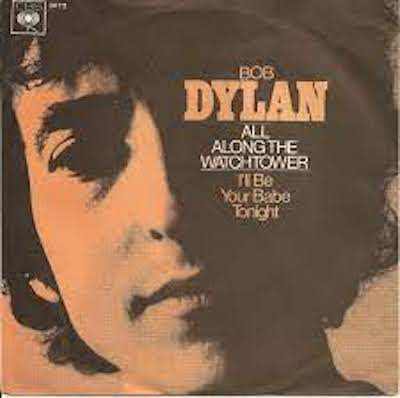
“SO LET US STOP TALKING FALSELY NOW”: BOB DYLAN’S ‘ALL ALONG THE WATCHTOWER’


(A sequel of sorts to my take on ‘Visions Of Johanna.’)

’All Along the Watchtower’ (from ’John Wesley Harding’) is is one of those Bob Dylan songs that has a general theory attached to it. It's held to be about his declining relationship with his then-manager, Albert Grossman. The Joker and Thief are them, respectively. So we’re told.

Well, there may well be other songs from this period which that explanation works for. (Dylan himself, who normally resisted analysis like his livelihood depended on it, said he hadn’t been thinking of any of that when he wrote ’Dear Landlord’, but okay, it did seem to fit.)

But does it work for this song? No, not at all.

In fact I suspect people just get as far as the word ‘Thief’ and cry “aha, he’s calling Grossman a thief, also some Biblical stuff to fancy it up.” David Stubbs, who perhaps propagated this theory the most, describes their relationship as “a stand-off.” Yet in the song they seem to get along. And, provided we accept the (more likely) theory that Dylan sings the verses in the wrong order, the Thief gets the last word. Which isn’t snake-oil spiel, in fact it sounds like sage advice. We, who have been through so much, can outlast this.

Let’s look somewhere else, then.

Was anything else on curly-locks’ mind at the time? There was, something pretty big in fact. He'd change his sound with the regularity others changed their sheets. But this time there had been something more to it…

He’d grown sick of being taken as a spokesman for a generation, or some kind of prophet whose every utterance required the utmost scrutiny. (Pithily epitomised by a scene from the 2007 film ‘I’m Not There’ where everybody, from music journalists to the Black Panthers, is desperately trying to figure out who Mr. Jones is.) Not being a job you could just quit, he decided he had to get himself fired.

It’s like trying to rid yourself of overstaying guests by putting on the music they most dislike. Except in this case he had to write that music. So be it. He’d make records so removed from anything his fan base wanted to hear that they’d desert him in droves, and finally he’d be left in peace.

All this is well enough known. But just in case that wasn’t enough sometimes he’d even spell it out in the lyrics.

Bluffer’s tip, when someone as egocentric as Dylan writes two characters into a song - assume they’re both him. He said of himself: “when I used words like 'he' and 'it' and 'they,' I was really talking about nobody but me.” But this comes with a twist. The Joker is Old Dylan, still looking for some way out of the situation he’s in. “Businessmen they drink my wine” may well be a reference to Grossman, though probably more a collective noun for music industry types. But “ploughmen dig my earth” sounds much more about those self-professed Dylanologists who’d scour his lyrics for buried meanings, sometimes literally rifting through his trash, naturally enough missing “what any of this was worth”.

While New Dylan tells the hipster nihilist that, while he might once have thought life is but a joke, they have now been through that - they can see the other side. In a song dripping with religious imagery, it’s about revelation.

(For this reason, I think the talk about the track being ‘circular’ sails past the point. Yes, what should be the first verse comes last. Yes, earlier songs like ’Stuck Inside Of Mobile’ or - for that matter - ’Visions Of Johanna’ had been about entrapment. Here the song is more a roadmap outta here. I’d guess rather than being up to anything clever Dylan just reordered the verses because that gave the song a better opening line. (If so he was right, most people must know it by now.)

Often analysts of the song reflect on how Biblical the imagery is, particularly the Book of Isiah. But this is almost entirely confined to the third verse (as sung). Few seem to consider how this relates to the song as a whole. Let’s detour into it…

One of the most annoying aspects of the “Dylan’s a poet” business is that actually he was a songwriter. There’s fairly strong evidence, in fact, that he recorded some of those songs. And a songwriter combines words and music for an overall effect. (Dylan himself was often frustrated his music was so overlooked.)

And the point these two come together most clearly is in the singer’s voice. And New Dylan even sounded different, dropping the nasal jeer famously liked by Bowie to “sand and glue”. For something quieter, more plainspeaking.

Elsewhere on the album, such as ’Frankie Lee And Judas Priest’ he strikes a conversational tone. But here he does something different. Truly grand things you don’t intone like a Hollywood voice-over, you have to speak of them softly, in a kind of hush. And the music does something very similar. The sound’s so ominous because it suggests at impending events that could only be alluded to, never fully described. (Those who only know the bigger sound of the Hendrix cover are often surprised by the original.)

I can remember being taught at school that, shortly after the crucifixion, many believed Jesus would return soon and usher in the end times. Which made for strange heady days to walk through, where each step might be your last. It’s something that has stayed in my head all my life. And this song has a similar mood of quiet apocalypse.

It’s known Dylan regularly read the Bible through this time. Solipsistic as ever, he seems to have associated his plan to remake himself with a parallel tumultuous change to the world. And, this being the late Sixties, there was plenty of evidence for that if you were to go looking. This quite possibly borders on a personality disorder. But it made for a good song.


Let’s go a bit more nitty-gritty…

You can see why the Joker might be called the Joker. He’s a Dadaish figure, not just writing songs without literal meaning but furiously denying there is a meaning to things. But why is the Thief the Thief? What’s he nicking exactly? Other song titles on the album mention a Drifter, a Hobo and an Immigrant, while the title track’s about a folklore outlaw. We’re on outsider to society here. Was Thief just the next line in the Thesaurus?

Perhaps, but let’s remember a slightly earlier song, ’Tears Of Rage’, had the repeated line “why must I always be the Thief?” If ’Watchtower’ flirts with confusion by being sung in the wrong order, this one gives us two characters without telling us. To the point that many simply didn’t notice. The only clue is in the use of ‘We’ and ‘I’, given to verses and choruses respectively. (Disclaimer: I seem to be the only person in the world who thinks this.)

‘We’ would seem to be parents vexed by a child asserting their independence. As many have been quick to point out, Dylan was by this time a parent. And it may be that he wouldn’t have written this song had he not been. But it isn’t credible that it’s *about* his experiences as a parent. The oldest, his step-daughter Maria, was six at the time. A little young for that sort of thing.

Instead I’d suspect ‘We’ to be those troublesome fans and Dylanologists, cast in the guise of controlling parents, sternly admonishing their charge over his change in direction. (“It was all pointed out the way to go’ means something like “What’s this? A country album? You are so grounded!”) And Dylan as the less-than-dutiful daughter, unwilling to conform to the plans made for her. What the ‘Thief’ is stealing is her own agency.

And like ‘why a thief’, we might want to ask ‘why a daughter?’ Why not a son? Dylan firmly associated himself with artistic genius stereotypes, which are highly gendered as male, and was effectively a misogynist. Why associate with a female character here? It may be because a daughter’s rebellion is seen as more a betrayal than a son’s. But also, ‘daughter’… it may simply have scanned better.

So to summarise, ’All Along the Watchtower’ by Bob Dylan isn’t about Albert Grossman. No, like many Bob Dylan songs it’s all about Bob Dylan. Have a great day!

(Those of an unusually obsessive nature may want to know I wrote something about the whole ‘John Wesley Harding’ album a while ago.)

Saturday, 27 January 2024

“THE HIGHWAY THAT’S LEADING ME”: JONI MITCHELL’S ‘HEJIRA’ (TOP 50 ALBUMS)

“I’m not an evasive writer. You don’t have to dig under the words for the meaning… When someone asks what a song is about, I want to say, ‘Well, did you listen to the words?’”
Joni Mitchell


”A Decade Full of Dreams”

We are here to talk about the 1976 Joni Mitchell album ’Hejira’. But if we take our time in getting to it, wind our way round some serpentine curves, wouldn’t that be the most *’Hejira’* way of going about things?

The NME Book of Rock, the first music book I ever read, described Mitchell as a “singer/songwriter with a pure voice, specialising in highly-wrought emotional ballads… notorious for various romantic attachments”. A widespread notion which reaches its nadir in the notion that her music’s ‘confessional’, like an emotional version of striptease. (Notably, its a term she always disliked.)

And some still see her through that frame, the epitome of a hippy-dippy Sixties artist, going gooey over clouds, getting wide-eyed about Woodstock and falling in love with passers-by every few minutes. But they mistake the overture for the act. It’s the early-to-mid Seventies where she came into her own.

It's the first two albums which most match that popular image, and while they do contain some great tracks there’s also times where she sounds like Phoebe from ’Friends.’ Mitchell herself later conceded “to me, most of those early songs seem like the work of an ingenue.” It was the third try, ’Ladies of the Canyon,’ which first brought in the changes. Released in 1970, it meant that for Mitchell the Sixties ended right on cue.

A few numbers, such as the title track, could have come from the earlier albums. But mostly it pointed forwards. Which also meant wider. While the earlier albums had featured occasional bass, extra instruments came to be used more expansively. But perhaps most significant of all was the guitar-sporting folkie making greater use of piano.

It was followed by ’Blue’ (1971), which capitalised on all of this and is regarded by some as her best album. And where the title track made it clear which element she was channelling - “Blue/ Songs are like tattoos/ You know I’ve been to sea before”. Then on ’River’ she imagines the titular body of water as something she could “skate away on”. (Yes, skate. She was Canadian.) And her piano-based music came to flow like a river. Which went with something else…

Leonard Cohen, particularly on his earlier albums, set his songs in a heightened realm, full of slightly mystic characters doing richly symbolic things. It is something of a wrench to hear that famous lines in ’Suzanne’ may have been inspired by someone called Suzanne making him a cup of tea and putting bits of orange in it.

While other songwriters use a more straightforward, conversational style, directly addressing the listener in a way which feels immediate and involving. (Think of how many songs are sung second-person, to “you”.) As John Lennon put it: “say what you mean and put a backbeat to it.” Sinead O’Connor’s ’The Emperor’s New Clothes’ would be an example, with its payoff line “you asked for the truth and I told you.” If you were ever to find out that the song wasn’t a faithful description of her life at the point you couldn’t help but feel it was lessened.

And these are diverging approaches, branching off from each other. You need to pick one.

Well, maybe me or you would. And most people seem convinced Joni Mitchell picked the second. But she didn’t. Instead, she straight out refused to pick. And she seems able to slip between the two irreconcilable opposites within a single line. At times she’d deliberately juxtapose them for effect…

“She speaks in sorry sentences
“Miraculous repentances
“I don't believe her.”


…the punchy immediacy of the last line added like a pin to a balloon.

And this created a kind of double virtue. You feel like something significant is being imparted while, at the very same time, that she’s talking straight to you. ’Song For Sharon’ (which we’ll get to, promise) is written as if a letter to a long-time friend, casually mentioning Dora and Betsy as if we know them.

And the flowing piano enhanced this, enabled her lyrics to be more free-flowing and semi-stream-of-consciousness. Her tracks can have the buzz of meeting up with an old friend, where the torrent of conversation seems both effortless and endless, something to ride. It gives it a compulsive quality, the exhilarating feeling of being absolutely in the moment. (Yeah okay, she’s the only one doing the talking. It still feels that way.) And the immediacy of music, the sense that it’s all happening now, is always a positive feature.

And these go on to work as part of a triple whammy, with her Seventies shift in subject matter. ’California’ starts:

“Sitting in a park in Paris, France
“Reading the news, it sure looks bad
“They won't give peace a chance
“That was just a dream some of us had”


…and this just one year after she’d written the hippie anthem ’Woodstock’! John Lennon, the one who’d coined ‘give peace a chance’, later sang “the dream is over.” Yet where he was rueful she was phlegmatic. Her tone is “remember when we thought that peace stuff? Boy, what had we been smoking?” From that point on the song moves on to other subjects, like waking and shrugging off a strange dream.

Mitchell has said she saw her generation as an equal-but-opposite reaction to the stultifying, conformist Fifties. “Out of it came this liberated, spoiled, selfish generation into the costume ball of free love, free sex, free music, free, free, free, free we're so free. And Woodstock was the culmination of it. [But] I was not a part of that.”

Except of course the writer of ’Woodstock’ was. Giving up on social change after finding out you won’t be given it seems pretty on-brand for that description. With Mitchell, as with many others, the dominant subject of her music became herself. On the afore-mentioned ’Song For Sharon’ she sang, out loud and upfront:

“Well, there's a wide wide world of noble causes
“And lovely landscapes to discover
“But all I really want right now
“Is... find another lover”


And its the self-importance of singer-songwriters which so often grates. The genre often feels like First Word problems recited over some strummed guitar. Godspeed’s Efrim Menuck once called it the “privileging of individual angst”, while Mclusky recorded an album acidly titled ’My Pain and Sadness Is More Sad and Painful Than Yours’.

All true. Except there’s a crucial difference between Mitchell recording ’Hejira’ and Jerry Rubin becoming a stockbroker. An artist’s first responsibility is to find what they’re good at and do that. There’s not a lot to be gained in demanding they write a song calling for the military-industrial complex be dissolved if their talents lie elsewhere. Mitchell was made to sing about the bittersweet richness of life, in all its complexities and self-contradictions. If it took her a little while to get round to that, she still got there. And anyway, personal relations, aren’t they part of life too? Or should we be stamping down Jericho full time?

As she said herself: “A lot of people could have written a lot of my other songs, but I feel the songs on ’Hejira’ could only have come from me.” Or as she sang herself…

“People will tell you where they got
“They’ll tell you where to go
“But till you’ve got there yourself
“You never really know”


Besides, in her case that free-flowing, semi-conversational style mitigates against self-absorption. (Or at least too much of it.) She sings less like she’s shining a spotlight on her personal dramas and more like she’s catching up with us.

And also, for someone supposedly so self-obsessive, Mitchell could be acutely observational, pinning people with a phrase…

“Like a priest with a pornographic watch
Looking and longing on the sly
Sure its stricken from your uniform
But you can’t get it our of your eyes”

And once more, there’s a companion musical shift. As said, post-’Blue’ she started the move to a fuller band. The music grew more intricate, bringing in brass and strings. This grew slowly, but was unmistakable by 1975’s ’The Hissing of Summer Lawns’, which even incorporated the jazz standard ’Centrepiece’.

’Ladies of the Canyon’ had, clearly enough, been her Laurel Canyon album, the backpackers and freewheeling hippies who passed through it drawn from her own crowd. Songs are like quick snapshots of life happening around her, friends caught in character poses. While ’Summer Lawns’ is definitely her take on LA – “the city of the fallen angels”. Its like a film, with a cast list full of larger-than-life figures. Which means the most inventive, the most musically rich Mitchell album is the one most concerned with artificiality. (“Beauty parlour blondes with credit card eyes/ Looking for the chic and the fancy/ To buy.”)

But then there’s a bend in the road.

By this point the ‘studio album’, rich with effects and overlays, had become a thing you did - cemented in the popular mind with ’Sergeant Pepper’. And, as with that example, there wasn’t much to do once you’d gone there but reverse back out again - go back to what you were doing before. And at least in part ’Hejira’ does this, goes back to the simpler and more direct songs of ’Blue’. Precisely one track has more than four players, most have three.

But at the same time the sound became more jazzy. Mitchell had always been as much a Jazz as a Folk fan and, feeling Rock musicians lacked finesse, she started to work with Jazz players. Perhaps starting off with LA Express playing on her 1974 album ’Court and Spark’. Which ended with the Jazz cover… yes cover, ‘Twisted’. But ’Hejira’ was the first of her albums to incorporate the fretless bass of Jaco Pastorius, and involved her singing evocatively about “strains of Benny Goodman”. So the album which went back simultaneously went forwards. 'Summer Lawns’ had worn its sophistication on its sleeve, while ’Hejira’ held it closer to the heart.

Now Jazz to me is like chilli or garlic. You wouldn’t want to taste it on its own too much, but it can serve well when added to other things. And when added to Folk it creates a kind of sweet ’n’ sour. (Just think Pentangle.) This fretless playing just went with her lyrics, free-form music to give wing to her free-form narrative. (Not unlike Van Morrison’s ‘Astral Weeks’.)


”Porous With Travel Fever”

Also, if the element running through ’Blue’ had been water, and the instrument piano, this changes too. This album featured not a note of piano. On ’Amelia’, she sees the vapour trails of six planes in the sky, and likens them to guitar strings. A track named, of course, after the aviation pioneer. Elsewhere she paid tribute to those “who’ll walk the girders of the Manhattan skyline.” The music doesn’t seem even as bank-bound as ’Blue’, but passing in jets and flurries like air streams.

As is often, the immediate reason for the switch was simple and practical. It was largely written on a road trip across America, from LA to Maine, and a guitar had simply gone in the van easier. At one point she describes coming across a piano mid-journey, and falling on it like an ex-lover. But that necessity was fortuitous. When she picked up a guitar again, it was as if it was a new instrument. The result was, if not in the standard sense, a classic air guitar album.

And, yes, travel… The observant reader might want to point out she had written about travel before. Often, in fact. ’Blue’ had opened with the line “I am on a lonely road and I’m travelling”. But those travel songs tended to focus on place. ’California’ was sung to California, as if to a person. Here the travel itself was the thing, the road runs through the whole album. One track is titled *’The Refuge of the Roads’* and the highway appears on the cover superimposed over her figure, as if it’s what she has inside - a space where you’d expect a presence. She said herself: 

“I wrote the album while travelling cross-country by myself and there is this restless feeling throughout it…The sweet loneliness of solitary travel.”

The title track opens with “I’m travelling in some vehicle/ I’m sitting in some cafe”, and its the “some” which sticks out. It’s the smooth transience of the road which soothes you, like rubbing a succession of freshly laundered hotel towels across your cheek. Freedom is the absence of snags and ties, passing through places the way a ghost walks through walls. On ’Coyote’ the road offers odd-couple romances and one-night-stands, inoculated against entanglements. Because all the time you’re in some place you’re just some person, unencumbered by the associations and expectations of those who ‘know’ you.

She sang “Your life becomes a travelogue/ Of picture postcard charms.” And the songs are like travelogues, flitting from one incident to the next, passing a farmhouse on fire or a couple sitting out on a rock.

The result’s an album that’s literally as free as air. Not in the sports commentator sense of “I literally don’t know what literally means”, but literally as free as air. Drums, which usually play a grounding role in music, are so sedate you pretty much need to check the track listing to know when they’re there. (They appear on four tracks, percussion on three, while two feature neither, seeing as you asked.)

But then there’s a curve in the road.

Like a yin/yang sign, pursue one course for long enough and it’ll bend and turn and become its opposite. And with that in mind it would be tempting to take songs as antonyms, set the floaty, gossamer-light title track and ’Amelia’, the world seen from “clouds at icy altitudes”, against ’Song For Sharon’, with it’s more distinct pulse, and self-confessed hankering for human attachment. But, as is often the way with Mitchell, nothing is so clear-cut…

Faulkner wrote the only thing worth writing about is the human heart in conflict with itself. He probably wasn’t thinking about Joni Mitchell, but he might as well have been. She writes not like she’s providing some summation of her life, where it all led to this, but mapping the beats of her heart. And ’Hejira’ frequently returns to her conflict between this wanderlust and a desire for the most tied of all knots. Described by her as ”the strongest poison and medicine of all.” Brought on not by a love affair, a one night stand or even a crush, but by spying “the long white dress of love” in a Staten Island window.

“In our possessive coupling
“So much could not be expressed
“So now I am returning to myself
“These things that you and I suppressed” 

But later in the same song she adds:

“I’m porous with travel fever
“But you know I’m so glad to be on my own
“Still somehow the slightest touch of a stranger
“Can set up a trembling in my bones”

And this is (as promised earlier) ’Song For Sharon’, sung as a letter to a home-town friend. Notably, Sharon’s possessions are material, Mitchell’s metaphysical…

“Sharon you've got a husband
“And a family and a farm
“I've got the apple of temptation
“And a diamond snake around my arm”


The concluding track is ’Refuge of the Roads’ as if Mitchell never really returned from that trip. But ’Song For Sharon’, the longest number, feels like the album’s centrepiece. Ultimately she doesn’t resolve any of this, or even try to. She just tells us it like it was.

To sum up… Heading for another drudgeful and demanding day of work one Monday morning with ’Hejira’ playing in my head, I figured that whatever transpired after I arrived, in that moment I was in free transit. An album that even makes Monday mornings more bearable. Who could ask for more?

Saturday, 13 May 2023

LANKUM/ METAL BOX REBUILT IN DUB (GIG-GOING ADVENTURES)

LANKUM
Barbican, London
Thurs 4th May


If your idea of Irish folk is professionally genial types trilling “fiddle-de-i-de-o” in plastic Paddy pubs, Lankum are your necessary antidote.

They’re part of the same general Dublin scene as John Francis Flynn, last seen on the roof of the De La Warr. But a better compare-and-contrast would be, conveniently enough, the last folk gig attended before this - the Scottish duo Burd Ellen. Both are part of what I’m dubbing Drone Folk until a better name comes along. (Which hopefully won’t be long.)

Except Burd Ellen are bewitching, like if you listen to them too long you’ll never make it back out of that enchanted wood. While Lankum are definitely about this mortal world, less likely to be found in the faerie realm, and more the graveyard. Less Edmund Spenser, more Thomas Hardy. Its long been a truism that folk songs have a higher body count than gangster rap. But Lankum push that along more than a little, with mortality as inevitable as the closing rhyme. Like death in a folk tale, relentlessly stalking his victim, tracks are long, slow and - above all - patient.

’The Pride Of Petravore’ starts with violin and bowed acoustic guitar. It sounds like the creaking of the world turning, more the sort of thing the Kronos Quartet would bring to the Barbican, by a composter from some East European country you hadn’t known existed. They then throw a jaunty tin whistle tune over the top. Which only makes the thing more eerie. (And later add a vocal section, not to be found on the record, folks.)

So they can feel like they’re on a mission to take folk standards and twist them. ’The Wild Rover’ opens the set, and what’s normally a raucous drinking song in their hands become bleak as moorland. Even when they go in for reels, as they do for the finale, there’s something slightly unhinged, almost possessed about them. Their sound has been compared to Sunn 0))), Swans and My Bloody Valentine, all Lucid Frenzy faves but scarcely standard folk influences.

Except they more commonly work the other way up to that. It’s a bit like the way the Velvet Underground brought together folk and rock - not as a creative contrast but as though the two had belonged together all along, and somehow no-one had noticed before now. In their way, Lankum are quite a traditional folk outfit. Their albums come with sleeve notes relating how they came across these songs, described at one point as “long thought forgotten.” They play traditional instruments, at least most of the time. Radie Peat even sings with a hand cupped to her ear. They just bring out the unhurried nature of those songs and the natural drone tendencies of those instruments.

And this may be most evident in the Radie Peat songs, such as ’Go Dig My Grave’ or ’Hunting the Wren’, which glowers with a slow-building intensity under vocals which exude inevitability. Other instruments get added along the way, but not adding countermelodies so much as thickening the stew. And so, however much I loved the Burd Ellen gig, I guess in the final count I just love Lankum more.

A view which seems surprisingly widespread. I’d cynically expect them to be one of those bands who win armfuls of awards and occasionally sell a record or two. In fact the popular appetite for eight-minute dirges about death turns out to be quite high. The Barbican’s packed, and I’ve seen bands whose finale didn’t get as much enthusiastic applause as the opening number receives here. Is this because they’re so good at it? Or do songs about the inevitability of mortality capture the spirit of the moment? Probably both.

...and finally, correcting a heckler, Peat explained her name’s pronounced “Ray-dee.” Which means if she ever married Roddy Radiation she’d be Radie Radiation. I think we should try to set them up.

’Go Dig My Grave’, from Paris, a couple of days before…


METAL BOX: REBUILT IN DUB
(Feat. Jah Wobble + the Invaders of the Heart)
Chalk, Brighton
Sun 7th May


“Let’s just start, shall we?” Jah Wobble gets going with characteristic genial geezerishness. But we here at Lucid Frenzy Tower are more in the way of obsessive nerds, so we’re going to lead up to things…

Public Image Ltd’s, ’Metal Box’ is seen as a definitive Post-Punk album, but more than that it’s surely one of the classic albums of all time. A reputation underlined by personality clashes ensuring that line-up never recorded again. It stood alone, or so it seemed.

Then about a decade ago, John Lydon reformed PiL. Some accounts say he offered Wobble ever-more silly amounts of money to rejoin. But Wobble instead took up with the other ex-member, Keith Levene, as Metal Box In Dub. And though alas I never got to see them, reworked versions of those days were already showing up in Wobble’s solo let. (Presumably why two tracks from the first album, ’Public Image’ and ’Fodderstompf’, show up here.) 

When Levene sadly died last year, that looked to be that. Except Wobble subsequently released the ’Metal Box: Rebuilt In Dub’ album. And, as you may have already guessed, toured.

Though reasons for the separate reunions were decidedly personal (Lydon had, at different times, sacked both Wobble and Levene), music differences still ensued. New PiL… let’s call them that… were essentially a new band working to the PiL mindset, and treated those tracks as covers, to be reworked in their own style. While with Wobble they’re more like standards which need souping up and rejuvenating.

He recites one of the album’s lyrics, “I could be wrong, it could be hate”. And it’s odd to think back to the time where the arch-egoist Lydon was writing so much about self-doubt. But more the point here is what this says about the music. ’Metal Box’ was a bold statement, audaciously calling time on the old, but there was also something sketch-like, almost tentative about it. The mostly improvised tracks found their way by walking it.

Yet at the same time the thumping bass of Reggae sound systems had been a big influence. Chiefly channelled through Wobble’s bass, often the through-line holding those tracks together. And so these powered-up reworkings both take the music forward and bring it back to its roots. And to hear these tracks delivered with such resounding force is something of a revelation! Old chassis, new engine.

There’s little of the spaciness so associated with Dub. “In Dub” means, I suspect, in the Dub spirit of taking what’s done as raw materials for what’s being done right now. And let’s remember what got Wobble sacked from PiL, at least ostensibly, was reworking tracks for his solo releases. ’Metal Box Goes Dancefloor’ might better capture the sound. The album cover’s of a speaker, after all. With those thumping riffs perhaps even ’Metal Box Goes Rock’, which would have been heresy back in those anti-rockist days!

So ’Albatross’ opened the album, the New PiL gig I went to, and it does again here. In fact as the Wobble and Levene gigs had a different, more free-form feel, that gives us four separate versions! And those four versions could scarcely sound more different. So many different ways to get rid of an albatross.

Wobble also says “who wants some Dub? And some fun?” And, perhaps strangely, this is a little like seeing a band who’ve played these tracks for years, and now need to throw in changes to keep themselves sane. Snatches of other numbers, not necessarily other PiL tracks, are thrown in without warning or explanation. And the band lark about on stage even more than they usually do. (Leading to some lark-like dancing in the audience.) The combination is bit like being in the path of a jet engine while the Captain cracks gags over the tannoy, exhilarating but also discombobulating.

The only weak points… As mentioned after seeing Wobble before, he may be the walking, talking definition of a character. But he does lack Lydon’s characterful voice. Moreover, vocals on ’Metal Box’ aren’t the typical upfront audience-addressing affair, they work more as another instrument in the mix. And Levene’s guitar often seemed pitched to match Lydon’s tones. All of which makes them hard to emulate.

The gigs with Levene had a separate singer. Here his solution is often just to recite the lyrics, which is a little bit “don’t try, can’t fail”. It may work best when they’re just dispensed with, as they are with ’Albatross’ and ’Swan Lake’. And if there’s many assembled here who don’t already know the words I’d be surprised. (Honourable exception - ’The Suit’, where the words are pretty much recited anyway.)

Also, the keyboards can be a strangely normalising element. They only time they were used on the album was when they took the place of guitar. Here there’s points where they seem superfluous, or even actively getting in the way. They don’t really come into their own until the encore, where ’Metal Box’ is done with and they head more into the regular Wobble world.

In brief, going back to a classic album doesn’t need to be nostalgist or retrograde. It can even be a way of looking forward…

There seems a shortage of live footage, so here’s the studio version of ’Albatross’

Saturday, 18 March 2023

BURD ELLEN/ CURRENT 93 (GIG-GOING ADVENTURES)

BURD ELLEN
The Brunswick, Hove
Fri 10th March


I came across Burd Ellen the same way I did Fern Maddie, from the Guardian’s ten best folk album list of last year. But the release than won that accolade, ’A Tarot Of the Green Wood’, ploughs quite a different furrow. It’s all traditional numbers, but not as we know them…

They announce they’ll be doing "one of those long, continuous sets like you read about in that ’Wire' magazine”. But it’s separate tracks run together, like a mixtape without gaps. Which is, I suspect, to defamiliarise the familiar folk gig, with all the to-audience explaining that this next song is from South Shropshire, not North Shropshire as was once thought.

What’s more, individual tracks can run so this just plays up that continuous sense they have already. To sound like that ’Wire’ magazine a moment, duration is made into a compositional tool, as much as it is in Minimalist music. It’s a set which takes time to steep but them becomes flavoursome.

The duo play behind a table laden with folk instruments and knob-twiddling gizmos. Even the glass of water gets put to a musical purpose. But if that has you ready to say ‘folktronicia’, that’s a term which suggests creative collisions. Whereas Burd Ellen don’t seem to make any such distinctions in the first place. For most of the gig, you wouldn’t know who was playing what without looking… in fact, it wasn’t always easy while looking. ‘Drone folk’ probably fits them better, taking the natural drone qualities of folk instruments and amplifying them.

In fact, rather than cleverly adding stuff, they tend to work at their best while most stripped down. If that table was laden, the less they pick up from it the better they work. The encore (which they seemed genuinely surprised to get) was down to voice, vocal loops and taps on the violin. Yep taps, not even bowed or plucked. Though I confess the one acapella number perhaps pushed a point too far, and was the one point my attention wandered.

If we have to have a sound-bite description, imagine a Lankum who are less dour and more enticingly eerie. The album, they can be keen to say, was released on Halloween. ’The Lovers’, with it’s references to a “green wood”, could describe a little girl lost in that deep dark wood, or be a siren call drawing you in.

And it warrants stuff I’ve been saying for some while now. We can’t truly reconnect with the past, but neither can we just forget it. So it will continue to haunt us, and so we should talk about how it haunts us. This is music which works like a lightning rod for phantoms.

Not sure there’s any footage of this tour, but this is both Burd and Ellen (note to self, check this is their real names before posting), performing ’The Hermit’ from Gateshead. A low-lit basement made a better setting for their sounds than a brightly lit glass-fronted gallery, but go with it…


Then, the very next day…

CURRENT 93
Union Chapel, London
Sat 11th March

If Burd Ellen are a recent discovery, Current 93 are a long-time fave at Lucid Frenzy Towers, producing one of my all-time favourite albums. If Burd Ellen are drone folk, Current 93 go in for apocalypse folk. They’ve since confessed they only coined the term as a joke, but like so many of these things the tag stuck.

A near-universal assumption has dominated recent years, that downloading has killed the integrity of the album. Current 93, however, continue to be zeitgeist-proof, and David Tibet (frontman and sole constant member) was probably busy learning more ancient Akkadian when that was announced. (Not a gag! The new album title came from some Akkadian he was perusing.)

You can pick out and play individual tracks from their releases, should you choose. But the albums have a thematic unity which turns them into part of a greater whole. And the past two times I’ve seen them they’ve played their last album through in track order, usually (as here) with the track titles projected on a screen.

Except this time, there’s a twist. Up to now each album has stood alone, a unique project with its own dedicated line-up. This time it’s very much a sequel to its predecessor, ’The Light is Leaving Us All'. (Which I saw live back in 2018.) The title, 'If A City Is Set Upon A Hill', suggests a shifting uptown of imagery from the bucolic English village imagery of last time. And themes, images and musical styles recur.

Notably, the post-album section of the gig, the part devoted to the more standard best-of, is dominated by a series of tracks from ’Light’. There was precisely one number from neither album the whole night, ’Sleep Has His House’. I guess, if you see more gold in that seam, you keep mining. And, as I suspected after last time, it all works better back in the atmosphere of the Union Chapel than the regular rock venue they decamped to last time.

Lyrically, Tibet combines the epic and eschatological with the more everyday. (“Read it in the tealeaves, read it in the stars.”) And the music does something similar, somehow combining grandeur and intimacy. Which might stem in part from the characteristically idiosyncratic line-up. Piano probably dominated, but combined with guitar, violin, wind instruments (including bagpipes) and two guys on laptops. One of which occasionally doubled on drums and, solely for ’Sleep Has His House', organ. (But this time no hurdy-gurdy. Perhaps the hurdy-gurdy players have joined in with the strike wave.)

’If A City Is Set Upon A Hill’ refers of course to urban planning coming before a fall. Which leads us to Tibet’s near-fixation with death and dissolution. It would be easy to caricature him as some blood-and-thunder street preacher screaming at us we’re all going to die, who has inexplicably drafted in a backing band. Their Marmitey reputation might well come from here, some look at them and that’s what they see. But, while they are certainly a most intense experience, to me that isn’t really right.

Granted, I’d be harder pressed to tell you what he is doing, but then I don’t think he’s making music with some specific purpose in mind. Not a fan of Damian Hurst, but when he titled a work ’The Physical Impossibility of Death In the Mind of Someone Living’, he was raising an interesting point. (The title was certainly the best part of the artwork.) And Tibet is in part straining against the certainty of that line, devoting decades of music-making to pushing back at a solid-seeming wall.

Further, death was not always seem as an outside interruption to life, but something woven into the fabric of things. And Tibet’s also trying to take us back to those folk culture days where he was a figure you might meet while out walking. A somewhat single-minded character, perhaps, but not necessarily a malevolent one. Ultimately, the intention isn’t at all nihilistic, though it may be somewhat fatalist. And the sombre beauty of their music conveys that.

They sound not at all like the Residents, the last band I saw in this venue. But there’s perhaps a similarity of attitude, of sticking to your thing whether there be head or tail winds. It’s the mark of a band where you leave a gig feeling you’ll see nothing like that until their next thing, and just what I felt here.

Ye Gods! Actual gig footage! The title track (sorta) and 'There Is No Zodiac’…


Saturday, 11 February 2023

THE RESIDENTS/ FERN MADDIE/ JOHN CALE (GIG-GOING ADVENTURES)

Apologies for the lack of a post last week. I was brought down by the left-wing economic establishment. Oh alright then, it was flu...

THE RESIDENTS
Union Chapel, London
Tues 31st Jan


I originally saw the Residents on their fortieth anniversary, and it seems now here we are at their fiftieth. I’m not sure how that happened, but seems it has. Their pronouns are…

”Alternately seen as a rock band, an arts collective, and a spirit, THE RESIDENTS have been regarded as icons in the world of experimental music for almost fifty years… the group has also been credited with being among the originators of performance art and music video.”

And I’ve asked before whether they really were a band, or a multi-media arts collective who found it easiest to masquerade as a band, just one of their many masks.

Well never to be pinned down, tonight a band is just what they are.There’s an accompanying film show, but bar that they work dilligently through a set. Even hearing tracks timed in by the drums seems curiously ‘regular gig’ for them.

As ever, their vibe is still sinister clown, one lyric espousing their credo: “everyone comes to the freak show/ But nobody laughs when they go”. Which works with the ever-present masks and costumes they sport. Something taken (as it always is) to be about anonymity. But like it always is in actuality, it allows them to take on other characters. This succession of deranged personas aren’t exactly satire, in the way someone like Zappa stuck it to Western consumerism and the like. (Even if both had Beatles-based album sleeves.) The Residents are more like weaponised parody, turning the form of popular music against itself.


Take ’Kill Him!’, which might ostensibly seem another example of the singer impersonating born-again preachers in order to undermine them. But what powers the track is an underlying ambiguity; is this God recast as devilish tempter, or some psycho using The Old Fellah as an alibi for his murderous actions? (“Blood is thick but/ God is thicker/ I am sick but/ He is sicker/ God says, Die!/ So I must kill him, but/ Why does God want/ To kill children?”)

And the extremity and ambiguity seem to marinate together, into something more unsettling. (I confess I was slightly disappointed afterwards to discover it was on an album of Bible-based songs, which seems to give too much away.)

And their musical style is still like Kurt Weill was leading a drunken carnival parade. But the gigness of this gig (if you follow) makes you aware how many of these numbers might once have been tuneful ditties, before being thrown into their hall of distorted mirrors. (Though there’s not one of their patented twisted cover versions.) You need to be good at music to be this good at anti-music.

Something like Anarcho-Punk always felt to me like making deliberately bad music in the hope it would undermine the good, when it actually just made the good music sound better. Whereas the Residents make good music gone bad, a very different order of things. What can seem like regular and quite innocuous features of songs, such as repetition, transform into something menacing. I fear ’Constantinople’ will now always be one of those anxiety-inducing ‘trigger words’ in my mind.

…all of which means there’s a disruptive, culture jamming feeling, a sense of interrupting regular programming. And, as said after their Brighton show, a whole set of that can have diminishing returns, a sense of sucking on too many sour things at once. Perhaps accentuated by this night being just about their songs, without the film show breaks.

I’m not quite sure what the best way to hear them is. I listened to ’Duck Stab’ afterwards, which was all over the set list. And it sounds more varied, more inventive on record but more intense live. You pays yer money…

The Fab Four saying ’Constantinople’ (quite a lot)….


FERN MADDIE
The Foghorn, Portslade
Mon 6th Feb


Someone standing up and signing from the corner of a craft beer bar, which is about the size of a bedsit, there could hardly be any more of a classic folk gig setting. Okay, it should be a pub serving real ale by pulling at brass handles. Even folk has to make some concession to the times.

Except I’m only here because of That Thar Interweb, when the Guardian named Fern Maddie's self-released debut one of the ten best folk albums of last year. It turns out, so did the promoter. Who stepped in for a last minute save, after a mooted Brighton gig fell through.

She sings a combination of self-penned songs and traditionals. A New Englander, she may be well placed to drawn on both the British and American songbooks. But as she sings each the British songs sound British and the American American, they’re not at all blended. Which is handily visualised by her switching between banjo and guitar. (Though one isn’t used exclusively for either.)

She talks of being attracted to the cyclic, ritualised form of those old ballads. And folk is perhaps the blank verse of music. But when she performs them she tends to throw in extra sections. Not so major you’d necessarily even notice where these rock songs, but a bigger deal with folk. Which is probably the point, occasionally breaking from the circle both has it’s own effect and draws attention back to the circle. And I can’t help but associate both those things with her singing style. Which is dramatic without ever tipping over into the melodramatic, using less to go further.

Her own songs match all that, walking the dark side of the street. Maidens are a-drownin’ part-way into the first number, while another’s about a Mayflower passenger who died before even sighting land. (Who also drowns, though other forms of demise are available.) She often alludes to the fantastical without ever saying such a thing outright.

’Hares On the Mountain’, which may well be becoming her signature song, is built round a series of metaphors, but when sung somehow feel more than that, as if singing it might make it all happen. Her album’s titled ’Ghost Story’, though as she points out it contains no actual ghost stories.

The gig’s only downside was the odd structure it was given, stopping for a Q&A not once but twice, which worked against the spells being woven. Added to which the interviewee seemed an almost entirely different character to the singer, as if Maddie’s not yet used to this attention. There was also the lack of CDs for sale, perhaps all snapped up earlier in the tour. (Self-released means hard to get hold of over here.)

Those darn folkies look to have been too laid back to film anything from her UK tour. So instead, this is the video for ’Hares On the Mountain’…


JOHN CALE

De la Warr Pavilion, Bexhill-on-Sea
Fri 10th Feb


Between buying my ticket and this multi-delayed gig taking place, I gave a listen to Cale’s latest release, ’Mercy’. Only a cursory listen so far. But from it his post-millennium purple patch, well represented by his last visit to this venue, seemed over.

When the gig proved full of songs I didn’t recognise, I assumed it to be dedicated to that album. It seems there were older tracks, if chosen with characteristic eccentricity, but ’Mercy’ still dominated. Which meant I didn’t take to this gig as much as the last one. Though my problems with the gig weren’t the same as with the album…

The album’s main drawback are the smoothed-out electronic beats, which seem a characterless but constant presence across the tracks, like a plastic tablecloth stretched across a cafe. Whereas with the gig, it’s a live band with a live-band sound.

Multiple times, a song would initially seem skippable, only for some mysterious reason start to work mid-way. But others… well, others just seemed skippable. At times, almost MOR-ish. They also seemed to go in for long durations, a curious combination.

The old songs? Classic number ’The Endless Plain of Fortune’ was essentially the words to an entirely new backing. Then equally classic ’Chinese Envoy’ was played pretty much straight, but alas wasn’t a great version.

Late on he switched from keyboards to guitar, rousing a cheer. This proved to be like ending a set and starting another, mid-way through. The second half proved to be one extended Velvets-style workout, taking in ’Pablo Picasso’ along the way. A left turn from the rest of the night, and all the better for it.

Cale is clearly going to only follow his own star at this point. And at times that’ll coincide with where you’re going, and at others it won’t. Leaving it up to you, John.

’Moonstruck’ is, IMHO, one of the new album’s better songs. From Liverpool…


Friday, 28 October 2022

GILLA BAND/ ORCHESTRE TOUT PUISSANT MARCEL DUCHAMP (GIG-GOING ADVENTURES)

GILLA BAND
Chalk, Brighton, Sun 23rd Oct


I last wrote about Dublin-based noise rock outfit Gilla Band after they appeared in this very venue six years ago, back in the days when things still went by the old names. They were then Girl Band, it The Haunt and my blog was… okay, some things never change. That was for their debut release and they’re now up to their third (‘Most Normal’). But its quality not quantity, innit?

Two Gillamen swap between guitars and electronics, though you’d be hard pressed to tell one from the other by sound alone. They can play audaciously stripped-back lines, sometimes just tones, colour fields not as serene Rothkos but shrieking hues.

Perhaps unusually for a noise-based band there’s a string dance music element, further evidence it shouldn’t all be seen as happy-clappy hedonism but willing to engage in sonic abrasion of its own volition. They’re professed fans of the Contortions, where No Wave cross-bred with disco. And the finale’s their storming cover of the Industrial Techno track ’Why They Hide Their Bodies Under My Garage?’. Last time they opened with it, and it’s effectively become their identifying song.

Which leaves the singer Dara Kiely often contributing the most melodic element. True, his penchant for frenzied Malcom Mooney-style madness mantras isn’t going to get him calls from Coldplay any time soon. (One lyric lists the various manufacturers of “shit clothes”.) But you could imagine more Death Grips-style vocals going with that music. He’s enough to keep them attached to something like regular rock music.

Famously they started out while still in secondary school, as an Indie band modelled on the Strokes. That’s never really quite gone away, and it serves them like a gift. Rather than flying off into free noise or falling back into white boy blues, they’re able to go further into what they were already doing, with greater and greater intensity.

None less than the Guardian called this new release a “turbulent masterpiece”. And it’s true that Kiely has been open about facing mental health problems, which he does seem to have used for musical inspiration. But at the same time it’s a common error to see music just as displaced autobiography, one which can steer you away from actual listening. And there’s a definite sense of humour to it all. Even if you missed it in Kiely’s lyrics it’s there in his voice.

Let’s compare them briefly to two other noise rock outfits who have showed up here. Show Me the Body had a much more angsty vibe, a sense that down these mean streets a power noise trio must strike up. While Lightning Bolt conveyed the sheer exhilarating thrill of throwing up a racket.

It would be temptingly easy to say Gilla Band exist in some midpoint between these two, like the Change UK of noise. But I don’t think they’re anything so fixed, they’re more able to straddle both spaces at once. Like the proverbial glass of water which can be half full and also half empty, all depending how you look at it.

Kiely was meet ‘n’ greeting the merch queue after the gig, demonstrating a highly Irish ability to treat a long line of strangers like long-lost friends. I made some quip to him about the meaning-defying lyrics. “I don’t know what they mean,” he replied, “but I believe in them.” And I think I probably do too.

From Leeds…


ORCHESTRE TOUT PUISSANT MARCEL DUCHAMP
The Con Club, Lewes, Sun 16th Oct


The brainchild of double bassist Vincent Bertholet, Orchestre Tout Puissant (“All Powerful”) Marcel Duchamp “mix free jazz, post punk, high life, brass band, symphonic elements and kraut rock, [and] make a transcendental, almost ritualistic music.” They’re named part in tribute to great African ensembles, and in other part (of course) to the arch-Dadaist.

Not kidding about that Orchestre tag, quite remarkably they have more members than words in their name. The most recent release and publicity photos features twelve members, but I counted thirteen on stage, including double drummers, twin marimba players, electric guitar, strings and brass.

Though to my mind they’re more an ensemble than orchestra. There are times when they play with counter-rhythms. But mostly they use their amassed numbers to all leap upon a groove. Their credo being “the more the merrier”. There’s a few points where they allow a second’s pause before the full outfit kick in, perhaps not a new trick but an effective one. The result is a set which feels pretty much all highlights.

The vibe they give off is some Arkestra-like collective, who practice eleven hours every day at the commune and then take turns to stir a big pot of mung beans. But, for a Swiss-based band they seemed to have a fair few English members, including the two main singers. Most vocals were choral and harmonious, floating over the music. Their unshowy ‘unrocky’ nature gives it much of its engaging quality.

But also… one of those singers turned out to be Jo Burke, last seem singing a cappella folk songs in a Sussex field. Her declamatory open-tuned cry made perhaps a strange fit the the syncopated beats. I couldn’t say why it worked, but it sure seemed to.

There’s a virtuous combination between their constant inventiveness, where you have little to no notion what might be coming next, and the infectiously uplifting quality of it. Perhaps the ‘Marcel Duchamp’ and ‘Tout Puissant’ parts of their name represent those two elements. Probably not, but I like to think so. I can’t be sure, but I suspect that even I might have been smiling.

A slightly different (and don’t tell Rees-Mogg but less English) line-up to the UK tour, but still very much worth a watch…


Saturday, 3 September 2022

EMMA RUTH RUNDLE/ THE MAGNETIC FIELDS (GIG-GOING ADVENTURES)

EMMA RUTH RUNDLE
Komedia, Brighton, Tues 23rd Aug


Emma Ruth Rundle is an American singer/songwriter, sometimes described as Gothic Folk, who’s previously worked with Chelsea Wolfe. She’s made more than six albums, but somehow slowcoach here only found about her during lockdown.

Every YouTube clip I’ve seen of hers had been not just with a band, but packed a full-on sound. Whereas it became clear from the stage set-up this was to be a solo gig. (Well, with one song where the support act, Jo Quail, joined in on electric cello.) She swapped between guitar and piano throughout.

The melodic lines were strong but her playing sparse, fingers held over one narrow section of the keyboard, a capo habitually fixed to her guitar. The music often felt less like ornamentation than augmentation; underlining, italicising and emboldening the lyrics.

There’s little doubting the power of these songs. But there’s that adage about too much of a good thing. It ends up as a whole lot of music in the key of black, with lyrics like “there’s no need to check the weather, as my winter’s never over.” Ironically, I’d imagine that had she played with a band but dropped down to solo for a couple of numbers, they’d have come across as highlights. As it is, the combination of unrelentingly bleak content and restricted form became a bit too much, like taking your potion in concentrate. (And I grew up during Post-Punk, I’ve a fairly strong tolerance for unrelenting bleakness!)

The main set’s all from the recent album, ’Engine Of Hell'. (Which, from some on-stage comments, she sees as a kind of song cycle.) Which, unbeknown to me at the time, was a much more stripped-back affair than anything done before, if not quite to the extent of this gig. The constraints of lockdown on recording may well have been a factor here. Ironically, she was quite possibly recording it precisely when I was catching up with her earlier band-based releases.

Whether this was a one-off experiment or a whole new direction remains to be seen. (There’s been one album since, but that takes a dark ambient path.) But I kind of wish my first Emma Ruth Rundle gig had been nearer the shallow end, with the rubber ring of a band attached.

Not from Brighton…


THE MAGNETIC FIELDS
Hammersmith Apollo (for some reason now called the Eventim Apollo), London
Wed 31st Aug


The last time I saw New York singer-songwriter Stephen Merritt (aka the Magnetic Fields), conditions could scarcely have been more different. Then he was presenting his latest release, the self-described ’50 Song Memoir’, in strict track order split over two nights. And a double dose of all-new songs seemed to daunt the ticket buying public, judging by their non-presence. (Me, I took to it. But no-one listens to me.)

This time… well there’s frequent numbers from the most recent album ’Quickies’. (So called because every track comes in under the three minute mark.) But they also dip heavily into the equally self-described ’69 Love Songs’, which probably counts as Merritt’s magnum opus. So a larger venue fairly brims with folk, who mostly recognise each new number a few bars in.

With track titles such as ’Kraftwerk in a Blackout’ and ’The Flowers She Sent And The Flowers She Said She Sent’, humour plays no small part in Merritt’s writing. And, while perhaps I was exposed to too much Barron Knights at an early age, humorous songs are often signified by a rough-edged sound, like telling gag cartoons from illustrations. But with Merritt both songs and gags are quite exquisitely crafted, with his baritone voice the ultimate in deadpan. Captivating melodies carry barked and pithy words, again, again and again.

Though crafted here definitely doesn’t mean adorned. The five Fields on stage play quite minimally, with one or more dropping out when not required. The great English folk singer Chris Wood once wisely said “a song is great not when you can't add anything to it, but when you can take nothing away.” And many songs here fit that definition.

Back in the day, it was often commented that British sitcoms would mix up their humorous and poignant moments, much in the manner of real life, while in America the two had to be clearly delineated. At which point I’d often add that British music did much the same thing, then go on about the Smiths.

Yet Magnetic Fields, formed back in 1991, would seem to scupper that theory. Merritt seems to exult in the combination, or sometimes the juxtaposition. No less than Peter Gabriel once sang ’The Book of Love’ on stage with them, before recording his own version and spawning a series of covers. (Though I confess to preferring the original.) Which effectively made it Merrit’s signature tune. He sings it here accompanied only by the barest plucks of ukulele, during which I doubt anyone dared breathe. Then mischievously followed it with a rousing version of ’The Biggest Tits In History’. (“She majored in biology/ She knows whereof she speaks.”)

And he takes a similarly gleeful mix-it-up approach to gender identity, as in ’Andrew In Drag’. (“A pity she does not exist/ A shame he’s not a fag/ The only girl I ever loved/ Was Andrew in drag.”) He also hands songs over to co-vocalist Sylvia Sims, blurring whether the perspective sung from is his or hers.

Merritt once wrote a song called 'Think I’ll Make Another World’ and often seems to have come from some parallel reality where Elvis never went on Ed Sullivan, rock ’n’ roll never became the monoculture and the spirit of great songwriters like Cole Porter and Stephen Sondheim still blooms. And it’s a parallel reality we can step into…

If this was a proper review, I’d be telling me how the Magnetic Fields continue to tour the UK and Ireland. ’The Book Of Love’, from San Francisco. We didn’t get the variant opening…


Saturday, 27 August 2022

JOHN FRANCIS FLYNN/ SOUND PLOTTING (GIG-GOING ADVENTURES GO AL FRESCO)

JOHN FRANCIS FLYNN
Rooftop, De La Warr Pavilion, Bexhill-On-Sea
Sat 15th Aug


I confess that the notion of a summer rooftop gig at the De La Warr is what first took my fancy. So, while I had of course checked out Irish folk singer John Francis Flynn on-line before clicking ‘Buy’, I had a less-than-full idea of how he’d be live.

Despite there being no house lights to dim, there was no audience announcement or any other sign the show had started. Instead he eased leisurely into his first number. So small were the beginnings I don’t think many were aware he’s started for some while. Now Flynn looks remarkably like a ’Lord of The Rings’ character. In particular, the one who looks like a warrior prince and, in the second hour of the third film, turns out to be a warrior prince. But rather than some full-throated roar, he sings in an understated, intonatory, gentle-giant fashion, barely moving.

And most of the set, rather than attention-grabbing, was longish numbers which spun a slow magic on you. He plays acoustic guitar, alternating with tin whistle. (Or, as he proudly pointed out, two tin whistles taped together. I expect they call that the Jimmy page tin whistle in the trade.) And was joined by a clarinetist and a droney/ambient keyboardist who doubled on drums. A Dublin base usually means traditional Irish instruments which no English tongue can possibly pronounce. Not here.

The instruments were, at points, looped and treated. But never in an ostentatious, show-off fashion. Had you asked any of the songs whether they were modernised or traditional, I think they’d have shrugged the question off without interest and just carried on. Which always seems the best way.

Then, when you started to think he might have overplayed the slow and mesmeric card, they shifted into a full-voltage rocked-up version of ’My Son Tim’, complete with whoops if not full-throated roars. The clarinetist even swapped to electric guitar, without any shouts of Judas.

My one complaint would be that the drums at times felt mixed too loud, as if they were what we’d come to hear. When they first broke in, I almost jumped!

Support act Iona Zajac had a richly evocative voice, fairly built for folk singing. But her songs only at times lived up to that voice. The best number was a traditional, saved for the finale, where she was accompanied by droney squeeze-box.

Having attended because of the open-air setting, it was something for those surroundings to melt away and be replaced by the world of the songs. There’s the sense with folk music that it’s all still steeped into things, and if we find a way to tune out the workaday world we’ll start to hear it again. I am probably getting carried away now, so had better stop.

A different version of ’My Son Tim’. They got a violin, but we had a rooftop…


Then from one outdoor gig…

SOUND PLOTTING
Stanmer Organics, Falmer, Sussex
Sat 20th Aug


“Set in the verdant sprawling plots of Stanmer Organics”, it says here, “Sound Plotting will be a day of site specific sound art, interactive installations, deep listening, sound walks, improvised music and pop-up performances.” It’s by Lost Property, the collective who previously took over a Napoleonic fort in Newhaven to stage similar shenanigans.

The idea, they confess, first struck them during lockdown when outdoor settings were literally the only show in town. But it’s a good one, which has you running about like a white rabbit, amid a host of other rabbits, dipping your expectant head down a whole bunch of holes. Pretty soon you become almost accustomed to the sight of laptops perched on tree trunks, or speakers hanging from branches. And if not every rabbit hole took you to a Wonderland, then these things are always more than the sum of their parts. Wandering, exploring, is a large part of the fun.

Venturing to see Gagarin in what the programme called ‘the willow dome’ I discovered it to be a dome of willows, which you entered like a teepee. As they swayed in the breeze they created a dappled light show on the ground, nature’s instillation piece. I often contend that ambient electronics work best when you’re not sure whether they’re sourced from natural sounds or not, it seems to create a sweet spot. And the set worked better for me the nearer it got to that sweet spot.

Paul Khimasia Morgan’s set was similarly slow-moving and ambient, but (from what I saw) more based around picking up tones from contact mikes. It’s music which always seems to slightly elude you. The more you try to focus on it, the more it drifts away just past your reach, as if floating on the summer breeze. Which of course only makes it more involving to listen to. (Older readers may remember Morgan put on the Aural Detritus concert series.)

In the midst of all this knob-twiddling and miking-up of things, Jo Burke stood up and sang some a cappella folk songs. And, for that matter, sang them well. Somehow she combined the best elements of professionalism with amateurism, the sense that this stuff is our common property. Much of being a good folk singer may be holding the notes just long enough, so you get the choral-like semi-drone effect without it feeling affected. While at the same time you could feel the old songs doesn’t require reinvention or rejuvenation, that people are simply still singing them, the way they always have.

Baby Hair have a name that sounds like a folk remedy and offered, according to the programme, “minimalist trance pop and ritualistic performance”. They reminded me of the old Marc Bolan adage about pop songs being like spells, as they recited words, struck triangles and blew haunted recorders, until you didn’t know whether to find it charmingly enthralling or sinisterly enchanting. Lyrics were reduced to a few babble phrases, repeated until they became mantras. It took us all somewhere, even if I couldn’t really tell you where.

However, while it’s clearly part of their mission that things have to go on too long, past the three-minute pop-song limit like exceeding the stated dose, they still went on a touch too long. Always leave ‘em wanting more!

So, where will Lost Property be found next? Inexpertly taken photos by me, including the culminating procession by Thee Bald Knobblers.