Showing posts with label Punk. Show all posts
Saturday, 14 December 2024
THE FIRST FESTIVE FIFTY! (AND ALSO THE TWENTY-FIFTH)
First drafts of history are never neat.
Take for example the first John Peel Festive Fifty. (Where listeners chose their favourite numbers.) Though ending the auspicious year of ’76, it contains not one single Punk track. Rather than ’Anarchy in the UK’ topping the list, its ’Stairway To Heaven’. It’s like one of those alt futures where we never escaped the servitude of the Roman Empire, except instead it’s listening to the guitar solo from ’Free Bird’.
Peel himself seemed less than impressed. The following year he decided he was picking all the tracks himself.
Perhaps more unexpectedly, listeners took the all-time request seriously. So the Beatles, the Stones, the Doors, Dylan and Hendrix all show up. (Tho’ nothing from before the Sixties.) And even when it does go Prog, the more bloated excesses (Rush, ELP) are happily absent. Yes creep in at No. 50 with ’And You And I’, probably one of their least proggy moments. (King Crimson may be the most curious absence.) For me, it was the more the AOR and classic rock stuff which was the obstacle. Jackson Browne and Poco were soon skipped.
But overall, as a snapshot of music up to ’76, it actually makes for a pretty good playlist. Sure its strange hearing ’No Woman No Cry’ segue into ’Supper’s Ready’. But not in a bad way.
Okay, British Punk was only just getting going at this point. The Pistols (for example) had released one single, ’Anarchy in the UK’. If it could conceivably have headered the list, there was no possibility of Punk packing it. But perhaps more conspicuous by their absence are the two biggest influences on British Punk.
You know the story of how, prior to forming the Buzzcocks, Shelley and Devoto took a trip to London to see the Pistols without having heard them? Because they played Stooges songs? And yet, you guessed it, no Stooges here. In fact American Punk appears only once, with Jonathan Richman’s ’Roadrunner’.
And mid-Sixties Powerpop, that shows up not at all. (‘My Generation’ made the 1979 and 1980 lists, but nothing in ’76.) Those lies John Lydon liked to tell, about British Punk supposedly having no influences (despite playing Stooges songs)… it looks like, at the time, people swallowed them wholesale.
As you might expect, subsequent years saw a slow decline in votes for ’Stairway to Heaven’ and a growth in Punk and Post-Punk. 1982 saw both an all-time and a year-only list, everything went year-only from then on.
Then, as a one-off for the momentous year of 2000, the all-time list was brought back. And it looks back as far as the original, some tracks make it from the early Nineties - roughly the same time lag.
But this time out its much more Eurocentric; almost half of ’76 had been American, this time precisely five Yanks make the cut. Despite many American acts not just being played but getting sessions on the show. And that with the simultaneous disappearance of Prog, which had always been a highly Europeanscene.
Remarkably, a mere three tracks from ’76 reappear, with two falling down the list. Take Hendrix’s ’All Along the Watchtower’, once no. 5, now to be found at no. 37. Dylan’s ’Visons Of Johanna’ fares similarly. Only Beefheart’s ’Big Eyed Beans From Venus’ moves up. And the early Seventies disappears almost entirely. (The Beefheart track is from ’72, but he was more a Sixties artist.)
But perhaps more significantly, a number of older tracks which could have been on the ’76 list suddenly show up. Tim Buckley’s ’Song To The Siren’ can perhaps be explained by This Mortal Coil’s cover, scoring much higher. But the Velvet Underground and Nick Drake? While the Beatles, who had been represented by three tracks, now switch to a new entry - ’I Am The Walrus’. (Still, surprisingly, no Stooges.)
Of course, you never hear music from the past directly. It cannot do other than come through the filter of the present. Perhaps, had there been another Festive Fifty two or three years earlier than ‘76, ’Tarkus’ and ’Tales From Topographic Oceans’ would have proudly reared their gatefold heads. Perhaps ’Kashmir’ and ’Supper’s Ready’ did suddenly sound bad in the context of the late Seventies, only to reach today and get good all over again.
But more, some songs go up like a firework and leaves a stain in the sky, while others have a slow-burning fuse. It takes a while for people to catch on to them.
Slightly bizarrely, this even takes in the world’s best-selling band. ’Walrus’ was one of the most radical-sounding Beatles songs. (Alongside ’Tomorrow Never Knows’, which stays inexplicably absent.)
Stories about the Velvets being shunned in their day get a little mythologised. In their time, their sound got slowly less extreme and their audience correspondingly increased. Plus their resurgence happened sooner than this might imply. Post-Punk openly owed them a debt, and by the time I was getting into music (early Eighties) they were already on the must-hear list. Had the all-time lists continued past ’82, I’d guessed they’d have shown up pretty soon.
Curiously, it was the much sweeter-sounding Folk-hued Nick Drake who took the slower lane. A press release from his own label proudly announced his new release wouldn’t be shifting any units either, but they were putting it out anyway because they liked it. After playing the track, Peel speculated about how Drake might feel about the change in response to his music.
Given which, supposing another all-time list could somehow be compiled now? Another quarter-century down the road?
Certainly, some things seem to take longer still to take. Krautrock’s era was roughly ’68 to ’75. But, despite being so big an influence on Post-Punk, it shows up not once. That would doubtless be different now. Maybe even… finally… the Stooges.
The premise of Peel’s show was the present. All-time lists stand out because they were a slightly counter-intuitive thing to do. Today, music seems to have gone the other way, with the past raked over at the expense of the present. There can be little left now that needs digging up, but still the slew of re-releases. So I’d expect a lot more leaning into the past and - most of all - much less of a difference in sound between bands of then and now.
Saturday, 25 March 2023
FUCKED UP/ GINA BIRCH/ GEORGE CRUMB'S 'BLACK ANGELS (GIG-GOING ADVENTURES)
FUCKED UP
Patterns, Brighton
Fri 17th March
Recent releases from Canadian punk band Fucked Up have been, respectively, a long and involved metafictional concept album about love and revolution, a reflection on growing older in the punk scene, and an even longer, even more involved metafictional concept album about I’m still not sure what. They don’t get overly confused with the Germs.
They’d always possessed a remarkable ability to combine seemingly contradictory elements. I mean, before you get onto punk and concept albums you have to start with hardcore punk and tunes. But the last-but-one release, ’Dose Your Dreams’, which I initially feared might be their ’Sandinista’ turned out to be more like their version of ’The Gift’. It branched out in so many new directions the centre was no longer holding, it was part something expanding and part falling apart.
Much was unreproducible live, with the result its tour had only a passing resemblance to it. They’d demonstrated a remarkable longevity, essentially running with the same line-up for more than two decades. But at that point some speculated this was the finale, others just took it as read.
Yet as ’One Day’, the title of their new release, suggests they’ve gone back to their more immediate roots, played a back-to-basics revolution on themselves. What do you do when you reach the end? Seems you start again. Except as the title also suggests, this comes with a twist…
While there could hardly be a more central hardcore credo than everyone plays together in a room, this was recorded this in relay form, passed between band members with each having a one-day deadline. (The alert reader may be able to guess from this whenabouts it was recorded.) The lyric “what could you do in just one day?” isn’t really all that speculative.
They boldly front-load the set with new songs, running most of them through together. Which keeps up the energy, but does deprive us a little of Damon Abraham’s engaging stage persona. Is it as good as their classic gigs of yore? In truth, no. The highlights for me were the main set ending withe the double-barrelled blast of ’Glass Boys’ and ’Joy Stops Time’. And after me saying last time that this isn’t really the right venue for the band, look where they’re back.
But it is good, just not as good. And it feels like we got to live in the parallel dimension we’d have otherwise wanted to, the one where that Canadian punk band we all liked so much didn’t split up but found a way to carry on.
There was a further twist, not obvious till I’d got the CD and taken it home. This is the first album since they're first not to be dedicated to a theme. Yet the album so about spontaneity and new starts is lyrically dominated by the past, how it’s neither recapturable nor escapable. 'Lords of Kensington’, for example, is about yuppification undermining Toronto’s DIY scene. (“So now I’m caught up in the past/ Just trying to change the facts/ We over-wrote the map/ Now I’m trying to get back.”) Alas as a Brighton resident I have no way of relating </sarcasm>.
There seems a dearth of decent footage of this tour, so here’s the video for the title track. Keeping to the tradition where the band appear only obliquely...
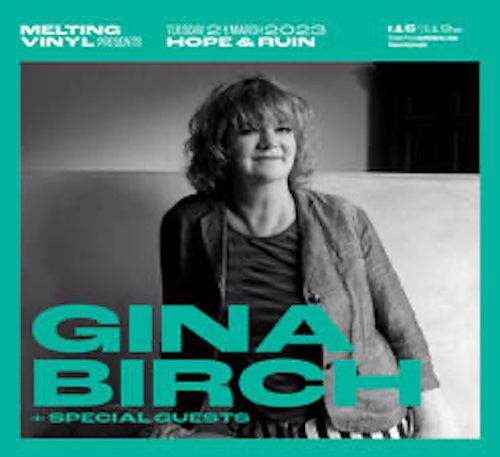
GINA BIRCH
The Hope + Ruin, Brighton
Tues 21st March
Gina Birch is from the Raincoats, of course one of the greatest post-punk bands if not one of the greatest bands. But as said after I last saw them, they were largely based on a double act. Portugese born, Ana da Silva always seemed beguiling and inscrutably cool. While Birch, English both by birth and manner, was much more an everywoman. I always associate da Sliva with second person songs, and Birch with first person. And she’s touring, perhaps remarkably, her first ever solo album. Would Birch alone be just half the picture?
When I say alone, the others in the trio join in on guitar and keyboards, with frequent swaps. (Bar one number where they all take up bass.) There’s no live drummer but programmed beats which rarely imitate a real drum sound, And the others also add catchy pop harmonies, often over skanking rhythms. They jerk their heads in an equally synchronised manner, like a post-punk Shangri Las. While Birch’s vocals are more stated or ranted. At time she seems to be channelling Marianne Faithful, existential torch songs.
As was common in post-punk, the Raincoats tended to sneak up on their subjects obliquely. While songs here can be more polemical, waxing lyrical on feminism or paying tribute to Pussy Riot. But they can also be laugh-out-loud hilarious. A whole number is given over to refusing to wear stilettos, going into some detail over more preferable forms of footwear. Which makes the whole set quirkily engaging and infectiously fun, never po-faced.
There’s precisely one Raincoats track, their only cover, ’Lola’. And as with the Raincoats lines like “girls will be boys and boys will be girls/ it’s a mixed-up, muddled-up, shook-up world” are less befuddled wail then cry of glee.
Punk nostalgists are always quick to tell you then was the time, and things can’t happen now. Missing the bit that if you make something happen… well then its happened, hasn’t it? First Slits guitarist Viv Albertine decided she was neither going to rest on past glories nor swerve up golden oldies, but break into something new. Now Birch has done the same thing. Or, as she put it itself in her album title, ’I Play My Bass Loud’. Remind them of this.
And here’s that very song from that very… okay, from Rough Trade in London if you must know. Still closer than normal…
GEORGE CRUMB’S ‘BLACK ANGELS’
Manchester Collective
Kings Place, London
Fri 24th March
The programme kicked off with ‘Carrot Revolution’ by Gabriella Smith. (The curious title coming from a Cezanne misquote.) It was one of those pieces which almost need a sign up on stage saying “it’s supposed to sound this way, honest,” as it scrapes and slides it’s way through varying tones and tempos. But rather than a difficult listen it’s lively and exuberant, the players jigging and swaying on-stage like this is one of those gig things.
My probably entirely wrong reaction was to think, as some contemporary composers become influenced by rock music, so had Smith been by klezmer. She’d develop rhythms which seemed just about to take over and turn things in a more regular beat-driven direction, for it all to take some unexpected corner.
Edmund Finnis’ second String Quartet was described as going from earth to air. And as the instruments fluttered and shimmered, it was exceptionally beautiful to listen to. But it didn’t prove terribly memorable, as if suffering from the ‘pretty face’ syndrome. It seemed the least contemporary-sounding work from the first half, though in fact it was written for the Collective.
Moor Mother’s ’DREAM CULTURE’ (in caps, it seems) was different again. After twice dodging the challenging bullet, we were now struck dead centre. Largely cello based with electronic tones breaking in, it was dark and brooding, one of those pieces which envelops you. It had everything the Finnis piece didn’t, and vice versa.
Before the headline work, they placed a section from Schubert which Crumb quotes from. (Though when it came it was inevitably too distorted for me to notice.) This passed pleasantly enough, but I confess such stuff just makes me think of stately homes and Gainsborough paintings. However, they did smartly use the opportunity to segue straight into the Crumb….
People who survived the Sixties will often tell you they were volatile, violent and chaotic, and notions of frolicking barefoot in the park only possible with a heap of hindsight. Political activists, particularly if black, often quite literally didn’t expect to survive. (We may have escaped the most extreme of that in the UK. But Crumb was American.)
And, written in 1970 and subheaded ’Thirteen Images from the Dark Land’, ‘Black Angels’ seismographs that Sixties. Let’s not deny it’s challenging. sometimes feels like the musical equivalent of a wild weather event, complete with eerie calms.
Those unlucky-for-some thirteen ‘images’ are crammed into barely twenty minutes of music. Which leads to a huge variety of sound compressed together. It can feel like there’s more musical ideas in those twenty minutes than most composers manage in a lifetime. But at the same time the mood range is confined - to turbulent, mournful and sinister. There’s no breath-back moments, it’s like a day with no break in the storm clouds, or a horror film which is just the scary stuff. (And that analogy’s not much of a reach, some of it was used in ’The Exorcist’.)
Though at times it feels less a reaction to and more an invocation of all that. To misquote Ken Kesey, less a seismograph than a lightning rod, calling down the storm. The staccato vocal utterances (labelled ‘Ancient Voices’ in the score), often just recite numbers in various languages, following Crumb’s interest in numerology. But they sound witchy conjurations, almost reminiscent of the vocals in some of Goblin’s soundtrack work.
There’s a running debate about what the references to ‘electric insects’ in the section titles comes from. Some have suggested the helicopters then strafing Vietnam. But as many of the effects require electronic amplification to work, it seems more likely it’s simply the instruments themselves. Crumb introduces some aids, such as glass rods and thimbles. But one interesting feature is for all that it is still a work for string quartet. Composers from this time were often moving into electronics and tape effects, particularly so when trying to map their times. Crumb sticking with strings has its own effects, like a dread warning being imparted by a once familiar voice.
Last time I saw this performed I heard a note of optimism in it. This time, to put it bluntly, I didn’t. Which is perhaps due to our own times growing darker. And probably makes it all the more important a work to hear.
The Manchester Collective seem a young and enthusiastic bunch, introducing the work without info-dumping a slew of obtuse music theory on you. And in the interval they turned Crumb’s score to face us, proudly pointing out it looked the scrawlings of a madman.
Patterns, Brighton
Fri 17th March
Recent releases from Canadian punk band Fucked Up have been, respectively, a long and involved metafictional concept album about love and revolution, a reflection on growing older in the punk scene, and an even longer, even more involved metafictional concept album about I’m still not sure what. They don’t get overly confused with the Germs.
They’d always possessed a remarkable ability to combine seemingly contradictory elements. I mean, before you get onto punk and concept albums you have to start with hardcore punk and tunes. But the last-but-one release, ’Dose Your Dreams’, which I initially feared might be their ’Sandinista’ turned out to be more like their version of ’The Gift’. It branched out in so many new directions the centre was no longer holding, it was part something expanding and part falling apart.
Much was unreproducible live, with the result its tour had only a passing resemblance to it. They’d demonstrated a remarkable longevity, essentially running with the same line-up for more than two decades. But at that point some speculated this was the finale, others just took it as read.
Yet as ’One Day’, the title of their new release, suggests they’ve gone back to their more immediate roots, played a back-to-basics revolution on themselves. What do you do when you reach the end? Seems you start again. Except as the title also suggests, this comes with a twist…
While there could hardly be a more central hardcore credo than everyone plays together in a room, this was recorded this in relay form, passed between band members with each having a one-day deadline. (The alert reader may be able to guess from this whenabouts it was recorded.) The lyric “what could you do in just one day?” isn’t really all that speculative.
They boldly front-load the set with new songs, running most of them through together. Which keeps up the energy, but does deprive us a little of Damon Abraham’s engaging stage persona. Is it as good as their classic gigs of yore? In truth, no. The highlights for me were the main set ending withe the double-barrelled blast of ’Glass Boys’ and ’Joy Stops Time’. And after me saying last time that this isn’t really the right venue for the band, look where they’re back.
But it is good, just not as good. And it feels like we got to live in the parallel dimension we’d have otherwise wanted to, the one where that Canadian punk band we all liked so much didn’t split up but found a way to carry on.
There was a further twist, not obvious till I’d got the CD and taken it home. This is the first album since they're first not to be dedicated to a theme. Yet the album so about spontaneity and new starts is lyrically dominated by the past, how it’s neither recapturable nor escapable. 'Lords of Kensington’, for example, is about yuppification undermining Toronto’s DIY scene. (“So now I’m caught up in the past/ Just trying to change the facts/ We over-wrote the map/ Now I’m trying to get back.”) Alas as a Brighton resident I have no way of relating </sarcasm>.
There seems a dearth of decent footage of this tour, so here’s the video for the title track. Keeping to the tradition where the band appear only obliquely...
GINA BIRCH
The Hope + Ruin, Brighton
Tues 21st March
Gina Birch is from the Raincoats, of course one of the greatest post-punk bands if not one of the greatest bands. But as said after I last saw them, they were largely based on a double act. Portugese born, Ana da Silva always seemed beguiling and inscrutably cool. While Birch, English both by birth and manner, was much more an everywoman. I always associate da Sliva with second person songs, and Birch with first person. And she’s touring, perhaps remarkably, her first ever solo album. Would Birch alone be just half the picture?
When I say alone, the others in the trio join in on guitar and keyboards, with frequent swaps. (Bar one number where they all take up bass.) There’s no live drummer but programmed beats which rarely imitate a real drum sound, And the others also add catchy pop harmonies, often over skanking rhythms. They jerk their heads in an equally synchronised manner, like a post-punk Shangri Las. While Birch’s vocals are more stated or ranted. At time she seems to be channelling Marianne Faithful, existential torch songs.
As was common in post-punk, the Raincoats tended to sneak up on their subjects obliquely. While songs here can be more polemical, waxing lyrical on feminism or paying tribute to Pussy Riot. But they can also be laugh-out-loud hilarious. A whole number is given over to refusing to wear stilettos, going into some detail over more preferable forms of footwear. Which makes the whole set quirkily engaging and infectiously fun, never po-faced.
There’s precisely one Raincoats track, their only cover, ’Lola’. And as with the Raincoats lines like “girls will be boys and boys will be girls/ it’s a mixed-up, muddled-up, shook-up world” are less befuddled wail then cry of glee.
Punk nostalgists are always quick to tell you then was the time, and things can’t happen now. Missing the bit that if you make something happen… well then its happened, hasn’t it? First Slits guitarist Viv Albertine decided she was neither going to rest on past glories nor swerve up golden oldies, but break into something new. Now Birch has done the same thing. Or, as she put it itself in her album title, ’I Play My Bass Loud’. Remind them of this.
And here’s that very song from that very… okay, from Rough Trade in London if you must know. Still closer than normal…
GEORGE CRUMB’S ‘BLACK ANGELS’
Manchester Collective
Kings Place, London
Fri 24th March
The programme kicked off with ‘Carrot Revolution’ by Gabriella Smith. (The curious title coming from a Cezanne misquote.) It was one of those pieces which almost need a sign up on stage saying “it’s supposed to sound this way, honest,” as it scrapes and slides it’s way through varying tones and tempos. But rather than a difficult listen it’s lively and exuberant, the players jigging and swaying on-stage like this is one of those gig things.
My probably entirely wrong reaction was to think, as some contemporary composers become influenced by rock music, so had Smith been by klezmer. She’d develop rhythms which seemed just about to take over and turn things in a more regular beat-driven direction, for it all to take some unexpected corner.
Edmund Finnis’ second String Quartet was described as going from earth to air. And as the instruments fluttered and shimmered, it was exceptionally beautiful to listen to. But it didn’t prove terribly memorable, as if suffering from the ‘pretty face’ syndrome. It seemed the least contemporary-sounding work from the first half, though in fact it was written for the Collective.
Moor Mother’s ’DREAM CULTURE’ (in caps, it seems) was different again. After twice dodging the challenging bullet, we were now struck dead centre. Largely cello based with electronic tones breaking in, it was dark and brooding, one of those pieces which envelops you. It had everything the Finnis piece didn’t, and vice versa.
Before the headline work, they placed a section from Schubert which Crumb quotes from. (Though when it came it was inevitably too distorted for me to notice.) This passed pleasantly enough, but I confess such stuff just makes me think of stately homes and Gainsborough paintings. However, they did smartly use the opportunity to segue straight into the Crumb….
People who survived the Sixties will often tell you they were volatile, violent and chaotic, and notions of frolicking barefoot in the park only possible with a heap of hindsight. Political activists, particularly if black, often quite literally didn’t expect to survive. (We may have escaped the most extreme of that in the UK. But Crumb was American.)
And, written in 1970 and subheaded ’Thirteen Images from the Dark Land’, ‘Black Angels’ seismographs that Sixties. Let’s not deny it’s challenging. sometimes feels like the musical equivalent of a wild weather event, complete with eerie calms.
Those unlucky-for-some thirteen ‘images’ are crammed into barely twenty minutes of music. Which leads to a huge variety of sound compressed together. It can feel like there’s more musical ideas in those twenty minutes than most composers manage in a lifetime. But at the same time the mood range is confined - to turbulent, mournful and sinister. There’s no breath-back moments, it’s like a day with no break in the storm clouds, or a horror film which is just the scary stuff. (And that analogy’s not much of a reach, some of it was used in ’The Exorcist’.)
Though at times it feels less a reaction to and more an invocation of all that. To misquote Ken Kesey, less a seismograph than a lightning rod, calling down the storm. The staccato vocal utterances (labelled ‘Ancient Voices’ in the score), often just recite numbers in various languages, following Crumb’s interest in numerology. But they sound witchy conjurations, almost reminiscent of the vocals in some of Goblin’s soundtrack work.
There’s a running debate about what the references to ‘electric insects’ in the section titles comes from. Some have suggested the helicopters then strafing Vietnam. But as many of the effects require electronic amplification to work, it seems more likely it’s simply the instruments themselves. Crumb introduces some aids, such as glass rods and thimbles. But one interesting feature is for all that it is still a work for string quartet. Composers from this time were often moving into electronics and tape effects, particularly so when trying to map their times. Crumb sticking with strings has its own effects, like a dread warning being imparted by a once familiar voice.
Last time I saw this performed I heard a note of optimism in it. This time, to put it bluntly, I didn’t. Which is perhaps due to our own times growing darker. And probably makes it all the more important a work to hear.
The Manchester Collective seem a young and enthusiastic bunch, introducing the work without info-dumping a slew of obtuse music theory on you. And in the interval they turned Crumb’s score to face us, proudly pointing out it looked the scrawlings of a madman.
(This was being filmed... you know, properly filmed, so may yet show up somewhere.)
Saturday, 17 September 2022
MCLUSKY/ MUDHONEY (GIG-GOING ADVENTURES)
MCLUSKY
The Old Market, Hove, Sat 10th Sept
Three years later, mclusky are back with their patented brand of catchy noise. Albeit shorn of the asterisk they sported last time and with a different (but equally bearded) bassist. The occasion is the twentieth anniversary of ’mclusky do dallas’, the album which people tend to rate the highest but I don’t have a copy of. (It’s inexplicably more expensive than the others.)
Last time there was a general feeling of old friends re-united. This gig starts like they mean business, songs piling after another like paratroopers out through the bow doors. It’s several songs in before frontman Falco (aka Andrew Falcous) speaks. And from there his chatty self gradually resurfaces. (Seems someone sort of important had died recently. He was unimpressed. More than that I couldn’t tell you.) Though more than a few times the relentless pace resumes. I suppose there will be those keen to tell you they were more on it back in the day. But it’s hard to see how, quite honestly.
The bearded bassist sings a few tracks. And while there’s nothing wrong with these in themselves, it does underline the importance of Falco’s voice in these proceedings, which could cut through finery like a laser, phasers on derision. It’s a voice made to go with abrasive guitar. Giving the de rigeur general thanks at the end, he confesses it’s hard for him to sound sincere.
I said last time their default position was “outside the frame of their songs, pissing in. It’s like a role reversal in which through their songs they heckle the audience.” But their target range may be wider than that, and there are times when the band sound like they’re heckling the band.
Titling a track ’Fuck This Band’, and adding lyrics like “cause they swear too much/It’s an obvious ploy/And irresponsible” already seems like offering up a hostage to fortune. Starting the set with it is like tying that hostage up to an inviting-looking post like Fay Wray. Falco explains another number is “not a how-to guide but a warning from history,” which may well be how he sees the band’s history. The whole thing as one grand folly, but let’s do it anyway.
At which point the not unimportant subject of humour in mclusky should be mentioned. Which is of course of the black variety, but also the funny kind, with lines like “If I had to give you something then I think I’d give you nothing.” Last time I described Falco as exuding a “nihilistic chirpiness”. And the humour keeps proceedings upbeat, even as they’re entirely negative.
You can never be quite sure how much a singer attracts an audience of the same mindset, or simply stamps his personality upon the crowd. But for a noisy punk gig it’s remarkably good-humoured. You come out of a mclusky gig feeling like you had a great time, rather than expressed your frustration with society or some such. About the last thing I heard after the set closed was someone calling out form the mosh pit, asking if anyone had lost their glasses. I bet that doesn’t happen with Metallica.
From Manchester...
…anyway, onto a noisy guitar band that starts with an M. After said after their last sighting, now twelve years ago, Mudhoney are essentially the anti-Nirvana, the Seattle band who stayed Grungey and so bypassed superstardom and escaped unscathed.
Exiting the venue, the inevitable flier thrust at me turned out to be only for tribute bands. Which seemed strangely incongruous for the gig I’d just seen. Yes, all too often acts became their own tribute bands, knocking out the hits each night from muscle memory alone. But Mudhoney seem unwitherable by age, the flame that lit them burning still. At one point they jest they’re all dead, they’re just carrying on anyway. Something I could see happening.
Had Nirvana not ended for too-often-told reasons, could they have lasted this long? It’s an unanswerable question, but my guess is not. There’s a clutch of new songs. And if they’re not exactly wild stylistic departures from their predecessors, they stand up well against their predecessors. More Mudhoney sounds like more Mudhoney. Which wasn’t Nirvana’s way.
Frontman Mark Arm, in what becomes a running gag, tells us the new album isn’t out till April, and - somewhat gleefully - who to blame. In fact they seem a chattier, more genial bunch than the no-nonsense outfit of before. They sometimes joke between themselves off-mike, like they’d forgotten we were here.
And, perhaps linked, there seems a little more high-spirited send-up to proceedings than before. But never enough self-awareness to get clever or knowing. Which is all to the good. Mudhoney learnt much from the Stooges. Including this, it seems.
The only complaint I could come up with is that there’s a long guitar solo, then later (yes, really) a drum solo. Surely we took to Grunge because it offered a cure against such ills! It offered a way of re-aquainting with rock, but only the parts we wanted back. The guitar solo number is followed by the snappiest, punkiest number of the set, an acknowledgement it needed some counterbalancing.
From Glasgow...
The Old Market, Hove, Sat 10th Sept
Three years later, mclusky are back with their patented brand of catchy noise. Albeit shorn of the asterisk they sported last time and with a different (but equally bearded) bassist. The occasion is the twentieth anniversary of ’mclusky do dallas’, the album which people tend to rate the highest but I don’t have a copy of. (It’s inexplicably more expensive than the others.)
Last time there was a general feeling of old friends re-united. This gig starts like they mean business, songs piling after another like paratroopers out through the bow doors. It’s several songs in before frontman Falco (aka Andrew Falcous) speaks. And from there his chatty self gradually resurfaces. (Seems someone sort of important had died recently. He was unimpressed. More than that I couldn’t tell you.) Though more than a few times the relentless pace resumes. I suppose there will be those keen to tell you they were more on it back in the day. But it’s hard to see how, quite honestly.
The bearded bassist sings a few tracks. And while there’s nothing wrong with these in themselves, it does underline the importance of Falco’s voice in these proceedings, which could cut through finery like a laser, phasers on derision. It’s a voice made to go with abrasive guitar. Giving the de rigeur general thanks at the end, he confesses it’s hard for him to sound sincere.
I said last time their default position was “outside the frame of their songs, pissing in. It’s like a role reversal in which through their songs they heckle the audience.” But their target range may be wider than that, and there are times when the band sound like they’re heckling the band.
Titling a track ’Fuck This Band’, and adding lyrics like “cause they swear too much/It’s an obvious ploy/And irresponsible” already seems like offering up a hostage to fortune. Starting the set with it is like tying that hostage up to an inviting-looking post like Fay Wray. Falco explains another number is “not a how-to guide but a warning from history,” which may well be how he sees the band’s history. The whole thing as one grand folly, but let’s do it anyway.
At which point the not unimportant subject of humour in mclusky should be mentioned. Which is of course of the black variety, but also the funny kind, with lines like “If I had to give you something then I think I’d give you nothing.” Last time I described Falco as exuding a “nihilistic chirpiness”. And the humour keeps proceedings upbeat, even as they’re entirely negative.
You can never be quite sure how much a singer attracts an audience of the same mindset, or simply stamps his personality upon the crowd. But for a noisy punk gig it’s remarkably good-humoured. You come out of a mclusky gig feeling like you had a great time, rather than expressed your frustration with society or some such. About the last thing I heard after the set closed was someone calling out form the mosh pit, asking if anyone had lost their glasses. I bet that doesn’t happen with Metallica.
From Manchester...
MUDHONEY
Concorde 2, Brighton, Mon 12th Sept
…anyway, onto a noisy guitar band that starts with an M. After said after their last sighting, now twelve years ago, Mudhoney are essentially the anti-Nirvana, the Seattle band who stayed Grungey and so bypassed superstardom and escaped unscathed.
Exiting the venue, the inevitable flier thrust at me turned out to be only for tribute bands. Which seemed strangely incongruous for the gig I’d just seen. Yes, all too often acts became their own tribute bands, knocking out the hits each night from muscle memory alone. But Mudhoney seem unwitherable by age, the flame that lit them burning still. At one point they jest they’re all dead, they’re just carrying on anyway. Something I could see happening.
Had Nirvana not ended for too-often-told reasons, could they have lasted this long? It’s an unanswerable question, but my guess is not. There’s a clutch of new songs. And if they’re not exactly wild stylistic departures from their predecessors, they stand up well against their predecessors. More Mudhoney sounds like more Mudhoney. Which wasn’t Nirvana’s way.
Frontman Mark Arm, in what becomes a running gag, tells us the new album isn’t out till April, and - somewhat gleefully - who to blame. In fact they seem a chattier, more genial bunch than the no-nonsense outfit of before. They sometimes joke between themselves off-mike, like they’d forgotten we were here.
And, perhaps linked, there seems a little more high-spirited send-up to proceedings than before. But never enough self-awareness to get clever or knowing. Which is all to the good. Mudhoney learnt much from the Stooges. Including this, it seems.
The only complaint I could come up with is that there’s a long guitar solo, then later (yes, really) a drum solo. Surely we took to Grunge because it offered a cure against such ills! It offered a way of re-aquainting with rock, but only the parts we wanted back. The guitar solo number is followed by the snappiest, punkiest number of the set, an acknowledgement it needed some counterbalancing.
From Glasgow...
Saturday, 2 July 2022
SHOW ME THE BODY (GIG-GOING ADVENTURES)
Green Door Store, Brighton, Sat 26th June
Show Me the Body hail from New York City, and mix hardcore punk with noise rock and sludge metal. (Wikipedia adds Hip-Hop to the mix, but my ears heard less of that.) A combination handily demonstrated by the visual aid of the singer’s close crop and guitarist’s multi-follickled locks. Effects pedals, often the preserve of Post-Rock, are used as a de facto keyboard. Though their sound is also achieved, rather wonderfully, with the aid of the banjo.
Given that those styles work by marshalling the force of repetition, this outfit switch things up with some alacrity. It gives the music a skittering quality, like it can’t quite be grasped. Like that Kung-Fu master who’s struck you in three separate places before you’ve even moved. But at other points they go in for the slow fuse, tracks building in intensity before plunging into the riff. At which moments the mosh-pit stands poised, awaiting the Sword of Damocles to fall.
Yes, the mosh pit… In one of his few audience comments, the singer remarks that last time they were here no-one else was. Whereas tonight I became afeared the mosh-pit would fill the venue, with no far wall left for us frail Fifty-somethings to flee too. But while there’s mosh-pits which seem Ian arena sport, to which the actual music is incidental, here everyone seems to know each track by heart. The singer often passes out the mike, with pretty much everyone singing their assigned line then obligingly handing it back. (Their early gigs were apparently held not only in basements, but alleys and under flyovers.)
Lyrics fly by you, as they will normally do with this sort of thing. But less than penning rebel anthems they seem more concerned with bottling and then uncorking pressure-cooker urban angst. Which of course has a rich history with New York bands. Going back to the famous Suicide quote: “People were coming in off the streets… where they were hoping they’d be escaping and all we were doing was shoving the street back in their face again.”
Even disregarding the lockdown impasse, this must have been one of the most high-energy gigs I’ve been to in recent years. Possibly since Death Grips. (Now nine years ago. Bloomin’ Ada!)
After the most recent Godspeed gig, I commented on how Punk can often feel a poor fit for our era. It’s not that there’s less to be angry about, but that there’s too much. As things degenerate further and further, Punk becomes stuck in an arms race of outrage, which inevitably leaves it outpaced. Reagan-level outrage no longer seems inadequate in the Trump years. What makes this trio different?
Show Me the Body hail from New York City, and mix hardcore punk with noise rock and sludge metal. (Wikipedia adds Hip-Hop to the mix, but my ears heard less of that.) A combination handily demonstrated by the visual aid of the singer’s close crop and guitarist’s multi-follickled locks. Effects pedals, often the preserve of Post-Rock, are used as a de facto keyboard. Though their sound is also achieved, rather wonderfully, with the aid of the banjo.
Given that those styles work by marshalling the force of repetition, this outfit switch things up with some alacrity. It gives the music a skittering quality, like it can’t quite be grasped. Like that Kung-Fu master who’s struck you in three separate places before you’ve even moved. But at other points they go in for the slow fuse, tracks building in intensity before plunging into the riff. At which moments the mosh-pit stands poised, awaiting the Sword of Damocles to fall.
Yes, the mosh pit… In one of his few audience comments, the singer remarks that last time they were here no-one else was. Whereas tonight I became afeared the mosh-pit would fill the venue, with no far wall left for us frail Fifty-somethings to flee too. But while there’s mosh-pits which seem Ian arena sport, to which the actual music is incidental, here everyone seems to know each track by heart. The singer often passes out the mike, with pretty much everyone singing their assigned line then obligingly handing it back. (Their early gigs were apparently held not only in basements, but alleys and under flyovers.)
Lyrics fly by you, as they will normally do with this sort of thing. But less than penning rebel anthems they seem more concerned with bottling and then uncorking pressure-cooker urban angst. Which of course has a rich history with New York bands. Going back to the famous Suicide quote: “People were coming in off the streets… where they were hoping they’d be escaping and all we were doing was shoving the street back in their face again.”
Even disregarding the lockdown impasse, this must have been one of the most high-energy gigs I’ve been to in recent years. Possibly since Death Grips. (Now nine years ago. Bloomin’ Ada!)
After the most recent Godspeed gig, I commented on how Punk can often feel a poor fit for our era. It’s not that there’s less to be angry about, but that there’s too much. As things degenerate further and further, Punk becomes stuck in an arms race of outrage, which inevitably leaves it outpaced. Reagan-level outrage no longer seems inadequate in the Trump years. What makes this trio different?
Partly by mixing Punk with other styles, creating a kind of cocktail effect. But mostly, it’s not because they play louder or faster, or any of the usual things. It’s that they sound more volatile, as if held together mostly by trajectory, like extemporised incendiary devices just about going off in the right place at the right time, like incandescent fury barely turned into music. They somehow seem at perpetual risk of fizzling out, even though they never do.
Forty-five minutes on onslaught later, they abruptly announce the show over. Like a summer storm which came out of nowhere, then finished just as fast.
From Detroit, rather than Brighton. But near in time, okay…
Forty-five minutes on onslaught later, they abruptly announce the show over. Like a summer storm which came out of nowhere, then finished just as fast.
From Detroit, rather than Brighton. But near in time, okay…
Saturday, 30 April 2022
UT/ ASIAN DUB FOUNDATION/ MICA LEVI (GIG-GOING ADVENTURES)
Ut
Cafe Oto, London, Sat 23rd Apr
Ut are a punk (though they look to prefer the tag “radical”) trio, first forming in New York in 1978. Finding the Lower East Side an incubator which ultimately became a confine, they relocated to London. From where they were championed by John Peel, toured with the Fall and – not least – actually got to release some music. (Sometimes using This Heat’s studio.) In the make-it-happen spirit of those times, the band name just means “do”. Splitting in 1990, they’ve been playing on and off again since 2010.
Things started with the announcement drummer Nina Camal couldn’t make it. (Seems she’s the only member who went back to the States.) And then the shaky start. After a few numbers, seemingly dissatisfied themselves, they stopped for a lengthy retune. After which they brought on an extra player, rotating between a bassist, violinist or sax player. (The last two were the same guy, but then you’re not bothered about that.) After which they become the band we came to see.
It’s perhaps a little too easy to reach for Sonic Youth comparisons. Though both bands are sometimes described as No Wave, these gals are pitched closer to the shock-treatment anti-art iconoclasm of the original No Wave bands like Mars or DNA.
And seen live it becomes clear that, within that, Jacqui Ham was the most uncompromisingly No Wave, happy for her guitar to shriek. And Sally Young more willing to let a little… just a little, mind… rock riffing in. Their on-stage personalities seem to match this, Ham intense and driven, speaking to the audience only to convey information, Young more convivial.
But both bands share an urban urgency, even by punk standards, the restless energy of having constant vibrant input from a thousand different sources transformed into music. Ham has said “we liked the interplay between discordant things, the hard and soft, the lush and spiky, the friction between sounds and styles.” This does mean tracks tread a fine line between signal and noise, between accordance and dissonance. And hearing them bravely get up on that edge and dance, that becomes part of the appeal. Perhaps something to bear in mind with the initial problems.
And both bands demonstrate how post-beat American punk was, the Year Zero business a British invention. Lyrics are declaimed, somewhere between sung and recited, and hover between wordplay free association and suggestion of sense. Tellingly, track titles often collide clashing words, ’Mosquito Botticelli’, ‘Absent Farmer’, ‘Homebled’.
Oddly, it ended almost as it began. A time-consuming stage rearrangement to allow Ham to double up on drums yielded fitful success. Though perhaps kudos are due for trying the unorthodox. They then encored with ’Evangelist’, perhaps their signature tune, despite Ham explaining she could no longer play the notes then demonstrating this.
From Paris, three years ago…
ASIAN DUB FOUNDATION
Chalk, Brighton, Fri 22nd Apr
Before the band came on, the DJ played a Dead Kennedys remix which kept the original front end, while replacing the back with some hyperactive drum ’n’ bass. And that’s this review written right there, really.
More? Okay. Let’s generalise wildly. Music made by and for ethnic minorities tends to focus on the uplifting. It makes sense. Everyone knows the bad stuff already, what people want to hear is that there’s a way through it. While white music tends to foreground rage and frustration. Yes, we may be the white kids. But don’t go thinking we’re not pissed off too. Well, I did say it was a wild generalisation.
Anyway, Asian Dub Foundation somehow manage to combine both, often at the same time. People dance so much it feels like a Friday night out. (Not that I remember much.) But will boo Priti Patel’s name readily, and with practiced ease.
For a band nearly thirty years old, who I’ve seen more times than I can count, age has not withered them nor custom stained their variety. If anything its the reverse. Chandrasonic, the sole constant member, comments on their songs’ propensity to become true. Be a doomsayer to become a prophet, it seems. So ever-more souring times have just offered them more material.
Both set and encore start with quite extended instrumentals. Which don’t seem any kind of straying from their mission. It’s like their stance isn’t just in the lyric sheet, but baked hard into their sound.
Eleven years ago, after another of their storming visits to our shore, I wrote “Nazis have Screwdriver. We listen to Asian Dub Foundation. Which side would you rather be on?” And now there’s one less of Screwdriver than before, after he refused the vaccine (a “Jewish plot”, you see) and was promptly killed by Covid. While here’s ADF still firing from every cylinder.
'Zig Zag Nation' is a song they played, but this is from Paris. (I’m not sure why everything is suddenly from Paris…)
Mica Levi: ***
Milton Court, Barbican, London, Fri 29th Apr
The record shows me to be a fan of both Mica Levi’s score to ‘Under The Skin’, equal parts enthralling and unsettling, and her composition ‘Greezy’.
’Star Star Star’ (seems you are allowed to pronounce it like that) was, unlike its predecessors, performed by a small ensemble with minimal instrumentation. The night started off with some suitably unearthly polyphonic chanting, sometimes sounding like reciting your vowels in an alien language. Which gave way to languorous, minimal synths, sometimes with the barest drum accompaniment. Voices sometimes accompanied this, but from that point always recited, never sung or chanted.
There was some on-stage theatrics. Ensemble members taking turns to sit front-stage, like a kid called to the front of the class. A piece of paper was passed while lit by torchlight, like an orbiting moon. All of which seemed a tacit admission that, while there was nothing wrong with any of the music, neither was it quite enough.
Had I seen this cold, my final word might have been “promising”. It all feels back-to-front, like this should be the early works, Levi still finding their way, the accomplishments still ahead.
The Barbican explained “these scores consist of written text instructions, speech rhythm techniques and drawings.” Which I either forgot before attending, or only found afterwards. Which leaves me wondering whether this is one of those works where the process is taken as the thing, and the ensuing work not really the point.
Cafe Oto, London, Sat 23rd Apr
Things started with the announcement drummer Nina Camal couldn’t make it. (Seems she’s the only member who went back to the States.) And then the shaky start. After a few numbers, seemingly dissatisfied themselves, they stopped for a lengthy retune. After which they brought on an extra player, rotating between a bassist, violinist or sax player. (The last two were the same guy, but then you’re not bothered about that.) After which they become the band we came to see.
It’s perhaps a little too easy to reach for Sonic Youth comparisons. Though both bands are sometimes described as No Wave, these gals are pitched closer to the shock-treatment anti-art iconoclasm of the original No Wave bands like Mars or DNA.
And seen live it becomes clear that, within that, Jacqui Ham was the most uncompromisingly No Wave, happy for her guitar to shriek. And Sally Young more willing to let a little… just a little, mind… rock riffing in. Their on-stage personalities seem to match this, Ham intense and driven, speaking to the audience only to convey information, Young more convivial.
But both bands share an urban urgency, even by punk standards, the restless energy of having constant vibrant input from a thousand different sources transformed into music. Ham has said “we liked the interplay between discordant things, the hard and soft, the lush and spiky, the friction between sounds and styles.” This does mean tracks tread a fine line between signal and noise, between accordance and dissonance. And hearing them bravely get up on that edge and dance, that becomes part of the appeal. Perhaps something to bear in mind with the initial problems.
And both bands demonstrate how post-beat American punk was, the Year Zero business a British invention. Lyrics are declaimed, somewhere between sung and recited, and hover between wordplay free association and suggestion of sense. Tellingly, track titles often collide clashing words, ’Mosquito Botticelli’, ‘Absent Farmer’, ‘Homebled’.
Oddly, it ended almost as it began. A time-consuming stage rearrangement to allow Ham to double up on drums yielded fitful success. Though perhaps kudos are due for trying the unorthodox. They then encored with ’Evangelist’, perhaps their signature tune, despite Ham explaining she could no longer play the notes then demonstrating this.
From Paris, three years ago…
ASIAN DUB FOUNDATION
Chalk, Brighton, Fri 22nd Apr
Before the band came on, the DJ played a Dead Kennedys remix which kept the original front end, while replacing the back with some hyperactive drum ’n’ bass. And that’s this review written right there, really.
More? Okay. Let’s generalise wildly. Music made by and for ethnic minorities tends to focus on the uplifting. It makes sense. Everyone knows the bad stuff already, what people want to hear is that there’s a way through it. While white music tends to foreground rage and frustration. Yes, we may be the white kids. But don’t go thinking we’re not pissed off too. Well, I did say it was a wild generalisation.
Anyway, Asian Dub Foundation somehow manage to combine both, often at the same time. People dance so much it feels like a Friday night out. (Not that I remember much.) But will boo Priti Patel’s name readily, and with practiced ease.
For a band nearly thirty years old, who I’ve seen more times than I can count, age has not withered them nor custom stained their variety. If anything its the reverse. Chandrasonic, the sole constant member, comments on their songs’ propensity to become true. Be a doomsayer to become a prophet, it seems. So ever-more souring times have just offered them more material.
Both set and encore start with quite extended instrumentals. Which don’t seem any kind of straying from their mission. It’s like their stance isn’t just in the lyric sheet, but baked hard into their sound.
Eleven years ago, after another of their storming visits to our shore, I wrote “Nazis have Screwdriver. We listen to Asian Dub Foundation. Which side would you rather be on?” And now there’s one less of Screwdriver than before, after he refused the vaccine (a “Jewish plot”, you see) and was promptly killed by Covid. While here’s ADF still firing from every cylinder.
'Zig Zag Nation' is a song they played, but this is from Paris. (I’m not sure why everything is suddenly from Paris…)
Mica Levi: ***
Milton Court, Barbican, London, Fri 29th Apr
The record shows me to be a fan of both Mica Levi’s score to ‘Under The Skin’, equal parts enthralling and unsettling, and her composition ‘Greezy’.
’Star Star Star’ (seems you are allowed to pronounce it like that) was, unlike its predecessors, performed by a small ensemble with minimal instrumentation. The night started off with some suitably unearthly polyphonic chanting, sometimes sounding like reciting your vowels in an alien language. Which gave way to languorous, minimal synths, sometimes with the barest drum accompaniment. Voices sometimes accompanied this, but from that point always recited, never sung or chanted.
There was some on-stage theatrics. Ensemble members taking turns to sit front-stage, like a kid called to the front of the class. A piece of paper was passed while lit by torchlight, like an orbiting moon. All of which seemed a tacit admission that, while there was nothing wrong with any of the music, neither was it quite enough.
Had I seen this cold, my final word might have been “promising”. It all feels back-to-front, like this should be the early works, Levi still finding their way, the accomplishments still ahead.
The Barbican explained “these scores consist of written text instructions, speech rhythm techniques and drawings.” Which I either forgot before attending, or only found afterwards. Which leaves me wondering whether this is one of those works where the process is taken as the thing, and the ensuing work not really the point.
Saturday, 12 February 2022
THIS IS AMERICA (A PLAYLIST OF 80s/90s AMERICAN PUNK, HARDCORE + ALTERNATIVE)
My latest, and last, themed Spotify playlist… Captain Beefheart once quipped “I play music, too many work it”. Whereas these guys worked it, just in a way which made it work. First, they worked a stage. Music had to be new and original but still built from blood and sinew. And they took a blue-collar build-it mentality to gig circuits and distro channels, creating facts on the ground which the rock stars airily flew over. Even lysergic-spewing reprobates the Butthole Surfers (handily pictured) were harder-working than anyone in showbiz. They did it their way.
All the other playlists had a sample lyric. For this let’s pick NoMeansNo: “If I could choose to believe or not to believe, I’d choose not to… but I can’t choose…”
“This America, man” (sample from TV series ‘The Wire’)
The Avengers: The American In Me
X: Los Angeles
Black Flag: Rise Above
Bad Brains: I Against I
Mission of Burma: The Ballad of Johnny Burma
Dead Kennedys: Pull My Strings
Millions of Dead Cops: I Remember
Big Black: Pavement Saw
Alice Donut: The Song of Disgruntled X-Postal Worker Reflects On His Life While Getting Stoned in the Parking Lot of a Winn Dixie Listening to Metallica
Fugazi: And The Same
Flipper: You Nought Me
Melvins: Goin’ Blind
Minutemen: Do You Want New Wave Or Do You Want the Truth?
King Missile: Take Stuff From Work
Lard: I wanna Be a Drug-Sniffing Dog
Ignition: Anger Means
Girls Against Boys: Bullet Proof Cupid
At the Drive In: Chanbara
Nation of Ulysses: The Kingdom of Heaven Must Be Taken By Storm
NoMeansNo: Rag ’N Bone
Butthole Surfers: 100 Million People Dead
PS Should anyone be bothered about this… yes, of course Neil Young and Joni Mitchell are right. No of course there’s not a ‘right’ to spread dangerous and pernicious misinformation for your personal enrichment, and they people telling you there is don’t really believe it either. And I still say, as Patti Smith once put it, people have the power. But me I’m just a person. And me pulling my little playlists would be gnat’s bite which Spotify might survive.
Saturday, 8 January 2022
IN THE EIGHTIES WE WERE EDGELORDS (SADLY BUT TRULY)
For the three or four people who might still care about Eighties subculture, and how it led to things now. Hopefully not too late for New Years Resolutions.
Back in October Steve Albini, ex-frontman of the somewhat infamous punk band Big Black, posted a series of Tweets which included the phrase: “I'm overdue for a conversation about my role in inspiring ‘edgelord’ shit.”
I’m a Big Black fan from back then. In fact I’m a big Big Black fan. So let’s ask the question out loud, just why did we think it was so punk to listen to those lyrics? “I would like to wrap your hair around your neck like a noose.” Or “she's wearing his bootprint on her forehead”?
At the time, I knew the answer. Misogyny was rife, domestic violence not just widespread but unstated. (The police then had an openly stated policy of not involving themselves in “domestic” cases.) And the saccharine cutie-pie world of pop songs, with all that “I love you true” and “moon in June” business, seemed just a pretty painted screen being unfurled in front of a pretty ugly reality. Providing everything stayed shiny on the surface, things were supposedly fine. We wanted to kick that screen down, in its feelgood hypocrisy, to make ugly music for ugly times.
More widely the nature of our society effectively determined stuff like that was going to happen. This wasn’t just something to oppose, it was a signifier of all that was wrong. We lived in a society based around violence, which encouraged you to use that violence, expending yourself anywhere that wasn’t against the powers that be.
Albini himself said: “If things like this remain unspoken, the thinking doesn’t die, it spreads sub-cutaneous like a fungus, making everything sick. To exorcise this kind of thinking it has to be stated plainly.” Thomas Hardy had said many years earlier, “if a way to the better there be, it exacts a full look at the worst.” And I still think both are right.
Big Black songs often employed the old Velvet Underground device of using a first-person protagonist, throwing the listener into an extreme situation with no guides or hand-holds as to how they’re supposed to be reacting. Which inevitably led to many not getting it, of thinking these songs encouraged such behaviour.
And if questioned, we would respond with derision. The same derision you’d use for a clueless know-nothing who didn’t know who the Velvet Underground were.
And in one way, it did all make more sense back then. Back then, subcultures more occupied their own spheres, like conceptual neighbourhoods whose bounds you stayed within. Which meant you weren’t likely to encounter Big Black without encountering Punk subculture, which gave the content a context. It wasn’t the situation where, for example, the lyrics would get pinned up on the internet divorced from the music. And it was partly the context of music, which made it clear those words were supposed to sound not triumphalist but fucked up.
Let’s look at this from another angle, just for a second. At the time, I was equally involved in comics fandom. A subculture which had little-to-no interest in shock and provocation, which if anything was rather desperate to ingratiate its chosen medium into respectability as an artistic form.
At one point I wrote a piece for the fanzine ’Vicious’ in which I recounted my reading my first Marvel comic. The villain, a Fu Manchu knock-off called the Mandarin, I described as a “scheming oriental”. Something I couldn’t have meant any less as a swastika armband. I was assuming two things; that even if I didn’t know personally everyone who would read it I knew comic fans, knew the sort of people they were, knew they were (broadly speaking) my sort of people. And that the whole Yellow Peril trope was, when stood up in the modern world, patently absurd. To the degree that shining a light on it was clearly enough to knock it down. And no-one ever questioned me about that at the time.
And that’s the thing. We were… ahem… somewhat over-optimisitic about a marginal music movement’s capacity to deliver social change. But in many ways I’m the person I am today largely because of the person I was then. What I question in retrospect… partly, it’s the certainty.
Back then, I blithely assumed that as soon as the sign was hung on the squat centre door, the one which decried racism, sexism and homophobia, it exuded a talismanic power to banish those things. I noted that I’d never experienced any of them, not thinking there may have been a rather obvious reason for that. I was young and excited to find myself amidst this radical counter-culture. It was a gift horse to me, and I wasn’t keen to start poking it about in the mouth. So those provocative songs, designed to make people stop and think, didn’t actually make us stop and think very much. We just figured they had messages for other people, even as they played to our scene.
And that unquestioning seems in retrospect a little too reminiscent of the over-familiar cry “but I’m a nice guy”. The problem with which is obvious – everyone likes to imagine they’re a nice guy rather than a horrific monster, and cognitive dissonance usually aids them in believing it. Harvey Weinstein still seems to believe a short stay in a de luxe clinic gives him the right to a “second chance”. Harvey... guys... you want a handy hint? You really want to know if you’re a ”nice guy”? Maybe ask those who have to interact with you.
But, and this is both the bigger and the bitterer part of the picture… Those people who would freak out at my listening to Big Black, sure I’d argue back at them. But at the same time they were giving me precisely what I wanted. There are lots of things driving you when you’re young, but the drive to not be understood is some way out in front.
When others don’t get you, that must mean you are smarter than them, ahead of them, brimming over with fascinating depth. Our scene was outwardly aggressive and nihilistic, wearing it’s positivity very much on the inside. I doubt that was entirely co-incidental.
Which brings us to politics…
Big Black might not be the best example, but radical subculture frequently spilt over into radical politics. Back then, truth to tell, for many of us it was the one path there was to follow. Like Henry Ford’s cars, you could have any politics you wanted provided they were black. Labour were the Tories’ mini-me, Trot groups like the Socialist Workers Party a cross between a cadet force and a cult, marching in line to a gulag. Anarchism was the only show in town you could bear to sit through.
And central to politics, surely, is winning others over to your point of view. It may not matter much if not everyone gets the record you put out, you may even want them not to. Whereas you might think a political magazine would work differently. Not so, it seemed. In fact it was the very the opposite – our politics was more tied to shock tactics than our subculture.
True, it was less about exposing domestic abuse than stressing the necessity of political violence. But the same game was being played. Anarchist magazines paraded titles such as ’Boot ‘em’, ‘Attack’ or – our local example – ’Brighton Bomber’, and traded in confrontational imagery often with the thinnest of ties to any context. To the point that today edgelordery is often seen as central to Anarchism, if not the very essence of it. Whereas for much of Anarchist history it wasn’t a significant feature at all.
After seeing Shellac, Albini’s current band, I commented on the difference twixt then and now: “Big Black were rooted in their Eighties era, holding a truth-telling mirror to Reagan America’s dark underbelly. Whereas Trump’s America wears that dark underbelly on its face, and the last thing it needs is further exposure.”
And Albini himself tweeted: “For myself and many of my peers, we miscalculated. We thought the major battles over equality and inclusiveness had been won, and society would eventually express that, so we were not harming anything with contrarianism, shock, sarcasm or irony.”
Whereas these days, there might as well be ‘How’s My Edgelording?’ bumper stickers. In the famous saying, in our times it’s now the bourgeoisie who shock the avant-garde. When someone as mainstream as a Guardian art critic, that total fuckwit Jonathan Jones, goes in for it you’d think folk would finally wise up that edgelordery isn’t really that edgy any more. But it seems not.
Now it would be nice to be able to argue that once the alt.right started using our tricks, we wised up. But that wouldn’t really be true. Certainly when I was still at school my classmates (using the term in the loosest definition) included fascism-fanciers. And part of its appeal to them was clearly that it seemed thrillingly too cool for school. Their edgelordery always mirrored ours, theirs has just gone more mainstream now.
So here we are, with Gamergate, Comicsgate and those other similarly festering piles of shit. I simply can’t imagine writing a line like “scheming Oriental” on the internet today, and blithely expecting it to be seen as an expose of racism. Not because the world has moved on. But precisely because it has moved backwards.
Significantly, back in those days we didn’t even have a term for edgelordery. Just as the Ancient Greeks didn’t have one for religion, because they assumed it to be all-pervasive. Spotting and defining the disease is normally part of the cure.
It may scarcely need saying that now is not the time for these antics. It may be more important to explain how it ever was. But just in case - now is not the time for these antics. From now on, we can be pinning our own colours to our own mast. How about we say we don’t think that society should be run to further enrich a few billionaires? That probably counts as edgy nowadays.
Post-Script: The role of edgelordery in the Industrial music scene is still more entangled, with some bands becoming direct precursors of the alt.right. But, less involved in that scene, I’d have less to say. This piece by John Eden is interesting…
Back in October Steve Albini, ex-frontman of the somewhat infamous punk band Big Black, posted a series of Tweets which included the phrase: “I'm overdue for a conversation about my role in inspiring ‘edgelord’ shit.”
I’m a Big Black fan from back then. In fact I’m a big Big Black fan. So let’s ask the question out loud, just why did we think it was so punk to listen to those lyrics? “I would like to wrap your hair around your neck like a noose.” Or “she's wearing his bootprint on her forehead”?
At the time, I knew the answer. Misogyny was rife, domestic violence not just widespread but unstated. (The police then had an openly stated policy of not involving themselves in “domestic” cases.) And the saccharine cutie-pie world of pop songs, with all that “I love you true” and “moon in June” business, seemed just a pretty painted screen being unfurled in front of a pretty ugly reality. Providing everything stayed shiny on the surface, things were supposedly fine. We wanted to kick that screen down, in its feelgood hypocrisy, to make ugly music for ugly times.
More widely the nature of our society effectively determined stuff like that was going to happen. This wasn’t just something to oppose, it was a signifier of all that was wrong. We lived in a society based around violence, which encouraged you to use that violence, expending yourself anywhere that wasn’t against the powers that be.
Albini himself said: “If things like this remain unspoken, the thinking doesn’t die, it spreads sub-cutaneous like a fungus, making everything sick. To exorcise this kind of thinking it has to be stated plainly.” Thomas Hardy had said many years earlier, “if a way to the better there be, it exacts a full look at the worst.” And I still think both are right.
Big Black songs often employed the old Velvet Underground device of using a first-person protagonist, throwing the listener into an extreme situation with no guides or hand-holds as to how they’re supposed to be reacting. Which inevitably led to many not getting it, of thinking these songs encouraged such behaviour.
And if questioned, we would respond with derision. The same derision you’d use for a clueless know-nothing who didn’t know who the Velvet Underground were.
And in one way, it did all make more sense back then. Back then, subcultures more occupied their own spheres, like conceptual neighbourhoods whose bounds you stayed within. Which meant you weren’t likely to encounter Big Black without encountering Punk subculture, which gave the content a context. It wasn’t the situation where, for example, the lyrics would get pinned up on the internet divorced from the music. And it was partly the context of music, which made it clear those words were supposed to sound not triumphalist but fucked up.
Let’s look at this from another angle, just for a second. At the time, I was equally involved in comics fandom. A subculture which had little-to-no interest in shock and provocation, which if anything was rather desperate to ingratiate its chosen medium into respectability as an artistic form.
At one point I wrote a piece for the fanzine ’Vicious’ in which I recounted my reading my first Marvel comic. The villain, a Fu Manchu knock-off called the Mandarin, I described as a “scheming oriental”. Something I couldn’t have meant any less as a swastika armband. I was assuming two things; that even if I didn’t know personally everyone who would read it I knew comic fans, knew the sort of people they were, knew they were (broadly speaking) my sort of people. And that the whole Yellow Peril trope was, when stood up in the modern world, patently absurd. To the degree that shining a light on it was clearly enough to knock it down. And no-one ever questioned me about that at the time.
And that’s the thing. We were… ahem… somewhat over-optimisitic about a marginal music movement’s capacity to deliver social change. But in many ways I’m the person I am today largely because of the person I was then. What I question in retrospect… partly, it’s the certainty.
Back then, I blithely assumed that as soon as the sign was hung on the squat centre door, the one which decried racism, sexism and homophobia, it exuded a talismanic power to banish those things. I noted that I’d never experienced any of them, not thinking there may have been a rather obvious reason for that. I was young and excited to find myself amidst this radical counter-culture. It was a gift horse to me, and I wasn’t keen to start poking it about in the mouth. So those provocative songs, designed to make people stop and think, didn’t actually make us stop and think very much. We just figured they had messages for other people, even as they played to our scene.
And that unquestioning seems in retrospect a little too reminiscent of the over-familiar cry “but I’m a nice guy”. The problem with which is obvious – everyone likes to imagine they’re a nice guy rather than a horrific monster, and cognitive dissonance usually aids them in believing it. Harvey Weinstein still seems to believe a short stay in a de luxe clinic gives him the right to a “second chance”. Harvey... guys... you want a handy hint? You really want to know if you’re a ”nice guy”? Maybe ask those who have to interact with you.
But, and this is both the bigger and the bitterer part of the picture… Those people who would freak out at my listening to Big Black, sure I’d argue back at them. But at the same time they were giving me precisely what I wanted. There are lots of things driving you when you’re young, but the drive to not be understood is some way out in front.
When others don’t get you, that must mean you are smarter than them, ahead of them, brimming over with fascinating depth. Our scene was outwardly aggressive and nihilistic, wearing it’s positivity very much on the inside. I doubt that was entirely co-incidental.
Which brings us to politics…
Big Black might not be the best example, but radical subculture frequently spilt over into radical politics. Back then, truth to tell, for many of us it was the one path there was to follow. Like Henry Ford’s cars, you could have any politics you wanted provided they were black. Labour were the Tories’ mini-me, Trot groups like the Socialist Workers Party a cross between a cadet force and a cult, marching in line to a gulag. Anarchism was the only show in town you could bear to sit through.
And central to politics, surely, is winning others over to your point of view. It may not matter much if not everyone gets the record you put out, you may even want them not to. Whereas you might think a political magazine would work differently. Not so, it seemed. In fact it was the very the opposite – our politics was more tied to shock tactics than our subculture.
True, it was less about exposing domestic abuse than stressing the necessity of political violence. But the same game was being played. Anarchist magazines paraded titles such as ’Boot ‘em’, ‘Attack’ or – our local example – ’Brighton Bomber’, and traded in confrontational imagery often with the thinnest of ties to any context. To the point that today edgelordery is often seen as central to Anarchism, if not the very essence of it. Whereas for much of Anarchist history it wasn’t a significant feature at all.
After seeing Shellac, Albini’s current band, I commented on the difference twixt then and now: “Big Black were rooted in their Eighties era, holding a truth-telling mirror to Reagan America’s dark underbelly. Whereas Trump’s America wears that dark underbelly on its face, and the last thing it needs is further exposure.”
And Albini himself tweeted: “For myself and many of my peers, we miscalculated. We thought the major battles over equality and inclusiveness had been won, and society would eventually express that, so we were not harming anything with contrarianism, shock, sarcasm or irony.”
Whereas these days, there might as well be ‘How’s My Edgelording?’ bumper stickers. In the famous saying, in our times it’s now the bourgeoisie who shock the avant-garde. When someone as mainstream as a Guardian art critic, that total fuckwit Jonathan Jones, goes in for it you’d think folk would finally wise up that edgelordery isn’t really that edgy any more. But it seems not.
Now it would be nice to be able to argue that once the alt.right started using our tricks, we wised up. But that wouldn’t really be true. Certainly when I was still at school my classmates (using the term in the loosest definition) included fascism-fanciers. And part of its appeal to them was clearly that it seemed thrillingly too cool for school. Their edgelordery always mirrored ours, theirs has just gone more mainstream now.
So here we are, with Gamergate, Comicsgate and those other similarly festering piles of shit. I simply can’t imagine writing a line like “scheming Oriental” on the internet today, and blithely expecting it to be seen as an expose of racism. Not because the world has moved on. But precisely because it has moved backwards.
Significantly, back in those days we didn’t even have a term for edgelordery. Just as the Ancient Greeks didn’t have one for religion, because they assumed it to be all-pervasive. Spotting and defining the disease is normally part of the cure.
It may scarcely need saying that now is not the time for these antics. It may be more important to explain how it ever was. But just in case - now is not the time for these antics. From now on, we can be pinning our own colours to our own mast. How about we say we don’t think that society should be run to further enrich a few billionaires? That probably counts as edgy nowadays.
Post-Script: The role of edgelordery in the Industrial music scene is still more entangled, with some bands becoming direct precursors of the alt.right. But, less involved in that scene, I’d have less to say. This piece by John Eden is interesting…
Saturday, 11 December 2021
“THEY WANNA MAKE AN OUTLAW OUT OF YOUR NEEDS” (A PLAYLIST OF CLASSIC PUNK!)
After looking at it’s Seventies East Coast roots, we reach that Punk kind of Punk! As Spotify provides us with seventy minutes of sonic reduction, bad attitude and sick humour. (Because punk had humour, so-o-o much more humour than official accounts made out.) From the time when a song seemed your three-minute chance to change the world. Like the man says, don't need no-one to tell me what I don't already know.
(The illo’s of the ever-awesome Guerilla Girls, who may not make music but are more punk in attitude than most mohawked no-hopers.)
Eddie & the Hot Rods: Do Anything You Wanna Do
The Saints: This Perfect Day
John Cale: Leaving It Up To You
Stiff Little Fingers: 78 RPM
Flux of Pink Indians: Tube Disasters
Mekons: Where Were You
Half Man Half Biscuit: The Trumpton Riots
Alternative TV: How Much Longer?
Television Personalities: Part Time Punks
Huggy Bear: Teen Tightens
The Ex: White Liberals
Siouxsie and the Banshees: Suburban Relapse
Sex Pistols: No Fun
The Snivelling Shits: I Can’t Come
The Cravats: Who’s In Here With Me?
Pere Ubu: Life Stinks
Melt-Banana: Picnic With Panic (Long Version)
Atari Teenage Riot: Sick To Death
The Damned: Smash It Up (Pts. 1 & 2)
Coming soon! And after Punk, then what?
Saturday, 30 October 2021
“AMERIKKKA IS KILLIN’ ITS YOUTH” (A PLAYLIST OF SEVENTIES AMERICAN PUNK)
Open here for sonic reduction
Down these dark streets a band must go… Punk was born in the big, bad cities of America’s east cost. The more those urban centres fell apart, the more weeds flowered in the cracks.
This was when Punk was still underground, not yet packaged or commodified. So it wasn’t a style you kept to, but a totemic term for all the freaks, losers and outsiders to gather under. As Patti Smith said: “To me, punk rock is freedom”.
(The illo’s the Velvet Underground against a magnificently shabby New York backdrop. You probably already guessed that…)
Suicide: Ghost Rider
Richard Hell: Blank Generation
New York Dolls: Personality Crisis
The Modern Lovers: She Cracked
Dead Boys: Sonic Reducer
Ramones: Blitzkrieg Bop
Johnny Thunders & the Heartbreakers: One Track Mind
MC5: Kick Out the Jams
Television: Foxhole
The Stooges: I Need Somebody
The Cramps: Strychnine
The Velvet Underground: The Black Angel’s Death Song
Glenn Branca: Structure
Theoretical Girls: Computer Dating
Ut: Confidential
Mars: Helen Forsdale
UI: Out
James Chance & the Contortions: Contort Yourself
Pere Ubu: Laughing
Talking Heads: Memories Can’t Wait
Patti Smith: Free Money
Coming soon! What Punk did next…
Saturday, 31 July 2021
“SEE THE CRIPPLE DANCE”: HOLE’S ‘CELEBRITY SKIN’ (TOP 50 ALBUMS)
”I’m Glad I Came Here…”
If Grunge was about reuniting Punk with rock, Hole played a characteristic twist on things. They set the two against one another, and so sounded like an arms race between the anti-social and self-loathing, creating music that was simultaneously furiously assertive and absolutely self-destructive. Tony Wilson famously said that Joy Division had moved music on, from Punk’s credo of “fuck you” to “I’m fucked”. Hole upped the ante with “fuck you, I’m fucked.” A fairly typical lyrical sentiment was “here you are just as ugly as me.”
Albums can split into tracks like libraries divide into sections - the cheery up-tempo one here, the melancholic ballad over there, and so on. Hole just curdled it all into one tangy taste. And with Courtney Love’s lyrics even the metaphors were fucked up, tangling, contorting, turning in on themselves. (“I love him so much it just turns to hate/ I fake it so much I am beyond fake.” Or “If you live through this with me/ I swear I will die for you”) She once said “whenever I write about something I end up writing about something else.”
‘Celebrity Skin’, their third album came out in 1998 and was in part “dedicated to all the stolen water of Los Angeles”, with an accompanying picture of the Department of Water and Power. The title track opened, riffing on the ruined decadence theme of classic films such as ‘Sunset Boulevard’ and ‘Whatever Happened to Baby Jane’, nicknamed “hag horrors” by a crassly cynical marketing machine. (“Wilted and faded, somewhere in Hollywood.”)
But the dominant image is of an LA all surface and superficiality - “Miles and miles of perfect skin/ I swear I do, I fit right in.” (The title comes from a cheap porn mag that went in for paparazzi celebrity shots.) It conjures up images of endless boulevards and avenues, all interchangeable, each only leading to more of the same. Populated by equally interchangeable people, plastic surgeried into sameness, where even those not in movies pass through an arbitrary series or roles. (“Hooker, waitress, model, actress/Oh, just go nameless.”) Guitarist Eric Erlandson confirmed “We used this great hollow city as inspiration for the album.”
With the opening line "oh make me over” it’s in many ways a post-break-up album. And like break-up albums immemorial, it’s full of regret for what’s passed (“It’s the emptiness that’s all you have left”) mixed with the desire to create a new identity for yourself.
And that break-up was in part with Punk. Perhaps not surprisingly after a four-year gap, the new album had a new sound. Well, not just one. It’s generally dubbed ‘alternative rock’, most likely because that’s a tag so elastic it can stretch as wide as anyone might need it to. Which is handy. The transition between the intense, strident acoustic ‘Northern Star’ to the FM/ West Coast sound of ‘Boys On the Radio’ is a particularly memorable leap, but really the album’s full of such moments. The cumulative effect of which is, to borrow a lyric, “hit so hard/ I saw stars.”
But let’s back up… Hole with a West Coast sound? Yes, really. Punk is perhaps at its most cliched with the “we won’t sell out” song, which mostly means “we will never change the record.” On the second track, ’Awful’, they launched into a now-familiar diatribe against Grunge being prettified and presented as mainstream rock. (“It was Punk/ Yeah it was perfect, now it's awful.”) Except it’s pointedly given the mainstream rock sound it ostensibly criticises.
Even with the previous release, Punk purists had been shouting “sell out!” at gigs. And to respond by goading her critics even further, to introduce more of a mainstream rock sound for punkish reasons, seems characteristically Courtney. Ben Hewitt in The Quietus called it “magnificently defiant, like someone raising a middle finger clad in swanky velvet gloves.”
“Have you ever felt so used up as this?”, she asked on her most inspired release. On a later track she states “when the fire goes out you better learn to fake”. And indeed this went on to become their best-selling album.
”All That’s Cold and Cruel”
That dedication continues “…and to anyone who ever drowned,” and the album’s also illustrated by Paul Abert Stick’s painting ‘Ophelia Drowning’. It’s about as lyrically consistent as it is musically varied, with themes and images constantly recurring shaken into different forms. Throughout opposites are juxtaposed, fire/water (even making it onto the cover), but also sweetness/sugarlessness and numerous others.
But most of all surface is contrasted with depth. Except here depth, even when you get it, is only for sinking into. (“Our love is quicksand/ So easy to drown.”) Proceedings turn into a tails-or-tails choice between surface and drowning, between un-life and death, between a headstone and a hard place.
And to understand that, we should remember something about this break-up. When Love sings “I know that you don’t love me any more”, her ex does have a good excuse for that. To try to make a twist out of something everybody knows very well, Kurt Cobain’s suicide had happened just before the previous album was released. So everyone had been waiting four years to hear Love’s reaction. And there is something creepily voyeuristic about all that, as if we’re keen to find out what use she’ll make of such great material.
She would often deflect this by insisting his death didn’t feature at all. And it’s true, none of the previous recordings had come in sunny side up. She’d started wishing she could die on the opening track of the first album. And the title track of the predecessor, ‘Live Through This’, was in memory of Black Flag’s roadie Joe Cole. Yet perhaps that just played up the problem. Simon Reynolds once described her lyrical style as “emotional nudism”. So this type of material, it really was just up her street. The difficult truth is that, however ghoulish it might be, all this did lead to the band’s greatest album, the one Love was born to make.
All of which Love took head on, audaciously and laceratingly. “You want a piece of me?” she spits on the opening track, “Well I’m not selling cheap.” ’Dying’ opened with the audience-confronting line “see the cripple dance”. ’Petals’ featured a violating stripping away (“Tear the petals off of you/ And make you tell the truth”), reprising a lyric from the last album. As if the whole point of the thing was for her to get her scars on show. Underlying the whole thing, Courtney’s stage surname, punned on throughout, started life as her stripper name.
The Rolling Stones’ ‘Paint It Black’ and Patti Smith’s ‘Gone Again’ may bookend musical reactions to bereavement. A jolt of stricken grief against a redemptive coming to terms. Given the time distance from the moment, we might expect from Love something closer to Smith’s. In fact it covers just about every point between, and including, the two.
So there’s anger (“How are you so burnt when you’re barely on fire?”), guilt at failing to prevent his death (“Put me up above the boy/ The one I love I should destroy”), survivor guilt (“I want what’s yours/ Oh I’d give anything/ And I’ll take the pain”), post-relationship bitterness (“And now I understand/ You leave with everything”), no-I’m-leaving-you wilful defiance (“No loneliness, no misery is worth you”) - and more. Quite a lot more, in fact.
And isn’t that how it is? When something momentous happens in your life, a hundred contradictory reactions collide in your head. So ‘Celebrity Skin’ captures them all, not resolving or even cataloguing them so much as externalising them. It’s not the sound of of someone feeling at times angry, at times despairing, at times redemptive. It’s feeling angry and despairing and redemptive, a dizzying whirlygig of emotions and images. The mix may ebb and flow, but each remains in the mix. Just when you think how have an image pegged to a symbol or a track to a theme, something else will appear to throw you off balance.
All of which are typical reactions to bereavement by suicide, about which there’s presumably been psychological studies. Yet because all this happened so much in public there can’t help but be an extra element…
Blaming suicides for suicide is like being one of those right-wing shock-jocks who blame poverty on the poor. Yet at the same time there’s a Romantic fixation with dying young, with screwing your life up to the ultimate degree made as some kind of social statement. People talk of That Stupid Club (which may even have got its name from Cobain) like its some exclusive hip establishment you should be clamouring to get into.
Whereas Love famously told Cobain’s fans to chant “asshole” at him for quitting before break time, commenting (fairly astutely) “so fucking what? - then don't be a rock star.” And this appears on the album too, Courtney knocking down Kurt the Idol of Easeful Death - “I had to tell them you were gone/ I had to tell them you were wrong”. Riffing on his Neil Young-quoting suicide note (“it’s better to burn out that fade away”) she countered “It’s better to rise than fade away”.
”Get Well Soon”
If LA dominates the album, even its sprawl can’t encompass the whole of it. The dark and brooding ‘Northern Star’ seems set in Seattle (or at least Washington state), as a kind of opposite pole. The refrain “run to the pines” recalls the folk standard ‘Where Did You Sleep Last Night’ (also known as ‘In the Pines’), often played by Nirvana. But of course its depth is again that of the grave. (“Praying to the wound that swallows / All that's cold and cruel.”) This reinforces the binary.
But the one point that things break from that system is where a third place is referenced. And it gives the title to the single, ’Malibu’. (Disclaimer: Three singles were released in total. But this is the one which sounds like the single.)
The sea is the only non-stagnant water on the album (“Down by the sea is where you drown your scars”). While the titular light on ’Northern Star’ got you nowhere except lost, here multiple stars morph into angels. The second-person address seems (as ever) to slip between her talking to Kurt and to herself. But the overall sense is one of escape - “And the sun goes down/ I watch you slip away/ And the sun goes down/ I walk into the waves.”
Referring to the most redemptive Hole album might be like naming the most danceable Leonard Cohen album or Von Stroheim film made most in colour. But it remains the case. “Can you stand up,” Love rails, “or will you just fall down?” It’s a classic Punk taunt, demanding inner strength and castigating those who lack it. But like all such taunts, the question rebounds on the questioner.
And the answer we got back was yes. But there’s little redeeming about this, no pines-and-sea version of “hello trees, hello flowers”. Ultimately the album may not decide life is worth the living so much as describe survival as a kind of reflex action, the way you reach out when you fall. As Dorothy Parker said many years before - “might as well live.”
Labels:
Grunge,
Music,
Punk,
Top 50 Albums
Saturday, 13 February 2021
THE GOLDEN AGE OF THE MIGHTY FALL: 3. “THE STREETS ARE FULL OF MERCENARY EYES”
(The previous part, looking at the first album, lies here.)
”Those flowers, take them away, he said,
”They’re only funeral decoration”
- ’Spectre vs. Rector’
”Stupid faces looking back”
Despite arriving only eight months after ’Witch Trials’, ’Dragnet’ (1979) brought important developments. Perhaps unsurprisingly, when you consider the only band member to remain from the original EP was Smith himself. On ’Dice Man’, he made clear this new arrangement was the new normal:
”I push, push, push, push
”Throw the bones and the poison dice
”No time for small moralists”
And significantly just as he took sole charge he took up Blake’s line “I must create my own system or live by another man’s”. From then the band were productive, forward-looking and ever-evolving. New songs were constantly elbowing out old ones, developed on the road, added to the set as soon as written – sometimes while being written. And with the consigning of old songs went with the consigning of old band members...
You could write a book based on Smith sacking anecdotes, except someone already has. Suffice to say he was already singing "Can't remember who I've sacked/ Just stupid faces looking back" on the B side 'In My Area'. It can seem like there was a press gang principle at work, where some poor soul would pop out for a pint somewhere in Salford and wake up with a bass strapped to his chest and the tour bus already half past Antwerp.
As so often with rock music, it's such a good legend it's tempting to just print it. For many years we all believed everything Captain Beefheart told us about the Magic Band, that he'd directed all the music and had taught band members to play from scratch. Which turned out to be nothing but spin.
True enough, ’Dice Man’s tumbling insistence nothing should ever stand still is certainly one of the Fall’s main driving factors. And there’s doubtless some truth in the second-most-common claim, that the ever-present threat of the P45 was Smith’s way of keeping the rank and file in line.
Yet merely totting up the sum of players who passed through the band creates something of a meaningless mean. Craig Scanlon and Steve Hanley, both of whom start here, were to remain to 1996 and 1998 respectively. Karl Burns, who had drummed on ’Witch Trials’, skips here but alternates with or plays alongside Paul Hanley throughout the golden age.
And the era when the line-up was at its most fluctuating, the mid Nineties to the mid Noughties, led by some margin to the most uneven output. After which things solidified again. Yes, Smith was central. But the Fall were more than the main man plus his minions.
The paradox of the Fall is that even if they were always Mark E Smith’s band, they were still always a band. Other bands with such a sum total of members, such as Current 93 or the Waterboys, were more solo artists who traded under a band name. Whereas the Fall needed that group mind to function. The most cost-effective and obedience-decreeing model would have been to hire and fire session musicians as and when required. Smith vehemently rejected this idea, despite conceding meagre takings often made it hard to keep the full band running.
Scanlon, Hanley and others made significant contributions to the music, songs often starting with their riffs. Hanley’s book ’The Big Mid-week: Life Inside The Fall’ repeatedly reiterates the paradox. He recounts how classic tracks were written, sometimes without Smith even in the room. Yet he remains an outsider to Smith’s motivations and thought processes. It’s like reading about the Napoleonic Wars from the perspective of an enlisted foot solider, who occasionally gets his orders directly from the General.
So if the Fall didn’t work much like the Magic Band of legend, did they work like the Magic Band of reality? Yes, but with one important variant. Beefheart required accomplished musicians to realise the sounds in his head. While, to hold true to the three R’s rule, what Smith needed was a garage band – and knew it. He insisted “I have never had musicians in the Fall. I don’t like them as people.” (‘The Fall’, Mick Middles) Paul Hanley wrote in his account ’Have a Bleedin Guess’ that the band’s great asset was their ability “to use their non-musicianship to their advantage.”
Johnny Cash’s manager would confiscate the group’s instruments between gigs, figuring that practise might make them too perfect when freshness counted for more. Similarly, Alfred Hitchcock struggled against luvvieness, pronouncing actors to be “cattle”. He didn’t want to be asked what someone’s motivation was to open a door in a scene, he just wanted them to open the door. And Smith’s persistent scorn for musicians was really a disdain for musos, with their mystifying air of self-importance. He wanted a group who’d just play his repetitive, no-frills music without getting clever about it.
But at the same time Smith was always throwing in the unexpected, to keep his recruits alert and responsive. Don’t play what you know, play in the now! Again there’s plenty of precursors to this, such as Miles Davis.
Further, Smith’s dice-rolling was in many ways more an American than a British attitude. Paradoxically, given his avowed Manchester localism. With the American underground scene independence went alongside a work ethic so strong it bordered on Protestant. Music was written and recorded quickly and cheaply, then the band moved on. If there was somewhere the band could play, the band would play there. But if audiences were to be sought out, they should never be appeased. The music industry was best treated as an irrelevance, at its worst an intrusion.
And that method of working created a positive feedback loop with the music, which wasn’t polished or radio-friendly but a work perpetually in progress. The requirement to be prolific meant the music evolved faster than with mainstream bands. Bands otherwise as varied as Black Flag, Big Black and the Butthole Surfers held to that philosophy.
While British bands were often more bohemian in outlook, perhaps because living on the margins was - at least at the time - easier. Mostly, though not entirely, through the dole. There’s the (possibly apocryphal) story that Virgin found Public Image a well-drilled machine for inhaling money and exhaling dope smoke and excuses.
Whereas Smith very much did have this work ethic, and the bulletin-like sound which came with it. He confessed he welcomed the discipline of financial necessity, which meant things had to keep moving to stay viable. In a man chiefly driven by dislikes, laidbackness seems to have been one of his greatest bugbears.
(Yet there’s one big exception to this rule. In the American underground, gobshite punks and freaks often proved surprisingly proficient in business acumen. The Butthole’s Gibby Hayes had studied accountancy, even making student of the year. Not things you would say of Smith. Only the Replacements rivalled him in a loathing of the music industry so deep they were even willing to screw with their own career to confound it.)
”My Vibrations Will Live On”
But back to ’Dragnet’. Like it’s predecessor, it was split down the middle - punk numbers and sour, surreal parodies at one pole, longer, stranger tracks on the other. In fact the parody numbers, ’Your Heart Out’ and ’Choc-Stock’ were even more blatant, sharply accentuating the distinction between them and the ‘arty’ tracks.
Yet it sounded quite different. Chiefly because the keyboards, so dominant on ’Witch Trials’, are gone. Compare two of the key tracks, last time’s ’Frightened’ to ’A Figure Walks’, which are thematically similar but simply don't sound it. If ‘Witch Trials’ sounded sluggish and smeary, ‘Dragnet’ is scratchy, like sinister runes scrawled into a wall with a knife blade. It’s the most twitchy, most speed-addled Fall album, a scrawny, frazzled street character you’d instinctively avoid. Infamously, the recording studio lobbied to have their name taken off the sleeve, fearing the album could only cost them work.
Much as the first Hawkwind album had few lyrical references to space, ’Witch Trials’ had not particularly delved into the weird. (Perhaps only the brief title track.) Which makes the album opener here - ’Psykick Dancehall’, with its opening séance cry “is anybody there? YEAH!!!” - as much a mission statement as had been ’Frightened’. The sleeve notes stated “this place actually exists”, which it sort of did – even if the punters didn’t really dance to spirit waves. It was based on a 'psychic centre' which replaced a ballroom in Prestwick. With typical derision Smith soon dubbed it “Alcoholics Anonymous for psychics”, but the image was potent.
For, much like Blake spying angels in East End trees, Smith didn’t drop the street-corner subject matter of punk but revelled in colliding the uncanny with the everyday. (“My garden is made of stone/There's a computer centre over the road/ I saw a monster on the roof.”) A later, 1986 B-side was somewhat gloriously titled ’Lucifer Over Lancashire’.
Stewart Lee (him again) described the band as “kitchen sink realists who found Lovecraftian horrors lurking down the U-bend.” The Fall became like Alan Sillitoe and HP Lovecraft superimposed on one another. From this point on they would work as shamans and mediums, Smith spouting psycho-babble over endlessly lumbering basslines and trance-repetitive beats. While simultaneously taking the piss out of pop stars and adverts.
Plus the band’s patented self-referentialism shacked up with the weird and produced some shapeshifting creature you could never classify. ‘Before the Moon Falls’ opens with Smith intoning: “We are private detectives onward back from a musical pilgrimage. We work under the name of the Fall.” There was soon a somewhat bewildering array of pseudonyms and author surrogates in song.
Yet with its group cry of “yeeeah” there's something triumphalist in ’Dancehall’- it really is a kind of dancehall number. Rather than Lovecraftian forces invading our reality and rending it, it reverses the perspective, it’s about being able to bust out of the arbitrary limits to your life. And quite literally your life:
“When I am dead and gone
”My vibrations will live on
”In vibes not vinyl through the years
”People will dance to my waves”
Whereas 'Figure Walks' not only picks up from where 'Frightened' left off, with the menace of the loner at night, it takes the original opening line (“someone's always on my tracks”) into another dimension. The spectre of street violence was then a common theme, but was either literal and visceral, as in the Specials’ ’Concrete Jungle’ (1979) or made into a manifestation of urban alienation, as in Stiff Little Fingers’ ’Big City Night’ (1982). But here the “something” which “followed me out” becomes (at least in the narrator’s paranoia) supernatural in its horror - “eyes of brown watery/ Nails of pointed yellow/ Hands of black carpet”.
And yet at the same time its the pack instinct personified, society's embodied judgement on its outsiders and scapegoats, disliking the unlike to the point of eliminating it. Its enmity is aroused by the “irascible” or a “genius”, in other words by Smith. The event's compared to the suicide of Socrates, as enforced by “the old golden savages”.
”Spectres Redundant”
And this strange melding of mundane and uncanny may have had it’s roots in Seventies Manchester. Middles has commented of Smith “it is difficult, perhaps even impossible, to think of a single living artist, in the rock spectrum at least, where a locality is so deeply embedded within their work.” Joy Division’s Bernie Sumner commented on the city’s deprivation at the time, “it was virtually a ghost town” (‘Rip It Up And Start Again’, Simon Reynolds). If so, the connection was clearest in the track ’Spectre vs. Rector’, which became literally embedded in a locality. A sleeve note confirmed it had been partly recorded in a disused warehouse, with the comment “maybe industrial ghosts are making spectres redundant”.
Mark Fisher finds this “the moment when the Fall really began to sound like themselves…. any vestigial rock presence subsides into hauntology... Steve Hanley’s bass rumbles and thumps like some implacable earth-moving machine invented by a deranged underground race, not so much rising from subterranea as dragging the sound down into a troglodytic goblin kingdom in which ordinary sonic values are inverted.”
We’re used to levels of sound in music, elements neatly placed above each other like theatre flats. This sound has depth, but like peering into a murky pool where you’re never sure how far down it runs. In a sense it’s the band’s ’Sister Ray’, not so much the pinnacle of their career as the point where they got down to the very essence of what made them, their ur-moment. Fisher insists it’s a track (not a song), but in many ways it isn’t even a track – it’s more like a ritual which coincidentally got recorded. Of all the Fall tracks, it’s closest to the industrial sound of Throbbing Gristle. Though it’s their turning point it’s less a template than a crucible, a point where everything to date was boiled down to the bones, and then reforged into something more basic.
Nothing they recorded subsequently ever matched it for pounding extremism. In fact even Smith would concede the track’s ‘challenging’ nature, at the end of the live ’Chaos Tapes’ version thanking “everyone who helped me with my vendetta tonight”. Nevertheless, with pun intended, its spirit permeated every subsequent held-down chord.
And like ’Sister Ray’ the ostensible narrative less degrades into incomprehensible gibberish than barely appears above it. The track’s underlined by what sound like field recordings. Which seems to be because the original warehouse recording was committed to a single-mike cassette, with Smith’s vocals subsequently overdubbed in the studio. (Perhaps more necessity than plan?)
Everyone knows the horror trope where some bunch of berks perform a conjuration, then act all surprised when the resulting demon turns out not to be their idiotically expected obedient servant. They’re almost like those safety films telling kids not to mess about about in electricity substations. Look both ways, just say no, don’t call on Cthulhu. Nothing like that happens here. Rather than wait to be inserted when it’s place in the narrative arrives the incantation kicks off the track, and repeats… well, repeatedly.
Even if we take it as just the chorus, what song ever had the chorus coming first? It becomes like the “evil dust in the air” (a sequel both to the fog and haze of ’Witch Trials'), what Fisher calls “verbal ectoplasm”, taking hold of the listener. The song’s about an exorcism but ultimately is an invocation. You end up succumbing, just as much as the possessed Inspector.
The hero, the “strange man” who lives not among other men, seems another clear stand-in for Smith himself. Unlike the Rector or Inspector his name doesn’t conveniently rhyme with Spector, and he’s the one the Spector can’t possess. It’s not so much that he’s stronger or more virtuous than the others, he’s simply more indigestible. The very stuff which makes him shunned make him unpossessable, assimilatable by neither system, not good or bad but outside. We’re told “selling his soul to the devil” was “his kick from life”, and certainly he seems unconcerned either by the Rector’s death or the Inspector being insane.
And yet through all this the black humour of ’Industrial Estate’, the sense of life’s absurdity, is retained. Is it threateningly deranged or a knowing parody of absurd ghost story tropes? It’s pretty much both. That incantation once (semi) decoded turns out to be a spew of Lovecraftian calls (“Yog-Sothoth, rape me Lord”) and references to MR James but among those literary allusions is King of the B movies Roger Corman. It’s simultaneously trying to draw down the horrors of the netherworld on your head and pointing out its own clichés.
And Smith plays up the absurdity further on the live version (from the follow-up album ’Totale’s Turns’), breaking from the script to reflect “you probably know this if you’ve got the record”, before musing on the incongruity of telling stories through loud amplifiers.
’Frightened’ kicked off ’Witch Trials’. ’Spectre vs. Rector’ didn’t conclude ’Dragnet’, it was succeeded by ’Put Away’. But it upped the ante considerably. Where was there next for the Fall to go..?
”Those flowers, take them away, he said,
”They’re only funeral decoration”
- ’Spectre vs. Rector’
”Stupid faces looking back”
Despite arriving only eight months after ’Witch Trials’, ’Dragnet’ (1979) brought important developments. Perhaps unsurprisingly, when you consider the only band member to remain from the original EP was Smith himself. On ’Dice Man’, he made clear this new arrangement was the new normal:
”I push, push, push, push
”Throw the bones and the poison dice
”No time for small moralists”
And significantly just as he took sole charge he took up Blake’s line “I must create my own system or live by another man’s”. From then the band were productive, forward-looking and ever-evolving. New songs were constantly elbowing out old ones, developed on the road, added to the set as soon as written – sometimes while being written. And with the consigning of old songs went with the consigning of old band members...
You could write a book based on Smith sacking anecdotes, except someone already has. Suffice to say he was already singing "Can't remember who I've sacked/ Just stupid faces looking back" on the B side 'In My Area'. It can seem like there was a press gang principle at work, where some poor soul would pop out for a pint somewhere in Salford and wake up with a bass strapped to his chest and the tour bus already half past Antwerp.
As so often with rock music, it's such a good legend it's tempting to just print it. For many years we all believed everything Captain Beefheart told us about the Magic Band, that he'd directed all the music and had taught band members to play from scratch. Which turned out to be nothing but spin.
True enough, ’Dice Man’s tumbling insistence nothing should ever stand still is certainly one of the Fall’s main driving factors. And there’s doubtless some truth in the second-most-common claim, that the ever-present threat of the P45 was Smith’s way of keeping the rank and file in line.
Yet merely totting up the sum of players who passed through the band creates something of a meaningless mean. Craig Scanlon and Steve Hanley, both of whom start here, were to remain to 1996 and 1998 respectively. Karl Burns, who had drummed on ’Witch Trials’, skips here but alternates with or plays alongside Paul Hanley throughout the golden age.
And the era when the line-up was at its most fluctuating, the mid Nineties to the mid Noughties, led by some margin to the most uneven output. After which things solidified again. Yes, Smith was central. But the Fall were more than the main man plus his minions.
The paradox of the Fall is that even if they were always Mark E Smith’s band, they were still always a band. Other bands with such a sum total of members, such as Current 93 or the Waterboys, were more solo artists who traded under a band name. Whereas the Fall needed that group mind to function. The most cost-effective and obedience-decreeing model would have been to hire and fire session musicians as and when required. Smith vehemently rejected this idea, despite conceding meagre takings often made it hard to keep the full band running.
Scanlon, Hanley and others made significant contributions to the music, songs often starting with their riffs. Hanley’s book ’The Big Mid-week: Life Inside The Fall’ repeatedly reiterates the paradox. He recounts how classic tracks were written, sometimes without Smith even in the room. Yet he remains an outsider to Smith’s motivations and thought processes. It’s like reading about the Napoleonic Wars from the perspective of an enlisted foot solider, who occasionally gets his orders directly from the General.
So if the Fall didn’t work much like the Magic Band of legend, did they work like the Magic Band of reality? Yes, but with one important variant. Beefheart required accomplished musicians to realise the sounds in his head. While, to hold true to the three R’s rule, what Smith needed was a garage band – and knew it. He insisted “I have never had musicians in the Fall. I don’t like them as people.” (‘The Fall’, Mick Middles) Paul Hanley wrote in his account ’Have a Bleedin Guess’ that the band’s great asset was their ability “to use their non-musicianship to their advantage.”
Johnny Cash’s manager would confiscate the group’s instruments between gigs, figuring that practise might make them too perfect when freshness counted for more. Similarly, Alfred Hitchcock struggled against luvvieness, pronouncing actors to be “cattle”. He didn’t want to be asked what someone’s motivation was to open a door in a scene, he just wanted them to open the door. And Smith’s persistent scorn for musicians was really a disdain for musos, with their mystifying air of self-importance. He wanted a group who’d just play his repetitive, no-frills music without getting clever about it.
But at the same time Smith was always throwing in the unexpected, to keep his recruits alert and responsive. Don’t play what you know, play in the now! Again there’s plenty of precursors to this, such as Miles Davis.
Further, Smith’s dice-rolling was in many ways more an American than a British attitude. Paradoxically, given his avowed Manchester localism. With the American underground scene independence went alongside a work ethic so strong it bordered on Protestant. Music was written and recorded quickly and cheaply, then the band moved on. If there was somewhere the band could play, the band would play there. But if audiences were to be sought out, they should never be appeased. The music industry was best treated as an irrelevance, at its worst an intrusion.
And that method of working created a positive feedback loop with the music, which wasn’t polished or radio-friendly but a work perpetually in progress. The requirement to be prolific meant the music evolved faster than with mainstream bands. Bands otherwise as varied as Black Flag, Big Black and the Butthole Surfers held to that philosophy.
While British bands were often more bohemian in outlook, perhaps because living on the margins was - at least at the time - easier. Mostly, though not entirely, through the dole. There’s the (possibly apocryphal) story that Virgin found Public Image a well-drilled machine for inhaling money and exhaling dope smoke and excuses.
Whereas Smith very much did have this work ethic, and the bulletin-like sound which came with it. He confessed he welcomed the discipline of financial necessity, which meant things had to keep moving to stay viable. In a man chiefly driven by dislikes, laidbackness seems to have been one of his greatest bugbears.
(Yet there’s one big exception to this rule. In the American underground, gobshite punks and freaks often proved surprisingly proficient in business acumen. The Butthole’s Gibby Hayes had studied accountancy, even making student of the year. Not things you would say of Smith. Only the Replacements rivalled him in a loathing of the music industry so deep they were even willing to screw with their own career to confound it.)
”My Vibrations Will Live On”
But back to ’Dragnet’. Like it’s predecessor, it was split down the middle - punk numbers and sour, surreal parodies at one pole, longer, stranger tracks on the other. In fact the parody numbers, ’Your Heart Out’ and ’Choc-Stock’ were even more blatant, sharply accentuating the distinction between them and the ‘arty’ tracks.
Yet it sounded quite different. Chiefly because the keyboards, so dominant on ’Witch Trials’, are gone. Compare two of the key tracks, last time’s ’Frightened’ to ’A Figure Walks’, which are thematically similar but simply don't sound it. If ‘Witch Trials’ sounded sluggish and smeary, ‘Dragnet’ is scratchy, like sinister runes scrawled into a wall with a knife blade. It’s the most twitchy, most speed-addled Fall album, a scrawny, frazzled street character you’d instinctively avoid. Infamously, the recording studio lobbied to have their name taken off the sleeve, fearing the album could only cost them work.
Much as the first Hawkwind album had few lyrical references to space, ’Witch Trials’ had not particularly delved into the weird. (Perhaps only the brief title track.) Which makes the album opener here - ’Psykick Dancehall’, with its opening séance cry “is anybody there? YEAH!!!” - as much a mission statement as had been ’Frightened’. The sleeve notes stated “this place actually exists”, which it sort of did – even if the punters didn’t really dance to spirit waves. It was based on a 'psychic centre' which replaced a ballroom in Prestwick. With typical derision Smith soon dubbed it “Alcoholics Anonymous for psychics”, but the image was potent.
For, much like Blake spying angels in East End trees, Smith didn’t drop the street-corner subject matter of punk but revelled in colliding the uncanny with the everyday. (“My garden is made of stone/There's a computer centre over the road/ I saw a monster on the roof.”) A later, 1986 B-side was somewhat gloriously titled ’Lucifer Over Lancashire’.
Stewart Lee (him again) described the band as “kitchen sink realists who found Lovecraftian horrors lurking down the U-bend.” The Fall became like Alan Sillitoe and HP Lovecraft superimposed on one another. From this point on they would work as shamans and mediums, Smith spouting psycho-babble over endlessly lumbering basslines and trance-repetitive beats. While simultaneously taking the piss out of pop stars and adverts.
Plus the band’s patented self-referentialism shacked up with the weird and produced some shapeshifting creature you could never classify. ‘Before the Moon Falls’ opens with Smith intoning: “We are private detectives onward back from a musical pilgrimage. We work under the name of the Fall.” There was soon a somewhat bewildering array of pseudonyms and author surrogates in song.
Yet with its group cry of “yeeeah” there's something triumphalist in ’Dancehall’- it really is a kind of dancehall number. Rather than Lovecraftian forces invading our reality and rending it, it reverses the perspective, it’s about being able to bust out of the arbitrary limits to your life. And quite literally your life:
“When I am dead and gone
”My vibrations will live on
”In vibes not vinyl through the years
”People will dance to my waves”
Whereas 'Figure Walks' not only picks up from where 'Frightened' left off, with the menace of the loner at night, it takes the original opening line (“someone's always on my tracks”) into another dimension. The spectre of street violence was then a common theme, but was either literal and visceral, as in the Specials’ ’Concrete Jungle’ (1979) or made into a manifestation of urban alienation, as in Stiff Little Fingers’ ’Big City Night’ (1982). But here the “something” which “followed me out” becomes (at least in the narrator’s paranoia) supernatural in its horror - “eyes of brown watery/ Nails of pointed yellow/ Hands of black carpet”.
And yet at the same time its the pack instinct personified, society's embodied judgement on its outsiders and scapegoats, disliking the unlike to the point of eliminating it. Its enmity is aroused by the “irascible” or a “genius”, in other words by Smith. The event's compared to the suicide of Socrates, as enforced by “the old golden savages”.
”Spectres Redundant”
And this strange melding of mundane and uncanny may have had it’s roots in Seventies Manchester. Middles has commented of Smith “it is difficult, perhaps even impossible, to think of a single living artist, in the rock spectrum at least, where a locality is so deeply embedded within their work.” Joy Division’s Bernie Sumner commented on the city’s deprivation at the time, “it was virtually a ghost town” (‘Rip It Up And Start Again’, Simon Reynolds). If so, the connection was clearest in the track ’Spectre vs. Rector’, which became literally embedded in a locality. A sleeve note confirmed it had been partly recorded in a disused warehouse, with the comment “maybe industrial ghosts are making spectres redundant”.
Mark Fisher finds this “the moment when the Fall really began to sound like themselves…. any vestigial rock presence subsides into hauntology... Steve Hanley’s bass rumbles and thumps like some implacable earth-moving machine invented by a deranged underground race, not so much rising from subterranea as dragging the sound down into a troglodytic goblin kingdom in which ordinary sonic values are inverted.”
We’re used to levels of sound in music, elements neatly placed above each other like theatre flats. This sound has depth, but like peering into a murky pool where you’re never sure how far down it runs. In a sense it’s the band’s ’Sister Ray’, not so much the pinnacle of their career as the point where they got down to the very essence of what made them, their ur-moment. Fisher insists it’s a track (not a song), but in many ways it isn’t even a track – it’s more like a ritual which coincidentally got recorded. Of all the Fall tracks, it’s closest to the industrial sound of Throbbing Gristle. Though it’s their turning point it’s less a template than a crucible, a point where everything to date was boiled down to the bones, and then reforged into something more basic.
Nothing they recorded subsequently ever matched it for pounding extremism. In fact even Smith would concede the track’s ‘challenging’ nature, at the end of the live ’Chaos Tapes’ version thanking “everyone who helped me with my vendetta tonight”. Nevertheless, with pun intended, its spirit permeated every subsequent held-down chord.
And like ’Sister Ray’ the ostensible narrative less degrades into incomprehensible gibberish than barely appears above it. The track’s underlined by what sound like field recordings. Which seems to be because the original warehouse recording was committed to a single-mike cassette, with Smith’s vocals subsequently overdubbed in the studio. (Perhaps more necessity than plan?)
Everyone knows the horror trope where some bunch of berks perform a conjuration, then act all surprised when the resulting demon turns out not to be their idiotically expected obedient servant. They’re almost like those safety films telling kids not to mess about about in electricity substations. Look both ways, just say no, don’t call on Cthulhu. Nothing like that happens here. Rather than wait to be inserted when it’s place in the narrative arrives the incantation kicks off the track, and repeats… well, repeatedly.
Even if we take it as just the chorus, what song ever had the chorus coming first? It becomes like the “evil dust in the air” (a sequel both to the fog and haze of ’Witch Trials'), what Fisher calls “verbal ectoplasm”, taking hold of the listener. The song’s about an exorcism but ultimately is an invocation. You end up succumbing, just as much as the possessed Inspector.
The hero, the “strange man” who lives not among other men, seems another clear stand-in for Smith himself. Unlike the Rector or Inspector his name doesn’t conveniently rhyme with Spector, and he’s the one the Spector can’t possess. It’s not so much that he’s stronger or more virtuous than the others, he’s simply more indigestible. The very stuff which makes him shunned make him unpossessable, assimilatable by neither system, not good or bad but outside. We’re told “selling his soul to the devil” was “his kick from life”, and certainly he seems unconcerned either by the Rector’s death or the Inspector being insane.
And yet through all this the black humour of ’Industrial Estate’, the sense of life’s absurdity, is retained. Is it threateningly deranged or a knowing parody of absurd ghost story tropes? It’s pretty much both. That incantation once (semi) decoded turns out to be a spew of Lovecraftian calls (“Yog-Sothoth, rape me Lord”) and references to MR James but among those literary allusions is King of the B movies Roger Corman. It’s simultaneously trying to draw down the horrors of the netherworld on your head and pointing out its own clichés.
And Smith plays up the absurdity further on the live version (from the follow-up album ’Totale’s Turns’), breaking from the script to reflect “you probably know this if you’ve got the record”, before musing on the incongruity of telling stories through loud amplifiers.
’Frightened’ kicked off ’Witch Trials’. ’Spectre vs. Rector’ didn’t conclude ’Dragnet’, it was succeeded by ’Put Away’. But it upped the ante considerably. Where was there next for the Fall to go..?
Subscribe to:
Posts (Atom)