googlee7ea825f63edb3f6.html
Showing posts with label Gigs. Show all posts

Saturday, 13 May 2023

LANKUM/ METAL BOX REBUILT IN DUB (GIG-GOING ADVENTURES)

LANKUM
Barbican, London
Thurs 4th May


If your idea of Irish folk is professionally genial types trilling “fiddle-de-i-de-o” in plastic Paddy pubs, Lankum are your necessary antidote.

They’re part of the same general Dublin scene as John Francis Flynn, last seen on the roof of the De La Warr. But a better compare-and-contrast would be, conveniently enough, the last folk gig attended before this - the Scottish duo Burd Ellen. Both are part of what I’m dubbing Drone Folk until a better name comes along. (Which hopefully won’t be long.)

Except Burd Ellen are bewitching, like if you listen to them too long you’ll never make it back out of that enchanted wood. While Lankum are definitely about this mortal world, less likely to be found in the faerie realm, and more the graveyard. Less Edmund Spenser, more Thomas Hardy. Its long been a truism that folk songs have a higher body count than gangster rap. But Lankum push that along more than a little, with mortality as inevitable as the closing rhyme. Like death in a folk tale, relentlessly stalking his victim, tracks are long, slow and - above all - patient.

’The Pride Of Petravore’ starts with violin and bowed acoustic guitar. It sounds like the creaking of the world turning, more the sort of thing the Kronos Quartet would bring to the Barbican, by a composter from some East European country you hadn’t known existed. They then throw a jaunty tin whistle tune over the top. Which only makes the thing more eerie. (And later add a vocal section, not to be found on the record, folks.)

So they can feel like they’re on a mission to take folk standards and twist them. ’The Wild Rover’ opens the set, and what’s normally a raucous drinking song in their hands become bleak as moorland. Even when they go in for reels, as they do for the finale, there’s something slightly unhinged, almost possessed about them. Their sound has been compared to Sunn 0))), Swans and My Bloody Valentine, all Lucid Frenzy faves but scarcely standard folk influences.

Except they more commonly work the other way up to that. It’s a bit like the way the Velvet Underground brought together folk and rock - not as a creative contrast but as though the two had belonged together all along, and somehow no-one had noticed before now. In their way, Lankum are quite a traditional folk outfit. Their albums come with sleeve notes relating how they came across these songs, described at one point as “long thought forgotten.” They play traditional instruments, at least most of the time. Radie Peat even sings with a hand cupped to her ear. They just bring out the unhurried nature of those songs and the natural drone tendencies of those instruments.

And this may be most evident in the Radie Peat songs, such as ’Go Dig My Grave’ or ’Hunting the Wren’, which glowers with a slow-building intensity under vocals which exude inevitability. Other instruments get added along the way, but not adding countermelodies so much as thickening the stew. And so, however much I loved the Burd Ellen gig, I guess in the final count I just love Lankum more.

A view which seems surprisingly widespread. I’d cynically expect them to be one of those bands who win armfuls of awards and occasionally sell a record or two. In fact the popular appetite for eight-minute dirges about death turns out to be quite high. The Barbican’s packed, and I’ve seen bands whose finale didn’t get as much enthusiastic applause as the opening number receives here. Is this because they’re so good at it? Or do songs about the inevitability of mortality capture the spirit of the moment? Probably both.

...and finally, correcting a heckler, Peat explained her name’s pronounced “Ray-dee.” Which means if she ever married Roddy Radiation she’d be Radie Radiation. I think we should try to set them up.

’Go Dig My Grave’, from Paris, a couple of days before…


METAL BOX: REBUILT IN DUB
(Feat. Jah Wobble + the Invaders of the Heart)
Chalk, Brighton
Sun 7th May


“Let’s just start, shall we?” Jah Wobble gets going with characteristic genial geezerishness. But we here at Lucid Frenzy Tower are more in the way of obsessive nerds, so we’re going to lead up to things…

Public Image Ltd’s, ’Metal Box’ is seen as a definitive Post-Punk album, but more than that it’s surely one of the classic albums of all time. A reputation underlined by personality clashes ensuring that line-up never recorded again. It stood alone, or so it seemed.

Then about a decade ago, John Lydon reformed PiL. Some accounts say he offered Wobble ever-more silly amounts of money to rejoin. But Wobble instead took up with the other ex-member, Keith Levene, as Metal Box In Dub. And though alas I never got to see them, reworked versions of those days were already showing up in Wobble’s solo let. (Presumably why two tracks from the first album, ’Public Image’ and ’Fodderstompf’, show up here.) 

When Levene sadly died last year, that looked to be that. Except Wobble subsequently released the ’Metal Box: Rebuilt In Dub’ album. And, as you may have already guessed, toured.

Though reasons for the separate reunions were decidedly personal (Lydon had, at different times, sacked both Wobble and Levene), music differences still ensued. New PiL… let’s call them that… were essentially a new band working to the PiL mindset, and treated those tracks as covers, to be reworked in their own style. While with Wobble they’re more like standards which need souping up and rejuvenating.

He recites one of the album’s lyrics, “I could be wrong, it could be hate”. And it’s odd to think back to the time where the arch-egoist Lydon was writing so much about self-doubt. But more the point here is what this says about the music. ’Metal Box’ was a bold statement, audaciously calling time on the old, but there was also something sketch-like, almost tentative about it. The mostly improvised tracks found their way by walking it.

Yet at the same time the thumping bass of Reggae sound systems had been a big influence. Chiefly channelled through Wobble’s bass, often the through-line holding those tracks together. And so these powered-up reworkings both take the music forward and bring it back to its roots. And to hear these tracks delivered with such resounding force is something of a revelation! Old chassis, new engine.

There’s little of the spaciness so associated with Dub. “In Dub” means, I suspect, in the Dub spirit of taking what’s done as raw materials for what’s being done right now. And let’s remember what got Wobble sacked from PiL, at least ostensibly, was reworking tracks for his solo releases. ’Metal Box Goes Dancefloor’ might better capture the sound. The album cover’s of a speaker, after all. With those thumping riffs perhaps even ’Metal Box Goes Rock’, which would have been heresy back in those anti-rockist days!

So ’Albatross’ opened the album, the New PiL gig I went to, and it does again here. In fact as the Wobble and Levene gigs had a different, more free-form feel, that gives us four separate versions! And those four versions could scarcely sound more different. So many different ways to get rid of an albatross.

Wobble also says “who wants some Dub? And some fun?” And, perhaps strangely, this is a little like seeing a band who’ve played these tracks for years, and now need to throw in changes to keep themselves sane. Snatches of other numbers, not necessarily other PiL tracks, are thrown in without warning or explanation. And the band lark about on stage even more than they usually do. (Leading to some lark-like dancing in the audience.) The combination is bit like being in the path of a jet engine while the Captain cracks gags over the tannoy, exhilarating but also discombobulating.

The only weak points… As mentioned after seeing Wobble before, he may be the walking, talking definition of a character. But he does lack Lydon’s characterful voice. Moreover, vocals on ’Metal Box’ aren’t the typical upfront audience-addressing affair, they work more as another instrument in the mix. And Levene’s guitar often seemed pitched to match Lydon’s tones. All of which makes them hard to emulate.

The gigs with Levene had a separate singer. Here his solution is often just to recite the lyrics, which is a little bit “don’t try, can’t fail”. It may work best when they’re just dispensed with, as they are with ’Albatross’ and ’Swan Lake’. And if there’s many assembled here who don’t already know the words I’d be surprised. (Honourable exception - ’The Suit’, where the words are pretty much recited anyway.)

Also, the keyboards can be a strangely normalising element. They only time they were used on the album was when they took the place of guitar. Here there’s points where they seem superfluous, or even actively getting in the way. They don’t really come into their own until the encore, where ’Metal Box’ is done with and they head more into the regular Wobble world.

In brief, going back to a classic album doesn’t need to be nostalgist or retrograde. It can even be a way of looking forward…

There seems a shortage of live footage, so here’s the studio version of ’Albatross’…

Saturday, 15 April 2023

fAUst (GIG-GOING ADVENTURES)

Jazz Cafe, London
Tues 18th April


With Faust it’s not even you’re never sure what you’re going to get. Since the revival there’s been different permutations of everyone’s favourite legendary anti-art neo-Dada Krautrock combo, so you can’t even be sure who you’re going to get. 

The last release I’d heard of had been founder member Gunter Westhoff, who had previously forewarn all reunions, joining up with drummer Zappi. The album, ’Daumenbruch’, was the more freeform side of Faust (who are fairly freeform to start with). And as the Jazz Cafe seemed a suitable version for such a thing, I’d wondered if that Faust would be this Faust. But I'd guessed wrong, and Jean-Herve Peron emerged to greet us. Still, he’s scarcely an unwelcome sight…

(Though it seems there is an insider’s tip to telling Faust from Faust. Peron’s version is styled fAUst, while Westhoff and Zappi go with faust. I don’t know if that adds to the fun or spoils things. But if Irmler is tempted to revive his version, they’re now going to have to go with fauST.)

Last time I saw fAUst was six months ago, reworking ’Faust IV’ with a large ensemble at the Union Chapel. This time, befitting the smaller venue, they’re more a lean machine. There’s still eight of ‘em in all, but only for the finale do they really take to the stage en masse. In a telling detail, last time when ensemble members had nothing to play they’d sit back and flip through books, stage management Brechtian style. This time the taskless vanish until needed again.

Not unusually for Faust there’s a spectrum of musical styles on offer, from full-on free-form noise (aided by angle grinders) to acoustic ballads done as a duo. At times there’s even Faust tracks for you to recognise.

Over time, Peron’s daughter Jeanne-Marie Varian has developed from band member to frontwoman, taking to the role with some aplomb. Her sheer glee at at it, somewhere between childlike joy and devilish delight, is very Faust. For one track she stages a psychotic episode, running from mania to fury, the music mirroring every turn.

True, not everything works as well as it might. ’J’ai Mal Aux Dents’ is given a more skanking rhythm, the keyboard player bopping like Jerry Dammers. But the backing vocals lack the required insistency, and Geraldine Swayne’s recited lead line don’t have that stream-of-consciousness quality the song needs. (Varian might have served better.) And one number was cool jazz. Venue befitting perhaps, but a worrying sign.

But the highlights were classic Faust in full swing. On ’Sad Skinhead’ Varian and Swayne traded vocals like it really was a love song, both charming and absurd. (It’s odd how what was once of their weaker numbers has since come to feel like a classic.)

There was a long floating drone number (name unknown to me), with bowed instruments and singing bowl. Which slowly but surely built up a backbeat, like a grand monument growing a pair of legs and then running with them.

So fAUst were more unmissable Faust. But if faust do feel like coming to town…

(More of me raving about the importance of Faust here.)

Saturday, 8 April 2023

NINA NASTASIA/ REICH RICHTER (GIG-GOING ADVENTURES)

NINA NASTASIA
Komedia Studio Theatre, Brighton
Monday 3rd April


Nina Nastasia is a New York singer-songwriter and longstanding John Peel fave. My previous attempts to see her have not always worked well. She appeared as part of a package tour where she seemed nervous and off. Then I ventured out on a night so freezing I was surprised the gig hadn’t been cancelled. To arrive at an empty bar and the news the gig had been cancelled. This was followed by twelve years of silence.

But now new album ’Riderless Horse’ has led to a new tour. It’s the first release for her to be playing solo. And you can see why, it’s been described as “her barest and most personal work ever.” She’s been open in interview about its origins, so it’s not too tabloidy to mention here. She broke with her manager and long-time partner over obsessive behaviour which became controlling, to find he’d killed himself the very next day. And many songs on the new album are directly addressed to him.

In the circumstances it seemed a somewhat churlish thought, but I wondered if it would repeat my last gig at Komedia, where Emma Ruth Rundle also played solo. Where the intimacy only intensified the intensity, until it became too much of a good thing.

And I always loved her band sound, with the violins which wailed on the edge of songs, like cats refusing to either come in or go out. I tend to think of her lyrics are planspokenly descriptive, with her singing style and musical style throwing the emotional filter over them.

She soon makes a comment about her ill-advised drinking whisky without water on-stage. But the night turns the other way around, and a single voice plus guitar fill the room without overwhelming. Perhaps because the songs were written to be played this way, perhaps because the have some tonal variety to them. ’Go Away’ is about as strong and strident a statement as the title suggests, which ’Blind As Batsies’ is by comparison almost jovial.

I assumed the new album dominated the set list, but checking afterwards it didn’t entirely rule the roost. The old songs slid in quite neatly with the new. Perhaps confirming Laura Snapes’ theory in the Guardian that this poison-laced relationship may have been her rosebud all along. (“This wasn’t foreboding songcraft but often completely literal.”)

So all in all, these songs of loss and despair led to splendid night for all. But my earnest wish remains to see her with a band. Even if I have to wait another twelve years.

From London the next night…


REICH/RICHTER
London Sinfonietta
South Bank Centre, London
Thurs 6th April


Over a decade ago, the Tate staged a Gerhard Richter exhibition. I intended to go, but didn’t. And up till now that’s all I could have told you about his art. In 2106 he made an animation of his art. Though rather than ‘animated art’ the the art’s essentially treated as raw materials for a new work. Starting with horizontal bands of colour, simple yet shifting. Out of which grow mirrored images, sampled sections of his artwork, developing like Mandelbrots. Then it slowly reverts to those strips of colour.

Steve Reich then put a score to it, and as the double headliner suggests we get the combination here. It’s slower-paced and more serene than the standard pulsing Reich, perhaps keeping pace with the film. The feeling is unhurried, late afternoon. Reich is quoted in the programme: “the structure of the music would be tied to the structure of the film”. Initially, when the film’s at its simplest, the score simply duplicates it in sound, then separates later.

Reich's also quoted in the programme on his connection with visual arts, pointing out that in the early days of Minimalism concert venues closed their doors but gallery spaces were more accommodating. And the music’s interest in structure over development proves the truth of this. With both sound and image essentially ‘abstract’ it becomes like a team-up rather than a struggle for dominance, a full-on synaesthesiac experience.

I wondered mid-piece how the sound would work without the visuals, then thought that a silly question to ask when I was getting the visuals. Listening to it afterwards I’d concede Reich has written greater works, but in combination it works very well indeed.


Julia Wolfe contributed what was essentially a modern composer’s version of George Harrison’s ’Only a Northern Song’. Based on a recording she heard of a brass section still very much in learning mode, she wrote ’Tell me everything.’ Which is a rollicking exuberant ride, like a toddler charging across a room, somehow always right in it’s wrongness. She’s quoted in the programme as finding it funny, which it is, but on the laugh-with side of the equation. It seemed to get the thinnest applause of the night, but as the record shows I’m a longstanding fan and was swept up in it.

In tribute to Mira Calix, who died too young last year, the Sinfonietta played ’Nunu’. Which may be her greatest hit, though never was there a more bizarre version of that label. It works its way up from sampled insects sounds, via plucks and taps into a mutated form of melodies. Otherly strange, but beguilingly so, enchanting rather than challenging. Calix’s relentless experimentalism didn’t always pay off, truth be told, but this piece wouldn’t be any more successful.

Julius Eastman was an entirely new name to me. Seems he was on the same New York scene as Arthur Russell, dedicated to eradicating the uptown/downtown demarcation, mostly by exploring the links between Minimalism and pop music.

’Joy Boy’ is a melodic piano pieces augmented by the most minimal contributions from the other instruments, until it’s impossible to hear individual lines apart from the complete work. Though sadly dying aged forty-nine, it seems he was prolific and it would be good to hear more. (Hint, hint, music programmers.)

Anna Clyne’s ’Fractured Time’ perhaps worked the least well for me. It’s agitated flurries seemed to want for something to work against, like a movement from a larger work rather than a piece in and of itself. Though it should be said if this was the weak link, it’s a sign of a pretty strong programme.

Saturday, 25 March 2023

FUCKED UP/ GINA BIRCH/ GEORGE CRUMB'S 'BLACK ANGELS (GIG-GOING ADVENTURES)

FUCKED UP
Patterns, Brighton
Fri 17th March


Recent releases from Canadian punk band Fucked Up have been, respectively, a long and involved metafictional concept album about love and revolution, a reflection on growing older in the punk scene, and an even longer, even more involved metafictional concept album about I’m still not sure what. They don’t get overly confused with the Germs.

They’d always possessed a remarkable ability to combine seemingly contradictory elements. I mean, before you get onto punk and concept albums you have to start with hardcore punk and tunes. But the last-but-one release, ’Dose Your Dreams’, which I initially feared might be their ’Sandinista’ turned out to be more like their version of ’The Gift’. It branched out in so many new directions the centre was no longer holding, it was part something expanding and part falling apart.

Much was unreproducible live, with the result its tour had only a passing resemblance to it. They’d demonstrated a remarkable longevity, essentially running with the same line-up for more than two decades. But at that point some speculated this was the finale, others just took it as read.

Yet as ’One Day’, the title of their new release, suggests they’ve gone back to their more immediate roots, played a back-to-basics revolution on themselves. What do you do when you reach the end? Seems you start again. Except as the title also suggests, this comes with a twist…

While there could hardly be a more central hardcore credo than everyone plays together in a room, this was recorded this in relay form, passed between band members with each having a one-day deadline. (The alert reader may be able to guess from this whenabouts it was recorded.) The lyric “what could you do in just one day?” isn’t really all that speculative.

They boldly front-load the set with new songs, running most of them through together. Which keeps up the energy, but does deprive us a little of Damon Abraham’s engaging stage persona. Is it as good as their classic gigs of yore? In truth, no. The highlights for me were the main set ending withe the double-barrelled blast of ’Glass Boys’ and ’Joy Stops Time’. And after me saying last time that this isn’t really the right venue for the band, look where they’re back.

But it is good, just not as good. And it feels like we got to live in the parallel dimension we’d have otherwise wanted to, the one where that Canadian punk band we all liked so much didn’t split up but found a way to carry on.

There was a further twist, not obvious till I’d got the CD and taken it home. This is the first album since they're first not to be dedicated to a theme. Yet the album so about spontaneity and new starts is lyrically dominated by the past, how it’s neither recapturable nor escapable. 'Lords of Kensington’, for example, is about yuppification undermining Toronto’s DIY scene. (“So now I’m caught up in the past/ Just trying to change the facts/ We over-wrote the map/ Now I’m trying to get back.”) Alas as a Brighton resident I have no way of relating </sarcasm>.

There seems a dearth of decent footage of this tour, so here’s the video for the title track. Keeping to the tradition where the band appear only obliquely...


GINA BIRCH
The Hope + Ruin, Brighton
Tues 21st March


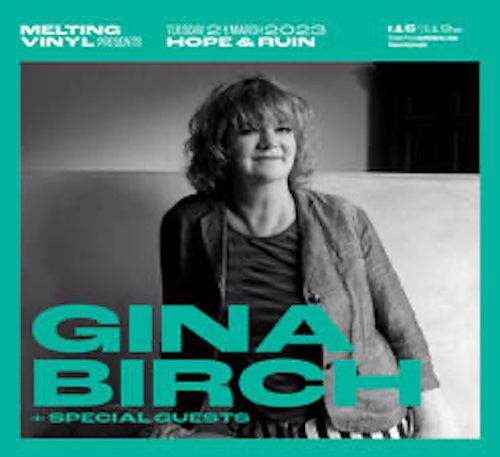
Gina Birch is from the Raincoats, of course one of the greatest post-punk bands if not one of the greatest bands. But as said after I last saw them, they were largely based on a double act. Portugese born, Ana da Silva always seemed beguiling and inscrutably cool. While Birch, English both by birth and manner, was much more an everywoman. I always associate da Sliva with second person songs, and Birch with first person. And she’s touring, perhaps remarkably, her first ever solo album. Would Birch alone be just half the picture?

When I say alone, the others in the trio join in on guitar and keyboards, with frequent swaps. (Bar one number where they all take up bass.) There’s no live drummer but programmed beats which rarely imitate a real drum sound, And the others also add catchy pop harmonies, often over skanking rhythms. They jerk their heads in an equally synchronised manner, like a post-punk Shangri Las. While Birch’s vocals are more stated or ranted. At time she seems to be channelling Marianne Faithful, existential torch songs.

As was common in post-punk, the Raincoats tended to sneak up on their subjects obliquely. While songs here can be more polemical, waxing lyrical on feminism or paying tribute to Pussy Riot. But they can also be laugh-out-loud hilarious. A whole number is given over to refusing to wear stilettos, going into some detail over more preferable forms of footwear. Which makes the whole set quirkily engaging and infectiously fun, never po-faced.

There’s precisely one Raincoats track, their only cover, ’Lola’. And as with the Raincoats lines like “girls will be boys and boys will be girls/ it’s a mixed-up, muddled-up, shook-up world” are less befuddled wail then cry of glee.

Punk nostalgists are always quick to tell you then was the time, and things can’t happen now. Missing the bit that if you make something happen… well then its happened, hasn’t it? First Slits guitarist Viv Albertine decided she was neither going to rest on past glories nor swerve up golden oldies, but break into something new. Now Birch has done the same thing. Or, as she put it itself in her album title, ’I Play My Bass Loud’. Remind them of this.

And here’s that very song from that very… okay, from Rough Trade in London if you must know. Still closer than normal…


GEORGE CRUMB’S ‘BLACK ANGELS’
Manchester Collective
Kings Place, London
Fri 24th March


The programme kicked off with ‘Carrot Revolution’ by Gabriella Smith. (The curious title coming from a Cezanne misquote.) It was one of those pieces which almost need a sign up on stage saying “it’s supposed to sound this way, honest,” as it scrapes and slides it’s way through varying tones and tempos. But rather than a difficult listen it’s lively and exuberant, the players jigging and swaying on-stage like this is one of those gig things.

My probably entirely wrong reaction was to think, as some contemporary composers become influenced by rock music, so had Smith been by klezmer. She’d develop rhythms which seemed just about to take over and turn things in a more regular beat-driven direction, for it all to take some unexpected corner.

Edmund Finnis’ second String Quartet was described as going from earth to air. And as the instruments fluttered and shimmered, it was exceptionally beautiful to listen to. But it didn’t prove terribly memorable, as if suffering from the ‘pretty face’ syndrome. It seemed the least contemporary-sounding work from the first half, though in fact it was written for the Collective.

Moor Mother’s ’DREAM CULTURE’ (in caps, it seems) was different again. After twice dodging the challenging bullet, we were now struck dead centre. Largely cello based with electronic tones breaking in, it was dark and brooding, one of those pieces which envelops you. It had everything the Finnis piece didn’t, and vice versa.

Before the headline work, they placed a section from Schubert which Crumb quotes from. (Though when it came it was inevitably too distorted for me to notice.) This passed pleasantly enough, but I confess such stuff just makes me think of stately homes and Gainsborough paintings. However, they did smartly use the opportunity to segue straight into the Crumb….

People who survived the Sixties will often tell you they were volatile, violent and chaotic, and notions of frolicking barefoot in the park only possible with a heap of hindsight. Political activists, particularly if black, often quite literally didn’t expect to survive. (We may have escaped the most extreme of that in the UK. But Crumb was American.)

And, written in 1970 and subheaded ’Thirteen Images from the Dark Land’, ‘Black Angels’ seismographs that Sixties. Let’s not deny it’s challenging. sometimes feels like the musical equivalent of a wild weather event, complete with eerie calms.

Those unlucky-for-some thirteen ‘images’ are crammed into barely twenty minutes of music. Which leads to a huge variety of sound compressed together. It can feel like there’s more musical ideas in those twenty minutes than most composers manage in a lifetime. But at the same time the mood range is confined - to turbulent, mournful and sinister. There’s no breath-back moments, it’s like a day with no break in the storm clouds, or a horror film which is just the scary stuff. (And that analogy’s not much of a reach, some of it was used in ’The Exorcist’.)

Though at times it feels less a reaction to and more an invocation of all that. To misquote Ken Kesey, less a seismograph than a lightning rod, calling down the storm. The staccato vocal utterances (labelled ‘Ancient Voices’ in the score), often just recite numbers in various languages, following Crumb’s interest in numerology. But they sound witchy conjurations, almost reminiscent of the vocals in some of Goblin’s soundtrack work.

There’s a running debate about what the references to ‘electric insects’ in the section titles comes from. Some have suggested the helicopters then strafing Vietnam. But as many of the effects require electronic amplification to work, it seems more likely it’s simply the instruments themselves. Crumb introduces some aids, such as glass rods and thimbles. But one interesting feature is for all that it is still a work for string quartet. Composers from this time were often moving into electronics and tape effects, particularly so when trying to map their times. Crumb sticking with strings has its own effects, like a dread warning being imparted by a once familiar voice.

Last time I saw this performed I heard a note of optimism in it. This time, to put it bluntly, I didn’t. Which is perhaps due to our own times growing darker. And probably makes it all the more important a work to hear.

The Manchester Collective seem a young and enthusiastic bunch, introducing the work without info-dumping a slew of obtuse music theory on you. And in the interval they turned Crumb’s score to face us, proudly pointing out it looked the scrawlings of a madman.

(This was being filmed... you know, properly filmed, so may yet show up somewhere.)

Saturday, 18 March 2023

BURD ELLEN/ CURRENT 93 (GIG-GOING ADVENTURES)

BURD ELLEN
The Brunswick, Hove
Fri 10th March


I came across Burd Ellen the same way I did Fern Maddie, from the Guardian’s ten best folk album list of last year. But the release than won that accolade, ’A Tarot Of the Green Wood’, ploughs quite a different furrow. It’s all traditional numbers, but not as we know them…

They announce they’ll be doing "one of those long, continuous sets like you read about in that ’Wire' magazine”. But it’s separate tracks run together, like a mixtape without gaps. Which is, I suspect, to defamiliarise the familiar folk gig, with all the to-audience explaining that this next song is from South Shropshire, not North Shropshire as was once thought.

What’s more, individual tracks can run so this just plays up that continuous sense they have already. To sound like that ’Wire’ magazine a moment, duration is made into a compositional tool, as much as it is in Minimalist music. It’s a set which takes time to steep but them becomes flavoursome.

The duo play behind a table laden with folk instruments and knob-twiddling gizmos. Even the glass of water gets put to a musical purpose. But if that has you ready to say ‘folktronicia’, that’s a term which suggests creative collisions. Whereas Burd Ellen don’t seem to make any such distinctions in the first place. For most of the gig, you wouldn’t know who was playing what without looking… in fact, it wasn’t always easy while looking. ‘Drone folk’ probably fits them better, taking the natural drone qualities of folk instruments and amplifying them.

In fact, rather than cleverly adding stuff, they tend to work at their best while most stripped down. If that table was laden, the less they pick up from it the better they work. The encore (which they seemed genuinely surprised to get) was down to voice, vocal loops and taps on the violin. Yep taps, not even bowed or plucked. Though I confess the one acapella number perhaps pushed a point too far, and was the one point my attention wandered.

If we have to have a sound-bite description, imagine a Lankum who are less dour and more enticingly eerie. The album, they can be keen to say, was released on Halloween. ’The Lovers’, with it’s references to a “green wood”, could describe a little girl lost in that deep dark wood, or be a siren call drawing you in.

And it warrants stuff I’ve been saying for some while now. We can’t truly reconnect with the past, but neither can we just forget it. So it will continue to haunt us, and so we should talk about how it haunts us. This is music which works like a lightning rod for phantoms.

Not sure there’s any footage of this tour, but this is both Burd and Ellen (note to self, check this is their real names before posting), performing ’The Hermit’ from Gateshead. A low-lit basement made a better setting for their sounds than a brightly lit glass-fronted gallery, but go with it…


Then, the very next day…

CURRENT 93
Union Chapel, London
Sat 11th March

If Burd Ellen are a recent discovery, Current 93 are a long-time fave at Lucid Frenzy Towers, producing one of my all-time favourite albums. If Burd Ellen are drone folk, Current 93 go in for apocalypse folk. They’ve since confessed they only coined the term as a joke, but like so many of these things the tag stuck.

A near-universal assumption has dominated recent years, that downloading has killed the integrity of the album. Current 93, however, continue to be zeitgeist-proof, and David Tibet (frontman and sole constant member) was probably busy learning more ancient Akkadian when that was announced. (Not a gag! The new album title came from some Akkadian he was perusing.)

You can pick out and play individual tracks from their releases, should you choose. But the albums have a thematic unity which turns them into part of a greater whole. And the past two times I’ve seen them they’ve played their last album through in track order, usually (as here) with the track titles projected on a screen.

Except this time, there’s a twist. Up to now each album has stood alone, a unique project with its own dedicated line-up. This time it’s very much a sequel to its predecessor, ’The Light is Leaving Us All'. (Which I saw live back in 2018.) The title, 'If A City Is Set Upon A Hill', suggests a shifting uptown of imagery from the bucolic English village imagery of last time. And themes, images and musical styles recur.

Notably, the post-album section of the gig, the part devoted to the more standard best-of, is dominated by a series of tracks from ’Light’. There was precisely one number from neither album the whole night, ’Sleep Has His House’. I guess, if you see more gold in that seam, you keep mining. And, as I suspected after last time, it all works better back in the atmosphere of the Union Chapel than the regular rock venue they decamped to last time.

Lyrically, Tibet combines the epic and eschatological with the more everyday. (“Read it in the tealeaves, read it in the stars.”) And the music does something similar, somehow combining grandeur and intimacy. Which might stem in part from the characteristically idiosyncratic line-up. Piano probably dominated, but combined with guitar, violin, wind instruments (including bagpipes) and two guys on laptops. One of which occasionally doubled on drums and, solely for ’Sleep Has His House', organ. (But this time no hurdy-gurdy. Perhaps the hurdy-gurdy players have joined in with the strike wave.)

’If A City Is Set Upon A Hill’ refers of course to urban planning coming before a fall. Which leads us to Tibet’s near-fixation with death and dissolution. It would be easy to caricature him as some blood-and-thunder street preacher screaming at us we’re all going to die, who has inexplicably drafted in a backing band. Their Marmitey reputation might well come from here, some look at them and that’s what they see. But, while they are certainly a most intense experience, to me that isn’t really right.

Granted, I’d be harder pressed to tell you what he is doing, but then I don’t think he’s making music with some specific purpose in mind. Not a fan of Damian Hurst, but when he titled a work ’The Physical Impossibility of Death In the Mind of Someone Living’, he was raising an interesting point. (The title was certainly the best part of the artwork.) And Tibet is in part straining against the certainty of that line, devoting decades of music-making to pushing back at a solid-seeming wall.

Further, death was not always seem as an outside interruption to life, but something woven into the fabric of things. And Tibet’s also trying to take us back to those folk culture days where he was a figure you might meet while out walking. A somewhat single-minded character, perhaps, but not necessarily a malevolent one. Ultimately, the intention isn’t at all nihilistic, though it may be somewhat fatalist. And the sombre beauty of their music conveys that.

They sound not at all like the Residents, the last band I saw in this venue. But there’s perhaps a similarity of attitude, of sticking to your thing whether there be head or tail winds. It’s the mark of a band where you leave a gig feeling you’ll see nothing like that until their next thing, and just what I felt here.

Ye Gods! Actual gig footage! The title track (sorta) and 'There Is No Zodiac’…


Saturday, 25 February 2023

ZOVIET FRANCE (GIG-GOING ADVENTURES)

Cafe Oto, London
Tues 21st Feb


The first time… the only other time I saw Zoviet France was way back in the Nineties. At one of those DIY arts events that happened more frequently before that much-feared dystopian future became our present. Not in a ‘proper’ venue, without stage or bar, we sat on the floor sipping from mugs of tea as the music wafted round us. Which was the perfect way to hear this legendary and possibly semi-mythical ambient duo, who I always like to think are named after an imaginary country. (Do I lie about semi-mythical? That ‘publicity’ photo of them ain’t exactly giving much away.) I was even apprehensive about seeing them again, fearing it couldn’t be the same… 

Then again, Cafe Oto isn’t a bad venue either.

They’d be another example of ‘the changing same’ in music. Dynamics are mostly eschewed. There are breaks and changes at times, true, but mostly there’s a slowly ever-morphing quality, where everything turns into something else before too long. The one time there was something like repetitive beats, their forward momentum was balanced out by a slow harmonica drag, played live and as if it were a drone instrument.

We tend to think of music, more than other arts, as a direct way to express an emotion. But a set such as this makes you realise how ill-suited regular music is to this task. Even a pop song has verses, choruses, bridges… too structured to capture the flow of thought, it works more like a speech or an essay. Whereas this, I contend, is the true music of the heart.

And so, of course, the thing which makes it appealing also makes it challenging to write about. It can be like trying to remember dreams, the act in itself pushes away the spirit that had once been there. But in my foolishness, I try to keep up this blog, and so…

They’re often tagged as dark ambient, even appearing on the Wikipedia page devoted to that genre. But if they came from the same post-industrial scene as Lustmord, they don’t really sound much like him. The nearest common descriptor for the sounds they produce would be analogue or organic, despite the abundance of shiny things on stage. In fact, the set starts with something sounding like vinyl crackle. Nothing even sounds sampled, referenced or ‘quoted’, even though it surely has to be. It’s not a melange of ingredients, it feels cut from whole cloth.

The mood’s serene, in fact I’d go as far as hymnal. (If that word could be shorn of its religious associations.) There’s the same mixture of quiet calmness with ecstatic states. It’s like one of those old Chinese paintings which depict an inherently ordered cosmos, in balance with itself.

The duo seemed to go quiet in recent years. (Though that’s a relative term in their case.) But there’s signs they’ve become more active again of late, and we can only hope so. No footage from this gig I could find, but this from supporting Autechre back in the Autumn… (Not as good a set, but still worth your time.)


Saturday, 11 February 2023

THE RESIDENTS/ FERN MADDIE/ JOHN CALE (GIG-GOING ADVENTURES)

Apologies for the lack of a post last week. I was brought down by the left-wing economic establishment. Oh alright then, it was flu...

THE RESIDENTS
Union Chapel, London
Tues 31st Jan


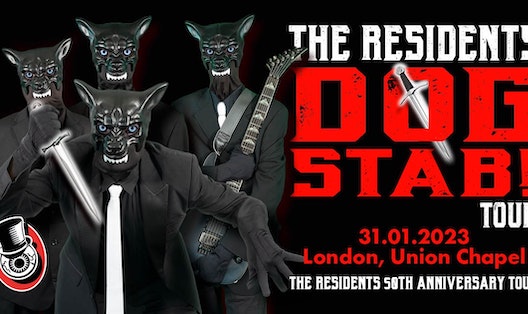
I originally saw the Residents on their fortieth anniversary, and it seems now here we are at their fiftieth. I’m not sure how that happened, but seems it has. Their pronouns are…

”Alternately seen as a rock band, an arts collective, and a spirit, THE RESIDENTS have been regarded as icons in the world of experimental music for almost fifty years… the group has also been credited with being among the originators of performance art and music video.”

And I’ve asked before whether they really were a band, or a multi-media arts collective who found it easiest to masquerade as a band, just one of their many masks.

Well never to be pinned down, tonight a band is just what they are.There’s an accompanying film show, but bar that they work dilligently through a set. Even hearing tracks timed in by the drums seems curiously ‘regular gig’ for them.

As ever, their vibe is still sinister clown, one lyric espousing their credo: “everyone comes to the freak show/ But nobody laughs when they go”. Which works with the ever-present masks and costumes they sport. Something taken (as it always is) to be about anonymity. But like it always is in actuality, it allows them to take on other characters. This succession of deranged personas aren’t exactly satire, in the way someone like Zappa stuck it to Western consumerism and the like. (Even if both had Beatles-based album sleeves.) The Residents are more like weaponised parody, turning the form of popular music against itself.


Take ’Kill Him!’, which might ostensibly seem another example of the singer impersonating born-again preachers in order to undermine them. But what powers the track is an underlying ambiguity; is this God recast as devilish tempter, or some psycho using The Old Fellah as an alibi for his murderous actions? (“Blood is thick but/ God is thicker/ I am sick but/ He is sicker/ God says, Die!/ So I must kill him, but/ Why does God want/ To kill children?”)

And the extremity and ambiguity seem to marinate together, into something more unsettling. (I confess I was slightly disappointed afterwards to discover it was on an album of Bible-based songs, which seems to give too much away.)

And their musical style is still like Kurt Weill was leading a drunken carnival parade. But the gigness of this gig (if you follow) makes you aware how many of these numbers might once have been tuneful ditties, before being thrown into their hall of distorted mirrors. (Though there’s not one of their patented twisted cover versions.) You need to be good at music to be this good at anti-music.

Something like Anarcho-Punk always felt to me like making deliberately bad music in the hope it would undermine the good, when it actually just made the good music sound better. Whereas the Residents make good music gone bad, a very different order of things. What can seem like regular and quite innocuous features of songs, such as repetition, transform into something menacing. I fear ’Constantinople’ will now always be one of those anxiety-inducing ‘trigger words’ in my mind.

…all of which means there’s a disruptive, culture jamming feeling, a sense of interrupting regular programming. And, as said after their Brighton show, a whole set of that can have diminishing returns, a sense of sucking on too many sour things at once. Perhaps accentuated by this night being just about their songs, without the film show breaks.

I’m not quite sure what the best way to hear them is. I listened to ’Duck Stab’ afterwards, which was all over the set list. And it sounds more varied, more inventive on record but more intense live. You pays yer money…

The Fab Four saying ’Constantinople’ (quite a lot)….


FERN MADDIE
The Foghorn, Portslade
Mon 6th Feb


Someone standing up and signing from the corner of a craft beer bar, which is about the size of a bedsit, there could hardly be any more of a classic folk gig setting. Okay, it should be a pub serving real ale by pulling at brass handles. Even folk has to make some concession to the times.

Except I’m only here because of That Thar Interweb, when the Guardian named Fern Maddie's self-released debut one of the ten best folk albums of last year. It turns out, so did the promoter. Who stepped in for a last minute save, after a mooted Brighton gig fell through.

She sings a combination of self-penned songs and traditionals. A New Englander, she may be well placed to drawn on both the British and American songbooks. But as she sings each the British songs sound British and the American American, they’re not at all blended. Which is handily visualised by her switching between banjo and guitar. (Though one isn’t used exclusively for either.)

She talks of being attracted to the cyclic, ritualised form of those old ballads. And folk is perhaps the blank verse of music. But when she performs them she tends to throw in extra sections. Not so major you’d necessarily even notice where these rock songs, but a bigger deal with folk. Which is probably the point, occasionally breaking from the circle both has it’s own effect and draws attention back to the circle. And I can’t help but associate both those things with her singing style. Which is dramatic without ever tipping over into the melodramatic, using less to go further.

Her own songs match all that, walking the dark side of the street. Maidens are a-drownin’ part-way into the first number, while another’s about a Mayflower passenger who died before even sighting land. (Who also drowns, though other forms of demise are available.) She often alludes to the fantastical without ever saying such a thing outright.

’Hares On the Mountain’, which may well be becoming her signature song, is built round a series of metaphors, but when sung somehow feel more than that, as if singing it might make it all happen. Her album’s titled ’Ghost Story’, though as she points out it contains no actual ghost stories.

The gig’s only downside was the odd structure it was given, stopping for a Q&A not once but twice, which worked against the spells being woven. Added to which the interviewee seemed an almost entirely different character to the singer, as if Maddie’s not yet used to this attention. There was also the lack of CDs for sale, perhaps all snapped up earlier in the tour. (Self-released means hard to get hold of over here.)

Those darn folkies look to have been too laid back to film anything from her UK tour. So instead, this is the video for ’Hares On the Mountain’…


JOHN CALE

De la Warr Pavilion, Bexhill-on-Sea
Fri 10th Feb


Between buying my ticket and this multi-delayed gig taking place, I gave a listen to Cale’s latest release, ’Mercy’. Only a cursory listen so far. But from it his post-millennium purple patch, well represented by his last visit to this venue, seemed over.

When the gig proved full of songs I didn’t recognise, I assumed it to be dedicated to that album. It seems there were older tracks, if chosen with characteristic eccentricity, but ’Mercy’ still dominated. Which meant I didn’t take to this gig as much as the last one. Though my problems with the gig weren’t the same as with the album…

The album’s main drawback are the smoothed-out electronic beats, which seem a characterless but constant presence across the tracks, like a plastic tablecloth stretched across a cafe. Whereas with the gig, it’s a live band with a live-band sound.

Multiple times, a song would initially seem skippable, only for some mysterious reason start to work mid-way. But others… well, others just seemed skippable. At times, almost MOR-ish. They also seemed to go in for long durations, a curious combination.

The old songs? Classic number ’The Endless Plain of Fortune’ was essentially the words to an entirely new backing. Then equally classic ’Chinese Envoy’ was played pretty much straight, but alas wasn’t a great version.

Late on he switched from keyboards to guitar, rousing a cheer. This proved to be like ending a set and starting another, mid-way through. The second half proved to be one extended Velvets-style workout, taking in ’Pablo Picasso’ along the way. A left turn from the rest of the night, and all the better for it.

Cale is clearly going to only follow his own star at this point. And at times that’ll coincide with where you’re going, and at others it won’t. Leaving it up to you, John.

’Moonstruck’ is, IMHO, one of the new album’s better songs. From Liverpool…


Saturday, 28 January 2023

THE DELGADOS/ BEAUTIFUL WORLD (GIG-GOING ADVENTURES)

THE DELGADOS
Concorde 2, Brighton
Fri 20th Jan


“Where you been?” someone shouts as they take the stage. He gets back a deadpan answer about road miles from Glasgow. But we all know. This isn’t just the first night of the tour, but the first Delgados appearance since 2005. (Before I started this blog, which I believe officially places it in pre-history.) 

Which of course raises the question of which Delgados we have back. Their indie credentials included being John Peel faves and launching the Chemikal Underground label, but musically they’d throw in the changes. (I made a hamfisted attempt to span their eras here.) When string players assemble on stage, it seems a give-away. This is going to be the time of ’The Great Eastern’, where such things augmented their sound.

In fact they pretty much play through everything, even their sparky power-pop origins. (When, in their own description, “two of us couldn’t play very well and two couldn’t play at all.”) They concentrate on their middle three albums, true, but that’s as it should be.

As the night goes on, we discover two things about those strings. First, appealingly, it’s the very same players as back then. Also, they’re used as sparingly as they were back then. It’s like the way only certain letters require accents, they embellish precisely where the music needs it and no more. Too disciplined to come in just because they’re there, they just sit quiet much of the time. Then and now a band credo seems to be “only do something where something needs doing.”

I don’t seem the only soul glad to see them back. The venue’s sold out, and pretty much every number gets only a few notes in before being met by applause. One comes to an emergency stop when a lead gets yanked, only to meet a bigger round of applause the second time. Quieter sections reveal pretty much everyone is listening, no-one talking. All of which makes of a pretty good start to a years’ gig-going.

Have they changed much in the interim? Not a whole lot. Songs so precision-engineered don’t lend themselves to radical reworkings. Alun Woodward’s fey, indie voice seems almost uncannily unaltered, but Emma Pollock’s, who was perhaps a little more rock even then, has gone more that way. Which can change the overall sound. ’Accused Of Stealing’ (always a personal favourite) probably isn’t played all that differently, but comes to sound more like the Velvets covering the song. Which is not at all a bad thing.

Someone else shouts if there’s any new songs. “Not yet”, they respond, a little teasingly. You never know your luck…

‘The Light Before You Land’…


‘BEAUTIFUL WORLD’
Brighton Philharmonic
Brighton Dome, Sat 21st Jan 


This programme was designed as a “Winter journey… exploring Arctic landscapes”. But more importantly, in a sign Brighton Philharmonic may be becoming more adventurous, every work was by a contemporary composer - all born within the last century, all bar one still living and one younger than me.

The opening ’Twine’ by Rolf Wallin, for marimba and xylophone, I confess did little for me. But the accompanying visual, by Kathy Hinde, a semi-abstract collage of river sediment and algae, was splendid. Hinde’s visuals continued throughout the night. And if they peaked at that point, they were all pretty darn good. Always inscribing themselves on your eyeballs, but never dominating over the music, more instillation pieces than mini-films.

It’s a peculiarity of life that Johny Greenwood is the guitarist of the risible Radiohead, yet can make music worth hearing when left to his own devices. This was a suite from his soundtrack to ’There Will Be Blood’. Six short movements were fitted inside sixteen minutes, of widely varying style and - it should be said - quality. Some did just sound like film music, when that’s the last thing film music should ever do. But others were way more inventive. Two successive movements I mentally dubbed ’Slide’ and ’Pluck’ after their dominant style of playing, with ’Slide’ seeming to shimmer in from somewhere else.

Philip Glass’ ’Glassworks’ from 1981 was described in the programme as “an immediate hit” which “introduced… minimalism to a huge public”. Which of course means it’s really post-minimalist. You listen to individual lines rather than a composite, and at points a particular player leads. Glass himself has confirmed he deliberately wrote something more cross-over, and the title has more than a little of the calling card about it.

Does that matter, when the music itself sounds this enthralling? (Partly because Glass can write so exquisitely for solo piano.) Only that, when minimalism when post-minimalist, a lot of the sense of nature left it. Those churning, flurrying wind instruments sound more like a machine. A serene machine, neither Victorian heavy industry nor malfunctioning Microsoft software, but still a machine. I think I tend to picture some dashing adventurer/ eccentric inventor sweeping along in some gleaming limousine, possibly powered by elegance alone. (Akin to the way Neu! can evoke the machine sense.) While his earlier works were more like mini-ecosystems. Notably, Hinde’s visuals shift away from nature scenes, to city squares and similar.

Of the two John Luther Adams pieces, ’Drums of Winter’ worked the best. Unlike anything I’ve heard from him before it was short and punchy, the polyrhythms of four pounding drummers. It could have been played to a rock audience and got a similarly euphoric reception.

While ’songbird songs’ did seem a regressive step in imitating birdsong. Nature can be an endless source of inspiration to art, but art imitative of nature is always going to be merely constrained. Some did work better than others, particularly ’mouring dove’ with its eerie Ocarinas.

’Cantus Articus: Concerto For Birds and Orchestra’, by Einjuham Rautavaara completed the night. As all that might suggest, the composer’s from Cleethorpes. Only kidding, its Finland. It tackled the bird song question more elegantly by playing back recordings over the music. Which confirmed the sheer strangeness of them, perhaps emphasised by being out of context. 

Musically, it was the most ‘classical’ work of the programme. I suspect when people used that word they really mean Romantic. And I was to read afterwards Rautavaara has been described as Neo-Romantic. At times my somewhat inexpert ears were reminded of Stravinski. But it had the sublime sense of the otherworldly that the best Romantic music has. There were points where the bird song enveloped the music, like a flock of feathers had somehow blown in the venue, and others where the two essentially met in the middle.

Psst! Brighton Philharmonic! Still three more seasons to go!

Saturday, 19 November 2022

OZRIC TENTACLES/ GONG (GIG-GOING ADVENTURES GO ALL COSMIC)

Concorde 2, Brighton, Thurs 18th Nov


Shortly after the sad death of Nik Turner seemed just the right time to attend an Old Hippies Reunited party, and as luck would have it a double-barrelled one came along…

I’m not sure how many time I’ve seen Ozric Tentacles now. There was a fifteen to twenty year period where it seemed almost impossible not to see them. Attend anything remotely resembling a festival or gathering and there they’d be. And I’m equally unsure when I last saw them, except it was some while ago. They would play regular venues too, but it what when that festival environment was clamped down on that they went out of my sight, like an animal losing its habitat.

Looking back, their sound was based on a kind of false memory. There wasn’t really a time when Psychedelic music overlapped with Prog, it was more than one waned as the other waxed. The bands who performed that transition, like Pink Floyd, tended to have a ‘mellow’ phase in-between. But that sound was why their best-known number came to be ’Kick Muck’, the guitar sounding less like a guitar and more like someone cranking furiously at a funnel which emits a ceaseless torrent of notes, so many and so fast they go by in a blur.

Guitarist Ed Wynne is the only survivor from back then. And the band’s become something of a family affair, featuring his ex-wife Brandi on bass, his son Silas Neptune on keyboards and a flautist and drummer whose names I failed to catch.

The standard thing to say about a longstanding band is what they’ve gained in ability they’ve lost in edge. Which sounds remarkably close to what music did when it morphed from Psychedelia to Prog. The greatest thing about Psychedelia being its abandon and derangement, and the worst thing about Prog being that it abandoned that abandon.

And for a band whose first-ever gig was a six-hour spontaneous jam at Stonehenge Free Festival in ’83, who often seemed to be jamming on stage, there seems little jam tonight. Wynne even introduced the tracks, something never done back in the day. The absence of ‘Jumping’ John Egan, who combined flute-plyaing with on-stage antics like a cosmic Bez, also changes the dynamic.

Nevertheless, if there’s now more smooth than rough, there was always some smooth. Unlike most festival circuit bands, they had (and have) the musical chops to work for those who stood to listen as well as those who waved their arms. There were points this set seemed to meander and my attention drifted, but overall it kept enough punch and was musically adventurous enough to take you with it.

The highlight, version of ’Kick Muck’ notwithstanding was the finale, also their most Dance-influenced number, where the abandanometer most definitely went into the red.

This was very much a double-headliner, with the auditorium packed and ready for Gong even at the un-rock & roll time of 8pm. In case there’s anyone left who doesn’t know who Gong are these days… Daevid Allen assembled a younger band around him (this time with no relatives) back in 2014, who released one album. After getting his no-hope diagnosis (the album was called ’Rejoice I’m Dead’), he suggested they carry on after he was gone, which they have.

But any debate about whether that makes them Proper Gong or a tribute band with validation is sidelined, when they play precisely one classic Gong track the whole set, even then segueing into it from somewhere else. Which was ’Master Builder’, my absolute favourite Gong track ever, so they made one Old Hippy happy.

How much the set drew on the one album made with Allen I don’t know, I’ve not heard it. Though at one point new new songs are announced. Pretty soon it became obvious that this was really only Gong in the sense of inheriting the family name, and you should look on them as a new band.

To which the verdict would be mixed. Some tracks did sound close to hippy music as described by its detractors, meanderingly pleasant music with ‘positive energy’-type lyrics. But, not just on ’Master Builder’, also elsewhere in their set, they proved that when they want to wig out they absolutely can.

Not from our fine shores, but more or less the right Ozrics line-up…


Saturday, 5 November 2022

MICHAEL ROTHER/ TEST DEPT (GIG-GOING ADVENTURES)

MICHAEL ROTHER + FRIENDS CELEBRATE 50 YEARS OF NEU!
Clapham Grand, London, Thurs 3rd Nov


As I may have given away by now I’m something of a Krautrock obsessive - particularly over what we might call the Holy Trinity of Can, Faust and… well, expect you’ve guessed the third one. And, after the unfortunate demise of Klaus Dinger back in 2008, seeing the remaining half of the duo is the closest we can ever to come to Neu! Rother’s joined by drummer Hans Lampe, who played on their third and final album, and guitarist Franz Bargman from Camera. 

Having seen anniversary sets of, in order, Can, Faust and now Neu!, I’d concede this was the most straightforward of the three - playing the classic tracks more or less as they were recorded back then. (Sometimes dipping into his other band of the era, Harmonia.)

But then again, these are classic tracks. It’s no exaggeration to call it some of the greatest music ever made. And it feels awesome to be in a room of fellow aficionados, enthusiastically clapping a few beats into each new number. Which is why I preferred this to the other time I saw Rother, where he concentrated more only his later solo output. Maybe Rother without Dinger is a little like a sweet ’n’ sour with just the sweet. But seriously, if you can’t celebrate fifty years of Neu!, I really don’t know what you can.

And also, as a duo, Neu! back then were really confined to be a studio project, only playing live with their expanded line-up of the final album. Leading to the sense that all this isn’t retrospective so much as overdue. And it’s not just great music, it’s great music to hear live, serene and ecstatic at the same time. So irresistibly dancey were they, codgers even older than myself were to be witnessed abandoning themselves to the moment. (There may have been a few aching joints the next day.)

And also also, people picture Krautrock as science fictiony. Which may be partly true of Kraftwerk, but doesn’t apply to the Holy Trinity. Neu! may lend themseles to machine metaphors, but there’s nothing to suggest anything futuristic. And nature analogies apply equally well. So if, in the well-know adage, nothing dates faster than science fiction, there’s nothing here to date. In fact you could easily believe it sounds as fresh today as it did fifty years ago. In Neu!s case the absence of lyrics also helps, nothing which might pin it to an era. (Fans of ’Hero’ look away, but they skip the few numbers Dinger sang on. Only one track had vocals all night.)

Speaking of machines, I’ve waxed lyrical before how their sound ”glides as if … so pure a thing as to be untroubled by the lumpen world of gravity. Its pulsing drive, repetitive yet so propulsive, always seems to be stretching ahead of you. It's like the car that always seems to stay in front of you on the motorway, seemingly sailing ahead without burning up any energy.”

And indeed part of the backdrop film show was of the camera drifting freely down the motorway. A coincidence? Probably. But I’m going with it anyway.

Neu! may have exceeded even Faust and Can in the disparity of lack of immediate units shipped and long-term influence felt. Post-Punk, Dance and Electronica all owe them an unpayable debt. And as a sign of that esteem those promised “friends” turned out to be Stephen Morris of New Order and Paul Weller, joining them for the encore. I’m not sure that musically they contributed all that much, but perhaps being there’s the thing.

Actually a Harmonia number, but it’s all good…


TEST DEPT/ BLURT
The Albany, London, Sat 29th Oct


“Test Dept's formation in 1981” it says here “in the decaying docklands of South London, was an urgent reaction to the materialistic drift and reactionary conservatism of the prevailing musical and political culture. TD rejected the conventional and developed a style that reflected the decay of their surroundings scavenging the unregenerated wastelands for raw materials, and transforming found industrial items into designed, sculptural instruments…. It was the antithesis of commercial record industry values.”

I have to admit I never quite caught up with them back in the day, even missing the famous Brighton show where they used police riot shields for percussion. But I liked the sound of them when I heard them. And, well, I liked the sound of them. Industrial outfits, to varying degrees, tended towards dodgy ‘provocations’ which seem even worse looking back from our era of hipster racism. While Test Dept were unapologetically Leftist, all Constructivist typefaces and collaborations with a striking Miner’s choir. More in the spirit of Mayakovsky than Charlie Sodding Manson. And more Mayakovsky means more me.

When this gig was announced, they commented they’d be glad to be back in New Cross, the place it had all started out for them. And, walking round the area beforehand, I discovered how Old London New Cross still is - graffiti, political flyposting and (perhaps most remarkably of all) cafes that give change from a tenner. Made all the more bizarre by the way you can constantly see Canary Wharf on the skyline.

While Blurt went through their set (more of which anon), visible behind them was a metal scaffold sporting sheets of metal, dangling chains and various extemporised devices which might have been musical or torturous in intent. If there was such a thing as Chekov’s Percussive Supply, that would have been it. It was then placed literally centre stage. And yes, they did all go off.

The set started with high-register electronics, pounding drums and everyone else pitching in on percussion. And bar occasional outbreaks of wind, usually on strange and ethnic-looking devices with names unknown to me, that was the musical set-up. One member showed a remarkable ability not just attach a bass drum to him but to march around with it.

Beats are martial, unrelenting, providing no release. And that era had a penchant for musing the master’s tools against him, calls-to-arms enlisted against the arms trade.

The drummer… you know the actual drummer looked young enough to be a recent recruit. And I wasn’t quite sure how the splendid drumming was down to him or the drum sound. But it was surely something of both. They rattled and resounded like an Ironmonger’s shelves all being upended at once.

Not knowing their output well, I couldn’t tell you from when the set was pulled. Some lyrics sounded quite contemporary, so I deduced not an entirely historic set. I further guessed several tracks were from the Nineties, when they took on more of a Dance influence. (Before they came on the canned music notably switched from the Stooges to House.) Though it seems it was dominated by the new album, ’Disturbance’, and sounding pretty good for it.

The Dance direction is now often ridiculed, like it was all old Punks desperately reaching for relevance. But in fact they’d spotted something in the music which they could work with, its insistency, its powerful production-line beats. And jettisoned the parts which didn’t work for them, such as the blissed-out hedonism. Besides, it all sounds pretty dancey, whenever from.

The only weakness… okay, you can’t bash and shout the whole gig long. And some of the more ambient passages were actually pretty good. But they got a little too ambient at points for a gig setting, and you felt the audience’s attention starting to wonder.

But overall, you know the way T-shirt manufacturers kept busting the ceiling of their scales. (L, XL, XXL and so on.) You may need something similar to convey the intensity of this performance.

Blurt are a Post-Punk band dating back even further, to 1979. They once played Brighton semi-regularly, but it must have been over fifteen years ago, as I don’t seem to have blogged about them before.

They’ve the peculiarity of being a beat-driven band not incorporating a bass player. Which they often manage via the guitar and drums trading places. Guitar lines can me the most metronomically simple, or even tones, while the drums power the number.

Frontman Ted Minton’s sense-defying lyrics, sometimes declaimed poetry and occasional sax blasts don’t just make the connections between Post-Punk, Dada and Beat recitals, they more defy any distinction between them. It’s all sound and fury signifying nothing, and that’s the very point of the thing. (The titles given to their discography gives some of this away.)

If memory serves, they were better fifteen years back, to be truthful. But they’re still worth catching, and provided the vital role of a support band to provide something unlike yet complementary to the main act.

Friday, 28 October 2022

GILLA BAND/ ORCHESTRE TOUT PUISSANT MARCEL DUCHAMP (GIG-GOING ADVENTURES)

GILLA BAND
Chalk, Brighton, Sun 23rd Oct


I last wrote about Dublin-based noise rock outfit Gilla Band after they appeared in this very venue six years ago, back in the days when things still went by the old names. They were then Girl Band, it The Haunt and my blog was… okay, some things never change. That was for their debut release and they’re now up to their third (‘Most Normal’). But its quality not quantity, innit?

Two Gillamen swap between guitars and electronics, though you’d be hard pressed to tell one from the other by sound alone. They can play audaciously stripped-back lines, sometimes just tones, colour fields not as serene Rothkos but shrieking hues.

Perhaps unusually for a noise-based band there’s a string dance music element, further evidence it shouldn’t all be seen as happy-clappy hedonism but willing to engage in sonic abrasion of its own volition. They’re professed fans of the Contortions, where No Wave cross-bred with disco. And the finale’s their storming cover of the Industrial Techno track ’Why They Hide Their Bodies Under My Garage?’. Last time they opened with it, and it’s effectively become their identifying song.

Which leaves the singer Dara Kiely often contributing the most melodic element. True, his penchant for frenzied Malcom Mooney-style madness mantras isn’t going to get him calls from Coldplay any time soon. (One lyric lists the various manufacturers of “shit clothes”.) But you could imagine more Death Grips-style vocals going with that music. He’s enough to keep them attached to something like regular rock music.

Famously they started out while still in secondary school, as an Indie band modelled on the Strokes. That’s never really quite gone away, and it serves them like a gift. Rather than flying off into free noise or falling back into white boy blues, they’re able to go further into what they were already doing, with greater and greater intensity.

None less than the Guardian called this new release a “turbulent masterpiece”. And it’s true that Kiely has been open about facing mental health problems, which he does seem to have used for musical inspiration. But at the same time it’s a common error to see music just as displaced autobiography, one which can steer you away from actual listening. And there’s a definite sense of humour to it all. Even if you missed it in Kiely’s lyrics it’s there in his voice.

Let’s compare them briefly to two other noise rock outfits who have showed up here. Show Me the Body had a much more angsty vibe, a sense that down these mean streets a power noise trio must strike up. While Lightning Bolt conveyed the sheer exhilarating thrill of throwing up a racket.

It would be temptingly easy to say Gilla Band exist in some midpoint between these two, like the Change UK of noise. But I don’t think they’re anything so fixed, they’re more able to straddle both spaces at once. Like the proverbial glass of water which can be half full and also half empty, all depending how you look at it.

Kiely was meet ‘n’ greeting the merch queue after the gig, demonstrating a highly Irish ability to treat a long line of strangers like long-lost friends. I made some quip to him about the meaning-defying lyrics. “I don’t know what they mean,” he replied, “but I believe in them.” And I think I probably do too.

From Leeds…


ORCHESTRE TOUT PUISSANT MARCEL DUCHAMP
The Con Club, Lewes, Sun 16th Oct


The brainchild of double bassist Vincent Bertholet, Orchestre Tout Puissant (“All Powerful”) Marcel Duchamp “mix free jazz, post punk, high life, brass band, symphonic elements and kraut rock, [and] make a transcendental, almost ritualistic music.” They’re named part in tribute to great African ensembles, and in other part (of course) to the arch-Dadaist.

Not kidding about that Orchestre tag, quite remarkably they have more members than words in their name. The most recent release and publicity photos features twelve members, but I counted thirteen on stage, including double drummers, twin marimba players, electric guitar, strings and brass.

Though to my mind they’re more an ensemble than orchestra. There are times when they play with counter-rhythms. But mostly they use their amassed numbers to all leap upon a groove. Their credo being “the more the merrier”. There’s a few points where they allow a second’s pause before the full outfit kick in, perhaps not a new trick but an effective one. The result is a set which feels pretty much all highlights.

The vibe they give off is some Arkestra-like collective, who practice eleven hours every day at the commune and then take turns to stir a big pot of mung beans. But, for a Swiss-based band they seemed to have a fair few English members, including the two main singers. Most vocals were choral and harmonious, floating over the music. Their unshowy ‘unrocky’ nature gives it much of its engaging quality.

But also… one of those singers turned out to be Jo Burke, last seem singing a cappella folk songs in a Sussex field. Her declamatory open-tuned cry made perhaps a strange fit the the syncopated beats. I couldn’t say why it worked, but it sure seemed to.

There’s a virtuous combination between their constant inventiveness, where you have little to no notion what might be coming next, and the infectiously uplifting quality of it. Perhaps the ‘Marcel Duchamp’ and ‘Tout Puissant’ parts of their name represent those two elements. Probably not, but I like to think so. I can’t be sure, but I suspect that even I might have been smiling.

A slightly different (and don’t tell Rees-Mogg but less English) line-up to the UK tour, but still very much worth a watch…