googlee7ea825f63edb3f6.html
Showing posts with label Absurdism. Show all posts

Saturday, 7 December 2024

WHAT IS ABSURDISM?


“They had it in for us, didn't they? Right from the beginning. Who'd have thought that we were so important..?”
“To be told so little – to such an end – and still, finally, to be denied an explanation...”
“In our experience, most things end in death.”
- 'Rosencrantz and Guildenstern are Dead’,
Tom Stoppard

It’s something of an absurd question, of course. Absurdism, surely that needs to stay indefinable by definition. We can say it overlaps greatly with Dadaism. But they're not identical.

Dadaism inclined heavily to the political, to shock tactics launched against bourgeois society. Its schtick is to exist permanently in the interchange between nihilism and insurrection, never quite siding with either. While Absurdism is more existential, more likely to reflect a general modern or even human condition. Dadaism is volatile, a corrosive that will try to burn its way out of any container it's put in. Absurdism is weighty. Not in the sense of great literary worth, in the sense of rocks in your backpack. 

Absurdism is best seen through the collision term 'passive protagonist'. The term protagonist has a double meaning – the central character, and the advocate or champion. Normally this doesn't trouble us too much, as the two travel so comfortably together. You could pretty much substitute 'hero' for 'protagonist' most of the time, without spannering any of the works.

But the hero brings meaning to his world, his actions ensure good will prevail and all the rest of it. While the Absurdist protagonist looks hopefully for meaning already existent in the world, and comes up confounded. In fact the two probably grew up together, as conjoined twins, each a reaction to the other, at least if the emblematic hero is taken as the purest form of the heroic type.

But… mirror, mirror on the wall… the awkward yet inescapable truth is that we live our lives more as Absurdist protagonists than heroes, we are more Josef K than Flash Gordon.

In Absurdism the protagonist is like a child on their first day in school, like a dreamer in a dream state. Mark Fisher summed it up: “This world was made for me, yet I have no place in it.” The adult often chooses to remember the child state indulgently, as a form of escapism, a break from responsibilities, filled with curious wonder at the beguiling world. But children often feel an all-thumbs frustration with what surrounds them. While it can have its effect on you, you are unable to work any traction upon it. Even objects do not seem obedient to you, while they seem so acquiescent in adult hands. You live in a world that makes no sense to you. And that is its power over you.

And so Absurdism’s passive protagonists are very often children or dreamers. In the case of both Carrol’s Alice and McCay’s Little Nemo they're both. Yet they don't need to be. Josef K from Kafka's ’The Trial’, is perhaps the ultimate passive protagonist. Nobody bothers explaining the rules to him, like the child in a particularly badly run custody case, and he can only surrender to the course of events.


In this way, though they may overlap philosophically, the Existential novels of Sartre and Camus are not Absurd. They take place in ‘real’ words, not just places we have heard of but which conform to recognisable rules. Absurdist works are always ‘unreal’, the most basic facts uncertain, and for that reason bleaker. Existential protagonists may discover agency, usually with great difficulty and at huge cost, but the task is not impossible. In Absurdism, reason is not just absent. The universe actively defies it, and works to repel it should you dare to try to wield it. The laws of physics themselves may decide to turn on you.

If there is an uncertainty to Absurdism, it lies in the humour. Because many Absurdist writers were held to be important, they were taken in deadly earnest by critics. Yet there's accounts of Kafka reading his works aloud to his friends, and all falling into convulsions of laughter. But it's not just that the humour is black. It's that even when you find laughter irresistible, you're never quite sure that's the right response. Is it just a defence mechanism on your part? It's like the adage about a laugh being a scream played at a different speed.

So if Absurdism has to contain humour, does humour have to contain Absurdism? Perhaps ‘have’ is too strong a term, but its common. As Priestley said: “Good clowns never try to be funny, they are eager, hopeful creatures, lost in a hostile world, and with great clowns the very furniture is menacing, never to be trusted.”

A friend, a huge fan of Laurel and Hardy, once told me that as a child he’d found them unbearable to watch. The way events constantly thwarted their plans seemed too much like real life. Which is perhaps why comedies can have ‘bad’ protagonists (Wile E Coyote, Dick Dastardly, Black Adder) whose perpetually failing schemes are dampened from invoking our sympathy.


But nothing can entirely remove the central dilemma. Absurdist fiction can appear like some sort of homeopathic remedy, by recognising the absurdity of the situation in a work of fiction we emerge better prepared to engage the absurdity in our lives. But does this work? Do we make Josef K our whipping boy to console ourselves that we would not become as weighted down as him, that we would fare better if given the role of protagonist?

Saturday, 29 January 2022

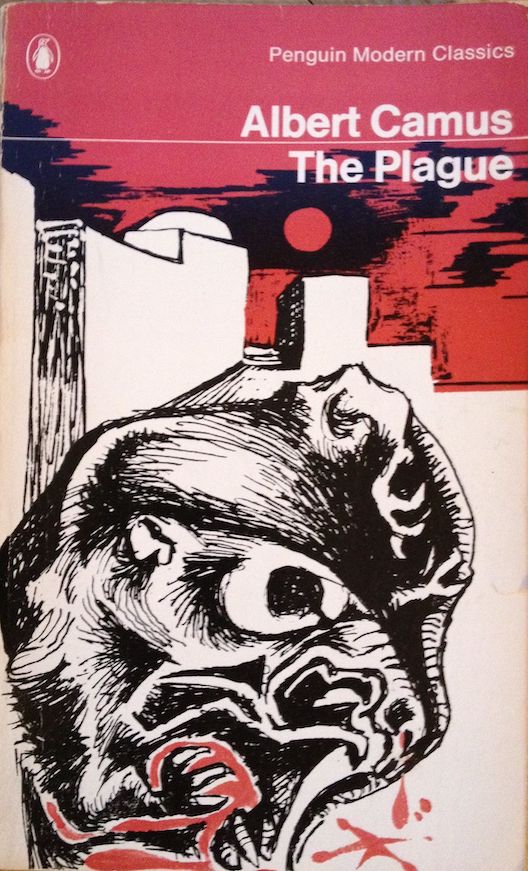
“THE VOICES OF THE STRICKEN”: CAMUS’ ‘THE PLAGUE’


Continuing my extremely irregular series on Existentialist novels, I somehow had the bright idea that Albert Camus’ ‘The Plague’ might be a good way to take my mind off contemporary events…

”It was undoubtedly the feeling of exile – that sensation of a void within which never left us, that irrational longing to hark back to the past or else to speed up the march of time.”

Published in 1947, Camus’ account of the bubonic plague striking the (sort of) French town of Oran is normally taken as a metaphor for the recently concluded War. Which was spanned in the Road To Freedom trilogy written by his (sort of) compatriot Jean-Paul Sartre. (Looked at here, here and here.) And, like Sartre, Camus had been involved in the Resistance.

But this reading is one of those fine-sounding ideas which falls apart on inspection. It seems to come down to one passage:

“He knew what those jubilant crowds did not know but could have learned from books: that the plague bacillus never dies or disappears for good; that it can lie dormant for years and years in furniture and linen chests; that it bides its time in bedrooms, cellars, trunks, and bookshelves; and that perhaps the day would come when, for the bane and the enlightening of men, it would rouse up its rats again and send them forth to die in a happy city.”

Which does bear a resemblance to something we know to be about fascism, Brecht’s epilogue to ’The Resistible Rise of Arturo Ui’:

“The world was almost won by such an ape!
“The nations put him where his kind belong
“But don’t rejoice too soon at your escape
“The womb he crawled from still is going strong”


But there are obvious reasons why Brecht would dress the Nazis up as Chicago gangsters, just as there were for Arthur Miller to relocate McCarthyism into the past. What benefit lies in dressing Nazis up as a disease? Doesn’t it sound, if anything, like a metaphor a Nazi would use? Moreover, Sartre was happy to talk about them directly. Why wouldn’t Camus do the same?

Fascism is political, historically contingent. As Camus knew, it can fall. As we now know, it can rise again. Plague - at least as portrayed here - is a recurring inevitability, part of the fabric of things which you adjust yourself around.

In fact, Sartre presents Nazis but is not especially interested in them. He is not writing historical novels, even if they have a historical setting. Instead, both writers use a destabilising external event (whether plague or war) solely to provoke their characters into reaction. Their interest lies in that reaction, not so much in the cause.

There are, however, important differences between the two. Sartre strives as hard as he can to get inside individual heads, showing events only through their eyes. Whereas Camus has written a character study of a town more than any of its inhabitants, which characters introduced largely so there can be someone there to describe it to us. While Sartre kicks off with his author surrogate Matthias, for his first chapter Camus doesn’t even feature an individual character. And he frequently returns to a wide-angle view of the town. Significantly, two of his cast are outsiders. When we first encounter Tarrou we’re told nothing other than his observations of the townspeople, as if he’s going to be our camera.

Not, Camus is at pains to tell us, there is much to see in Oran. The portrait is more unsparing than flattering. It’s distinguished by “ordinariness” and “banality”, a featureless landscape without even trees to break up the endless white. And its population are equally distinguished by habit. A Jesuit priest sermonises that the plague is due to insufficiently devout behaviour, a theory treated much as you’d expect. But the suggestion the townsfolk had the plague coming in some way or other is persistent, mostly remaining a lurking suggestion but sometimes breaking cover:

“It was as if the earth on which our houses stood was being purged of its secreted humours - thrusting up to the surface of the abscesses and pus-clots that had been forming in its entrails. You must picture the consternation of our little town, hitherto so tranquil, and now, out of the blue, shaken to its core, like a quite healthy man who all of a sudden feels his temperature shoot up and the blood seething like wildfire in his veins.”

(It’s not my main interest to compare Camus’ fictional plague with our actual one. But this does seem reminiscent of Benjamin Zephaniah’s recent comment about our returning to normal - “normal is what got us here.”)

Further, it’s well known that Camus rejected the commonly applied Existentialist tag, preferring Absurdist. We tend to imagine Absurdist literature as outwardly fantastical, as in Kafka’s transforming beetles, or at least making no attempt to set itself in a plausibly real world, as with Beckett’s tramps. Absurdist becomes inevitably intermingled with absurd in the more colloquial sense. Martin Esslin, in ’Theatre of the Absurd’, defined it as “the open abandonment of rational devices and discursive thought.”

Whereas this is a series of quite plausible events set in a real town. For example, Rambert’s trying to break out of quarantine because he wants to see his girlfriend in Paris, a motive which seems almost too petty to make up. The book also cleaves to a strict chronology, chapters effectively crossing off the months of the calendar, April to February.

But Camus wilfully smears the the edges of this of this realist picture. How are we to parse, for example, Grand’s attempts to write a novel, a hopelessly Sisyphean task in which over endless attempts he only ever writes and re-writes his first sentence? It’s hard to accept this grand folly as realist. Yet it isn’t treated any differently to any of the other events, the text as dispassionate in describing it as the responses of the other characters. Such tastes of the Absurd aren’t common but they are present, a spice sprinkled into the overall grey flavour.

Tarrou and Cottard have their attitudes transformed by the plague, so suddenly in the latter case that I initially thought I was getting characters confused. Cottard gains a new lease of life from being thrown back in the community of men, while Tarrou shifts from observer to participant. And even though the effectiveness of his actions are questioned, this is something which seems close to the novel’s heart. Ed Vulliamy has argued in the Guardian that “the group of men gathered around the narrative represent, it feels, all human response to calamity. Each takes his turn to tell it.”

“Thus week by week the prisoners of plague put up what fight they could. Some even contrived to fancy they were still behaving as free men and had the power of choice. But actually it would have been truer to say that by this time the plague had swallowed up everything and everyone. No longer were there individual destinies; only a collective destiny, made of plague and the emotions shared by all.”

(Not a paragraph you can picture Sartre writing.)


But there’s an ill-fitting piece in this picture, in fact a sizeable one. For nothing similar happens with the main character - Doctor Rieux. Less dramatically heroic than resilient, he trudges solidly from the book’s start to end, with an almost permanently affixed air of focused calm. And he becomes the thread. You soon come to feel that any character could come down with plague and be offed at any point, with the sole exception of Rieux.

His “severance from his wife”, who leaves town just before the plague hits, suggests that his personal connections went with her, leaving him permanently on duty. Quite late in the day there’s a scene where Tarrou opens up to him. But the event is noticeably one-way.

He insists “there’s no question of heroism in all this. It’s a matter of common decency…. the only means of fighting a plague is common decency.” And he must be this unfailing to match and counter his remorseless opponent.

“The narrator is well aware how regrettable is his inability to record at this point something of a really spectacular order; some heroic feat, or memorable deed like those that thrill us in the chronicles of the past. The truth is that nothing is less sensational than pestilence, and by reason of their very duration great misfortunes are monotonous. In the memories of those who lived through them the grim days of plague do not stand out like livid flame, ravenous and inextinguishable, beaconing a troubled sky, but rather like the slow, deliberate progress of some monstrous thing crushing out all upon its path… it was a shrewd, unflagging adversary, a skilled organiser, doing his work thoroughly and well.”

In what will seem a segue, let’s turn to Camus’ strange quirk of slipping between quoted and reported speech in dialogue, such as…

“Is it true” asked Character A, “that even though I am speaking to you directly you will respond in reported speech?”

Character B replied that they were indeed responding in reported speech.

He does this often, and often without any apparent rhyme or reason - but the most with Rieux. And he tends to do it most when Rieux is giving out some generalised pleasantry, or being placatory. For example:

”Do you think, Doctor Rieux, that the epidemic will get worse?”

Rieux replied that one could only hope it wouldn’t.


Rather than voicing his own thoughts, it’s a more widely applied version of the Doctor’s bedside manner. Which leaves us with a terse and private character, even from us.

As a quote above shows the Narrator repeatedly establishes their presence on the page. The Blog Post Author found this odd for a novel written after 1790. By this point the conventions of the novel had been well established, and could be taken for granted. Yet both Sartre and Camus, in this sense very much Modernists, accept none of this, and insist on rethinking things from first principles. One of which is the novel’s very existence. Someone must have witnessed these events, after all, for us to be told of them.

There’s a brief early reference to the narrator’s identity being revealed, and another at the end confirming this is Rieux. Which doesn’t exactly count as a spoiler. It’s more like one of those plot twists which has you responding “I didn’t know I wasn’t supposed to know that”. We may be glad that Camus didn’t go in for whodunnits. But, however eccentric, we may be better off focusing on how fitting this is. It’s less about giving us a diegetic reason for the novel’s existence than the role of that reason in establishing its tone.

….which is evocative and yet dispassionate. Rather than indulging in flourishes it captures images as sharply as defining legal clauses. (For example, the phrase “clubs where large sums change hands on the fall of a card.”) We’re told…

”The narrator has aimed at objectivity. He has made hardly any changes for the sake of artistic effect, except those elementary adjustments needed to preserve his narrative in a more or less coherent form.”

…while we’re also told of Rieux:

“The language he used was that of a man who was sick and tired of the world he lived in - though he had much liking for his fellow-men - and had resolved, for his part, to have no truck with injustice and compromises with the truth.”

Then later:

”This self-imposed reticence cost him little effort. Whenever tempted to add his personal note to the myriad voices of the plague-stricken, he was deterred by the thought that not one of his sufferings but was common to all the others, and that in a world where sorrow is so often lonely this was an advantage. Thus, decidedly, it was up to him to speak for all.”

In short, if Rieux is sometimes quoted through reported speech, the whole novel is a kind of reported speech. But if he often functions simply as a lens through which we might see the town, we get hints as to more…

Though set in occupied Algeria, this seems largely a convenience based on where Camus himself was based. (Though he didn’t live in Oran itself, most likely picked due to a more historic outbreak of plague.) The town needs only to be provincial to Paris, and could be shifted to southern France with little effort. 

However an exchange between Rieux and the journalist Rambert hinges on one word. Rieux asks if a proposed article on living conditions in the Arab quarter could be an “unqualified condemnation”. And when Rambert baulks at “unqualified”, Rieux’s reticence returns and he refuses further co-operation. The implication is that, there being no-one who wants to hear of this, it is pointless to say it.

Yet what is strong writing when considering the character of Rieux is pretty weaksauce as far as the locals go. If Sartre did not always present his minority characters terribly well, the lack of Algerians in a book set in Algeria is a little troubling. You sometimes wonder if the Spanish characters are introduced as a kind of half-way house, of twilight morality but still a slightly more respectable substitute for the natives.

There is a reference to quarantine driving up food prices…

“The result was that the poor were in great straits, while the rich went short of practically nothing. Thus, whereas plague by its impartial ministrations should have promoted equality amongst our townsfolk, it now had the opposite effect and, thanks to the habitual conflict of cupidities, exacerbated the sense of injustice rankling in men’s hearts.” 

…but who would most of “the poor” have been in occupied Algeria? It’s not hard to guess. But it’s not said aloud.

And while we’re at it, female characters do worse than with Sartre, in number or importance, which wasn’t a high bar to start with. “Self-effacement” is specified as a feminine virtue, one in which the gals here seem to excel. Rambert’s off-page girlfriend does appear briefly at the end, but is given neither a name nor any dialogue. (Though she is Parisian, so she may just be too snooty to talk to the locals.)

Here, then, Camus has Rambert’s fault and has not written an unqualified condemnation. Like Rieux, we shouldn’t fail to notice this. But unlike Rieux, we don’t necessarily need to cut off all co-operation. Within the parameters it sets itself, perhaps as provincial as the town setting, the novel’s a success.

Sunday, 22 December 2013

UBU ROI

Cheek By Jowl, Barbican Theatre
Should you not be familiar with this infamous play, an absurdist assault on the senses, know first that it's first Parisian staging in 1896 led to instant audience uproar. (Author Alfred Jarry later claimed he'd hired goons to stir by countering the rest of the audience, cheering when they booed and vice versa.) At the inaugural Dadaist club, the Cabaret Voltaire, extracts from the play were read. It's plot and, more important, tone were actually best described by another audience member I overheard - “imagine 'Macbeth' if it had been written by Cartman from 'South Park'.” (And I really wish I'd said that.)

Initially, I'll admit, I was suspicious of the notion of a version with live actors. I've always contended the play works best either with puppets, as was a Jarry's original intention, or as an animation. (The first public performance used actors, but masked and described by Jarry as “man-sized marionettes”.)

Both mediums lend themselves to render the title character as monstrous and diminutive, and are least likely to try and humanise the sick beast. (He was described by the Independent's Paul Taylor as “an ovoid oaf... a Humpty Dumpty monarch with a loo-brush for a sceptre and a set of a lavatorial id-like appetites ungoverned by the least suggestion of a superego.”) Crucially, his motives must be as petty-minded as his means depraved. In particular, the faintest whiff of 'proper' acting, of digging Stanislavaskian depths into his green candle, are to be avoided at all costs.

As it transpires, Cheek By Jowl have found an ingenious way around this. They give a performance that's (in the colloquial sense of the word) schizophrenic. They start out with a naturalistically played scene, a dinner party held in the gleaming white of a designer home. This then flips arbitrary into the id-world of Ubu, the gestures suddenly spasmodic and grotesque, the voices strangulated and guttural. Lighting switches and projections then change the environment almost entirely, even as we're aware we're looking at the same scene.


That last part is crucial. Throughout the props remain the same as the standard domestic paraphernalia – a lampshade becomes a crown, a food blender a weapon, silver foil booty, like children's play transforming the meaning of objects while their parents are out.

In one memorable scene the dinner guests arrive, then promptly reverse out again – as if in a backwards film. Their seemingly spontaneous gestures, their waving and hugging are reproduced exactly, suggesting they were never so naturalistic in the first place.

...all of which is of course as Freudian as my green candle. One is id to the other's ego, the sublimated struggle of each against all, buried only slightly beneath those bourgeois pleasantries. Proceedings swap jolting back and forth between the two, chalk cut with cheese, never giving you the chance to get used to either.

The resetting is perpetuated through the performance, and needs to be. Back then, you could stun an audience with the word “merde”, which is precisely how Jarry started this play. Yet literal versions of Ubu staged now, “merdes” all present, would no longer have any shock value left to trade. It would be like the Sex Pistols reforming and... oh, hang on, that actually happened. Anyway, you take the point. The closer the imitation, the more the point will be lost. It's a straight choice between preserving the form and keeping the spirit. Which is, I suspect, why director Declan Donellan reacted with umbrage when an interviewer described the play as a classic - “I don’t do [these plays] because they’re classics; I do them because they’re good.” Which is of course precisely the right attitude.


And Ubu without the accoutrements, the hood, the spiral on the pot belly, works like the vampire without the cape or the superhero without the cowl. Which is to say, it works. It short-circuits expectations, discards what once might have been emblems but are now merely heirlooms, to get closer to the heart of things. The result is a richly grotesque seam of black humour, where you're often not sure whether to respond with shock or mirth, and mostly can't help but do both.

The play is performed entirely in French, with surtitles for us linguistically challenged Brits. Much like the live actors, I wondered how this would work. Keeping to the original language is not necessary. Jarry's text could hardly be more basely anti-poetic so is hardly likely to lose in translation. But, much like the live actors, it works surprisingly well. Our received images of French may be as the language of romance, diplomacy and expensive consumption, but in actuality it lends itself to the guttural with ease.

While the performance was almost ceaselessly inventive, it should be said it was also overlong. In that sense it was actorly, as if those performances were too priceless to be shoehorned into mere purpose. Yet 'Ubu' should, above all things, be a short, sharp, shock. This was particularly noticeable in the opening. As said, the 'classic' opening cannot be kept, and swapping it for a naturalistic scene may be smart. But it risked going beyond lulling us into a false sense of security, and instead sending us to sleep. And what foreshadows and undercurrents there were seemed a rather banal literalisation of the theme, reaching their nadir with the camcorder close-ups of the stains in the toilet rug.

The film projections could also feel superfluous. The semi-abstract ones, used for scene-setting worked well. Much of the play is set in what Jarry described as “Poland, that is to say Nowhere.” He suggested getting someone to walk on and “put up signs indicating the locations of the various scenes”. By comparison,'Hamlet'
is a historical documentary about Denmark of scrupulous accuracy. Suggesting at the setting, rather than indelibly taking us there, is the perfect thing to do. But the repeated live projections of the scene we were actually watching seemed gimmicky, done simply because they could.

But more problematic is the character of the teenage son, brooding under his sullen fringe. At times he seemed able to switch things between the 'ego' and 'id' settings, as if he was magically in charge of the play's remote control. Perhaps we were in similar territory to Haneke's film 'Hidden', with the teenager as the inside outsider, neither guest nor host at the dinner party - and so able to see it for what it is.

If so, it feels too close for comfort to the self-image of the teenager. 'Ubu' is of course not a politically sophisticated play, nor is it intended to be. Jarry wrote it as a young man, early versions while still at school in order to satirise a teacher. Running on pith and bile, it in many ways was a punk record before its time. Yet to simply flatter the teenager as a natural rebel seems too much. The child is of course living off the silver foil of the parents, even as he emanates disdain from their sofa.

There's also an odd connection between the family teenager and the avenging Prince Boggerlas, who is of course not an outsider but very much a character within the play. It's like he casts himself in the play and so gets to make himself the hero. The climactic scene, as he stalks and dispatches his adult antagonists, seemed to push things beyond 'Hidden' into Lynne Ramsey's post-Columbine 'We Need to Talk About Kevin'. (The Independent review even suggested the alternate title 'We Need to Talk About Boggerlas.')


This scene is notably not in Jarry's original play, where the monster survived to belch and grab again. And we seem encouraged to fit it with another added scene – the beginning. In one he prowls the house with a camcorder, in the other a gun, as if we should find an equivalence between them. But a post-Columbine Boggerlas is frankly boggling. Any suggestion his counter-Ubu is merely another Ubu, a monster begat by such monstrousness, does not seem to have been reflected anywhere else up to this point.

And how could it be? The teenager was more than half a century distant when 'Ubu' was first performed. His roots are more in the grasping nature of the child, of infantile fixations being grotesquely indulged by the power inherent in an adult body.

Jarry himself came to be nicknamed Ubu, and as time passed took on more and more of his gait and manners. Which suggests to me Jarry's intent was different to all that, both more potent and more incisive. Who is Ubu, chest stuffed with medals he was awarded himself for valour in furthering his own self-interest? Of course he's us. He's every self-centred thought you ever had and suppressed shame-faced, turned into a totem to assail you. He only does what we would do, given his half-a-chance.

Jarry himself said “I wanted the stage to stand before the public like one of those mirrors in fairy tales... where the vicious villain sees himself with bulls' horns and a dragons' body, like the exaggerations of his own vicious nature.”
Or, to translate into pithier and more modern parlance - “that's you, that is.” We become represented by a puppet so he can work like a fetish, drawing out the evil that it may be shut away somewhere else.

Modernism is always ridiculed for assuming it has a radical audience, while actually relying on a bourgeois one. Yet 'Ubu' is aimed straight between the eyes of that bourgeois audience. Teenagers may have not originally been in Jarry' sights. But they should not escape his distorting mirror. None should escape.

(This, incidentally, is why I've always considered it misplaced to tie Ubu too closely to Franco, Botha or any actual tinpot dictator. Ubu may in many ways resemble Brecht's Arturo Ui from the play of the same name. But while Ui was tagged as a diminutive copy of Hitler, Ubu's pot belly is broader than that.)

But perhaps the true test of an adaptation isn't whether it re-works the text into a new configuration, but whether it portrays the text in a new light. At one point Ubu, looking for fresh financiers to bag and dispatch, the better to line his pockets, stalks the audience. Breaking into English for the only time, he reminded us that where we sat bordered the City of London – one of the world's great financial institutions, whose recent Ubu-like greed and folly has brought misery to millions.

But mostly it brought to light that, if the teenager is in many ways a problem of the production, the production is still able to find a problem in the play. While the play became a darling of modernist shock, it is in many ways quite reactionary. First performed during the dawning days of Modernism, it looks back as much as it does forward. Ubu's crimes are entirely bourgeois; his insatiable greed, his lack of decorum or respect for tradition. His self-coronation scene compares him to Napoleon.

While the Tzar is referred to as “builder of mountains”, a proper toff who rules by divine right. Lacking these reserves and refinements, Ubu goes all-out to sate his senses. The tomb-robbing scene sums this up the best. Gold is buried with the ancestors out of respect for tradition. In seeking to rob it, Ubu is seduced by its cash value and fails to see its true worth.

Perhaps this is a side-effect of the play's purpose, of holding that distorting mirror up to the bourgeoisie. For they do not through choice distinguish themselves from the proletariat so much as the landowning class, grandiloquent and indulgent, too comfortable where they sit to be driven by avarice.

The downside of Jarry's anti-naturalism emerges here, for one of the things unnecessary to show on stage becomes the armies pressed into fighting one another. The final line of Jarry's original was “there'll always be a Poland. Otherwise there wouldn't be any Poles.” Yet this Poland is Nowhere. And no Poland means no Poles. A play that makes the bourgeoisie monsters, but monsters according to their own compass, may be congenitally unable to come out any other colour than Ubu green. Perhaps a play devised in a boarding school, however irreverent, was always going to be circumscribed by it's walls. In this way the anti-bourgeois is like the teenager. He is still defined by being bourgeois, unless or until he finds some other centre of gravity.

So, in inventing a fresh perspective from which to see this play, the production exposed a political weakness endemic to it. It may seem strange to feel grateful for having been shown one of your favourite plays in a lesser light. But yet I am!


Coming soon! 2014 would seem most likely. For we seem to be at the end of the year again. However did that happen? So the next few weeks (or, more likely, couple of months) will be dedicated to some quite unseemly catching up. Be it gigs, exhibitions or (as here) plays. If Ubu's sin is avarice, mine is surely tardiness...