googlee7ea825f63edb3f6.html
Showing posts with label Songs. Show all posts

Saturday, 9 November 2024

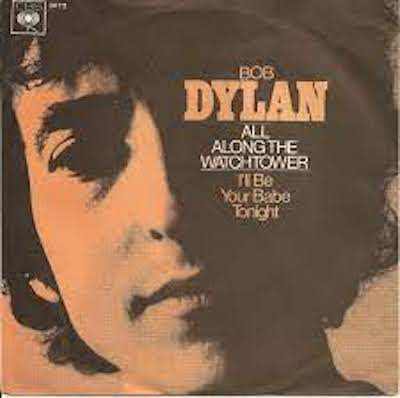
“SO LET US STOP TALKING FALSELY NOW”: BOB DYLAN’S ‘ALL ALONG THE WATCHTOWER’


(A sequel of sorts to my take on ‘Visions Of Johanna.’)

’All Along the Watchtower’ (from ’John Wesley Harding’) is is one of those Bob Dylan songs that has a general theory attached to it. It's held to be about his declining relationship with his then-manager, Albert Grossman. The Joker and Thief are them, respectively. So we’re told.

Well, there may well be other songs from this period which that explanation works for. (Dylan himself, who normally resisted analysis like his livelihood depended on it, said he hadn’t been thinking of any of that when he wrote ’Dear Landlord’, but okay, it did seem to fit.)

But does it work for this song? No, not at all.

In fact I suspect people just get as far as the word ‘Thief’ and cry “aha, he’s calling Grossman a thief, also some Biblical stuff to fancy it up.” David Stubbs, who perhaps propagated this theory the most, describes their relationship as “a stand-off.” Yet in the song they seem to get along. And, provided we accept the (more likely) theory that Dylan sings the verses in the wrong order, the Thief gets the last word. Which isn’t snake-oil spiel, in fact it sounds like sage advice. We, who have been through so much, can outlast this.

Let’s look somewhere else, then.

Was anything else on curly-locks’ mind at the time? There was, something pretty big in fact. He'd change his sound with the regularity others changed their sheets. But this time there had been something more to it…

He’d grown sick of being taken as a spokesman for a generation, or some kind of prophet whose every utterance required the utmost scrutiny. (Pithily epitomised by a scene from the 2007 film ‘I’m Not There’ where everybody, from music journalists to the Black Panthers, is desperately trying to figure out who Mr. Jones is.) Not being a job you could just quit, he decided he had to get himself fired.

It’s like trying to rid yourself of overstaying guests by putting on the music they most dislike. Except in this case he had to write that music. So be it. He’d make records so removed from anything his fan base wanted to hear that they’d desert him in droves, and finally he’d be left in peace.

All this is well enough known. But just in case that wasn’t enough sometimes he’d even spell it out in the lyrics.

Bluffer’s tip, when someone as egocentric as Dylan writes two characters into a song - assume they’re both him. He said of himself: “when I used words like 'he' and 'it' and 'they,' I was really talking about nobody but me.” But this comes with a twist. The Joker is Old Dylan, still looking for some way out of the situation he’s in. “Businessmen they drink my wine” may well be a reference to Grossman, though probably more a collective noun for music industry types. But “ploughmen dig my earth” sounds much more about those self-professed Dylanologists who’d scour his lyrics for buried meanings, sometimes literally rifting through his trash, naturally enough missing “what any of this was worth”.

While New Dylan tells the hipster nihilist that, while he might once have thought life is but a joke, they have now been through that - they can see the other side. In a song dripping with religious imagery, it’s about revelation.

(For this reason, I think the talk about the track being ‘circular’ sails past the point. Yes, what should be the first verse comes last. Yes, earlier songs like ’Stuck Inside Of Mobile’ or - for that matter - ’Visions Of Johanna’ had been about entrapment. Here the song is more a roadmap outta here. I’d guess rather than being up to anything clever Dylan just reordered the verses because that gave the song a better opening line. (If so he was right, most people must know it by now.)

Often analysts of the song reflect on how Biblical the imagery is, particularly the Book of Isiah. But this is almost entirely confined to the third verse (as sung). Few seem to consider how this relates to the song as a whole. Let’s detour into it…

One of the most annoying aspects of the “Dylan’s a poet” business is that actually he was a songwriter. There’s fairly strong evidence, in fact, that he recorded some of those songs. And a songwriter combines words and music for an overall effect. (Dylan himself was often frustrated his music was so overlooked.)

And the point these two come together most clearly is in the singer’s voice. And New Dylan even sounded different, dropping the nasal jeer famously liked by Bowie to “sand and glue”. For something quieter, more plainspeaking.

Elsewhere on the album, such as ’Frankie Lee And Judas Priest’ he strikes a conversational tone. But here he does something different. Truly grand things you don’t intone like a Hollywood voice-over, you have to speak of them softly, in a kind of hush. And the music does something very similar. The sound’s so ominous because it suggests at impending events that could only be alluded to, never fully described. (Those who only know the bigger sound of the Hendrix cover are often surprised by the original.)

I can remember being taught at school that, shortly after the crucifixion, many believed Jesus would return soon and usher in the end times. Which made for strange heady days to walk through, where each step might be your last. It’s something that has stayed in my head all my life. And this song has a similar mood of quiet apocalypse.

It’s known Dylan regularly read the Bible through this time. Solipsistic as ever, he seems to have associated his plan to remake himself with a parallel tumultuous change to the world. And, this being the late Sixties, there was plenty of evidence for that if you were to go looking. This quite possibly borders on a personality disorder. But it made for a good song.


Let’s go a bit more nitty-gritty…

You can see why the Joker might be called the Joker. He’s a Dadaish figure, not just writing songs without literal meaning but furiously denying there is a meaning to things. But why is the Thief the Thief? What’s he nicking exactly? Other song titles on the album mention a Drifter, a Hobo and an Immigrant, while the title track’s about a folklore outlaw. We’re on outsider to society here. Was Thief just the next line in the Thesaurus?

Perhaps, but let’s remember a slightly earlier song, ’Tears Of Rage’, had the repeated line “why must I always be the Thief?” If ’Watchtower’ flirts with confusion by being sung in the wrong order, this one gives us two characters without telling us. To the point that many simply didn’t notice. The only clue is in the use of ‘We’ and ‘I’, given to verses and choruses respectively. (Disclaimer: I seem to be the only person in the world who thinks this.)

‘We’ would seem to be parents vexed by a child asserting their independence. As many have been quick to point out, Dylan was by this time a parent. And it may be that he wouldn’t have written this song had he not been. But it isn’t credible that it’s *about* his experiences as a parent. The oldest, his step-daughter Maria, was six at the time. A little young for that sort of thing.

Instead I’d suspect ‘We’ to be those troublesome fans and Dylanologists, cast in the guise of controlling parents, sternly admonishing their charge over his change in direction. (“It was all pointed out the way to go’ means something like “What’s this? A country album? You are so grounded!”) And Dylan as the less-than-dutiful daughter, unwilling to conform to the plans made for her. What the ‘Thief’ is stealing is her own agency.

And like ‘why a thief’, we might want to ask ‘why a daughter?’ Why not a son? Dylan firmly associated himself with artistic genius stereotypes, which are highly gendered as male, and was effectively a misogynist. Why associate with a female character here? It may be because a daughter’s rebellion is seen as more a betrayal than a son’s. But also, ‘daughter’… it may simply have scanned better.

So to summarise, ’All Along the Watchtower’ by Bob Dylan isn’t about Albert Grossman. No, like many Bob Dylan songs it’s all about Bob Dylan. Have a great day!

(Those of an unusually obsessive nature may want to know I wrote something about the whole ‘John Wesley Harding’ album a while ago.)

Saturday, 2 November 2024

“WHAT SALVATION MUST BE LIKE AFTER A WHILE”: BOB DYLAN'S 'VISIONS OF JOHANNA'


“Johanna may not even be real. But she is an addiction”
- Rolling Stone

The finest songs are not always the most immediate. I doubt if anyone in 1966, on first hearing Bob Dylan's new album  'Blonde On Blonde’, thought of 'Visions of Johanna' as the stand-out track.

First you needed to cope with yet another of Dylan's turns of direction, from the abrasive electric sound and venomous in-your-face surrealism of the previous year's 'Highway 61 Revisited'. That had been definitively Northern – urgent, brimming with attitude – while the Nashville-recorded 'Blonde' could not have sounded any more Southern, languid and brooding. Some tracks even gave woozy New Orleans jazz a look in.

But even then 'Johanna' must have sounded strangely closely to the country station it disparaginly describes, the one that “plays soft, but there's nothing really nothing to turn off”. It couldn't be any further from the epic swoops and rolls of the next number 'Sooner Or Later', the only track on the album to have survived from the original New York sessions. And yet what didn't arrive with a fanfare lingered, and is now one of Dylan's most celebrated songs. 

Perhaps that could be something to do with the air of mystery which Dylan characteristically stirs up. “Inside the museums, infinity goes up on trial”; “Jewels and binoculars hang from the head of the mule.” You could probably throw a dart at the lyric sheet and come up with something similar. It all sounds so vivid, like it should mean something, but trying to figure out precisely what can result in a whole load of headscratching.

Perhaps to try and pin down the cascade of images is a kind of category error. Robert Shelton wrote in his Dylan bio ’No Direction Home’ “the nonsequential visions are like a swivelling camera recording a fractured consciousness”, and he went on to quote Fowlie on Rimbaud, on a poet “bent upon subordinating words to their sounds and colours”. Dylan himself had earlier written: “To understand you know too soon/ There is no sense in trying” and was scornful of those who thought themselves able to interpret him.

Would the facts help any? Dylan almost certainly wrote the song while on honeymoon with Sarah Lownds in New York in the winter of 1965/66. And yet this isn’t exactly a love song. Which has tempted some to speculate that he wrote it pining for an earlier paramour, Joan Baez. The present Louise in the song thereby becomes a stand-in for Sara, contrasted against the absent but longed-for Johanna, aka Baez. (Though some claim the earlier ’Like A Rolling Stone’ was a put-down of Baez.)

Of course I have no more idea than anyone else whether this is true or not, but there may well be something in it. Firstly, when you hear sections of Dylan fandom hating on Baez so badly, in a manner reminiscent of Beatles fans on Yoko, you almost want to take it up just to spite them. But more importantly, Norman Mailer's theory of Picasso was structured around his relationships, embarking on new styles to capture each new lover, then all over again to decry them as he tired of them. And Dylan is in many ways the Picasso of music. For example, his earlier break into his trademark 'protest songs' came at least in part through the influence of an earlier girlfriend, Suze Rotolo. (Pictured with him on the cover of the 'Freewheelin' album of 1963, which launched that style.)

Except, as ever, the main problem with this biographical reading is that its just that – a biographical reading. Your interest flickers to hear the line “the ghost of 'lectricity howls in the bones of her face” after finding out that New York had that winter suffered a power blackout. Or that the song was originally called <i>'Freeze Out'</i>. But really, where does it take you? It's a bit like finding out where a film director used for a location shoot, or an artist for a painting. At most you're describing the impetus of a work, rather than the work itself. Ultimately, reducing “the ghost of electricity” to a power cut seems... well... reductive

As Andrew Rilstone has said “I don't think that Bob set out to tell a naturalistic story... but decided, for some reason, to present the story in the form of a riddle.” To which we might add, when Dylan had earlier broken up with Suze Rotolo he didn't think himself as above writing a perfectly straightforward account of the whole affair in 'Ballad in Plain D'. (Much to the disdain of her sister, who'd been savaged while virtually named outright.)

Okay, you might well ask, so what is going on?

A common theme of the album was 'strandedness', referred to specifically in many tracks such as 'Temporary Like Achilles' or 'Stuck Inside of Mobile With the Memphis Blues Again', and ever-present in the more languidly paced music. But the theme is perhaps at its most developed here. Note the two separate references to keys, jangling uselessly in this inescapable situation. Note the second line “we sit here stranded, though we're all doing our best to deny it”.

“All” makes it seem a crowded song. But, befitting the feeling of confinement, I contend there's only three characters to the story – and one of those is conspicuous by her absence. All the others – the ladies and the watchmen, the pedlar and the countess – merely collapse in on one another, like alter egos invented to distract you from your loneliness. (Or perhaps bystanders, a watchman seen through the window who has a character projected onto him. It scarcely matters which.)

Before we get to Louise and Johanna, let's start with the third-named character:

”Now, little boy lost, he takes himself so seriously 
He brags of his misery, he likes to live dangerously”

Remind you of anybody? Little Boy Lost is starting to sound like a straw-man parody of Dylan himself. And after slagging off pretty much everybody he knew, plus a fair few innocent bystanders, why not give himself a turn?

Now the alert reader at this point is probably thinking there's a fourth character in the song.I f Little Boy Lost is Dylan, then just who is the unnamed narrator? And I'll concede things might seem that way.

”Just Louise and her lover so entwined 
And these visions of Johanna that conquer my mind”


Then again, perhaps not. Little Boy Lost most likely is the lover getting it on with Louise. But I'm suggesting Dylan is simultaneously the body entwined with Louise and the mind thinking of the absent Johanna. He feels so disconnected from the picture he's in that he conceives of himself as two entities – the present body and the removed, preoccupied mind.

Johanna is a religious name – it means the grace of God. If you look Louise up, it means warrior. But you might as well go and forget that second part, for it's not really got much to do with the song. I suspect Dylan just picked the most regular and the most out-of-ordinary names he could think of. I must have met many Louises in my time, I'm not sure I've known one Johanna.

And the distinction between them is all there in that early line...

”Louise, she’s all right, she’s just near... 
But she just makes it all too concise and too clear
That Johanna’s not here”


Something many people seem to miss is that, unlike many a Dylan song, he's not actually disparaging about Louise. “She’s alright... she's delicate and seems like the mirror.” He quotes her saying “Ya can’t look at much, can ya man?” as if she's being perceptive. But the point about Louise is that she's merely present, just as Johanna is defined by her absence. They divide much as Little Boy Lost and the narrator are split.

Clinton Heylin has suggested that Dylan, suffering from writer's block at this point, has made Johanna his absent muse. And lines about Mona Lisa with “the highway blues” would seem to go along with that. But this seems only marginally less prosaic than the earlier romantic triangle notion. Dylan may have got there through cold feet about a marriage, or deciding to write a song about not being able to write a song. In the end, the how of it doesn't really matter.

In a word, it's purgatorial. The song is about separation, about the body being exiled from the spirit. At the end of the song, rather than having Johanna show up, everything else goes away – leaving only her absence.

”And Madonna, she still has not showed 
We see this empty cage now corrode...
...the harmonicas play the skeleton keys and the rain
And these visions of Johanna are now all that remain”

Coming soon! While we're on the subject of Dylan...

Saturday, 3 September 2022

EMMA RUTH RUNDLE/ THE MAGNETIC FIELDS (GIG-GOING ADVENTURES)

EMMA RUTH RUNDLE
Komedia, Brighton, Tues 23rd Aug


Emma Ruth Rundle is an American singer/songwriter, sometimes described as Gothic Folk, who’s previously worked with Chelsea Wolfe. She’s made more than six albums, but somehow slowcoach here only found about her during lockdown.

Every YouTube clip I’ve seen of hers had been not just with a band, but packed a full-on sound. Whereas it became clear from the stage set-up this was to be a solo gig. (Well, with one song where the support act, Jo Quail, joined in on electric cello.) She swapped between guitar and piano throughout.

The melodic lines were strong but her playing sparse, fingers held over one narrow section of the keyboard, a capo habitually fixed to her guitar. The music often felt less like ornamentation than augmentation; underlining, italicising and emboldening the lyrics.

There’s little doubting the power of these songs. But there’s that adage about too much of a good thing. It ends up as a whole lot of music in the key of black, with lyrics like “there’s no need to check the weather, as my winter’s never over.” Ironically, I’d imagine that had she played with a band but dropped down to solo for a couple of numbers, they’d have come across as highlights. As it is, the combination of unrelentingly bleak content and restricted form became a bit too much, like taking your potion in concentrate. (And I grew up during Post-Punk, I’ve a fairly strong tolerance for unrelenting bleakness!)

The main set’s all from the recent album, ’Engine Of Hell'. (Which, from some on-stage comments, she sees as a kind of song cycle.) Which, unbeknown to me at the time, was a much more stripped-back affair than anything done before, if not quite to the extent of this gig. The constraints of lockdown on recording may well have been a factor here. Ironically, she was quite possibly recording it precisely when I was catching up with her earlier band-based releases.

Whether this was a one-off experiment or a whole new direction remains to be seen. (There’s been one album since, but that takes a dark ambient path.) But I kind of wish my first Emma Ruth Rundle gig had been nearer the shallow end, with the rubber ring of a band attached.

Not from Brighton…


THE MAGNETIC FIELDS
Hammersmith Apollo (for some reason now called the Eventim Apollo), London
Wed 31st Aug


The last time I saw New York singer-songwriter Stephen Merritt (aka the Magnetic Fields), conditions could scarcely have been more different. Then he was presenting his latest release, the self-described ’50 Song Memoir’, in strict track order split over two nights. And a double dose of all-new songs seemed to daunt the ticket buying public, judging by their non-presence. (Me, I took to it. But no-one listens to me.)

This time… well there’s frequent numbers from the most recent album ’Quickies’. (So called because every track comes in under the three minute mark.) But they also dip heavily into the equally self-described ’69 Love Songs’, which probably counts as Merritt’s magnum opus. So a larger venue fairly brims with folk, who mostly recognise each new number a few bars in.

With track titles such as ’Kraftwerk in a Blackout’ and ’The Flowers She Sent And The Flowers She Said She Sent’, humour plays no small part in Merritt’s writing. And, while perhaps I was exposed to too much Barron Knights at an early age, humorous songs are often signified by a rough-edged sound, like telling gag cartoons from illustrations. But with Merritt both songs and gags are quite exquisitely crafted, with his baritone voice the ultimate in deadpan. Captivating melodies carry barked and pithy words, again, again and again.

Though crafted here definitely doesn’t mean adorned. The five Fields on stage play quite minimally, with one or more dropping out when not required. The great English folk singer Chris Wood once wisely said “a song is great not when you can't add anything to it, but when you can take nothing away.” And many songs here fit that definition.

Back in the day, it was often commented that British sitcoms would mix up their humorous and poignant moments, much in the manner of real life, while in America the two had to be clearly delineated. At which point I’d often add that British music did much the same thing, then go on about the Smiths.

Yet Magnetic Fields, formed back in 1991, would seem to scupper that theory. Merritt seems to exult in the combination, or sometimes the juxtaposition. No less than Peter Gabriel once sang ’The Book of Love’ on stage with them, before recording his own version and spawning a series of covers. (Though I confess to preferring the original.) Which effectively made it Merrit’s signature tune. He sings it here accompanied only by the barest plucks of ukulele, during which I doubt anyone dared breathe. Then mischievously followed it with a rousing version of ’The Biggest Tits In History’. (“She majored in biology/ She knows whereof she speaks.”)

And he takes a similarly gleeful mix-it-up approach to gender identity, as in ’Andrew In Drag’. (“A pity she does not exist/ A shame he’s not a fag/ The only girl I ever loved/ Was Andrew in drag.”) He also hands songs over to co-vocalist Sylvia Sims, blurring whether the perspective sung from is his or hers.

Merritt once wrote a song called 'Think I’ll Make Another World’ and often seems to have come from some parallel reality where Elvis never went on Ed Sullivan, rock ’n’ roll never became the monoculture and the spirit of great songwriters like Cole Porter and Stephen Sondheim still blooms. And it’s a parallel reality we can step into…

If this was a proper review, I’d be telling me how the Magnetic Fields continue to tour the UK and Ireland. ’The Book Of Love’, from San Francisco. We didn’t get the variant opening…


Friday, 1 March 2019

“SOMETHING HAPPENED ON THE DAY HE DIED”: DAVID BOWIE’S ‘BLACKSTAR’


Bowie’s ’Blackstar’… okay, I’m coming a little late to this one. But its very existence is heartening to me. It may have taken someone who hailed from the days from when ‘LPs’ were ‘released’ (instead of ‘items’ being added to ‘feeds’) to rekindle the feeling of an LP being released, but let’s just focus on the fact we got there.

And for me it’s extra sweet. Before the end of the Eighties I’d finally got over my fervent youthful denunciations of his “selling out” and simply stopped thinking about him. Then, slowly and surely, it became the musical equivalent of people’s paths diverging only to come back together later in life. As if he’d become bored of attending award shows and glitzy parties, and decided he was really one of us outsider types after all. Culminating in an album that genuinely bears comparison to his Seventies stuff.

So it seems gloriously old-fashioned the way so many people devoted so much webspace to raking over every utterance and studying the cover for “clues”, even if there was little of quality analysis amid that width. They roved from Norwegian villages to computer code, hoping to overturn so many stones that surely something useful will be stumbled upon. But however absurd the exercise it does hearken back to the days when an album being released was an event, like a monolith being found on the moon, around which the rest of life would have to reorient itself.

And I wonder if, with the title track in particular, it wasn’t preloaded for that response, to both provoke and stymie it. With any piece of music, you’ll hear the sound of the voice before you take in any words, which will inevitably colour the lyrics. And there’s two distinct vocal lines in this song, even if both are provided by Bowie himself. The ceremonial voice which opens the track is like the musical equivalent of a Greek chorus, describing things, setting the scene.

The other voice, sounding more like a regular Bowie vocal, slips between first and second person. But both are concerned with the actions of a character. It behaves like a lead vocal, the ceremonial voice slipping into backing vocals when it’s around. In other words, the first vocal frames the second, both in form (the song being palindromic in structure) and in content. As if the track has its own inbuilt audience. In the video he ‘plays’ the two voices as different characters.


“At the centre of it all” is nothing that radiates but a blackstar, defined as a set of absences (“I’m not a filmstar… a popstar… a marvel star” and so on.) A corpse in a spacesuit. Bowie often demonstrated a Dylanish disdain for pinning songs to ‘meanings’, and here the compound word title brings together ‘centre of attention’ and ‘blank slate’. Maybe his last words to us all were “you try making some sense of this stuff if you want. Me, I have somewhere I need to be…” While at the same time saying, in Lennon’s teasing words, “here’s another clue for you all”. And, to quote him from another track on the same album, “ain’t that just like me?”

So why do that? Bowie had a wry sense of humour. But that’s not the whole of it. Scanning songs for ‘clues’, like they’re puzzle games or detective stories, is clearly not the right way to respond to them. It borders on category error. But in its klunking, gormless way it clutches at something important. Art is not a work email or a note left out for the milkman. It’s not a switchboard for conveying straightforward information. The artist only launches the artwork, lets it loose in the world. From thereon in, it’s up to you, the listener, to make your own sense of it.

Saturday, 23 January 2016

FROM SPLENDID ISOLATION: DAVID BOWIE’S ‘STATION TO STATION’

Okay, 'Bowie still dead' may not seem an obvious news item. But its still hard to think of much else. So here's something about one of my favourite tracks of his...


”It's too late to be late again
”It's too late to be hateful
”The European canon is here”

Picture this... an album that acts as a transition between two seemingly incompatible styles, laid down quickly by a singer so strung out he later couldn't even remember anything involved. Actually, scratch that... it’s not so much in transition as occupying a kind of schizoid state, it’s rigidly black-and-white colour scheme as indicative as the jagged stripe of the now-iconic ‘Aladdin Sane’ cover.

Not, perhaps, the most promising of starts...

Bowie recorded ‘Station to Station’ late in 1975, between the Philadelphia Soul of ‘Young Americans’ and the Krautrock-influenced “Berlin trilogy” of ‘Low’, ‘Heroes’ and ‘Lodger’. The title suggests some kind of transference between the two places; and indeed, shortly after it was made Bowie abandoned Los Angeles for Europe. However, the album rarely bridges those styles, it mostly alternates between them – the white-boy funk of ‘Golden Years’, ‘TVC 15’ and ‘Stay’, American as eggs over easy, intercut with the Europe-inclined ‘Word On A Wing’ and the Nina Simone cover ‘Wild Is the Wind’.

Yet with the opening, title track the trains collide head-on. And “collide” is the operative word; at over ten minutes, twice the length of most of the other numbers, its construction is basically the two styles, the American and the European, crashing into one another. Surely this becomes the point where the centre cannot hold and all this falls apart? The point where the drug-addled, has-been star finally crashes and sinks somewhere mid-Atlantic.

But its the opposite. By bringing together white and black, it gives the album it's key, rending the rest of it (kind of) comprehensible. More than that, it creates one of Bowie’s finest tracks. As Benjamin Aspray has commented at PopMatters: “If Station to Station’ boils a career down to an album, then ‘Station to Station’ boils an album down to a song.” From hereon in, we can focus on this track alone and miss almost nothing.


Though joined only at the edges, the two sections oppose and mirror one other. In the lyrics you can almost match the antonyms off like a game of anti-snap; “lost in my circle” versus “I must become one in a million”; “dredging the oceans” versus “mountains on mountains”; and (most prosaic-sounding, but actually most important of all), “here am I” versus “here are we”.

This album is held to herald Bowie’s Krautrock era, and he said himself “’Low’
and its siblings were a direct follow-on from the title track”. Indeed, once in Berlin, Bowie would hang out with Harmonia until he'd absorbed their influence wholesale. But that came later... While still in LA, the yet-unseen Berlin came from films and other received images. As exmplified by the name of a predecessor band to Harmonia, Neu!, Krautrock took as its mission to break all connections with what had gone before. The emphasis here is all on the past - on German Expressionism, or the ‘Cabaret’ shtick of decadent Weimar. (That stark black-and-white aesthetic, for example, came from Expressionist cinema, to which he'd become almost as addicted as the drugs.) While once he'd mythologised America from Europe, now it's the reverse, and that past being his past just makes the images shine brighter:

”Once there were mountains on mountains
”And once there were sun-birds to soar with
”And once I could never be down”

It also revived Bowie’s earlier interest in the pre-rock world of chanson and cabaret music, which had already run to the extent of covering Jacques Brel and Kurl Weill songs. Hence the reference to “the European canon”, a classical term which seems strangely archaic applied to modern music. (Some internet discussion boards struggle valiantly to explain why cannons are suddenly being fired.)

The style is measured and almost intonatory, sounding almost restrained when set against the orgiastic excess of rock music. Though no more repetitive than most other kinds of popular music, its downtempo beat and lack of release makes it feel repetitive - glowering and oppressive, as if the music is stalking you.

When words are set to this, the result is imagery that accumulates rather than progresses; “here am I, flashing no colour, tall in this room overlooking the ocean”. Images are clipped and precise, too composed to sound like a rock song, too stark to sound like poetry. They build into the picture of a solitary figure, trapped within its own grandeur, a prisoner of his own device.

Then, just as you think the song must surely be over, it bursts into the euphoric funky soul of the final section, a juxtaposition about as arresting as seeing a statue suddenly break into dance. Live clips of the time show a stage sparsely lit, which then explodes with brightness as it reaches this half-way point. The words lose their composure and take on the rush of conversation – “it’s not the side effects of the cocaine, I’m thinking that it must be love” is less Brechtian bon mot and more like something you might have burbled in your ear at a nightclub.

And the two sections combine into something so much more than the sum of their parts. Like a sweet and sour, each taste is richer through being juxtaposed with the other. Some call it transitional, some call it completely unique in Bowie’s repertoire. Some call it commercial and some experimental. Quite often, the same people call it all those things at the very same time...

It’s often a few listens in before you realise, in a perfect irony, the words to the two halves are effectively swapped – like an exchange of prisoners. It’s the stark ‘European’ section in which Bowie describes his situation in LA, then its the funk which arrives to announce “the European canon is here!”

Indeed, for much of the first half, Bowie is simply reporting the facts of his life in LA. He really did live alone in a big house overlooking the ocean. Heavy cocaine use had driven him to a state of near-complete psychosis and paranoia. (One of his delusions being that witches were breaking in to steal his urine. Or, according to others, his semen. Perhaps the witches weren't that choosy.)

The key to the song is perhaps in the opening line (and original title) “the return of the Thin White Duke”. This was of course Bowie’s latest character, to replace and supplant Ziggy and Major Tom. But this is the first we have heard of him - how can he be returning? In the sense of coming around, rejoining the world, escaping the prison his life in LA had become.


Bowie was at the time obsessed with occultism, and the line “from Kether to Malkuth” relates to sephiroths (to you and me, points) on the Kaballic tree of life. (He can be seen sketching this out on the original back cover.) Kether, which translates to ‘Crown’, is the apex of Kaballa, the divine essence transcending the merely human - just as the crown goes above the head. Malkuth means ‘Kingdom’ and occupies the base of the tree; relating to matter or Earth. It’s the only sephiroth held to not directly emanate from God.

Yet in which direction is this “magical movement”? The Kaballa is based on the expectation the adherent will attempt to climb the tree, in the quest for divinity. Bowie is doing it the other way around, reversing down a one-way street, descending to Malkuth. This is the inverse of what he sung about in ‘Space Oddity’ – the journey of a man back from beyond, into the arms of ground control. Live,he would often accompany the line with a downward hand movement. “I must be only one in a million” means “I must become only one in a million” – end my splendid isolation.

And what’s bringing him back is the power of love – but love in a strangely pure sense. Love songs tend to be descriptive (“and then she kissed me”) or seductive (“love, love me do”). But when Bowie sings “I won’t let the day pass without her” there’s one slight snag - as yet, there’s no actual herLike Berlin, she’s a creation of his imagination he’s hoping will manifest itself. Still stuck up the Kaballic tree, he is only able to conceive of the Earth he wants to rejoin. He wonders “who will connect me with love?”, as if love comes before the lover - a mental state which then needs a physical person to connect to, like lightning aiming at a rod. (Ironically, in telephony a station-to-station call is one where “the caller is willing to talk to anyone who answers”.)

Bowie is tapping into an ancient idea of art, that it is not a device for recording events but an act of sympathetic magic which aims to change the life of the artist. (“Such is the stuff from which dreams are woven.”) He is singing not to any lover, hoping to enchant them. The Thin White Duke is throwing darts in his own eyes. He hopes to reacquaint himself with love, to emerge from his drug-induced stupor, simply by singing about himself as a lover, inventing a character which he can them inhabit. (Compare to ‘Soul Love’, “all I have is my love of love.”)

Bowie once wrote a song called ‘Rock ‘n’ Roll Suicide’. We tend to want rock stars to follow the road of excess, crash their cars and generally sacrifice themselves, become beautiful corpses to look good on our posters. It’s a salacious tabloid desire, to see them burn up for our entertainment, so we might feel a bit better about sticking with our moribund day jobs. Yet what if they pass through that road of excess, make it out the other side? Even in ‘Rock ‘n’ Roll Suicide’, death is ultimately rejected.

‘Station to Station’ came out of a direct and personal need, a missing person notice written about it's own author, a spell cast over himself that might lead to his return. That urgency, that compulsion, is a large part of its appeal. Yet if it’s a spell he wrote for himself, it’s not a spell that need just be applied to himself. It’s quite genuinely life-affirming. I have never, you understand, found myself trapped in a big house overlooking the Pacific Ocean and a life of coke-addled paranoia. Witches are not, to the best of my knowledge, after my semen. But I like the idea that, were I ever in such a place, there’s a magic spell waiting to free me.

Let's drink to the men who protect you and I.

Saturday, 22 November 2014

“FROM MY BLACK SPITFIRE TO MY FUNERAL BARGE”: KATE BUSH'S 'LIONHEART'


”I don't care what I see outside. My vision is within! Here is where the birds sing! Here is where the sky is blue!”
- 'A Room With a View'

Just as the big splash of Kate Bush returning to live performing has subsided again, the time seems ideal for a belated post about her. (I will almost certainly be late for my own funeral. In fact, if I should be there now please let me know via the mailing comments.)

'Oh England My Lionhearted', to give the song its full title, appeared on Kate Bush's second album in '78. As with many of her early songs, Bush is not thought to look back on it favourably. But at the time it not only gave the title to it's album, the lyrics got the personalised handwritten treatment while all about them were typescript. The inevitable embedded YouTube video (below) makes it look like she saved the song for her encore. At the time, it mattered to her.

In the clip Bush is sporting a pilot's uniform. For the song takes the perspective of a Spitfire pilot, shot down over Wartime London. But from there, as you might well expect from a Kate Bush song, things start to get strange...

“The soldiers soften, the war is over
The air raid shelters are blooming clover”

Highly melodic, the song lives in the juxtaposition between that kind of pastoral imagery and the knowledge of the destruction of war. Notably the Spitfire is coloured black when they were normally camouflage green. (Did they even make black Spitfires?) No matter, this blackness allows it to become the funeral barge, while the flowers and blossom of the garden of England become the garlands and wreaths which decorate it.

The reference to war being over might suggest the crashing plane has somehow time warped to somewhere the other side of VE day. Seen this way, the song revolves around the paradox of the soldier who fights for peace. Fighting a war he never wanted, he has become a sacrifice to a peace he will only ever get this glimpse of. (He's presumably been shot down during the Battle of Britain, the main air battle over London, which happened in 1940.)

And one of the appealing elements of this interpretation is that it places the bucolic dream England not in the past but the future. “Dream England” songs are virtually a sub-genre by now, but they normally overlap with state-of-the-nation songs. Think for example of June Tabor's 'Place Called England' or the Waterboys' anti-Thatcherite parable 'Old England' with it's refrain “old England is dying”.

But what about Peter Pan stealing the kids in Kensington park? Where does that fit this narrative? And yet the line does seem to match the haunting music, which Bush described as “madrigally”. All too often songwriting is talked about in terms of the writing, with scant notice paid to the fact this writing comes to us in the form of a song. Unusually for a modern song, 'Lionheart' has no real bass parts. Instead there's Bush's high-pitched voice, some high-pitched piano, a high-pitched harpsichord and even-higher pitched recorders. It's music which couldn't do more to sound ethereal, to suggest at the immaterial.

...all of which might suggest the pilot is not fast-forwarded to the future, but transported into a spirit world. Bush punned on the Fairy King name Oberon on the later track 'Cloudbursting', and things here have something of a 'Midsummer Night's Dream' feel – of another world alongside ours, separated only by a permeable membrane.

Yet that's probably not really it either. The ending makes it clear the pilot doesn't end up in this spirit world, like some pastoral happy hunting ground. He's “in your garden” but “fading fast”. He just perceives if, before being taken aloft. (The final line, with its reference to the gathering shepherd, is an unusually Christian image for Bush.)

Moreover, quite mundane images appear among the more esoteric stuff, such as the flapping umbrellas on rainy London Bridge. And take the reference to “wassailing”. These days we tend to take the term as a reference to singing carols, but she specifies the context is an apple orchard. It's the tradition of singing the fruit into bloom. Similarly the Thames is compared to Shakespeare, but described as itself a “river poet”, flowing like stanzas.

How about this? The pilot crashes in his contemporary London. He probably grew up there, the smog-ridden streets and rainy bridges over-familiar to him. But in his last few minutes of life he sees things the way they always were. To paraphrase Huxley, his doors of perception are given a bit of a wipe.

Crucially, it's not a song about passing into some pure Platonic realm where flowers smell sweeter, but about the interconnections. Notably, Bush sings about the natural and constructed landscape, the Thames and the Tower, interchangeably.

“Our thumping hearts hold the ravens in
And keep the tower from tumbling”

...is perhaps the key couplet to the song. Most tourists to London learn the popular tale - should the ravens fly away from the Tower, the building will fall and Britain with it. (These days they’re kept captive with clipped wings, so we’re probably safe.) The superstition may originally have been based on the perception that, prior to the invention of flight, climbing a tower was the nearest a human could ever get to a bird’s perspective.

But of course its continuing popularity is because it acts as a kind of a fable. Why would a mighty tower need a few birds to stay up, rather than just acting as a perch for them? Because it suggests a symbiosis between the human and natural worlds, that however big we build our towers we remain dependent on nature. The tower stands for the physical world and human body, with the ravens/ hearts as the spiritual - and each is contingent on the other.

For ultimately, its a song about the thing its made of - language. Language is not a mere labelling system for the physical world, a signifier to hang on the signified. We don't just look at the landscape, we impose language upon it, we inscribe it with meaning. The world out there enters into an inter-relationship with the world going on in our heads. Language and reality are conjoined, perhaps each is just one side of the other. (As Bush later sang, in the self-same track she punned on Oberon, “just saying it could even make it happen”.) The garden of England, the rolling landscape of patchwork fields and summer lawns we like to imagine, it mostly just exists in our imaginations. But language allows us to connect it to the real world. That's how we do it – that's how we make home into home. We just need to be reminded sometimes that's what we're doing.


Late addendum! My old mate, and knower of such things, Lee Brimmicombe-Wood, contacted me on Facebook to say there were black Spitfires. But as these weren't launched till after the Battle of Britain, where air combat became a nocturnal affair, I was sort of right. In a gormlessly literal sort of a way.

Sunday, 30 December 2012

'DOWN ON AIRSTRIP ONE' (A SONG OF NEW YEARS PAST)


”Another New Year and too much beer
And a puke into the sea...”

It was the early hours of New Year's Day 1984, and a somewhat sozzled John Baine was walking home from a night's celebrating in Shoreham. On arriving home, he turned into his alter ego, the punk poet and musician Attila the Stockbroker, picked up his mandola and wrote the song 'Down On Airstrip One'.

“Going on about Orwell” was indeed something of a national pastime at that point. Michael Radford made a bad film version of '1984', while the Eurythmics stripped it for buzzwords and turned them into a rubbish dance number. As already mentioned on this blog, the sheer dreadness of the date was enough for the anarcho-punk band band Crass to split up. It all felt like something of a media frenzy. (Which is, you know, different to a lucid frenzy.) After all, it was common knowledge that Orwell hadn't picked the date out of some prophetic vision but as an anagram of 1948, the year he'd written the book.

But mostly it felt like misdirection. Perhaps there was no point looking for 1984 on the horizon, perhaps it had already arrived. Since the time of Orwell's writing, the world had been locked into a war between superpowers. It was just a cold war, and when it was fought it was by proxy. 'Cruise' (read nuclear) missiles had arrived at the American base on Berkshire's Greenham Common two months earlier. Many felt that Britain was already Airstrip One, America's Cuba. A handy platform on which to park it's battle gear, and a handy fall guy to take the hit should it's enemies start firing back.

Those nuclear warheads overshadowed everything, to a degree that's hard to imagine now. For all our watching apocalyptic faux-documentaries such as 'Threads' or 'The War Game' I doubt anyone could actually envisage so much destruction, it was simply too big an idea to truly hold in your head. But it became a totemic issue for all that was wrong with the world – people at the top willing to risk the end of it. I constantly wore an anti-nuclear badge through those years, which led to a fair few... ahem!... heated debates.

Yet, however prevalent the blather about Orwell, neither was there much of a shortage of songs about nuclear war. In the spirit of the times, Crass had taken to releasing compilation albums of tapes sent in to them. After listening to the slush pile for these Steve Ignorant emerged muttering “if I hear one more bastard song about Cruise missiles”, before wandering off into the night. Truth to tell, most of these songs were so turgid and worthy you started to wish for the onset of mutually assured destruction just so you didn't have to hear another one.

(Some even came to see them as a reactionary pursuit, suggesting problems didn't riddle our divided society but were confined to a few loose screws at the top. But that's a question for another time...)

Attila's number immediately outpaces the pack by not trying to sound as much like the Subhumans as possible. Those kind of pleasures were scant back then. But there's more...

On first listen, the New Year setting and the Sussex landmarks seem mere scene-setting, incidental to the main thrust of the song. In fact they're what lifts it from it's sorry company. Attila smartly roots things in the everyday, one minute singing about the over-familiar lights of Shoreham harbour, the next the end of everything.

But mostly the song works, and rather brilliantly epitomises it's era, through juxtaposing the New Year's jollity with the threat of annihilation. He sings the word “fun” more sardonically than at any other point in British history. Given the times, getting wrecked seemed simultaneously an act of bravado and the only option left, in a world so intent on wrecking itself. (In that way it's a kind of second cousin to the Specials' 'Ghost Town.') This has an extra piquancy in my case. I first heard this song live, at some Sussex University benefit gig Attila had agreed to play. And yes, at that moment I really was too wrecked to care.

Attila's posted the lyrics and some details of the song here. Though oddly, he hasn't mentioned what might be the most obscure reference for modern ears:

“And if you think your Kentish prayers
Are mightier than the gun
I'll tell you that you're dreaming
Cause the countdown's just begun”


This recounts a 1982 meeting of South Coast Against the Bomb, where the Kent contingent baulked at Sussex's insistence on more radical direct action. Some have compared this to the historic split in the First International...

...okay I made that bit up! It's really a reference to Bruce Kent, Catholic priest and then General Secretary of the Campaign for Nuclear Disarmament - a group who emphasised political lobbying and electoral support for Labour. Attila, it seems, was unimpressed.

“There's some choose civilisation
And a promise unfulfilled
And there's some choose extermination
When it's someone else who gets killed
A gesture of insanity
And a world left to the crabs
Five thousand years of history
And now they're up for grabs”


At a time when the Tories are trying to throw cash at a replacement to the Trident submarine programme just as they slash benefits for disabled people, I'd sing along with those words today. Come to think of it, I just did.

Sunday, 26 July 2009

"SOME OF YOU ARE GOING TO DIE..."

As part of an occasional series of reviews of things for no better reason than they happen to be lying about- an appreciation (yes, really!) of Genesis’ ‘The Knife’


Absently thumbing through the shelf of old records left in our living room, the detritus of past tenants unknown, I realise I’ve never actually heard ‘The Knife’ by Genesis. I’ve not listened to anything off their second album Trespass for that matter, but it’s ‘The Knife’ which was supposedly their inaugural moment - the point where they threw a six to start and hit upon their classic sound. A story I’ve heard so many times, without ever actually hearing the track it centres round. So I take it for a spin and discover, over a quarter-century after I foreswore off all things prog, that it’s actually pretty good!

Perhaps that’s not quite as surprising as it sounds. Genesis had a plus point their contemporaries lacked – negativity. While ELP were the soundtrack of the techno-fix culture and Yes indulged in New Age platitudes, Genesis sought to disturb and unsettle. (Hence the famous story that William Friedkin, director of The Exorcist, headhunted frontman Peter Gabriel to write for horror films.) And better still, they exuded English menace, homing in on pastoral garden suburbs until they revealed the snake in the grass.

But all of that starts here so part of ‘The Knife’s’ appeal inevitably becomes the contrast between it and the album it closes, like a switchblade suddenly pulled at the end of a dinner party. As Wikipedia put it, “The song was unusually aggressive for Genesis at the time, as most of their work consisted of soft, pastoral acoustic textures and poetic lyrics.” The album cover reflects this concept. (And if that’s all tantamount to saying it wakes you up after a dreary album, I have to admit to quite liking a couple of the earlier songs, such as ‘Visions of Angels’... I must be getting old!)

Ultimately, though, it’s the contrasts within ‘The Knife’ that truly make it work. For once the inevitable suite of parts really do fit together into a greater whole, and some of them are even (gasp!) catchy. Check out the segue from the flute-and-keyboard-wash sequence into the clashing guitars, a mighty riff that would have done credit to Black Sabbath.

But perhaps the classic contrast, the one which really sums up the song, is between the slow measured chant (“we are on-ly wan-ting free-dom”) and the more manic delivery of the verses. Satire will often ape the voice of its targets in order to ridicule them, but when delivered by a singer this age-old trick gains an extra resonance. The song draws much of its sinister feel from the way the malevolent, self-serving leader is speaking directly at us, as if hypnotising us – “some of you are going to die...” Oratory is raised to the level of a malevolent spell. (For a very different piece of music which pulls exactly the same trick, try The Dead Kennedys’ ‘California Uber Alles’. As singer Jello Biafra explained “I like to slip in behind villains and expose them that way.”

It’s notable that Gabriel would return to this character of the charismatic charlatan (albeit with more humour to alleviate the blackness) with ‘The Guaranteed Eternal Sanctuary Man’ from their later magnum opus ‘Supper’s Ready’. (“Look, look into my mouth he cries, I bet my life you’ll walk inside”.) An explanation for this fascination might lie buried in the bands’ history. Most school-based bands are formed out of a desire to grab attention, and scrabble a set together in order to justify getting up on stage. But with Genesis it was the reverse. They had set out as a team of songwriters, who first made recordings simply to demo their songs and only reluctantly took to performance. And as the front-man, Gabriel would have been thrust further into the limelight than the others.

Perhaps, given the task of working out quite consciously what a performer needs to do, he became aware of how manipulative the exercise can actually be. Perhaps in working out how to gain a crowd’s attention he also grew aware of how dangerous such a power could be in the wrong hands. Consequently he took on the persona of an anti-messiah who will whip up his followers, but lead them only from behind.

However, before we start calling the song’s distrust-your-leaders message ‘proto-punk’ or some such, it could easily be argued that it is in many ways quite a reactionary song. The masses are a bewildered herd, hoodwinked by a few fine-sounding phrases. (Gabriel had something of a predilection for comic commoners, not the nicest notion for a public schoolboy to adopt.) The claim that an event like the Russian Revolution was derailed by sanctimonious but self-serving leaders seems less than controversial. But to go on to claim that they were able to cause such an event by sheer skill in rhetoric seems absurd. It could also be argued that the true horror of messianic leaders is their ability to convince even themselves of the rightness of their cause, something missing from the song. But one song can only tell us so much, and its effectiveness should above all be judged as a piece of music. And not for little reason did this rattling number remain a live favourite for years...

And before I’m accused of going soft, I also tried to listen to the final offering from classic-era Genesis, the double concept album The Lamb Lies Down On Broadway. Which I found to be pretty much the way you expect double concept albums to sound, overheated, babblingly incoherent and ultimately unendurable. Most likely, what makes ‘The Knife’ palatable now isn’t that it was forward-looking but precisely the opposite. It was created when prog was still nascent, when lots of funny time changes weren’t supposed to rend killer riffs redundant. So perhaps the prog revival doesn’t start here after all...

NB The video clip below starts part-way through the song, but you can hear the whole thing via the ever-reliable Spotify.


Coming soon! More records from that old shelf...

Thursday, 16 July 2009

SEVEN (MORE) SONGS: Part Two

These three songs complete my description of “seven songs which have been shaping my spirit lately." Part One here.

Spotify Playlist here


‘AIRSCAPE’ by Robyn Hitchcock and the Egyptians

Inevitably for me, I tend to prefer the darker more menacing side to psychedelia. The softer stuff tends to the fey and twee, rich kids prancing about in parks and frilly shirts whilst rejoicing under names liked the Crocheted Donut Holes. Perhaps we more readily recognise the existence of bad drugs nowadays, but my favourite Hitchcock tends to be from his early, punk-era outfit The Soft Boys. But as his later work often demonstrates there is an upside, a light psychedelia that isn’t just psychedelia-lite. In fact ‘Airscape’ would be a strong contender for my favourite Hitchcock track of all. (And, according to Wikipedia, Hitchcock himself concurs.)

This song isn’t named for nothing. It infuses the sound of psychedelia with the feeling of weightlessness, for the pealing guitar and wind-chimes don’t sound like they possibly could have come from any earth-bound instruments. (The album was titled after the line “element of light.”) Hitchcock uses this sense to conjure up the perfect summer song. (“And in the element of summer/ The cliffs suspended in the heat/ The air in columns.”)

It’s the observation that in the haze of summer objects seem to lose their substance and become nothing but forms of light, then fed into the poetic fancy that an eternal summer would bring with it the end of all physical separation –we’d become just floating elements of light. (“Where angels hover, I’ll hover too.”)

(For the importance of those psychedelic sounds in conveying this sense, check out this live version from YouTube. Without them the song keeps something of it’s beauty, but more narrowly escapes being another post-Byrds jangle. With them comes the lift-off.)

And like much psychedelic music, there’s something indefinably English about the whole thing. “The tiny figures of the world are walking/ Underneath your feet” makes me think of another supernatural world, existing in parallel to our own yet passing us by. In today’s bid for Pseud’s Corner, it could be said to be reminiscent of Shakespeare’s Midsummer Night’s Dream:

“Over hill, over dale,
Thorough bush, thorough briar,
Over park, over pale,
Thorough flood, thorough fire,
I do wander everywhere,
Swifter than the moon's sphere;
And I serve the fairy queen,
To dew her orbs upon the green.”


Of course such conceits have a purpose beyond mere fancy. The supernatural world is really nothing but the natural world, ceaselessly trodden by us but in our daily bustle never noticed. The music’s a means to reacquaint us with it. In fact, in the finest tradition of romantic poetry, the song was written about Hitchcock’s favourite beach, as featured on the cover art.

’RISE ABOVE’ by Black Flag

In in an e-mail group to which I belong, a recent exchange awarded Black Flag’s ‘Police Story’ the coveted prize for dumbest punk lyrics of all time. (With special points awarded for the opening: “This fucking city/ Is run by pigs/ They take the rights away/ From all the kids.”) But a close contender might be ‘Rise Above’, also from their debut album 'Damaged' (released in 1981).

In fact this virtually became their signature song, normally opening their notoriously confrontational live shows. Lyrically its a debunking anaylsis of the capitalist mode of accumulation... no of course it isn’t. It’s a great two-and-a-half-minute fuck-you to the in-crowd kids who disdained them. ”We are tired of your abuse/ Try to stop us, its no use!” is made into a band chant. (There’s even the line “think they’re smart”!) As original singer Keith Morris (gone by this recording) put it: “We were going to make as large a racket, piss as many people off, go apeshit as we could, and we had no choice but to play to please ourselves and a handful of friends.” (Quote from Clinton Heylin’s 'Babylon’s Burning'.)

Its dedication to defiance is juvenile but awe-inspiring, risible but brilliant, cheesy but coruscating, petty but life-changing. All of which is completely punk. Punk’s blanket insistence that “you can do it” led to some pretty terrible efforts, if also some good stuff. But the truly great punk is good and terrible simultaneously. I laugh whenever I hear it, both at it and with it, and I wouldn’t want it any other way. “We are born with a chance/ I am going to have my chance.” What better messaged could you hope to hear in your teens?

MEMO FROM TURNER by Mick Jagger


I normally dislike posting a video link when the subject of enquiry is actually the song (remember them?), but this time there’s a method to my madness. Before music video was established, this song was stuck surrealistically in the middle of the cult film 'Performance' (in which Jagger starred). It fits the film so well it’s astonishing to hear it was an old demo, only utililised by Jagger after he failed to come up with anything new. Both compare and contrast the world of the rock star with the gangster in myriad ways, but let’s home in here on one more specific to the song.

It’s a sleazy blues number, typically sneered through and smeared with slide guitar. (Courtesy of Ry Cooder, this isn’t a Stones song.) Richie Unterberger describes it accurately enough as “spinning bizarre mini-snapshots of decadent, cruel gangster behavior...” However it also sets up a chronology, beginning with lowlife tussles “eating eggs in Sammy's... on a hot and dusty night” before leading up to grey executives “at the Coke convention, back in nineteen sixty-five.” (Then just three years ago.) Moreover, the personalised and conversationally familiar speech (“Didn't I see you down in San Antone..?”) is also juxtaposed with the more formal choruses (the repeated “Come now gentlemen...”).

Rock stars had once been outsiders, doing little more than providing a soundtrack to delinquency. No-one had been a better poster boy for bad-guy status than the young Stones. But by ’68 (when the first demo version of this song was laid down), the Beatles’ 'Sergeant Pepper' had happened and rock music was now relabelled Art. (It was reviewed in the Village Voice under the header ‘The Album As Art Form’.) Perhaps consequently, the Stones remained keen to play Altamont against the Beatles’ Woodstock.

Hence Jagger delivers the song suited from behind a desk, reminding his contemporaries (and quite likely himself) their roots lay in dives like Sammys rather than Coke conventions.

”Come now, gentlemen,
I know there's some mistake.
How forgetful I'm becoming,
now you fixed your business...
...straight.”


Less-than-PC lines like “you drowned that Jew in Rampton” would be the equivalent of reminding the Beatles of when, broke in Hamburg, they attempted to mug a sailor. There’s even a coded reference to the idea they might all be getting on a little - “When the old men do the fighting/ And the young men all look on”. (Which compounds with James Fox’s line to him in the film, “You’ll look funny when you’re forty.”)

Of course these days that’s hard to remember. There’s (to put it mildly) something of an irony in hearing Jagger warn about the corporatisation of rock music. (Or for that matter the redefining of rock music as art whilst starring in an art movie.) But perhaps we should treat it less as warning and more prediction.

"So, remember who you say you are,
and keep your noses clean...
"The baby's dead," my lady said.
You gentlemen, why, you all work for...
...me!"


Admission: With the above write-ups I seem to have taken the term ‘song’ quite prescriptively. Descriptions either don’t mention the music much at all, or explain how it illustrates the lyrics – like it lacked its own motivation. Its analogous to the way criticism about comics homes in on the writing, with the art just some kind of side-order. Like goes to like, and words go to words. Ah well...