googlee7ea825f63edb3f6.html

Saturday, 8 October 2022

“A MEANINGLESS QUESTION”: CAMUS’ ‘THE OUTSIDER’


When I came to read Sartre’s post-War Road To Freedom trilogy (starting here), I devoured it like a meal prepared specially for me. Then when I came to his pre-War ’Nausea’, I was constantly chewing, and sometimes re-chewing, without ever successfully digesting anything. And I seem to now be having a similar reactor to Camus’ ’The Outsider’. (Though it was written during the war, 1942 to be precise.)

In ’The Plague’, a game is played over who is writing the novel. Ostensibly, it’s one of the characters. But stylistically we’re aware that it can only have come from an accomplished writer. Here, like a character actor putting on an accent, Camus takes the tone of his first-person narrator, Meursault.

Which means that from the first, ’The Outsider’ is written in the most flat and direct prose. It’s more the tone of a police report than a novel. While at the same time his unreliability as a narrator is never forgotten; he often fails to hear things, or makes assumptions which he later concedes must have been mistaken. And there’s no more clear-cut way to get this over than starting the novel with the blunt announcement “Mother died today. Or maybe yesterday, I don’t know.”

And this implies the central paradox. We see Meursault only through his reactions to other characters and events, to which he has precious little reaction. This leads to the most famous passage of the novel, possibly of Camus’ writing:

“She asked me, a moment later, if I loved her. I answered that it didn’t mean anything, but that I probably didn’t love her. She seemed sad. But while preparing lunch, for no reason at all she suddenly laughed in such a way that I kissed her.”

Camus giving up his prose is like a talented artist reverting to stick figures. It seems such a sacrifice to make, there must surely be a very good reason for doing it. And so inevitably we set to work with what we have, and try to parse Meursault’s lack of reaction. So those limitations are inevitably passed onto the reader.

Though it’s clearly intended as a shocking twist, we’re now no more able to read this novel not knowing of the murder than we are watch ’Citizen Kane’ and wonder who Rosebud is. A friend has got into a feud with an Arab, leading to Meursault taking the guys’s gun from him. But then later, Meursault returns to the spot and shoots the Arab himself.

We saw how some were keen to find an anti-fascist message into ’The Plague’. Unsurprisingly they do the same here. Meursault’s non-explaining is to be associated with the occupation of France. At a time when more active resistance was impossible, silence became a form of non-collaboration. Which at times it did. But, even if we could take murdering an Arab as an anti-fascist gesture, it’s simply untrue to say that Meursault stays silent or is wilfully uncompliant. As we’ll see, he explains things as well as he’s able.

A character in ’The Plague’ rails against capital punishment, clearly ventriloquising Camus’ own view. Yet in this book where capital punishment plays so central a role there’s no innocent party under injustice, nor even (as they’d commonly be understood) any mitigating circumstances. Meursault is guilty. He shoots someone. He tells us so himself. The trial has a different purpose.

First, let’s note that the moment is literally pivotal. We jump straight from the shooting to preparations for the trial, a consequence made to seem inevitable. And at this point the narrative effectively flips over, from Meursault talking about others without making any real effort to understand them, to a trial in which the officials talk about him the same way.

Guilt being established, they jump straight to talking about whether the crime was premeditated. But, with no real means to establish this, they jump to an assessment of his character. And so they spend more time discussing his response to his Mother’s death than the shooting.

Small details, such as his accepting a cup of coffee while sitting up with the body, are seized on. Which is strangely extra-diegetic, like the second half of a book is handed over to critics of the first half. It’s decided that he displayed insufficient mourning at the funeral, so should be guillotined. Hence Camus’ oft-repeated gag "in our society any man who does not weep at his mother's funeral runs the risk of being sentenced to death."


What are we to make of all this? In 1947, Sartre provided an Explication. (Which can be read here.) Camus himself wrote an afterword in 1955. Both suggesting the short novel was unfinished business.

Camus himself said “the hero of my book is condemned because he does not play the game.” And, ostensibly at least, this is easy enough. He has simply failed to provide the outward signs of mourning which society requires. We are dealing with a free thinker, scorning such performative rituals, who follows his own maps, who loved his Mother in his own way and will mourn her similarly.

And certainly the alternate translation of the title, ’The Stranger’, works better. Meursault is shown to be living in a large town, holding down a regular job, eating in restaurants and going to the beach. He’s not outside of society, but estranged from it.

And this misreading is made more dangerous by being so neat and thereby so appealing. Let’s take the quote above in full. Asked straight out if he’d “felt any grief on that day” he replies “I’d rather got out of the habit of analysing myself and that I found it difficult to answer his question. I probably loved mother quite a lot, but that didn’t mean anything”. It isn’t always noticed that the first part is reversed from his comment about his mistress. But what’s salient is what stays the same, “that didn’t mean anything”.

It’s not the conventions around it but the human connection itself which is being questioned, seen as absurd. Ultimately it’s impossible to truly know whether he loved his Mother, for him as much as for us. We take on habits, perform rituals, diarise to send a card on Mother’s Day, with which we try to paper over this space. While Meursault lives with the space.

Unsurprisingly more fulsome, Sartre found significance in the writing style, pointing out how it differed from regular Camus. He saw it’s aim as: 

“…to insert a glass partition between the reader and his characters. Is there really anything sillier than a man behind a glass window? Glass seems to let everything through. It stops only one thing: the meaning of his gestures. The glass remains to be chosen. It will be the Stranger’s mind, which is really transparent, since we see everything it sees. However, it is so constructed as to be transparent to things and opaque to meanings.”

And he relates this to Camus’ predilection for reported speech:

”Camus irons out the dialogue, summarises it, renders it frequently as indirect discourse. He denies it any typographic privileges, so that a spoken phrase seems like any other happening.”

He uses the above-quoted famous passage as an example of this. We’re not told “my saying I didn’t love her made her sad”. We’re told “I answered that… I probably didn’t love her. She seemed sad” - this then that, as if the two events might have happened co-incidentally, with no causal link. Which he describes as “the discontinuity between the clipped phrases that imitate the discontinuity of time.” We use novels, perhaps texts in general, as tools to make things more explicable to us. This does the reverse.

In the Court both Prosecution and Defence create their own Meursaults. In opposition to one another but both explicable within their system. To do this they must exclude the real Meursault. Hence his comment that the process seems to have nothing to do with him. They combine to form what he describes as a mechanism, one from which he must escape but cannot.

With Rieux in ’The Plague’ we are guided to imagine he has ‘hidden depths’, there are things about him which we only glimpse as he focuses on recounting external events. The challenge is to find Rieux the man inside Rieux the narrator, stitching him out of hints and clues.

Meursault conversely, is the subject of his own story. And the challenge is to accept that these few bald statements are all there is of him, though they seem so inadequate. When asked whether he loved his Mother, for example, there is no more to him than the answer he gives.

And, as had Sartre’s own ’Age of Reason’, the novel ends on a point of realisation. He recognises his situation is absurd and accepts “the benign indifference of the universe.”

This is, insofar as I can tell, the intended reading. But there’s a problem with it. It does precisely what the Court did, jumps back to the funeral by leapfrogging over the murder. In a long essay Sartre uses ‘murder’ once and ‘kill’ twice. It comes to be treated as a merely precipitating event, we need a crime in order to get to the trial.

We don’t just look out. In a sense our minds detach from us and we look at ourselves as an outside thing, in order to make sense of ourselves to ourselves. Whereas Meursault seems as much a stranger to himself as anyone else is. In Sartre’s terminology, he is to himself a fact he perceives without being able to grasp its meaning. A situation he calmly accepts.

The Court questions whether it was premeditated or impulsive. Go back to the murder scene, and it’s one of the few passages which seems to have been written by Camus in his own voice. The main word for which would be ‘feverish’. When asked why he shot the Arab, he can only talk about the sun being hot. Which provokes laughter, but seems his best effort to explain it. (And the sun’s fever-inducing powers on the human mind also appears in his story story ’The Renegade’.)

Which is neither of the Court’s options. The nearest to them would be compulsive. Circumstances drove him to it, even if they were chance circumstances. He speaks of being “pushed” by the sun, (“the whole beach was reverberating against me and pushing against me from behind”) and wanting to seek shelter. But he can’t get to the rocks while the Arab, his antagonist, is there. One way of reading the scene would be that his craving was for solitude, the only way of achieving which was by removing other people.

Sartre comments “If there were a grace of absurdity, we would have to say that he has grace.” And there are times you can see what he means…

“He then asked me if I wasn’t interested in changing my life. I replied that you can never change your life, that in any case one life was as good as another and that I wasn’t at all dissatisfied with mine here.”

And perhaps my ultimate inability to parse the book is this combination of murder with any form of grace. Meursault seems to me to be exhibiting less grace than a deficiency, or at most a passive acceptance of the problems existence throws at us.

Readers will need to ask themselves if they can manage this. My answer would be “it’s a meaningless question, but probably not”. To me, human relations are les external forces we encounter, like hills and valleys, but things we create between us, like roads and bridges. And there’s no reason to see the things we create as any less real, any less solid in our lives, than the things we encounter.

Further, the tale unavoidably rests on the notion that the victim is “only” an Arab, that the game hands Meursault cards to play that could spare him the guillotine, cards that would not be awarded were the roles reversed, in order for us to watch him indifferently decline to play those cards.

Two of Camus’ three novels and several of his short stories are set in Algeria, and its sense of place is often evoked. But out of his Arab characters this is quite possibly the main one, and soon after appearing he’s dispatched in order to precipitate the plot. The emphasis is all on that Meursault killed, the who deemed unimportant.

So, much like ’The Plague’ later, exploitation of the colonised Algerians isn’t shied away from. But it is simply assumed, taken as a fact of life. We’ve all heard a lot lately about there supposedly being no need to say Black Lives Matter. Here there is a need to say Arab Lives Matter, but at the same time there would be no point. The Arab character isn’t even granted a name.

From the little I could glean from ’Nausea’, it’s about a first-person narrator who comes to accept the essentially arbitrary nature of reality, where the only meanings are the ones we impose upon it. Perhaps Sartre was disposed to speak up for ’The Outsider’ because he sensed a similar intent. ’The Stranger’ gets closer to that, but is pretty much the definition of problematic.

Saturday, 1 October 2022

15 YEARS OF LUCID FRENZY!

 Yes, 'twould seem Lucid Frenzy has hit its fifteenth anniversary. I thought about how to celebrate this momentous moment. Then thought that I'd write a post saying that Lucid Frenzy has hit its fifteenth anniversary. This is it, in fact.

Saturday, 24 September 2022

‘THE TRAGEDY OF MACBETH’

By Flabbergast Theatre
The Old Market, Hove, Thurs 15th Sept


I’d found my seat and sat in it before I realised the performers were already on stage. Acting out, it would seem, a scene from Bedlam. Everyone having some psychotic episode of their own, oblivious to those around them, switching arbitrarily from one extreme mental state to another. This was doubtless intended to establish the dark mood, and did.

They performed in identical non-costumes with minimal props, and no staging save for the drums and gongs the company played themselves. ‘Performers’ works better than ‘actors’ here. They’d cavort, leap and gesture wildly, like something from an Expressionist painting. And strike tableau poses, for which I’m not sure if there’s a name. They’d not just make up a pattern but combine together to form a single shape, like a gestalt creature. The poster image came from one of these (the witches at work, as you may have guessed), and was what first piqued my interest.

We’re now used to naturalistic versions of Shakespeare. Which probably started as a righteous reaction to the stiff-backed, tights-clad RP recitals of luvvieland, but has long since become as ritualised in its own way. So reacting against this, with a very physical, very ritualised approach may well be wise. Rather than be desperate to ‘contemporise’ a Jamesian play it almost looked back. While part of the company went through with their lines, the rest acted as a kind of Greek chorus.

At times it seemed to be riffing on popular notions of “the Scottish play’”, that the whole thing is an extension of the witches scene, some sort of dark, malevolent spell. And if the whole play is the witches while we’re the fearful yet forever curious Macbeth, drawn in by that poster. (And remember, while ’Hamlet’ opens with characters talking about the ghost, ’Macbeth’ goes straight to the witches. Even though plot demands means it then has to go elsewhere, then come straight back to them.) And it was often nothing less than striking to watch.

But what Shakespeare is is psychological. Whether he was the first dramatist to get us interested in the interior life of his characters, or whether he was the one who got known for it, is probably moot at this point. We accept devices such as the heightened language because it aids his mission, gives us more of an insight into those character’s minds. Which means…

When Macbeth first encounters the three witches, in all their otherworldliness, the grand gestures of physical theatre work well. But when he hesitates to commit the crime, and has to be talked into it by his Missis, that’s quite a different kind of scene. The witches are, in some way or other, a personification of his ambition. While Lady Macbeth is a character in the play. We need to believe two people are standing on stage, debating, each with their own thought processes. Inevitably, the staging for this scene differs.

The programme states that Flabbergast “takes a rigorous and respectful approach to text, combining it with exhilarating aspects of live music and event performance.” Which seems a little like wanting it both ways, to be both an Expressionist painting and a faithfully realist sketch.

For one thing, the acrobatics of physical theatre often made it hard to hear the words, which were sometimes gabbled or delivered sing-song. I overheard one guy, who was reliant on lip-reading, saying he’d picked up not one line.

Is this circle unsquareable? I don’t think it is. But you need to go round it one way or the other.

For one way, we might argue that Shakespeare is now part of our folk culture. In the old Radio Four phrase, his works are already on the island. Not many of us now go to see ’Macbeth’ to see how ’Macbeth’ ends, after all. So he can be taken the way you would a folk tale. It’s not enough to say he’s open to re-interpretation, he’s become embedded, source material, so we can create works which only refer obliquely to him.

In a week when we’re all remembering Jean-Luc Godard, one of his maxims was “texts are death”. Meaning, I think, they constrain and stifle. DreamThinkSpeak’s version of ‘Hamlet’, ’The Rest Is Silence’ would be an example of this approach. (Note how it’s not named after the original play, but a quote from it.)

Or you can play up a problem until it becomes its own solution. In a ‘schizo style’ performance, where the two styles are deliberately set against one another, perhaps conveyed by something like lighting changes. The banquet scene, when Macbeth spies daggers and then not, is the closest to this. This is more or less how Cheek By Jowl managed ‘Ubu Roi’. 

As it was, Flabbergast gave a bold effort which didn’t entirely come off, something you wanted to like more than you actually did.

Saturday, 17 September 2022

MCLUSKY/ MUDHONEY (GIG-GOING ADVENTURES)

MCLUSKY
The Old Market, Hove, Sat 10th Sept 


Three years later, mclusky are back with their patented brand of catchy noise. Albeit shorn of the asterisk they sported last time and with a different (but equally bearded) bassist. The occasion is the twentieth anniversary of ’mclusky do dallas’, the album which people tend to rate the highest but I don’t have a copy of. (It’s inexplicably more expensive than the others.)

Last time there was a general feeling of old friends re-united. This gig starts like they mean business, songs piling after another like paratroopers out through the bow doors. It’s several songs in before frontman Falco (aka Andrew Falcous) speaks. And from there his chatty self gradually resurfaces. (Seems someone sort of important had died recently. He was unimpressed. More than that I couldn’t tell you.) Though more than a few times the relentless pace resumes. I suppose there will be those keen to tell you they were more on it back in the day. But it’s hard to see how, quite honestly.

The bearded bassist sings a few tracks. And while there’s nothing wrong with these in themselves, it does underline the importance of Falco’s voice in these proceedings, which could cut through finery like a laser, phasers on derision. It’s a voice made to go with abrasive guitar. Giving the de rigeur general thanks at the end, he confesses it’s hard for him to sound sincere.

I said last time their default position was “outside the frame of their songs, pissing in. It’s like a role reversal in which through their songs they heckle the audience.” But their target range may be wider than that, and there are times when the band sound like they’re heckling the band.

Titling a track ’Fuck This Band’, and adding lyrics like “cause they swear too much/It’s an obvious ploy/And irresponsible” already seems like offering up a hostage to fortune. Starting the set with it is like tying that hostage up to an inviting-looking post like Fay Wray. Falco explains another number is “not a how-to guide but a warning from history,” which may well be how he sees the band’s history. The whole thing as one grand folly, but let’s do it anyway.

At which point the not unimportant subject of humour in mclusky should be mentioned. Which is of course of the black variety, but also the funny kind, with lines like “If I had to give you something then I think I’d give you nothing.” Last time I described Falco as exuding a “nihilistic chirpiness”. And the humour keeps proceedings upbeat, even as they’re entirely negative.

You can never be quite sure how much a singer attracts an audience of the same mindset, or simply stamps his personality upon the crowd. But for a noisy punk gig it’s remarkably good-humoured. You come out of a mclusky gig feeling like you had a great time, rather than expressed your frustration with society or some such. About the last thing I heard after the set closed was someone calling out form the mosh pit, asking if anyone had lost their glasses. I bet that doesn’t happen with Metallica.

From Manchester...


MUDHONEY
Concorde 2, Brighton, Mon 12th Sept


…anyway, onto a noisy guitar band that starts with an M. After said after their last sighting, now twelve years ago, Mudhoney are essentially the anti-Nirvana, the Seattle band who stayed Grungey and so bypassed superstardom and escaped unscathed.

Exiting the venue, the inevitable flier thrust at me turned out to be only for tribute bands. Which seemed strangely incongruous for the gig I’d just seen. Yes, all too often acts became their own tribute bands, knocking out the hits each night from muscle memory alone. But Mudhoney seem unwitherable by age, the flame that lit them burning still. At one point they jest they’re all dead, they’re just carrying on anyway. Something I could see happening.

Had Nirvana not ended for too-often-told reasons, could they have lasted this long? It’s an unanswerable question, but my guess is not. There’s a clutch of new songs. And if they’re not exactly wild stylistic departures from their predecessors, they stand up well against their predecessors. More Mudhoney sounds like more Mudhoney. Which wasn’t Nirvana’s way.

Frontman Mark Arm, in what becomes a running gag, tells us the new album isn’t out till April, and - somewhat gleefully - who to blame. In fact they seem a chattier, more genial bunch than the no-nonsense outfit of before. They sometimes joke between themselves off-mike, like they’d forgotten we were here.

And, perhaps linked, there seems a little more high-spirited send-up to proceedings than before. But never enough self-awareness to get clever or knowing. Which is all to the good. Mudhoney learnt much from the Stooges. Including this, it seems.

The only complaint I could come up with is that there’s a long guitar solo, then later (yes, really) a drum solo. Surely we took to Grunge because it offered a cure against such ills! It offered a way of re-aquainting with rock, but only the parts we wanted back. The guitar solo number is followed by the snappiest, punkiest number of the set, an acknowledgement it needed some counterbalancing.

From Glasgow...

Saturday, 10 September 2022

‘WALTER SICKERT’

Tate Britain, London


”The plastic arts are gross arts, dealing joyously with gross material facts”

- Sickert

Confining Interiors

“The first major retrospective of Sickert at Tate in over 60 years.” 
So tell us, Tate Britain, why has it taken you this long to catch up? While you’ve resorted to staging shows for those with the most tangential connection to the UK, here’s a guy who your own biography states was “one of the most influential figures in twentieth-century British art.” 

In 1886, he became a founder member of the New English Art Club who tried to shake British art out of its provincialism. Then, from 1911, the more-modern-still Camden Town group, who usually met in his studio. Which (comics analogy alert) is a little like being in both versions of the Justice League.

Of course Modernism was then very much a continental import, principally via French Impressionism. Sickert himself was a Francophile who frequently lived there, to the extent the Pallant House gallery could devote an exhibition to his time in Dieppe.

And Sickert could not have done what he did without Impressionism, in 1889 even exhibiting in a ‘London Impressionists’ show. But rather than become some second-rate copyist, he took his source and twisted it almost beyond recognition. (NB What’s said next about Impressionism will be broad generalisations at best. For the fuller story go here.)

Perhaps most obviously, Impressionism had a fascination with the light, to the extent some have described the movement as an attempt to paint light. And so became renowned for its shimmering and radiant colours. Whereas Sickert has, to quote the show, an “auburn, brown and black palette”. But more than that, he moved everything into gloom.

It’s hard to show this because so many internet images are ‘corrected’ (possibly auto-corrected) from what he painted, to artificially brighten them. But here’s ’The End of the Act, or The Acting Manager’ (c. 1885/6, below).


And this isn’t like Caravaggio, where light is used to highlight certain aspects set against a dark background, like theatre spotlights. Seemingly vital information is consigned to the gloom, such as the figure’s expression, while one hand is lit arbitrarily. There’s that point where you enter a darkened room, just before your eyes adjust, which Sickert seems to be homing in on. There’s a sense of uncertainty and menace that comes with that inscrutability, as if everything might collapse back into that miasma of murk.


It’s true he did start to incorporate more colour later. (To, we’re told, his agent’s delight.) But in a very particular way. Take ’The Red Shop, or The October Sun’ (c. 1888, above). The bright orange should look highlighted against the sombre browns and greys, like Eisenstein’s flying red flag. Yet it doesn’t *feel* like that to look at it. Perhaps it’s simply that orange is not that much a chromatic contract to brown. But it looks like the visual equivalent of quoting ironically; “yeah, that was sooo orange!” (I have, incidentally, no idea why the title has red in it!) Also, remember that reference to October…


The later ’Baccarat’ (1920, above) has fuller colours. But they look more lurid than radiant, less stimulation and more an assault on the eye. In particular those sharp minty greens and blue-whites of the light shades convey the sting of electric light.


Furthermore, Impressionists painted ‘wet-on-wet’, blending the colours on the canvas, creating that shimmering effect. Sickert not only audaciously pared back his palette, he painted in posterised blocks of colour. See for example his portrait of Audrey Beardsley from 1894 (above). The sleeve, for example, is essentially one colour, with just a couple of highlights.

And all this carries over into mood and tone. Impressionist art is exuberant, has a sense of verite, throws you into the action. Sickert is more detached and observational. Framing devices abound, such as windows or mirrors. And figures are solitary, even when they have other figures around them. Sickert does in art what Pinter did in drama. If an awkward silence had a look, he was able to capture it.


Take for example, ’Ennui’ (1914, above.) The way the figures are aligned only enhances the way they look past each other, and pushes the glass of water (half-empty I’m sure) into the foreground. Behind them, the room looks to be closing in.

Though I confess I’m not actually as much a fan of this work as others, as it lays that all out a little too clearly. Saying aloud that no-one is saying anything doesn’t seem the best strategy, elsewhere he’s more effective in merely suggesting this. Nevertheless, if it’s a bit demonstrational, it demonstrates the point we need to make.

Sickert’s portraits are noticeably inferior to his other work, with the show speculating he painted them for saleability. And this partly explains why. His penchant was for confining interiors, characters trapped in environments, not interacting with one another.


’Girl At A Window, Little Rachel’ (1907, above) gives a rare glimpse of daylight. But we don’t just see the outside world through a window, there’s a kind of double barrier between the frame and the railings. The silhouetted rooftops arguably provide just another obstacle. While the girl’s pose, outstretched arm at right angle to her body, echoes the frame. It doesn’t look like she’s getting out any time soon.

Comparing and contrasting Sickert with Pierre Bonnard (the subject of another recent Tate show) might prove a rich seam. The generation after the Impressionists, both took their tenet that art could capture a moment and upended it. Both made art where the elusiveness was the point. To achieve this both reversed Impressionist methods. Both frequently incorporated reflections and diffracting devices into their compositions.

Yet it’s fascinating how this simple idea can go in two so different directions. Bonnard applied this literally, we could flail but never grasp the material world, real life always passed us by. Sickert’s approach is more narrative, or perhaps anti-narrative, we can’t be sure what’s going on. In fact it seems doubtful the figures he paints know any more than we do. (Sickert was insistent on the narrative element in art, at a time when others considered it retrograde.)

But why should all this be? The great shift in mood can be put down to the way times had soured since the optimism of Impressionism’s heyday, but that was gone into over the Pallant House show. Let’s move more into specifics.

The show does a good job in conveying how Sickert’s use of colour was influenced by the way black and white photographs were shown in print. Technology being more rudimentary back them, it tended to flatten perspective and simplify forms. And as time went on, he worked more and more from photographs.

Also, while he abandoned painting on the spot he’d still sketch observed figures in public places, then work them into paintings once in the studio. And these agglomerations of what were often entirely separate sketches may partially account for the way they look distanced from one another. Invention is often borne from necessity.

The End of the Act


But the most important influence, he’s handily pictured. Sickert painted ’Portrait of Degas in 1885’ (above) in 1928, using an old photo. For the date was significant, it was the year they met. And Sickert didn’t really become Sickert until then, when he fell under Degas’ influence. (The show, alas, sacrifices half a room to pre-Sickert, in order to reiterate this point.)

Let’s not get drawn now into how much Degas was an Impressionist, though it’s known he disliked the tag. It’s true he talked Sickert out of methods which might seem central to the movement, such as painting from life, or painting wet-on-wet, but working slowly and deliberatively. And it’s notable how his work never had that joyous tone so associated with the scene. Let’s see the influence in action…


Degas’ ’The Ballet Scene From Meyerber’s Opera’ (1876, above) devotes a third of the frame to something which is supposed to be placed out of sight in an opera - the orchestra. Then has the tips of their instruments protrude further. While the on-stage dancers look blurry, as if out-of-focus. (They’re playing ghosts, hence the sheet-like costumes.) We see some profiles, but a fair few back of heads.

In paintings of the opera or theatre, we expect the audience’s perspective to be taken on. You look where you’re supposed to be looking, to the stage. After all, the viewer’s perspective in a painting has a similar function, to get to see what you need to. Degas seems to obstinately choose to look at it wrong


Now look at Sickert’s ’Little Dot Hetherington at the Bedford Music Hall’ (c.1888/9). A chunk of audience has replaced the chunk of orchestra, with theatre boxes added to the right. But there’s clear comparisons. The figure on stage is more distinct, she even hogs the title. But repeat descending verticals seem to de-centre her, box her in, while showing up another figure in the wings.

There’s a kind of anti-mimesis at work, an undoing the spell of the theatre like showing the workings in a magic trick. As the show’s keen to say, Sickert was a former actor (only swapping for art at the age of twenty-two) so would have been aware of these tricks.

But if the debt is large, the differences are important too. The show tells us Little Dot is singing ’The Boy I Love Is Up In the Galley’, hence her pointing. And that’s significant. Degas painted opera and ballet, high arts for well-behaved audiences. Sickert’s penchant was for Music Hall, attending (it says here) “almost every night”. Which was a more boisterous, lower-class affair involving more crowd interaction. He frequently painted just the audience.

And Degas’ interest in opera and ballet was partly the challenge of capturing movement, once the subject of a Royal Academy exhibition. Sickert has little to no interest in this, his Little Dot has a held pose. And the downward dash, the a vertical silhouette of a figure would become a Sickert trademark.


While ’The PS Wings in the OP Mirror’ (c. 1888/9, above) effectively echoes the composition of ’Ennui’, the open-mouthed singer placed above the audience so the two seem to be looking past each other. Their faces are Mount Rushmore impassive. (The title comes from the theatre terms ‘Prompt Side’ and ‘Opposite Prompt’.)


There’s another work hung near to ’Brighton Pierrots’ (1915, above), which for some reason is in an oversize frame. Which exposes the normally hidden sides of the canvas, with their nails and splatters of paint. And Sickert does a similar thing within the stage here, in a side view which emphasises not the performers actions but the bare boards. (Another trick he picked up from Degas.) The dancing figure is obscured by the pole, throwing our focus onto the other, who (another vertical silhouette) is stock still. Most of what he’s looking out onto seem to be empty deck chairs.

Remember from earlier that Sickert painted the October sun? Similarly, he was depicting Music Hall in the period of its decline, as its popular entertainment role was slowly usurped by cinema. (In ’Gallery of the Old Mogul’, 1906, he painted one of the first cinema scenes.) While by this point Brighton was no longer the gentrified, fashionable resort it had been in Victorian times. For subject matter he naturally gravitated to places that were fading, events that now seemed empty rituals.

Flesh and Its Failings

Next we come to the most infamous series in Sicket’s career, the Camden Town Murder series. Advance warning, you’re not going to like it much… For there’s no separating these works from the problem of them. It would be truer to say they are their problem. And, once it comes out in the open, you realise it’s been lying latent all along. Whether we like it or not, they rival the Music Hall works as Sickert’s greatest series. But I’m not sure we do like it.

(And for those who haven’t come across this yet, for this section I will have to use links rather than thumbnails. Not because of the suggestions of sexualised violence, but because of the boobies. This is the ludicrous way Google works. Well that and sacking workers who try and unionise.)

Things don’t start off too badly. In 1910, he wrote an essay ’The naked and the Nude’ (his capitalisations), which criticised the Nude genre in art as over-idealised, and disconnected from the actual human figure. Which might seem progressive, an alternative to Gauguin’s fantasy topless Tahitians.

And first he created pastels in the style of (you guessed it) Degas; quite sumptuously eroticised while being given contemporary domestic settings, for example ‘Nude Stretching: La Coiffure’ (1905/6).

But the nude’s face, not especially prominent there, is then steadily de-emphasised. Sometimes he uses compositional devices for this. With ’Woman Washing Her Hair’ (1906) for example, we have to take the title on trust as he brings in a doorframe to crop off her head.

Other times the head is angled away from us, sometimes not but is barely filled in anyway, as if an irrelevant detail. ’La Hollandaise’ (c. 1906) is perhaps the most extraordinary. The room is perhaps shown more dimly lit than usual, but those paint marks suggest more a refusal to paint a face than anything else. If we saw this in a studio, we might wonder if it was finished. It almost resembles the pixellated, anonymised faces of documentaries.

Plus, the figure comes to be shown lying prone. Not in recline, as it often was in the Nude genre, but prone. She lolls so much, it’s pretty hard to work out whether she’s alive or dead. And frequently with the legs and lower body angled towards us, making the pubic region more prominent than the head, a sexualised corpse.

This reaches it’s terminus in ’L’affaire de Camden Town’ (1909), where the figure no longer looks human, more cuts of meat yet to be chopped into joints. If it’s a hard work to look at, it’s partly the combination of extremity with dispassion, with chilling forensicness. Lisa Tickner, writing on the Tate website, describes these works as “electric with violence but nothing is happening. He paints the stasis before or after; it is not clear which.”

The male figure who looms over her reappears in other works, always clothed while she’s always naked. There is never, as you may be expecting any interaction between them. In ‘The Camden Town Murder’ (c. 1908) the figures are at right angles to one another, and they manage to look away, both from each other and us. Her pose, that arm flat but with the hand angled out, seems so unnatural you cannot help but wonder if she still lives.

Why that title? In the midst of this, in 1907, the Camden Town Murder happened. A woman was found murdered at home, lying on her bed with her throat cut. (Her name, often skipped over in accounts, was Emily Dimmock.) Perhaps partly because she worked as a prostitute, and partly because no killer was ever convicted, it became the subject of salacious tabloid interest.

And, piggybacking that interest, Sickert then retitled and partially reworked four of these paintings. (‘The Camden Town Murders’, for example, was previously ’What Shall We Do For The Rent?’) Details of them still don’t match known facts about the discovered body, nor those reported and illustrated lasciviously in the press. (Which didn’t necessarily match.) But it’s not like the implication of murder is suddenly introduced, so much as finally said out loud.

Were they an assault on the Nude genre by dragging it through the mud? This seems the angle the Tate is taking. But they’re way too excessive, too fixated to warrant that. Were they an expose of sexualised violence, intended to shock the viewer into action? Hard to credit it. One he even retitled, in an innuendo-like gag, ’The Prussians In Belgium’ (1912, retitled 1915).

The press wasted no time comparing the murder to the earlier Jack the Ripper killings. And while the notion that Sickert was the Ripper was never credible, it does seem he was one of the many who sent hoax letters claiming to be the killer. And why would someone do such a thing? It suggests a kind of identification with the murderer, an acting out of the killings on the page, done in such a way as to maintain deniability.

(At the opposite bookend, I suspect part of the appeal in claiming Sickert to be the Ripper is that it cuts down the numbers of those who thought like that. The guy who did the dodgy paintings was also the misogynist murderer, the one I’m pointing at now, him, it’s all down to him. It’s like the way conspiracy theories so often insist evil has a single source. In fact, as the number of hoax letters would suggest, this mindset seems widespread.)

But unlike that letter, there is at least an honesty to these works. I suspect Sickert was venting something he possibly didn’t understand in himself, the way the misogynist mind will always come to associate desire with disgust. It may well be that women’s actual bodies don’t often resemble the voluptuous stuff which fill our fantasies, normally fed by the inflated idealisations of popular art. Plus we live in a society where male heterosexual desire is taken as desire’s default form. So it becomes possible to blame women for those supposed failings, the object not looking like the picture on the box.

Plus these are all working class women. There’s a reason prostitutes gained the euphemistic tag ‘working girls’. And for a toff such as Sickert, the assumption was that they were there for your pleasure, and were ultimately disposable. But there’s more to it than that…

Men, I can attest, are made of flesh as much as women. (Well, a bit more gristle in my case.) But the cultural association of women with flesh means that the disquiet with it, the knowledge that at some point or other our bodies will fail us and snuff us out, gets projected onto them. This is accentuated by the knowledge we were born from women, had bodily existence passed on to us like some kind of original sin. So by extinguishing their bodies, perhaps we may be able to escape the trap ourselves. And when inevitably none of that works, you blame them all the harder.

And a tangential thing… I’ve mostly not mentioned Sickert’s long influence over post-war artists, mostly because it’s already been covered in the Tate’s recent ‘All Too Human’ show. But the ‘recipe’ of these works - the naked figure, the white sheets, the iron bedstead, the windowless room - is very much taken up by Lucien Freud. As with Sickert and Degas, there are important differences. But the influence is there.

Taking Things Outside

Perhaps we could do with letting in a little light at this point. Like Degas, Sickert did sometimes paint exteriors. And Like Degas he wasn’t always terribly good at them. (Though he may have been the better of the two.) Of the examples here, he was worst at monumental buildings. Admittedly the best examples of these are of Dieppe, already seen in the Pallant House show so not standing out here.

With the scenes of Venice, this time his work does suffer from Impressionist comparisons. Monet had not only got there first, these efforts seem either imitative of him, or not even that. (Though it may be they were something of a day job. There are three views of the facade of St. Marks, so similar the only possible motive could have been to sell them three times over. And the problem here isn’t that artists sometimes knock out stuff for cash, to keep themselves in brushes and Music Hall tickets. I have a day job too. The problem is when starstruck curators come along and try to claim everything they signed was touched by the hand of genius.)


He was, however, much better at street scenes. Which, once he’d escaped the confines of his own interiors, tended to be less melancholic and more mysterious, more classically Impressionist ’Easter’ (c. 1928, above) shows a flurry of white Easter bonnets in a shop window, as if luminously lighting up the night by themselves. Two solitary figures stand silhouetted by them. By including the less display-like floor above, the image looks similarly everyday and numinous.


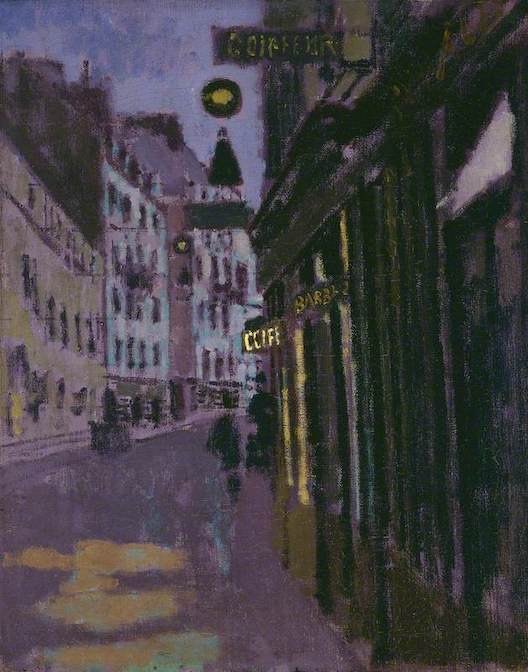
While ’Rue Notre Dame Du Champs, Paris, Entrance of Sergeant’s Studio’ (1907, above) is one of those pictures which seems an invitation, designed to pull you in and allow to drift through those streets. Whatever’s round the curve of the road is made into a temptation, if the blurry figures could be caught up with. The brightest point, the nearest to pure white, is the cafe sign placed almost exactly at the centre of the frame, attracting the eye. The two other signs are made noticeably dimmer.

If Sickert was a problematic figure, so was his mentor. But in his case it’s both less obvious and more extreme. With Degas it’s hard not to see the Dance Masters he so frequently depicted as displaced self-portraits, seated and patrician, the still point of order around which young girls obediently pirouetted. He seems to have played up to his curmudgeon image, and had he lived long enough would doubtless have ranted about immigrants on tabloid TV shows. Sickert the ex-actor was seen more as a wit and a raconteur. But there was a dark side to him which his dark art revealed…

Saturday, 3 September 2022

EMMA RUTH RUNDLE/ THE MAGNETIC FIELDS (GIG-GOING ADVENTURES)

EMMA RUTH RUNDLE
Komedia, Brighton, Tues 23rd Aug


Emma Ruth Rundle is an American singer/songwriter, sometimes described as Gothic Folk, who’s previously worked with Chelsea Wolfe. She’s made more than six albums, but somehow slowcoach here only found about her during lockdown.

Every YouTube clip I’ve seen of hers had been not just with a band, but packed a full-on sound. Whereas it became clear from the stage set-up this was to be a solo gig. (Well, with one song where the support act, Jo Quail, joined in on electric cello.) She swapped between guitar and piano throughout.

The melodic lines were strong but her playing sparse, fingers held over one narrow section of the keyboard, a capo habitually fixed to her guitar. The music often felt less like ornamentation than augmentation; underlining, italicising and emboldening the lyrics.

There’s little doubting the power of these songs. But there’s that adage about too much of a good thing. It ends up as a whole lot of music in the key of black, with lyrics like “there’s no need to check the weather, as my winter’s never over.” Ironically, I’d imagine that had she played with a band but dropped down to solo for a couple of numbers, they’d have come across as highlights. As it is, the combination of unrelentingly bleak content and restricted form became a bit too much, like taking your potion in concentrate. (And I grew up during Post-Punk, I’ve a fairly strong tolerance for unrelenting bleakness!)

The main set’s all from the recent album, ’Engine Of Hell'. (Which, from some on-stage comments, she sees as a kind of song cycle.) Which, unbeknown to me at the time, was a much more stripped-back affair than anything done before, if not quite to the extent of this gig. The constraints of lockdown on recording may well have been a factor here. Ironically, she was quite possibly recording it precisely when I was catching up with her earlier band-based releases.

Whether this was a one-off experiment or a whole new direction remains to be seen. (There’s been one album since, but that takes a dark ambient path.) But I kind of wish my first Emma Ruth Rundle gig had been nearer the shallow end, with the rubber ring of a band attached.

Not from Brighton…


THE MAGNETIC FIELDS
Hammersmith Apollo (for some reason now called the Eventim Apollo), London
Wed 31st Aug


The last time I saw New York singer-songwriter Stephen Merritt (aka the Magnetic Fields), conditions could scarcely have been more different. Then he was presenting his latest release, the self-described ’50 Song Memoir’, in strict track order split over two nights. And a double dose of all-new songs seemed to daunt the ticket buying public, judging by their non-presence. (Me, I took to it. But no-one listens to me.)

This time… well there’s frequent numbers from the most recent album ’Quickies’. (So called because every track comes in under the three minute mark.) But they also dip heavily into the equally self-described ’69 Love Songs’, which probably counts as Merritt’s magnum opus. So a larger venue fairly brims with folk, who mostly recognise each new number a few bars in.

With track titles such as ’Kraftwerk in a Blackout’ and ’The Flowers She Sent And The Flowers She Said She Sent’, humour plays no small part in Merritt’s writing. And, while perhaps I was exposed to too much Barron Knights at an early age, humorous songs are often signified by a rough-edged sound, like telling gag cartoons from illustrations. But with Merritt both songs and gags are quite exquisitely crafted, with his baritone voice the ultimate in deadpan. Captivating melodies carry barked and pithy words, again, again and again.

Though crafted here definitely doesn’t mean adorned. The five Fields on stage play quite minimally, with one or more dropping out when not required. The great English folk singer Chris Wood once wisely said “a song is great not when you can't add anything to it, but when you can take nothing away.” And many songs here fit that definition.

Back in the day, it was often commented that British sitcoms would mix up their humorous and poignant moments, much in the manner of real life, while in America the two had to be clearly delineated. At which point I’d often add that British music did much the same thing, then go on about the Smiths.

Yet Magnetic Fields, formed back in 1991, would seem to scupper that theory. Merritt seems to exult in the combination, or sometimes the juxtaposition. No less than Peter Gabriel once sang ’The Book of Love’ on stage with them, before recording his own version and spawning a series of covers. (Though I confess to preferring the original.) Which effectively made it Merrit’s signature tune. He sings it here accompanied only by the barest plucks of ukulele, during which I doubt anyone dared breathe. Then mischievously followed it with a rousing version of ’The Biggest Tits In History’. (“She majored in biology/ She knows whereof she speaks.”)

And he takes a similarly gleeful mix-it-up approach to gender identity, as in ’Andrew In Drag’. (“A pity she does not exist/ A shame he’s not a fag/ The only girl I ever loved/ Was Andrew in drag.”) He also hands songs over to co-vocalist Sylvia Sims, blurring whether the perspective sung from is his or hers.

Merritt once wrote a song called 'Think I’ll Make Another World’ and often seems to have come from some parallel reality where Elvis never went on Ed Sullivan, rock ’n’ roll never became the monoculture and the spirit of great songwriters like Cole Porter and Stephen Sondheim still blooms. And it’s a parallel reality we can step into…

If this was a proper review, I’d be telling me how the Magnetic Fields continue to tour the UK and Ireland. ’The Book Of Love’, from San Francisco. We didn’t get the variant opening…


Saturday, 27 August 2022

JOHN FRANCIS FLYNN/ SOUND PLOTTING (GIG-GOING ADVENTURES GO AL FRESCO)

JOHN FRANCIS FLYNN
Rooftop, De La Warr Pavilion, Bexhill-On-Sea
Sat 15th Aug


I confess that the notion of a summer rooftop gig at the De La Warr is what first took my fancy. So, while I had of course checked out Irish folk singer John Francis Flynn on-line before clicking ‘Buy’, I had a less-than-full idea of how he’d be live.

Despite there being no house lights to dim, there was no audience announcement or any other sign the show had started. Instead he eased leisurely into his first number. So small were the beginnings I don’t think many were aware he’s started for some while. Now Flynn looks remarkably like a ’Lord of The Rings’ character. In particular, the one who looks like a warrior prince and, in the second hour of the third film, turns out to be a warrior prince. But rather than some full-throated roar, he sings in an understated, intonatory, gentle-giant fashion, barely moving.

And most of the set, rather than attention-grabbing, was longish numbers which spun a slow magic on you. He plays acoustic guitar, alternating with tin whistle. (Or, as he proudly pointed out, two tin whistles taped together. I expect they call that the Jimmy page tin whistle in the trade.) And was joined by a clarinetist and a droney/ambient keyboardist who doubled on drums. A Dublin base usually means traditional Irish instruments which no English tongue can possibly pronounce. Not here.

The instruments were, at points, looped and treated. But never in an ostentatious, show-off fashion. Had you asked any of the songs whether they were modernised or traditional, I think they’d have shrugged the question off without interest and just carried on. Which always seems the best way.

Then, when you started to think he might have overplayed the slow and mesmeric card, they shifted into a full-voltage rocked-up version of ’My Son Tim’, complete with whoops if not full-throated roars. The clarinetist even swapped to electric guitar, without any shouts of Judas.

My one complaint would be that the drums at times felt mixed too loud, as if they were what we’d come to hear. When they first broke in, I almost jumped!

Support act Iona Zajac had a richly evocative voice, fairly built for folk singing. But her songs only at times lived up to that voice. The best number was a traditional, saved for the finale, where she was accompanied by droney squeeze-box.

Having attended because of the open-air setting, it was something for those surroundings to melt away and be replaced by the world of the songs. There’s the sense with folk music that it’s all still steeped into things, and if we find a way to tune out the workaday world we’ll start to hear it again. I am probably getting carried away now, so had better stop.

A different version of ’My Son Tim’. They got a violin, but we had a rooftop…


Then from one outdoor gig…

SOUND PLOTTING
Stanmer Organics, Falmer, Sussex
Sat 20th Aug


“Set in the verdant sprawling plots of Stanmer Organics”, it says here, “Sound Plotting will be a day of site specific sound art, interactive installations, deep listening, sound walks, improvised music and pop-up performances.” It’s by Lost Property, the collective who previously took over a Napoleonic fort in Newhaven to stage similar shenanigans.

The idea, they confess, first struck them during lockdown when outdoor settings were literally the only show in town. But it’s a good one, which has you running about like a white rabbit, amid a host of other rabbits, dipping your expectant head down a whole bunch of holes. Pretty soon you become almost accustomed to the sight of laptops perched on tree trunks, or speakers hanging from branches. And if not every rabbit hole took you to a Wonderland, then these things are always more than the sum of their parts. Wandering, exploring, is a large part of the fun.

Venturing to see Gagarin in what the programme called ‘the willow dome’ I discovered it to be a dome of willows, which you entered like a teepee. As they swayed in the breeze they created a dappled light show on the ground, nature’s instillation piece. I often contend that ambient electronics work best when you’re not sure whether they’re sourced from natural sounds or not, it seems to create a sweet spot. And the set worked better for me the nearer it got to that sweet spot.

Paul Khimasia Morgan’s set was similarly slow-moving and ambient, but (from what I saw) more based around picking up tones from contact mikes. It’s music which always seems to slightly elude you. The more you try to focus on it, the more it drifts away just past your reach, as if floating on the summer breeze. Which of course only makes it more involving to listen to. (Older readers may remember Morgan put on the Aural Detritus concert series.)

In the midst of all this knob-twiddling and miking-up of things, Jo Burke stood up and sang some a cappella folk songs. And, for that matter, sang them well. Somehow she combined the best elements of professionalism with amateurism, the sense that this stuff is our common property. Much of being a good folk singer may be holding the notes just long enough, so you get the choral-like semi-drone effect without it feeling affected. While at the same time you could feel the old songs doesn’t require reinvention or rejuvenation, that people are simply still singing them, the way they always have.

Baby Hair have a name that sounds like a folk remedy and offered, according to the programme, “minimalist trance pop and ritualistic performance”. They reminded me of the old Marc Bolan adage about pop songs being like spells, as they recited words, struck triangles and blew haunted recorders, until you didn’t know whether to find it charmingly enthralling or sinisterly enchanting. Lyrics were reduced to a few babble phrases, repeated until they became mantras. It took us all somewhere, even if I couldn’t really tell you where.

However, while it’s clearly part of their mission that things have to go on too long, past the three-minute pop-song limit like exceeding the stated dose, they still went on a touch too long. Always leave ‘em wanting more!

So, where will Lost Property be found next? Inexpertly taken photos by me, including the culminating procession by Thee Bald Knobblers.


Saturday, 20 August 2022

‘MUNCH: MASTERPIECES FROM BERGEN’

The Courtauld Gallery, London


From Daylight To Twilight (How Munch Became Munch)

The Munch paintings in this smallish two-room show more normally reside in a dedicated museum in Bergen, in fact they haven’t been seen outside of Norway before. Perhaps unusually, they come from all stages of Munch’s career. Let’s start at the start…

The prime example of Expressionism, we soon discobver, started out as an Impressionist. That may be like discovering a Punk musician originally played Blues. It may be the more surprising thing that those early works hold up so well. To get here you need to walk through the Courtauld’s impressive Impressionist collection, Monet, Manets and Degas on all sides. Yet they don’t particularly pale in this fine company.


Take ’Morning’ (1884, above) with its captured moment in time, casual pose of the figure, precise play of light and the floorboards and side of bed seeming to extend out past you. It’s immediate, involving, like the painting’s not here but we’re there. It was a good enough stab at the style to flummox the Norwegian critics, who soon dubbed him ‘Bizarro’.


Or take ’Inger in Sunshine’ (1888, above), which manages to convey the sunshine despite being painted in Norway, and with what the show calls “shimmering colours”. Only the model’s impassive expression seems a departure.


But then try ’Summer Night: Inger On the Beach’ (above). It’s from 1889, only a year later. It takes the same model (one of his sisters), in a fairly similar outfit. But everything is now different, and Munch as we know him has arrived. She doesn’t look out but off, as if in a reverie.

The colours are flatter and more sombre. But two things stand out most of all. The lack of horizon line, the water extending past the edge of the frame. And that white dress makeing her the focus of the image, even though she’s not centred.

She isn’t placed before a setting, it’s built around her. This isn’t a slice of life but a psychodrama, a moodscape. Shoreline setting and twilight combine to create a liminal space, aids to help us guess what her pensive thoughts might be. As I said over the British Museum show of his prints: “Munch is perhaps the default example of an Expressionist artist, who painted not what he saw but what he felt.” In fact, the show is keen to say that it’s with this exact work that the shift occurred.


And he didn’t stop there. ’House in Moonlight’ (1893/5, above) is almost a series of theatre flats, where we work out what’s in front of what by placement, not perspective, the gate behind the woman, the house behind the gate and so on. (Only the very foreground, with the falling shadow, breaks from this.) And the greens look too green, the browns too brown, to be naturalistic. Everything we see here looks like a symbol.

Trapped In A Timeline

And ‘Woman in Three Stages’ (1894,) from the series ’The Frieze Of Life’ merely uses pictorial space as a backdrop to a light-to-dark timeline. Let’s get the obvious said first. The three stages of women, already referred to like points on a production line, are not-yet-ready-for-sex, ready-and-up-for-it and then past-her-sell-by. Just as with nature, Munch’s only interest in women seems to be what they can offer him. It shouldn’t be contentious to say this.


But let’s look more at how the theme recurs in other works on show here. At first glance, ’At the Deathbed’ (1985, above) more resembles the better-known ‘The Sick Child’ (1885/6). Both are inspired (if that’s the word) by the early death of his sister Sophie. Both split the frame, placing the sickly child on the left, the grieving adults on the right.

Yet in this work he inverts the figure and places her prone under a white sheet, as if already in her coffin. Which makes for a strong contrast to the assembled family, a cluster of black which extends beyond their mourning clothes to take up almost all the right section.

So we are almost back to the light-to-dark timeline of ’Woman In Three Stages’, merely with the middle figure removed. Sophie was fifteen when she died, but truncation makes this figure seem smaller. It’s as if she died before gaining the full awareness of death the adult figures are lumbered with, innocence your only possible protection against this world. It’s like the classic Larkin line amended: “Get out as early as you can, before the possibility of having any kids yourself has even arisen.”


’Four Stages of Life’ (1902, above), as the title suggests adds a stage. Though probably more significant is his arranging of the figures behind one another. The young girl isn’t just pushed to the front and given a red hat (with echoing flecks of red in her coat), she looks out at us, and so becomes our focus. She may even be pleased to see us.

While the figures receding along a receding road look progressively gloomier, and meet our gaze to lesser and lesser degrees, the third already seeming to wear a mask. With life reduced to a timeline, we can only focus our attention on the short-lived part that’s liveable.


’Evening on Karl Johan’ (1892, above) resembles the print ’Angst’ (1896) from the British Museum show, and indeed Munch had fixations he’d repeatedly hammer on. But there’s an irony here that the deep perspective and pushing of figures to the foreground, almost out of the frame, is an Impressionist device that almost takes us back to the start.

Except with them it would convey the vim and bustle of street life. While he uses it to get us eyeballed by that dead-eyed clump of black, with their identically blank expressions. This is like the mourning family from ’At The Deathbed’ transplanted. Last time I used an Eliot phrase to describe the pallor of those ghoulish faces, “the skull beneath the skin”. Let’s add another one, “I had not thought death had undone so many.”

As we saw in the British Museum show, Munch was very much a Bohemian who associated with other Bohemians and (at least at times) exulted in shocking polite society. Yet as we also saw, rather than any of the libertinism and hedonism we associate with Bohemianism, he gives us very much the reverse.

His family background was Pietist, an uber-Protestant group who saw little good in this world other than a way out of it, via connection to God. And he doesn’t upend or challenge any of that. He simply cuts the connection, leaving us marooned and bereft. Chesterton famously said “When a man stops believing in God he doesn't then believe in nothing, he believes anything.” Munch proves this wrong. He very much believed in nothing.

Right at the end are a few works by later Munch where, taking on a more optimistic perspective, he sought to portray human vitality. Which seems the opposite to what you tend to expect, that people start out full of vigour and drive to change the world, and as they age feel mortality slowly closing around them.

But it must be said these works are simply less involving to look at. Whether this is because he was faking the look, like giving a wan smile, because he was built to glower in the gloom, or simply because optimism is a harder look to pull off than pessimism… there’s probably no way of knowing. Whichever it is, Munch’s home ground was the liminal spaces.