googlee7ea825f63edb3f6.html

Saturday, 10 December 2022

SVANKMAJER’S ‘ALICE’


The Real Surreal

If you wanted a central image to separate this ’Alice’, by Surrealist Czech animator Jan Svankmajer, from more standard adaptations, take a central one – the White Rabbit himself. Rabbits can lend themselves to cuteness, they’re sometimes given to children as pets. But this is quite pointedly a stuffed rabbit, a taxidermy exhibit, with frequent references to its spilling sawdust innards and regular close-ups of its sharp chomping teeth.

It’s too easy to contrast him against the fluffy Disney version, so let’s instead use the gentleman in fur of Tenniel’s original illustration. This version isn’t something I’d be following down any holes, looking more like something more from an anxiety dream than Wonderland. (A word notably missing from Svankmajer’s title.) We might want to ask, where would such a critter come from?


If Svankmajer was a Surrealist, Lewis Carroll was often cited by that movement as a precursor. He was name-checked by Breton, the movement’s self-appointed Pope; made the subject of a 1931 essay by Louis Aragon; his Alice was twice painted by Max Ernst (if not terribly recognisably), and Carroll’s own drawings were even included in their 1936 New York exhibition. 

But were they finding a fellow traveller or press-ganging him into their service? To me the best take on ’Alice’ remains Mark Fisher’s. Beneath all the clean pinafores and innocence of youth lies an absurdist work, “the precursor of Kafka”. Which is precisely why it appeals to children...

“There is the feeling that Wonderland is Alice's world alone, yet she has no place in it. She is always late, in the way, misunderstanding what ought to be obvious… The adult world as seen by children is, precisely, a Nonsense world, incomprehensibly inconsistent, arbitrary and authoritarian, full of bizarre rituals.”

It’s vital, I think, to understand that at least the majority of the characters she encounters are stand-in adults. While the ever-analysed White Rabbit doesn’t really stand for any thing, not even Alice’s curiosity. The whole point of him is that he can’t be caught up with. Forever just out of reach, the elusive nature of answers.

And Absurdist isn’t the same thing as Surreal. A Surrealist Wonderland would be thrilling and transformative but also dangerous and destructive. While Carroll’s is ultimately confounding, sinister and incomprehensible. And this brings risk of appropriation. The same way the later hippie generation appropriated Alice into a reductive metaphor for drugs.

Wells famously stripped his film version of Kafka’s ’The Trial’ (1962) of any of the standard period detail. Similarly Svankmajer doesn’t de-Victorianise ’Alice’ so much as domesticate it down, strip it of any Technicolour Oz-like grandeur. For example, turning the famous fall down the rabbit hole into a descending lift. The majority of the film was shot in his own house.

Though there’s a bigger difference. The now-famous book Alice’s sister reads, as we all know, has no pictures or conversation in it. While the book Alice appears in is full to bursting with both. It’s stuffed with wordplay, while the film is (typically for Svankmajer) largely silent. But those visual symbols, occupy much the same place as words did for Carroll.

And much of Carroll’s approach is to treat nonsense consistently. If there is such a thing as Mock Turtle soup, it follows there must be a Mock Turtle to make it from. And the film follows similar lines. The White Rabbit is stuffed with sawdust, so when he eats he swallows more of the stuff.

A World Of Symbols

The film opens pretty much like the book - the summer’s day, the riverbank, the accompanying adult/older sister (it scarcely matters which), the book without pictures or illustration. The only addition is to show Alice diffidently tossing stones in the river, as if to alleviate her boredom. But then, when so many scenes from the book don’t make the screen, we get a Svankmajer invention - Alice effectively duplicating all this in her room. The toys and other items around her then become the cast list for the film. As Caryn James of the New York Times has said, it’s “a world of symbols come alive.”


Combined with which, throughout the film only Alice is played by an actor. Everyone and everything else is portrayed by puppetry or stop-motion. Plus, while the book is written in the third person, she narrates the film. As she also provides the dialogue, she’s both omnipotent narrator and lost intruder. And she makes little attempt to provide voices for others, they simply speak with her voice.

All of which is like child’s play, an attempt to make sense of the wilder world using toys as diminutive props. Alice spies on the bizarre happenings, but her face is stoic. Which upholds the central irony, that this world is made by Alice’s imagination yet she remains uncomprehending of it. Basic functions, such as opening drawers, work for other characters but not her. That deadpan scrutinising look, the “what can this be about”, is familiar to anyone who has ever dealt with children.

That emphasis on drawers, often using them as portals, may be because adults often try to keep children out of them, storing not-for-play objects in them. (One is shown containing scissors).

We’ve seen before two Surrealist devices as least as common as dreams, both of which come up here. One’s the single often-youthful explorer of a huge, multi-roomed house, as in the painting of Dorothea Tanning. The other’s the charged object. Which simply animates well.

Child animism is, at root, the presumption that all objects have their own life. And behind much of Svankmajer is an audaciously simple idea, that stop-motion animation is a perfect means to convey this. You can even take the object the child sees and bring it to life, or at least a kind of life. How easily an old sock and some false teeth can turn into a Caterpillar! What often seem the medium’s limitations, its jerky quality, its sense of animate unreality, suddenly transform into advantages.

‘Uncanny valley’ is used to describe the awkward interchange between cartoony symbols and realism, between a smiley face and a photo-realist portrait. And there’s something equally neither/nor at work here. It all seems to slip and slide, elude any categories we try to give it.


Much has been written about how CGI ‘smoothness’ is the special effect of neoliberalism, a spectacle which creates a disjunction between ‘realism’ and the real. In such an era, to see extemporising being foregrounded, pointedly showing false teeth attaching to a sock to make up a Caterpillar like giving away a magic trick, feels like being a thirsty person who’s fallen on water.


One of the more ambiguous cases for the child, and interestingly one we tend to push on them, is automata. Things that move, surely they must live. And both the Mad Hatter and March Hare are portrayed by automata. One has a wind-up key in his back, the other very visible strings. Their repetitive chatter and behaviour becomes like the stock dialogue of wind-up toys.

But unlike most adaptations this isn’t aimed at children. (Alice even makes a gag of this in her introduction.) Which raises the question, if this is all about child perspective, why tell us? When we mostly gave up on socks being sentient a while ago. The answer’s in something else Alice tells us in her introduction - “Close your eyes, otherwise you won’t see anything”.

Like many Surrealist phrases, this might seem an invitation to dream, dream dream your days away. But these dreams are not sweet. It’s more an injunction to close our eyes against the things we have decided we know, to shut out the consensus reality we have built. Svankmajer has said his practice was to keep hold of the way he saw the world when he was seven. (We already looked at his earlier short ‘The Flat’, which has a similar character-vs-objects duality yet with an adult protagonist.)

The Three Alices 

But at the same time as a look back to child psychology this a film about the changes brought by adolescence. Alice doesn’t just change size, she’s always awkwardly the wrong size for her world, too big or too small. (Though some of this occurs in the book I don’t think it was Carroll’s original intention.)

If we say many images are sexually suggestive, we don’t need to find too precise analogies. The soon-pierced clingfilm lid of the jam jar could represent a hymen, for example. But the drawing pin then found in the jam just conveys the general sense that sex is ‘dangerous’. After all, you suggest to get away from saying. (Needless to say, when the actor is a child this skirts dodgy territory. But overall it stays the right side of the line.)


Perhaps as one way of reconciling these themes, the size-shifting makes Alice seem almost three different characters – Regular Alice, Big Alice and Little Alice. This last one is (in another Svankmajer invention) represented by a doll and is most integrated into Wonderland, obeying the White Rabbit which Regular Alice chases. Unlike Little Alice, the existence of Regular Alice is forever contingent, yet in this strange world has nothing to pin that contingency on.

Big Alice is stuck in a room (see up top), but in a narrative flip then defends it against a siege by the White Rabbit and assorted creatures of Wonderland. It’s as if it’s become her body, which she safeguards against violation. When she’s attacked the imagery strongly suggests sexual assault, skull teeth tugging at her skirt.


”Say What You’re Supposed To Say” 

Carroll refers to his lead’s “good-natured anxiety”. And accounts of the film often refer to Alice’s passivity, how she wanders a world she finds no way to engage with. Yet this disregards Big Alice, and the final trial scene where Regular Alice effectively transforms into Big Alice. While other scenes see bigger changes, the changes made here seem most significant.

In the book it’s the Knave who’s placed on trial. But the focus is more on the absurd and chaotic nature of the proceedings. It’s a trial run by those with no notion of how a trial runs, and no intention of admitting it, so such details become ambiguous. Alice starts growing inadvertently, which gives her the gumption to challenge proceedings.

In the film it’s her who’s the accused, with the whole trial based around nailing her, the jury essentially a jeering mob. Literally given a script to read (an admission and plea for mercy) and told “say what you’re supposed to say” she refuses, and mocks the court by eating one of the tarts, the very thing she’s accused of. She adopts a cheeky grim, as familiar on a child’s face as the deadpan curiosity, yet the first time we see it. She shakes her head and in that motion briefly becomes the creatures of Wonderland, as if she’s come to realise where they’re from.

In this scene everything is brought to a head, which turns out to be her head. She overcomes Wonderland by realising, at the very same time it’s been a strange and foreign world, it has been part of her all along. Her very last line, about cutting the White Rabbit’s head off next time, suggests the old Alice who hopelessly followed him is gone, that her adventures have crowned her the Queen of her own imagination. That’s Surreal, that is.

Much of Svankmajer’s appeal is that he isn’t a modern film-maker who’s been influenced by Surrealism, he’s simply a Surrealist artist. And if he could make a film as fully Surrealist as this in the Eighties, surely someone could make one now. (Okay the accursed marketisation of film funding works against this. But that’s an external constraint, not a creative one. It’s not impossible for an artist today to think as a Surrealist, the way it would be with say a Constructivist.)

And Surrealist versions of Alice always work best when transforming the original explicitly. There’s a reason, after all, adaptations are called adaptations, not transpositions. If we wanted to get back to the book we could just read the book. The original Czech title was ’Something From Alice’, stating quite explicitly it was never intended as a straightforward adaptation from page to screen. 

But the last thing it does is take an innocent Victorian children's tale and messes with its skirts. It would be truer to say it takes a dark Absurdist drama and finds it a happy ending.

Saturday, 3 December 2022

NOT A PROPER REVIEW AT ALL OF THE BRITISH MUSEUM’S ‘HIEROGLYPHS - UNLOCKING ANCIENT EGYPT’ EXHIBITION


...in fact it teatures precisely one exhibit, a relief from the Karnak Temple, which depicts the defeat of the Libyans, photographed by my good self which characteristic ineptitude. 

The two figures are the sort of thing we expect to see in Ancient Egyptian art, standard hieratic profile view. Yet that rearing horse deominates the image. And more importantly both sets of its legs are doubled. The motion effect which adds to the sense of it rearing up mid battle.


It’s an effect mostly associated with Futurist art of the early twentieth century, for example Boccioni’s ’The Charge of the Lancers’ (1915, above). This image looks more eye-popping because the effect is used more extensively. In fact everything seems to lead out from the body of that horse, enhanced by the dark-to-pale colour gradation.

While at Karnak Temple the effect is never used anywhere else. It’s perhaps not clearly visible in my hurried photo, but it’s not used on those falling and feeling figures, which are all kept integral. Yet they’re such a jumble, you have to scrutinise the work quite hard to realise they’re not. (An effect possibly heightened by the contrast between them and the neat columns of hieroglyphs.) The whirlygig blur of battle looks very much the intended effect.

Art from this era is usually almost anti-dynamic, it’s impassive, ritualistic. To quote Wikipedia: “Artworks served an essentially functional purpose that was bound with religion and ideology. To render a subject in art was to give it permanence. Therefore, ancient Egyptian art portrayed an idealized, unrealistic view of the world. There was no significant tradition of individual artistic expression since art served a wider and cosmic purpose of maintaining order… It is also very conservative: the art style changed very little over time.” In short, it exists to say ”this is so”.

Here, not so much. A more dynamic art suggests a more volatile world. So how to explain this multi-legged horse? Options include

i) “A useful reminder not to over-generalise over the culture of an ancient civilisation, especially one which went on for so many centuries.”

ii) “It’s interesting, but you can’t extrapolate that much from a single example. For all we know popular reaction could have been befuddlement, and the artist firmly told to count the number of horse’s legs the next time.”

iii) “The answer’s obvious. A Futurist artist had a time machine, duh.”

iv) “Shut up Gavin, no-one cares about this sort of thing apart from you.”

Saturday, 26 November 2022

‘OBJECTS OF DESIRE: SURREALISM + DESIGN 1924 - TODAY’

Design Museum, London


“There already are enough useful objects designed to perfectly fulfil their function, what I am looking for is to communicate and interact with the object.”
- Cinzia Rugger

Lobster Telephones That Ring

“Although Surrealism is often seen as escapist”, this show points out, “its founders were more interested in changing perceptions of reality.” Well of course! It’s a shame it still needs to be said, but as it does it’s better to say it. And there seems little doubt that the movement’s popular association with painting and drawing is because they’re associated with escaping into another world.

Design, though? It also says “Surrealism liberates design from the rational and utilitarian.” I hate to be a killjoy. But don’t we want design to be a bit utilitarian, or at least useable?

Dali’s famous Lobster Telephone isn’t just here but adorning the poster. We’re told that Edward James commissioned eleven of them for his various residences, which do seem to have been working models. But even if we still had cradle phones, let’s face it you wouldn’t want one of the cumbersome things yourself, wrapping it round your head only to hear from some dodgy call centre calling themselves “your bank”.

The show quotes Isamu Noguchi, “everything is sculpture”. Which sounds more a Bauhaus statement than Surrealist. The Bauhaus credo was of course ‘form follows function’, which the show counters with ‘form follows fantasy’. But this ignores the degree to which Surrealism was intended as sabotage.


Take Many Ray’s famous ’Gift’ (1921, above). It clearly wasn’t designed to ever be used as an iron, but to be disruptive. Just like an actual iron like that would tear through shirts, Surrealism intends to tear through art and society. Strictly its Dada rather than Surreal, but the slippage between one and the other is considerable. And as Dada was anti-art, wouldn’t Surrealist design need to be anti-design?

Similarly, some of Duchamp’s readymades show up. But the whole point was to tear them from their function, sometimes quite literally, and put them somewhere where they didn’t fit. People have used his urinal for its original purpose, but only as a prank. It’s similar to the way that words, when taken in isolation, seem to descend into prattle. Duchamp wasn’t interested in them as works of design, nor of designing with them.

Furthermore, we use design as a synonym for plan, in phrases such as “by design”. Whereas Surrealist artists frequently worked by automatist (chance and/or unconscious) processes. You could claim that to come from the authentic Surreal region of art it needs to involve, as said of the recent ‘British Surrealism’ show, “artists surprised by what springs from their own hands.”


And further furthermore, early on the show gives us Dali’s ’Metamorphosis of Narcissus’ (1937, above). Even if we were to somehow miss it in the work, the focus on transformation’s there in the title. Things are not still or separate, but ever-changing, to the point where things aren’t really even things any more. The show refers to these as “ungoverned shapes”. How can you convey this with real world objects? 


As it turns out, you can. Dali’s ’Cats Cradle Hands’ chair (c. 1936) transforms its back into arms and hands. Or Meret Oppenheim’s ’Traccia’ (1939, both above) gives a table bird’s feet.


Ray and Charles Eames’ ’Moulded Plywood Sculpture’ (1943) has the sinuous curves often found in Surrealism, but almost works better for being ‘real’. They seem to flow so, the eye can’t really get a purchase on them and hopeless follows them round and round. It’s not a ceaseless Moebius strip, ever-twisty and ever-turny, but it still looks like one. Sculpture is surely, by definition, about solid and fixed objects. Well, not here.


In fact Surrealist artists had pretty much a penchant for realising in real life things they’d originally painted. Dali’s sofa of Mae West’s lips is on show here, but us Brighton folk are familiar with another version in our local Museum. So more interesting to me was Victor Brauner’s ’Psychological Space’ (1939, above). The show displays the original painting, from which he made that wolf table for a 1947 exhibition. Why do such a thing? A quote from Shiro Kuramata might come closer: “Enchantment should also be considered a function.”

As seen before, over the Tate’s recent ‘Surrealism Beyond Borders’ show, a large part of Surrealism was about having an almost animist relationship with charged objects. “Its perspective comes from recognising objects as entities; to be recognised, to enter into accordances with, the most humble modern objects seen as possessing spirits.”

It’s true that, to intensify this feeling, they tended to prefer objects whose origin was somehow mysterious, stumbled upon in flea markets and the like. But there’s nothing essential about this. It’s similar to the way couples can relish the tale of the unusual way they met, but that’s not essential to being in a couple.

However, you don’t have to think about this for very long before you realise you’re being asked to treat functional things as though they were some combination of art object and magical force. The problem then becomes that the designer can’t pre-determine this relationship, which is all between the object and the user.

And speaking of exhibitions, they seem important here in themselves. Or at least the ones the movement itself staged. As the show points out “Surrealists approached [them] as collective artworks”. Just as with Dada, they were part of Surrealist practice, not just a means by which to display already finished works. In fact the works just became materials for the overall show, with obligations such as displaying them clearly being discarded. There’s photos of various exhibitions here which are effectively installations, the opposite of neatly ordered and carefully labelled rooms like the one we’re in. A particular favourite of mine is is Duchamp’s ’Sixteen Miles Of String’ for a New York show in 1942. (Photo below by John D Schiff.)


And there seems a similarity with Dali’s home designs for Edward James’ Monkton House, where everything seems incorporated, integral to the Surrealist concept, nothing left to be ‘normal’. Or his film or theatre sets, or window displays for Bonwitt Teller, (1939, above). And these do look different, and more effective, than when individual elements are ripped from the room and shown as isolated artworks. It’s a kind of fishbowl design, where part of the point is we know we’re looking at real objects. But they’re there for us to look at rather than engage with. As much as it is design its design as display, not use.

Design Into Dollars?


The skeptical reader may note how much Dali has dominated things so far. And its unsurprising that the man soon anigrammatically nicknamed Avida Dollars led the way in this direction. (It’s a bit of a tangent but the show includes 'Destino’, the animation he made for Disney. In 1945/6, but not realised until 2003. And it’s notable how easily his slick later style blends with the smooth Disney look.)

After all… shop windows, objects made to be talking pieces for toffs, don’t these consumer items seem a world away from an art movement that declared itself revolutionary? How does this fit with the Tate show which largely focused on colonial subjects? And couldn’t that be said to be inherent in this direction? Enchantment, like most desirable things, turns out to be a luxury product. The rich, after all, live their lives on show, consume conspicuously, while the rest of us make do with frill-less functionality.


Or take ’Horse Lamp’ by Front Design (2006, above). It looks a surreal triumph, a full-size model of a horse made to do no more than hold up a lamp. Most of us would literally not have room for such a thing. Except you can buy it, given the will and a spare five grand. Which kind of transforms it from absurd object to click and collect. (Well, okay, you’d probably ask for it to be delivered.) 

Or, perhaps more strongly still, Carlo Mollino’s 1938 designs for Casa Miller, which included a torso-shaped hole in a wall. Is there a left-field charm to this? Yes. But that charm all belongs to Magritte, a Surrealist artist I’m not even especially keen on. In such moments it’s hard not to think of those who crowbar Banksys off public walls for private clients. One leaves a hole behind, the other makes off with it, but same difference.

There doesn’t seem much point debating whether Dali was a dollar-clutching scumbag. But life isn’t obliged to hand us easy answers, and he was also (at times) a superlative artist. While James was a longstanding supporter of Surrealism and an interesting figure in his own right, not just a standard toff looking for the latest thing. And Meret Oppenheim, Surrealist par excellence, made limited-edition luxury gloves. (If not until 1985.) Besides, in those days most painters got by either via patrons or by being wealthy themselves. We don’t live in this world and get to be untainted.

Besides, what’s often appealing about these themed shows isn’t the through line but the by-ways. Things which don’t necessarily belong here but, now they are in front of you, you’re glad of it. And the chance encounter seems the more Surreal way of going about things, better than rigidly inspecting the guest list. The show quotes Ingo Maurer: “Chance rules our lives, much more than intention.”


Case in point… When the architect Le Corbusier was claimed as Surrealist-influenced, first I felt they were clutching at straws early. But they went on to convince me. The painting by him, while good, was more post-Picasso than Surreal. (Albeit from the era where Picasso was saying he was Surreal.) But the sculpture ’Ozon III’ (1962, above) could have had Andre Breton pinning a medal to it for services to strangeness. It seems to simultaneously reduce the human body to a mechanism and turn it into a charming cartoon, with parity found between an arm and an ear. With its bizarre anthropomorphism there’s a strong sense of humour to it, and I didn’t know Le Corbusier even had one of those.

Should We Still Be Surreal?

“Surrealism”, the show says, “is still evolving. The torch has now been passed to contemporary artists and designers who dare to shake up the creative process.”

Well, we could argue about whether art is still evolving. But Surrealism didn’t re-use century-old devices, it sought out new methods to deal with the world they found themselves in, revelling in any upset this caused. Current-day artists shouldn’t be in thrall to it, they should be using it in the way it used primitive art, ruthlessly plundering it of anything that looked useful, discarding the rest.

As said over the ‘Dreamers Awake’ show at the White Cube, “contemporary artists are forever claiming they’re its inheritors, often on the basis of a hazy notion that once it was ‘edgy’ and now so are they. Does for example Sarah Lucas belong here? (Inasmuch as her tedious efforts belong anywhere.)” And you’d have to say much the same here, to the extent that Sarah Lucas does indeed show up again. But let’s do what we did then, and talk about the stuff that’s worth talking about.


Gae Aulenti’s ’Tour’ (1993, above) is a coffee table on wheels. It may initially seem akin to ’Horse Lamp.’ Except it’s anti-functionality doesn’t come about through lack of space, it’s inherent to the thing. You could take it home if you wanted, but it couldn’t do other than create chance processes in your lounge.


From 1950 on, Piero Fornasetti was taking one face (the opera singer Line Cavalieri) and placing it on an endless succession of plates, each with some Surreal twist to the image. Though the twists are often ingenious, it’s the combination of form and content which makes it. We associate plates with mass production, with repetition, with conformity.

Anyway, the twin highlights of this more modern section of the show are chairs. Make of that what you will…


Danny Lane’s ’Etruscan Chair’ (1984, above) is made from the most industrial of materials, glass and steel tubing. Yet just by making them geometrically irregular he anthropomorphises it. Those are definitely eyes in its back, and I stood there waiting for it to scuttle off.


Alberto de Braud’s ’An Uncomfortable Place’ (1992, above) features what would be a regular chair frame, except that it’s erupting strange tendrils and knotty protuberances. Chairs we assume to be made from dead wood, but this seems to somehow have not just retained life but still be growing. (It’s actually bronze, it just looks like wood.)

And, in a sense, carpenters do to wood what society does to people, drain its essence, chop it into regulation size, make it into a usable commodity. Except the title leads us not to side with this rebellious chair but take on the perspective of the sitter. If you thought someone was about to sit on you, you’d automatically assume a more awkward shape, and this is the chair’s way of doing that. It’s reminiscent of the rebellious furniture of Svankmajer’s short film ‘The Apartment’.

That which you thought tamed and made orthodox may still surprise you, it may be a good point to end on. Except of course precisely what makes this a great art objects makes it literally impossible to use as a chair. It’s merely disguised as a functional work of design to make its point. This show’s full of things which are functionally useless. Some of which are just useless. While others enchant.

Saturday, 19 November 2022

OZRIC TENTACLES/ GONG (GIG-GOING ADVENTURES GO ALL COSMIC)

Concorde 2, Brighton, Thurs 18th Nov


Shortly after the sad death of Nik Turner seemed just the right time to attend an Old Hippies Reunited party, and as luck would have it a double-barrelled one came along…

I’m not sure how many time I’ve seen Ozric Tentacles now. There was a fifteen to twenty year period where it seemed almost impossible not to see them. Attend anything remotely resembling a festival or gathering and there they’d be. And I’m equally unsure when I last saw them, except it was some while ago. They would play regular venues too, but it what when that festival environment was clamped down on that they went out of my sight, like an animal losing its habitat.

Looking back, their sound was based on a kind of false memory. There wasn’t really a time when Psychedelic music overlapped with Prog, it was more than one waned as the other waxed. The bands who performed that transition, like Pink Floyd, tended to have a ‘mellow’ phase in-between. But that sound was why their best-known number came to be ’Kick Muck’, the guitar sounding less like a guitar and more like someone cranking furiously at a funnel which emits a ceaseless torrent of notes, so many and so fast they go by in a blur.

Guitarist Ed Wynne is the only survivor from back then. And the band’s become something of a family affair, featuring his ex-wife Brandi on bass, his son Silas Neptune on keyboards and a flautist and drummer whose names I failed to catch.

The standard thing to say about a longstanding band is what they’ve gained in ability they’ve lost in edge. Which sounds remarkably close to what music did when it morphed from Psychedelia to Prog. The greatest thing about Psychedelia being its abandon and derangement, and the worst thing about Prog being that it abandoned that abandon.

And for a band whose first-ever gig was a six-hour spontaneous jam at Stonehenge Free Festival in ’83, who often seemed to be jamming on stage, there seems little jam tonight. Wynne even introduced the tracks, something never done back in the day. The absence of ‘Jumping’ John Egan, who combined flute-plyaing with on-stage antics like a cosmic Bez, also changes the dynamic.

Nevertheless, if there’s now more smooth than rough, there was always some smooth. Unlike most festival circuit bands, they had (and have) the musical chops to work for those who stood to listen as well as those who waved their arms. There were points this set seemed to meander and my attention drifted, but overall it kept enough punch and was musically adventurous enough to take you with it.

The highlight, version of ’Kick Muck’ notwithstanding was the finale, also their most Dance-influenced number, where the abandanometer most definitely went into the red.

This was very much a double-headliner, with the auditorium packed and ready for Gong even at the un-rock & roll time of 8pm. In case there’s anyone left who doesn’t know who Gong are these days… Daevid Allen assembled a younger band around him (this time with no relatives) back in 2014, who released one album. After getting his no-hope diagnosis (the album was called ’Rejoice I’m Dead’), he suggested they carry on after he was gone, which they have.

But any debate about whether that makes them Proper Gong or a tribute band with validation is sidelined, when they play precisely one classic Gong track the whole set, even then segueing into it from somewhere else. Which was ’Master Builder’, my absolute favourite Gong track ever, so they made one Old Hippy happy.

How much the set drew on the one album made with Allen I don’t know, I’ve not heard it. Though at one point new new songs are announced. Pretty soon it became obvious that this was really only Gong in the sense of inheriting the family name, and you should look on them as a new band.

To which the verdict would be mixed. Some tracks did sound close to hippy music as described by its detractors, meanderingly pleasant music with ‘positive energy’-type lyrics. But, not just on ’Master Builder’, also elsewhere in their set, they proved that when they want to wig out they absolutely can.

Not from our fine shores, but more or less the right Ozrics line-up…


Saturday, 12 November 2022

"SOMEBODY CALLIN'" HOWLIN’ WOLF’S ‘MOANIN’ IN THE MOONLIGHT’

(Top 50 Albums)


When I was first getting into music, what histories there were faithfully followed a script. Rhythm & Blues’ role had been important but brief, to be the midwife of Rock & Roll. (And it normally was R&B, more than Gospel or Country.) It was portrayed as original but basic. It had taken black people to come up with it, all simple-minded yet pure of heart like they were. But it had taken white people to pick up on that and turn it into something.

Even R&B artists would at times go along with this, perhaps figuring it not best to bite the hand attached to the deepest pockets. None less than Muddy Waters sang ’The Blues Had A Baby And They Named It Rock and Roll’ (1977), which at least moved midwife along to mother.

But if anything, it was the other way up. Rock & Roll finally formally broke something which had in actuality been undermined in American music decades back, the colour bar. And that was a significant cultural event. But to do it, it had to dilute the material down for a mass audience, make it more palatable. (And the right term is mass, not white, audience. You could tell a similar story with Country.)

Big Joe Turner’s version of ’Shake, Rattle and Roll’ is not just better than Bill Haley’s, it’s better at all the things Rock & Roll is supposed to be good for. The same is true for Big Mama Thornton’s ’Hound Dog’ over Elvis’, and you could keep going.

But it’s more than that. The problem with constantly searching for the roots of Rock & Roll is that everything else just gets thrown away as a weed. When, if you just look at what’s in your hand, it can be the finest flower. We should stop seeing Blues as a staging-post to somewhere else, and start seeing it as a place in itself.

The two big stars of the classic post-war era of R&B were Muddy Waters and Howlin’ Wolf. Their creative rivalry was only accentuated by their being on the same label (Chess) and using the same main songwriter. (Willie Dixon, who would deliberately tell Wolf a song was already promised to Waters, knowing he’d then insist it had to be his.)

And they sound very little like someone trying to come up with Rock & Roll. True, there’s times they rock it, and as well as anyone. Wolf’s ’Rock It Boogie’ comes self-described. But, as a general rule, in straightening itself out in order to be made into Rock & Roll, Blues became a more rigid, more regularised form of music. In picking up the fixed-voltage power of electricity, it lost the free-form force of unpredictability.

Not so with our guys! Giles Oakley wrote “they can continue the use of country-style unpredictability in bar lengths, giving free range to the blues feeling surging through the whole band as if it were one man.” (‘The Devil’s Music’, 1976). He was talking of Waters’ band, but it applies to both. Rather than upbeat and animated, their music was measured and spacious, even laconic. (Perhaps best summed up by the Wolf lyric “Oh the church bell tollin’/ Oh the hearse come driving slow”. Not something you could sing over a Gene Vincent beat.) Harmonica was often then used to thread, bend and stretch between the placed-out guitar notes, like barbed wire curling round fenceposts.

And Waters was great. Truly great. But ultimately, Wolf was even better.

I’d first heard Blues early, as a child, as my Dad had some old records. And my young ears could barely take in music that sounded so unearthly, so totally removed from the Pop music and advertising jingles which I’d taken to be music.

He had no Howling Wolf. (Due, I’d suspect, to the lack of any ‘authentic’ acoustic era.) In fact I wasn’t to hear him until an adult. Whereupon, despite having had years to acclimate myself to music, when I finally got there he still sounded as unearthly as the Blues I’d first heard.

It is true that lyrically, particularly by the time of R&B, Blues did tend to prefigure Rock & Roll. And Wolf sang as much about the familiar themes as anyone else, women not being able to resist him, and his baby doing him wrong. (However those two were supposed to fit together.)

But his lyrics could also hinted at something sinister going on, at lurking, indeterminate menace. (Something people associate with Robert Johnston, but don’t imagine in electric Blues.) In the later track ’Ain’t Superstitious’ from 1961, the title phrase is continually countered by lots of good reasons to be superstitious. Yet, importantly, Wolf knew to never make it any more explicit than that. It was like that anxiety dream where you’re not sure quite what’s causing the anxiety, making you all the more anxious.

(And Blues was ever thus. All the things that books earnestly list as creating the genre, which basically come down to racism, are almost never referred to explictly in the music.)

And this perfectly matched his voice, gravelly but also given to unearthly, name-defining howls, wails and moans. (He liked to say he’d originally tried to yodel like Country star Jimmie Rodgers, but howls were simply what had come out of his throat and so he’d gone with them.) Suffice to say, if you take to Wolf’s voice, you’ll most likely take to everything else about him.

And voice and lyrics were then married to the spectral music, sounding like it could pass through walls. The opening track ’Moanin’ At Midnight’ (1951) sums this up well. It starts with Wolf literally setting the tone with a low moan, as if retuning you into his frequency. Surely one of the greatest track openings of all. It’s the equivalent of saying “who-hoo” in a ghost story, except in a way that actually works.
It’s a classic example of the combination effect in music, the whole being more than its parts. Lyrics like “Somebody calling me/ Calling on my telephone” scarcely sound like Pulitzer prize stuff. But add it to the voice and the music and the result is spine-tingling.


But going back to that idea R&B was a basic genre, does any of it get repetitive? The short answer is yes. Even that low moan intro gets straight-out duplicated on another track on the same album, ’Moanin’ For My Baby.’ But there’s two things to consider here…

First, this was never planned as an album. The currency of R&B was the single, at most the EP. The Billboard R&B chart, which began in ’49, even included jukebox plays alongside record sales. This album, though put together back in the day, was complied from already released singles. (In ’59, from material dating back to ’51.) And that was what albums were to Chess, at least back them. (Fun fact! ‘Album’ originally referred to a clutch of 78s packaged together. It meant ‘separate things collected together’, like a stamp or photo album.)

And more broadly… the notion that Blues was, formally speaking, an authentic Folk art is nothing but a hopeless romanticism. It was a commercial genre, with labels as much hit factories as Motown would later be, which gave many a living and got some rich (Wolf included). However, it still retained many elements from folk culture. Including a lack of interest in originality. If someone had a new idea, whether a lyric or rhythm, that was simply taken as added to the buffet table. Everyone else just helped themselves, and were unabashed about doing it.

And if that person who had the new idea was you, then what else would you do but copy yourself? Stars would commonly cover their own songs under different aliases. Sometimes this was to slip through contractual obligation. But it was more than that, songs didn’t have some definitive ‘finished’ version, like novels or paintings. They were fluid things, changing with each iteration.

So the line between one song and another naturally became thin and porous. Recording essentially the same track with a few elements shifted around was par for the course. R&B was only interested in what worked. And Wolf himself did all three of these - borrowed from others, got borrowed from by others, and recycled his own best ideas.

So if the measure of R&B is its effect on R&R, Howlin’ Wolf’s was probably nil. But that’s because it took rock music over a decade to catch up with him. Sam Phillips claimed he was the greatest artist he ever worked with, despite going on to record the Sun Records roster. Dylan named him as the best live act he’d seen. The Stones, though named after a Waters song, called him “one of our greatest idols” and covered ’Little Red Rooster’. The Doors did ’Back Door Man’, while Marc Bolan stole ’You’ll Be Mine’ and Led Zeppelin ’Killing Floor’… the list goes on. And you hear his howl all the way through Tom Waits and Captain Beefheart. Hail the wolf!

Saturday, 5 November 2022

MICHAEL ROTHER/ TEST DEPT (GIG-GOING ADVENTURES)

MICHAEL ROTHER + FRIENDS CELEBRATE 50 YEARS OF NEU!
Clapham Grand, London, Thurs 3rd Nov


As I may have given away by now I’m something of a Krautrock obsessive - particularly over what we might call the Holy Trinity of Can, Faust and… well, expect you’ve guessed the third one. And, after the unfortunate demise of Klaus Dinger back in 2008, seeing the remaining half of the duo is the closest we can ever to come to Neu! Rother’s joined by drummer Hans Lampe, who played on their third and final album, and guitarist Franz Bargman from Camera. 

Having seen anniversary sets of, in order, Can, Faust and now Neu!, I’d concede this was the most straightforward of the three - playing the classic tracks more or less as they were recorded back then. (Sometimes dipping into his other band of the era, Harmonia.)

But then again, these are classic tracks. It’s no exaggeration to call it some of the greatest music ever made. And it feels awesome to be in a room of fellow aficionados, enthusiastically clapping a few beats into each new number. Which is why I preferred this to the other time I saw Rother, where he concentrated more only his later solo output. Maybe Rother without Dinger is a little like a sweet ’n’ sour with just the sweet. But seriously, if you can’t celebrate fifty years of Neu!, I really don’t know what you can.

And also, as a duo, Neu! back then were really confined to be a studio project, only playing live with their expanded line-up of the final album. Leading to the sense that all this isn’t retrospective so much as overdue. And it’s not just great music, it’s great music to hear live, serene and ecstatic at the same time. So irresistibly dancey were they, codgers even older than myself were to be witnessed abandoning themselves to the moment. (There may have been a few aching joints the next day.)

And also also, people picture Krautrock as science fictiony. Which may be partly true of Kraftwerk, but doesn’t apply to the Holy Trinity. Neu! may lend themseles to machine metaphors, but there’s nothing to suggest anything futuristic. And nature analogies apply equally well. So if, in the well-know adage, nothing dates faster than science fiction, there’s nothing here to date. In fact you could easily believe it sounds as fresh today as it did fifty years ago. In Neu!s case the absence of lyrics also helps, nothing which might pin it to an era. (Fans of ’Hero’ look away, but they skip the few numbers Dinger sang on. Only one track had vocals all night.)

Speaking of machines, I’ve waxed lyrical before how their sound ”glides as if … so pure a thing as to be untroubled by the lumpen world of gravity. Its pulsing drive, repetitive yet so propulsive, always seems to be stretching ahead of you. It's like the car that always seems to stay in front of you on the motorway, seemingly sailing ahead without burning up any energy.”

And indeed part of the backdrop film show was of the camera drifting freely down the motorway. A coincidence? Probably. But I’m going with it anyway.

Neu! may have exceeded even Faust and Can in the disparity of lack of immediate units shipped and long-term influence felt. Post-Punk, Dance and Electronica all owe them an unpayable debt. And as a sign of that esteem those promised “friends” turned out to be Stephen Morris of New Order and Paul Weller, joining them for the encore. I’m not sure that musically they contributed all that much, but perhaps being there’s the thing.

Actually a Harmonia number, but it’s all good…


TEST DEPT/ BLURT
The Albany, London, Sat 29th Oct


“Test Dept's formation in 1981” it says here “in the decaying docklands of South London, was an urgent reaction to the materialistic drift and reactionary conservatism of the prevailing musical and political culture. TD rejected the conventional and developed a style that reflected the decay of their surroundings scavenging the unregenerated wastelands for raw materials, and transforming found industrial items into designed, sculptural instruments…. It was the antithesis of commercial record industry values.”

I have to admit I never quite caught up with them back in the day, even missing the famous Brighton show where they used police riot shields for percussion. But I liked the sound of them when I heard them. And, well, I liked the sound of them. Industrial outfits, to varying degrees, tended towards dodgy ‘provocations’ which seem even worse looking back from our era of hipster racism. While Test Dept were unapologetically Leftist, all Constructivist typefaces and collaborations with a striking Miner’s choir. More in the spirit of Mayakovsky than Charlie Sodding Manson. And more Mayakovsky means more me.

When this gig was announced, they commented they’d be glad to be back in New Cross, the place it had all started out for them. And, walking round the area beforehand, I discovered how Old London New Cross still is - graffiti, political flyposting and (perhaps most remarkably of all) cafes that give change from a tenner. Made all the more bizarre by the way you can constantly see Canary Wharf on the skyline.

While Blurt went through their set (more of which anon), visible behind them was a metal scaffold sporting sheets of metal, dangling chains and various extemporised devices which might have been musical or torturous in intent. If there was such a thing as Chekov’s Percussive Supply, that would have been it. It was then placed literally centre stage. And yes, they did all go off.

The set started with high-register electronics, pounding drums and everyone else pitching in on percussion. And bar occasional outbreaks of wind, usually on strange and ethnic-looking devices with names unknown to me, that was the musical set-up. One member showed a remarkable ability not just attach a bass drum to him but to march around with it.

Beats are martial, unrelenting, providing no release. And that era had a penchant for musing the master’s tools against him, calls-to-arms enlisted against the arms trade.

The drummer… you know the actual drummer looked young enough to be a recent recruit. And I wasn’t quite sure how the splendid drumming was down to him or the drum sound. But it was surely something of both. They rattled and resounded like an Ironmonger’s shelves all being upended at once.

Not knowing their output well, I couldn’t tell you from when the set was pulled. Some lyrics sounded quite contemporary, so I deduced not an entirely historic set. I further guessed several tracks were from the Nineties, when they took on more of a Dance influence. (Before they came on the canned music notably switched from the Stooges to House.) Though it seems it was dominated by the new album, ’Disturbance’, and sounding pretty good for it.

The Dance direction is now often ridiculed, like it was all old Punks desperately reaching for relevance. But in fact they’d spotted something in the music which they could work with, its insistency, its powerful production-line beats. And jettisoned the parts which didn’t work for them, such as the blissed-out hedonism. Besides, it all sounds pretty dancey, whenever from.

The only weakness… okay, you can’t bash and shout the whole gig long. And some of the more ambient passages were actually pretty good. But they got a little too ambient at points for a gig setting, and you felt the audience’s attention starting to wonder.

But overall, you know the way T-shirt manufacturers kept busting the ceiling of their scales. (L, XL, XXL and so on.) You may need something similar to convey the intensity of this performance.

Blurt are a Post-Punk band dating back even further, to 1979. They once played Brighton semi-regularly, but it must have been over fifteen years ago, as I don’t seem to have blogged about them before.

They’ve the peculiarity of being a beat-driven band not incorporating a bass player. Which they often manage via the guitar and drums trading places. Guitar lines can me the most metronomically simple, or even tones, while the drums power the number.

Frontman Ted Minton’s sense-defying lyrics, sometimes declaimed poetry and occasional sax blasts don’t just make the connections between Post-Punk, Dada and Beat recitals, they more defy any distinction between them. It’s all sound and fury signifying nothing, and that’s the very point of the thing. (The titles given to their discography gives some of this away.)

If memory serves, they were better fifteen years back, to be truthful. But they’re still worth catching, and provided the vital role of a support band to provide something unlike yet complementary to the main act.

Friday, 28 October 2022

GILLA BAND/ ORCHESTRE TOUT PUISSANT MARCEL DUCHAMP (GIG-GOING ADVENTURES)

GILLA BAND
Chalk, Brighton, Sun 23rd Oct


I last wrote about Dublin-based noise rock outfit Gilla Band after they appeared in this very venue six years ago, back in the days when things still went by the old names. They were then Girl Band, it The Haunt and my blog was… okay, some things never change. That was for their debut release and they’re now up to their third (‘Most Normal’). But its quality not quantity, innit?

Two Gillamen swap between guitars and electronics, though you’d be hard pressed to tell one from the other by sound alone. They can play audaciously stripped-back lines, sometimes just tones, colour fields not as serene Rothkos but shrieking hues.

Perhaps unusually for a noise-based band there’s a string dance music element, further evidence it shouldn’t all be seen as happy-clappy hedonism but willing to engage in sonic abrasion of its own volition. They’re professed fans of the Contortions, where No Wave cross-bred with disco. And the finale’s their storming cover of the Industrial Techno track ’Why They Hide Their Bodies Under My Garage?’. Last time they opened with it, and it’s effectively become their identifying song.

Which leaves the singer Dara Kiely often contributing the most melodic element. True, his penchant for frenzied Malcom Mooney-style madness mantras isn’t going to get him calls from Coldplay any time soon. (One lyric lists the various manufacturers of “shit clothes”.) But you could imagine more Death Grips-style vocals going with that music. He’s enough to keep them attached to something like regular rock music.

Famously they started out while still in secondary school, as an Indie band modelled on the Strokes. That’s never really quite gone away, and it serves them like a gift. Rather than flying off into free noise or falling back into white boy blues, they’re able to go further into what they were already doing, with greater and greater intensity.

None less than the Guardian called this new release a “turbulent masterpiece”. And it’s true that Kiely has been open about facing mental health problems, which he does seem to have used for musical inspiration. But at the same time it’s a common error to see music just as displaced autobiography, one which can steer you away from actual listening. And there’s a definite sense of humour to it all. Even if you missed it in Kiely’s lyrics it’s there in his voice.

Let’s compare them briefly to two other noise rock outfits who have showed up here. Show Me the Body had a much more angsty vibe, a sense that down these mean streets a power noise trio must strike up. While Lightning Bolt conveyed the sheer exhilarating thrill of throwing up a racket.

It would be temptingly easy to say Gilla Band exist in some midpoint between these two, like the Change UK of noise. But I don’t think they’re anything so fixed, they’re more able to straddle both spaces at once. Like the proverbial glass of water which can be half full and also half empty, all depending how you look at it.

Kiely was meet ‘n’ greeting the merch queue after the gig, demonstrating a highly Irish ability to treat a long line of strangers like long-lost friends. I made some quip to him about the meaning-defying lyrics. “I don’t know what they mean,” he replied, “but I believe in them.” And I think I probably do too.

From Leeds…


ORCHESTRE TOUT PUISSANT MARCEL DUCHAMP
The Con Club, Lewes, Sun 16th Oct


The brainchild of double bassist Vincent Bertholet, Orchestre Tout Puissant (“All Powerful”) Marcel Duchamp “mix free jazz, post punk, high life, brass band, symphonic elements and kraut rock, [and] make a transcendental, almost ritualistic music.” They’re named part in tribute to great African ensembles, and in other part (of course) to the arch-Dadaist.

Not kidding about that Orchestre tag, quite remarkably they have more members than words in their name. The most recent release and publicity photos features twelve members, but I counted thirteen on stage, including double drummers, twin marimba players, electric guitar, strings and brass.

Though to my mind they’re more an ensemble than orchestra. There are times when they play with counter-rhythms. But mostly they use their amassed numbers to all leap upon a groove. Their credo being “the more the merrier”. There’s a few points where they allow a second’s pause before the full outfit kick in, perhaps not a new trick but an effective one. The result is a set which feels pretty much all highlights.

The vibe they give off is some Arkestra-like collective, who practice eleven hours every day at the commune and then take turns to stir a big pot of mung beans. But, for a Swiss-based band they seemed to have a fair few English members, including the two main singers. Most vocals were choral and harmonious, floating over the music. Their unshowy ‘unrocky’ nature gives it much of its engaging quality.

But also… one of those singers turned out to be Jo Burke, last seem singing a cappella folk songs in a Sussex field. Her declamatory open-tuned cry made perhaps a strange fit the the syncopated beats. I couldn’t say why it worked, but it sure seemed to.

There’s a virtuous combination between their constant inventiveness, where you have little to no notion what might be coming next, and the infectiously uplifting quality of it. Perhaps the ‘Marcel Duchamp’ and ‘Tout Puissant’ parts of their name represent those two elements. Probably not, but I like to think so. I can’t be sure, but I suspect that even I might have been smiling.

A slightly different (and don’t tell Rees-Mogg but less English) line-up to the UK tour, but still very much worth a watch…


Saturday, 22 October 2022

AN ASTRAL ISLE (ANOTHER SPOTIFY PLAYLIST)


A Spotify playlist that soars! The notion here is for tracks that are mightIly mysterious, the musical equivalent of that celestial city you see floating in the sky, strange towers semi-hidden by clouds. Or something like that anyway. The image is a Frank R Paul illo from an old 'Amazing Stories' pulp. Don't be put off by the title of the opening track, which is awesome and not at all happy-clappy.

Popol Vuh: The Christ Is Near
John Cale & Terry Riley: The Hall of Mirrors In the Palace of Versailles
Sleep: Giza Butler
Cluster: Im Süden
Tangerine Dream: Nebulous Dawn
Föllakzoid: Pulsar

Saturday, 15 October 2022

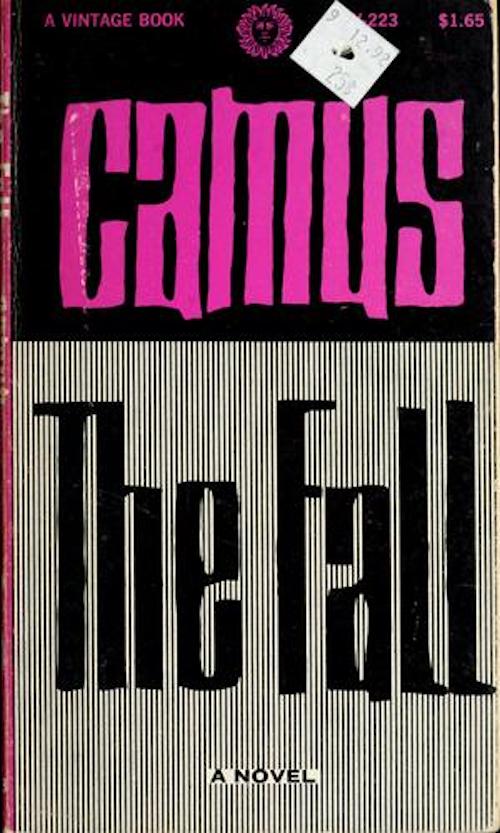
“THE MOST NEGATIVE LANDSCAPE”: CAMUS’ ‘THE FALL’

“Truth, like light, blinds. Falsehood on the contrary, is a beautiful twilight that enhances every object.”


After ’The Plague’ and ‘The Outsider’, ’The Fall’ (1956) marks my third Camus novel. And the first not to be set in his native Algeria, but… well, is that Paris or Amsterdam?

Though it’s the backstory in Paris that forms the spine of the narrative, this is not like those films that are one long flashback bookended by a brief framing device. Instead Camus repeatedly throws us back into the present. Just as soon as we might be getting used to Parisian life back we are in Amsterdam. And there seems to be two reasons for this.

First, the setting is established so a mood can be pinned to it. Which isn’t weekend break by the canals. In fact this so differs from our modern view of Amsterdam you need to imagine we’re in some fictional town which just shares the same name. Perhaps in France in those far-off days, it was seen as some rough-edged port you didn’t venture to unless bulk-buying Tulips. But it’s still remarkable how foreign it is here, somewhere where “life becomes denser, darker.” A stolen painting, searched for throughout the world, can be hung prominently in a harbourside bar, as if we’re somewhere in Patagonia.

And the Dutch play no greater role than the Arabs in the Algeria-set works, the book’s very structure denying them speaking roles. A grunting brute of a barman, devoid of any French, is the closest we come to a native character.

And this sense of being in an un-place, off the map is carried through into the sights. Or, more accurately, lack of them. The sheer absence of topography, the featureless flat landscape bordering the flat sea, is repeatedly evoked, the way a character can be brought back onstage to again pointedly say nothing. The limbo of Amsterdam represents the modern condition; we’re adrift in it, sailors without ports, bereft of landmarks by we could navigate.

“Isn’t it the most beautiful negative landscape?… A flabby hell, indeed! Everything horizontal, no relief: space is colourless and life dead. Is it not universal obliteration, everything nothingness made visible? No human beings, above all, no human beings!”

Second, this keeps alive the notion that the narrator, Clamence, is not writing but talking. Ostensibly, he’s talking to another character. But in effect his words pass right through the space they only formally occupy, with the result he is talking directly to us.

With dialogue that keeps incidentally describing the surroundings, it’s very similar to reading the transcript of a radio play. In fact, that medium might have even worked better. Camus’ sometime compatriot Sartre wrote about this aspect of radio in ‘The Reprieve’, where a young woman listens mortified to a Hitler speech…

”The great plain of Germany, the mountains of France, had dissolved, he confronted her as an absolute enemy, outside space, he was threshing about in that box of his – he’s looking at me, he sees me. She turned to her mother, to Ivy: but they had suddenly receded. She could still see them but not touch them. Paris had drifted out of reach, the light from the windows fell dead upon the carpet. Contacts between people and things were imperceptibly disintegrating, she was alone in the world with that voice… He was addressing her as though they two were alone, his eyes glaring into hers.”

A monologue on the radio feels like it’s been spoken straight at you. Even if others are in the room with you they become somehow marginal, for that voice is speaking to you. It can even feel like it’s already in your head.


And the novel needs this because of an essential difference to ’The Outsider’. There, Meursault made no attempt to persuade you of his way of thinking, he just asserted it and that was all. This time, Clamence is a devilish tempter. The novel becomes his book-length attempt to drawn you in, lure you over to his side, a tirade couched in soft words. (“So you know the Scriptures? Decidedly, you interest me.”) Amsterdam and its environs are the wilderness where the tempter always lurked.

The titular Fall he recounts is his own, from a successful and highly regarded defence barrister specialising in “widows and orphans” to someone who haunts seedy bars in Amsterdam. But as anyone who knows the story of Faustus will tell you, devils are nothing but fallen angels. The novel’s therefore full of inverted imagery; in a book titled ’The Fall’ he has a ceaseless desire to scale physical heights, he is a “judge-penitent”, declared a (kind of) Pope by compatriots because he is the most debased, and so on.

And the easiest route for fallen angels to take you is the one they have marked out themselves. His clever-sounding words, and his recounts of his actions, are like a breadcrumb trail leading to an abyss.

So he paints all virtuous acts as performative, helping a blind man cross the street only to bask in the gaze of onlookers and so on. And it tends to build from this banal-sounding example. Virtue really only exists in the eyes of others, therefore is ultimately self-serving.

Then, with no meaning to things, without the possibility of any genuine attachment between people, what is there left to hold off the ennui than turn life into a sport? Realisation of this is made to seem a form of sophistication. You, sir, unlike those others you are smart enough to get this.

I was surprised how many reviews portrayed Clamence as an abject character, his narrative one long confession to a non-existent Priest. They clearly read quite a different book to me! Why then, for example, would he be declared Pope? The relations are entirely the other way round, he is Mephistopheles to our Faustus. Try the following quote:

“After prolonged research on myself, I brought out the basic duplicity of the human being. Then I realised, as a result of delving in my memory, that modesty helped me to shine, humility to conquer, and virtue to oppose.”

Jimmy Maher calls this “a work absolutely drenched in Christian symbolism.” Which is the perfect phrase, as “drenched in” differs from “composed of”. Unsurprisingly for Camus, if the book borrows heavily from religion it is merely borrowing. Clamence is neither intended to be a Devil nor there to represent one, simply devilish in nature. We are used to talking about moral questions in religious terms, so Camus appropriates those terms. Just as questions of debts and obligations would translate more easily into Francs and Cents than Guilders.


As with the notion that ’The Plague’ was some kind of analogy for the rise of fascism, people are keen to see something of the post-War world at work in all this. You could indeed pen a tale about someone’s life of success and plenty being upended by Nazi invasion, causing their worldview to be rent in twain. Most likely, people already have. But that has nothing to do with this book.

True enough, there is one reference to Jewish people been taken from Amsterdam to the camps. But the claim soon reaches rather desperate levels. A bar named Mexico City is enlisted and turned into a reminder of the genocide against the Aztecs. As a bar of that name really existed, it seems more likely Camus went for some local colour than any such flight of fancy.

In fact the events which precipitate Clamence’s Fall precede, and are not at all associated with, the War. So instead of bombing raids and death camps, this Fall is strung along events such as a road rage incident, one so minor he acknowledges himself that those who witnessed it would soon forgot it happened.

To do otherwise would tie the novel to a specific era, when it wants to make its concerns more about the modern condition in general. Were it the War we’d soon be telling ourselves that people were driven to terrible things in those terrible times only to survive, and reassuring ourselves that we are lucky to be living now. There would be a barrier between us and the text.

Of course Camus is not Clamence, and his purpose isn’t to stop us helping the blind cross the road. In fact, the sequence where Clamence refuses to aid the Resistance, when Camus was widely known for taking the contrary course, seems to consciously oppose the two. The precis on GoodReads says:

“His… discomforting monologue gradually saps, then undermines, the reader's own complacency.”

And this seems pretty good description of authorial intent. I suspect you’re intended to go through a process, first considering shutting your ears, but finally decide to engage head-on with his anti-moralist tirade. His purpose is to expose and then burn away that complacency, all the false and performative actions until hopefully some core is left at the end which will hopefully be true meaningful action.

I found, however, I wasn’t reading things that way. I had a tendency to think “ah, the Devil, there he goes again”, like getting a repeat tele-sales call. True, he does a better job of setting out this stall than some alt.right nut baying about “virtue signalling”. But that’s just to talk about style. It can feel a little like getting a poet to pen a tele-sales script, it’s comes to be worded so much more evocatively but is ultimately still about flogging you wares.

Evil - at least to me - is not richly seductive, mellifluous in its malevolence. The effects of evil may be terrible. But evil itself is fundamentally banal. Donald Trump, for example, is someone rich and powerful who would like to become more rich and powerful than he already is. Less Mephistopheles spouting infernal wisdom, more a simple-minded boorish braggart. Falsehoods are not beautiful, as in the opening quote, but easy and cosy. Had Clamence approached me in a bar with his patter, I’d have just made my excuses. There’s better things to do in Amsterdam…