googlee7ea825f63edb3f6.html

Saturday, 30 April 2022

UT/ ASIAN DUB FOUNDATION/ MICA LEVI (GIG-GOING ADVENTURES)

Ut
Cafe Oto, London, Sat 23rd Apr


Ut are a punk (though they look to prefer the tag “radical”) trio, first forming in New York in 1978. Finding the Lower East Side an incubator which ultimately became a confine, they relocated to London. From where they were championed by John Peel, toured with the Fall and – not least – actually got to release some music. (Sometimes using This Heat’s studio.) In the make-it-happen spirit of those times, the band name just means “do”. Splitting in 1990, they’ve been playing on and off again since 2010.

Things started with the announcement drummer Nina Camal couldn’t make it. (Seems she’s the only member who went back to the States.) And then the shaky start. After a few numbers, seemingly dissatisfied themselves, they stopped for a lengthy retune. After which they brought on an extra player, rotating between a bassist, violinist or sax player. (The last two were the same guy, but then you’re not bothered about that.) After which they become the band we came to see.

It’s perhaps a little too easy to reach for Sonic Youth comparisons. Though both bands are sometimes described as No Wave, these gals are pitched closer to the shock-treatment anti-art iconoclasm of the original No Wave bands like Mars or DNA.

And seen live it becomes clear that, within that, Jacqui Ham was the most uncompromisingly No Wave, happy for her guitar to shriek. And Sally Young more willing to let a little… just a little, mind… rock riffing in. Their on-stage personalities seem to match this, Ham intense and driven, speaking to the audience only to convey information, Young more convivial.

But both bands share an urban urgency, even by punk standards, the restless energy of having constant vibrant input from a thousand different sources transformed into music. Ham has said “we liked the interplay between discordant things, the hard and soft, the lush and spiky, the friction between sounds and styles.” This does mean tracks tread a fine line between signal and noise, between accordance and dissonance. And hearing them bravely get up on that edge and dance, that becomes part of the appeal. Perhaps something to bear in mind with the initial problems.

And both bands demonstrate how post-beat American punk was, the Year Zero business a British invention. Lyrics are declaimed, somewhere between sung and recited, and hover between wordplay free association and suggestion of sense. Tellingly, track titles often collide clashing words, ’Mosquito Botticelli’, ‘Absent Farmer’, ‘Homebled’.

Oddly, it ended almost as it began. A time-consuming stage rearrangement to allow Ham to double up on drums yielded fitful success. Though perhaps kudos are due for trying the unorthodox. They then encored with ’Evangelist’, perhaps their signature tune, despite Ham explaining she could no longer play the notes then demonstrating this.

From Paris, three years ago…


ASIAN DUB FOUNDATION
Chalk, Brighton, Fri 22nd Apr


Before the band came on, the DJ played a Dead Kennedys remix which kept the original front end, while replacing the back with some hyperactive drum ’n’ bass. And that’s this review written right there, really.

More? Okay. Let’s generalise wildly. Music made by and for ethnic minorities tends to focus on the uplifting. It makes sense. Everyone knows the bad stuff already, what people want to hear is that there’s a way through it. While white music tends to foreground rage and frustration. Yes, we may be the white kids. But don’t go thinking we’re not pissed off too. Well, I did say it was a wild generalisation.

Anyway, Asian Dub Foundation somehow manage to combine both, often at the same time. People dance so much it feels like a Friday night out. (Not that I remember much.) But will boo Priti Patel’s name readily, and with practiced ease.

For a band nearly thirty years old, who I’ve seen more times than I can count, age has not withered them nor custom stained their variety. If anything its the reverse. Chandrasonic, the sole constant member, comments on their songs’ propensity to become true. Be a doomsayer to become a prophet, it seems. So ever-more souring times have just offered them more material.

Both set and encore start with quite extended instrumentals. Which don’t seem any kind of straying from their mission. It’s like their stance isn’t just in the lyric sheet, but baked hard into their sound.

Eleven years ago, after another of their storming visits to our shore, I wrote “Nazis have Screwdriver. We listen to Asian Dub Foundation. Which side would you rather be on?” And now there’s one less of Screwdriver than before, after he refused the vaccine (a “Jewish plot”, you see) and was promptly killed by Covid. While here’s ADF still firing from every cylinder.

'Zig Zag Nation' is a song they played, but this is from Paris. (I’m not sure why everything is suddenly from Paris…)


Mica Levi: ***
Milton Court, Barbican, London, Fri 29th Apr


The record shows me to be a fan of both Mica Levi’s score to ‘Under The Skin’, equal parts enthralling and unsettling, and her composition ‘Greezy’.

’Star Star Star’ (seems you are allowed to pronounce it like that) was, unlike its predecessors, performed by a small ensemble with minimal instrumentation. The night started off with some suitably unearthly polyphonic chanting, sometimes sounding like reciting your vowels in an alien language. Which gave way to languorous, minimal synths, sometimes with the barest drum accompaniment. Voices sometimes accompanied this, but from that point always recited, never sung or chanted.

There was some on-stage theatrics. Ensemble members taking turns to sit front-stage, like a kid called to the front of the class. A piece of paper was passed while lit by torchlight, like an orbiting moon. All of which seemed a tacit admission that, while there was nothing wrong with any of the music, neither was it quite enough.

Had I seen this cold, my final word might have been “promising”. It all feels back-to-front, like this should be the early works, Levi still finding their way, the accomplishments still ahead.

The Barbican explained “these scores consist of written text instructions, speech rhythm techniques and drawings.” Which I either forgot before attending, or only found afterwards. Which leaves me wondering whether this is one of those works where the process is taken as the thing, and the ensuing work not really the point.

Friday, 22 April 2022

THE WEIGHT OF ABSENCE (ANOTHER SPOTIFY PLAYLIST)


Don those headphones, travellers. It's time to soar past the confines of that three-minute limit, to get spacey, to go all ethereal, tuning into the music of the spheres before (very gradually) heading back down. All in under an hour of your Earth time. The Coil track in particular is like tuning into some new, between-stations frequency but finding messages made for you there.

The illo is De Chirico's 'Mystery & Melancholy of a Street’ (1914). The man who said: “To become truly immortal, a work of art must escape all human limits: logic and common sense will only interfere. But once these barriers are broken, it will enter the realms of visions and dreams.”

https://open.spotify.com/playlist/7K6Alt3ifjhmDzQz0Wkru2?si=8af2ab405c2b469b

OM: Pilgrimage
Earth: Datura’s Crimson Veils
Black Light District (aka Coil): Refusal Of Leave To Land
Faust: SoftTone
Föllakzoid: IIII
Neu!: Negativland

Saturday, 16 April 2022

‘LOUISE BOURGEOIS: THE WOVEN CHILD’

Hayward Gallery, London


“It is not an image I am seeking. It is not an idea. It is an emotion you want to recreate, an emotion of wanting, of giving, of destroying."

Getting out The Dirty Linen

Louise Bourgeois’ life was so long and so remarkably productive that this exhibition, fills the Hayward with work produced when she was in her Eighties and Nineties. An era where her art incorporated textiles and “domestic fabrics”, including bed linen and items of clothing.

Her career was effectively launched in 1932 where Fernand Leger, then her tutor, told her she was at root a sculptor. Because her art is about the physical, and needs its own physical presence. She said herself “to me, a sculpture is the body.” Yet much of her work alludes to the human figure without showing it. And crucially, when absent, the figure is made conspicuous by that absence. It’s in no one place in order to be everywhere.

As a rough but ready analogy - you know that scene from horror films, where someone pokes about in an attic full of weird old stuff, unsure whether something alive is hidden amongst it? In the films the cat is soon let out of the bag. Whereas this show is like rummaging endlessly about in that attic while remaining unknowing, and retaining all that enticing tension.


Let’s start off with the Pole pieces, where various elements are hung from a central pole (example above). They’re often items of clothing, as if arranged on a somewhat spectral radial clothes hanger. It recalls the commonly used Surrealist device, where clothes and mannequins are used to stand for the human figure. In one dated 1996 (all are untitled), a dress is sewn up and stuffed to resemble a mannequin.

The pole acts as a kind of equals sign, inviting us to compare the items around it. Which seems key. In general throughout the show its the large-scale assemblages which work best, where we have to somehow reconcile the often-disparate elements in our minds. (Even the piece from which the show took its title, a fabric book, is unmemorable.) So in another, also from 1996, a gnarled tree stump is combined with the clothing, with one truncated branch morphing into a mannequin arm.

Bourgeois called clothes a “second skin” and there’s a sense they’re to do with the extended self. (The way we formulate the terms “my foot” and “my shoe” so similarly.) But at the same time this expanded definition goes alongside a narrow one. Consciousness means that we’re aware we have a physical existence. Most living creatures don’t know this, precisely because that’s all they have. But consciousness can also lead us to the sense that physical existence goes on outside of ourselves, that our real self is elsewhere. And in practise our terminology becomes fuzzy, slipping between these two extremes. Sometimes our shoe is part of us, other times our foot isn’t.


At the same time she was producing Cells, installation environments enclosed by doors, walls or chain fencing, littered with objects. Many such as ’Cell VIII’ (1998, above) have narrow entry-ways. And we are, I suspect, intended to use them, to experience the work from inside, enveloped by it. (Unfortunately if unsurprisingly, they’ve been deemed off limits by a nervous gallery.)

Should we see these as rooms or head spaces? The point is they’re both. Earlier in her career, Bourgeois had produced a series of Femme Maisons, which were less anthropomorphised buildings than figures morphing into buildings.

Bourgeois’ career was long enough that she personally knew the Surrealists. Who she was simultaneously influenced by and took against, more-or-less for the reasons a women artist would. (She was a natural fit for the ‘Dreamers Awake’ show, on female responses to Surrealism.)

And, as mentioned, these phantom forms of the self are a Surrealist device. The Surrealists sought to undermine the notion of the essential self, which they saw as limiting. They developed a penchant for alter egos, and their works can often look like a self-portrait which has just been divided into its component parts, a cast of characters created to illustrate various aspects of the artist. All this is to the good.

But there’s times when this multiplicity of selves tries to do away with the central question just by sub-dividing it. What can look from outside as one person is in fact several selves cohabiting. We’re less like a classical bronze, solid and fixed, and more like a wardrobe, a collection of costumes. But the central question remains - what does it mean to have a self?


Bourgeois’ answer is that we become like a scrapbook of experiences we amass. These don’t build up like kit parts to create some core identity but perpetually interact. A little like the way we discovered atoms to not be a solid mass but a collection of particles in space, the self is little more than an optical illusion when seen from without. Elsewhere, a fabric head such as ’Pierre’ (1998, above) is held together by Frankenstein stitching, despite the cloth all being the same colour.

Along Came A Spider


“All very interesting”, you say, “but what about the spiders?” Bourgeois is famous for them, and one of the two variants of the exhibition poster is devoted to ’Spider (Cell)’ (1997, above), so let’s look at that next. A spider straddles a cell like a kind of double cage, and there is something deliciously menacing about those elongated, knotty legs.

Spiders do, in fact, have a body. At least they have head and abdomen segments. But we tend to conceive of them as a head sporting multiple limbs, an image we see in several of Bourgeois’ drawings. Part of our horrified reaction may be that we parse them as something we cannot parse. They appear to be physical beings but are unembodied, a defiance of what seems fundamental rules. So they come to represent utter otherness, as alien as anything on Earth can be. Hence their very existence can feel menacing.

But we also tend to parse them as feminine. Google has readymade answers to the questions “are there male spiders?” and “are house spiders female?” (Spoilers: “yes”, and “not always”.) Spider-Man aside, most spider characters in popular culture tend to be female. And this spider is shown with eggs, in the upper part of the cell. Her pose could be construed as protective of that cell. In which case, it’s being protected against us.

There’s also fragments of tapestry stretched along sections of the chain-link cage. And Bourgeois identifies spiders with her mother, who worked as a tapestry restorer. “The spider is a repairer”, she commented. And of course we need to bring together both these things. The ‘otherness’ of the spider remains part of the point. To Bourgeois, it’s the very thing which makes it something with which to identify.

The Needle And The Pin

On the subject of repairers, she further commented: “When I was growing up, all the women in my house were using needles. I’ve always had a fascination with the magic power of the needle. The needle is used to repair the damage. It’s a claim to forgiveness. It is never aggressive, it’s not a pin.”

Mostly it is remarkable to think she produced these works in decades most devote to watching UK Gold. However it is possible they represent an old person’s view of the world, a time when memory has more substance to you than substance has, when both your environs and mind are full of the detritus of earlier eras. Bourgeois said herself “I am a prisoner of my memories”, and she was perhaps caught in her own web.

In this way there’s a tension between whether her work is a repairing needle or a pin - in the sense of pinning something down, of documentation. Some critics claim to find her art pedagogically ‘feminist’ and therefore dismissible as one-dimensional. In fact it’s often highly ambiguous, and this is the axis on which that ambiguity plays out.


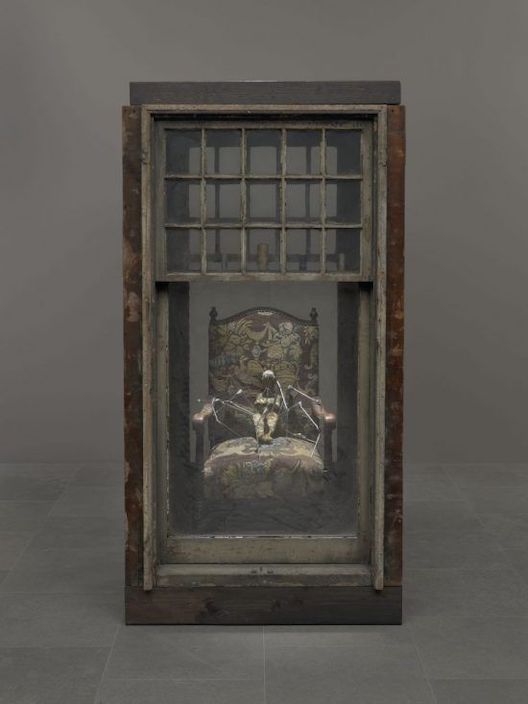
At times her art’s about the familiar Modernist frustration with the flesh, of our minds being stuck inside meat sacks which will slowly wear out on us. ’Lady In Waiting’ (2003, above) is another Cell, but of quite a different kind. It’s recursive, the small figure set inside a larger fabric chair, itself inside a doorless chamber. But also the figure is made of the same fabric as the chair. It isn’t just in the cell, but is of the cell - we are our own prison. Similarly the red legs (which must have been signed somewhere, but I couldn’t find it) have stigmata holes, as if bodily existence is inherently a form of crucifixion.


But more often their focus is gendered existence. You wouldn’t need to be a strict Freudian to see ’Cell XXV’ (2001, above) as composed of male and female elements. The three floating dresses seem to orbit the grounded spheres, as if the male essence is the centre of this world, protons to electrons. (Is there a testicular equivalent to phallocentrism?)

Perhaps significantly, its enclosed against us. (While elsewhere, vitrines are used as confining cells.) It’s sub-headed ’The View Of the World of the Jealous Wife’, as if a map of symbolic power, so perhaps owes us no other perspective. Yet where does that other perspective come in? Telling it like it is, that’s important. But in itself it’s insufficient.

The print ’Eternity’ (2009) is a clock face with a male and female torso set against every hour, one sporting an erection, the other already pregnant The pregnant belly is normally absent from Surrealist art, so fixated on male desire. Yet this also reads as essentialist, as if biology is all-defining to us. Every time is up-the-duff o’clock, with literally no way out of this endless round. In that sense it’s not so far from a work like Duchamp’s ’Bride Stripped Bare By Her Bachelors’ (1923), which (as noted another time) involved “the reduction of sex to the mechanical.”


And ’Knife Figure’ (2002, above), where a chopping knife hangs poised over a pink mannequin, doesn’t look so different to some of Giacometti’s Surrealist sculptures, such as ’Man And Woman’ (1928/9) or the charmingly titled ’Woman with Her Throat Cut’ (1932). Does she intend as protest what they meant as simple description? Quite possibly. Does that make a difference? Yes. But not enough of one.

Whereas ’Femme’ (2005) is a block with ‘feminine’ parts attached, breasts and vagina. It seems linked to the notion of ‘femininity’ as a construct, an idea some have forced upon others.

Similarly, while the clothes could be her second skin, you could as easily see them as shed skins, relics of the past, the way a spider sheds old ill-fitting skins. The figure in ’Lady in Waiting’ has spools of thread going into her mouth, perhaps forming her, and spiders’ legs digging into her torso. Or is it the other way around, that she’s both exuding the thread and growing the legs? Could the cell be a womb-like space, in which it can grow?


This tension between pin and needle may be most acute in ’Repairers In the Sky’ (1999), where gashes in a metal plate are part-stitched together. This perhaps turns the magic of the needle in on itself. Whether we take these as eyes, mouths, vaginas or some combination of them all, does this turn ‘repair’ into a form of silencing, as erasure?

Overall, though ambiguity over this question runs right through her work, Bourgeois seems to fall more on one side. The existence of her art confirms that there can be such a thing as a woman artist, bringing a female perspective to things. The strange-but-true story that she saw little recognition till the Eighties may, at least in part, be due to this. But the content of her art, too often that merely looks back to before such a time.

Doors Marked Private

The items were sometimes foraged for, but often were personal effects, items of clothing she once wore, and similar. She said part of her fascination with the spider was that it made its web from its own body. And there’s no doubt that much of her work stemmed from her relationship with her father, which she regarded as emotionally abusive.

A door, used as a wall, on one of the cells is marked ‘Private’. And never let it be said we don’t know a metaphor when we run into one. What do we do when we reach this door? The standard answer is that we need the guidance of experts, who can unlock it for us, who can demonstrate their familiarity with her life by explaining where this particular object came from, and so on. And initially, this seam can seem a lucrative one to dig. We’re told, for example, to look out for when objects are in groups of five, representing the size of her family.

But these are breadcrumbs which will just get you lost in the wood. And we know this from those who’ve already followed them. Tracey Emin, a self-acknowledged Bourgeois fan who has even collaborated with her, shows us what the terminus of this trail is. Her ’My Bed’ (1998) offers no point of contact with the viewer. It shows us the messy, unmade bed where she had a depressive episode, but is silent on the episode itself. It’s like trying to figure out why a battle was fought, going only by marks left behind in a field. We who got there too late gape at the bed from the outside, remarking on the heightened sensitivities of the artist which we couldn’t possibly share.

Do these works tell us things about the artist? Of course they do, the artist made them! But the more challenging and more vital question is - do they say things to us? If they don’t then nothing is exchanged, and where there isn’t exchange there’s robbery. We shouldn’t look at Bourgeois’ work in that misdirected way, and we don’t need to.

Coming soon! You never know, there may be more visual arts reviews…

Saturday, 9 April 2022

SAVING GRACE FEATURING ROBERT PLANT + SUZI DIAN (GIG-GOING ADVENTURES)

De La Warr Pavilion, Bexhill-on-Sea, Fri 8th Apr


Robert Plant… couldn’t all old rockers do it this way? A while ago he gave up singing “You been coolin’/Baby I been droolin’”, and headed off in a more rootsy direction. When he does a Led Zeppelin song it’ll be heavily reworked, and he doesn’t even bother with that once here. I’m not still doing what I did when I was twenty-one. Why should he?

Of course, paradoxically, he’s able to do this because Led Zeppelin had that element to them in the first place. But that’s part of the point. It’s because they were such a great band that he’s able to leave them, and it means they remain a great band in our memories. (Though it’s also true their one-off reunion show was awesome.)

His wish seems to subsume himself back in a band unit. The tickets in our pockets and the banner behind the stage read ‘Saving Grace’. And a great many of the vocals are sung chorally, between him and Suzi Dian, normally while looking to one another. It’s a noble endeavour. But of course a hopeless one. He gets the biggest round of applause as he comes on, and this review starts with his name.

The music’s rootsy not rocky, the guitarists swapping various acoustic and electric instruments with some dexterity. Early on there’s a banjo/mandolin team-up which sounds great, only for that combination to never come back. Even as they sing together it’s the difference between Plant and Dian’s voices which make it, like layers in a sandwich. (It’s bizarre to think now that throughout Zeppelin’s history he was only once paired with a female voice. It’s just that it was Sandy Denny, so we all remember.)

As he tends to these days, the set was mostly (perhaps all) covers. But with lyrics about angels handing you a new set of wings, of changing an old coat for a new, it feels like they’ve been chosen for a reason. This new band are yet to record. So while the support act has a CD stall they don’t, despite Plant’s career stretching back to the Sixties. Just like starting over.

There seems a strong tendency towards spirituals, perhaps more than the solo releases. And from there it all fits together. Choral vocals lend themselves to that, being intrinsically about the us. “It’s better than staying in,” Plant quips. And this proves timely. One of the first post-lockdown gigs reminds you that part of the point of music is to take you out of yourself, to bring us all together. The set ends with an out-and-out gospel number, five voices and one acoustic guitar around one mike. A warming way to be sent out into the night. I was still tempted to shout out for ‘Stairway to Heaven’, but resisted.

From an earlier tour, one of several Low covers Plant has done…

Saturday, 2 April 2022

‘CODENAME ICARUS’


(The next instalment of ‘Mutants Are Our Future’, on the Tomorrow People trope in popular media. With the usual PLOT SPOILERS. First part here, but they can be read in any order.)


Bitten By a Gift Horse 

Martin Smith… could there be a more regular-sounding name than Martin Smith? Then there’s his Northern accent, as so often in British culture used to signify utter ordinariness. Martin Smith is in trouble at school, described as “disruptive, slack, insolent”. Though we guess fairly quickly he’s not too dumb but too smart, solving a Maths problem his supercilious teacher couldn’t manage - and promptly being accused of cheating.

’Codename Icarus’ was a BBC children’s drama, first broadcast in 1981. And there are strong similarities between these classroom scenes and an earlier BBC effort, Susan’s in the introductory ‘Doctor Who’ episode, ‘An Unearthly Child’. 

However, as the title casually gave away, Susan had a diegetic explanation - she was actually an alien. Martin’s cleverness is just asserted. Okay, in his case it’s not actually a super-power, but it’s effectively treated as one. We’re told he’s “another Galileo, Einstein, Newton.” From the title down there’s repeated, if metaphoric, comparisons to flight.


And this works in the tale’s favour, creating no barriers between viewer and protagonist. When young it’s common enough to imagine yourself as imbued with almost endless possibility. If there’s no sign of any of that now, then you are yet to fully unfurl. The older generation thereby becomes your adversary, with their confining rules and customs. But you still believe this to be true of yourself, not those fools who surround you in your generation, who seem to be equally unaware of your genius. Youth makes you special. But only your youth. So in both scenes our identification character is shown as trapped between their teacher and classmates.

There’s little attempt to make him likeable. Unlike Susan or those nicely spoken Tomorrow People he’s every bit the irascible genius, obsessive in his work and impatient of others. He might not be a mutant, but he’s still a freak. (“Kids like us, freaks. No-one wants to know. Until they can use what we’ve got!”) He’s pretty horrid even to his highly platonic girlfriend. The assumption is that we’ll identify with him anyway. Or possibly even identify with him more.

Notably, his chief complaint about that teacher is that he’s never acknowledged the “beauty” of Maths. As children we expect school to be all about stimulating our imagination, only to find it’s more about rote learning of set doctrine, leading to several years of cross-purpose communication.

There are a few hints, however, as to where Martin’s Maths mind came from. He’s reading a book of advanced calculus only so he can improve on it, because it’s “out of date”. He won’t show it to anyone at school, as that would be like handing “flowers to an ape”. This is our old friend the generation gap as evolutionary leap. And flight is sometimes used as a metaphor for puberty.

Except it’s more acute than that. It’s not generation that makes the leap, but the essence of youth itself. We’re explicitly told that Martin and the other young proteges will be spent by the time they’re adults, to be replaced by the next intake of gifted teens. Never trust equations made by anyone over thirty.


He’s in the habit of sneaking back in after school to use the (wonderfully retro-looking) computer, climbing in the window like Romeo scaling the balcony to his beloved but forbidden Juliette. The ensuing scene, where he then gets into a text conversation, not knowing whether this is with the computer or someone else, must have seemed more mystifying in those days before e-mail. We are to take it, I think, that he assumes he’s communing directly with Science in some way, and is surprised to find another person on the other end.

This brings him to the attention of John Doll, who recruits him to attend Falconleigh (“some sort of school for bright kids”), run by - wait for it - the Icarus Foundation. The attentive, encouraging Doll with his suave, modulated voice seems the antonym to the closed-minded disciplinarian Maths teacher we ran into earlier. Naturally enough Falconleigh is in a country house, with kids reading under trees in bucolic grounds while classical columns adorn the door. Here it’s the tutors who call the kids “sir”, as they’re the ones with the real know-how.


An Uncivil War

But that’s only half the story. These events intercut with a Cold War espionage tale, where Allied missile tests are mystifyingly being disrupted. So we segue between war rooms and classrooms, between received pronunciation and regular life. In fact it starts out by establishing the Cold War scenario, and at some length.

Why do this? Why not kick off with the audience identification stuff? Partly it enhances the juxtapositions if we start grand and go small. The opening theme is dramatic and classical (Stravinsky’s ’Firebird’), as if the whole thing will go off in that direction. Then the first word used in the school setting is “disaster”, a Cold War word transported to the diminutive.

This double-barrel structure does somewhat give away that the gifted pupils of Falconleigh are going to be connected to this. (Still soon after the Second World War, Bletchley Park may have been an inspiration.) But then foreshadowing is generally chosen over surprise; official investigator Andy Rutherford soon guesses all’s not well in the school of Falconleigh, with the plot throwing obstacles in his way.  

And that’s because this is in essence a series about a nightmare hiding inside of the dream. The ostensibly similar ‘Tomorrow People’ story ‘The Secret Weapon’ is based around kidnap, about being taken from your kind. This is about being seduced and recruited, being taken to your kind, but it all goes wrong anyway. Like being bitten by a gift horse.

And unlike the Tomorrow People, there’s nothing inherently moral about Martin’s genius, which can be weaponised. (“It’s not the knowledge that’s bad, it’s what the rest of us do with it.”) Hence Martin’s antagonist soon switches to Doll.

Doll tells him he should become “just what you ought to be,” but of course he’s the one doing the defining. Scientific enquiry is made into a kind of Fordist production line, each pupil working on their part while unaware of the whole. Results end up on “the supermarket shelves”.

Martin’s truculent working class manner, so at odds with Doll’s devilish charm, makes it all something of a class issue. In fact it’s not far off being a story about a bright working class kid who wins a scholarship but becomes disillusioned, just with added space lasers.

He resents the fruits of his labour being used by others, even if it’s mental labour. (“Have you ever had an idea that hasn’t been in anyone’s head before yours? Hasn’t been greasy-fingered?”) His repeated line “I won’t be used” becomes a variant on “I won’t go down pit” from ’Kes’. (Which also used the metaphor of flight as escape.) And in a reversal of the colour coding we saw in ’Secret Weapon’, it’s Martin who sports black and Doll white.


In a nod both to the Foundation and series title, Doll tells him he should “free your spirit and mind… fly”. Ironically, then, he’s dismissive when he sees Martin sporting binoculars, telling him there’ll be no time for his birdwatching hobby here. So it’s in not doing what he ought that Martin starts to stumble across the truth. Which happens when he sees a pigeon fly near an outbuilding, then drop dead to the ground.

Yet Martin the freak also knows he belongs nowhere else. The story rather labours this dilemma with his brainwashing, which seems no more than a souped-up, dramatised way to portray his unwillingness to leave the gift horse behind, even as its biting into him. In fact, with the girlfriend figure that seems to be literally the case, as if she didn’t require the metaphor part.

So what starts out as a Cold War drama effectively turns into a civil war within the Establishment. With Martin about as uncivil to the Establishment Good Guys as he is Doll. When parallel protagonist Andy offers to get him out of Falconleigh he replies that either way “the bomb would get made, wouldn’t it?” Though this development is rather scuppered by the revelation that Andy’s posh boss is really on our side.

Only in the final episode does Martin meet the mind behind the Foundation, Frohelich. Unlike Doll his motivations are much more personal, and he appeals to Martin to stay, without the usual school aids of hypnosis and injections. A scene which becomes the Last Temptation Of Martin.

Frohelich’s own situation was even quite similar to Martin’s. Told by the Nazis to make a bomb, he escaped by faking his death and in a sense did die, losing his vital youthful insight. (We’re repeatedly shown him flying but by artificial means, by helicopter.) The Foundation seems his attempt to perpetuate this youthfulness, keep it bottled, as well as create a technocratic elite to take charge of things. But also, it’s heavily hinted, so that he can keep associating with others like him. The whole scheme’s an elaborate way of asking “will you be my friend?”


As things progress the espionage plotline seems to be taking over, only for it to fall away and be replaced by this scene. Martin isn’t rescued, and we don’t see what happens to Doll or Frohelich. The point is that Martin hears Frohelich out and refuses. The show’s peculiarity is to cleave closely to other elements of the trope, but make a frontal assault on the business about joining the gang of your peers.

And arguably this contradiction comes out in the very last shot. As Martin runs into the arms of his rescuers we look on in convenient long shot, out of hearing. He’s never had much to say to them so far, and that doesn’t look likely to change. In Joseph Campbell terminology, this is a story which ends with the Refusal of the Call. So perhaps the last shot should have been him slamming the door on Frohelich. In true stroppy teenager style.

What’s more it includes the most Eighties school disco scene of all Eighties school disco scenes. Which might sound a rash boast, but is not an idle one..

Coming soon! Mutants Are Still Our Future, but the series will be taking a short break…

Saturday, 26 March 2022

SUNBURNED HAND OF THE MAN (GIG-GOING ADVENTURES RESUMED)

(Cafe Oto, London, Sat 20th Mar)


The last time I saw self-styled ‘free rock music’ collective Sunburned, nigh-on fifteen years ago, I wrote such a mini-review I may as well quite it in full: 

“This band has a cool idea (or at least an idea I took from them), to take the trajectory of the Sixties San Francisco sound and reverse it. While the original bands got more into the studio and ‘proper’ album releases, why not take it the other way and explore the ‘improvised happening’ angle instead? 

“The results were mixed, but with high points. The band seemed to need a beat going for something to play against, and sometimes floundered without this. And the ‘happening’ elements (brandishing lighted crosses etc) just seemed the wrong end of hippy – ostentatious and self-consciously ‘meaningful’.”


And stuff I’d heard on-line since then I’d liked more. And they have such a floating line-up, it’s unlikely two sightings will be similar. Besides, I haven’t been getting out so much lately…

Indeed, many of the details differed. But what was I to come away with but the same mixed response?

It was in a way summed up the the two vocalists. (Neither of whom, I think, were there last time.) One went in for the ‘outsider’ style often found in free impro music, guttural moans and wails which sound as much a stranger to standards speech patterns as singing conventions, surely too unmediated to be directed in any way, yet too perfectly matched to the music to be anything else. Further enhanced by his live electronic treatment of them.

Rarely were discernible words used, and when they were it was with destructive Dada intent. At one point he recited the well-known Karen mantra, “I want to speak to your manager”, until it truly became a mantra.

While the other vocalist recited his lines theatrically and ostentatiously, like the wrong side of Jim Morrison had broken free and gone solo. Yes, you were clearly not intended to take these altogether seriously. Still didn’t help.

Curiously then, the points where the two overlapped were effective in the extreme. Perhaps because they were doing such different things there was no risk of competition.

The guitar and bass were often restrained while insistent, contributing tones or pulses, sometimes just etherial shimmer. Which would sometimes build up behind the combined vocals, culminating into a cacophony, a soundtrack for the end times.

The accompanying film show had none of the standard morphing psychedelic colours, and was more devoted to juxtaposing images of flying with those of crashing or falling. The opening sequence was of a truck going into a giant-size shredder, a fairly audacious opening statement!

The gig was, I think, a siren attempt to draw you in before deranging all your senses as much as that truck got it. There’s a ‘devil clown’ vibe to it, enhanced by lines about melting faces and all the absurd gestures, such as the drummer sporting a horse’s head as he plays. The band name may be a reference to the price to be paid when gaining wisdom. (Well, either that or I’m just getting carried away.)

Yet again I’m reminded how strange it is that people think psychedelic music is all pastoral and twee, like fairy tales for grown-ups. Whereas it’s more exercised by the desire to drive you out of your senses. And being driven out of your senses every now and then is good for you. Free rock music!

Friday, 18 March 2022

KNOW NO BOUNDARIES (ANOTHER SPOTIFY PLAYLIST)


After recent endeavours, time we went back to a good old-fashioned polyglot playlist. No theme or scheme, just a bunch of great tracks collided together, all rapid fire from the left field. Because as Mclusky remind us great explorers know no boundaries.

The illo's of great explorer Henry Morton Stanley. And never did a man look more like he should be called Henry Morton Stanley...

Chumbawamba: Bankrobber
Jeffrey Lewis + The Deposit Returners: Carpe Diem
Julian Cope: Parallel University
PJ Harvey: Beautiful Feeling
Marlena Shaw: Woman Of The Ghetto
Moon Duo: Lost Heads
The Delgados: Thirteen Gliding Principles
The Magnetic Field: When My Boy Walks Down The Street
Pixie: Ed Is Dead
Richard Thompson: The Egypt Room
Mclusky: Your Children Are Waiting For You To Die
Zounds: Fear
Rhiannon Giddens + Francesco Turrisi: Little Margaret
The Imagined Village: Cold Hailey Rainy Night
Fucked Up: Tell Me What You See 

"She took my hand, and then she said to me
"There are things underneath, that you have never seen…”

(More Mutants Are Our Future next time…)

Saturday, 12 March 2022

“ALL THE STRANGERS CAME TODAY”: DAVID BOWIE’S ‘HUNKY DORY’

(Another instalment of Mutants Are Our Future, this time turning from comics and TV shows for some of that pop music the kids dig so much. You can read things from the top here, should you choose.)


”So I Turn Myself To Face Me…”

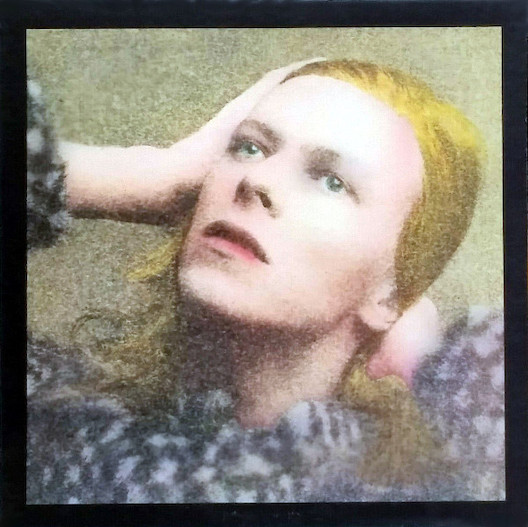
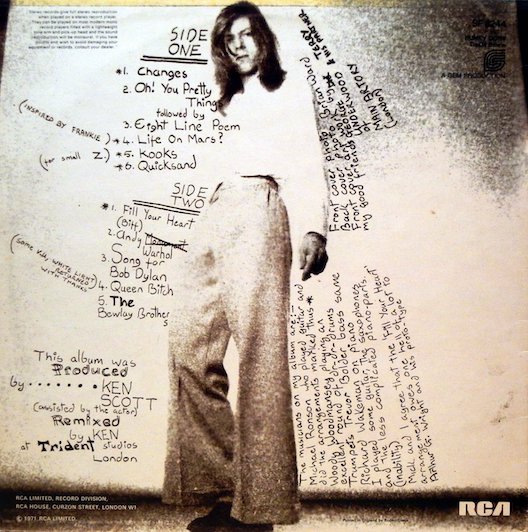
‘Hunky Dory’ (1971), David Bowie’s third album (depending how you count it) came between the mystic-folk-meets-primordial-heavy-rock of ‘The Man Who Sold The World’ and the snappy pop-rock of ‘Ziggy Stardust’. Each within a year of the next. But, bar odd tracks, and despite the Spiders From Mars being formed in all but name, it doesn’t sound like either. His voice is mostly accompanied by piano. Wrapped between a front close-up of a far-sighted Bowie and a handwritten back cover, it’s very much his singer-songwriter album.

Because of course those are all devices we associate with the personal voice, the raw unmediated truth, sung straight at us with no space for artifice. In ’Shock And Awe’ Simon Reynolds wrote “it resembled an existentialist Elton John”, and it often seems to be, in his own words…

“Written in pain, written in awe
“By a puzzled man who questioned
“What we are here for”

There’s even a direct tribute to the then-knighting King of singer-songwriters, Bob Dylan. Called, naturally enough, ‘Song For Bob Dylan’. Though it’s a mixture of tribute and barb, addressing him (as a disillusioned Lennon had) by his real name Zimmerman.

“We lost your train of thought
“Your paintings are all your own”


…was a none-too-subtle dig at his latest, underwhelming effort ’Self-Portrait’. In asking when we’d be getting the old Dylan back while knowing full well we weren’t, Bowie was clearly positioning himself as the great man’s successor. (Perhaps ironically, for an album which on release didn’t even chart.)

At this point Dylan’s run of late Sixties great electrified albums had only just happened. But Bowie skips over this creative peak, to go back almost a decade and focus on the righteous and dungareed spokesman for a generation with his Woody Guthrie cap and words of “truthful vengeance.”

Except Dylan performed those songs on guitar, the instrument of choice of protest singers, the one whose unadorned truth fascists were supposedly so allergic to. While Bowie’s on the piano. An instrument which can also signify ‘personal voice’, Joni Mitchell would swap between the two ambidextrously. But it’s as much associated with urbanity and verbal theatrics. (Perhaps because it’s less portable, or has a more dextrous sound.) And furthermore…

Audiences of the genre like singer-songwriters to be solo, or at least play the main instrument themselves, the way a painting is supposed to be all the artist’s own hand. They are even known to shout “Judas!” when they don’t think they’re getting this. But here even that piano is mostly provided by Rick Wakeman. (Who’d already played on ’Space Oddity’.) Bowie cheerfully conceded on that hand-written sleeve: “I played the less complicated piano parts (inability).”

And he plays into this, peppered the album with twists and turns on the theme. Even as he evokes “a voice like sand and glue”, he makes clear he’s as keen on greasepaint and glitter. “So I turn myself to face me”, could come from any singer-songwriter, making themselves their own inspiration. But Bowie quickly follows it with “but I’ve never caught a glimpse.”

’Quicksand’ refers to both Garbo and “the next Bardo”. Which could be, respectively, the wartime spy and Buddhist concept. Or perhaps the two glamorous actresses? People argue over which but… guys, really… twice in one song? Remember the sane/Seine pun from the previous album? He’s doing this deliberately, isn’t he?


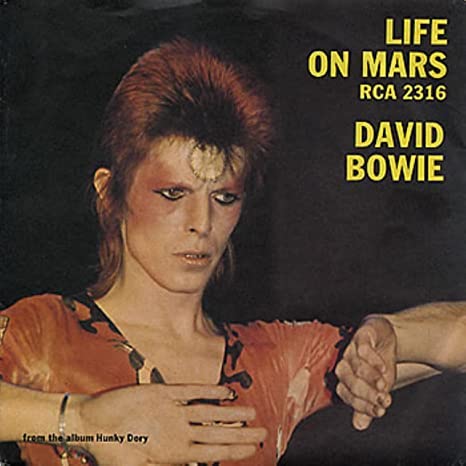
‘Life on Mars’ is clearly Bowie’s zigzagged, idiosyncratic version of a protest song. While the two opening tracks, ’Changes’ and ‘Oh! You Pretty Things’ would seem to be his take on the classic ‘Times They Are a-Changin’.’ (Perhaps the best-known early Dylan song after ‘Blowing in the Wind.’) Like their source they’re both ostensibly addressed disdainfully to an adult generation, telling them to get out our way (“don’t kid yourself they belong to you”), while of course they’re actually an anthem for marching youth. 

Except Dylan’s song is full of quite Biblical imagery, floods and tribulations (“The line it is drawn/ the curse it is cast”). It opens with the proclamatory line “Come gather round people wherever you roam”, like a town cryer. While Bowie begins with “wake up you sleepy head”. His tone throughout is more intimate, conversational not confrontational. Even when he spies “a crack in the sky and a hand reaching down to me” he doesn’t dramatise, in fact he could sing in the same voice about the postman having come.

While Dylan was always writing accusatory “you” songs (usually pronounced “yeeeeeew!”), the first personal pronoun on this album is inevitably “I”. It’s clear enough that here its inner change, personal transformation, that counts. Bowie sings “I’m much too fast to take that test”. The streets aren’t made for political protest, they’re there to be treated as a catwalk. The secret to life is realise that this is all a show. And those children that you spit on try to change their world, they don’t just bring change, they represent it. Don’t just change one thing for another, be change, swap fixity for fluidity.

Simon Reynolds also wrote:

“Bowie came along at a time when the idea of revolution or alternative ways of living proposed in the Sixties began to fade. The big trade-off that ensured was the shunting of ‘revolution’ out of the social-political domain and into the commercial-aesthetic zone, as well as into the private life… Bowie is the emblem for this individualised, privatised form of revolution.”

And the man himself said, two years later: “The revolution has been fought on an entirely different plane to the plane that I thought it should be fought on… For instance, like capitalism can be all right.” (Another reason, should we need one, not to treat the Tomorrow People trope as somehow inherently radical.) He’d reject in song “that revolution stuff” of the Sixties - “what a drag, too many snags.”

While, interestingly, the chorus to ‘Song For Bob Dylan’ makes Sandy Glue’s adversary not Mr. Jones or some other fusty establishment figure, but “the same old painted lady/ From the brow of the superbrain.” Wait, what, who?

A clue might have come from the track straight before, another personal tribute, this time ‘Andy Warhol’. The words to which read something like a Glam manifesto:

“Dress my friends up just for show
“See them as they really are
“Put a peephole in my brain
“Two new pence to have a go
“Like to be a gallery
“Put you all inside my show”

For Warhol was more than anyone the self-proclaimed antithesis of the confessional school of creation - art was artifice, appearance, effect. He described himself as a “deeply superficial person”, and insisted “if you want to know all about Andy Warhol just look at the surface, and there I am. There’s nothing behind it.” For the press release, Bowie called him “a man of anti-message.”

Julian Cope later wrote ‘Christ vs. Warhol’, conveying how torn he felt between the rival pulls of pop immediacy and lasting grandeur. And Bowie at this point seems very Dylan vs. Warhol, split between really meanin’ it man and the desire to dress up and put on a show. An approach he arguably kept up over the rest of his career. He was the Seventies artist who was effectively employed to shut the door on the Sixties, yet at the same time never fully crossed that threshold himself.

And after all, how different were they really? Bowie’s already reminded us Sandy Glue was just a stage persona for Robert Zimmerman. And a corduroy cap and an acoustic guitar can be as much a pose as a blonde wig, as Dylan surely proved more than most. He said himself: “You're born, you know, the wrong names, wrong parents. I mean, that happens. You call yourself what you want to call yourself.”

His “you” songs rarely stretched to “we”. That was more the era of the agitational late Sixties, perhaps reaching its succinct epitome in Jefferson Airplane’s “your enemy is we”. But it was a distinction most failed to spot, and his consequent failure to support that agitation mystified them. Bowie then positions himself to be Dylan’s successor, but with the “I” presented as a twist. His relationship to his fans was by the same mass media, but it was to be one-to-one, kids alone in their bedroom hearing a transformative track on the radio.

”The Start of the Coming Race”


Yet at the same time as all this Bowie ups the ante with the line that took us here - “better make way for the homo superior.” We’re “the start of a coming race”, not just different to their generation, but of another kind altogether. “The Earth is a bitch” (famously censored in the Peter Noon cover), suggests we’re leaving mere physical existence behind.

You could play compare and contrast to another great piano song, from the previous year - Neil Young’s ‘After the Gold Rush’. Which portrays the present as an impasse, a “burned out basement”, stuck between a Medievalist golden age and a silver science-fiction future, with spaceships to ferry to us to the stars. It’s eschatological, an SF retelling of the end-times, with aliens replacing angels to take the nice folk like us out of a place like this. (And remember “tall Venusians passing through” had appeared in Bowie’s earlier ‘Memories of a Free Festival’.)

Ever the early bird, Bowie was getting in ahead here. In the well-known tale he picked up the phrase “homo superior’ from meeting Roger Price in a TV studio. Yet, as we saw last time, Price’s ‘Tomorrow People’ series didn’t debut for another two years.

But this was another way he was still channelling the Sixties, for this cosmic mysticism had always been part of the hippie mentality. Once it had co-exited with fervent insurrectionism. But as the possibilities for radical social change faded, it was able to hog more and more of the stage. George Harrison had said in ’67 (quoted in Clinton Heylin’s ‘The Band You’ve Known For All These Years’): 

“I read somewhere that the next… Messiah, he’ll come and he’ll just be too much… The majority of people are going to believe and they’ll be digging everything and he’ll come and say ‘Yeah, baby, that’s right’, and all those other people who are bastards, they’re gonna get something else.” 

It’s a kind of inverted Calvinism, with the sober-minded short-haired businessman the damned and the indolent long-hairs the UFO-hopping elect. But it’s the same rigid division into saved and consigned. This is precisely what Nigel Kneale satirised with the Planet People in ‘Quatermass’. 

Yet that “I” reasserts. The track which most aligns with ’The Tomorrow People’ is ’Pretty Things’, and that only comes as close as the plural “you”. ’Tomorrow People’s whole sell had been plugging into the we - you didn’t just join a gang, you became permanently telepathically linked. The teleological optimism of their premise was much more post-Sixties than Bowie. Questions like the role of violence in social change are literally not even questions for them, the answers seen as innate.

Bowie is much more personalised, more egotistical and at the same time more fractured. And it would be this less utopian take which would come to win the toss in dramatising the spirit of the often-contrapedal Seventies. Naming an album after a slang phrase for feeling good, that’s a surefire way of spelling out it won’t be very feelgood.

And significantly this album, which bombed on release, is not considered a classic. Bowie is often seen via his trailblazing influence on those who came after him. While ’Tomorrow People’ has become almost a byword for retro chic.

Which leads us to…

”If I don’t explain what you ought to know…”


’Quicksand’ is the album track of the album, not the one you went to it for but the one that keeps you there. Somewhat self-disparagingly, Bowie said he wrote it while still pretending he understood Nietzsche. But it’s more about not understanding Nietzsche, having a head full of half-digested notions of the ubermensch, stewing with some semi-masticated Cowley and chewed Buddhism. There’s a long list of characters, but they all seem to exist only in Bowie’s head. He described it as an “epic of confusion”, representing a “cacophony of thought”. 

It reminds me most of student life, picking up one author and being swayed almost just by touching the cover, then trying another and being immediately converted, transferring your allegiances so often you get giddy. It’s the perspective of a young man, his voracious but magpie reading eye always bigger than his word-digesting brain, so constantly getting sucker-punched by erudition. Ultimately, it’s about having a reading hangover. The song we all struggled so hard to understand in our teenage bedrooms is ultimately about struggling so hard to understand. The war imagery, so pored over when Bowie attracted his own flock of magpie readers, stems from there.

But the album’s magic happens when these three themes intersect. Bowie was at this point coming up with songs at a rate of knots, so was free to choose what went with what for each album. (Many Ziggy songs were at this point already written, but saved till later.)

This doesn’t make it coherent, just cohesive. If he sang of being “torn between the light and dark”, that doesn’t map precisely to Dylan vs. Warhol. But 'Quicksand’ still internalises the conflict staged elsewhere, relocates Young’s “burned-out basement” inside his brain. While singing of a “crack in the sky”, he was only a few years from drawing a dividing line down his own face and in-so-doing creating the most potent self-image of his career. He’s not hoping the rest of the elect pick him for the team, he’s quizzing himself what his nature might turn out to be.

“I'm not a prophet or a stone-age man
“Just a mortal with the potential of a superman
“I’m living on”

And this creeps into other songs. ‘Pretty Things’ is more complex than the glam anthem it might appear, however proto-Ziggy that rousing chorus. Though thought to be written before his first child was born, “wake up you sleepy head” suggests that’s who its addressed to. The man who shortly would become a transexual alien saviour is here a father; at a time of great generational conflict he’s trapped between the sides. “Look at your children… Don’t kid yourself they belong to you” could be addressed as much to himself as some squaresville grown-up.

When that sky cracks and the hand points down to him, there’s no real telling which side of the divide he’ll be falling on. Let’s remember that ’Cygnet Committee’ two albums back, ostensibly a state-of-the-Sixties song is effectively about a parent/child relationship in which Bowie also gave himself the parent role.

Faulkner famously wrote “the only thing worth writing about is the human heart in conflict with itself”. Which is ultimately where ‘Hunky Dory’ is at, the befuddled mortal and the would-be superman in symbiotic struggle.

Saturday, 5 March 2022

THE X-MEN VS. THE TOMORROW PEOPLE, ROUND TWO

(This third helping of Mutants Are Our Future compares the story scenarios of the original Marvel comic strip ‘The X-Men’ with the British kids’ TV show ‘The Tomorrow People’. Previous part here.) 


The classic Lee/Kirby era of ’The X-Men’ (effectively the first nineteen issues) essentially features two types of story, themselves determined by two types of antagonist. Handily, they arrive consecutively. Following Magneto’s appearance in the first issue, bad mutants become the good mutants’ default foe. While Marvel usually rotated their rogue’s gallery, the Brotherhood of Evil Mutants (Magneto, plus his henchmen) came back in issues 4, 5, 6 and 7, and were already being called ‘The Evil You-Know-Who’ on the cover of 6. 

Adjacent panels often juxtapose the fair-play teamwork of the X-Men against the fractious world of the Brotherhood. Who represent about every way to fail to form a brotherhood; the imperiously commanding Magneto, the obsequious Toad (whose excessive fawning even gets on his master’s nerves), the scheming underling Mastermind, and Quicksilver and the Scarlet Witch, trapped by their misapplied sense of duty to Magneto.

Then, as if suddenly noticing how reliant on the Brotherhood they’d become, Lee and Kirby put them out of harm’s way by splitting them up in three different directions. And segue straight into the first Sentinels story. This is clearly intended as something of an epic. It’s not just the first three-part run, even the next issue is largely devoted to the battle’s aftermath.


The Sentinels, as we all know by now, were designed precisely to eliminate the mutant “threat”. Public fear and distrust of the super-powered had long been a distinct feature of Marvel, distinguishing it from DC. Now it comes into its own.

Except here it’s specified precisely as public distrust. Crowds in the street are likely to degenerate into anti-mutie lynch mobs at any sign of unorthodox behaviour. This includes cops, but government and military... they clearly know better. In issue 10 Professor X says casually “Washington has already contacted me” about the latest drama. So the constituency of their designer Trask isn’t ranting Republicans but the salacious popular press. He even launches the Sentinels on live TV.

As robots tend to, the Sentinels then rebel. But this is because they decide the best way to carry out their orders, to protect humanity, is to subjugate them. The story them becomes a parable about the rise of, but also the inherent deficiencies with, machines. They’re often depicted neatly lined up, like beans on a shelf, while their plot is essentially to make more of themselves. But they’re also shown lacking the basics of gumption and initiative.


‘Mutant’ would seem a very science fiction word. But there’s only one alien in the whole Lee/Kirby run, the Stranger, who appears in ’The Triumph of Magneto’ (11). Both sides assume him to be a mutant and so set about trying to win him over to their camp. Only to discover he’s not just literally but conceptually alien, outside their common frame of references. (“Have I not said I am… a stranger?” he asks, channelling Leonard Cohen.) His only interest is in collecting specimens of mutation for study. He picks Magneto, for plot convenient reasons.

Whereas, as we’ve seen the Tomorrow People comes with a plot contrivance where the whole concept of bad Tomorrow People, in brotherhoods or otherwise, is blocked off. Instead, with their first story ’The Slaves of Jedikiah’ (1973) their antagonists are established as aliens.

While Magneto tries to misuse the power of the mutants he manages to pick for his side, Jedikiah tries to limit his, with the recurrent one-eyed motif, with constraining anti-telepathic headbands and the like. There’s a moment where Stephen, rather half-heartedly, Refuses The Call and sulkily claims he’s not a real Tomorrow Person after all. But the premise is auto-inoculated against him voluntarily taking Jedikiah’s side.

Jedikiah turns out to be the henchman of a bigger baddie called (confusing our comparison) the Cyclops. Except, in the very last episode he suddenly switches to sympathetic. As it turns out, his spaceship was broken and he really just needed the psychic equivalent of a push to get him home again. This becomes something of a show staple - not resolving conflicts so much as wishing them away, making it never-was. And one way to manage this is to decide at the last minute the bad guy was just misunderstood. The Prime Barrier perhaps necessitates this. They can’t fight a deciding battle because they don’t fight, so everything has to just turn out to be okay.

There’s some suggestion the Cyclops was simply scared of us (“your planet has an evil reputation throughout the galaxy… you are always at war”), which might be more convincing if he hadn’t recruited human henchmen. In a vain bid to keep the story propulsive, the antagonism abruptly switches to Jedikiah, who in short order is revealed as a robot, goes mad and starts rampaging round Cyclops’ spaceship. (Some robots revolt. Others go mad. Them’s the breaks.)

As we saw another time, the monsters in ’Dr. Who’ tend to be human foibles, which are magnified, externalised and then stuffed in a rubber suit. The penchant of ’Tomorrow People’ is for more generalised social ills which turn out to be the fault of menacing aliens; gang warfare (‘The Blue and the Green’), the fashionability of fascism (‘Hitler’s Last Secret’) and so on. Except, as we’ve seen, they’re not really the aliens’ fault either. They shilly-shally between manipulative monsters and the equivalent of the Stranger.

Human hostility is established. Well, mentioned. Told the TPs can’t make war, Stephen asks the not-unreasonable question “what if someone makes war on us?” While the Cyclops warns them: “Arm yourself against your own species. They will kill you if they find you out.” But unlike the X-Men, unlike every Marvel hero ever, this secrecy doesn’t apply to their own parents. It’s taken for granted Stephen’s must be told.

Human mistrust only really appears with the biker gang who aid Jedikiah. Except ‘aid’ is a loose term, and he’s forever telling the serial bunglers “no more incompetence will be tolerated.” Which makes you wonder why he thought he needed them in the first place.


Their outlaw attire suggests that rather than adult authority figures they’re ‘bad kids’, the delinquent hooligans who plagued Seventies popular culture. They even have laddish nicknames, Ginge and Lefty. Which leads to an emphasis on brains triumphing over brawn, as if they’ve been set up to fail. There’s a scene where the TPs repeatedly jaunt out of their charging way, leaving them to fall in lakes and other hilarious consequences, which recalls the ghost cat taunting the live dog in the Hanna-Barbera cartoon ’The Funky Phantom’.

We’re told rather late on that they were recruited ideologically, told “you lot were just a bunch of freaks”. But this shows up out of nowhere, and is used as a convenience for them to swap sides, following the show’s No True Villains rule. Like school bullies, they’re tauntingly confrontational on the outside but really need the nerd kids’ help. From that point on they reappear as the pacifists’ handy contracted-out muscle, a little like the Ian role in ’Doctor Who’.

’Secret Weapon' (1975) is the nearest to a Sentinels-like story. Opening the third season it again introduces a new Tomorrow Person who’s conveniently ‘breaking out’, Tyso. Who’s wanted by a secret Government department, to make him the secret weapon of the title. The distinction between him and them is established with a first shot, a toff car appearing on the road behind other gypsy kids as they play. And of course experiments on gypsies recall Nazi horrors. 


The story’s tension lies between Professor Cawston and Colonel Masters, scientific curiosity against military instrumentalisation. One is handily colour-coded black and the other beige, against the Tomorrow People’s perpetual white. And like Jedikiah though he seeks to harness their powers, Masters spends virtually the whole time dampening them, giving Guards “dope guns”, placing Tyso and Stephen in comas.


In this way it’s almost the inverse of the Sentinels, the military being informed becoming the very problem. “Can you imagine living your whole life in a tribe of monkeys?” Cawston asks Masters. “With your very survival depending upon their not finding out you’re a human being, a superior creature?” But Masters’ reaction to their powers is not so much fearful as avaricious.

Writer and series creator Roger Price was in many ways an old Sixties radical, and the story resounds with anti-establishment and internationalist pacifism. Though he’s careful enough to portray Masters as sincere in his beliefs, however ruthless, allowing him counters in a stand-off argument with Elizabeth. (When he asks what would happen if such powers were to develop in Russia or China she replies there’d simply be more Tomorrow People like us, perhaps the series’ ethos encapsulated.)

But then the finale is a let-down even by the standards of the show, whether measured dramatically or politically. They essentially defeat military intelligence by going to its manager, leading to the so-bad-its-great line “what’s the Prime Minister doing here?” To get to the PM, they need to jauntingly kidnap him, which luckily he is rather sanguine about. See, kids? The system works.

Worse still, Chris, not a Tomorrow Person, can be presented as less enlightened, a slightly less street-level Ginge and Lefty. He’s essentially the hot-headed agitational radical, the peace hawk, against John’s sober-minded faith in reason. He’s even willing to threaten the old boy with a “Martian ray gun”, only for John to give the game away. Yet it’s him who cooks up this half-baked plan in the first place!


And the two most interesting features of the story, that the Tomorrow People initially underestimate Masters’ threat, and that his assistant is herself a telepath, are essentially orphaned by this rubbish resolution. Her powers seem lesser than the TPs, and are limited to telepathy, but still seem to grant her greater empathy than Masters. This is eventually explained as her being a kind of forerunner, who failed to fully break out.

And while Tyso may seem another point won for diversity casting, his actual role in the story is so slight he’s effectively a boy damsel in distress. He really does spend most of his time asleep, so much that he nearly gets forgotten at the end. And his Romany family are portrayed absurdly, his father even willing to sell him to Masters! The message would seem to be that we are such generous and tolerant folk, we even apply it to these backward Gyppo types.

Which shouldn’t surprise us. Frequently referred to as a critique of racism, this trope’s perhaps worse than useless for that. It exists to flatter its audience, convincing them it works as some sort of anti-racist credential, like those diversity training certificates workplaces give you. The truth is, people follow this stuff because they like to see some bigged up version of themselves, particularly with bigged up brains and hearts.

Being part of a band of elite pariahs, the tension over this trope is how much it can be a fantasy and how much a phobia. Witch-like powers come with witch hunts, after all. (As future instalments in this series will show, a feature of this trope is the way it weaves between kids’ TV shows and outright horror films.) This can be used creatively, making the dish into a sweet and sour.

’X-Men’ got this at some level, ’Tomorrow People’ less so. True, it suffered from cheap budgets even if compared to the often-mocked ’Doctor Who’, and from often-excruciating child acting. But chiefly it feels auto-inoculated against everything which might make its own scenario involving. Its utopianism may seem distant from us now, so it’s tempting to frame the problem as to do with eras. But it was dramatic too, forever presenting us with an enticing situation of conflict then whisking that conflict away. It took a great premise and fumbled it with wooly well-meaningness.

Coming soon! More mutants, more future...