“The Surrealists explored liminal spaces between consciousness and dreaming, including mental illness. In contrast, Leonora experienced these first hand.”
Leonora Carrington’s life was, in one sense, a succession of escapes. She escaped two prestigious English schools by getting herself expelled. Then in ’37 she escaped a privileged yet confining life among the moneyed English by taking up with Surrealist enfant terrible Max Ernst and relocating to France. Nazi occupation and Ernst’s arrest necessitated another escape, this time to Spain. Then in ’42, she escaped a combination of sexual assault, mental illness and institutionalisation by moving to Mexico.
Yet, and despite so many of the works here being from so late in her life, it was those early English years which tended to dominate her imagery. And small wonder. “Do you think anyone escapes their childhood?” she once asked. “I don’t think we do. That kind of feeling you have in childhood of being very mysterious.” (Quoted in the recent ’British Surrealism’ show.) And of course we don’t. Childhood is when the basement of our brains are built, everything after just added on.
Her life story is something like a character from an Angela Carter novel. While her father wanted her married off to high society, her mother, nanny and grandmother read her Celtic folk tales from a young age. And, however taken she was when she discovered continental Surrealism, they remained her primary influence.
Take for example ’Green Tea’ (1942, up top.) The figure on the left is generally agreed to be Carrington herself, swaddled in some kind of strait-jacket. She’s paired with the two tethered animals, the cow hide on her swaddling echoing their animal state. While she also seems paired with the larva-like creature in the underworld beneath her feet. Beyond one tethered dog, the only points the stillness in that picture is broken is in that underworld.
Yet the focus isn’t on the swaddled figure but on the landscape. A cloistered garden of a landscape, with each tree depicted individually in an iconic fashion. Perhaps, confined long enough, she’ll turn into another tree. But the landscape still dominates. And it’s imbued with its own kind of charm. This isn’t a protest work, a rejection of green-lawned England, its a portrait of that England more than of herself. This is where she was grown.
Carrington first met Leonor Fini in ‘37. The two soon became fast friends, often painting one another. And a key feature of both their work is the delicate style, made up of small deft strokes. It’s not as bold and in-your-face as is standard for Surrealism, more diffuse, more similar to illustration. There’s definitely a feedback loop here where this led to their art being sidelined - this women’s art looks just like illustrative art and vice versa, not really proper painting you know.
One thing the show does well is to meet this square-on, displaying illustrations (including from children’s fairy books) which influenced her. (Less happily, it doesn’t always credit the artists.)
An artist it does name is Dore. Which is to the good, but it then disregards the way in which her art differs. His engravings are classical in style, foregrounding knowledge of proportion and anatomy in a bid to make the strange sights look credible. It’s like the tag line to the original ’Superman’ film - “You’ll believe a man can fly.” Whereas Carrington deadpans, more in the way of fables and folk tales. Characters within her work rarely react to the strangeness, they stay stoic, often calmly meeting our gaze. Her approach is “man flies”.
The show goes on to say “subversion and transformation were key approaches… [they] channel her rejection of the attempt at being categorised, where hybrids of animals and humans inhabit a mix of imagined, real and ritualistic worlds.” Again this channels childhood, where we don’t feel the same sense of separation from animals, can even feel like we are between the human and animal worlds.
See for example the etching ’Badger Causing Table To Fly As Medium Falls In Trance’ (1987, above). The badger and medium are not only placed the same side of the table, her ankle-length dress and its fur are made up of the same two blocks of shading - downward strokes and cross-hatching. The badger is the medium’s familiar, joined to her if not part of her self. Other works look very much like the Surrealist ‘exquisite corpse’ game of chimera creatures, one (undated) is appealingly titled ’Alien Whale Sphinx Goose’.
But the show misses one element of this. Yes, in her work the distinction between human, animal and spirit forms are slippery. But check out her lithograph ’Stag At Mourn’ (1974, above). No less than four of these figures are passing between physical form and symbols. Which surely reflects her interest in magic and alchemy. Those symbols may have meant something specific to her, or just found their way onto the plate. We’re never likely to know which, and it doesn’t matter much because the point is a broader one. Magic is the manipulation of symbols, with the intent to alter the physical world. It’s been said well enough before now how that links it to art, that the two may have at one time been interchangeable.
And her art often functions like symbols, an arrangement of elements where their combination is the thing to look out for. They’re usually discrete from one another but placed within the same pictorial space, prompting you to take them together. Take ’Night of the Eighth’ (1987, above). A highly symmetrical work, this immediately draws our attention to the place where that symmetry is broken. The silver-and-grey figure has an opposite number in purple, but that second figure has been shifted up in the composition. Its place is taken by another symbol, a loop. Or it may be the figure and symbol together make up the eight of the title. It ‘flies’ with birds, but they’re so stub-winged and chubby they could never soar like that. Suggesting that we’re seeing is some spirit form of flight.
Silver-and-grey holds its hand out in a shaping motion, and the outlined creature next to them looks the most morphing. You could say this figure represents the artist, just as you could for the medium earlier. But it’s more than that really. Reality isn’t depicted as something normally static, which a select band of magicians know the secrets to make it shift. Reality is in a continual state of flux, and we can learn how to ride the waves. As David Gascoyne, a fellow British Surrealist, put it: “the marvellous is within everyone’s reach.”
Overall this show does well on the indicia front, contextualising Carrington’s work. (See up top for an example.) Alas it does less well actually showing her work, which is sparse, not always well selected and padded out- at times with little more than ephemera. ’Green Tea’ is rather ridiculously represented by a print. (Disclaimer: it was free to get in.) Perhaps I’ll get to see a fuller show some day, maybe pairing her art with Fini’s. The title is right there, curators - ’Leonor and Leonora’!
Like something lost in time ’Sapphire And Steel’ is back on the box, courtesy the good folks of Rewind TV. And though I’ve not seen it since it was first broadcast (1979 to 1982), David McCallum and Joanna Lumley wandering obliquely around empty rooms is something of which I have strong memories.
Each episode starts with as classic a portentous credit sequence as ’The Twilight Zone’ or ’The Outer Limits’. And like those the sober oration fits voice-over takes the place of “explain the premise”, so convincingly you might not notice at first that it actually sews more confusion. (It somehow knows what transuranics are, but not what an element is.)
There’s some kind of helmeted head which draws closer as the sequence goes on, but never quite near enough to be discerned. At the time I fondly imagined there was some elaborate and inventive back story they’d decided to reveal to us a little at a time.
Whereas of course it was all in the British spirit of made do and mend. Given the few sets the meagre budget allowed for each story, there was always going to be some sense of stasis. So why not play into it?
Creator PJ Hammond has said he wanted to reverse the standard orientation of time travel stories, where it's time which comes to the characters. Rob Young, in ’The Magic Box’ commented “each assignment takes place in one location, and rather than emotion or interpersonal drama, it is the space, the architecture of the set and its spatial relationship to time that the characters are most preoccupied with.”
And yes, time. The show opens with the homely image of a child doing his homework. It’s the tick-ticking of a surfeit of clocks which is foregrounded and defamiliarised, four shown in the first minute, before there’s even any dialogue or action. Time’s sometimes presented as besieged by hostile actors. Or at others time itself seems the problem, a recalcitrant force forever needing to be kept on the straight and narrow.
Ostensibly, the titular two are detectives. They show up at a time crime and scan the place for clues, in order to hunt out the guilty party. But logic and deduction play little actual part. Stories are strung together by free association, magical thinking and handwavey references to ley-lines and the like. (Often involving out-and-out urban myths, such as ’Ring-A-Ring-O’Roses’ being about the Great Plague.) Dialogue is almost akin to an Absurdist drama, words turned over and over in the search for meaning in them.
Given this set-up, essentially placing strangers in strangeness, it was going to be either great or terrible. Sometimes it was both. But mostly that first one. In fact, the fact that it makes no actual sense whatsoever becomes its greatest asset.How come? Some pointers…
It seems it was originally pitched for children’s TV but found itself promoted up the schedules to early evening. Which paid off, I remember my Dad would watch it avidly. But it remained based on a child perspective, rooted in childhood fears.
And time, to a child, something you have tasted so little of, seems strange and heady stuff. It is, a Steel puts it, “immense”. You still live very much in a kind of eternal present, against which the influence of the past can seem an inexorable, foreign force. Alan Moore told a story of, as a child, standing watching the clock’s hour hand till he saw it move, something he found giddying.
Added to which, one character says of a Victorian photo “that thing could be a thousand years old”. As a child much more about you seems like antiques than to an adult. And those things don’t seem cosy so much as otherly, ever-present and unparseable. The past seemed more than a foreign country, it was like a different reality altogether, but one always inexplicably breaking into the now.
Which meant you were forever coming across objects and situations which should have been familiar if not homely, shown in such a way as to make them sinister. The world was, in a word, uncanny.
But that undersells it. As we saw when we looked at Rob Young’s ‘The Magic Box’, this was an era where many shows took these paths, following the same prompts of cultural milieu and budgetary necessity. But ’Sapphire And Steel’ was pure neat distilled uncanny! It headered that particular nail then kept hitting it. It feels simultaneously eccentric beyond eccentric and completely built to fit a brief. Which only makes it feel more eccentric.
…which may go to some way to explaining its relatively short life - only six Assignments (as they called them). The general reason given is that it became increasingly difficult to synch the two stars’ schedules, and no doubt that was a factor. But also this was a show fully formed from the get-go, doing just what it needed to be doing. There was nowhere for it to go to. It was the height of an approach, and so inevitably also the end of it. It burnt twice as bright and half as long.
The seeming similarities often turn into differences, just like reassuringly familiar objects did within the show. Steel manages to be brusque and irascible simultaneously, like he’s above these petty humans but also they’re annoying him. Sapphire is more gracious, at times sympathetic, but often in order to be manipulative. They communicate telepathically, beyond human hearing. They relate to humans, they relate to them not.
And the Doctor often had a similarly double nature. Tom Baker’s trademark grin and eye-glint could be taken as warm and humanistic, but also chillingly alien. Hartnell was a stern patrician but also a kindly grandfather. A double nature essentially split into two with their good cop/ bad cop act.
But overall, with ’Who’ it was the companion character who cemented the notion that at least one of these newly-arrived strangers was a person just like you. In ’Fire Of Pompeii’ the Doctor confesses “sometimes I need someone” to keep him grounded in human affairs. A character as absent from this show as is the leads’ lack of concern for human affairs. The solutions they find can be not at all humanistic, with the humans unlucky enough to be in the vicinity just getting instrumentalised.
…which takes us to the biggest difference between the shows. The Doctor’s a traveller, an adventurer, a maverick. Sapphire and Steel are cops. Time cops, that’s still cops. They turn up in the first episode in place of the called-for police. They’re soon to be found burning books. In fact, it's more than that. That big, booming voice-over signifies they don’t work for an authority, they work for Authority. Just like there are Archangels, they are Archcops.
And equally the villains are just villains. Unlike ’Who’, there’s little to suggest they represent psychological states, that mental conflicts are being externalised. It’s more Lovecraftian, they’re things from without and should they succeed in getting in then our whole reality will come crashing down.
The Doctor says come with me, travel in my box to think outside the box. They tell people to stay just where they are, not to experiment with time, or show much curiosity about anything come to that. Leave that stuff to the pros. It's hard-wired conservative.
’Who’ often posed order as the problem. There was a moribund, ossified state of affairs, whose frozen grip on life needs to be broken. Multiple stories end with people hopelessly raging at one another as to what should happen now, with the Doctor delightedly saying “my work here is done.” Here the problem is disorder, things not in their proper allotted place. From the opening narration, it was about ironing out “irregularities”.
And so the stories rely on connections which can seem arbitrary, if not active bizarre. A Thirties-themed party is linked to the megalomania of the host in seeking to defy time. Or upping things further, we have time travel powered by vivisection, just to underline the sheer badness of it all. Each time accompanied by Steel’s stern “I try to tell you but you never listen” speech.
The difference are striking. But, beyond the obvious point that the uncanny doesn’t automatically cleave to one politics or another, its harder to know what to do with them. Hammond wrote all assignments but one. (And that, the whodunnit, was the weakest.) But surely more than authorial intent is at work.
Though the show has sometimes been called Thatcherite, its conservatism seems more small-c. Let’s look at it in a way that’s most likely a post-hoc rationalisation, but by now time’s been disrupted anyway. Its a truism the past no longer leaves our lives in the way it used to. New TV shows aren’t just in ratings competitions with a finite number of other new TV shows, but with most of what’s already been recorded. We have become rather like the future humans encountered in the third Assignment, cosplayers rather than adventurous time travellers, saturating ourselves in other eras and still not understanding them. Because to us they’ve been reduced to an aesthetic, vicarious experience.
In 1982, the date of the final assignment, people spent much more of their time in their time than we do today. But time was already eroding, and Sapphire and Steel’s missions to keep the past at bay already had an increased urgency, as the first video recorders were rolled out. It now seems an assignment they were doomed to lose.
And this was a war on two fronts. The future of broadcasting encroached simultaneously, with its focus groups and market testing. Audiences were to get what they wanted, which of course meant something they already knew, and certainly nothing they might need to get acclimatised to. So insidious, so all-prevalent would this new ideology be that it was us, once the radicals, who were thrown on the defensive and with it into a kind of conservatism. We wanted to hold onto what we were fast losing, and still do. It’s us who have become the ghosts.
Steel would glower that they were always called out too late, and perhaps they were. Time now assails us, from both sides, and not as single spies but battalions. Perhaps he and Sapphire out there still, valiantly fighting a war long since lost. Looked at like that, no wonder he was in such a bad mood all the time.
Coming soon! Time for something completely different...
Our latest Spotify playlist starts much the way modern music did, with Howlin’ Wolf's wail setting the bar. From there Jeffrey Lewis raises kvetching to an artform (not for the first time), the Jam predict a final conflagration (okay, perhaps a lucky guess), Tom Waits finds the frontier and is probably not coming back, Otomo Yoshihide unleashes his special big… er… band, the twelve-strong Orchestre Tout Puissant Marcel Duchamp take inspiration from African ensembles, the Balfa Brothers serve up some tasty Cajun cooking, and Chumbawamba remember to say thank you (though possibly sarcastically). Plus, as the saying goes, more…
The illo is of a fancy dress party held at the legendary Bauhaus.
Howlin' Wolf: Moanin’ At Midnight Jeffrey Lewis & The Voltage: Except For The Fact That It Isn't The Jam: Funeral Pyre Tom Waits: Cold Cold Ground The Angels Of Light: Dawn Prince Jammy: Chapter Of Money Vivian Goldman: Private Armies African Head Charge: Stebeni’s Theme Daevid Allen: All I Want Is Out Of Here Talking Heads: Making Flippy Floppy (live) Goat: Chukua Pesa Mabe Fratti: Kravitz Deerhoof: Milking Orchestre Tout Puissant Marcel Duchamp: Beginning The Balfa Brothers: Lacassine Special Chumbawamba: That’s How Grateful We Are
"Well we know the reason for the turning of the season But the winter takes us in the end"
(Another in a series of not-proper reviews of films)
“I’ve always preferred mythology to history. History is truth that becomes an illusion. Mythology is an illusion that becomes reality.” - Cocteau
’A Complete Unknown’ works well, if taken just as a film. It rips along, tells its story well. I’ve no idea if early Sixties Greenwich Village was anything like the way its shown, but it feels like a real place captured. From the little I know about the main characters (Dylan, Pete Seeger, Joan Baez, Stand-In Suze), they were pretty much as depicted here.
But of course its not just a film. Its a dramatisation. ’A Complete Unknown’ is completely known to us, that is what attracts us. And therein lies the problem.
Dylan essentially mythologised himself, not only in his music. In interviews and general behaviour, he was a character played by the method actor Robert Zimmerman. Or more accurately, a series of characters. He built an elaborate mythology, but that’s long since condensed down to a single legend - the Judas incident, the Bob-goes-electric saga at Newport. This has become as much What Dylan Is About as any song he ever wrote.
It’s been raked over enough what degree of truth there is in this. (Go here or here if you hadn’t already.) But the point isn’t that what actually happened wasn’t much like its shown here. The point is that this is what people want to believe happened. They believe it the way other people believe Boris Johnson saved us from Covid.
And to be believed myths need to be re-recited. Just like Church-goers can’t only attend once and tick salvation off the to-do list, believers need to be fed more documentaries and dramatisations like this. The first draft of history, that didn’t work out quite the way it should, so now we need a reconstruction to correct.
I’m not a great fan of biopics, and this may be partly why. The advantage of fiction is… well, it's fictional nature. You can devise and arrange incidents and symbols as you choose, to convey what you’re conveying. Your imagination can go free range. Conforming to actual events pens it in. But also, real lives are never so neat as to compress into the required running time. So biopics tend to reach for the myth just because it's more manageable, while at the same time feigning authenticity.
Let’s remember Dylan gave his approval. Someone who never approves of anything much. It’s true that when Baez calls him “kind of an asshole” and “completely full of shit”, the film more-or-less backs her up. Yet his assholeness is considered necessary. You can either please other people or be yourself. Its an either/or choice, like the acoustic and electric guitars which get repeatedly held out for him.
In perhaps the most telling exchange, he contradicts Stand-In Suze about the Bette Davis film they just watched. “She didn’t ‘find herself’, like a lost shoe. She made herself into something different, what she wanted to be in that moment.”
Later, walking away from… well, you know what, an infuriated Lomax yells at him: “Do you even remember folk music, Bob?” He snaps back “no, what’s that?” It’s not just a put-down. It means, I am no longer the person you think you are talking to. I have moved on to my next me. Your call cannot be redirected.
Significantly, he never seems to have his own place. He crashes on Seeger’s couch, he stays in Stand-In Suze’s apartment, bangs on the door of Joan Baez’s hotel room… the nearest we get is his own motel room at Newport. Literally on the move.
So, instead of being examined, the myth is fed. The offered acoustic vs. electric guitar becomes something like the blue and red pill in ’The Matrix’, uncritical conformity versus you becoming you. It’s simultaneously a straight choice and an evolutionary path. Electric trumps acoustic, right? It’s more modern, and anyway its louder and stuff.
Electric Dylan fans tend to believe that when he gave up protest music he actually made better protest music. He went from the particular to the general, not tackling wrongs one-on-one but as a bunch. And by then there were too many wrongs to do things any other way. The film essentially sides with this, though it places most of it in the mouths of his associates. It’s silly stuff, better alluded to than spelt out. It is, to drag up a term from my day, Rockist.
Rockism comes down to the notion that all other music forms are fake, tainted by commercialism, confined by genre rules, while Rock is real - free, unmediated expression. As that doesn’t sound like the sort of thing likely to be brought to you by corporate conglomerates, in place of arguing for it they fetishise aspects of Rock. Chief among which is the electric guitar. In other words, it bestows the same talismanic significance as Folk purists do to the acoustic. (The other signifier he dons are a permanently affixed pair of sunglasses. Which arguably mean something slightly different. While the electric guitar’s an avowal, they’re a deflection of scrutiny.)
And this explains the standard stopping of the story here. Because it conveniently ignores an obvious fact - within the next few years he did the same thing again, this time burning his bridges to his Rock fans, and for pretty much the same reasons.
’I’m Not There’ (2007) was a much less literal take, featuring multiple Dylans all running round at once, with no interest in one another. Which was much more effective because it was explicitly about the Dylan myth, examining rather than regurgitating it. I said at the time, “the film actually feels like a Dylan song rather than some prosaic account of events surrounding its recording. It feels like one of his sprawling mid-Sixties electric numbers, packed with hallucinogenic images and allusions.”
It would be neat to now say this film is like one of the more literal acoustic songs, the ones it claimed got so gazzumped. Perhaps one of the more auto-biographical ones like ’Ballad In Plain D’. But to the degree that’s true, its like one of those songs played by somebody else.
Let’s remember that, when Blues guys went electric, they saw no big deal in it. Some had already played electric at Newport. Others, realising the money came from white folk purists, had by then switched back. (For which I don’t blame them.) Whereas Dylan did see the deal, had the same values as Lomax. They were just arguing about which way up they went. His credo of change prefigured the Beatles and Bowie. Its taken that he didn’t just change into a Rock star, because Rock music is held to embody change.
But 1965, that was a white ago now. How on earth can this still be held to, sixty years down the road? This is the general problem with Rock now, it hasn't done much a-changin' lately. Elements which had once been attached to some purpose are being kept around out of habit. Dylan’s was a time of greater social conformity, a jobs-for-life culture where your future lay between tramlines ahead of you. You deciding on you derailed the tram. Now we live with a volatile jobs marked which involves regularly reinventing yourself just to stay fed and housed. Tom Peters gave the following life coaching:
“Starting today you are a brand. You're every bit as much a brand as Nike, Coke, Pepsi, or the Body Shop. To start thinking like your own favourite brand manager, ask yourself the same question the brand managers ask themselves: What is it that my product or service does that makes it different?”
Another way of saying this is – there are multiple yous, but in none of them do you get to actually be you. Its no longer enough to sell your labour, now you need to sell your self into the bargain. Of course its true that Dylan rebranded himself not to get hired but precisely to get fired, to burn his bridges to one set of fans so that another could be built. But this isn’t the distinction you might think. How will we learn this lesson, us non-geniuses, us regular beings? Thinking “my brand isn’t Pepsi but Bob Dylan” doesn’t help you, it just rephrases the problem.
The film ends with Joan Baez left standing as Dylan motorbikes off. She never abandoned either the Folk world or the notion of music associating itself to movements for social change. Perhaps its time we switched this story round. In a world which has since filled itself with Bob Dylans, be a Joan Baez. She wasn’t such as asshole.
Take for example the first John Peel Festive Fifty. (Where listeners chose their favourite numbers.) Though ending the auspicious year of ’76, it contains not one single Punk track. Rather than ’Anarchy in the UK’ topping the list, its ’Stairway To Heaven’. It’s like one of those alt futures where we never escaped the servitude of the Roman Empire, except instead it’s listening to the guitar solo from ’Free Bird’.
Peel himself seemed less than impressed. The following year he decided he was picking all the tracks himself.
Perhaps more unexpectedly, listeners took the all-time request seriously. So the Beatles, the Stones, the Doors, Dylan and Hendrix all show up. (Tho’ nothing from before the Sixties.) And even when it does go Prog, the more bloated excesses (Rush, ELP) are happily absent. Yes creep in at No. 50 with ’And You And I’, probably one of their least proggy moments. (King Crimson may be the most curious absence.) For me, it was the more the AOR and classic rock stuff which was the obstacle. Jackson Browne and Poco were soon skipped.
But overall, as a snapshot of music up to ’76, it actually makes for a pretty good playlist. Sure its strange hearing ’No Woman No Cry’ segue into ’Supper’s Ready’. But not in a bad way.
Okay, British Punk was only just getting going at this point. The Pistols (for example) had released one single, ’Anarchy in the UK’. If it could conceivably have headered the list, there was no possibility of Punk packing it. But perhaps more conspicuous by their absence are the two biggest influences on British Punk.
You know the story of how, prior to forming the Buzzcocks, Shelley and Devoto took a trip to London to see the Pistols without having heard them? Because they played Stooges songs? And yet, you guessed it, no Stooges here. In fact American Punk appears only once, with Jonathan Richman’s ’Roadrunner’.
And mid-Sixties Powerpop, that shows up not at all. (‘My Generation’ made the 1979 and 1980 lists, but nothing in ’76.) Those lies John Lydon liked to tell, about British Punk supposedly having no influences (despite playing Stooges songs)… it looks like, at the time, people swallowed them wholesale.
As you might expect, subsequent years saw a slow decline in votes for ’Stairway to Heaven’ and a growth in Punk and Post-Punk. 1982 saw both an all-time and a year-only list, everything went year-only from then on.
Then, as a one-off for the momentous year of 2000, the all-time list was brought back. And it looks back as far as the original, some tracks make it from the early Nineties - roughly the same time lag.
But this time out its much more Eurocentric; almost half of ’76 had been American, this time precisely five Yanks make the cut. Despite many American acts not just being played but getting sessions on the show. And that with the simultaneous disappearance of Prog, which had always been a highly Europeanscene.
Remarkably, a mere three tracks from ’76 reappear, with two falling down the list. Take Hendrix’s ’All Along the Watchtower’, once no. 5, now to be found at no. 37. Dylan’s ’Visons Of Johanna’ fares similarly. Only Beefheart’s ’Big Eyed Beans From Venus’ moves up. And the early Seventies disappears almost entirely. (The Beefheart track is from ’72, but he was more a Sixties artist.)
But perhaps more significantly, a number of older tracks which could have been on the ’76 list suddenly show up. Tim Buckley’s ’Song To The Siren’ can perhaps be explained by This Mortal Coil’s cover, scoring much higher. But the Velvet Underground and Nick Drake? While the Beatles, who had been represented by three tracks, now switch to a new entry - ’I Am The Walrus’. (Still, surprisingly, no Stooges.)
Of course, you never hear music from the past directly. It cannot do other than come through the filter of the present. Perhaps, had there been another Festive Fifty two or three years earlier than ‘76, ’Tarkus’ and ’Tales From Topographic Oceans’ would have proudly reared their gatefold heads. Perhaps ’Kashmir’ and ’Supper’s Ready’ did suddenly sound bad in the context of the late Seventies, only to reach today and get good all over again.
But more, some songs go up like a firework and leaves a stain in the sky, while others have a slow-burning fuse. It takes a while for people to catch on to them.
Slightly bizarrely, this even takes in the world’s best-selling band. ’Walrus’ was one of the most radical-sounding Beatles songs. (Alongside ’Tomorrow Never Knows’, which stays inexplicably absent.)
Stories about the Velvets being shunned in their day get a little mythologised. In their time, their sound got slowly less extreme and their audience correspondingly increased. Plus their resurgence happened sooner than this might imply. Post-Punk openly owed them a debt, and by the time I was getting into music (early Eighties) they were already on the must-hear list. Had the all-time lists continued past ’82, I’d guessed they’d have shown up pretty soon.
Curiously, it was the much sweeter-sounding Folk-hued Nick Drake who took the slower lane. A press release from his own label proudly announced his new release wouldn’t be shifting any units either, but they were putting it out anyway because they liked it. After playing the track, Peel speculated about how Drake might feel about the change in response to his music.
Given which, supposing another all-time list could somehow be compiled now? Another quarter-century down the road?
Certainly, some things seem to take longer still to take. Krautrock’s era was roughly ’68 to ’75. But, despite being so big an influence on Post-Punk, it shows up not once. That would doubtless be different now. Maybe even… finally… the Stooges.
The premise of Peel’s show was the present. All-time lists stand out because they were a slightly counter-intuitive thing to do. Today, music seems to have gone the other way, with the past raked over at the expense of the present. There can be little left now that needs digging up, but still the slew of re-releases. So I’d expect a lot more leaning into the past and - most of all - much less of a difference in sound between bands of then and now.
“They had it in for us, didn't they? Right from the beginning. Who'd have thought that we were so important..?” “To be told so little – to such an end – and still, finally, to be denied an explanation...” “In our experience, most things end in death.” - 'Rosencrantz and Guildenstern are Dead’, Tom Stoppard
It’s something of an absurd question, of course. Absurdism, surely that needs to stay indefinable by definition. We can say it overlaps greatly with Dadaism. But they're not identical.
Dadaism inclined heavily to the political, to shock tactics launched against bourgeois society. Its schtick is to exist permanently in the interchange between nihilism and insurrection, never quite siding with either. While Absurdism is more existential, more likely to reflect a general modern or even human condition. Dadaism is volatile, a corrosive that will try to burn its way out of any container it's put in. Absurdism is weighty. Not in the sense of great literary worth, in the sense of rocks in your backpack.
Absurdism is best seen through the collision term 'passive protagonist'. The term protagonist has a double meaning – the central character, and the advocate or champion. Normally this doesn't trouble us too much, as the two travel so comfortably together. You could pretty much substitute 'hero' for 'protagonist' most of the time, without spannering any of the works.
But the hero brings meaning to his world, his actions ensure good will prevail and all the rest of it. While the Absurdist protagonist looks hopefully for meaning already existent in the world, and comes up confounded. In fact the two probably grew up together, as conjoined twins, each a reaction to the other, at least if the emblematic hero is taken as the purest form of the heroic type.
But… mirror, mirror on the wall… the awkward yet inescapable truth is that we live our lives more as Absurdist protagonists than heroes, we are more Josef K than Flash Gordon.
In Absurdism the protagonist is like a child on their first day in school, like a dreamer in a dream state. Mark Fisher summed it up: “This world was made for me, yet I have no place in it.” The adult often chooses to remember the child state indulgently, as a form of escapism, a break from responsibilities, filled with curious wonder at the beguiling world. But children often feel an all-thumbs frustration with what surrounds them. While it can have its effect on you, you are unable to work any traction upon it. Even objects do not seem obedient to you, while they seem so acquiescent in adult hands. You live in a world that makes no sense to you. And that is its power over you.
And so Absurdism’s passive protagonists are very often children or dreamers. In the case of both Carrol’s Alice and McCay’s Little Nemo they're both. Yet they don't need to be. Josef K from Kafka's ’The Trial’, is perhaps the ultimate passive protagonist. Nobody bothers explaining the rules to him, like the child in a particularly badly run custody case, and he can only surrender to the course of events.
In this way, though they may overlap philosophically, the Existential novels of Sartre and Camus are not Absurd. They take place in ‘real’ words, not just places we have heard of but which conform to recognisable rules. Absurdist works are always ‘unreal’, the most basic facts uncertain, and for that reason bleaker. Existential protagonists may discover agency, usually with great difficulty and at huge cost, but the task is not impossible. In Absurdism, reason is not just absent. The universe actively defies it, and works to repel it should you dare to try to wield it. The laws of physics themselves may decide to turn on you.
If there is an uncertainty to Absurdism, it lies in the humour. Because many Absurdist writers were held to be important, they were taken in deadly earnest by critics. Yet there's accounts of Kafka reading his works aloud to his friends, and all falling into convulsions of laughter. But it's not just that the humour is black. It's that even when you find laughter irresistible, you're never quite sure that's the right response. Is it just a defence mechanism on your part? It's like the adage about a laugh being a scream played at a different speed.
So if Absurdism has to contain humour, does humour have to contain Absurdism? Perhaps ‘have’ is too strong a term, but its common. As Priestley said: “Good clowns never try to be funny, they are eager, hopeful creatures, lost in a hostile world, and with great clowns the very furniture is menacing, never to be trusted.”
A friend, a huge fan of Laurel and Hardy, once told me that as a child he’d found them unbearable to watch. The way events constantly thwarted their plans seemed too much like real life. Which is perhaps why comedies can have ‘bad’ protagonists (Wile E Coyote, Dick Dastardly, Black Adder) whose perpetually failing schemes are dampened from invoking our sympathy.
But nothing can entirely remove the central dilemma. Absurdist fiction can appear like some sort of homeopathic remedy, by recognising the absurdity of the situation in a work of fiction we emerge better prepared to engage the absurdity in our lives. But does this work? Do we make Josef K our whipping boy to console ourselves that we would not become as weighted down as him, that we would fare better if given the role of protagonist?
Our next Lucid Frenzy playlist on Spotify steps out with Lankum’s characteristically existential take on Irish folk, which shapeshifts into a bleak Philip Glass midway. Angels Of Light (Michael Gira’s non-Swans outfit) cast a sardonic eye over the penetrating effects of mass media. Rev JM Gates keeps the Gospel tradition alive, Tom Waits washes up on foreign shores, Burd Ellen bewitch and beguile with some Scottish folk (returning from Faerieland is at your own risk), Bardo Pond… well soar is really the only word for it, and both Page & Plant and Jah Wobble revisit and rework some classics. All in under an hour! (Okay, in just over an hour…)
The title comes from the old movie serial ’The Phantom Creeps’, while the illo's the Ernst painting ’Angel of the Hearth’.
Lankum: The Granite Gaze Nina Nastasia: You’re a Holy Man The Angels of Light: Promise Of Water Rev. J. M. Gates: Must Be Born Again Tom Waits: Shore Leave Current 93: Cuckoo Burd Ellen: The High Priestess & The Hierophant Bardo Pond: My Eyes Out Popol Vuh: Wo Bist Du? Jimmy Page & Robert Plant: Four Sticks Hawkwind: Magnu Jah Wobble: Albatross
“Now they live in your head and they travel your veins Every word that you speak is a word they have made”
“You wish to sack Heaven?” “Yes, I wish to lay open it’s treasures to the world.” “This is to my liking.”
The scenario of Roger Zelazny’s ’Lord Of Light’ is that humans have colonised another planet, with the First (the original landing crew) co-opting Hinduism in order to act as Gods and keep themselves in charge. People do as they are told, or get reincarnated further down the chain. Though this involves more than cosplaying. While technology is strictly suppressed among their subjects, they hoard it for themselves to take on Godlike powers. All of which happened so long ago, they seem to have largely come to believe this tale themselves.
First published in ’67, it is perhaps one of the most Sixties of Science Fiction works. It inspired the classic Hawkwind track of the same name (released in 1972, though any lyrical connection is oblique). And there’s really two reasons for that…
Reviews are almost duty-bound to quote Arthur C Clarke’s famous dictum: “Any sufficiently advanced technology is indistinguishable from magic.” (Though it seems it wasn’t coined until after the book appeared.) Which is probably normally defined too narrowly. This was the point where technology had become indistinguishable form magic even to those living in that society, let alone savages coming across a landing UFO. So the fusion of the mystical with the mechanical came to be a highly Sixties motif. Bowie’s ’Saviour Machine’, for example, was released in 1970. And here we’ve come across a prayer machine within the first couple of pages.
But also, and happily for us, it’s not the Sixties of the dawning age of Aquarius but the other Sixties - of iconoclastic cynicism, where established doctrine was by definition a lie, where all accepted wisdoms needed knocking down, even if there was little idea what to raise in their place. This is the Sixties of 'Sympathy for the Devil’, not ’All You Need Is Love’.
And this is embodied in Sam, who dominates the novel from the first paragraph. Though one of the First, he has now decided to sack Heaven and end the Gods’ rule. He’s told “a world has need of your humility, your piety, your great teaching and your Machiavellian scheming.” Though not necessarily in that order. It's an attitude which proves infectious. Keen to be rid of him, but facing logistical issues in killing him off, the Gods instead award him Nirvana. His spirit is raised from this earthly realm, purely as a means of sending him into exile.
How he’s presented, we’re going to have to sneak up on that…
Novels have an essential choice of mode, between external and internal. They might start, for example…
“The tall man strode purposefully down the street, hat turned against the wind. He entered a small corner shop. ‘Good morning, Mr. Smith’ responded the shopkeeper, ‘you are after more cornflakes I suppose’. ‘I am indeed”, Bert Smith replied.”
…or alternately see it from the inside…
“His hat turned against the wind, Bert Smith strode purposefully towards his local shop. As so often, his mind was turned to cornflakes.”
Once the mode is chosen, they will normally stick to it. And in the first, as in my little example, once he has been named Bert Smith will be referred to as that from thereon in. He doesn't need reintroducing to us.
Zelazny does something more unusual. He introduces Sam by names in his first paragraph. (It is names, we’ll get to why later.) But there’s a recurrence of the second person, as new scenes begin with merely ‘he’ or ‘she’. Sometimes ‘he’ turns out to be Sam, at others someone else. It’s like regularly winding back to the beginning, placing us on the outside of events looking in again. Why do this?
Firstly, for the same reason as the external mode is always used. It creates an immediacy, throwing us into events deep-end-first, so we need to keep reading just to establish the basics. And its very much Zelazny’s style to drop us in this world and expect us to catch up. (This is one of those books which has how-to-read guides online.)
Also, there’s identity slippage. Sam and the Gods are forever going in disguise or changing their names. As reincarnation is a thing here, they can even change their bodies. So the question of who is who must continually be re-posed.
But most importantly, it keeps Sam at a distance from us. There’s both a narrative and a thematic reason for doing this. All the Gods have Aspects, a form of super power. Though unspecified, Sam’s is definitely cunning. Sometimes described as a Trickster, he defeats his enemies by outwitting them, by doing the unexpected. Which means we cannot know his plans before they do.
His decision to sack Heaven doesn’t occupy the book so much as cause it, yet his motivations are little dwelt on. The people he is ostensibly freeing he doesn’t seem to regard especially sympathetically, in fact he casually instrumentalises them in his war. And in the rare glimpses we’re given of the inside of his head, he seems almost a different character to the one on the outside.
“He thought upon this city [Heaven] and these gods, and he knew of its beauty and its rightness, its ugliness and its wrongness. He thought of its splendour and its colour, in contrast to that of the rest of the world, and he wept as he raged, for he knew that he could never feel either wholly right or wholly wrong in opposing it. raged was why he had waited as long as he had, doing nothing. Now, whatever he did would result in both victory and defeat, a success and a failure and whether the outcome of all his actions would be the passing or the continuance of the dream of the city, the burden of the guilt would be his.”
At one point he describes himself simply as “a man who has set out to do a thing.” Ultimately, we could reasonably assume he seeks to overthrow heaven for the sheer hell of it. And this seems central. Part of his plan is to spread Buddhism, to counter the ideological influence of the Hindu gods. He says at one point that he had no belief himself, that he masqueraded as the Buddha, yet “whatever the source, the message was pure, believe me. That is the only reason it took root and grew”.
And yet the opposite proves true as well. A non-believer cannot be disabused, a man who doesn’t really want anything can’t be bought off. He is able to depose the Gods without assuming their mantle precisely because he doesn’t believe in what he’s doing, because he simply plays at it. In the parlance of the times, he’s a Merry Prankster.
So his antithesis may not be his antagonist, Brahmin, but Niritti the Black One. Less for his choice of creed (Christianity) than the fanaticism which he holds for it. He has an army of zombies do his bidding, a dig perhaps less than subtle.
There’s also Taraka. Though the novel’s anti-colonial, this has a peculiarity to it not always dwelt on. The planet’s true inhabitants are not its people but bodiless forces described as demons. As Sam points out: “it was their world first. We took it away from them. To them, we are the demons.” Sam unleashes them at Heaven. Though powerful they find it hard to act collectively, a classic Colonialist trope.
Which suggests the demons perform some other function. At one point Sam becomes possessed by what passes for their head, Taraka. Which suggests the demon represents his own dark side. Taraka says at one point “it is of my nature, which is power, to fight every new power which arises, and to either triumph over it or be bound by it.” And once possessed Sam finds…
“He had been touched by the lusts of the demon-lord, and they were becoming his own. With this realization, he came into a greater wakefulness, and it was not always the hand of the demon which raised the wine horn to his lips, or twitched the whip in the dungeon. He came to be conscious for greater periods of time, and with a certain horror he knew that, within himself as within every man, there lies a demon capable of responding to his own kind.”
Though this street turns out to be two-way. His possession fails to hold because by turn he grants Taraka the curse of his own guilt. Inadvertently on his part, it simply happens. But it still seems a manifestations of Sam’s power, Sam being Sam. He will come at his foes from an unexpected angle, against which they are unprepared and defenceless, simply because that is his nature.
Questions are frequently asked about this book. Is it a form of Orientalism? Is Zelazny in sympathy with Buddhism as the true nature of religion, countering Hinduism with its caste system and other forms of social control? But just like Sam, Zelazny always slips free of them. He’s always somewhere else, himself espousing Sam’s playful attitude to serious matters. He cheerfully offered the explanation that he wrote the book to be uncategorisable either as Science Fiction or Fantasy. Sometimes he even mischievously claimed to have written it to use a single pun, which happens early.
And there may be good reasons for that. Not unusually for Science Fiction, he’s more a writer who throws concepts at the page like mud at a wall, a brainstormer not an architect. An elliptical narrative then becomes a handy way to disguise that, by suggesting at a bigger picture where this all fits together. But then, credit to him for realising that and acting on it.
So… sacking heaven and laying its treasures open to the world with the power of play. Is this the equivalent of a disruptive Yippie action in novel form? Well, sort of. But also, we should remember not just that Sam is one of the First, but that those he’s fighting over don’t get much of a look in. They appear, but come and go, none staying long enough to be called a character. The people don’t free the people here, the nice Gods free them from the nasty ones.
And Sam’s playfulness looks back to the insouciance of the original adventure heroes such as Robin Hood or the Scarlet Pimpernel. An attitude which was closely linked to their aristocratic origins. As said another time, the Pimpernel can effectively be reduced to one line from the source novel - “I vow, I love the game, for this is the finest sport I have yet encountered. Hair-breadth escapes – the devil's own risks! - tally ho! - and away we go!”
Then again, that actually seems pretty Sixties. The underground (as it tended to then be called) was ostensibly non-hierarchical but in practice led by figureheads who tended to come from privileged backgrounds. This all makes the novel more Sixties, rather than less.
Still… sacking heaven to lay open its treasures. That is to my liking.
“We are human beings, our greatest obsession is with ourselves.” - Bacon
The Self As A Moving Target
First off, don’t go thinking this is the equal of the Tate retrospective. Then again, that was fifteen years ago so this is the easier show to see now. And it has its moments of insight, as we’ll see…
For a story which gets so messy, with so much paint slathered across canvases, it starts off with surprising neatness. Post-War British art was dominated by Francis Bacon and Lucien Freud, with their return to figuration. Spurred by Freud’s first solo show and Bacon’s ‘Three Studies For Figures At the Base of a Crucifixion’ both in ’44.
And the two were friends. Freud’s wife is quoted commenting that they met for dinner almost every day, and often for lunch too. Yet they were similar the way bookends are, as complimentary opposites. Freud worked slowly, obsessively and always from life. Bacon tried that, but soon gave up on it. A trivial-sounding detail which becomes a thread to keep tugging at.
When he did use models, he normally brought in friends. Yet he was soon asking for them to be photographed instead. Even for his many self-portraits. He worked from photographs when painting the cast of William Blake’s head, despite owning a copy of it. He repeatedly worked on, in his phrase, distorted records, of Velazques’ ’Portrait of Pope Innocent X’ and Van Gogh’s ’Painter On The Road to Tarason’. But from reproductions, he never saw the originals. (In the latter case, it had been destroyed in the War, only reproductions existed.) Not the normal artist’s impulse.
One reason is a combination of collage and mutation-through-reproduction. After that first mark on a cave wall, all art has existed in the context of its influences, so in some way has been a reply to them. But with mass media this became more and more prevalent. The more that had already been said, the less and less could anything be added which wasn’t some sort of reply. It was in this context that Bacon chose to make his images from already existing images.
He kept a large, (and characteristically disordered) collection of photos and reproductions, from all sources - torn from the pages of art books or clipped from newspapers or cheap magazines. One photo (from 1950) shows some of these laid out on his studio floor, jumbled and paint-splattered, high art, history and nature studies thrown in together. It doesn’t look far from a Paolozzi collage of the same era. And from much the same motives, to break down creative hierarchies.
But there’s a bigger reason…
The show is full of photographs, to the point you can’t help but think a few more paintings might have been an idea. But that might well be how he wanted it, for he cultivated images both of himself and his studio (with its legendary messiness). They’re almost a part of his art, as much so as if he’d been a performer.
And two hung in the same batch give us our clue. ’Francis Bacon’ by JS Lewinski (1950, above) is a multi-exposure double image. While ’Francis Bacon At the Marlborough Gallery, London’ by Guy Bourdin (1986) shows his face in motion blur before one of his own images, inevitably creating a comparison. (That wasn’t to be tracked down. But then you’ve seen motion blur.)
And none of his paintings look exactly like either of these. But they look quite like both of them, there’s a familial resemblance. Even if we say there’s only motion blur because the photo “went wrong”, only a photo would “go wrong” like that. Photography had its own visual vocabulary, which painting could borrow like languages use loanwords. There’s a looser, more fluid approach to imagery which photography had enabled.
The shows says shrewdly that he sought to “exploit our familiarity with the traditional portrait form to shocking effect.” Because we know how portraits work, don’t we? For much of their history they were there to convey status, launder the reputations of usurpers and embezzlers by placing them loftily on the wall. Inevitably, they were still- in the way hieratic art was still.
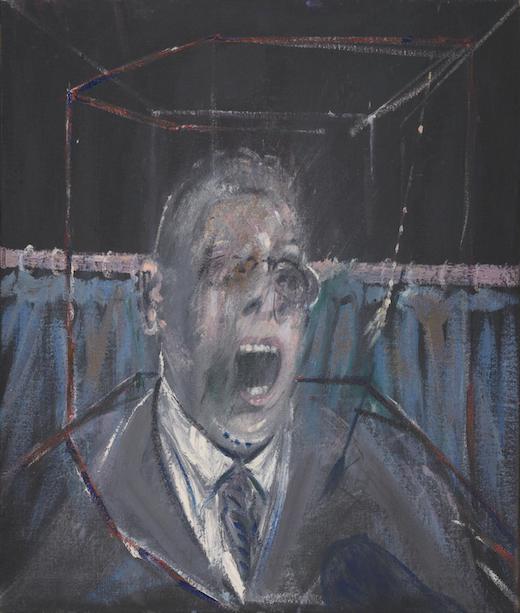
Bacon’s figures are plasticated, amorphous, sweeping curves of paint which neither go abstract or quite resolve into a face. Portraits are supposed to be adjacent to still lifes. Bacon’s figures seem to shift before us, slithering, ungraspable. We’re not the stuff of statues, we’re protoplasmic. Many have words like “study” in the title, like they’re unfinished and quite possibly unfinishable. Just look, for example, at ’Portrait of Man With Glasses III’, (1963) below.
And if the portrait had to some extent been democratised in previous decades, we still assumed our identities were fixed. After all, above all things, we know who we are. Yet there’d been what David Bowie called “that triumvirate at the beginning of the century, Nietzsche, Einstein, and Freud. They really demolished everything we believed. 'Time bends, God is dead, the inner-self is made of many personalities’.” Bacon was using modern methods to convey a modern theme, while using his chosen genre to exploit the discrepancy between modernity and tradition.
It All Comes Into Colour (But Black and White Was Better)
Early Bacon wasn’t just monochrome, it was so murky you peer into his paintings like darkened rooms. When colour is used, it's not too different to spot colour in printing. You are often unsure what are objects in space and what are lines representing psychological states, like those wiggly lines in cartoons which represent anger and so on. Take 'Study For a Portrait’ (1949, below).
But by the early Sixties that had started to change. Works become bigger and brighter, as if someone just hit the light switch. Sizes enlarge and the figures correspondingly shrink, become more situated in a ‘real’ space. See for example the couch potato in another ’Study For a Self-Portrait’ (1963, below).
The show is laid out to present this as if its Bacon coming into his own. The first section is essentially a long corridor, which you travel through to arrive into a bright and spacious room. Except I feel precisely the opposite. There’s a nightmarish quality to the earlier works which is banished by all this light.
About the same time, he started to paint and re-paint a relatively small group of friends. (The show puts this down to the death of his lover Peter Lacy, in 1962.) And this large room is divided into sections, devoted to each of these. Which isn’t the way to go. It may have worked for Freud, but not here. The portraits don’t differ in style or imagery very much, their subject is more the person holding the brush than the one smeared across the canvas. Rather than his chief motive being fidelity to his subjects, he could switch from one to another mid-portrait. Bacon’s art at its best was universal, more than particular.
As Laura Cumming points out in the Guardian: “Likeness is almost beside the point… If it weren’t for the photographs threaded through this show, could you really tell [these subjects]? The one recognisable face is Bacon’s own.”
Except there’s one glaring exception to this rule, and that’s George Dyer. Their relationship was tempestuous to the point of violence, but he seems to have been Bacon’s great love. The show saves for its finale the 1973 triptych which portrays his suicide. But perhaps more interesting is ’Portrait Of George Dyer In a Mirror’ (1968), which looks like multiple images of him scalpel-bladed together. The presence of the mirror suggests truth, and recalls Bacon’s comment “no matter how deformed it may be, it returns to the person you are trying to catch.”
Overall, the image suggests Bacon was divided whether to capture or obliterate him. The flying flecks of white paint are added to other Dyer portraits and, as far as I could see, to no others. There’s little avoiding the suggestion that someone has been jerking off to this disturbing scene.
And there’s other upsides. An early work, ’Study For a Portrait’, (1952) was based on the well-known still from Eisenstein’s film ’Battleship Potemkin’ (both above). But while the broken eyeglasses remain the figure is swapped from female to male. Bacon’s earlier era was in general very male-dominated. Which, when combined with its themes, does start to stray towards man-painy. While in the later portraits women feature more. The poster image, for example, is of Muriel Belcher (up top).
Then there’s the small heads…
Most of Bacon’s paintings of this era were on an almost monumental scale. But at the same time, as the name might suggest, the heads aren’t even life size. With the show arranged around subject model, again and again these are hung adjacent to the large paintings. They look almost like punctuation marks between words. But you notice it quickly - the smaller is the better. See for example ’Three Heads of Muriel Belcher’ (1966, below). The poster image is the middle one.
The heads are normally arranged in triptychs like that, sometimes diptychs. And they look to me like they were composed together, with the combination in mind. (I hve no way of proving that. But that’s how they look.) They’re not sequential, like a mini comic strip. But when the individual images suggest movement anyway, lining them up like this enhances the sense. The eye’s movement across them comes to suggest movement within them.
At the time, that old Tate show seemed pretty comprehensive. So it must be a tribute to Bacon that there was more to say about him.


.jpg)


.jpg)


.jpg)
.jpeg)
%20copy.jpg)
.jpeg)


.jpeg)


