googlee7ea825f63edb3f6.html

Saturday, 30 November 2024

THE FOOTPRINTS OF PHANTOMS (LUCID FRENZY PLAYLIST)


Our next Lucid Frenzy playlist on Spotify steps out with Lankum’s characteristically existential take on Irish folk, which shapeshifts into a bleak Philip Glass midway. Angels Of Light (Michael Gira’s non-Swans outfit) cast a sardonic eye over the penetrating effects of mass media. Rev JM Gates keeps the Gospel tradition alive, Tom Waits washes up on foreign shores, Burd Ellen bewitch and beguile with some Scottish folk (returning from Faerieland is at your own risk), Bardo Pond… well soar is really the only word for it, and both Page & Plant and Jah Wobble revisit and rework some classics. All in under an hour! (Okay, in just over an hour…)

The title comes from the old movie serial ’The Phantom Creeps’, while the illo's the Ernst painting ’Angel of the Hearth’. 

Lankum: The Granite Gaze
Nina Nastasia: You’re a Holy Man
The Angels of Light: Promise Of Water
Rev. J. M. Gates: Must Be Born Again
Tom Waits: Shore Leave
Current 93: Cuckoo
Burd Ellen: The High Priestess & The Hierophant
Bardo Pond: My Eyes Out
Popol Vuh: Wo Bist Du?
Jimmy Page & Robert Plant: Four Sticks
Hawkwind: Magnu
Jah Wobble: Albatross

“Now they live in your head and they travel your veins
Every word that you speak is a word they have made”

Saturday, 23 November 2024

“TO TOPPLE HEAVEN”: ROGER ZELAZNY’S ‘LORD OF LIGHT’

(with some PLOT SPOILERS)


“You wish to sack Heaven?” 
“Yes, I wish to lay open it’s treasures to the world.”
“This is to my liking.”


The scenario of Roger Zelazny’s ’Lord Of Light’ is that humans have colonised another planet, with the First (the original landing crew) co-opting Hinduism in order to act as Gods and keep themselves in charge. People do as they are told, or get reincarnated further down the chain. Though this involves more than cosplaying. While technology is strictly suppressed among their subjects, they hoard it for themselves to take on Godlike powers. All of which happened so long ago, they seem to have largely come to believe this tale themselves.

First published in ’67, it is perhaps one of the most Sixties of Science Fiction works. It inspired the classic Hawkwind track of the same name (released in 1972, though any lyrical connection is oblique). And there’s really two reasons for that…

Reviews are almost duty-bound to quote Arthur C Clarke’s famous dictum: “Any sufficiently advanced technology is indistinguishable from magic.” (Though it seems it wasn’t coined until after the book appeared.) Which is probably normally defined too narrowly. This was the point where technology had become indistinguishable form magic even to those living in that society, let alone savages coming across a landing UFO. So the fusion of the mystical with the mechanical came to be a highly Sixties motif. Bowie’s ’Saviour Machine’, for example, was released in 1970. And here we’ve come across a prayer machine within the first couple of pages.

But also, and happily for us, it’s not the Sixties of the dawning age of Aquarius but the other Sixties - of iconoclastic cynicism, where established doctrine was by definition a lie, where all accepted wisdoms needed knocking down, even if there was little idea what to raise in their place. This is the Sixties of 'Sympathy for the Devil’, not ’All You Need Is Love’. 

And this is embodied in Sam, who dominates the novel from the first paragraph. Though one of the First, he has now decided to sack Heaven and end the Gods’ rule. He’s told “a world has need of your humility, your piety, your great teaching and your Machiavellian scheming.” Though not necessarily in that order. It's an attitude which proves infectious. Keen to be rid of him, but facing logistical issues in killing him off, the Gods instead award him Nirvana. His spirit is raised from this earthly realm, purely as a means of sending him into exile.


How he’s presented, we’re going to have to sneak up on that…

Novels have an essential choice of mode, between external and internal. They might start, for example…

“The tall man strode purposefully down the street, hat turned against the wind. He entered a small corner shop. ‘Good morning, Mr. Smith’ responded the shopkeeper, ‘you are after more cornflakes I suppose’. ‘I am indeed”, Bert Smith replied.”

…or alternately see it from the inside…

“His hat turned against the wind, Bert Smith strode purposefully towards his local shop. As so often, his mind was turned to cornflakes.”

Once the mode is chosen, they will normally stick to it. And in the first, as in my little example, once he has been named Bert Smith will be referred to as that from thereon in. He doesn't need reintroducing to us.

Zelazny does something more unusual. He introduces Sam by names in his first paragraph. (It is names, we’ll get to why later.) But there’s a recurrence of the second person, as new scenes begin with merely ‘he’ or ‘she’. Sometimes ‘he’ turns out to be Sam, at others someone else. It’s like regularly winding back to the beginning, placing us on the outside of events looking in again. Why do this?

Firstly, for the same reason as the external mode is always used. It creates an immediacy, throwing us into events deep-end-first, so we need to keep reading just to establish the basics. And its very much Zelazny’s style to drop us in this world and expect us to catch up. (This is one of those books which has how-to-read guides online.)

Also, there’s identity slippage. Sam and the Gods are forever going in disguise or changing their names. As reincarnation is a thing here, they can even change their bodies. So the question of who is who must continually be re-posed.

But most importantly, it keeps Sam at a distance from us. There’s both a narrative and a thematic reason for doing this. All the Gods have Aspects, a form of super power. Though unspecified, Sam’s is definitely cunning. Sometimes described as a Trickster, he defeats his enemies by outwitting them, by doing the unexpected. Which means we cannot know his plans before they do.

His decision to sack Heaven doesn’t occupy the book so much as cause it, yet his motivations are little dwelt on. The people he is ostensibly freeing he doesn’t seem to regard especially sympathetically, in fact he casually instrumentalises them in his war. And in the rare glimpses we’re given of the inside of his head, he seems almost a different character to the one on the outside.

“He thought upon this city [Heaven] and these gods, and he knew of its beauty and its rightness, its ugliness and its wrongness. He thought of its splendour and its colour, in contrast to that of the rest of the world, and he wept as he raged, for he knew that he could never feel either wholly right or wholly wrong in opposing it. raged was why he had waited as long as he had, doing nothing. Now, whatever he did would result in both victory and defeat, a success and a failure and whether the outcome of all his actions would be the passing or the continuance of the dream of the city, the burden of the guilt would be his.”

At one point he describes himself simply as “a man who has set out to do a thing.” Ultimately, we could reasonably assume he seeks to overthrow heaven for the sheer hell of it. And this seems central. Part of his plan is to spread Buddhism, to counter the ideological influence of the Hindu gods. He says at one point that he had no belief himself, that he masqueraded as the Buddha, yet “whatever the source, the message was pure, believe me. That is the only reason it took root and grew”.

And yet the opposite proves true as well. A non-believer cannot be disabused, a man who doesn’t really want anything can’t be bought off. He is able to depose the Gods without assuming their mantle precisely because he doesn’t believe in what he’s doing, because he simply plays at it. In the parlance of the times, he’s a Merry Prankster.

So his antithesis may not be his antagonist, Brahmin, but Niritti the Black One. Less for his choice of creed (Christianity) than the fanaticism which he holds for it. He has an army of zombies do his bidding, a dig perhaps less than subtle.

There’s also Taraka. Though the novel’s anti-colonial, this has a peculiarity to it not always dwelt on. The planet’s true inhabitants are not its people but bodiless forces described as demons. As Sam points out: “it was their world first. We took it away from them. To them, we are the demons.” Sam unleashes them at Heaven. Though powerful they find it hard to act collectively, a classic Colonialist trope.

Which suggests the demons perform some other function. At one point Sam becomes possessed by what passes for their head, Taraka. Which suggests the demon represents his own dark side. Taraka says at one point “it is of my nature, which is power, to fight every new power which arises, and to either triumph over it or be bound by it.” And once possessed Sam finds…

“He had been touched by the lusts of the demon-lord, and they were becoming his own. With this realization, he came into a greater wakefulness, and it was not always the hand of the demon which raised the wine horn to his lips, or twitched the whip in the dungeon. He came to be conscious for greater periods of time, and with a certain horror he knew that, within himself as within every man, there lies a demon capable of responding to his own kind.”

Though this street turns out to be two-way. His possession fails to hold because by turn he grants Taraka the curse of his own guilt. Inadvertently on his part, it simply happens. But it still seems a manifestations of Sam’s power, Sam being Sam. He will come at his foes from an unexpected angle, against which they are unprepared and defenceless, simply because that is his nature.


Questions are frequently asked about this book. Is it a form of Orientalism? Is Zelazny in sympathy with Buddhism as the true nature of religion, countering Hinduism with its caste system and other forms of social control? But just like Sam, Zelazny always slips free of them. He’s always somewhere else, himself espousing Sam’s playful attitude to serious matters. He cheerfully offered the explanation that he wrote the book to be uncategorisable either as Science Fiction or Fantasy. Sometimes he even mischievously claimed to have written it to use a single pun, which happens early.

And there may be good reasons for that. Not unusually for Science Fiction, he’s more a writer who throws concepts at the page like mud at a wall, a brainstormer not an architect. An elliptical narrative then becomes a handy way to disguise that, by suggesting at a bigger picture where this all fits together. But then, credit to him for realising that and acting on it.

So… sacking heaven and laying its treasures open to the world with the power of play. Is this the equivalent of a disruptive Yippie action in novel form? Well, sort of. But also, we should remember not just that Sam is one of the First, but that those he’s fighting over don’t get much of a look in. They appear, but come and go, none staying long enough to be called a character. The people don’t free the people here, the nice Gods free them from the nasty ones.

And Sam’s playfulness looks back to the insouciance of the original adventure heroes such as Robin Hood or the Scarlet Pimpernel. An attitude which was closely linked to their aristocratic origins. As said another time, the Pimpernel can effectively be reduced to one line from the source novel - “I vow, I love the game, for this is the finest sport I have yet encountered. Hair-breadth escapes – the devil's own risks! - tally ho! - and away we go!”

Then again, that actually seems pretty Sixties. The underground (as it tended to then be called) was ostensibly non-hierarchical but in practice led by figureheads who tended to come from privileged backgrounds. This all makes the novel more Sixties, rather than less.

Still… sacking heaven to lay open its treasures. That is to my liking.

Saturday, 16 November 2024

‘FRANCIS BACON: HUMAN PRESENCE’

National Portrait Gallery, London 


“We are human beings, our greatest obsession is with ourselves.”
- Bacon

The Self As A Moving Target

First off, don’t go thinking this is the equal of the Tate retrospective. Then again, that was fifteen years ago so this is the easier show to see now. And it has its moments of insight, as we’ll see…

For a story which gets so messy, with so much paint slathered across canvases, it starts off with surprising neatness. Post-War British art was dominated by Francis Bacon and Lucien Freud, with their return to figuration. Spurred by Freud’s first solo show and Bacon’s ‘Three Studies For Figures At the Base of a Crucifixion’ both in ’44.

And the two were friends. Freud’s wife is quoted commenting that they met for dinner almost every day, and often for lunch too. Yet they were similar the way bookends are, as complimentary opposites. Freud worked slowly, obsessively and always from life. Bacon tried that, but soon gave up on it. A trivial-sounding detail which becomes a thread to keep tugging at.

When he did use models, he normally brought in friends. Yet he was soon asking for them to be photographed instead. Even for his many self-portraits. He worked from photographs when painting the cast of William Blake’s head, despite owning a copy of it. He repeatedly worked on, in his phrase, distorted records, of Velazques’ ’Portrait of Pope Innocent X’ and Van Gogh’s ’Painter On The Road to Tarason’. But from reproductions, he never saw the originals. (In the latter case, it had been destroyed in the War, only reproductions existed.) Not the normal artist’s impulse.

And let us not forget the New York School were at this same time creating a style or art which they thought could hold photography at bay. Bacon’s instincts took him in the opposite direction.

One reason is a combination of collage and mutation-through-reproduction. After that first mark on a cave wall, all art has existed in the context of its influences, so in some way has been a reply to them. But with mass media this became more and more prevalent. The more that had already been said, the less and less could anything be added which wasn’t some sort of reply. It was in this context that Bacon chose to make his images from already existing images.

He kept a large, (and characteristically disordered) collection of photos and reproductions, from all sources - torn from the pages of art books or clipped from newspapers or cheap magazines. One photo (from 1950) shows some of these laid out on his studio floor, jumbled and paint-splattered, high art, history and nature studies thrown in together. It doesn’t look far from a Paolozzi collage of the same era. And from much the same motives, to break down creative hierarchies.

But there’s a bigger reason…

The show is full of photographs, to the point you can’t help but think a few more paintings might have been an idea. But that might well be how he wanted it, for he cultivated images both of himself and his studio (with its legendary messiness). They’re almost a part of his art, as much so as if he’d been a performer.


And two hung in the same batch give us our clue. ’Francis Bacon’ by JS Lewinski (1950, above) is a multi-exposure double image. While ’Francis Bacon At the Marlborough Gallery, London’ by Guy Bourdin (1986) shows his face in motion blur before one of his own images, inevitably creating a comparison. (That wasn’t to be tracked down. But then you’ve seen motion blur.)

And none of his paintings look exactly like either of these. But they look quite like both of them, there’s a familial resemblance. Even if we say there’s only motion blur because the photo “went wrong”, only a photo would “go wrong” like that. Photography had its own visual vocabulary, which painting could borrow like languages use loanwords. There’s a looser, more fluid approach to imagery which photography had enabled.

The shows says shrewdly that he sought to “exploit our familiarity with the traditional portrait form to shocking effect.” Because we know how portraits work, don’t we? For much of their history they were there to convey status, launder the reputations of usurpers and embezzlers by placing them loftily on the wall. Inevitably, they were still- in the way hieratic art was still.

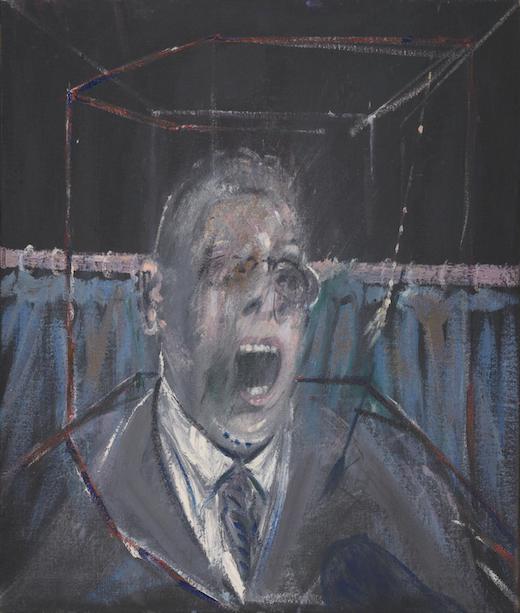
Bacon’s figures are plasticated, amorphous, sweeping curves of paint which neither go abstract or quite resolve into a face. Portraits are supposed to be adjacent to still lifes. Bacon’s figures seem to shift before us, slithering, ungraspable. We’re not the stuff of statues, we’re protoplasmic. Many have words like “study” in the title, like they’re unfinished and quite possibly unfinishable. Just look, for example, at  ’Portrait of Man With Glasses III’, (1963) below.


And if the portrait had to some extent been democratised in previous decades, we still assumed our identities were fixed. After all, above all things, we know who we are. Yet there’d been what David Bowie called “that triumvirate at the beginning of the century, Nietzsche, Einstein, and Freud. They really demolished everything we believed. 'Time bends, God is dead, the inner-self is made of many personalities’.” Bacon was using modern methods to convey a modern theme, while using his chosen genre to exploit the discrepancy between modernity and tradition.

It All Comes Into Colour (But Black and White Was Better)

Early Bacon wasn’t just monochrome, it was so murky you peer into his paintings like darkened rooms. When colour is used, it's not too different to spot colour in printing. You are often unsure what are objects in space and what are lines representing psychological states, like those wiggly lines in cartoons which represent anger and so on. Take 'Study For a Portrait’ (1949, below).


But by the early Sixties that had started to change. Works become bigger and brighter, as if someone just hit the light switch. Sizes enlarge and the figures correspondingly shrink, become more situated in a ‘real’ space. See for example the couch potato in another ’Study For a Self-Portrait’ (1963, below).


The show is laid out to present this as if its Bacon coming into his own. The first section is essentially a long corridor, which you travel through to arrive into a bright and spacious room. Except I feel precisely the opposite. There’s a nightmarish quality to the earlier works which is banished by all this light.

About the same time, he started to paint and re-paint a relatively small group of friends. (The show puts this down to the death of his lover Peter Lacy, in 1962.) And this large room is divided into sections, devoted to each of these. Which isn’t the way to go. It may have worked for Freud, but not here. The portraits don’t differ in style or imagery very much, their subject is more the person holding the brush than the one smeared across the canvas. Rather than his chief motive being fidelity to his subjects, he could switch from one to another mid-portrait. Bacon’s art at its best was universal, more than particular.

As Laura Cumming points out in the Guardian: “Likeness is almost beside the point… If it weren’t for the photographs threaded through this show, could you really tell [these subjects]? The one recognisable face is Bacon’s own.”


Except there’s one glaring exception to this rule, and that’s George Dyer. Their relationship was tempestuous to the point of violence, but he seems to have been Bacon’s great love. The show saves for its finale the 1973 triptych which portrays his suicide. But perhaps more interesting is ’Portrait Of George Dyer In a Mirror’ (1968), which looks like multiple images of him scalpel-bladed together. The presence of the mirror suggests truth, and recalls Bacon’s comment “no matter how deformed it may be, it returns to the person you are trying to catch.”

Overall, the image suggests Bacon was divided whether to capture or obliterate him. The flying flecks of white paint are added to other Dyer portraits and, as far as I could see, to no others. There’s little avoiding the suggestion that someone has been jerking off to this disturbing scene.


And there’s other upsides. An early work, ’Study For a Portrait’, (1952) was based on the well-known still from Eisenstein’s film ’Battleship Potemkin’ (both above). But while the broken eyeglasses remain the figure is swapped from female to male. Bacon’s earlier era was in general very male-dominated. Which, when combined with its themes, does start to stray towards man-painy. While in the later portraits women feature more. The poster image, for example, is of Muriel Belcher (up top).

Then there’s the small heads…

Most of Bacon’s paintings of this era were on an almost monumental scale. But at the same time, as the name might suggest, the heads aren’t even life size. With the show arranged around subject model, again and again these are hung adjacent to the large paintings. They look almost like punctuation marks between words. But you notice it quickly - the smaller is the better. See for example ’Three Heads of Muriel Belcher’ (1966, below). The poster image is the middle one.


The heads are normally arranged in triptychs like that, sometimes diptychs. And they look to me like they were composed together, with the combination in mind. (I hve no way of proving that. But that’s how they look.) They’re not sequential, like a mini comic strip. But when the individual images suggest movement anyway, lining them up like this enhances the sense. The eye’s movement across them comes to suggest movement within them.

At the time, that old Tate show seemed pretty comprehensive. So it must be a tribute to Bacon that there was more to say about him.

Saturday, 9 November 2024

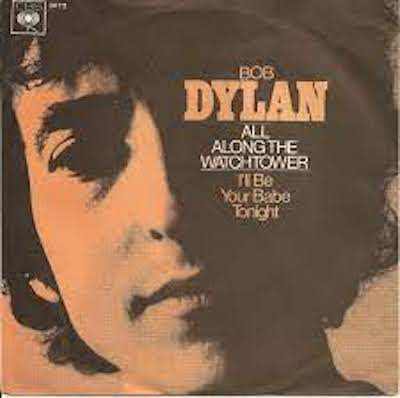
“SO LET US STOP TALKING FALSELY NOW”: BOB DYLAN’S ‘ALL ALONG THE WATCHTOWER’


(A sequel of sorts to my take on ‘Visions Of Johanna.’)

’All Along the Watchtower’ (from ’John Wesley Harding’) is is one of those Bob Dylan songs that has a general theory attached to it. It's held to be about his declining relationship with his then-manager, Albert Grossman. The Joker and Thief are them, respectively. So we’re told.

Well, there may well be other songs from this period which that explanation works for. (Dylan himself, who normally resisted analysis like his livelihood depended on it, said he hadn’t been thinking of any of that when he wrote ’Dear Landlord’, but okay, it did seem to fit.)

But does it work for this song? No, not at all.

In fact I suspect people just get as far as the word ‘Thief’ and cry “aha, he’s calling Grossman a thief, also some Biblical stuff to fancy it up.” David Stubbs, who perhaps propagated this theory the most, describes their relationship as “a stand-off.” Yet in the song they seem to get along. And, provided we accept the (more likely) theory that Dylan sings the verses in the wrong order, the Thief gets the last word. Which isn’t snake-oil spiel, in fact it sounds like sage advice. We, who have been through so much, can outlast this.

Let’s look somewhere else, then.

Was anything else on curly-locks’ mind at the time? There was, something pretty big in fact. He'd change his sound with the regularity others changed their sheets. But this time there had been something more to it…

He’d grown sick of being taken as a spokesman for a generation, or some kind of prophet whose every utterance required the utmost scrutiny. (Pithily epitomised by a scene from the 2007 film ‘I’m Not There’ where everybody, from music journalists to the Black Panthers, is desperately trying to figure out who Mr. Jones is.) Not being a job you could just quit, he decided he had to get himself fired.

It’s like trying to rid yourself of overstaying guests by putting on the music they most dislike. Except in this case he had to write that music. So be it. He’d make records so removed from anything his fan base wanted to hear that they’d desert him in droves, and finally he’d be left in peace.

All this is well enough known. But just in case that wasn’t enough sometimes he’d even spell it out in the lyrics.

Bluffer’s tip, when someone as egocentric as Dylan writes two characters into a song - assume they’re both him. He said of himself: “when I used words like 'he' and 'it' and 'they,' I was really talking about nobody but me.” But this comes with a twist. The Joker is Old Dylan, still looking for some way out of the situation he’s in. “Businessmen they drink my wine” may well be a reference to Grossman, though probably more a collective noun for music industry types. But “ploughmen dig my earth” sounds much more about those self-professed Dylanologists who’d scour his lyrics for buried meanings, sometimes literally rifting through his trash, naturally enough missing “what any of this was worth”.

While New Dylan tells the hipster nihilist that, while he might once have thought life is but a joke, they have now been through that - they can see the other side. In a song dripping with religious imagery, it’s about revelation.

(For this reason, I think the talk about the track being ‘circular’ sails past the point. Yes, what should be the first verse comes last. Yes, earlier songs like ’Stuck Inside Of Mobile’ or - for that matter - ’Visions Of Johanna’ had been about entrapment. Here the song is more a roadmap outta here. I’d guess rather than being up to anything clever Dylan just reordered the verses because that gave the song a better opening line. (If so he was right, most people must know it by now.)

Often analysts of the song reflect on how Biblical the imagery is, particularly the Book of Isiah. But this is almost entirely confined to the third verse (as sung). Few seem to consider how this relates to the song as a whole. Let’s detour into it…

One of the most annoying aspects of the “Dylan’s a poet” business is that actually he was a songwriter. There’s fairly strong evidence, in fact, that he recorded some of those songs. And a songwriter combines words and music for an overall effect. (Dylan himself was often frustrated his music was so overlooked.)

And the point these two come together most clearly is in the singer’s voice. And New Dylan even sounded different, dropping the nasal jeer famously liked by Bowie to “sand and glue”. For something quieter, more plainspeaking.

Elsewhere on the album, such as ’Frankie Lee And Judas Priest’ he strikes a conversational tone. But here he does something different. Truly grand things you don’t intone like a Hollywood voice-over, you have to speak of them softly, in a kind of hush. And the music does something very similar. The sound’s so ominous because it suggests at impending events that could only be alluded to, never fully described. (Those who only know the bigger sound of the Hendrix cover are often surprised by the original.)

I can remember being taught at school that, shortly after the crucifixion, many believed Jesus would return soon and usher in the end times. Which made for strange heady days to walk through, where each step might be your last. It’s something that has stayed in my head all my life. And this song has a similar mood of quiet apocalypse.

It’s known Dylan regularly read the Bible through this time. Solipsistic as ever, he seems to have associated his plan to remake himself with a parallel tumultuous change to the world. And, this being the late Sixties, there was plenty of evidence for that if you were to go looking. This quite possibly borders on a personality disorder. But it made for a good song.


Let’s go a bit more nitty-gritty…

You can see why the Joker might be called the Joker. He’s a Dadaish figure, not just writing songs without literal meaning but furiously denying there is a meaning to things. But why is the Thief the Thief? What’s he nicking exactly? Other song titles on the album mention a Drifter, a Hobo and an Immigrant, while the title track’s about a folklore outlaw. We’re on outsider to society here. Was Thief just the next line in the Thesaurus?

Perhaps, but let’s remember a slightly earlier song, ’Tears Of Rage’, had the repeated line “why must I always be the Thief?” If ’Watchtower’ flirts with confusion by being sung in the wrong order, this one gives us two characters without telling us. To the point that many simply didn’t notice. The only clue is in the use of ‘We’ and ‘I’, given to verses and choruses respectively. (Disclaimer: I seem to be the only person in the world who thinks this.)

‘We’ would seem to be parents vexed by a child asserting their independence. As many have been quick to point out, Dylan was by this time a parent. And it may be that he wouldn’t have written this song had he not been. But it isn’t credible that it’s *about* his experiences as a parent. The oldest, his step-daughter Maria, was six at the time. A little young for that sort of thing.

Instead I’d suspect ‘We’ to be those troublesome fans and Dylanologists, cast in the guise of controlling parents, sternly admonishing their charge over his change in direction. (“It was all pointed out the way to go’ means something like “What’s this? A country album? You are so grounded!”) And Dylan as the less-than-dutiful daughter, unwilling to conform to the plans made for her. What the ‘Thief’ is stealing is her own agency.

And like ‘why a thief’, we might want to ask ‘why a daughter?’ Why not a son? Dylan firmly associated himself with artistic genius stereotypes, which are highly gendered as male, and was effectively a misogynist. Why associate with a female character here? It may be because a daughter’s rebellion is seen as more a betrayal than a son’s. But also, ‘daughter’… it may simply have scanned better.

So to summarise, ’All Along the Watchtower’ by Bob Dylan isn’t about Albert Grossman. No, like many Bob Dylan songs it’s all about Bob Dylan. Have a great day!

(Those of an unusually obsessive nature may want to know I wrote something about the whole ‘John Wesley Harding’ album a while ago.)

Saturday, 2 November 2024

“WHAT SALVATION MUST BE LIKE AFTER A WHILE”: BOB DYLAN'S 'VISIONS OF JOHANNA'


“Johanna may not even be real. But she is an addiction”
- Rolling Stone

The finest songs are not always the most immediate. I doubt if anyone in 1966, on first hearing Bob Dylan's new album  'Blonde On Blonde’, thought of 'Visions of Johanna' as the stand-out track.

First you needed to cope with yet another of Dylan's turns of direction, from the abrasive electric sound and venomous in-your-face surrealism of the previous year's 'Highway 61 Revisited'. That had been definitively Northern – urgent, brimming with attitude – while the Nashville-recorded 'Blonde' could not have sounded any more Southern, languid and brooding. Some tracks even gave woozy New Orleans jazz a look in.

But even then 'Johanna' must have sounded strangely closely to the country station it disparaginly describes, the one that “plays soft, but there's nothing really nothing to turn off”. It couldn't be any further from the epic swoops and rolls of the next number 'Sooner Or Later', the only track on the album to have survived from the original New York sessions. And yet what didn't arrive with a fanfare lingered, and is now one of Dylan's most celebrated songs. 

Perhaps that could be something to do with the air of mystery which Dylan characteristically stirs up. “Inside the museums, infinity goes up on trial”; “Jewels and binoculars hang from the head of the mule.” You could probably throw a dart at the lyric sheet and come up with something similar. It all sounds so vivid, like it should mean something, but trying to figure out precisely what can result in a whole load of headscratching.

Perhaps to try and pin down the cascade of images is a kind of category error. Robert Shelton wrote in his Dylan bio ’No Direction Home’ “the nonsequential visions are like a swivelling camera recording a fractured consciousness”, and he went on to quote Fowlie on Rimbaud, on a poet “bent upon subordinating words to their sounds and colours”. Dylan himself had earlier written: “To understand you know too soon/ There is no sense in trying” and was scornful of those who thought themselves able to interpret him.

Would the facts help any? Dylan almost certainly wrote the song while on honeymoon with Sarah Lownds in New York in the winter of 1965/66. And yet this isn’t exactly a love song. Which has tempted some to speculate that he wrote it pining for an earlier paramour, Joan Baez. The present Louise in the song thereby becomes a stand-in for Sara, contrasted against the absent but longed-for Johanna, aka Baez. (Though some claim the earlier ’Like A Rolling Stone’ was a put-down of Baez.)

Of course I have no more idea than anyone else whether this is true or not, but there may well be something in it. Firstly, when you hear sections of Dylan fandom hating on Baez so badly, in a manner reminiscent of Beatles fans on Yoko, you almost want to take it up just to spite them. But more importantly, Norman Mailer's theory of Picasso was structured around his relationships, embarking on new styles to capture each new lover, then all over again to decry them as he tired of them. And Dylan is in many ways the Picasso of music. For example, his earlier break into his trademark 'protest songs' came at least in part through the influence of an earlier girlfriend, Suze Rotolo. (Pictured with him on the cover of the 'Freewheelin' album of 1963, which launched that style.)

Except, as ever, the main problem with this biographical reading is that its just that – a biographical reading. Your interest flickers to hear the line “the ghost of 'lectricity howls in the bones of her face” after finding out that New York had that winter suffered a power blackout. Or that the song was originally called <i>'Freeze Out'</i>. But really, where does it take you? It's a bit like finding out where a film director used for a location shoot, or an artist for a painting. At most you're describing the impetus of a work, rather than the work itself. Ultimately, reducing “the ghost of electricity” to a power cut seems... well... reductive

As Andrew Rilstone has said “I don't think that Bob set out to tell a naturalistic story... but decided, for some reason, to present the story in the form of a riddle.” To which we might add, when Dylan had earlier broken up with Suze Rotolo he didn't think himself as above writing a perfectly straightforward account of the whole affair in 'Ballad in Plain D'. (Much to the disdain of her sister, who'd been savaged while virtually named outright.)

Okay, you might well ask, so what is going on?

A common theme of the album was 'strandedness', referred to specifically in many tracks such as 'Temporary Like Achilles' or 'Stuck Inside of Mobile With the Memphis Blues Again', and ever-present in the more languidly paced music. But the theme is perhaps at its most developed here. Note the two separate references to keys, jangling uselessly in this inescapable situation. Note the second line “we sit here stranded, though we're all doing our best to deny it”.

“All” makes it seem a crowded song. But, befitting the feeling of confinement, I contend there's only three characters to the story – and one of those is conspicuous by her absence. All the others – the ladies and the watchmen, the pedlar and the countess – merely collapse in on one another, like alter egos invented to distract you from your loneliness. (Or perhaps bystanders, a watchman seen through the window who has a character projected onto him. It scarcely matters which.)

Before we get to Louise and Johanna, let's start with the third-named character:

”Now, little boy lost, he takes himself so seriously 
He brags of his misery, he likes to live dangerously”

Remind you of anybody? Little Boy Lost is starting to sound like a straw-man parody of Dylan himself. And after slagging off pretty much everybody he knew, plus a fair few innocent bystanders, why not give himself a turn?

Now the alert reader at this point is probably thinking there's a fourth character in the song.I f Little Boy Lost is Dylan, then just who is the unnamed narrator? And I'll concede things might seem that way.

”Just Louise and her lover so entwined 
And these visions of Johanna that conquer my mind”


Then again, perhaps not. Little Boy Lost most likely is the lover getting it on with Louise. But I'm suggesting Dylan is simultaneously the body entwined with Louise and the mind thinking of the absent Johanna. He feels so disconnected from the picture he's in that he conceives of himself as two entities – the present body and the removed, preoccupied mind.

Johanna is a religious name – it means the grace of God. If you look Louise up, it means warrior. But you might as well go and forget that second part, for it's not really got much to do with the song. I suspect Dylan just picked the most regular and the most out-of-ordinary names he could think of. I must have met many Louises in my time, I'm not sure I've known one Johanna.

And the distinction between them is all there in that early line...

”Louise, she’s all right, she’s just near... 
But she just makes it all too concise and too clear
That Johanna’s not here”


Something many people seem to miss is that, unlike many a Dylan song, he's not actually disparaging about Louise. “She’s alright... she's delicate and seems like the mirror.” He quotes her saying “Ya can’t look at much, can ya man?” as if she's being perceptive. But the point about Louise is that she's merely present, just as Johanna is defined by her absence. They divide much as Little Boy Lost and the narrator are split.

Clinton Heylin has suggested that Dylan, suffering from writer's block at this point, has made Johanna his absent muse. And lines about Mona Lisa with “the highway blues” would seem to go along with that. But this seems only marginally less prosaic than the earlier romantic triangle notion. Dylan may have got there through cold feet about a marriage, or deciding to write a song about not being able to write a song. In the end, the how of it doesn't really matter.

In a word, it's purgatorial. The song is about separation, about the body being exiled from the spirit. At the end of the song, rather than having Johanna show up, everything else goes away – leaving only her absence.

”And Madonna, she still has not showed 
We see this empty cage now corrode...
...the harmonicas play the skeleton keys and the rain
And these visions of Johanna are now all that remain”

Coming soon! While we're on the subject of Dylan...

Saturday, 26 October 2024

THE SELECTION ACCUMULATOR (LUCID FRENZY PLAYLIST)


The next Lucid Frenzy playlist starts off with the one song-based team-up of John Cale and Terry Riley. The platters that matter then include Current 93 lamenting the passing of the dead (as is their wont), Nina Nastasia telling us how it is, …and The Native Hipsters making musical Dada while the Delgados use a semi-colon in their track title; surely the most Delgadoish moment of all. And New Order still sound like the future, if unfortunately not the one we got.

Muddy Waters either needs no introduction or whoever you’re introducing him to is unworthy of the honour. Hawkwind go all JG Ballad and dystopian, but get to admire the view. King Crimson see red (and in the process inventing alt.metal years early). Brainticket combine psychedelic soul with Krautrock into one heady brew.

(The title is from the counter they had in juke boxes, when plays were included in chart placement)

John Cale & Terry Riley: The Soul of Patrick Lee
Current 93: There Is No Zodiac
Nina Nastasia: This Is What It Is
The Angels Of Light: The Man With The Silver Tongue
New Order: The Him
...And The Native Hipsters: Flowers R Machines As Well
The Delgados: Tempered; Not Tamed
Jeffrey Lewis: It Only Takes a Moment
Bert Jansch: The Black Swan
Muddy Waters: Rock Me
Sonny Terry & Brownie McGhee: Southern Train
Hawkwind: High Rise
King Crimson: Red
Brainticket: Like A Place In The Sun

“There is no-one here, Just photographs of the gone”

Saturday, 19 October 2024

EXIT ONLY

(The third part of 'Everybody's Happy Nowadays', a look at politics, how it hits our daily lives and how we can hit it back. It began with ‘You Are Here’, taking in ‘This Way Up’ before landing here.) 


“You think that’s what I want? Become one of them? Become my own enemy? I want to move around for myself. If I’m going to laugh or cry, I want to do it for myself.”
- Alexander, ‘Star Trek’ 

“It can only know by means of your knowledge… understand through your understanding. It can only exist through your submission.” 
- ‘The Quatermass Experiment’

“I offer you nothing. I’m not a politician.” 
- William Burroughs

So how could we get out of this sorry state of affairs? Well, what are the main obstacles to us getting back control of our lives? There's several contenders, of course. Big capital, mainstream political parties, the police force... but the most pernicious and so perhaps the most dangerous of them all? That’s the Left.

Now people can find this one… um... counter-intuitive. After all, if you’re opposed to the Right you must be on the Left, right? Yet the very fact that the Left is a generally agreed term, that even when it’s pilloried it’s regarded as within the frame of acknowledged thought, that should already be raising our suspicions.

To generalise a little… okay more than a little, let’s say the Left wing itself has two wings, the ‘official’ Left (the Labour Party, Trade Unions, formalised political pressure groups, etc) and the hard Left of the ever-sloganising Trot sects. Then let’s look at them in turn.

We’re often told that it was a Labour government which brought about gains for working people. The most obvious example would be the National Health Service. And it was a gain! Treatment suddenly based on the depth of a patient's need, not the size of their wallet. But then if it was all due to Labour why were the Tories so quick to accept those changes, and weren’t to challenge them for the next thirty years? Further, why did Labour governments more recently actively participate in the piecemeal privatisation of the NHS?

The truth is, even if it happened *under* Labour the NHS was not brought about because of them. It was the high level of class struggle at the time which enabled it... in fact, probably the more accurate word there is compelled. The simply didn’t dare not do it. But when that level of struggle dissipated the NHS became assailable, like a retreating army leaving one of it’s main cities open to attack.

And of course we have in recent years been pressed into defending those hard-won victories. These struggles are of course important. We need the NHS for one simple reason - we might get sick. But seemingly confined to the two options we came to believe our choices were over how much state control should be exerted. If privatisation was the foe, nationalisation was the desired result.

Reader please note this is not a matter of – in that popular cliché – the workers being “bought off”, through pay settlements or whatever. The problem with the Left isn’t that it’s stuffed with traitors and turncoats. Of course, it normally is. Contrary to all the tabloid propaganda about the Trade Unions manipulating credulous workers into strike action through their wormtongue words, strikes are almost always initiated by workers and then scabbed out by Union bosses.

But even when that happens it stems from the actual problem, which is more inherent. It’s that the Left treats state and legal institutions as though they’re politically neutral. Sometimes it actively complains that they’re not, sometimes it tries to set up it’s own legal institutions, very often it does both at the same time. But regardless of the rhetoric, regardless of the personal motivations of those inside the Left, it will always act in this way, always seek an accommodation with the system it’s ultimately part of.

Yes of course workers show up at a workplace every morning and sell their labours to others. Yes of course tenants remain housed only on the basis of agreement made with landlords who live elsewhere. That's accepted. The only open questions concern particularities - how this relationship operates, not whether it does.

And this is definitional to the Left. After the French revolution, before political parties were formalised, the more pro-revolutionary factions tended to sit together on the left side of Parliament. It has always been a Parliamentary term. These groupings led to political parties. And ultimately, as Pannekoek said, “a party is an organisation that aims to lead and control the working class.”

And so by accepting the Left we accept capitalism. We became merely another faction within it, debating how it might be run and thereby arguing on its terms. To quote Gilles Davue: “Communism is not a programme one puts into practice or makes others put into practice, but a social movement... We will not refute the various brands of socialists whose programmes merely modernise and democratise all existing features of the present world. The point isn't that these programmes are not communist, but that they are capitalist.”


But here we need a caveat. Some see this and come to the conclusion that it’s ‘un-communist’ to become involved in ‘reformist’ struggles. What we want is ‘revolution’, so naturally nothing less will do. A path which, you can’t help but notice, doesn’t lead to revolution. In point of fact, it doesn’t lead anywhere at all. It’s mostly an excuse for inaction. There is nothing… nothing at all wrong with workers agitating for a decent pay rise, tenants demanding safety features in the building they live in so they don’t catch fire, a neighbourhood resisting fracking, and so on. Better things for us are always to be welcomed. Concessions count as victories.

However, concessions are always going to be the cheese in the mousetrap. Tasty stuff, to be sure. But to be extracted and made off with without getting yourself caught up in the binding mechanism.

Similarly, people can confuse rejection of the mainstream political system with militant tactics, such as black blocism. Such tactics can admittedly have their time and place. And we give no credence to those who moralise over a few smashed windows, then cheer on the mass bombing of whole countries. It was Paulo Friere who said “with the establishment of a relationship of oppression, violence has already begun.” Their system is institutionalised violence. Ours won’t be.

But the problem arises when people turn these tactics into their identity, as if you need to be masked up and chucking bricks or you’re not doing it right. The thing that defines us, that makes us truly radical, isn’t militant tactics. Tactics must always be secondary.

If you move beyond ‘reformism’ the next political faction you normally encounter is Bolshevism. Represented in Britain by the Socialist Party, the Socialist Workers Party and a bewildering array of other squabbling factions. (In Britain it’s almost always Trotskyism in some form or other, though different strands exist elsewhere.) To quote the Situationist film ’Call It Sleep’: “Bolshevism is the dominant notion of what it means to rebel against authority. Every notion about revolution inherited from Bolshevism is false.”

Bolshevism sets itself against the ’reformist Left’. Yet, however endless their squabbles, both are part of the same continuum. As Trotwatch said: "A Leninist party simply reproduces and institutionalises existing capitalist power relations inside a supposedly 'revolutionary' organisation: between leaders and led; order givers and order takers; between specialists and acquiescent and largely powerless party workers. And that elitist power relationship is extended to include the relationship between the party and the class."

The most immediate problem with the hard Left is how it takes people eager for change and turns them into unpaid workers, labouring for the benefit of a new set of bosses. But ultimately, the last line in that quote is the most important one. Bolshevism is summed up remarkably accurately by the ‘Ripping Yarns’ episode ‘Roger of the Raj’, where the protagonist’s private tutor “had told me that a moment like this would come. When the old order would finally collapse. And I was to let him know if it happened while he was out.”

And note the use of “collapse”. Bolshevism reduces to the notion that, just like its ersatz products, capitalism itself comes with a sell-by date. One day it will simply lay down and die. The Party as an elite institution is required, not to bring about that “collapse,” which is assumed to be happening anyway, but to step into the resulting vacuum and organise the workers on the march into the next phase of history. Me and you, we don’t overthrow the system that exploits and oppresses us. Our role is to welcome our new bosses with the better management plan, and then get back to work - this time for them.

Lenin always claimed “the working class by its own effort is able to develop only trade-union consciousness.” Which would have been news to Marx and Engels, who always insisted “the emancipation of the working class must be achieved by the working class itself. We cannot therefore co-operate with people who openly state that the workers are too uneducated to emancipate themselves and must first be freed from above”. For all its claims otherwise, Bolshevism is Marxism only in that its Marxism turned upside down.

Bolshevism’s selling point is its claim to elevated perspective. Standing above our heads and outside history, “the Party” had a unique perspective granting it insight - and so can always accurately assess the social situation and know what is to be done. And you can see how appealing that would be. No more confusion, no more wondering what’s best to do, now we can just defer everything up the chain.

And of course historically that’s the one thing “the Party” has most consistently failed on. Like water, information does not flow well uphill. A remote, autocratic and doctrinal leadership simply misreads every situation and gets everything wrong. The ‘Ripping Yarns’ quote above is even historically accurate, the Russian Revolution really did happen while Lenin was out; he read about it in the morning paper while in exile in Zurich, and was gobsmacked by the unexpected news. They’ve got no better since.

And something else...communism is often described as the workers owning the means of production. Marx himself sometimes spoke of things that way. But the Russian revolution demonstrated a fatal ambiguity in this. In early 1917, the revolution largely consisted of workers seizing control of their own industries. But after the Bolshevik take-over, as soon as the next Spring, managers were brought back. Often the old managers the workers had just got rid of.

The workers still really owned things, the argument ran, because the managers were now answerable to the Party, and the Party represented the workers. But workers no longer had direct control, they were no longer collectively making the decisions which affected their working lives. The revolution was lost at that moment.

Further, the means of production has changed. Particularly in Britain, many jobs may produce a profit but have a social value of zero. Should we collectivise a call centre which rings you up to flog you insurance? The means of production is no more a politically neutral instrument than the political or legal system. The question of capitalism doesn’t reduce to a question of ownership. It’s a social structure, which determines how we relate to one another within it, and it’s one which needs replacing.


The Left’s two faces, set in endless ritual argument with one another, are a distraction which leads to us lose sight of what should be axiomatic. Communism was not taking over the state or corporation and making them nicer, even if such an idea was even conceivable. Communism is at root about people taking control of their own lives - where they form co-operative ventures which are made up from and are answerable to the local communities they spring from, ventures which then federate with one another. Talking about a centralised form of communism is as oxymoronic as talking about an anti-nationalist form of Fascism.

The most important thing Marx ever said, possibly the most important political sentence anyone ever said, was “history is the history of class struggle.” It’s not that we live under some monolithic and absolute state of capitalism, but one day a revolution might strike along and sweep us into some equal but opposite absolute state of communism.

The idea that the class struggle is to come, that its arrival is something we wait for like millennial cultists, is as much an error as imagining it’s about Stalin signing off Five Year Plans. This is not a difference in emphasis. It’s a difference of kind, of chalk to cheese.

And this assumption class struggle should always be seen as a break from the norm plays into the capitalists’ hands. In reality the class struggle is ongoing, every hour of every day, and what happens is the outcome of the clash of those competing class forces. We already shape the world.

The class struggle starts, by necessity, where it is. And, to quote perhaps an unusual figure for this piece, the Duke of Westminster warned “beginning reform is beginning revolution”. Or, as the Workers Solidarity Movement put it:

”Our politics must begin always at this point; at the contradiction in our daily lives between our needs, our desires, what we see is possible and the constraints capital puts on us by operating according to an alien logic that forces us to abandon our needs, our desires, our dreams and work according to its dictates. Our revolutionary politics must always begin with working class resistance to this experience, it must be an intervention not to assert or defend 'communism' or 'the working class' as ideal forms against impurities, but rather to search for the quickest, speediest and most painless route from here to where we want to go.” 

And yet of course that’s easier said than done. Leftism isn’t confined to a defined set of groups, who you can ignore when you can and oppose when you need to, even if that’s where it’s most prevalent. I have very often seen, for example, Anarchists behaving in the most Leftist way. And we are always pushed towards Leftism, not by some inner weakness of character but by incremental social pressures. Like sailing against a headwind, we need to constantly compensate just to stay on course. And we act as Leftists every time we behave as though we have privileged knowledge, denied to others, which means all struggles must be centred around us.

But perhaps there’s a bigger objection. Aren’t the odds so weighted against us as to make the struggle pointlessly one-sided? Does David really want to get himself in a tussle with Goliath? Truth be told, it often feels like that.

But first, there is effectively no choice. The past forty years have shown precisely what happens if we try opting out. Economists gaze perplexed at a Britain where the link between economic growth and wages is broken; put bluntly, at a country that gets richer while its people don’t. But that ‘link’ was never a neat mechanism, a function of the system. It was through struggle that we won those gains. Opting out doesn’t mean opting out of the game. It means losing it.

And besides, David had a little trick up his sleeve when facing Goliath...

Against the Left… against all capitalists, we say this system was only ever made by our hands, and only our hands can bring it down. It will end when we collectively chose to end it, and at no other time. If we deliberately defer the date that's going to start, then it will always be deferred – dangling ahead of us like the donkey's carrot.

It's a notable feature of our language that words for a directed crowd are all negative, such as 'mob.' The Courts openly stated that more severe penalties would be handed out for activities committed at the time of the 2011 riots, even if no causal link was proven. This fear of the directed crowd should tell us where our true power lies.

To counter the alienated notion that conditions we endure now are inevitable, we need to bust a hole in the edifice (it scarcely matters where) then try to enlarge it. Back in '87, the Frankfurt Autonomists perhaps summed this up the best:

“We are can openers in the supermarket of life. Not willing to wait until humankind changes, we pretend that already happened and live our lives accordingly. It means the refusal to be a victim. Give us everything that life has to offer. Let our forms of struggle and desire, the time and the place, the beginning and the extent, not be determined by them.”

The times where the powers-that-be have seemed most under duress was when a campaign was widespread and grassroots, yet had a radical wing which was not estranged from the rest. One example of this in action would be the anti-Poll Tax movement of the late Eighties. In his book 'Poll Tax Rebellion’, Danny Burns commented:

“The Anti-Poll Tax Unions… had to make people feel wanted and included and give everyone a sense that they had a role… This immediate form of organisation also meant that people weren't patronised by those who had political experience. In the local groups, people didn't need permission to act, they just had to get on the phone to their neighbours and get something going. People stay involved in political campaigns if they can contribute in the way that they feel is most effective. Very often this is not by sitting in boring meetings… This means that political movements have to accommodate a great deal of diversity. Because of this, most of the successful Anti-Poll Tax Unions operated on a principle of parallel development. 

“Rather than trying to assert majority control or spend hours reaching consensus, people were allowed to get on with what they thought was most important. Everything could be done in the name of the Anti-Poll Tax Union, which existed to co-ordinate activity against the Poll Tax, not to specify its exact nature… The Anti-Poll Tax movement encompassed an enormous range of approaches…

“The activities of those who were not prepared to break the law were not undermined by the actions of the few who chose to throw fire bombs. Likewise, those who chose to leave Trafalgar Square peacefully, were not tarnished by those who chose to fight back against the police attack. The occupations of the courts didn't prevent those who wanted to argue legal technicalities, and those who chose not to attend meetings but to take action on their own, didn't undermine the collective decisions of those who met in the APTUs. The movement was not damaged by this diversity, it was strengthened by it. It created a feeling that everyone, from every walk of life, was involved in this campaign in some way, and that meant it was strong.”


Crucially the relationship wasn't a vanguardistic one, where the insight provided by the higher foreheads and more attuned senses of ‘the politically educated’ came to provide ‘the workers’ with the correct theory. The truth was that we needed each other, like two chemicals needed to mix for a reaction to occur. Without grassroots campaigns to keep them on course, autonomous social movements easily become unmoored from reality and drift off into militant lifestylism – and in truth they very often do. Sartre famously said “it’s those who aren’t rowing who have time to rock the boat”. But when does the boat stop? That’s determined by the rowers.

And the Left know this too. Maurice Brinton’s eyewitness account of the events in Paris ’68 includes descriptions the CGT (the French, Stalinist-controlled version of the TUC) sending goon squads to physically prevent different sections of the demo from intermingling, particularly the students and the workers, and ensure everyone went home again once time was officially called. When they go to that much effort to keep us apart, we can only conclude we’ll be better off together.

What good might be done by writing all this out? In itself, nothing. The notion that our primary task should be prosleytising, laying “the truth” before the poor befuddled masses, is not just limited in approach, its a fundamental misconception of the situation we find ourselves in. Theoretical understanding of our situation is fine, but only in theory.

To quote Jean Barrot again: “There is an illusion in propaganda, whether it is made by texts or by deeds. We do not ‘convince’ anyone. We can only express what is going on. We cannot create a movement in society. We can only act within a movement to which we ourselves belong.”

I’m not claiming to be particularly politically active these days, nor that the stuff I was involved with held any especial importance. I’m just doing what I can, which is write stuff. And you’re better doing what you can than railing about what you can’t. Communism isn’t, and has never been, about executing some masterplan. Communism is, and always has been, about the subjects of capitalism doing what they can about their situation - until we’re subjects no more.

”Mayday isn't an army. We are Mayday. They’re people just like us.”
-June, ‘The Handmaid’s Tale’

“If you're listening to this, you are the resistance.”
- John Connor, 'Terminator Salvation'

(Okay, that was a crap movie. It's still a good quote...)

Saturday, 12 October 2024

THIS WAY UP

(Part Two of 'Everybody's Happy Nowadays', Part One here.)


”History has just begun”
- The Ex

“Let's change the future from here”
- Atari Teenage Riot

”Nobody will give you freedom, you have to take it”
- Meret Oppenheim

(The story so far: Back when our side fought the class war more acutely, we had near-universal benefits, pensions and healthcare, and better protection in the workplace. Now we're fighting less, and by a remarkable coincidence all of that's being eroded. But how did we come to be losing like this? And even then wasn’t it that we didn’t have it good, just less bad? How come we ever put up with this situation in the first place?) 

It’s notable how in practice people slip back and forth between saying “we live freely in a democracy” and “but you can’t ever touch the rich, why bother trying?”, despite them being so clearly contradictory. But the puzzle’s soon solved. It’s a matter of starting off with the obvious-sounding conclusion then going back to the working-out. Both assert nothing is to be done, so we might as well stay sitting where we are. Which takes us to the real question. Why the need for such ‘rationalisations’?

While the thing they’re busily not saying is “capitalism’, the thing they are busy saying is “human nature”. This is known as the naturalistic fallacy, the notion that if something is that’s proof in itself it out to be. To want to change things is to go against some fundamental order, like defying gravity.

In a classic example, in the film ‘Dr. Zhivago’ the revolutionary Pacha (played by Tom Courtney) curtly insists “people will be different after the revolution”. And if we’re presented at all in the mainstream media it’s usually as some form of this - equal parts fanatical and unworldly.


Yet there’s abundant evidence of mutual aid being practiced. What, for example, about food banks? Their spread is often taken as an inevitable consequence of hunger. Yet people must set them up, others must donate to them and still others volunteer in them. You could look at these examples and assume the truth’s the very opposite. We are not greedy, its just the greedy telling us we are. So our nature must not be bad but good.

But ultimately that just makes the same mistake the other way up. Yes, history shows there were those who risked their own lives to hide those in danger from Nazis. But it shows others grassing them up, even - in no small numbers - murdering them themselves, in order to take their property. It’s not enough to find a few surface examples, and then try to apply some universal rule.

When faced with such reductive simplicities we shouldn’t reverse but transcend them. We need to reject altogether the confining notion we are limited to some kind of “nature”. Nature is here being used as a synonym for essence, or set of inherent qualities, as if we’ve been made in a mould. In this sense it can only be applied to objects. Geologists classify rocks according to their structure, and the job’s done. Whereas even other animals have a culture, in that they can adapt or innovate, choose to do one thing or another.

But to go back to the Pacha quote, the thing is – he’s right. People would be different. After so seismic an event as a revolution, how could they not? ‘Human nature’ isn’t natural at all. It’s human, by definition. It is, and always has been, a social construct. We make our nature, by creating its conditions.

Our bodies are quite literally composed of what we consumed through our lives. An archaeologist can come across human remains and, by analysis of its bone and teeth, deduce where and how that person lived. Should our minds be any different? Isn’t our upbringing, the people we’ve met and our experiences of life, the best guide to understanding what makes us ourselves? Doesn’t that sound more credible than us being like sticks of seaside rock, with the same few words written right through us? And why should this not also apply collectively? History books talk freely of how, for example, life became different after the Second World War.

Zoologists how now effectively given up studying animals in captivity, as it’s so unconnected to their behaviour in the wild. Yet Sociology has done nothing but study humans in captivity since its inception. As Marx said “the essence of man is no abstraction inherent in each single individual. In reality, it is the ensemble of the social relations.”


Besides, isn’t there a bizarre twist to this? While it’s supposedly a foolish fancy to imagine we can “change human nature”, the existence of Capitalism itself proves the opposite. Capitalism replaced Feudalism, a quite different system of social organisation which required people to adopt a quite different “nature”. For the main argument it uses against us to be true, it couldn’t be here to make it in the first place.

So wage labourers under capitalism act and think as wage labourers, just as peasants think and act as peasants and tribespeople as tribespeople. Limited historical perspective can hide this truth from us, but once pointed out it becomes obvious. They call us hopeless idealists, when we’re the real materialists! 

So this mean a communist society would reshape us until we we’re all neat nuggets of altruism, slaving selflessly for the pubic good, scrubbed clean of any traces of individual identity? No of course it doesn’t! But then such a parodic notion was never anything to do with communism in the first place.

We need to ask, all this supposed individualism, but what’s in it for us? We want communism precisely because we are the ones who will benefit from it, because we will gain control of our lives not lose it. It’s your boss at work who tells you “there’s no I in team”, when he wants you to work harder for no more reward. It’s us who tell you there is an I in communism.

The legendary Pop Group liked to sing “only you can be your liberator”. And the way we live now, putting yourself at the centre of your life is in itself virtually a radical act. But you can’t carry out that act alone, you need to work in accord with others or you’ll be easily beaten down. It may sound a paradox. But it’s because we’ve always been told an inherent division exists, between ‘the individual’ and ‘society’, a chasm which we must leave to wise heads as something only they can manage. Might there be times conflicts can arise? Of course. Is it inherent? Effectively, the opposite. ‘The individual’ needs ‘society’, and vice versa.

Marx and Engels always insisted “the free development of each becomes the condition of the free development of all.” Bakunin was more eloquent still: “no tree ever brings forth two leaves that are exactly identical. How much more will this be true of men, men being much more complicated creatures than leaves. But such diversity, far from constituting an affliction is… one of the assets of mankind. Thanks to it, the human race is a collective whole wherein each human being complements the rest and has need of them; so that this infinite variation in human beings is the very cause and chief basis of their solidarity.”

And there’s a second way their argument is self-defeating. It may be true that none of us are selfless saints. But then what does that say about the wisdom of handing vast reserves of power and wealth over to a few individuals, in the hope they then use some of that back for the betterment of the rest of us? Or making some order-givers on the assumption they’ll legislate for the greater good?

The most infamous example of this is the orange goon Trump. Remember how every “sensible” political pontificator was telling us that first securing the nomination, then assuming the Presidency would lead him to become “more Presidential”, the burden of office straightening him out. Of course it was the opposite. Being born into such a position of power was the very thing which had made him such a grasping psychopath. So, strangely enough, granting him more power didn’t prove much of a cure. Its like saying the cure for alcoholism is more booze.

But as ever he’s just a more egregious example of a general rule. Power corrupts, we see the evidence all around us. It’s true to say that it couldn’t do so unless we were corruptible. But the sensible answer to that is - let’s minimise the chances of corruptibility!


Okay, you reply, but whose going to do the work?

The answer in brief is – who do you see doing it now?

You hear all the time people complaining against (real or, more commonly, imagined) “scroungers” and “shirkers”. They say they want to see these “idlers” getting a job, contributing to society, doing something useful. Yet if you ask the self-same people whether they feel they are contributing or doing something useful in their own jobs, you’re either met with a stupefied look or a diatribe over how much they hate the whole valueless experience. And that disconnection is the very point. Work is so awful for me, why should others get to escape it?

Almost everybody knows the Marxist phrase that we’re “alienated from the means of production”. And of course it’s very true. The factory worker who tightens widgets all day, or the call centre operative who ceaselessly repeats their script, both feel disassociated from what they do. This remains the case even if they’re in one of the few remaining jobs which have an actual social value. We’re doing things not of our choosing, under conditions not of our making, simply so we can survive. How is that likely to make us feel?

But Marx didn’t stop there, where everybody thinks he did. He went on to describe how the situation also left the worker alienated from him or her self, was unable to interact with the world in a way they chose, was therefore unable to fulfil themself. We don’t just live in a world where the things we create and enable don’t belong to us. We live in a world where, in a material sense, we don’t belong to us either.

There’s a thing you have which you must sell, if you’re to get by in the world. And that thing you must sell is you. Ever seen a thing you used to own, disconnected from you, for sale in a shop window? Now imagine that thing is you. Estranged from even your own self, of course you come to feel estranged from others.

The paradox is almost unparalleled. We are the engine of it all, every day we are the fuel which obligingly pours itself in - and only then can the machine run. But we appear to ourselves as the passengers. It’s the backbreaking business of labour, combined with the passive feeling of being strapped in your seat.

As Malatesta commented: “Someone whose legs had been bound from birth but had managed nevertheless to walk as best he could, might attribute his ability to move to those very bonds which in fact serve only to weaken and paralyse the muscular energy of his legs…. Just imagine if the doctor were to expound… a theory, cleverly illustrated with a thousand invented cases to prove that if his legs were freed he would be unable to walk and would not live, then that man would ferociously defend his bonds and consider as his enemy anyone who tried to remove them.” That’s where we are.

Exploitation and alienation are the two fists that maintain the abusive relationship we endure with capital. Yet alienation has a particular twist. Alienation is simultaneously a form of psychological damage and the justification for that damage, the gaslighting voice that tells us this abusive relationship is all we have so we should cling to it.


Yet, as that great philosopher Homer Simpson said, “it’s a crummy system, but what you gonna do?”

The first step to overcome this alienation is to act for ourselves. A Reclaim The Streets flyer for an action in support of the (then striking) London Tube workers craftily modelled itself on the Tube map handouts. Under the header ‘Mind The Gap (Between What is Possible and What Capitalism Allows)’ they said:

“If we want another world we’ve got to stop maintaining this one through our action and inaction. The power of our rulers is based on the fact that they have separated us from each other, and we act as alienated individual workers and as passive consumers. By endlessly repeating the same patterns – paying our fares and bills, going to work, watching the world unfold on TV – we recreate the world every day. Today we attempt for a brief period to upset the normal pattern, to feel the power that we have when we act together… Workers can bring this world to a halt.” 

It’s a good first step. Yet life is more complicated and, unfortunately but inevitably, to talk about what communism is necessity compels us to start with what it isn’t. This goes beyond the inevitable distortions of black propagandists. The sad truth is that very few people alive today claim to be communists and very few people even know what communism is. And sometimes this seems particularly true among those who claim to be communists.

Mention the word and expect the Soviet Union to be thrown in your face. Even today, thirty-five years after its passing. There are those able to see the obvious truth that it wasn’t at all communist, some even able to grasp the more important point that it was capitalist. But mostly they still cling to the notion that ‘central planning’ becomes at some point antithetical to capitalism. Then, when you ask them where Marx says such a thing, they’ll hurriedly change the subject. This fixation with central control is what Bordiga called “the mistaken thesis”: 

“Constructing industrialism and mechanising things is supposedly the same as building socialism whenever central and ‘national’ plans are made… The difference between the employment of mechanical forces in a capitalist society and in a socialist one is not quantitative, it does not lie in the fact that technical and economic management passes from restricted circles to a complete circle. It is qualitative and consists in the total overthrow of the capitalist characteristics of the use of machines by human society, something much more thoroughgoing and which consists in a ‘relationship between men’ in opposition to the cursed ‘factory system’ and the social division of labour.”

And Marx himself said the very opposite to the words so often stuffed in his mouth: “To be radical is to grasp the root of the matter. But, for man, the root is man himself.” (Okay, “man” should be “human”, he was writing a while ago.) His conception of Communism was “a free association of producers under their own conscious and purposive control.”

The revolutionary subject is not the plan but ourselves. Inasmuch as there is such a thing as revolutionary plans, its because we make them. We make them ourselves and make them for ourselves. We are not ancillary or subservient to them. They are subservient to us.

But what would this free association of producers actually look like? How do these high-sounding ideas fare against reality?

Most people seem to assume there’s an intrinsic link between authority and organisation. Fascist societies might have been repressive, but you can’t deny they got things done. Whereas anyone who’s actually studied actual fascist societies knows they were effectively the opposite - fractious, chaotic and corrupt. The famous formulation that Mussolini made the trains run on time was a baseless propaganda line, still repeated now all these decades later. Whereas during the Spanish revolution, anarchist workers collectivised the Barcelona trams - and they did run on time.


This is George Orwell's description of the workers' militias he encountered during that time, as recounted in 'Homage To Catalonia':

“The essential point of the system was social equality between officers and men. Everyone from general to private drew the same pay, ate the same food, wore the same clothes, and mingled on terms of complete equality. If you wanted to slap the general commanding the division on the back and ask him for a cigarette, you could do so, and no one thought it curious…. each militia was a democracy and not a hierarchy. 

”…there was no military rank in the ordinary sense; no titles, no badges, no heel-clicking and saluting. They had attempted to produce within the militias a sort of temporary working model of the classless society....”

”Cynical people with no experience of handling men will say instantly that this would never 'work', but as a matter of fact it does 'work' in the long run… 'Revolutionary' discipline depends on political consciousness - on an understanding of why orders must be obeyed; it takes time to diffuse this, but it also takes time to drill a man into an automaton on the barrack-square.” 

”The journalists who sneered at the militia-system seldom remembered that the militias had to hold the line while the Popular Army was training in the rear. And it is a tribute to the strength of 'revolutionary' discipline that the militias stayed in the field at all. For... there was nothing to keep them there, except class loyalty. Individual deserters could be shot - were shot, occasionally - but if a thousand men had decided to walk out of the line together there was no force to stop them. A conscript army in the same circumstances - with its battle-police removed—would have melted away.”

A more nuts-and-bolts explanation of the working mechanisms of workers’ collectives in Spain states... 

“...the individual collective was based on a mass assembly of those who worked there. This assembly nominated administrative staff who were mandated to implement the decisions of the assembly and who had to report back to, and were accountable to, that assembly... So, in general, the industrial collectives were organised from the bottom-up, with policy in the hands of workers’ assemblies… [which] were widely attended and regularly held... if an administrator did something which the general assembly had not authorised, he was likely to be deposed at the next meeting.”

I’ve picked the Spanish revolution because it’s the best known example. But there’s frequent examples of such things throughout history, Wikipedia gives a brief list here


Let’s spell out clearly something which shouldn’t really need saying - this is not some magic cure-all which, as soon as unleashed, dispenses with all ills. The problems, issues and debates which came up in Spain and elsewhere have been widely discussed, should anyone want to read about them.

Nevertheless, the examples above give widespread practical examples of something we’re always being told is an impossibility. It is, it might be argued, somewhat in the interests of those currently controlling our lives to tell us that we couldn’t do the job better ourselves. When, most of the time, we’d be harder pressed to do it worse.

But of course we no longer live in 1936. Historical accounts of this period may make for compelling narratives, but as guides for action today do they hold any real relevance? Accounts of the more recent anti-austerity movement in Spain inevitably focus on their negatives, or on their likely effect on electoral politics. Yet popular assemblies not only reappeared, arranged along broadly the same lines, but in the same neighbourhoods – for example at Madrid’s Puerta del Sol.

The CNT, a revolutionary union still in existence, said of these:

”The organizational formulas developed in these mobilizations prove the viability of direct participation through assemblies for taking decisions that channel our aspirations and demands and make us overcome individualism. We become protagonists, rather than spectators of a system based in representation and delegating authority, which erases our individuality. Assemblies, a rotating microphone, working groups, responsibility, capacity, organization, self-responsibility, coordination, involvement and visibility are the collective teeth that move our gears, capable of challenging the institutions… We continue to build at the same time as we disobey. The protest continues!”

Next time! Tune in for our final thrilling instalment...