Happening
to walk past the venue earlier in the day, I found they've recently
placed one of those old-fashioned long white name strips outside. So
the names Irmler and Liebezeit were spelt out to one of Brighton's
busiest streets. And of course most simply trudged straight past.
While to those of us steeped in Krautrock lore those lengthy,
foreign-sounding and entirely unprepossessing names couldn't seem
more enticing. However much it might sound like hyperbole the bands
they stemmed from, Can and Faust, were credible contenders for the
most important band in the history of everything, ever.
How
could you sum up the appeal? The nearest I could manage, at least for
comics fans, would be when Marvel and DC staged the Superman and
Spider-man team-up. It's not just two greats, its two reality systems
coming together. Liebezeit drummed with Can, Zen masters of metronony
who could take a groove to trance states. Meanwhile Irmler played
home-made keyboards plus any number of other invented or extemporised
instruments in a multitudinous collective who brimmed with deranged
invention. Like the Velvets, they could coin and discard musical
styles and ideas which later bands would build careers around. While
Can's method was to boil music down, Faust's was to rip it apart.
While Can's credo was less is more, Faust's was that more could be
more too. Put them together, I wondered, and what do you get?
The
result is perhaps closer to Neu!, the third great Krautrock band,
than either outfit they were in. There's the same sense of music as a
serene, gliding force, as if untroubled by gravity. As is always the
distinction between great and merely good musicians, what they did
didn't seem impressively hard so much as infectiously easy. You felt
they could have continued playing for hours without breaking a sweat
or furrowing a brow. You felt like anyone else cold have got up and
joined in, just through getting swept up in the sheer joy of it.
While
drums often merely provide the base line for other instruments to
jump up and down on, here neither instrument led. When I saw Irmler
earlier this year, accompanied only by a woman drawing, I didn't feel
it that engaging. Yet give him another musician to spark off and the
magic is soon unleashed.
Liebezeit
played ostensibly simple patterns, but subtly shifting throughout.
Jah Wobble has compared his playing to a man running, and for all its
marshalling of the power of repetition there's something very organic
about it. Rolls often kick off with a lift, throwing the emphasis on
their beginning. Rather than dominating Irmler would often pass
through sections of tone and washes, like colour fields. Only for the
last number did he – literally and metaphorically – pull out the
stops for some powerful surges.
Sometimes
you get the feeling people come out to see great musicians from past
eras just to say they've seen them. It's like a form of
commemoration. Not this time. In the small but crowded Hope, the
mesmerising set went down a storm. What are Irmler and Liebezeit
doing these days? More of what they've always done. If that's not
inspirational, I can't imagine what is.
Film reviews are like buses. You wait for ages then two come along at once
A
GIRL WALKS HOME ALONE AT NIGHT
Reader,
if you're here to simply ascertain whether you want to see this film
or not, you may wish to stay wary of PLOT SPOILERS which lie in wait
below. There is, however, a swifter means to achieve your end –
simply scan the page and check out some of the stills. The film's
very much a mood piece, with a strong aesthetic and some quite
stunning black-and-white photography – somehow connecting classic
cinema with stylish art movie. If those stills appeal, most likely
the film will too. If they don't, you're probably better off
following your taste buds elsewhere.
With
a film self-styled as 'the first Iranian vampire western', its no
surprise for it to frequently be described as surreal. However, a
more accurate word might be uncanny. Take the central image, captured
in the poster, of the vampire in her chardor. It's simultaneously
jarring and fitting, a spooky echo of the vampire's black cloak,
lacing the usual associations of compliance and confinement with
undercurrents of menace and mystery. It's not an image you find you
can file and put away, it stays, it haunts you. Her sinister
presence, glidingly stalking the streets, is accentuated halfway
through when she starts... yes... skateboarding. It's absurd, it's
laugh-out-loud funny. But crucially, it stays spooky.
Filmed
on location in California with an all-Iranian cast speaking in subbed
Persian, it creates a similarly strangely indeterminate mood. This is
furthered by it being shot in black-and-white, which always tends to
work as a distancing device. You're quite literally never sure where
you are. And temporally its equally indeterminate, flatscreen TVs
existing alongside classic cars and vinyl record players. The
standard recipe for the surreal is the juxtaposition of the familiar
with the unfamiliar, epitomised by Dali's lobster telephone. But here
both elements are defamiliarised, like one
exoticness rubbed up against another. The result is that all figures
look lost in the terrain.
Director Ana Lily Amirpour is herself an Iranian brought up in the
West and now living in California, so we may be seeing things through
the prism of her eyes - a film about outsiders made from the
perspective of an outsider. She's said of the setting:
“It’s
not Iran, it’s like a fairy tale world, it’s universal. It’s
like any town where there’s corruption and there’s secrets and
there’s loneliness and people that got dealt a shit hand. They’re
searching for something in this loneliness. I mean, that’s what I
am and that’s why I made the film. That’s all I really know. I
don’t know how everyone else feels.”
(At
one point the chardor-clad titular Girl is asked where they are and
she replies “Bad City”. The questioner seems familiar with the
name. Yet several reviews and even the Wikipedia entry went on to literal-mindedly declare this
the official name of the town. Which seems to me mistaken. It cuts
against that all-important state of indeterminacy. The term could as
easily be a nickname and its allegorical nature, akin to calling a
city Babylon or Mahogany, is the point.)
Reviews
as frequently cite the Iranian New Wave as an influence, but the New
Wave it recalls more is the French. Americana is framed in a way
which it never could be from inside, while the screen exudes coolness
and composure to a degree Hollywood could never match. Arash, the
other lead character, has a studied rocker look which echoes
Michael's channelling of Humphrey Bogart in Godard's
'Breathless' (compare them below). Actor Arash
Mirandi is now being called by almost everybody the Persian James
Dean.
Given
the prominence of the chardor, and scenes such as the one where the
Girl kills the bullying pimp Saeed, some have been keen to find a
feminist message in the film. Certainly her motivation is partly to
rescue the prostitute he mistreats, and the scene must rank as one of
the most barely symbolic of all symbolic castration scenes in cinema
history. And her very presence often seems accusatory, a sudden
black-clad appearance.
Yet,
confessing at one point she's done “bad things”, she seems like
judgement without the justice. She does seem to have a rule only to
feed on bad men. Yet her morality seems much like the Gemma Arterton
character in 'Byzantium', walking the streets of
Bad City at night is an occupation likely to lead to situations where
'bad' and 'men' run rather easily together. The otherwise superfluous
scene of her feeding off the homeless guy seems there to suggest that
she needs a meal of an evening as much as everyone else - and needs a
good reason not to make you her victim rather than
the other way around. At another point she mimics a potential
victim's movements, like a cat playing with a cornered mouse.
Similarly,
the scene where she frightens a young boy seems creatively ambiguous.
While she could be trying to frighten him onto the straight and
narrow, she could equally be looking for a weakness which would allow
her to make him a victim. Besides she leaves town rather meekly on
Arash's instruction, which would be an odd scene to include in an
avowedly feminist film.
Rather
than having a political message about reclaiming the night, the film
is probably more existential. Characters encounter one another on
empty streets and try – and normally fail – to size each other
up, in a way reminiscent of the existential concept of the Other. It is of course very often women who are
characterised as 'otherly' in this way, and the Girl makes a classic
example. Through staying silent, she allows Saeed to project his own
prejudices onto her, assuming she's yet another prostitute. Notably,
she never gives away her name. (I kept misremembering the title as
”She Walks Home…”, but its the
less personalised, more distanced ”A Girl
Walks...”)
And
yet while we learn neither her name nor her backstory we do see her
at home alone, dancing like no-one's looking, without her chardor. We
even see her in the tub, surely the most un-vampiric of all
activities. The one way the 'crusader' element of the character works
is that the chardor is something like a superhero costume, like
Batman striking dread in the hearts of criminals. And the girl inside
the costume is something more vulnerable, more human.
The
nearest we get to a self-description is when she goes to see the
prostitute, Atti, and gives her the watch she's purloined from Saeed
– confirming he's dead. Asked who she is, she's unresponsive. But
with everything she then says to Atti in description of her - that
she is growing older, that at one time she imagined she could escape
this life, that she has since forgotten to hope – she is describing
herself as well. Notably, both women have maps on their walls –
signifying a will to escape. Amirpour has said the film's “really a story about battling
loneliness. And vampires are the loneliest.”
And
all this talk of existentialism, it's probably a way of saying the
vampire western is at heart a love story. All the supernatural
elements are merely there to amplify this. Even the Girl's age
signifies that she's been young for the longest time, like some dark
sibling to Peter Pan, adding more pop star posters to her wall as the
decades passed. And her mysteriousness, her meaningful silences, the
sense she's possessed of strange powers - that's pretty much how
girls seem to a teenage boy.
When
she meets Arash on the street he's off his head and lost, on his way
home from a party. It was fancy dress and, in a typically witty
inversion, he's gone as Dracula. Finding her (naturally enough) cold
he wraps her in his cloak to warm her. It's a reversal of the classic
Dracula lunge, when he is if anything the one in danger. The goofy
costume becomes the ironic counterpoint to his inner goodness and,
rather than making him another victim, she takes him home like a
stray.
(Some
reviewers have described Arash as a drug dealer. Yet while we do see
him selling drugs at the party he's simply helped himself to Saeed's
stash to get over his cash shortage. He doesn't even charge the girls
for the pills he gives them. Clearly when they then insist he takes
one himself its his first time – hence he has so strong a reaction.
Rather than making him cocky and strutting like the coke-sniffing
Saeed, drugs make him helpless and child-like.)
Its
their encounters, not the Girl's vampire attacks, which are the crux
of the film. The most trite, most cliched scenes from any movie here
become the most memorable. On their dates they stay awkwardly yet
meaningfully silent, standing before pounding oil derricks or roaring
diesel trains. They communicate mostly by playing music, at the age
where it feels more natural to put on a record than speak your mind.
Notably all the music in the film is diegetic, played by characters
within the film. The characters wrap themselves up in tracks like
garments, the music working something like the thought balloons in
comic strips.
They're
at the age where you become aware the self can only have meaning by
relation to the other, and so the existence of the other is a
necessity – they have to be there just for you to be you. And yet
the other seems inscrutable, remote, removed. Even love is ambiguous,
whether its a means to bridge the divide or whether it just heightens
the problem. The basic elementary question of how one person related
to another becomes foregrounded, raised to a fever pitch.
The
significance of possessions is also tied up with this. When asked by
Atti if she's a thief, the Girl replies no. Yet several times over we
see her takes her victims' belongings, and in this very scene she has
Saeed's. However at no other point does she lie, and it doesn't sound
as if she's doing so here. For here possessions have no exchange
value (only Saeed is seen dealing in money), they're more tokens of
identity, the way a crown bestows regalness or a badge authority. And
transference of objects transfers this power. Yes, the Girl takes
Saeed's expensive watch but only to give it to Atti, to symbolise she
can now control her own life. Saeed takes Arash's car, ostensibly as
payment for his father's debt, but clearly to belittle and disenpower
him. Even Arash steals some earrings from a rich girl he has the hots
for, but gives them to the Girl, piercing her ears and attaching them
himself. They represents the transfer of attraction.
That
other great staple of young love stories, the generation gap - here
its more of a generation rupture. Arash's father becomes angry when
he hears he has been with the Girl, an absurd burst of morality from
a man so fixated with prostitutes. But its best captured in the
role-reversal scene where Arash throws him out the house for bad
behaviour. This sets up events which cause him to forcibly attempt to
inject Atti with drugs, then be killed by the Girl in her defence.
Coming to realise this as they drive out of town Arash stops, gets
out of the car and paces. She has killed the pimp to liberate Atti
and the father to protect her, but in so doing liberated Arash
instead. He then gets back in the car, silently puts on a tape and
drives off.
It
would be tempting to take this acceptance and see the story as
redemptive, as about a killer of men who instead learns to love and
make a life with one. Yet this ignores the crucial theme, running
right through the film, of addiction. Arash's father is addicted to
smack and prostitutes, Saeed literally to coke but more generally to
power and dominance. Even the young boy is always popping sweets.
While for Arash and the girl, their addiction is one another. In this
way she doesn't abandon vampirism for love, their affair is more a
mutual form of vampirism. The love scene where she first takes Arash
back to her flat, where they simultaneously devour and offer
themselves to each other, spells this out with images.
Seen
in this way the ending is characteristically ambiguous. They're less
making a new life outside Bad City, a place which doesn't seem likely
to be festooned with labelled exit routes, than they are swapping one
set of addictions for another. (In Arash's case, life with the father
versus life with the Girl.) Perhaps they are simply removing all
that's extraneous to be left with their primary addiction. It's
teenage romance in its purest form, looking for your reflection in
another's eyes.
And
from the ridiculously sublime to the sublimely ridiculous... (We don't just throw this show together, you know.)
MAD
MAX: FURY ROAD
Once
more with the PLOT SPOILERS
Let's
start this review the way the film does - by cutting to the chase.
This belated yet gazumping entry in the Mad Max series does exactly
what it says on the lid. Which is to say there's a guy called Max in
it and it's mad. It's an almost continuous white-knuckle ride,
frothing with deranged invention. In the Guardian Peter Bradshaw called it “Grand
Theft Auto revamped by Hieronymus Bosch”. Personally I'd have gone
for “an ultraviolent 'Wacky Races' filtered
through punk and surrealism”. But either work. There's images which
genuinely almost reach Bosch levels, delirious and compelling.
In
one scene some of the characters handily supply their motivation in a
single word. As most of them share the same motivation, there's
really only two words to learn. Yet what might seem risible is
actually the way to go. When action films make feints to
characterisation, in the English Lit sense of the term, the result is
usually neither/nor. It's like interrupting a roller-coaster ride for
a psychobabble feelgood session. Here there's no pretence there's any
hidden depths to the characters, everything happens on the surface.
Significantly director George Miller chose to storyboard the film rather than script it, working with the comic artist Brendan McCarthy – regarded (at least
by me) as one of comics' most singular visionaries. Miller's
commented he wanted a film comprehensible to foreign audiences even
without subtitles. (Perhaps just as well, for my middle-aged ears
lost much of the dialogue to those roaring car engines.) You read the
film via the look, the style, the images. The way you'd read a comic
strip. Or, for that matter, look at a Bosch painting.
In
this post-apocalyptic setting, does the villain Immortan Joe
represent a return to the pre-civilization world of the patriarchal
tribe, while Max and his mates keep the flame of civilization
flowing? In short, are we being told our world can be down but never
out? Its true, labour power (as opposed to the
looting of predatory gangs) is largely absent from the film. As a
natural resource being hoarded by Joe, water is simultaneously scarce
and abundant. There doesn't even seem much reason for him to be
keeping alive those ragged peasants (alas another passive mass in a
multiplex movie), other than to demonstrate his tyranny.
Yet
Maher also foregrounds “the battle cry of
Joe’s escaped wives: 'we are not things'.” Which seems selective,
for their other quote, “who broke the world?”, hangs just as
heavily over the film. With the machines largely gone, remaining
merely as a residue, it's people who have become both machines and
their fuel. Women are farmed for baby milk, Joe's wives kept in a
vault of a room like prize jewellery. But the pallid flesh of Joe's
War Boys is also shown manning the dark cogs of the lift to his
Citadel, human grease to the gears.
You
could tie yourself in knots trying to figure what the social system
represented is. Patriarchal tribalism? An all-commodifying
neoliberalism, in which this is our future even if you take
ecological disaster out of the equation? Primitive accumulationism?
(Probably the most likely answer, but hardly a multiplex movie
staple.) Or some other thing? All these answers overlook that this is
a film composed of images. And the images are of divine right and the
machine age coexisting. They're deliberately juxtapositional, tourist
viewfinders pressed into service as security devices. But the point
is that they can and do fit together.
And
Joe's sermon to his flock? “Do not, my friends, become
addicted to water. It will take hold of you, and you will resent its
absence!” This may be a singularly British response, but its hard
not to think of one of George Osborne's budget statements about
austerity. Joe bears a remarkable resemblance to Bane from 'Dark Knight Rises'. (Check 'em out below.) And like Bane's Gotham,
there's an ambiguity to his domain. But its horror resides in its
recognisability.
Maher
is on stronger ground when he criticises an anti-patriarchy that
confines itself to escape from a harem. When Joe points to a pregnant
wife on the run and cries “that's my property!”, its hilariously
monstrous. But it's as archaic as the chastity belts we see them
remove. It bears little relation to patriarchy as we find it, you
can't imagine someone saying anything like it in the Western world
today. (Though of course what's unsayable isn't necessarily what's
unthinkable.) Joe contrasts with someone like the 'Gotham'
villain the Ogre, a charismatic metropolitan who seduces women back
to his pad, then chillingly makes them into his possessions. Of
course its heightened for the sake of the drama. But his behaviour is
connected to a recognisable real-life type, the possessive boyfriend,
while Joe is simply a panto menace unmoored to our lives.
Maher
says sardonically of Max “with the collapse
of society, our only hope resides in the individual... the lone
hero”. Yet in his narration Max comments “it was hard to
tell who was more crazy... me... or everyone else”. In the early
stages of the film he's a classic example of a man without a mission,
floundering and getting himself captured as a result. The ghosts he
sees of relations past don't spur him on to fight for justice in a
barren land, they beset him. At all the wrong times. And it remains a
singular feature of the film how Tom Hardy's Max is so un-matinee
idol. True he repeatedly performs the actions of the hero. But
there's no pithy one-liners, no victory-through-handsomeness
close-ups. He seems mad in the more common sense of the word, rather
than the righteously vengeful.
The
word which strangely seems to be missing from all this is 'family'.
I'll take Maher's Jesus comparisons and counter with a Dad. Max is
more the reluctant father who steps up to do his duties. He and
Furiosa become honorary parents to Joe's escaped five wives, the
family unit held against the tribal horde. The escape scene where
Furiosa drives as he lies astride the bonnet, pouring petrol into the
tank, seems their bond in microcosm. (Is it pushing it too far to
point out their initials also stand for Mother and Father? Probably,
but I seem to be saying it anyway.)
Maher
rightly calls the film “a classical Hollywood western”. As much
as his comparison of 'The Searchers' it recalls
Ford's 'Stagecoach', the lone coach trying to keep
to the straight line against the amassed, whooping Indians. But it as
often, and perhaps more inventively, appropriates the tropes of
sea-battle cinema. In this dried-out world, the desert has become the
new sea. The cars almost have sails, which amass on the horizon. When
they arrive they torpedo Furiosa's tanker with harpoons like whale
hunters, swing aboard while its still in motion like pirates. While a
prisoner, Max is tied to the front of a car like a human figurehead.
And
another sea battle trope is the symbolic association of the Captain
with the ship. While Max commandeers other vehicles at numerous
points, Furiosa sticks firmly behind the wheel of the tanker. (Only
abandoning it for a motorbike when she's considering going
off-quest.) As the tanker is pierced in the battle, she is stabbed in
the side. To aid their escape, Max has to both pour gas in the tank
and give her a blood transfusion. In a film which avoided computer
graphics wherever it could, her metal arm necessitated it's use in
almost every scene she appears. So why include it? To underline the
symbiotic relationship between her and her vehicle.
And
associated with this is the hiding of the five
wives in the hold. This is partly to get the film off to the required
running start, bypassing explicatory and redundant scenes of how
Furoisa got them out or decided to risk the run. But also the belly
of the tanker is by association her belly, and
when they emerge – the first time in the film we see them - it's a
symbolic birth. (One emerges already impregnated by Joe, as if born
pregnant. But this merely underlines the symbolism by irony.)
When
Max first sees the five wives they're hypersexualised, washing
themselves while wearing very little – the subject of a myriad
model photoshoots. They're played, more or less, by models, so
there's little point in pretending they're not used as eye candy. But
their presence, after both a battle and a sand storm, is also
incongruous. They're equally like water nymphs, spirits seemingly
appearing out of nowhere. Of course, as has to be established by
repeated cut-tos, their honorary father Max has to react merely to
the incongruity. (He's puzzled, get it? Puzzled.)
But if we're invited to see them sexually, we also see them his way.
If they're models they're Marilyn models, with an innocence to them.
The
conceit is that the harem has offered them a paradoxical kind of
protection from the outside. The big bad world, which has rubbed
itself all over Max and Furiosa, hasn't touched them yet, however
often Joe got his grubby hands on them. Furoisa tells them this
explicitly. Seeing what's around her, one repeatedly toys with the
idea of going back to the devil she knows.
In
this way they can be as innocent as children, even as they're
themselves bearing children. They wear white. Some have semi-angelic
names like the Splendid Angharad. They can believe they're going to
the Green place, they can pray, they can disdain killing.
Unsurprisingly the Green place itself turns out to be long despoilt.
But they pick up and keep the bag of seeds given them. In effect,
they are the Green place of the film. The answer
to “who killed the world?” is of course the same as to “who
killed the Kennedys?” - we're all implicated. So its asked by the
most clear-cut representation of the next generation.
It
can at times involve fuzzy logic. At one point Nux, a War Boy gone to
their side, points to a tree. He doesn't know what to call it,
despite widespread foraging in this wasteland he's not seen one
before. Yet faith in the Green place means the Wives do, even if
they've never been to the non-existant place and have previously had
less cause to see one than him. Nevertheless its a paradox which
perhaps rests on an inherent feature of polygamous patriarchy, which
almost inherently blurs the distinction between wife and daughter.
However,
Max and Furoisa's job isn't just to deliver this cargo. They start
off as hope without agency allied with agency without hope. But the
trip mixes the two up, the Wives aiding more and more in their own
rescue. One even gets a putative boyfriend in Nux, they grow up fast
in these parts. While those with survival skills start to see
something to survive for. Like all road trips in films, this is part
pilgrimage.
If
there's been a lot of talk about the sexual politics of this film (improbably reaching the pages of the Daily Mail), you are frankly best
off forgetting all of that. It does worse than getting in the way.
Championing the film as some kind of feminist manifesto undoes what
is otherwise it's best and boldest move, the way Furiosa is simply
assumed to be a strong and capable character with no further
explanation considered necessary. In the New Statesman, Tracy King titled her review 'No,
Mad Max: Fury Road is not a feminist masterpiece (but that’s
OK)'. And it is. Once you start to prod and poke at them the
politics aren't all that progressive. In many ways they're
reactionary. But it was ever thus. Instead focus on what the film is
good at. Instead think of 'Wacky Races' crossed
with Hieronymus Bosch...
If
Tricky's still best known for trip-hop via his debut LP
'Maxinquaye' (1995), its true to form for him when
that album scarcely gets a look-in tonight. (Contributing precisely
one song, 'Overcome'.) His own opinions of the
genre may, ironically enough, be summed up by one of its other tracks
- 'Brand New You're Retro'. Feeling it quickly
became branded, he complained of going to the cinema to find all the ads had been given quasi-trip-hop soundtracks. (“That
was the end for me. My music had become McDonald's and I had to run
away from it. I could never make another album like
'Maxinquaye'.")
Of
course, as ever, to fit those cinema ads the sound of trip-hop was
twisted as much as it was stretched. Though the description of it as
a “cooler, late-night vibe” comes from Massive Attack's 3D, this ignores the important early
influence of Gary Clail and Tackhead, colliding post-punk and dance
at high impact. Alas the edgier, more disortienting side of the style
soon got edited out for a slightly beatier version of chill-out. Yet
'Maxinquay' in particular was characterised by
murky beats and slurred vocals, as if punch-drunk by life.
Six-and-a-half minute songs about being sectioned don't fit the
standard definition of chill-out.
Tricky
also has a strange overlap with the other great genre of that era,
grunge, even covering Nirvana's 'Something In the Way'.
Like Nirvana, many of his tracks sound like they might once have been
clean and anthemic, but fell into a disorienting fever dream before
they could be released.
But
'Maxinquay' was, in its own weird way, ornate –
in the way a collage artwork can juxtapose so many elements it builds
up into a kind of sensory overload. In fact, the cover art - a
collection of corroded surfaces, often covered with graffiti or the
residue of layers of torn posters - was a kind of
collage. (“Let me take you down the corridors of my life”, was
perhaps the key lyric, like his mind was a labrynthine delapidated
mansion even though when he wrote those words he probably lived in a
bedsit.) It marshalled the insistent power of repetiton, but normally
the 'artificial' repetition of samples on repeat, not the 'natural'
samples of re-struck chords.
Whereas
here everything which isn't strictly functional is discarded. The
music's boiled-down, lyrics often reduced to a few repeated phrases.
And the rock-totem guitar becomes a prominent instrument, with as
many tracks riff-driven as beat-based. There's more Link Wray to it
than there is Massive Attack. And, always a contrary bugger and
averse to being labelled a black artist, it may be part-wilfulness on
Tricky's part to be taking up so white a style.
Then
two-thirds through an already intense set, he summarily dismisses his
co-vocalist. (Who had previously seemed to be doing most of the
work.) And things grow more intense still, like we'd already taken
the mixer out of the spirits and now start on the neat alcohol. He
skitters across the stage like a twitching spider, clutching at his
clothes, a mike in each hand, head jerking between them.
The
length of tracks seems not just sprawling but almost arbitrary, at
least in the sense of developing as compositions. 'Vent',
just over three minutes in the studio, stretched to forever. It has
more of a ritual element, like the drums in voodoo the purpose of the
track is to install some trance state upon everyone, and it'll keep
going until it gets there. Which is probably another way of saying
the tracks are tracks, in their purest form.
It's
only the second time I've seen Tricky, and with many years between,
but there is the same weird energy to things. He occasionally speaks
to the audience, even thanks us for showing up, but mostly seems lost
to some private episode, frequently turning away, at times not even
thinking to hold the mike to his mouth. (“On my own again”
becomes a repeated lyric.) It can sit strangely with a Saturday night
crowd, large numbers of whom look dressed to go clubbing later. (And
there was, alas, no shortage of audience wankers.)
It
is, saying it can't be avoided, much the same weird energy you can
feel radiating from a crazy guy in the street. But equally Tricky has
often said he finds a fixation with his mental health be racist, and
perhaps it is the cultural equivalent to the way higher numbers of
black people get sectioned. He's often at pains to point out “on stage I'm a different
person, very aggressive, very tense... I shake my head and the little
lights start blurring, so I'm having trips and dreams. It's almost
speaking in tongues.” There is of course a world of difference
between being able to channel some force and having your life
overwhelmed by it. Dali famously said “the only difference between
me and a madman is that I am not mad”. And that difference is
important.
There
are those who dismiss trip-hop, and all who sailed in it, as some
Nineties fad. Like Blairism, something which just seemed a good idea
at the time. And yet Tricky's still here, unbound to the sound he
sprang from, and as strange and intense as ever.
The
afore-mentioned 'Vent', though not from Brighton.
There may not appear much to look at in this clip. But there often
isn't with Tricky gigs. They go in for mood lighting, in the main...
In
one of his last ever interviews, the late great Captain Beefheart
explained his reason for relocating to the desert – he found it
“subtle”. His was not always an easy mind to guess. But what I
think he meant was the place that looked to the outsider like a
featureless expanse was, to the attuned eye, anything but.
And
the desert blues of Malian band Tinawriwen (the name meaning
“deserts” in their Tuareg language) seems similar. It's not as
dynamic as conventional rock music, pretty much eschewing breaks and
bursts for a continuous flow, one section blending smoothly into the
next. And if a river metaphor seems to be shaping up there, let's
pursue it. The surface of their tracks isn't always lively, they
proceed at a measured rate and can appear placid. Something
accentuated by the way both main set and encore were given a slow
incline, starting with steady chant and a solo acoustic guitar
respectively. But the longer you listen, the more you feel
undercurrents are starting to hook you. The choral vocals, the guitar
lines first seem mantra-like in their repetitivenessm but start to
sound more intricate and interwoven as they progress. (I am not sure
how many rivers there are in the deserts of Mali. Just go with it,
okay?)
And
in fact I later discovered this passage from
their website bio:
“The
desert is a place of hardship and subtle beauty, a stark world that
reveals its secrets slowly and carefully... For Saharan blues band
Tinariwen, the desert is their home, and their hypnotic and
electrifying guitar rock reflects complex realities of their
homebase.”
Not
to over-generalise about the music of a continent, but John Peel once
said of Zimbabwean band the Bundhu Boys that their music seemed to be
coming up from the ground and passing through them. Similarly, rather
than unleashing a barrage of power chords, Tinariwen seemed linked to
some ceaseless energy source. You felt they could have played two or
three times as long, had they been someplace which could accommodate.
Of
course it's possible to be cynical about the whole 'world music'
industry. It often feels like people are liking the sort of thing
they think they should like. It can suggest rich
hippies listening to their expensive steroes, and convincing
themselves the process attunes them to the Global south. (The Dead
Kennedy's famous “ethnicy jazz to parade your snazz.”) But one
cool thing about Tinariwen, and perhaps desert blues in general, is
that it's not music which is particularly interested in
'authenticity'. Though the drummer slaps traditional African drums,
the rest utilise electric guitars. (Founder member Ibrahim Ag Alhabib allegedly built his first guitar, after seeing one in actionin a Western film.)They cite as influences the folk music of Mali, but also Arabic pop,
Led Zeppelin, Bob Marley and (ulp!) Dire Straits. And seeing them in
a rock venue like the Concorde, not some sedate arts centre, feels
appropriate. First and foremost, they're a great live band.
Before
the internet showed up and started recording everything, the
fallibility of human memory was almost a creative act. Perhaps you
saw some Seventies pseudo-arty piece of erotica shown on BBC2, and
over the years your memories of it morphed. So hard was it to see
something so ephemeral as a film back then, perhaps you only saw some
stills from it, and resorted to imagining what it might be like. It's
less that your young mind read more into the film than it was
carrying, it's more that the atmosphere of the film and your memories
of it ferment over time, acquire a significance which comes to await
being pinned to something. Like a dream which stays with you, even
though you're never sure why or what it might mean.
Given
this, going back to watch the original film is obviously a mistake
bordering on category error. It won't add anything to a memory that
was only built up subsequently, the film itself can now only undo it
all – like pulling the foundations from a tower. One solution,
perhaps, is to try and remake the film as you remember it. Which is
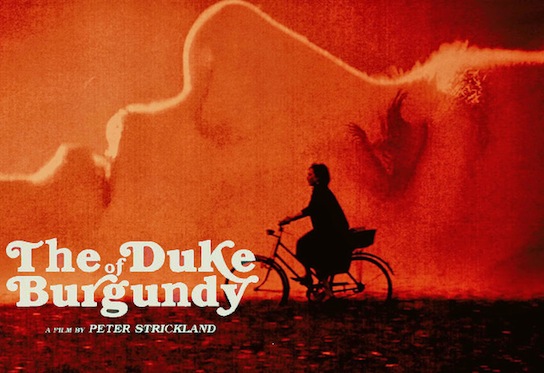
pretty much what director Peter Strickland is doing here. The
Seventies pastiche credit sequence recalls the one for his previous
film, 'Berberian Sound Studio', but perhaps here
the conceit's enlarged to the whole film.
The
programme quoted him as particularly keen to channel the films of
Jess Franco, which “struck me as being incredibly rich in
atmosphere, intensity and sexual fever”. It notably recycles many
of the tropes of Seventies erotic cinema – the inherent kinkiness
of lesbianism, assumed to overlap with sado-masochism, the
near-hysteric mentality of women – with just enough framing that we
know not to take all this entirely seriously. (The audience
frequently laughed out loud, though even the absurdest moments are
presented deadpan.)
With
it's pointedly indeterminate setting in time and place, it could be
set in the Seventies, or as easily not. It has the same stilted,
distanced feeling of the era, as if the actors are presenting rather
than inhabiting the characters. (Often a side-effect of dubbing,
though English-language films can have much the same effect, such as
'Picnic at Hanging Rock'.) The central characters,
Cynthia and Evelyn, seem to inhabit the same hermetic dream-world,
inside which they are either free to pursue their obsessions, or
constrained to the same. In fact those central characters are pretty
much the only characters, bar a saleswoman, a
distantly-glimpsed neighbour and some public talks. (Where some of
the audience are quite visibly dummies.) Their cloistered world
contains not a single male character.
It's
mentioned in passing that Evelyn owns the big house they live in,
though she seems to have no job to speak of. While you could
speculate over the source of her masochism, the film doesn't seem to
encourage this. Its more presented as something she chooses to
indulge. She even refers to it at one point as “a luxury”.
The
conceit of the film is that Evelyn, ostensibly the masochist of the
relationship, is calling all the shots. And Cynthia becomes wearied
by the way her life has become so scripted. (In quite a literal
sense, she's given cue cards to read like an actor.) Notably,
however, if it is Cynthia who has what Hollywood screenwriters would
call “the arc” the film starts off with Evelyn and effectively
stays with her throughout. Almost every scene, even the ones where
Cynthia breaks down under the burden of bossing, are hers. To quote
Strickland from the programme again: “The most essential aspect of
the film is its dreamy, post-orgasmic flow. One feels as if the film
itself is a spell that Evelyn is under. Being under the spell is what
she's addicted to.”
Sixties
and Seventies culture perhaps became obsessed with the way we live
out roles. (Pinter's 1962 play 'The Lover' has
many of the same elements.) But perhaps it could never quite decide
whether they were liberating or confining. The Situationist writer
Raoul Vaneigem railed against roles as an aspect of modern alienation. (“Roles
are the bloodsuckers of the will to live. They express lived
experience, yet at the same time they reify it. They also offer
consolation for this impoverishment of life by supplying a surrogate,
neurotic gratification.”) While glam rock embraced them about as
fully as can be.
And
the recurrent and title-supplying motif of the moths, prevalent
enough that they get their own section of the credits, exists to
exemplify this. In the film it's both a metamorphosing creature
capable of taking shining flight and a pinned and labelled specimen
on the wall of Cynthia's study. Yet while Cynthia seems happiest
pulling off her wig and peeling her false eyelashes, the film ends
with the roles still in place. Her breakdowns against the script just
become part of the script - another cycle set on repeat. Like the
punishment chest Evelyn insists on being locked in, what makes roles
confining ultimately makes them inescapable.
Cat's
Eyes are Rachel Zeffira and Horrors singer Faris Badwan, not names I
can claim to be familiar with. (Though Badwan was recently controversial for decrying the vote.) It's effective enough. Classical instruments are
marshalled into producing rich and leisurely Europop, wafts of choral
vocals passing like white clouds in the sky, so sweet it almost tips
over into sinister. It matches well enough the spell Evelyn is under.
However,
it's not staggeringly memorable and unlike Goblin's 'Suspiria' seeing it performed live doesn't add
much. Indeed, in one sense the live setting may even distract. For
long periods Strickland uses only ambient sounds – the creak of
cupboards, the click-clack of bicycle wheels. At first, there's a
structural reason. We enter the film with the roleplaying up and
running. Consequently we believe Evelyn may actually be a bullied
maid to Cynthia, so the initial note that's struck must be one of
realism. However, the soundtrack and the ambient sounds then
intersperse through out. Doubtless, the contrast allows each to
enhance the other. But there also seems a way in which Strickland is
actually employing two soundtracks, keeping the ambient sounds
running until we find a musicality in those creaking cupboards.
Yet
when the soundtrack is played live it creates a strange reversal of
the diegetic and non-diegetic, we see the actual strings being struck
but with the 'natural' sound of the cupbaord door being closed
there's only a representation projected onto a wall behind them. It
can weight what should really be a balance.
'Duke
of Burgundy' is perhaps eclipsed by Strickland's two
previous films, 'Katalin Varga' and 'Berberian
Sound Studio'. But it is certainly well worth seeing, if
not necessarily waiting for the soundtrack's next live outing.
Four
years after her last Brighton festival appearance, Laurie Anderson is back
with an assemblage of her stories about animals. At which point you
may well ask – animals, why them? A clue might come from an early
comment on having read 'Wind in the Willows' as a
child, and the oddity of a six year old reading about “eccentric
gay bachelors”. The point being that Grahame's fully
anthropomorphised animals are really only displaced humans. Whereas
her interest is in things between, with one forepaw in human culture
and a tail flicking back into the animal world. Hence all the tales
of teaching her dog to play keyboards, it going on to headline a lot
of animal rights benefits and all the rest.
Which
may explain both why animals are so popular with children, and why
they are such a staple of fables. And Anderson's conception of
stories is basically fables in more modern dress. Her conceit may
even be that animals and fables become analogies for one another, as
representatives of the indeterminate. In one tale Adam and Eve are
morphed into a yachting couple who moor on an island, and the snake
offers no apples but instead tells Eve stories.
Her
measured, melodiously deadpan delivery leaves you constantly
wrongfooted as to how to take things, as she shifts between anecdote,
surrealist non-sequiturs and philosophical aphorisms. Did she really
do a concert for dogs in Sydney harbour, and did curious whales show
up half-way through? Perhaps, she's done stranger things. But the
literal truth of the stories doesn't seem to matter much, even for
the ones which might actually be true.
The
key image may have come early on. Before the earth was created,
flocks of birds swarmed the air with nowhere to land, endlessly
forming and reforming different shapes. But when one bird dies they
have nowhere to bury him, so his daughter inserts him in the back of
her head. Then began memory. Memory and the earth thereby become
conflated. Each gives you a reference point, they're ordering
devices. But ordering devices associated with myth's classic Fall
moment – awareness of death.
And
Anderson's accumulated stories become like the murmurations of those
birds. It's an image remarkably similar to the one in 'Landfall', of her belongings floating in her
flooded studio after Hurricane Sandy. As the show moves on things
don't develop so much as accrue, images and themes sparking off one
another. The earth's gravity never quite takes control. Like the
daughter bird, there's no path laid our for us. The show's not about
dispelling nuggets of feelgood wisdom or giving you new ideas about
the world. It's more like getting a personal trainer for your
imagination, making you more alert to associations, sharpening your
antennae.
Not
unrelatedly absence was also a key theme. There's lists of all the
animals who have existed over time but are now gone, there's the
Hebrew alphabet kicking off with a silent letter to represent all
that can't be said. (I have no idea whether this was something she
made up or not!) It suggests these epigrammatic tales are themselves
incomplete. They're there largely to hint at larger things, even if
its up to us what those larger things might be.
Like
the daughter bird, the show is so reliant on us doing so much of the
work the glass of water can feel half-empty as easily as half-full.
This show worked better for me than her previous Festival appearance.
Perhaps I was more keyed in to what to expect, or perhaps the
experience is so subjective it may simply be down to what mood you're
in on the night.
Something
she didn't do at all in Brighton, from Buenos Aires...
Another Spotify playlist for those who care to listen. A grab-bag
of stuff I've been listening to lately, and ocassionally even writing
about on this blog.
Including, but not limited to, Slint sounding fragile yet expansive, one of the most
minimal Can tracks ever (which by Can standards is saying something), Goblin getting infernal,
Alternative TV having an existential crisis, a track by Swans and a
track about swans. We don't just throw this show
together, you know..
Bob
Dylan: No More Auction Block
Slint:
Washer
Arab
Strap: Phone Me Tonight
Can:
Desert
Goblin:
Opening to the Sighs (Originale)/ Sighs
Tricky:
Bad Dreams
The
Fall: Who Makes The Nazis? (Peel session)
Big
Bill Broonzy: Letter to My Baby
Dock
Boggs: Pretty Polly
Pentangle:
Rain And Snow
Fucked
Up: Royal Swan
Tom
Waits: Bad As Me
Gomez:
Shitbag/ Steve McCroski (Radio One session)
When
frontman Mark Stewart launches the set with the words “we are all
prostitutes”, the title and opening line of perhaps their most
classic number, it might signal a statement of intent. Last time round it had been the set closer. Clearly, this won't
be a night for messing about.
But
it might also suggest a deeper purpose. The last gig had been built
around the 1980 album 'We Are Time'. This time its
all about the brand new release 'Citizen Zombie',
and they're getting the known numbers out the way. Indeed, the title
track is the very next to be played. Though it was somewhat controversially pitchforked by Pitchfork, from
where I'm standing this makes for a better gig. The fresh songs
dominate the set and make the band sound... well, fresher.
They seem to run the gamut from quite bouncy numbers to the sinister
and discordant. (Stewart back-announces one recited vocal piece as “a
bit weird, that one”. And coming from him…)
I
said last time round that the curse that befalls bands is that they
get better, and that their incendiary yet
disorientating blend of syncopation and dislocation could easily
suffer from such a fate. But possibly they have got the better sort
of better, from the days they were channelling some force they could
barely control. Yet they're still not too
accomplished, if things are no longer right on the edge of chaos
they're still closer to it than today's health and safety regulations
normally allow.
I
even take to fancying they sound less like a reunited band getting
back in the saddle than a band taking their next step – like they'd
just been timewarped from 1980 to now, and were picking up where they
left off. With typical impassioned hyperbole, Stewart was recently insisting to the Guardian that today's bleak
times were precisely the reason to reignite things: “We always
wanted to be a pop group...We’re getting right into the belly of
the beast. And this is the time to be there.”
And
seeing them live you could almost believe him...
The
afore-mentioned 'We Are All Prostitutes' not from
Brighton but... well, you'll guess where. Still ringing true today...
The
only way I can think to describe electronica artist Squarepusher (aka
Tom Jenkinson) is that he's to dance music what modern jazz was to
trad. He twists, turns and distorts the beats into
near-unrecognisable shapes, marshalls them into unpredictable
compositions. And yet you feel at the heart of it is someone who
loves old-style dance, loves the feeling of surrender to wave after
wave of pummelling beats like a blissful form of drowning, someone
who's remaking it his way than someone arriving with lofty notions to
improve it. It remains dancey throughout. ('Modern
dance' might even be a better term than klunkers like 'intelligent
drum'n'bass'. But it would make everyone think of Pere Ubu so it
isn't much good.)
The
result's like a cross between an arcade game on mind-altering drugs
and the music of the spheres, a pretty virtuous combination indeed.
The beats are so heavy you feel as much as hear
them, while the visuals are keyed by the music (by some electronic
process I don't profess to understand) – so are in perfect time and
give a perfect synaesthesic experience. The overall experience is
mesmerising.
Last
time I saw Squarepusher, in this very venue some seven or eight years
ago, he seemed able to play bass and keyboards simultaneously. This
time his bass stood propped up behind him like Chekhov's gun, with everyone waiting for it to go off. And yet I think the set
sounded better without it. Jenkinson more or less started out as a
bassist, and is an accomplished player. But he's almost too
accomplished, the virtuoso playing can bring back something I hoped
dance's beats had buried – muso-ness. The bass could make it jazzy
in all the wrong ways. While with pure electronica it all sounds...
purer somehow, more unearthly, more difficult to
grasp.
In
fact he only picked the thing up for the encore. Shorn of the fencing
mask he'd sported for the whole of the main set, he first picked out
idle notes as if mucking around casually at home. They only slowly
built up into a fuller, more textured number, much more leisurely
than the frenetic force of before. He mostly played notes so
high-register I thought he must have switched to guitar, and needed
to be told otherwise afterwards. After the sheer sonic shock of the
main set, after which almost all the audience were on the feet, it
was perhaps a strange sidestep. But the music was effective and
demonstrated the variety of sounds he's capable of.
Anna
Calvi must be one of the most theatrical performers I've seen lately,
and I write that as someone who was only recently at Marc Almond. She purposefully strides
on stage after the rest of the band, and finishes the gig with fans
throwing flowers to her. She remains slightly aloof, rarely speaking.
Despite a slightly alarming resemblance to Simmonds from 'Agents
of Shield', with her trademark tied-back hair, scarlet
lipstick and flamenco outfits, and her equally distinctive voice
she's very much a self-identifying star.
At
the same time she's just as much a guitarist, strapping on at the
start of the gig then keeping it to hand throughout. As someone known
to reject the very concept of guitar solos as pointless busywork...
well truth be told, at times I found them too excessive, but mostly
coped with them surprisingly well. They seemed expressive rather than
merely flamboyant, connected to the rest of the music rather than
interrupting it. The guitar became her voice when her voice wasn't
being her voice.
She
often plays in the interchange where rock'n'roll meets country, the
twangy, trebly echoey sound of 'Ghost Riders in the
Sky'. And in general the music manages to keep a foot in
rootsy without ever sounding regressive or constrained. She even
manages a Bruce Springsteen cover without losing me, something I
would have previously thought impossible. Overall the music can hone
in on quite small sounds, then break into explosive bursts. The woman
to her (stage) right bustles between a bewildering array of
instruments, squeeze-box, xylophone, scraping a bow across a
cymbal...
”The
curse that normally befalls bands isn't that they get worse but that
they getbetter. They become tighter, more
professional, and lose the looseness – the unstable elements that
had made them so idiosyncratic and unpredictable.”
Some
of those present who'd seen her before did suggest she has got better
in this way. Though she could have been born better for all I'd know.
All I can say is betterness beset her that night.
Embedding
disallowed but follow this link for actual gig footage.