...but apparently it can't. I lost count of the amount of times I had to repost and hand-edit the posting below just to get something halfway readable. One link I have now officially given up on formatting correctly. However many times I redid it I'd just have it 'corrected' back to being wrong again. Apologies if people ever find things here hard to read. It's not me. It's them.
Blogger provides a forum for problems, but rather than anyone monitoring it for reported bugs they pretty much expect users to sort out their own problems between them. (Yep, while providing a product that isn't open source.)
Does anyone know if other browsers create the same problems? If so, I may well consider migrating.
What a piece of crap...
Thursday, 18 March 2010


JOSEPH CAMPBELL DOESN’T NECESSARILY COME IN CANS
In a recent blog entry, Andrew Hickey tears into ‘comparative mythologist’ Joseph Campbell, for the negative and homogenising effect he’s had on genre fiction.
”If there is one person who I wish had never been born, it’s Joseph Campbell...
The concept of ‘the Hero’s Journey’ has done more to ruin fiction and popular culture than any other concept I can think of. What annoys me is that something that was intended as a *description* is instead increasingly being taken as a *prescription*.”
In short, Campbell to Andrew is the man who said the hero can have a thousand faces, but only one sodding story! This low level of esteem is commonly held in our circles. Andrew Rilstone, for example, has written of “the increasingly cancerous influence of Joesph Campbell”.
I would readily agree that there are many points where Campbell’s work can be criticised. But is it really him to blame every time you see a crap film? Hasn’t he just become a handy target, whereas really we know better?
In fact it’s in the gap between Andrew’s two comments above that I want to insert my two-penneth.
How did we get into this situation? Campbell is now inextricably caught up in the popular mind with Star Wars. It probably was George Lucas’ namedropping of his Hero With a Thousand Faces that propelled him into the popular consciousness. Without this connection would they have made a popular TV series about him, The Power of Myth (even filmed on Lucas’ ranch) or brought out the accompanying (and refreshingly slim-line) book?
Yet Hero itself had actually been published back in ’48 and all his major works completed at least decade before Star Wars was released. Moreover, Campbell had been writing studies on myths and legends for those interested in history, culture or psychology. There’s no suggestion anywhere that any of it was intended as a practical guide for contemporary writers. When Lucas finally caught up with him and showed him the Star Wars films, he confessed to ignorance of them – for he rarely visited the cinema and didn’t own a TV.

But the real villain of the piece isn’t even Lucas - it’s Disney Exec Christopher Volger who wrote the 1992 ‘guide’ The Writer’s Journey: Mythic Structures For Writers, a book so appallingly autistic that burning would be too good for it.
Volger reduced Hero to the clod-hopping, meritocratic, evening-classes-for-all notion that it wasn’t even a guide but a manual. You just have to enroll in the course, read the set book with due diligence, follow the requisite sixteen steps and – hey presto! – your writing is mythic. That’s what it says on this here certificate, don’t it?
Volger made Campbell into cans, something saleable and consumable. It’s the difference between shamanic flight and a package holiday. It reminds me of the William Burroughs story Ah Pook Is Here about the wicked American capitalist who reads myths, but as if he were reading Moby Dick to know about whaling and having to skip all the bits about the white whale. If you wanted to make the mistake the other way up, you could read a recipe book then complain it was hard to relate to the characters. There’s no point wishing Christian Volger was never born because he already has been. But maybe there’s some way to fix the problem retrospectively...
For all their wooliness and New Age tendencies, the insight contained in Campbell’s works is that stories take on their own power. Any writer will tell you there’s some point where the story seems to surge ahead of him and write itself while he struggles to catch up. (Of course the operative word there is ‘”seems”. Stories are sentient life forms only in the worst of New Age mumbo jumbo.)
The point is that writing is a way of unlocking something, of accessing parts of your brain you didn’t know you had. The Surrealists fixated on automatic writing as a method of unleashing the subconscious. But in a sense all writing – at least all good writing – becomes automatic writing. As is said on www.jfc.org>the Joseph Campbell Foundation website:
“All myths are the creative products of the human psyche, artists are a culture’s mythmakers, and mythologies are creative manifestations of humankind’s universal needs.”
Of course the gormless literalists don’t even have the courage of their own convictions. They insist endlessly ‘all stories are one’. So if that’s the case, why do they even need this stupid manual in the first place? It’s like saying all roads lead to Rome, so I’d better bring a map. If they really believed what they say, wouldn’t anything they wrote take on that form, manual or not? Shouldn’t they even try to break from the mould, secure in the knowledge their story would reshape itself back into the one ideal form? Of course they would never do anything so edgy, so close to surrendering control! This is an essential part of colonising Campbell, that you can leave enough of a veneer to make your money-making seem somehow ‘spiritual.’
To re-iterate my main theme, the workaday hack writers don’t get it. So what else is new? You don’t judge a book by its slowest reader. The stupidest, klunkiest interpretation of something may well be the easiest one to get. It doesn’t mean it’s the only one. There’s a simpler reason for all the bad scripts out there. There’s bad writers.
PostScript: For those who haven’t yet had enough of this sort of thing, I posted some comments on Andrew’s blog about the relationship of Campbell to Structuralism. Given this description, I am not expecting an unseemly rush...
Wednesday, 10 February 2010
WHILE THE TEXT TAKES A BREAK...

Not sure when the next text entry will arrive here, to be honest. In the meantime, here's a link to some wintry-looking pictures I've recently uploaded to Flickr.
(If you like those, there's also a few more in different sets.)
I've actually got a whole slew of pictures hanging around which I would like to upload. The only snag is that I am possibly the last person left alive to have a film camera, which means laboriously scanning in each snap one at a time. It's like, so Twentieth Century!
Wednesday, 3 February 2010
‘FORWARD IN ALL DIRECTIONS’: THE EX LIVE IN BRIGHTON
Audio, Tues 2nd February
If Faust hadn’t already nabbed the name, you could call this gig ‘return of a legend.’ Though the band stated at one point this to be “not our first time in Brighton, of course”, it is by my reckoning over twenty years since their last visit. Of course the band were actually formed a decade even before then, but that gap still counts as a fair while even in my book.
This return visit had filled me with excitement, but also stirred up some trepidation. Their previous visit (at the now-defunct Richmond) had seared itself into my young memory. At the time I was religiously attending hardcore punk gigs, still oblivious to the essential fracture in that scene. Most attendees insisted that political radicalism must be married to musical conservatism, with only a few of us questioning this orthodoxy. Yet, though I couldn’t have articulated it at the time, was inspired me about The Ex’s performance was the way they inhabited the punk genre without being confined by it. What to others was a narrow passageway, which pretty much dictated movement within it, The Ex treated as a broad open space where their elbows could poke wherever they chose.
Alas I’m not as familiar with their subsequent career as I would like to be, but it would seem that they continued to carry their “forward in all directions” maxim into ever-new territory. Formed from the Dutch squat scene, it was like they went on to squat every new piece of musical territory they could find – playing with everyone from free improvisers to traditional Ethiopian musicians. As Ian Aitch wrote in The Guardian:
“Take any major musical development of the last 50 years and you can almost guarantee that they have either incorporated it into their sound or played with it and discarded it. They have dabbled in jazz, improvisation, guitar-destruction, drilling venue walls, dance music, military-band precision, ska, toy instruments, horns, African beats and sampling. I could go on. Yet, surprisingly, none of this comes across as radical departure in style. They still sound like the Ex on every recording and at every gig.”
“Take any major musical development of the last 50 years and you can almost guarantee that they have either incorporated it into their sound or played with it and discarded it. They have dabbled in jazz, improvisation, guitar-destruction, drilling venue walls, dance music, military-band precision, ska, toy instruments, horns, African beats and sampling. I could go on. Yet, surprisingly, none of this comes across as radical departure in style. They still sound like the Ex on every recording and at every gig.”
So in short I was massively keen to see the band again, yet wary that a let-down gig might tarnish my memory of how much they’d shone in the Eighties. I was also curious how they’d sound with the new singer. (“After 29 years and 1,371 performances” founder member GW Sock finally left the band.) Or, for that matter, accompanied by a four-piece brass ensemble. (Brass Unbound, more used to the free jazz scene.) After all The Ex sound is spiky, abrasive and angular, not necessarily an obvious fit for jazzers.
On stage the band took the standard audience-facing formation, while Brass Unbound filed along sideways beside them. This turned out to be a handy visual metaphor for what happened aurally. Much of the time the band would dominate, with the brass acting as an accompaniment or simply not playing at all. Then at a point where even The Ex seemed to have spent their fury, things would transfer to the brass section for a fresh eruption of sound. Their rolls gave a kind of flesh to the band’s more skeletal sound. Formally, it reminded me of the way that Godspeed You Black Emperor is almost two bands within one group – the ‘rock band’ and ‘string section’ passing the ball between them as their tracks progress.
But there’s perhaps a deeper connection. On the Pitchfork site, Aaron Leitko has commented on the band’s “repetitive, dissonant, and weirdly funky riffs.” (My emphasis.) Just listen to the video clip above of the track ‘Double Order’. In a reversal of conventional musical hierarchy, it’s the guitar which holds the line with that morse-code pulse – freeing the bass to lope and swoop and the drums in particular to go scatter-crazy. In general, there’s something intrinsically uninhibited in Katherina Bornefeld’s polyrhythmic drum patterns, which rarely march in the lockstep of punk orthodoxy. In short, there are already ‘receptors’ in the band’s sound for the brass to insert itself. This was no gimmick or sterile ‘experiment’, but a true marriage waiting to be made.
Despite my description above, there were rarer moments when both band would blast along together. There was even a visual correlative for this – a couple of times a member of each outfit would swap places, as if exchanging prisoners. When these moments worked they were stupendous, and perhaps reminiscent of the Eeen Ronje Holland release (where the band effectively expanded into a twenty-piece outfit given to frenzied noise symphonies).
However it has to be said such moments didn’t always entirely work. When they were good they were very, very good. And while they were never so bad as to be horrid, they were sometimes cacophonous rather than convulsive. I could be wrong, but I also got the impression that the tracks were written by (and hence for) the band, with the brass parts incorporated at a later point. (Certainly the video clip above, despite announcing the tour, features only the band.) Yet for all that the gig was overall above 90% successful, a pretty good batting record.
And Arnold de Boer gave such a sterling performance as the singer that I found myself seized by a romantic hope. True, the band now contain only one founding member - guitarist Terrie Hessels. (Who I hope stays awhile longer.) But perhaps they don’t need any. Perhaps they could perpetuate their existence for another thirty years, perhaps even forever, morphing members as they went, advancing in all directions...
NB: The band’s site currently has some cool stuff to download, for the punk-rock price of bugger all! (But nothing yet with Brass Unbound. Their practise seems to be to hone a sound by touring before releasing it.)
Friday, 29 January 2010
GOCOMPAREDOTCOM

"If there was any possibility he [Saddam Hussein] could develop weapons of mass destruction, we should stop it.”
- Tony Blair, giving evidence to the Chilcot enquiry today
“The best form of defence is attack and the most vital element of attack is surprise. Therefore... the best way to protect yourself against any assailant is to attack him before he attacks you... or better... before the thought of doing so has even occurred to him!!!”
- Master of Llap-Goch, The Brand New Monty Python Papperbok

Sunday, 24 January 2010
REVOLUTION ON PAPER: Mexican prints 1910-1960
At the British Museum until 5th April


I don’t have much of a conclusion to come to here, except to encourage one and all to see this must-see show, viewable for the pro-worker price of bugger all! Check out the details here or watch this official video.

1. Re-inscribing the Tombstones
“Politics was central to his art”. They’re talking about Leopoldo Mendez, but the label could convincingly be applied to almost anyone here. This is a highly political collection stemming from a highly political era, roughly spanning from the 1910 Mexican revolution to the world war against fascism. (The single exception may be Orozco whose heart always seems to have lain with the grotesque.)
Of course Diego Riviera is the ‘name’ on which the show is hung. Not only does his image (above) advertise the exhibition, we see two of his prints almost before we’ve even entered the room. But the show does a sterling job in unearthing his lesser-known contemporaries. Pasada’s print ‘The Graveyard’ icily portrays the tombstones of the poor as lacking inscriptions, yet he is but one of many artists rescued from similar anonymity.
There’s perhaps an irony here in these prints being taken up in the country they so lambasted, the United States. In some ways they were adopted the way white musicians adopted blues, nodding obligingly to the originators as they rushed past them towards fame. This influence persists; and, truth to tell, I mostly think of these artists through their influence on the radical comics collective from New York World War Three (even if their weapons of choice are stencils ratther than prints).
There’s often a roughness to things, but a roughness which keeps them vibrant and compelling. As Richard Dorment comments in, all of all places, the Telegraph: “If this kind of thing seems crude, it was meant to be. Most of this art was never intended to shown in museums or even private homes, but was pasted on walls, or distributed at protest marches.”
(At the same time, we perhaps shouldn’t over-romanticise this aspect. The prints are a good less crude than, for example, the screenprints that filled walls of France during 1968. And tellingly, unlike in France, these prints were normally signed. These artists never asked for anonymity! They exist on the slippery borderline between art and political activity, but do not fall for either side.)
And of course function determines form. Simplicity and reduction play to prints’ strengths, not against them. But more, these works, designed for walls or pamphlet covers, are more often signs than windows. The veteran World War Three posse member Seth Tobocman articulated the difference when I was lucky enough to interview him: “A window moves inward. You look into it – at a scene. Whereas a sign actually exists in, and interacts with, the world outside of it.” ('Comics Forum' 26, 2002) As you walk around you can find exceptions to this rule, or works which lie between the two. But the signs predominate.
2. Fathers and Skeletons
A classic example of this re-inscribing is the very artist who came up with the ‘without inscriptions’ print - Jose Guadalupe Posada (above), who is presented here as the founding father of this school, like Woody Guthrie to the Sixties folkies. Perhaps due to his working in an earlier era, his work is admittedly less eye-grabbing than his disciples. His images don’t dominate the broadsheets in which they appeared, but are incorporated into (often heavy slabs of) text, like cartoons in a newspaper. Sometimes rather than a single bold image a series of thumbnails pepper the page. You need to look past all that to discover the power of his images.
All that said, it’s important to notice the divergencies his followers underwent. The curator suggests that Posada pioneered the ‘calaveras’ genre of skeleton imagery. However, Posada is more rooted in this imagery’s origins in the Day of the Dead festival than his followers would be. Death to him was a great social leveller, reducing us to the skeletons we all are underneath. In this way his skeletons are almost like the Neurath’s semi-contemporary ‘universal man’ iconic figures, so often used in statistical graphics (below). The skeleton figure acts paradoxically, throwing emphasis onto the figures’ accoutrements (bosses’ top hats versus peasant caps), whilst confirming that these are only accoutrements for almost identical figures. (See for example his ‘Skeleton of the Brave KKK’ (1910/13), in which a skeleton confronts the Klansmen with their mortality.
Yet the later Mexican artists tended to use the calaveras image in a more targeted way, as a shorthand for the dead hand of capital. Take for example Ramirez’s ‘Mother Country’ (1940) where a skull and vulture leer behind the fascist ‘side’ of his composition, against heroes of the revolution standing behind the leftists. This may be a case of the Mexican artists absorbing an international image. The Russian caricaturists most associated with the 1905 revolution, such as Bordsky or Kustodiev, tended to use the skeleton in this way. It’s certainly the way this image has come down to us, with the World War Three artists regularly depicting cops, politicians and real estate developers as skeletons.
3. Flags Need Soil
Yet, notwithstanding the above, the exhibition emphasises the importance of indigenous folk art on the movement. For example, it recounts how the era coincided with a spate of discoveries of Olmec ruins, which demonstrated how old indigenous civilisation truly was, and led to anthropological magazines such as ‘Mexican Folkways.’ (It is perhaps a little naive in accepting this as pure coincidence. Surely such discoveries could have been emphasised and capitalised on by the leftist government, or perhaps even invested in through increased archeological budgets.) In Mendez’ ‘The Large Obstacle’ (1936), for example, the fist that stops the fascist tank arises from the land itself.
This is doubtless part of the appeal of such art. In a way it becomes the opposite of the Italian Futurism of the same era, rejecting an ‘avant garde’ sensibility and choosing to draw from the past rather than trample over it. The art comes to feel rooted in popular movements, not intellectual currencies. Yet this feeling is too good to take on trust. Whilst commenting on the Futurist show I felt the need to contextualise, if not rehabilitate, their rampant technophilia. Yet perhaps the opposite is true here, we can become so seduced by this notion that we neglect to look the horse in the mouth.
For what roots the art can also cause it to become mired in nationalism. Life springs from soil, but sadly so do flags. Jose Chavez Morado’s ‘The Laughter of the Public’ (above, 1939) is ostensibly anti-fascist, but treats it’s threat as a Spanish import – countering nationalism with more nationalism. (In much the way the Eighties Labour Party lambasted the oligarch Rupert Murdoch, but only for being a foreign oligarch.) Yet in an irony of history the Spanish empire exported anarcho-syndicalism to South America along with dictatorship, and several works (including Dosamante’s ‘Bombardment Spain’, 1937) cry for unity with Republican Spain.

4. Collectives and Warfare
Curator Mark McDonald depicts a scene as a hub of creativity, a “great print-making furnace and a forum for artists”. Yet look closely and there’s the all-too-familiar mix of resources being pooled and co-ops created (such as Mendez’s Workshop of Popular Graphic Art) at the same time as intense factionalism. While Riviera befriended Trotsky on his exile to Mexico, Siqueras tried to assassinate him. (Yes, in person! Though his was not the successful attempt.)
Sadly, this seems to sum up the politics of the latter part of the era. While the name of Zapata continued to be venerated, Trotskyism and Stalinism became the only actual games in town. A 1941 print by Zalce is entitled ‘The USSR is Defending The Freedom of the World – Let’s Help!’ Despite the United States remaining their main print-buying market, the conflation of dollar signs with swastikas continued even after American entry into the war.
But perhaps the best barometer of this is the way Zapata himself was depicted. Curator Mark McDonald describes him as “the saint of the farmers”, and certainly his 1919 death had made him a secular saint to which all factions must pay homage. Yet his departure from the here and now also made his image malleable, and within this image there are significant variants. Siqueiros’s ‘Emiliano Zapata on Horseback’, isolates his figure and places him above others on a horse, in what could almost be a portrait of Cortez. Yet Aguirre’s ‘Emiliano Zapata, the Great Leader of the Revolutionary Peasant Movement’ conversely rehumanises the man, placing him before a field of crops, and putting his feet so firmly on the ground that they must surely be dirty. In a famous tale, after taking President Diaz’s palace, Zapata refused to occupy it and made his bed in the stables. Formally both pictures observe the same salutations, but in the second some residue remains of Zapata’s libertarian politics.
Yet radical art was not crushed as completely in Mexico as in Russia, and other images are perhaps more ambiguous. Riviera’s introductory image shows him holding a horse, yet standing. In Bracho’s ‘The Struggle of the Popular Movement’ (1948), the figure of Zapata is fused with the landscape, and set behind a mass of people. In one sense it recalls Mendez. Yet the identification of a figure with a landscape must surely always carry a taint of royalism.
Sunday, 17 January 2010
A CENTURY, SIR... AND STILL NOT OUT!!!

Believe it or not but, since I started this blog in September 2007, this makes for my hundredth entry! Perhaps a paltry number when you consider that I first started contributing to comics fanzines over twenty-five years ago, but still something worth bragging about! After upgrading to the blog format from a badly copied (and still-worse distributed) paper fanzine, I have actually surprised myself how well I’ve managed to keep it up! A quick calculation suggests that I have averaged slightly more than three posts a month. While some of these have admittedly been short comments or updates, I’m confident that the majority have been more substantial fare.
(In fact I consider one of this blog’s failings to date is that some entries have been too long... at least to be wieldy for the blog format, giving even the most dedicated reader scroller’s cramp. Though in the past I’ve normally chopped these into parts, that always felt somewhat inelegant and I am working on a better and more long-term solution to this... honest, guv!)
And while life has intervened and I’ve often been slower than I intended in getting things down, I can think of only one occasion where I’ve specifically promised something then later had to admit to myself it would never appear. (And a no-prize to anyone who manages to find what I’m talking about there!)
I will confess to treating this blog as a complete indulgence, using it as an excuse to sound off about whatever was in my head at any one time. From Seventies girls’ comics to experimental music festivals, from auto-destructive art to ancient history... such is its eclecticism that I fully expect that the only person interested in all of it was me. I’m sure the readership levels would be higher if it was about something more specific. (Though they aren’t actually as low as the persistent lack of comments might suggest!)
Of course the ‘solution’ here is just to read the bits you feel like reading. In some ways this was something better served by a paper fanzine format. The reader would thumb through it, more naturally stopping only on the bits that interested him or her. On the other hand, dipping in and out is pretty much the way I read other people’s blogs. (There are bloggers I read almost everything by, but they’re the exception rather than the rule.) The dashboard page on my blogger account tells me which of the blogs I’m following has been updated, then I decide which among them I actually want to read. And of course there’s nothing to stop someone opening a blog account (it’s free and easy) just to access that facility. Nor does it limit you to following accounts only in the blogger platform.
The main downside I’ve found of keeping this blog is that it has definitely slowed down my comics creation. The last time I brought out a comic was so long ago I’m not even going to say the date here, but as a clue the cover price was a penny farthing. I spent the last year only intermittently in work, but even that didn’t seem to conjure up enough hours to comfortably stay on top of both. This is partly because looking for a job can be so ***$$$$***ing time consuming in itself, but also because of another secret project... one I’m not letting on about yet! I still consider comics creation to be the primary thing I do, even if I haven’t really had the evidence to back that up lately. Nevertheless, if I had made so crass a thing as a New Year’s resolution, it would be to somehow combine maintaining both.
There’s detailed masterplan for the future of this blog all laid out in Microsoft Project, which mostly reduces to ‘more of the same’. As I make most of it up as I go along, the truth is I can say little else. Perhaps the obvious next post would be on Joe Strummer’s pre-Clash outfit the 101ers, but almost certainly won’t be. I still hold to the idea of writing a series on my top fifty favourite albums. As I have only managed a mighty two so far I’m not sure whether I’ll ever get to the magic fifty, but more of those are planned. I’ve also plans for more comics stuff. (Currently, the casual reader might be forgiven for thinking I don’t read comics any more.) But mostly I’ve got a whole slew of entries planned on quite another topic. (Well, strictly speaking two topics which are kind of related!) About which I’m saying nothing for now in case I curse it!
As they say, watch this space...
Coming next! Will the revolution be paperised?
Thursday, 14 January 2010
FILMS OF 2009: THE PLATINUM AWARDS
Concluding our look-back on the films of 2009 with the toppermost of the poppermost. Feel free to check out the previous installments: the Silver , the Bronze, and the Tin-plated and Turkey.

The Wrestler
I’ve previously been slightly agnostic about Darren Aronofsky’s films, finding them a little too insistently art-house. The Fountain in particular reeked of someone trying that bit too hard for effect. But this takes quite a left turn into a low-key, almost documentary style at which (so it turns out) Aronofsky excels.
The film stakes it’s territory on the thin line between narcissism and self-harm. Mickey Rourke demonstrates this by playing the anti-Rocky, the has-been too dumb to stay down, keeping up his lifelong dedication to making the same mistake twice. You see almost everything coming, but the fact he can’t is the hook which makes the experience almost unbearable! (That and the Memorabilia Fair scene, which reminded me of far too many small press events I’ve been to!)
Let The Right One In
For some reason I’m never quite sure of, one of the most vital ingredients of a horror film is a sense of locale. The uncanny needs to be rooted in a place, the merely nebulous is harmless. As it turns out, snow-covered Seventies Stockholm works almost perfectly – at one and the same time drably provincial and compellingly sinister, bland suburbs bordering dark forests. A common horror motif is the portal, the point where the horrific punctures into our consensus reality. But here the whole landscape is that portal.
One admitted weakness of this otherwise excellent film is the ending, which (if inventively executed) brings things back to a more conventional revenge fantasy. But after that disappointing finale the coda felt much more successful, it’s creepy suggestion not hitting you until after you’ve left the cinema.
However the disjunction between the two exposes something illfitting on a more fundamental level. The film repeatedly hints that the vampiric girl is actually the boy’s anger. She turns up just as he vents his rage by stabbing a tree. Later they communicate through tapping a shared wall, like two halves of the same person. ‘Let the right one in’ means ‘let that rage be released’. However, from what little I glean from the source novels (by John Ajvide Lindqvis), she is less a mysterious apparition and more of a realized character with a long backstory. Of course something more direct and symbolic better suits the medium of film. But proceedings here fluctuate between honouring the book’s intentions and going off at it’s own tangent, with the result of having to close with two rival endings.
Yet for all that carping, this was a highly atmospheric highlight of the year. Despite the recent wearying cultural saturation of all things vampiric, two of my favourite films from last year featured them so perhaps there’s... um... blood in the concept yet.

Synecdoche, New York
This is the biggest and boldest example of the genre technically known as “the headfuck film”, at least since David Lynch hit us with Inland Empire three years ago. No less a personage than Roger Erbert has called it the film of the decade! And while I can imagine others reacting quite heavily against this film (or perhaps running away at great speed), surely no-one could deny its brilliance. I’m not sure whether there’s fewer laughs than in Charlie Kaufman’s previous films, or whether they’re just being played slower so they start to sound like screams. (Truth to tell, there is something about the combination of ceaseless formal playfulness and big-issues intensity which is hard to take, like eating chalk and cheese.)
There’s little point in even trying to describe the plot, whose metafictional elements continually radiate out until they take over the film like an ever-more-virulent virus. (As Alan Moore wrote those many years ago: “the backdrops peel and the sets give way, and the cast gets eaten by the play.”) There’s even little point in trying to review it under any pretense of an objective basis, at least after a single viewing. But (for all it’s worth) I took it’s theme to be a critique of the realist genre, or at least the notion that art allows us to remove and isolate elements of life for study and contemplation – like the stage is a microscope. There’s an almost zen message, those who strive the hardest to comprehend life will fail the deepest.

Katalin Varga
As suggested earlier whilst discussing Let The Right One In, films tend to work better when they are filmic. Peter Strickland’s debut is a good case in point. We learn early our heroine has some sort of secret, but (before finally spilling the beans) Strickland intercuts the narrative by giving her quite hallucinogenic perspective scenes. They work like injections of ‘pure cinema’ into a body of literary inheritance, working to a delirious effect. (The trailer below gives some measure of this.) One simple but strangely effective shot of Katalin looking through woodland is particularly memorable. Strickland later commented in The Wire magazine that, had he been unable to secure the rights for the Nurse With Wound track he used, he’d have considered scrapping the whole film!
The jarring ending is perhaps a little more suspect. The film looks about to resolve itself into a more conventional and feelgood conclusion, which happily it avoids. But is the actual ending merely a means to dodge that happening, leaving us with no kind of conclusion at all?

The White Ribbon
Other films here haven’t been treated to a fuller analysis through sheer shortage of typing time. With this latest from Michael Haneke, however, I’m not actually sure I’m up to it! Instead here’s a few near-random remarks...
As with his previous film Cache, he conjures up a dark mystery in the midst of an apparently blameless world – this time a bucolic-looking German village on the cusp of the First World War. And yet again, he deprives the viewer of a tidy or literal denouement. As he has complained himself, “the questions that people are looking for an answer to are the least important part of the film.”
Indeed it’s interesting to read reviews and message boards replicating what the townspeople do in the film, insisting all the wrongs which go on must have a single source – and so keep up the pretence they’re not symptoms of something inherent. Yet the rarely stated but ever-present shadow of war surely insists upon this second reading. The phrase “the world won’t end” is used at least twice, a sure indicator that their world will.
A recurring motif is the contrast between interiors and exteriors. Even in period films it’s rare to see interiors on screen in genuinely pre-electric-light gloominess, mostly we just magically ‘see’. In fact Haneke was so insistent on this that technical reasons forced him to shoot in colour, only later transferring to his intended black and white. The contrast between these and the rolling fields is notable. A parallel image is the contrast between the caged and the wild bird.
On the Film 4 site, Anton Bidel compares this film to Clouzot’s infamously poison-riddled Le Corbeau. But perhaps the differences are more instructive. Le Corbeau is a morality tale, it’s characters just pointers to the point it seeks to make. The characters here are much more realised and (unnoticed by most reviews) far from simple textbook examples of repression. There’s even a love story (hardly a staple of Haneke movies), though conducted by outsiders to the town. At one point, when the Pastor’s pet bird dies, his young son dutifully offers his own. Yet even this image is characteristically double-edged, for this was a wild bird he had previously promised his father he would free once recovered from its injuries.
Postscript: At the preview of The Road, director John Hillcoat predicted the cold financial climate would result in fewer good films for the next eighteen to twenty-four months – that investors would instead play it safe. So, perhaps this is a good time to remind ourselves that overall last year’s crop of movies was such a good one.
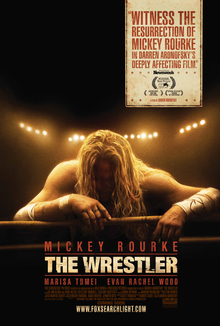
The Wrestler
I’ve previously been slightly agnostic about Darren Aronofsky’s films, finding them a little too insistently art-house. The Fountain in particular reeked of someone trying that bit too hard for effect. But this takes quite a left turn into a low-key, almost documentary style at which (so it turns out) Aronofsky excels.
The film stakes it’s territory on the thin line between narcissism and self-harm. Mickey Rourke demonstrates this by playing the anti-Rocky, the has-been too dumb to stay down, keeping up his lifelong dedication to making the same mistake twice. You see almost everything coming, but the fact he can’t is the hook which makes the experience almost unbearable! (That and the Memorabilia Fair scene, which reminded me of far too many small press events I’ve been to!)
Let The Right One In
For some reason I’m never quite sure of, one of the most vital ingredients of a horror film is a sense of locale. The uncanny needs to be rooted in a place, the merely nebulous is harmless. As it turns out, snow-covered Seventies Stockholm works almost perfectly – at one and the same time drably provincial and compellingly sinister, bland suburbs bordering dark forests. A common horror motif is the portal, the point where the horrific punctures into our consensus reality. But here the whole landscape is that portal.
One admitted weakness of this otherwise excellent film is the ending, which (if inventively executed) brings things back to a more conventional revenge fantasy. But after that disappointing finale the coda felt much more successful, it’s creepy suggestion not hitting you until after you’ve left the cinema.
However the disjunction between the two exposes something illfitting on a more fundamental level. The film repeatedly hints that the vampiric girl is actually the boy’s anger. She turns up just as he vents his rage by stabbing a tree. Later they communicate through tapping a shared wall, like two halves of the same person. ‘Let the right one in’ means ‘let that rage be released’. However, from what little I glean from the source novels (by John Ajvide Lindqvis), she is less a mysterious apparition and more of a realized character with a long backstory. Of course something more direct and symbolic better suits the medium of film. But proceedings here fluctuate between honouring the book’s intentions and going off at it’s own tangent, with the result of having to close with two rival endings.
Yet for all that carping, this was a highly atmospheric highlight of the year. Despite the recent wearying cultural saturation of all things vampiric, two of my favourite films from last year featured them so perhaps there’s... um... blood in the concept yet.

Synecdoche, New York
This is the biggest and boldest example of the genre technically known as “the headfuck film”, at least since David Lynch hit us with Inland Empire three years ago. No less a personage than Roger Erbert has called it the film of the decade! And while I can imagine others reacting quite heavily against this film (or perhaps running away at great speed), surely no-one could deny its brilliance. I’m not sure whether there’s fewer laughs than in Charlie Kaufman’s previous films, or whether they’re just being played slower so they start to sound like screams. (Truth to tell, there is something about the combination of ceaseless formal playfulness and big-issues intensity which is hard to take, like eating chalk and cheese.)
There’s little point in even trying to describe the plot, whose metafictional elements continually radiate out until they take over the film like an ever-more-virulent virus. (As Alan Moore wrote those many years ago: “the backdrops peel and the sets give way, and the cast gets eaten by the play.”) There’s even little point in trying to review it under any pretense of an objective basis, at least after a single viewing. But (for all it’s worth) I took it’s theme to be a critique of the realist genre, or at least the notion that art allows us to remove and isolate elements of life for study and contemplation – like the stage is a microscope. There’s an almost zen message, those who strive the hardest to comprehend life will fail the deepest.

Katalin Varga
As suggested earlier whilst discussing Let The Right One In, films tend to work better when they are filmic. Peter Strickland’s debut is a good case in point. We learn early our heroine has some sort of secret, but (before finally spilling the beans) Strickland intercuts the narrative by giving her quite hallucinogenic perspective scenes. They work like injections of ‘pure cinema’ into a body of literary inheritance, working to a delirious effect. (The trailer below gives some measure of this.) One simple but strangely effective shot of Katalin looking through woodland is particularly memorable. Strickland later commented in The Wire magazine that, had he been unable to secure the rights for the Nurse With Wound track he used, he’d have considered scrapping the whole film!
The jarring ending is perhaps a little more suspect. The film looks about to resolve itself into a more conventional and feelgood conclusion, which happily it avoids. But is the actual ending merely a means to dodge that happening, leaving us with no kind of conclusion at all?

The White Ribbon
Other films here haven’t been treated to a fuller analysis through sheer shortage of typing time. With this latest from Michael Haneke, however, I’m not actually sure I’m up to it! Instead here’s a few near-random remarks...
As with his previous film Cache, he conjures up a dark mystery in the midst of an apparently blameless world – this time a bucolic-looking German village on the cusp of the First World War. And yet again, he deprives the viewer of a tidy or literal denouement. As he has complained himself, “the questions that people are looking for an answer to are the least important part of the film.”
Indeed it’s interesting to read reviews and message boards replicating what the townspeople do in the film, insisting all the wrongs which go on must have a single source – and so keep up the pretence they’re not symptoms of something inherent. Yet the rarely stated but ever-present shadow of war surely insists upon this second reading. The phrase “the world won’t end” is used at least twice, a sure indicator that their world will.
A recurring motif is the contrast between interiors and exteriors. Even in period films it’s rare to see interiors on screen in genuinely pre-electric-light gloominess, mostly we just magically ‘see’. In fact Haneke was so insistent on this that technical reasons forced him to shoot in colour, only later transferring to his intended black and white. The contrast between these and the rolling fields is notable. A parallel image is the contrast between the caged and the wild bird.
On the Film 4 site, Anton Bidel compares this film to Clouzot’s infamously poison-riddled Le Corbeau. But perhaps the differences are more instructive. Le Corbeau is a morality tale, it’s characters just pointers to the point it seeks to make. The characters here are much more realised and (unnoticed by most reviews) far from simple textbook examples of repression. There’s even a love story (hardly a staple of Haneke movies), though conducted by outsiders to the town. At one point, when the Pastor’s pet bird dies, his young son dutifully offers his own. Yet even this image is characteristically double-edged, for this was a wild bird he had previously promised his father he would free once recovered from its injuries.
Postscript: At the preview of The Road, director John Hillcoat predicted the cold financial climate would result in fewer good films for the next eighteen to twenty-four months – that investors would instead play it safe. So, perhaps this is a good time to remind ourselves that overall last year’s crop of movies was such a good one.
Sunday, 10 January 2010
FILMS OF 2009: THE GOLD AWARDS
This just in! I felt myself to be writing too much about my favourite films of 2009 to go into one digestible entry, so at the last minute devised a whole new top category heading – expect the Platinum Awards to get their ceremony shortly. In the meantime you’ll have to make do with second-best, but there’s some pretty good second-best efforts here!
And check out the Silver, the Bronze, and the Tin-plated and Turkey awards already presented.

Moon
The great thing about this film is that it doesn’t just duplicate the look of those great Seventies SF dystopias, but also takes up their bleak form. Typically it juxtaposes the grandiose with the mundane, putting a man on the moon but merely to give him the most boring caretaker job of all time. Such films always looked both grandly utopian and slightly unsettling, like someone’s utopia would always be someone else’s dystopia. (There always seemed the thinnest of lines between, for example, Silent Running and The Parallax View.) And here you just know those pristine whites won’t stay pure-looking for long, the antiseptic will become septic. It’s hard to say more without venturing into plot spoilers...

Fish Tank
Formally speaking, the main development of this film from Andrea Arnold’s previous, Red Road, is that we are given no ‘guide’ character to lead us into the sub-class underworld – we’re just plunged straight in that sink estate.
Indeed, for about the first fifteen minutes, it dedicates itself to displaying the chief character in the darkest possible light – she’s foul-mouthed and fist-ready, the epitome of chavness which the tabloids rail against, already alienated from everyone and everything around her. The cool thing is that, while it goes on to contextualise this character, it never flips or whitewashes her. Rather than allowing us to become her confidant, she remains at one remove. So in one stroke any resemblance to Billy Elliot and such odious ilk is entirely superficial.
But more to the point, this is also why it doesn’t seem accurate for The Guardian’s Peter Bradshaw to call Arnold “Ken Loach's natural successor” – however well-intentioned the compliment. While Loach laments the disappearance of class solidarity, Arnold takes it’s absence almost as a given. She is more lyrical than Loach, more psychological than political. Film Four’s Jon Fortgang puts it better when he says she “suggests an episode of EastEnders' directed by Michelangelo Antonioni.” But she perhaps has most in common with Lynne Ramsey or Pawel Pawlikowski.

Thirst
There is admittedly something slightly list-ticking about the taboo-busting nature of Park Chan-Wook’s vampire love story. And I’m not sure that it’s actually about very much. But it’s so relentlessly inventive, throwing up ten times the ideas you’d find in a regular film, that you can’t help but be swept along by it.
And it sets itself against a recent trend I’ve noticed in vampire lore – where the fanged beasts are either sexy and seductive or revolting and feral. Surely if such a figure is going to be at all interesting, it has to be a paradoxical combination of both. Happily, that’s the case here.
One little detail appealed to me. I could understand how Superman (for example) refrained from flight while posing as a norm. After all, you’re either flying or you’re not. But what about his super-strength? How come he never once absent-mindedly used it against a sticky desk drawer or an overtight jar lid? Here one vampire forgets themself and brings those undead biceps to bear in public, with what could euphemistically be described as ‘consequences.’
A Serious Man
I couldn’t quite bring myself to join in the critical love-fest for the Cohen Brother’s previous offering, No Country For Old Men. Obviously it was a bold departure from their previous work, which had sometimes bordered on flippancy, which did suggest a developing maturity. But I somehow never quite got the film, which left me feeling infuriated as much a beguiled.
A Serious Man feels like a kind of rapprochement between that film and their earlier work, like someone no longer striving to act grown up who is now at peace with their younger years. It has a pleasing either-way quality; it reads perfectly well if you just take it as a simple mid-life-crisis comedy, yet you’re equally able to see in it some kind of parable. Starting with a self-enclosed and self-evident parable from the past, even when it jumps into the main storyline I contend what we are watching is still a kind of meta-parable.
The humour often appears as merry interludes to the story but actually provides an integral element. Typical is the tale told to our troubled protagonist Larry, when he sees his Rabbi for advice. A Jewish dentist is befuddled to find a sign from God in the strangest of places, something which troubles and preoccupies him. But finally he stops worrying about it and simply gets on with his life. This works well as a gag, our hero coming away only with some pointless anecdote when he was in need of capital-A Answers. Yet it is his answer – to stop worrying about life and start living it. Even if God were talking to you, how equipped would you be to listen? Everything else is (as one character puts it) “mere surmise, sir”. Serious man – lighten up!
At the same time, nothing in the film is ever quite so neat or feelgood. From the introductory parable onwards, we are given no easy route to ride through life’s ills unscathed. As CH Dodd said of parables, “the meaning is sufficiently in doubt to tease the mind into active thought.”
The Jewish traditionalist setting not only lends itself to parables, but also offers an appealing kind of holism. It’s not that our protagonist’s maths problems and ethical concerns reflect one another – the suggestion is more that they are actually linked, like Hebrew letters which could double as numbers, different means of expressing essentially the same thing.
Perhaps the film’s biggest weakness is its inattention to its female characters. Of course it’s a perspective story, we don’t see the world as it is but through the lead character’s eyes. But while Larry’s son is granted his own plotlines, his wife and daughter are seen only through the impact they have upon him. Perhaps the most-developed female character in the film is the peasant wife we see only in the beginning. Of course this film is set in the male-dominated Sixties, but even so this seems something of a lapse. The unknowableness of women is a common Cohen shtick that sits ill with their new claims to maturity.
And check out the Silver, the Bronze, and the Tin-plated and Turkey awards already presented.

Moon
The great thing about this film is that it doesn’t just duplicate the look of those great Seventies SF dystopias, but also takes up their bleak form. Typically it juxtaposes the grandiose with the mundane, putting a man on the moon but merely to give him the most boring caretaker job of all time. Such films always looked both grandly utopian and slightly unsettling, like someone’s utopia would always be someone else’s dystopia. (There always seemed the thinnest of lines between, for example, Silent Running and The Parallax View.) And here you just know those pristine whites won’t stay pure-looking for long, the antiseptic will become septic. It’s hard to say more without venturing into plot spoilers...

Fish Tank
Formally speaking, the main development of this film from Andrea Arnold’s previous, Red Road, is that we are given no ‘guide’ character to lead us into the sub-class underworld – we’re just plunged straight in that sink estate.
Indeed, for about the first fifteen minutes, it dedicates itself to displaying the chief character in the darkest possible light – she’s foul-mouthed and fist-ready, the epitome of chavness which the tabloids rail against, already alienated from everyone and everything around her. The cool thing is that, while it goes on to contextualise this character, it never flips or whitewashes her. Rather than allowing us to become her confidant, she remains at one remove. So in one stroke any resemblance to Billy Elliot and such odious ilk is entirely superficial.
But more to the point, this is also why it doesn’t seem accurate for The Guardian’s Peter Bradshaw to call Arnold “Ken Loach's natural successor” – however well-intentioned the compliment. While Loach laments the disappearance of class solidarity, Arnold takes it’s absence almost as a given. She is more lyrical than Loach, more psychological than political. Film Four’s Jon Fortgang puts it better when he says she “suggests an episode of EastEnders' directed by Michelangelo Antonioni.” But she perhaps has most in common with Lynne Ramsey or Pawel Pawlikowski.

Thirst
There is admittedly something slightly list-ticking about the taboo-busting nature of Park Chan-Wook’s vampire love story. And I’m not sure that it’s actually about very much. But it’s so relentlessly inventive, throwing up ten times the ideas you’d find in a regular film, that you can’t help but be swept along by it.
And it sets itself against a recent trend I’ve noticed in vampire lore – where the fanged beasts are either sexy and seductive or revolting and feral. Surely if such a figure is going to be at all interesting, it has to be a paradoxical combination of both. Happily, that’s the case here.
One little detail appealed to me. I could understand how Superman (for example) refrained from flight while posing as a norm. After all, you’re either flying or you’re not. But what about his super-strength? How come he never once absent-mindedly used it against a sticky desk drawer or an overtight jar lid? Here one vampire forgets themself and brings those undead biceps to bear in public, with what could euphemistically be described as ‘consequences.’
A Serious Man
I couldn’t quite bring myself to join in the critical love-fest for the Cohen Brother’s previous offering, No Country For Old Men. Obviously it was a bold departure from their previous work, which had sometimes bordered on flippancy, which did suggest a developing maturity. But I somehow never quite got the film, which left me feeling infuriated as much a beguiled.
A Serious Man feels like a kind of rapprochement between that film and their earlier work, like someone no longer striving to act grown up who is now at peace with their younger years. It has a pleasing either-way quality; it reads perfectly well if you just take it as a simple mid-life-crisis comedy, yet you’re equally able to see in it some kind of parable. Starting with a self-enclosed and self-evident parable from the past, even when it jumps into the main storyline I contend what we are watching is still a kind of meta-parable.
The humour often appears as merry interludes to the story but actually provides an integral element. Typical is the tale told to our troubled protagonist Larry, when he sees his Rabbi for advice. A Jewish dentist is befuddled to find a sign from God in the strangest of places, something which troubles and preoccupies him. But finally he stops worrying about it and simply gets on with his life. This works well as a gag, our hero coming away only with some pointless anecdote when he was in need of capital-A Answers. Yet it is his answer – to stop worrying about life and start living it. Even if God were talking to you, how equipped would you be to listen? Everything else is (as one character puts it) “mere surmise, sir”. Serious man – lighten up!
At the same time, nothing in the film is ever quite so neat or feelgood. From the introductory parable onwards, we are given no easy route to ride through life’s ills unscathed. As CH Dodd said of parables, “the meaning is sufficiently in doubt to tease the mind into active thought.”
The Jewish traditionalist setting not only lends itself to parables, but also offers an appealing kind of holism. It’s not that our protagonist’s maths problems and ethical concerns reflect one another – the suggestion is more that they are actually linked, like Hebrew letters which could double as numbers, different means of expressing essentially the same thing.
Perhaps the film’s biggest weakness is its inattention to its female characters. Of course it’s a perspective story, we don’t see the world as it is but through the lead character’s eyes. But while Larry’s son is granted his own plotlines, his wife and daughter are seen only through the impact they have upon him. Perhaps the most-developed female character in the film is the peasant wife we see only in the beginning. Of course this film is set in the male-dominated Sixties, but even so this seems something of a lapse. The unknowableness of women is a common Cohen shtick that sits ill with their new claims to maturity.
Thursday, 7 January 2010
FILMS 0F 2009: THE SILVER AWARDS
See here for the Bronze awards.
Gold awards coming soon!

Milk
The only criticism I’d make of Gus Van Sant’s quite splendid biopic of gay rights activist Harvey Milk is that it succumbs to the standard movie depiction of crowds. Cinema crowds are always painted as less than the sum of their parts, a Freudian regression into brute instincts who require leadership and direction from a few great men. It’s like they’re wary of the assembled audience ever discovering it’s collective identity, looking to each other rather than that shiny screen.
Though there’s little in modern research to give credence to this view, it seems our society is so dependent upon it that it must be maintained at all costs. Admittedly other films play up this cliché to a far worse degree than here, but it’s disappointing to see it in a film that is otherwise so socially progressive.
Watchmen
Yep, the comics adaptation we know-all fans said should never be! Maybe it’s a good job no-one listens to us after all. (My full review here.)

District 9
To me the genius of this South African SF black comedy didn’t lie in the ‘alien apartheid’ theme everyone else has commented on, but in making such a geek the hero. Though the character is reasonably well played by Sharlto Copley, what makes it is the jarring context he’s put in. We watch him travel from petty bureaucrat, a semi- tolerated imposition upon his colleagues, to despised pariah and finally... well okay, no plot spoilers! Socially speaking, he is the alien.
Tales From the Golden Age
Romanian director Cristian Mungiu comes up with quite a change of pace from his earlier bleak docu-drama 4 Months, 3 Weeks and 2 Days This is a blackly comic portmanteau of urban myths told during the days of the Ceausescu's dictatorship, all seeking to highlight it’s absurdity with laughter. The absurdity of the final image of the first tale will stay with you for a while, and perhaps even remind you of Even Dwarfs Started Small. Interestingly, some tales also seem to retain a folkish undercurrent, with their insistence on the fall of those who fail to follow the rules.

Up
Pixar pull it off again! If not quite the absolute best of their films, this may well be the maddest - crammed full of crazy images and sequences. True, you can see references in it. The take-off scene, with its combination of the adventurous with the cosily domestic, recalls the suburban moonshot of the first Wallace and Gromit. There must also be an influence from the famous early Keaton, where he takes the concept ‘moving house’ so literally. And the bird which everyone is hunting is surely Road Runner.
But, in what’s probably the key to Pixar’s success, the whole film started with a personal daydream - Director Pete Docter would imagine that he could somehow upend and fly off anytime other people got annoying. As he comments:
“One of the things that's really important to me in everything that I've worked on is finding some relatable thing that the audience can identify with, ... that they understand is true for them in their own life.”
This leaves even such a madcap adventure feeling – if you’ll forgive the phrase – grounded.
The Inferno of Henri-Georges Clouzot
Truth can be stranger than fiction even when it’s about fiction. This documentary focuses on acclaimed director Clouzot (“the French Hitchock’s”) attempt to make his mid-Sixties masterpiece - Inferno.
Of course it all goes terribly wrong. As the title here hints, the study of a man on the brink came more and more to be made by a man on the brink. Given an unlimited budget but a strict timescale, Clouzot obsessively re-shot a small number of scenes over and over while fixating over technical tests, until struck by a heart attack which scuppered filming. Watching both the reconstructed story and surviving footage, you feel strangely torn. You ache to see the finished film while being aware that in one way it all went terribly right - the story simply feels so much more appropriate played out as a grand folly.
Despite their dry description, the technical tests are actually one of the most interesting aspects. Clouzot wanted to portray psychological states on the screen by playing with colour and form. It’s reminiscent of the way psychedelic music of the era would use the studio as an instrument rather than a recording device, treating and reshaping the sound it captured, though in this Clouzot was ahead of the curve – filming happened in 1964.
(Shown as part of Brighton’s Cine-City programme.)

Paranormal Activity
PLOT SPOILERS! (For this review only)
Sound-bite description: imagine the creepy attic noises from The Exorcist given their own spin-off movie.
Despite the generic title, and the suggestion that this ‘faux-found-footage’ horror could just be another Blair Witch Project knock-off, this film succeeded quite remarkably. For one thing, the swapping of Blair Witch‘s woodland setting for suburban house sounds counter-intuitive but works well. It relies on the paradoxical estrangement of suburbia; though surrounded by other houses, the central couple might as well be in the middle of nowhere.
But there’s a bigger difference. Blair Witch was ultimately about age, about adults being reduced to children, fearful of the dark. Their totems of adulthood, their camcorders and maps, their ‘project’, help them not at all. This film, with its demon-haunted woman, is much more about the gender divide.
It’s even mildly reminiscent of Charlotte Perkin’s Gilman’s classic early feminist short story, The Yellow Wallpaper. We’re told that the girlfriend is studying to become an English teacher, leaving the implication that it’s the boyfriend who is paying for their expensive home and it’s many mod cons. (Though there’s only one passing reference to him trading.) The paranormal scenes terrify her, but drive him to ‘take control of the situation’.
His gormlessly literalist disregard for the demon’s disembodied status becomes almost a black joke. He lays talc on the floor to capture its footprints, like it’s a stray mouse. It responds by leaving impossible prints, which stop tauntingly in mid-stride. It’s surely no accident that his interventions provoke the demon as much as they annoy her. The demon is surely her subconscious rejection of him and his domineering tendencies. (Though interestingly this interpretation relies heavily upon the ending we have now, which was only suggested post-hoc by Steven Spielberg.)
Gold awards coming soon!
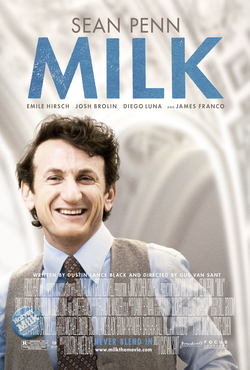
Milk
The only criticism I’d make of Gus Van Sant’s quite splendid biopic of gay rights activist Harvey Milk is that it succumbs to the standard movie depiction of crowds. Cinema crowds are always painted as less than the sum of their parts, a Freudian regression into brute instincts who require leadership and direction from a few great men. It’s like they’re wary of the assembled audience ever discovering it’s collective identity, looking to each other rather than that shiny screen.
Though there’s little in modern research to give credence to this view, it seems our society is so dependent upon it that it must be maintained at all costs. Admittedly other films play up this cliché to a far worse degree than here, but it’s disappointing to see it in a film that is otherwise so socially progressive.
Watchmen
Yep, the comics adaptation we know-all fans said should never be! Maybe it’s a good job no-one listens to us after all. (My full review here.)

District 9
To me the genius of this South African SF black comedy didn’t lie in the ‘alien apartheid’ theme everyone else has commented on, but in making such a geek the hero. Though the character is reasonably well played by Sharlto Copley, what makes it is the jarring context he’s put in. We watch him travel from petty bureaucrat, a semi- tolerated imposition upon his colleagues, to despised pariah and finally... well okay, no plot spoilers! Socially speaking, he is the alien.
Tales From the Golden Age
Romanian director Cristian Mungiu comes up with quite a change of pace from his earlier bleak docu-drama 4 Months, 3 Weeks and 2 Days This is a blackly comic portmanteau of urban myths told during the days of the Ceausescu's dictatorship, all seeking to highlight it’s absurdity with laughter. The absurdity of the final image of the first tale will stay with you for a while, and perhaps even remind you of Even Dwarfs Started Small. Interestingly, some tales also seem to retain a folkish undercurrent, with their insistence on the fall of those who fail to follow the rules.

Up
Pixar pull it off again! If not quite the absolute best of their films, this may well be the maddest - crammed full of crazy images and sequences. True, you can see references in it. The take-off scene, with its combination of the adventurous with the cosily domestic, recalls the suburban moonshot of the first Wallace and Gromit. There must also be an influence from the famous early Keaton, where he takes the concept ‘moving house’ so literally. And the bird which everyone is hunting is surely Road Runner.
But, in what’s probably the key to Pixar’s success, the whole film started with a personal daydream - Director Pete Docter would imagine that he could somehow upend and fly off anytime other people got annoying. As he comments:
“One of the things that's really important to me in everything that I've worked on is finding some relatable thing that the audience can identify with, ... that they understand is true for them in their own life.”
This leaves even such a madcap adventure feeling – if you’ll forgive the phrase – grounded.
The Inferno of Henri-Georges Clouzot
Truth can be stranger than fiction even when it’s about fiction. This documentary focuses on acclaimed director Clouzot (“the French Hitchock’s”) attempt to make his mid-Sixties masterpiece - Inferno.
Of course it all goes terribly wrong. As the title here hints, the study of a man on the brink came more and more to be made by a man on the brink. Given an unlimited budget but a strict timescale, Clouzot obsessively re-shot a small number of scenes over and over while fixating over technical tests, until struck by a heart attack which scuppered filming. Watching both the reconstructed story and surviving footage, you feel strangely torn. You ache to see the finished film while being aware that in one way it all went terribly right - the story simply feels so much more appropriate played out as a grand folly.
Despite their dry description, the technical tests are actually one of the most interesting aspects. Clouzot wanted to portray psychological states on the screen by playing with colour and form. It’s reminiscent of the way psychedelic music of the era would use the studio as an instrument rather than a recording device, treating and reshaping the sound it captured, though in this Clouzot was ahead of the curve – filming happened in 1964.
(Shown as part of Brighton’s Cine-City programme.)
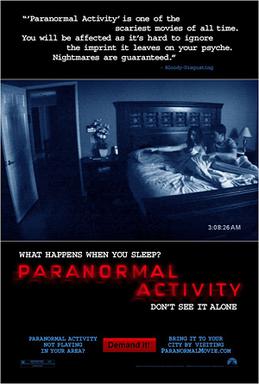
Paranormal Activity
PLOT SPOILERS! (For this review only)
Sound-bite description: imagine the creepy attic noises from The Exorcist given their own spin-off movie.
Despite the generic title, and the suggestion that this ‘faux-found-footage’ horror could just be another Blair Witch Project knock-off, this film succeeded quite remarkably. For one thing, the swapping of Blair Witch‘s woodland setting for suburban house sounds counter-intuitive but works well. It relies on the paradoxical estrangement of suburbia; though surrounded by other houses, the central couple might as well be in the middle of nowhere.
But there’s a bigger difference. Blair Witch was ultimately about age, about adults being reduced to children, fearful of the dark. Their totems of adulthood, their camcorders and maps, their ‘project’, help them not at all. This film, with its demon-haunted woman, is much more about the gender divide.
It’s even mildly reminiscent of Charlotte Perkin’s Gilman’s classic early feminist short story, The Yellow Wallpaper. We’re told that the girlfriend is studying to become an English teacher, leaving the implication that it’s the boyfriend who is paying for their expensive home and it’s many mod cons. (Though there’s only one passing reference to him trading.) The paranormal scenes terrify her, but drive him to ‘take control of the situation’.
His gormlessly literalist disregard for the demon’s disembodied status becomes almost a black joke. He lays talc on the floor to capture its footprints, like it’s a stray mouse. It responds by leaving impossible prints, which stop tauntingly in mid-stride. It’s surely no accident that his interventions provoke the demon as much as they annoy her. The demon is surely her subconscious rejection of him and his domineering tendencies. (Though interestingly this interpretation relies heavily upon the ending we have now, which was only suggested post-hoc by Steven Spielberg.)
Subscribe to:
Posts (Atom)