googlee7ea825f63edb3f6.html

Saturday, 25 February 2023

ZOVIET FRANCE (GIG-GOING ADVENTURES)

Cafe Oto, London
Tues 21st Feb


The first time… the only other time I saw Zoviet France was way back in the Nineties. At one of those DIY arts events that happened more frequently before that much-feared dystopian future became our present. Not in a ‘proper’ venue, without stage or bar, we sat on the floor sipping from mugs of tea as the music wafted round us. Which was the perfect way to hear this legendary and possibly semi-mythical ambient duo, who I always like to think are named after an imaginary country. (Do I lie about semi-mythical? That ‘publicity’ photo of them ain’t exactly giving much away.) I was even apprehensive about seeing them again, fearing it couldn’t be the same… 

Then again, Cafe Oto isn’t a bad venue either.

They’d be another example of ‘the changing same’ in music. Dynamics are mostly eschewed. There are breaks and changes at times, true, but mostly there’s a slowly ever-morphing quality, where everything turns into something else before too long. The one time there was something like repetitive beats, their forward momentum was balanced out by a slow harmonica drag, played live and as if it were a drone instrument.

We tend to think of music, more than other arts, as a direct way to express an emotion. But a set such as this makes you realise how ill-suited regular music is to this task. Even a pop song has verses, choruses, bridges… too structured to capture the flow of thought, it works more like a speech or an essay. Whereas this, I contend, is the true music of the heart.

And so, of course, the thing which makes it appealing also makes it challenging to write about. It can be like trying to remember dreams, the act in itself pushes away the spirit that had once been there. But in my foolishness, I try to keep up this blog, and so…

They’re often tagged as dark ambient, even appearing on the Wikipedia page devoted to that genre. But if they came from the same post-industrial scene as Lustmord, they don’t really sound much like him. The nearest common descriptor for the sounds they produce would be analogue or organic, despite the abundance of shiny things on stage. In fact, the set starts with something sounding like vinyl crackle. Nothing even sounds sampled, referenced or ‘quoted’, even though it surely has to be. It’s not a melange of ingredients, it feels cut from whole cloth.

The mood’s serene, in fact I’d go as far as hymnal. (If that word could be shorn of its religious associations.) There’s the same mixture of quiet calmness with ecstatic states. It’s like one of those old Chinese paintings which depict an inherently ordered cosmos, in balance with itself.

The duo seemed to go quiet in recent years. (Though that’s a relative term in their case.) But there’s signs they’ve become more active again of late, and we can only hope so. No footage from this gig I could find, but this from supporting Autechre back in the Autumn… (Not as good a set, but still worth your time.)


Saturday, 18 February 2023

‘MAKING MODERNISM’

Royal Academy, London


“She was an exceptionally strong, spirited personality, full of revolutionary spirit against all things timid and lukewarm.”

Visual Soliloquies

…that was said of Marianne Werefkin. (And said by Elizabeth Erdmann, should you like to know that sort of thing.) But you could apply it as easily to any of the three other artists featured here - Paula Modersohn-Becker, Kathe Kollwitz, and Gabriele Munter. All come from the classic era of Modernism, the early twentieth century. All lie somewhere in the interchange between Fauvism and Expressionism. All were, more or less, German. (Werefkin was Russian by birth, but lived in Germany and Switzerland for much of her life.) And, as you may have already guessed, all were women. Co-curator Sarah Lea has said the show “celebrates women artists on their own terms.” (See viclip, linked at end)

We kick off with photos of these four, then a room devoted to their portraits and self-portraits, a genre defined by Kollwitz as a “visual form of soliloquy”. And as said many times before, all portraits are a displaced form of self-portrait. But let’s narrow that field for now by looking at either self-portraits or portraits of other women. Of which there’s plenty. (Though at a time when there were all sorts of barriers to women being artists, part of the motivation may simply have been using what was to hand.)

Unusually, the poster image is the first thing we see, Munter’s ’Portrait of Anna Roslund’ (1917, up top). Equally unusually most versions of the poster give us the whole image. But the ones that don’t noticeably focus in on that pipe-smoking face, as a kind of icon of female empowerment. (Which makes the slightly generic show title a bit odd. Perhaps the Academy used up their good name back in ’99, when they staged ’Amazons Of the Avant Garde’.)

But, as Magritte might have said, ceci ne’st pas qu’un pipe. The main things about the pose is that there isn’t one. She sits casually, framed off-centre, and looks off as if more interested in her own thoughts than acknowledging us. Only the red bob looks particularly ‘feminine’. There’s a quiet air of self-assuredness to it, and we’re not surprised to discover Roslund was an author and musician.


Women as subjects rather than decoration, the easiest means to achieve this might seem androgyny. Which is what Modersohn-Becker uses in ’Portrait of a Woman in Black With Handkerchief’ (1906, above). But such works perhaps blur concepts in place of overcoming them. And it turns out there are smarter ways…


In her earlier ’Self-Portrait In Front Of Window’ (1900, above) she’s not trying to look ‘masculine’, she even sports a white bow. But the elements which hit you are the calmly meeting gaze and upraised chin. Symmetry is often held to bestow power in art, and here she uses to it convey an ordered, directed mind. She’s not there to look demure or appealing, but to announce her presence.


Let’s return to Modersohn-Becker a moment, with ’The Sculptor Clara Rilke-Westhoff’ (1905, above). The interesting element isn’t the composition so much as something which will convey less well via internet thumbnail, the painting style. She makes her subject look solid, present and … well, sculpted. As if, were you to touch it, it would have physical shape.


Then compare that to something she show smartly hung next to it. ’The Dancer Alexander Scharoff’ by Werefkin (1909, above). It’s not just the femme fatale expression, impish and inscrutable. The figure looks lithe and fluid, but with it she becomes slightly insubstantial. An effect enhanced by the background being the same shade of blue. As if women were things of spirit.


Then compare her to a portrait of Werefkin. To be precise, ’Portrait of Marianne Werefkin’ (c. 1910). (Not by one of our Fab Four but Erma Bossi.) Werefkin’s looking less alluring, but there’s the same swish sweep of clothing dominating the frame, the same pose that looks like a pose, with the head turned to profile. These are, I don’t deny, good paintings. They shouldn’t be ‘cancelled’, or whatever hysterical term the GB News clowns are using this week. It’s just that this is a more traditional way of representing women, while Modernism should be modern.

Women & Children First

The show makes much of this era deciding the child has an inner life, and isn’t just clay to be set in the correct mould. Didn’t the Romantics already do that? Well, sometimes things need to get discovered over again.


Werefkin’s ’Portrait of a Girl’ (1913, above) works quite differently to the portraits we’ve encountered so far. The radiant colours (painted in tempura, a favourite of hers), set in combination with the closed eyes make for a figure that’s quite present (for example, pushed forward in the frame) yet at the same time feels removed and inscrutable. She looks sensual and devotional, at the very same time.

Werefkin was in her Fifties at this point and age was supposed to hit you harder and faster in those days, so perhaps the beautific inscrutability of youth seen from the perspective of age is the point. The theory that all portraits are self-portraits seems to be scuppered here. There definitely seems something pre-Roaring Twenties about it. (Or alternately, I’m in my Fifties too so this may well just be me talking.)


Perhaps we shouldn’t make too much of Munter’s ’Portrait Of A Boy’ (1908/09, above) having so similar a title. Besides, her ‘boy’ looks more a child age. The rough way he’s painted rubs off on him, so the work looks immediate and he dishevelled. He looks at the same time defiant and vulnerable, caught on the canvas like an animal in a trap.

There are also naked portraits of children.

Uh-oh.

With the blunderbuss approach to censorship taken by our Google overlords, I’ve take to cautiously linking to paintings of nudes rather than thumbnailing them. This time I may well have done that anyway. Modersohn-Becker’s ’Seated Nude Girl, Her Legs Pulled Up’ (c. 1904) comes quite accurately self-described. And granted, we all know the defensive postures which children take on.

’Beta Naked’ (c. 1900) is by another artist outside the big four, Ottilie Reylaender. With the girl’s skin so pale and wan, she’s hard both to look at and away from. While her defiant return of our gaze only amplifies that awkwardness.

It’s curious that one title uses ‘nude’, an art genre which often has sexual connotations, and ‘naked’, a more general term just meaning undressed. (Though of course they’re coming to us through translation.) Particularly when they seem so similar. One says “go away”, the other “what are you looking at?”, but that’s not a vast difference.

The indicia tells us Modersohn-Becker had to bribe this girl a mark to pose naked, after which “I blushed inwardly and hated myself.” There’s little doubt that’s the goal here, to paint that discomfort. But that only raises the question - why paint the discomfort? It’s tempting to glibly respond that you don’t intend bribing young girls to get naked, so you don’t really need telling what it feels like.

Yes, it’s possible these works had more traction in their day, where there was far less concern over child protection. But that would scupper the show’s thesis, that this was the time which first saw children as people. Yet interestingly, other works by Modersohn-Becker do suggest precisely this, depicting small children life-size but captured by tiny frames, which keep them as the focus.

Four Artists Means Four Styles 

Women artists from this time were often kept in an obscurity they didn’t deserve. And rescuing them from that, even this belatedly, seems the right thing to do. But while the show acknowledges “each developed a distinctive style,” it does at times feel over-keen to present them as a group. When in actuality they didn’t all even know one another. Yes, they may all be Expressionist to some degree or another. But we should probably look at movements in Modernism as murmurations, rather than schools. And besides, really, what do you call a woman artist? You call her an artist, right? So let’s look at them more individually here.

It’s always tempting to see Modernism as a fascinating failure, which set itself the somewhat monumental task of transforming the way we look at art, which we study in order that we can fail better. The Russian revolution of aesthetics. But if you look at its artists on their own admittedly narrower terms, of whether they made the art they wanted to make, and very often it’s a great success.


Modersohn-Becker’s ’Still Life With Goldfish Bowl’ (1906, above), it hardly has the most enticing title. But the work itself is quietly rhapsodic! There’s a slightly naive quality to the depictions, particularly over those goldfish, which make it engaging. But mostly, it just is engaging. It has me half-convinced I’ve never seen a still life before, in fact it has me semi-convinced I’ve never even seen orange before. 

Modernism’s greatest challenge had been to escape the dead weight of art history, to see things again as if they were fresh and new. And here it’s like Modersohn-Becker doesn’t even see the obstacles to overcome, she just goes ahead and does it with no need of methods or manifestos. How did she manage such a feat?


A clue may lie in a work of hers from the previous year, ’Boy In the Snow’ (c. 1905, above). Much of its achievement may lie in placing the boy figure in the foreground, yet turning him so he looks at the same scene as us. It’s like we see through his eyes, take on his perspective of all this fresh snow.

We’re told Munter collected child art. And Modersohn-Becker, as we’ve seen, painted children frequently. My guess would be that she took similar inspiration from their art. Which was not imbued with any sense of exotica strange otherness to get sidetracked by. This was art made by Westerners, who had not yet been warped by the Western tradition because they’d not had time to learn it. No-one had ever needed to go to the South Seas in the first place.


Munter may be the least significant artist of the four, simply because she’s the least individual, the most representative of a style. For example ’Interior In Murnau’ (1910, above) is clearly indebted to Van Gogh’s interiors. A debt she wasn’t shy of acknowledging, she called a place she lived in the Yellow House, after his often-painted lodgings in Arles.

But on the other hand, this is a Van Gogh by someone who at least gets Van Gogh. The vibrant colours and expanded perspective serve to make an empty room (bar one distant figure) pulse with life. Her composition cleverly not only places the rag rug along the length of the room, it aligns it with the discarded shoes at one end and sideboard at the other, then crosses it against the floorboards. What could seem mere empty space instead pulls at the eye.


’Man In an Armchair’ (1913, above), as the show points out, aligns the man’s head with the table, and so compares it to the geometric objects of her folk art collection. It’s a witty demonstration of her style, built into one of her works. Notably, it’s achieved by flattening so many other objects, including the man’s torso and legs. The door is so straight there’s effectively an even line running right across the lower part of the painting. Only the two chairs have dimension. (The “man”, incidentally, is thought to be Paul Klee.)


As suggested over ’Portrait Of a Girl’, Werefkin’s vibrant tempuras make her art a distinctive from Modersohn-Becker and Munter. And if that was a splendid work, ’The Contrasts’ ( 1919, above), painted after moving to Switzerland, is possibly better still. Since Romanticism we’ve assumed depictions of mountains call out for the solidity of oil paint. Yet here the tempura makes them look shimmering and otherworldly, as vertiginously distant as clouds. (And, as anyone who’s been to the Alps knows, there’s times of day when they do glow like that.)

Moreover, they’re otherworldly enough that the humans below, bent over their daily tasks, are oblivious to them. Humans who are notably depicted more solidly. Only the statue atop the water fountain peeps from one realm to the other, enhancing the distinction.


Alas she goes on to repeat these contrasts with increasingly laboured emphasis, and decreasing effect. In ’Life Behind Them’ (1928, above) the humans are shown, ostensibly on some viewing bench, but obstinately fixing their eyes against those peaks. Their folded arms suggest this is a deliberate snub, as if they’ve fallen out with them. The title may be too on the nose, but then us visitors to such areas do often find the locals taking for granted what we gawp at.


Then with ’Eternal Path’ (1929, above) everything is pushed more into a symbolic realm. It virtually begs to be read metaphorically. The small figures at the base must climb the frame, to reach that white tower, but how? It’s almost the layout of a puzzle game. Which only takes you away from those vertiginous descending lines, and ultimately from the painting itself. Werefkin, you never needed to spell out what you were painting. You just needed to paint it.

Sorrow Not Confined

An alert reader like yourself, you’ve doubtless have noticed I’ve said nothing about Kollwitz as yet. That’s because, however different Werefkin is to the others, it’s Kollwitz who really seems at a remove. She was the only artist I’d heard of when the show was announced, and may have been included as the ‘name’. (Though notably she didn’t bag the poster.) For one thing she abandoned painting early, for the more reproducible print-making. But it’s the reason she did this which marks her out. Her art was politically motivated, and she found prints more disseminable. And all her works here are of human figures, rather than environments.


Because of this, she has a reputation for dourness. Which isn’t always the case. The charcoal drawing ’Lovers Nesting Against Each Other’ (1909/10, above) is warm and tender, created not by the composition but those sinuous lines. You feel less you’re looking at this embrace than it’s incorporating you.


…whereas the charcoal drawing ’Love Scene 1’ (1909/10)… well that’s a sex scene, okay, but as they grasp one another like wrestlers the title really questions whether it could be called ‘love-making’. It’s more like each person is convinced the other has something which they need to get at. It’s twisted and grotesque.


…and the etching ’Death And Woman’ (1910) demands to be read symbolically, if not existentially. Giving birth was then much more fraught with danger, Modersohn-Becker essentially died from it. And the female figure is grasped between the skeleton figure of death and the demanding child, less torn between them as brought down by a tag team.

There’s two tensions to her work. She saw Expressionism as “the expression of profound emotion through portrayals of the human body”. But its a style which often takes the body as a seismograph to display emotional states, contorting it past the limits of possibility. Expressionists are interested in how things look only insofar as that’s a signifier of how they feel. Yet she also took a strong interest in the actual human body, in anatomy. We’re told she was highly influenced by Michelangelo. And these are diverging roads. Ultimately, you have to pick one.

Also, her work is pitched between an expose of social misery, an inevitable result of a class system which should be done away with, and something more existential, concerned with the inevitabilities of birth and death. And this is a tension which is more creative. As she said “sorrow isn’t confined to social misery. All my work hides within it life itself.”

The big London galleries can sometimes feel like those ‘classic rock’ radio stations, which just play the established hits on rotation. Attempts to widen the field a bit further should be welcomed, and this show demonstrates well enough there’s more talent out there. (And raises the question of how many times you could do this before you ran out of artists worth discovering. Some while, I would guess.)

But the necessary price for that is this ‘bundle’ kind of a show, as if several lesser-known names add up to match one big one, copper put together to equal silver. And when a three-room exhibition is devoted to four artists, it inevitably ends up as a kind of appetite-whetter. Whereas in all likelihood, for at least three of these artists, this won’t be the start of a rediscovery but their belated moment in the limelight. I’d tell you what the solution to all this was if I knew it.

Saturday, 11 February 2023

THE RESIDENTS/ FERN MADDIE/ JOHN CALE (GIG-GOING ADVENTURES)

Apologies for the lack of a post last week. I was brought down by the left-wing economic establishment. Oh alright then, it was flu...

THE RESIDENTS
Union Chapel, London
Tues 31st Jan


I originally saw the Residents on their fortieth anniversary, and it seems now here we are at their fiftieth. I’m not sure how that happened, but seems it has. Their pronouns are…

”Alternately seen as a rock band, an arts collective, and a spirit, THE RESIDENTS have been regarded as icons in the world of experimental music for almost fifty years… the group has also been credited with being among the originators of performance art and music video.”

And I’ve asked before whether they really were a band, or a multi-media arts collective who found it easiest to masquerade as a band, just one of their many masks.

Well never to be pinned down, tonight a band is just what they are.There’s an accompanying film show, but bar that they work dilligently through a set. Even hearing tracks timed in by the drums seems curiously ‘regular gig’ for them.

As ever, their vibe is still sinister clown, one lyric espousing their credo: “everyone comes to the freak show/ But nobody laughs when they go”. Which works with the ever-present masks and costumes they sport. Something taken (as it always is) to be about anonymity. But like it always is in actuality, it allows them to take on other characters. This succession of deranged personas aren’t exactly satire, in the way someone like Zappa stuck it to Western consumerism and the like. (Even if both had Beatles-based album sleeves.) The Residents are more like weaponised parody, turning the form of popular music against itself.


Take ’Kill Him!’, which might ostensibly seem another example of the singer impersonating born-again preachers in order to undermine them. But what powers the track is an underlying ambiguity; is this God recast as devilish tempter, or some psycho using The Old Fellah as an alibi for his murderous actions? (“Blood is thick but/ God is thicker/ I am sick but/ He is sicker/ God says, Die!/ So I must kill him, but/ Why does God want/ To kill children?”)

And the extremity and ambiguity seem to marinate together, into something more unsettling. (I confess I was slightly disappointed afterwards to discover it was on an album of Bible-based songs, which seems to give too much away.)

And their musical style is still like Kurt Weill was leading a drunken carnival parade. But the gigness of this gig (if you follow) makes you aware how many of these numbers might once have been tuneful ditties, before being thrown into their hall of distorted mirrors. (Though there’s not one of their patented twisted cover versions.) You need to be good at music to be this good at anti-music.

Something like Anarcho-Punk always felt to me like making deliberately bad music in the hope it would undermine the good, when it actually just made the good music sound better. Whereas the Residents make good music gone bad, a very different order of things. What can seem like regular and quite innocuous features of songs, such as repetition, transform into something menacing. I fear ’Constantinople’ will now always be one of those anxiety-inducing ‘trigger words’ in my mind.

…all of which means there’s a disruptive, culture jamming feeling, a sense of interrupting regular programming. And, as said after their Brighton show, a whole set of that can have diminishing returns, a sense of sucking on too many sour things at once. Perhaps accentuated by this night being just about their songs, without the film show breaks.

I’m not quite sure what the best way to hear them is. I listened to ’Duck Stab’ afterwards, which was all over the set list. And it sounds more varied, more inventive on record but more intense live. You pays yer money…

The Fab Four saying ’Constantinople’ (quite a lot)….


FERN MADDIE
The Foghorn, Portslade
Mon 6th Feb


Someone standing up and signing from the corner of a craft beer bar, which is about the size of a bedsit, there could hardly be any more of a classic folk gig setting. Okay, it should be a pub serving real ale by pulling at brass handles. Even folk has to make some concession to the times.

Except I’m only here because of That Thar Interweb, when the Guardian named Fern Maddie's self-released debut one of the ten best folk albums of last year. It turns out, so did the promoter. Who stepped in for a last minute save, after a mooted Brighton gig fell through.

She sings a combination of self-penned songs and traditionals. A New Englander, she may be well placed to drawn on both the British and American songbooks. But as she sings each the British songs sound British and the American American, they’re not at all blended. Which is handily visualised by her switching between banjo and guitar. (Though one isn’t used exclusively for either.)

She talks of being attracted to the cyclic, ritualised form of those old ballads. And folk is perhaps the blank verse of music. But when she performs them she tends to throw in extra sections. Not so major you’d necessarily even notice where these rock songs, but a bigger deal with folk. Which is probably the point, occasionally breaking from the circle both has it’s own effect and draws attention back to the circle. And I can’t help but associate both those things with her singing style. Which is dramatic without ever tipping over into the melodramatic, using less to go further.

Her own songs match all that, walking the dark side of the street. Maidens are a-drownin’ part-way into the first number, while another’s about a Mayflower passenger who died before even sighting land. (Who also drowns, though other forms of demise are available.) She often alludes to the fantastical without ever saying such a thing outright.

’Hares On the Mountain’, which may well be becoming her signature song, is built round a series of metaphors, but when sung somehow feel more than that, as if singing it might make it all happen. Her album’s titled ’Ghost Story’, though as she points out it contains no actual ghost stories.

The gig’s only downside was the odd structure it was given, stopping for a Q&A not once but twice, which worked against the spells being woven. Added to which the interviewee seemed an almost entirely different character to the singer, as if Maddie’s not yet used to this attention. There was also the lack of CDs for sale, perhaps all snapped up earlier in the tour. (Self-released means hard to get hold of over here.)

Those darn folkies look to have been too laid back to film anything from her UK tour. So instead, this is the video for ’Hares On the Mountain’…


JOHN CALE

De la Warr Pavilion, Bexhill-on-Sea
Fri 10th Feb


Between buying my ticket and this multi-delayed gig taking place, I gave a listen to Cale’s latest release, ’Mercy’. Only a cursory listen so far. But from it his post-millennium purple patch, well represented by his last visit to this venue, seemed over.

When the gig proved full of songs I didn’t recognise, I assumed it to be dedicated to that album. It seems there were older tracks, if chosen with characteristic eccentricity, but ’Mercy’ still dominated. Which meant I didn’t take to this gig as much as the last one. Though my problems with the gig weren’t the same as with the album…

The album’s main drawback are the smoothed-out electronic beats, which seem a characterless but constant presence across the tracks, like a plastic tablecloth stretched across a cafe. Whereas with the gig, it’s a live band with a live-band sound.

Multiple times, a song would initially seem skippable, only for some mysterious reason start to work mid-way. But others… well, others just seemed skippable. At times, almost MOR-ish. They also seemed to go in for long durations, a curious combination.

The old songs? Classic number ’The Endless Plain of Fortune’ was essentially the words to an entirely new backing. Then equally classic ’Chinese Envoy’ was played pretty much straight, but alas wasn’t a great version.

Late on he switched from keyboards to guitar, rousing a cheer. This proved to be like ending a set and starting another, mid-way through. The second half proved to be one extended Velvets-style workout, taking in ’Pablo Picasso’ along the way. A left turn from the rest of the night, and all the better for it.

Cale is clearly going to only follow his own star at this point. And at times that’ll coincide with where you’re going, and at others it won’t. Leaving it up to you, John.

’Moonstruck’ is, IMHO, one of the new album’s better songs. From Liverpool…


Saturday, 28 January 2023

THE DELGADOS/ BEAUTIFUL WORLD (GIG-GOING ADVENTURES)

THE DELGADOS
Concorde 2, Brighton
Fri 20th Jan


“Where you been?” someone shouts as they take the stage. He gets back a deadpan answer about road miles from Glasgow. But we all know. This isn’t just the first night of the tour, but the first Delgados appearance since 2005. (Before I started this blog, which I believe officially places it in pre-history.) 

Which of course raises the question of which Delgados we have back. Their indie credentials included being John Peel faves and launching the Chemikal Underground label, but musically they’d throw in the changes. (I made a hamfisted attempt to span their eras here.) When string players assemble on stage, it seems a give-away. This is going to be the time of ’The Great Eastern’, where such things augmented their sound.

In fact they pretty much play through everything, even their sparky power-pop origins. (When, in their own description, “two of us couldn’t play very well and two couldn’t play at all.”) They concentrate on their middle three albums, true, but that’s as it should be.

As the night goes on, we discover two things about those strings. First, appealingly, it’s the very same players as back then. Also, they’re used as sparingly as they were back then. It’s like the way only certain letters require accents, they embellish precisely where the music needs it and no more. Too disciplined to come in just because they’re there, they just sit quiet much of the time. Then and now a band credo seems to be “only do something where something needs doing.”

I don’t seem the only soul glad to see them back. The venue’s sold out, and pretty much every number gets only a few notes in before being met by applause. One comes to an emergency stop when a lead gets yanked, only to meet a bigger round of applause the second time. Quieter sections reveal pretty much everyone is listening, no-one talking. All of which makes of a pretty good start to a years’ gig-going.

Have they changed much in the interim? Not a whole lot. Songs so precision-engineered don’t lend themselves to radical reworkings. Alun Woodward’s fey, indie voice seems almost uncannily unaltered, but Emma Pollock’s, who was perhaps a little more rock even then, has gone more that way. Which can change the overall sound. ’Accused Of Stealing’ (always a personal favourite) probably isn’t played all that differently, but comes to sound more like the Velvets covering the song. Which is not at all a bad thing.

Someone else shouts if there’s any new songs. “Not yet”, they respond, a little teasingly. You never know your luck…

‘The Light Before You Land’…


‘BEAUTIFUL WORLD’
Brighton Philharmonic
Brighton Dome, Sat 21st Jan 


This programme was designed as a “Winter journey… exploring Arctic landscapes”. But more importantly, in a sign Brighton Philharmonic may be becoming more adventurous, every work was by a contemporary composer - all born within the last century, all bar one still living and one younger than me.

The opening ’Twine’ by Rolf Wallin, for marimba and xylophone, I confess did little for me. But the accompanying visual, by Kathy Hinde, a semi-abstract collage of river sediment and algae, was splendid. Hinde’s visuals continued throughout the night. And if they peaked at that point, they were all pretty darn good. Always inscribing themselves on your eyeballs, but never dominating over the music, more instillation pieces than mini-films.

It’s a peculiarity of life that Johny Greenwood is the guitarist of the risible Radiohead, yet can make music worth hearing when left to his own devices. This was a suite from his soundtrack to ’There Will Be Blood’. Six short movements were fitted inside sixteen minutes, of widely varying style and - it should be said - quality. Some did just sound like film music, when that’s the last thing film music should ever do. But others were way more inventive. Two successive movements I mentally dubbed ’Slide’ and ’Pluck’ after their dominant style of playing, with ’Slide’ seeming to shimmer in from somewhere else.

Philip Glass’ ’Glassworks’ from 1981 was described in the programme as “an immediate hit” which “introduced… minimalism to a huge public”. Which of course means it’s really post-minimalist. You listen to individual lines rather than a composite, and at points a particular player leads. Glass himself has confirmed he deliberately wrote something more cross-over, and the title has more than a little of the calling card about it.

Does that matter, when the music itself sounds this enthralling? (Partly because Glass can write so exquisitely for solo piano.) Only that, when minimalism when post-minimalist, a lot of the sense of nature left it. Those churning, flurrying wind instruments sound more like a machine. A serene machine, neither Victorian heavy industry nor malfunctioning Microsoft software, but still a machine. I think I tend to picture some dashing adventurer/ eccentric inventor sweeping along in some gleaming limousine, possibly powered by elegance alone. (Akin to the way Neu! can evoke the machine sense.) While his earlier works were more like mini-ecosystems. Notably, Hinde’s visuals shift away from nature scenes, to city squares and similar.

Of the two John Luther Adams pieces, ’Drums of Winter’ worked the best. Unlike anything I’ve heard from him before it was short and punchy, the polyrhythms of four pounding drummers. It could have been played to a rock audience and got a similarly euphoric reception.

While ’songbird songs’ did seem a regressive step in imitating birdsong. Nature can be an endless source of inspiration to art, but art imitative of nature is always going to be merely constrained. Some did work better than others, particularly ’mouring dove’ with its eerie Ocarinas.

’Cantus Articus: Concerto For Birds and Orchestra’, by Einjuham Rautavaara completed the night. As all that might suggest, the composer’s from Cleethorpes. Only kidding, its Finland. It tackled the bird song question more elegantly by playing back recordings over the music. Which confirmed the sheer strangeness of them, perhaps emphasised by being out of context. 

Musically, it was the most ‘classical’ work of the programme. I suspect when people used that word they really mean Romantic. And I was to read afterwards Rautavaara has been described as Neo-Romantic. At times my somewhat inexpert ears were reminded of Stravinski. But it had the sublime sense of the otherworldly that the best Romantic music has. There were points where the bird song enveloped the music, like a flock of feathers had somehow blown in the venue, and others where the two essentially met in the middle.

Psst! Brighton Philharmonic! Still three more seasons to go!

Saturday, 21 January 2023

‘THE ICE WARRIORS’ (PATRICK TROUGHTON’S DOCTOR WHO)

First broadcast: Nov/ Dec 1967
Written by Brian Hayles
This is a preliminary warning. PLOT SPOILERS reside beneath the surface of this review


“The mission must be carried out. The computer has ordered it.”

The Thing of It Is…

After ’The Tenth Planet’, barely over a year ago, ’Doctor Who’ decides to shamelessly rip off ’Thing from Another World’ (1951) for a second time.

Although it seems unlikely writer Brian Hayles re-watched the film, if he’d even seen it in the first place. That would have taken such time and trouble, in those far-flung days. He more probably worked from a kind of folk memory. Which allows for much more slippage and variation, without anyone involved even necessarily noticing. Let’s compare…

The film ends with the iconic “I bring you a warning” radio broadcast, the Red Menace encapsulated in one neat little clip. But overall, little of the anti-Soviet stuff gets said out loud. The Thing acts with malevolent intelligence but makes only animal noises rather which would be hard to interpret as diatribes on the benefits of command economies.

It’s seen solely through the eyes of the crew, at a distance or in darkness, or (more often) both at once. And the human characters are split between the airmen and the scientists, a division given a very white-versus-blue collar aspect. Chief Scientist Carrington insists “there are no enemies in science, only phenomena to study”. While the airmen instinctively understand the blood-and-claw nature of reality.


For, as was not uncommon for the time, the Cold War is seen less geopolitically and more as something innate. The Thing turns out to be a plant that lives on blood, hence its well-known description as an “intellectual carrot”. Reversed polarities which mean the film could as easily have been called ’Revenge of the Root Vegetables’. The Thing is other, just like the Soviets are, so exists in antagonism to us and we to it.

Now… none of that sounds very ’Doctor Who’, does it?

”Escapades in Computer Land”

’The Thing’ starts in a bar, establishing a normal world for the title creature to invade. ’Ice Warriors’ kicks off with a crisis in a computer room. In fact, the New Ice Age setting is so established it might almost have been a story on its own. (Compare it to, say, the Monastery we’ve just seen.) It would have been a solid story, if not a terribly original one. In that computer room, attendant staff talk in clipped tones. We then cut to a field party sounding more human, while scoffing at the computerised schedule.

“The mighty computer”, as its sarcastically tagged, soon becomes a synecdoche for a mechanised society. To the extent that base chief Clent himself defers to it. (“I must inform the computer immediately for its decision.”) Despite the line (yes, really) “the computer says no” it’s not one of those megalomaniac computers so commonly encountered in SF, which likes to say “I am now your maaaaaster” boomingly, while lightning blots fly out from its diodes. Instead it behaves pretty much like a computer would. And so it represents is a folly people have done to themselves.


As we discover, an over-reliance on synthesised foods has cut back on vegetation and so reduced the carbon dioxide in the air, triggering this freeze-out and impending threat of glaciers. (Just go with it…) Which seems to have only exacerbated the existing problem. The advancing glacier, intractable and unpredictable, becomes Clent’s adversary, his White Whale. He enthuses: “What a triumph! Science the victor over nature, and it happened in my sector.” (Prematurely, as you may have guessed.) His stick is simultaneously rod of authority, used for pointing at people, and walking aid.

By contrast, the Doctor refers to “creative scientists,” which would seem to apply both to himself and boffin-in-chief Penley, who’s absconded from Clent’s “escapades in computer land”. As is not uncommon in SF, science is seen as a creative art, progressing by flashes of insight rather than consolidated research. The computer’s not a problem in itself, but by itself it is inadequate. Hence nothing functions until the Doctor replaces Penley. But Clent’s Fordist, kit-part mind baulks at recognising this because it places elements of the process outside his control. (His slightly bizarre name perhaps suggests ‘clenched’.)

”Not Of Our Time…”

Hayles always claimed his inspiration for this story had not been Hollywood but news reports of mammoths frozen in ice. True, the Thing get frozen but only briefly, the notion of being stuck down there from one Ice Age to the next is Hayles’. (Not said out loud, but presumably to get around Mars now being a dead planet, as it was in ‘Quatermass and the Pit.’)

The helmeted warriors are first assumed to be Vikings, and while this is soon disproved in a more symbolic sense it never goes away. (Originally, they were more closely modelled on our helmeted invaders.) So we’re given the double-barrelled explanation they’re “not of our time, nor of this planet.”

In an almost complete reversal of ’Tenth Planet’, there’s a paucity of rule-book-bound guards. In fact there’s precisely one, Walters, who does perhaps two guard-like things and spends more time complaining he’s been conscripted. Instead, in a sexist era, most of Clent’s underlings are obedient women. No wonder the base is so easy for Penley to steal from. When The Ice Warriors enter the base, you half-expect them to say the door was open so they wandered in. But then ’Tenth Planet’ thrust a mechanised mind-set onto the Cybermen. Here the Ice Warriors get the militarism.

It’s Walters who first hits on their name - “Proper Ice Warrior, isn't he?”. After which they’re alternately called simply “warriors” or “ice giants”. Tall actors were sought out, and in repeated shots tower intimidatingly over others. And it’s commonly, if entirely inaccurately, assumed primitive people were bigger than us. These warriors are our tribal instincts and brutish urges, repressed, buried, now thawed out.

Storr, could not have been made any more of a stereotypical wild Highlander if… actually, he just couldn’t have been made any more of a stereotypical wild Highlander. (The actor Angus Lennie was brought back the next time they needed a stereotypical wild Highlander, in ’Terror Of the Zygons’.) Anyway, he tries to side with the Warriors, who are “against the scientists, that’s good enough for me.”

Though Clent’s shown to be more at fault than Penley, the story also hints heavily the two need to reconcile to survive. Without Penley, or some other creative mind, Clent’s computations are useless. But without Clent, Penley’s attempts to acclimatise himself to the new realities of “an avalanche waiting on your doorstep” seem entirely dependent upon Storr, whose Highland brogue forever contrasts with Penley’s soft tone.

At one point the Doctor warns of another character: “He’s a scientist and a bit inclined to have his head in the air. You know what they’re like.” “Aye, I certainly do”, Jamie replies sagely.

In fact it’s effectively ’Tenth Planet’ in reverse, where it’s us humans who have become too mechanised, and this time what comes flying back at us out the ether is the buccaneer spirit. This may seem like the series is contradicting itself, but it doesn’t really matter much. Firstly, SF is really just a set of cautionary tales. More importantly, this is just a way of telling the same cautionary tale, just a different way up. The problem in both is the mechanised mindset. In one we see it from without, presented as an alien force. In the other from within.

And this is no hidden subtext. The story is insistent on it all, if not actively belligerent. ‘Characters’ tend to embody a position in a philosophical debate, and the dialogue tends to consist of them reiterating this. It’s not some backstory to fill the bits where a monster isn’t chasing Victoria around. This is in the great SF tradition of A Story About Something.


”…Nor Of This Planet”

As has been said, Red Menace stories try to ‘other’ Those Darn Commies and so fixate on creatures which skulk indeterminately in the shadows. In ’The Thing’, conversation with it not exactly flowing, the crewman merely guess the monster is from Mars. Here the Ice Warrior Varga (named, let’s note) has told us this five minutes after de-frosting.

But if the Red Menace trope really only occupied the early Fifties, the Cold War lasted longer with that, and so different ways arose to frame the earthly enemy. So, soon after explaining just why the Cybermen can’t be considered commie hordes, that’s pretty much exactly what the Ice Warriors turn out to be!

A kind of mutually assured destruction soon emerges. Clent can’t use the Ioniser on the glacier with their spaceship present, as it will trigger a nuclear explosion. While they call this a “secret weapon” which they fear he will use, melting the glacier and drowning their engines. In ‘The Moonbase’, the Cybermen are sneaking in the title base from the start… actually, probably before. Here the two sides mostly remain within their own camps, only outsiders like the Doctor and Penley venturing twixt the two.

And when Varga replies to Victoria’s offer of help (“They would not help me, they would keep me as a curiosity, and they would leave my warriors for dead, or destroy them”) it rings with more than a little truth.

The Klingons first appeared in ’Star Trek’ earlier that year. Similarities aren’t exact. They’re more caste-based and duty-bound, the Ice Warriors more utilitarian and calculating. (Accused of being “monsters” they reply “it was necessary.”) But they’re more similarity than with any other ’Who’ adversary. With the Daleks there’s the endless trope of their taking on allies, until their usefulness is over. Conversely, the Ice Warriors never lie or cheat, and take umbrage when they consider themselves betrayed.

There’s a sense they believe as fully in their wrong way of life as much as we do our right one, so in a way should be respected. Both were established as adversaries, but a future episode saw the two sides uniting against a common foe. (With ’Star Trek’ in ’Day of The Dove’ the following year, with ’Who’… well, hopefully, we’ll get that far.)

(Demonstrating their origins, New Who brought them back for a Cold War story, so much later that it counted as a historical setting. It was called ’Cold War’. Unfortunately, that proved the smartest thing about it.)

A show staple is medicalised garlic, a magic potion to defeat the monster dressed up as a chemical. The more everyday this is, the better. The nail varnish remover in ’The Moonbase’ is a classic example. Here, rather inelegantly, there’s three…

The first is the best, but alas is rather casually thrown away. Its ammonium nitrate, which as Victoria points out more is commonly known as stink bombs. Which has a particular effect on the Warriors due to the peculiarities of the Martian atmosphere. And defeating invading aliens with stink bombs seems quintessentially ’Who’, daft but possessed of a quirky charm. On a par with having a bright white computer room whose crew wear op-art uniforms, but which still has a chandelier.

The final one is the Doctor reworking the Warriors’ own gun against them. (Which has a particular effect on them as they’re mostly liquid. Not like us then…) Not bad. But the middle one, wait for it…

Penley turns up the heating on them.

Yes, Penley turns up the heating on them. Not endearingly daft, just plain silly. Worse, it exposes a fault-line in the story. The Ice Warriors are forever saying things like “ice is our friend”. But it’s not their natural habitat, Mars is no ice planet, they just got themselves stuck in it and then with their name. And it’s precisely because they’re cold-blooded that reptiles need heat.

As mentioned earlier, they were originally more akin to Space Vikings. The ’About Time’ guide says the idea to turn them reptilian arose during rehearsals. So perhaps as initially scripted they were acclimatised to cold to the point of being near-allergic to heat, were never fully rewritten.

We know the change was made largely to make them distinct from the Cybermen. And it could have been associated with their Martian origins, already known to be a desert planet. Shannon Sullivan credits the idea to Martin Baugh, the costume designer. But perhaps the impetus wasn’t visual.

Successful monsters on the show, at that point just the Daleks and Cybermen, had been given distinctly monstrous speech. You only have to hear them set against normal human voices, and much of the work is done. Whereas those beeping Zarbi never got a callback. The Ice Warrior rasp follows in this lineage, while actually sounding like neither. Ironically it was the last-minute thought, which actively screwed with much of the plot-line here, which went on to give the Ice Warriors their enduring appeal. The reason for their frequent reappearances? It’sssss probably thisssss.

Coming soon! Onto other things, but back to the good Doctor before long…

Saturday, 14 January 2023

'THE ABOMINABLE SNOWMEN’ (PATRICK TROUGHTON'S DOCTOR WHO)

First transmitted: September - November 1967
Written by Mervyn Haisman & Henry Lincoln
Plot spoilers! And not just for this story! (Maybe just skip this one if you don't like plot spoilers)


”Why does someone wish harm to the monks of Det-Sen?"
- Khrisong

Making The Yeti A Threat Again 

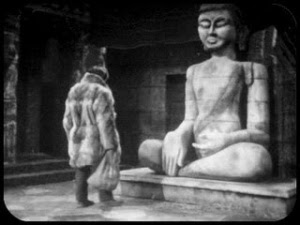
After Atlantis but before Loch Ness... it was inevitable the Abominable Snowman would show up on ’Who' someday. The hirsute fellow was a surprisingly late addition to the Western canon of folk monsters, due to the relatively late exploration of Tibet. Though longstanding in local folk mythology, he didn't gain his more dramatic stage name until acquiring an English agent in 1921. ('Yeti' in Tibetan means simply 'bear of the rocky place'.) He was in short one of the last wild things to be hunted down.

And it wasn’t really till the mid Fifties that his career truly took off, with salacious newspaper reports on Himalayan expeditions. (Even his name was coined by a journalist, Henry Newman.) These soon spread into films, with the Goons parodying the phenomenon (with ’Yehti’) in ‘55. From there he became ubiquitous, appearing in the central cast list of monsters in films such as ’Monsters Inc’ (2001), because he couldn’t not do.

Such stories were the latest iteration of a broader trope, which has resonance because of the ‘between’ nature of the man-beast. In folklore this creature often haunts the edges of towns, sneaking in under darkness. Neither fully feral nor human, his relationship to us is ambiguous. So we’re both drawn and repelled. More modern stories tend to be about attempts to seek him out, capture and categorise him, in an attempt to reassert order on the world. Which never, ever go wrong…

Yet this is more than a decade later and much of that had already been revised. In Nigel Kneale's 1957 film 'The Abominable Snowman' he twists the story by revealing the thing is not between but beyond, an all-wise being simply waiting out man's hubristic rise and inevitable fall, communing only with some Buddhist monks. The protagonist states “it isn’t what’s out there that’s dangerous, so much as what’s in us”.


Herge's 1960 comic album 'Tintin in Tibet' is less radical, but still imagines a sympathetic monster, capable of care, with a “human soul”, but misunderstood – in the mould of King Kong and Marvel's Hulk. But significantly both work in the other great cultural export of Tibet, robed Buddhism, manifesting ancient wisdom through the medium of Jedi mind tricks. And both rely on a Boo Radley ending, coming to the conclusion they're best off undiscovered.


Haisman and Lincoln faithfully reproduce many of Kneale's elements - the signifying footprint in the snow (despite a distinct lack of snow), the two Western parties who run into one another, the bumped-off hunter, the psi-powered monks and so on. However, after years of shamelessly ripping off Kneale like no-one was supposed to notice, despite his Yeti film being heavily borrowed from in the predecessor to this story, not only do they turn those elements into a whole new plot they seem to treat the original as a kind of canon.

By now the Yeti had been rehabilitated into fiction's equivalent of polite society. Here, even as it keeps that abominable title, it chiefly refers to its critters as Yeti and explains they're “timid creatures”. So it reverses the twist – it’s when they up and start killing that people get perplexed.

And if the Buddhism in these stories is similarly given a particular slant, perhaps that's standard. Westerners are often attracted to the exotic trappings of Tibetan Buddhism – the robes, the chanting and so on become spiritual bling. But at the same time they're less keen on its ascetic insistence on discipline. So they try to populate its form with the content of Zen Buddhism. (Which is actually Indo-Chinese.) 

Being less doctrinal and more experiential, it appears more adapted to our individualised way of life. (Though whether they actually grasp any of that or simply read what they want into it is another matter.) In Herge's story, for example, psychic powers are personalised, the 'gift' of one particular Monk rather than part of the Monastery's teachings.

So if 'Who' has a somewhat schizo approach to Det-Sen Monastery, perhaps that's par for the course. It is a Monastery, with “strict discipline and self training”, and not some Tibetan equivalent of a hippy commune. But, this being a Troughton story, it has to double as the de rigueur base under siege. Which of course is a metaphor for the closed mind. So chief sentry Khrisong busily orders his underlings while still more busily distrusting the Doctor. “Let them meditate! Let them consult!” he cries in derision. “I will act!” You could call him trigger-happy, if he was armed with anything more than a stick.

The story even takes steps to avoid it's own natural get-out. As Yeti start attacking people you could imagine him reactively falling into a military mentality. Yet dialogue between other Monks seems there specifically to tell us that he's just that kind of person.

”Formless in Space... I Astral Travelled”


In a rare early example of retconning, the Doctor has not only been here before but is there to return a relic. He even knows its Master, Padmasambhava. (Or as Jamie calls him 'Padmathingmy'.) And 'old friend of the Doctor' is a pretty clear nod that this is a character to be trusted.

...which of course is exactly why we shouldn't. Because Padmathingmy has fallen under the psychic control of the Great Intelligence, a disembodied force seeking to make itself manifest. The Yeti are actually robots at his malevolent command.

Now, by this point in 'Who' history, mind control might seem somewhat hackneyed. We've already had it in 'Keys of Marinus’, 'Web Planet’ and 'The War Machines’ to name three. (In fact the beeping of the spheres which control the Yeti is quite similar to the Zarbi signalling in 'Web Planet'.) And of course it's hard to escape the notion that these are plain cheaper to stage. You don't even need the rubber suit, just tell an actor to put on his sinister voice and you're away.

Yet, as we've seen, all those Hartnell examples are about the separation of mental from manual labour. This time it takes Buddhism as a set of synonyms for Western psychology. The Great Intelligence, that’s a name the Ego would like to adopt. Its as if his achievements had led Padmathingy not to enlightenment but to a pride which then Bunyanesquely rears up at him – his ego manifesting as an alter ego. When it states proudly “I am much power!”, the formulation of words seems telling.

Or on the other hand it could actually be Buddhist after all. At least by the standards of this sort of thing. The Great Intelligence's plan is like nirvana in reverse, an incorporeal being desiring to get back on the wheel. Padmathingmy can be seen as stuck in the state between death and rebirth, which Buddhists call Bardo. Initiates are taught to surrender to this process, but some trap themselves by clinging hopelessly to what has gone before. The plot involves him living hundreds of years past his natural span, then at the end welcoming death as “rest” and “peace”. (Which would make for two stories in a row about accepting the inevitability of death.)


And of course retconning a prior connection between him and the Doctor establishes an equivalence between the two. When Victoria attempts to explain the Tardis to a novice monk, he counters that his Master's astral travelling is pretty much the same thing. (Though oddly Jamie later shushes the Doctor against mentioning their mode of transport.) A plot point is his concealing his presence from the Doctor, to avoid giving away that he's hundreds of years old. Just like… oh, you guessed.

And these suggestions permeate the story. When Jamie first sees the Doctor on the Tardis monitor in his Himalayan fur coat, he cries “beastie!” And the same fur coat leads the explorer Travers to claim it must have been the Doctor who murdered his buddy, and Khrisong to insist he has the Yeti under his control. (Right plot, Khrisong, wrong perp.) There's even the suggestion that in returning the relic the Doctor is on some kind of pilgrimage. Certainly it's his managing to achieve this task which convinces the Monks to stop leaving him out as Yeti bait.

Ghost Traps and Chains

And beyond the Tardis and astral flight, there's a fair amount of paralleling in the story. The Doctor takes two objects from the Tardis, the relic and an electronic triangulation device (to track the Yeti). A captured Yeti is held down by a magic ghost trap, but also heavy chains. (A double precaution a monk describes as “wise”.) It's very 'Who', his science and their religion merely one thing seen from different angles. But how does it play out?

In the finale, Travers rushes out to the mountain where the Intelligence is physically manifesting, armed with his gun. To no avail, of course. While the Doctor and his crew find a room behind the sanctum, literally the power behind the throne. It's full of machinery which they promptly smash up. To no avail either. After all, we've already seen how the GI controls them by moving Yeti pieces around a game board rather than by any mechanism.


But then they break a pyramid of spheres. Throughout, the GI has been represented by these geometrically pure objects, like they're the portal-like link between his Platonic realm and our world. The Doctor finds the spheres inside the Yeti early in the story, but initially dismisses them as too light to contain any mechanisms. Not the mountain, not the mechanisms. It's a neat final twist, there to tell us what sort of story this was. It's an inner story, concerned with the workings of the mind.

But it pulls the twist only by utilising its own contradictions. Why are the machines there then? Just as a decoy? Beyond that, why go to the trouble of building the robot Yeti at all? Khrisong's question up top is quite a good one. The intra-story reason seems to be to scare away those pesky interfering monks and explorers, but before the Doctor shows up no-one seems much of a threat. And why model them on a creature everyone knows to be timid? Perhaps if the GI had tried this in England he’d have frightened everyone off with giant robot squirrels. Beyond that, just how were the Yeti built, with what materials? We're told it took Padmathingmy many years, which poses time as a solution for lack of materials.

It's much like Wotan's War Machines. There's two separate stories, joined together only in a plan that defies coherence. Not only can you imagine the story working without the robot Yeti stamping about, at times they seem keen to show you just how it would work – through spiritual possession, levitation and so on. The monastery could seem to be haunted by 'evil spirits', the faithful being driven out. Or perhaps the GI could have animated the actual Yeti into attacking, just as he turns people into his thralls. But we have to have killer robots, because killer robots are the sort of thing you have to have on 'Who'. 

While the equivalence between the Doctor, the GU and Padmathingmy seems not even undeveloped but merely hinted at. You expect at least an 'Exorcist' moment where the GI suddenly tries to possess the Doctor, but no.

The Curious Case of Victoria 


After an introductory story in which she was no more than a plot piece, and a follow-up where she obligingly stepped into a death trap, this time Victoria's even dressed differently. Her explorer's trouser suit makes her look like a principal boy in a panto. And this time she does stuff.

Yes, actually does stuff.

Alas, it doesn't help.

She's driven by a new-found curiosity, first insisting to Jamie she wants to go exploring despite what the Doctor said. Then once in the Monastery she becomes intent on reaching the Sanctum, off limits even to the monks. Of course she's being plot driven. She gets in there to discover it harbours ill deeds, stumbling on a revelation rather than confirming suspicions. But her cavalier disdain for the customs of her hosts makes her look brattish, like space travel has finally given her her teenage years. And, in a story which otherwise gestures at Buddhist sympathies, it doesn't seem at all clear we're supposed to be bothered by this.

On Balance...

Buddhists are big on balance, and there's a balance to be struck here. The way the GI's intrusive force goes almost entirely unexplained makes for something more effective than the banal biography Moffat later gave him. But rather than striking right this merely becomes imbalanced the other way. There's some intriguing themes and images, but they tend to lie about undeveloped and disconnected on the surface of a standard adventure story. Overall, the closest cousin to this story is 'The Faceless Ones’. In many of it's themes it feels like a dry run for 'Planet of the Spiders', despite that coming so much later. You may be best off foregoing your 'Who' fixation and watching the Kneale film instead.

Further reading: 'How Buddhist is This Series?' In the first 'About Time' volume, Wood and Miles came up with an intriguing reading of 'Web Planet' based on a biography of the writer. In the second volume, they do a similar thing...