googlee7ea825f63edb3f6.html

Saturday, 12 March 2022

“ALL THE STRANGERS CAME TODAY”: DAVID BOWIE’S ‘HUNKY DORY’

(Another instalment of Mutants Are Our Future, this time turning from comics and TV shows for some of that pop music the kids dig so much. You can read things from the top here, should you choose.)


”So I Turn Myself To Face Me…”

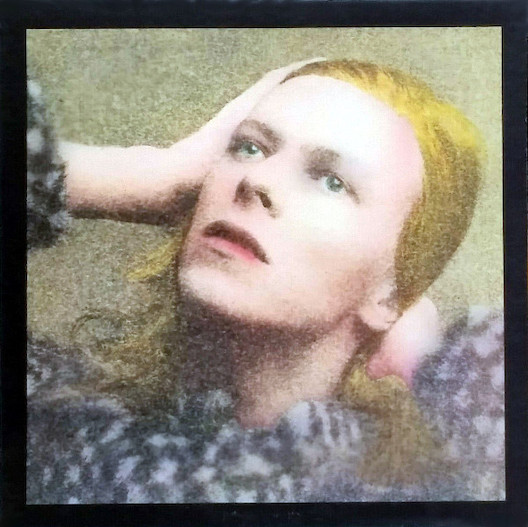
‘Hunky Dory’ (1971), David Bowie’s third album (depending how you count it) came between the mystic-folk-meets-primordial-heavy-rock of ‘The Man Who Sold The World’ and the snappy pop-rock of ‘Ziggy Stardust’. Each within a year of the next. But, bar odd tracks, and despite the Spiders From Mars being formed in all but name, it doesn’t sound like either. His voice is mostly accompanied by piano. Wrapped between a front close-up of a far-sighted Bowie and a handwritten back cover, it’s very much his singer-songwriter album.

Because of course those are all devices we associate with the personal voice, the raw unmediated truth, sung straight at us with no space for artifice. In ’Shock And Awe’ Simon Reynolds wrote “it resembled an existentialist Elton John”, and it often seems to be, in his own words…

“Written in pain, written in awe
“By a puzzled man who questioned
“What we are here for”

There’s even a direct tribute to the then-knighting King of singer-songwriters, Bob Dylan. Called, naturally enough, ‘Song For Bob Dylan’. Though it’s a mixture of tribute and barb, addressing him (as a disillusioned Lennon had) by his real name Zimmerman.

“We lost your train of thought
“Your paintings are all your own”


…was a none-too-subtle dig at his latest, underwhelming effort ’Self-Portrait’. In asking when we’d be getting the old Dylan back while knowing full well we weren’t, Bowie was clearly positioning himself as the great man’s successor. (Perhaps ironically, for an album which on release didn’t even chart.)

At this point Dylan’s run of late Sixties great electrified albums had only just happened. But Bowie skips over this creative peak, to go back almost a decade and focus on the righteous and dungareed spokesman for a generation with his Woody Guthrie cap and words of “truthful vengeance.”

Except Dylan performed those songs on guitar, the instrument of choice of protest singers, the one whose unadorned truth fascists were supposedly so allergic to. While Bowie’s on the piano. An instrument which can also signify ‘personal voice’, Joni Mitchell would swap between the two ambidextrously. But it’s as much associated with urbanity and verbal theatrics. (Perhaps because it’s less portable, or has a more dextrous sound.) And furthermore…

Audiences of the genre like singer-songwriters to be solo, or at least play the main instrument themselves, the way a painting is supposed to be all the artist’s own hand. They are even known to shout “Judas!” when they don’t think they’re getting this. But here even that piano is mostly provided by Rick Wakeman. (Who’d already played on ’Space Oddity’.) Bowie cheerfully conceded on that hand-written sleeve: “I played the less complicated piano parts (inability).”

And he plays into this, peppered the album with twists and turns on the theme. Even as he evokes “a voice like sand and glue”, he makes clear he’s as keen on greasepaint and glitter. “So I turn myself to face me”, could come from any singer-songwriter, making themselves their own inspiration. But Bowie quickly follows it with “but I’ve never caught a glimpse.”

’Quicksand’ refers to both Garbo and “the next Bardo”. Which could be, respectively, the wartime spy and Buddhist concept. Or perhaps the two glamorous actresses? People argue over which but… guys, really… twice in one song? Remember the sane/Seine pun from the previous album? He’s doing this deliberately, isn’t he?
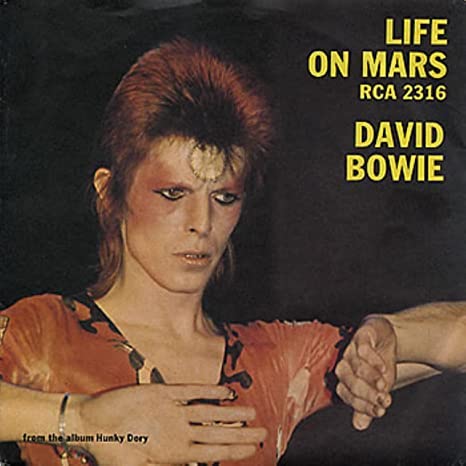

‘Life on Mars’ is clearly Bowie’s zigzagged, idiosyncratic version of a protest song. While the two opening tracks, ’Changes’ and ‘Oh! You Pretty Things’ would seem to be his take on the classic ‘Times They Are a-Changin’.’ (Perhaps the best-known early Dylan song after ‘Blowing in the Wind.’) Like their source they’re both ostensibly addressed disdainfully to an adult generation, telling them to get out our way (“don’t kid yourself they belong to you”), while of course they’re actually an anthem for marching youth. 

Except Dylan’s song is full of quite Biblical imagery, floods and tribulations (“The line it is drawn/ the curse it is cast”). It opens with the proclamatory line “Come gather round people wherever you roam”, like a town cryer. While Bowie begins with “wake up you sleepy head”. His tone throughout is more intimate, conversational not confrontational. Even when he spies “a crack in the sky and a hand reaching down to me” he doesn’t dramatise, in fact he could sing in the same voice about the postman having come.

While Dylan was always writing accusatory “you” songs (usually pronounced “yeeeeeew!”), the first personal pronoun on this album is inevitably “I”. It’s clear enough that here its inner change, personal transformation, that counts. Bowie sings “I’m much too fast to take that test”. The streets aren’t made for political protest, they’re there to be treated as a catwalk. The secret to life is realise that this is all a show. And those children that you spit on try to change their world, they don’t just bring change, they represent it. Don’t just change one thing for another, be change, swap fixity for fluidity.

Simon Reynolds also wrote:

“Bowie came along at a time when the idea of revolution or alternative ways of living proposed in the Sixties began to fade. The big trade-off that ensured was the shunting of ‘revolution’ out of the social-political domain and into the commercial-aesthetic zone, as well as into the private life… Bowie is the emblem for this individualised, privatised form of revolution.”

And the man himself said, two years later: “The revolution has been fought on an entirely different plane to the plane that I thought it should be fought on… For instance, like capitalism can be all right.” (Another reason, should we need one, not to treat the Tomorrow People trope as somehow inherently radical.) He’d reject in song “that revolution stuff” of the Sixties - “what a drag, too many snags.”

While, interestingly, the chorus to ‘Song For Bob Dylan’ makes Sandy Glue’s adversary not Mr. Jones or some other fusty establishment figure, but “the same old painted lady/ From the brow of the superbrain.” Wait, what, who?

A clue might have come from the track straight before, another personal tribute, this time ‘Andy Warhol’. The words to which read something like a Glam manifesto:

“Dress my friends up just for show
“See them as they really are
“Put a peephole in my brain
“Two new pence to have a go
“Like to be a gallery
“Put you all inside my show”

For Warhol was more than anyone the self-proclaimed antithesis of the confessional school of creation - art was artifice, appearance, effect. He described himself as a “deeply superficial person”, and insisted “if you want to know all about Andy Warhol just look at the surface, and there I am. There’s nothing behind it.” For the press release, Bowie called him “a man of anti-message.”

Julian Cope later wrote ‘Christ vs. Warhol’, conveying how torn he felt between the rival pulls of pop immediacy and lasting grandeur. And Bowie at this point seems very Dylan vs. Warhol, split between really meanin’ it man and the desire to dress up and put on a show. An approach he arguably kept up over the rest of his career. He was the Seventies artist who was effectively employed to shut the door on the Sixties, yet at the same time never fully crossed that threshold himself.

And after all, how different were they really? Bowie’s already reminded us Sandy Glue was just a stage persona for Robert Zimmerman. And a corduroy cap and an acoustic guitar can be as much a pose as a blonde wig, as Dylan surely proved more than most. He said himself: “You're born, you know, the wrong names, wrong parents. I mean, that happens. You call yourself what you want to call yourself.”

His “you” songs rarely stretched to “we”. That was more the era of the agitational late Sixties, perhaps reaching its succinct epitome in Jefferson Airplane’s “your enemy is we”. But it was a distinction most failed to spot, and his consequent failure to support that agitation mystified them. Bowie then positions himself to be Dylan’s successor, but with the “I” presented as a twist. His relationship to his fans was by the same mass media, but it was to be one-to-one, kids alone in their bedroom hearing a transformative track on the radio.

”The Start of the Coming Race”
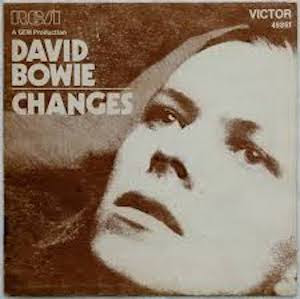

Yet at the same time as all this Bowie ups the ante with the line that took us here - “better make way for the homo superior.” We’re “the start of a coming race”, not just different to their generation, but of another kind altogether. “The Earth is a bitch” (famously censored in the Peter Noon cover), suggests we’re leaving mere physical existence behind.

You could play compare and contrast to another great piano song, from the previous year - Neil Young’s ‘After the Gold Rush’. Which portrays the present as an impasse, a “burned out basement”, stuck between a Medievalist golden age and a silver science-fiction future, with spaceships to ferry to us to the stars. It’s eschatological, an SF retelling of the end-times, with aliens replacing angels to take the nice folk like us out of a place like this. (And remember “tall Venusians passing through” had appeared in Bowie’s earlier ‘Memories of a Free Festival’.)

Ever the early bird, Bowie was getting in ahead here. In the well-known tale he picked up the phrase “homo superior’ from meeting Roger Price in a TV studio. Yet, as we saw last time, Price’s ‘Tomorrow People’ series didn’t debut for another two years.

But this was another way he was still channelling the Sixties, for this cosmic mysticism had always been part of the hippie mentality. Once it had co-exited with fervent insurrectionism. But as the possibilities for radical social change faded, it was able to hog more and more of the stage. George Harrison had said in ’67 (quoted in Clinton Heylin’s ‘The Band You’ve Known For All These Years’): 

“I read somewhere that the next… Messiah, he’ll come and he’ll just be too much… The majority of people are going to believe and they’ll be digging everything and he’ll come and say ‘Yeah, baby, that’s right’, and all those other people who are bastards, they’re gonna get something else.” 

It’s a kind of inverted Calvinism, with the sober-minded short-haired businessman the damned and the indolent long-hairs the UFO-hopping elect. But it’s the same rigid division into saved and consigned. This is precisely what Nigel Kneale satirised with the Planet People in ‘Quatermass’. 

Yet that “I” reasserts. The track which most aligns with ’The Tomorrow People’ is ’Pretty Things’, and that only comes as close as the plural “you”. ’Tomorrow People’s whole sell had been plugging into the we - you didn’t just join a gang, you became permanently telepathically linked. The teleological optimism of their premise was much more post-Sixties than Bowie. Questions like the role of violence in social change are literally not even questions for them, the answers seen as innate.

Bowie is much more personalised, more egotistical and at the same time more fractured. And it would be this less utopian take which would come to win the toss in dramatising the spirit of the often-contrapedal Seventies. Naming an album after a slang phrase for feeling good, that’s a surefire way of spelling out it won’t be very feelgood.

And significantly this album, which bombed on release, is not considered a classic. Bowie is often seen via his trailblazing influence on those who came after him. While ’Tomorrow People’ has become almost a byword for retro chic.

Which leads us to…

”If I don’t explain what you ought to know…”
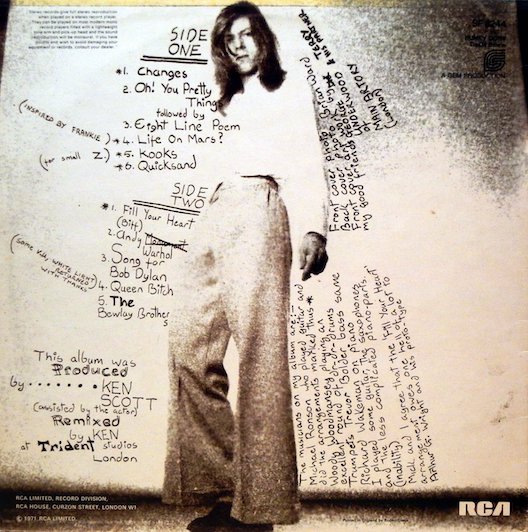

’Quicksand’ is the album track of the album, not the one you went to it for but the one that keeps you there. Somewhat self-disparagingly, Bowie said he wrote it while still pretending he understood Nietzsche. But it’s more about not understanding Nietzsche, having a head full of half-digested notions of the ubermensch, stewing with some semi-masticated Cowley and chewed Buddhism. There’s a long list of characters, but they all seem to exist only in Bowie’s head. He described it as an “epic of confusion”, representing a “cacophony of thought”. 

It reminds me most of student life, picking up one author and being swayed almost just by touching the cover, then trying another and being immediately converted, transferring your allegiances so often you get giddy. It’s the perspective of a young man, his voracious but magpie reading eye always bigger than his word-digesting brain, so constantly getting sucker-punched by erudition. Ultimately, it’s about having a reading hangover. The song we all struggled so hard to understand in our teenage bedrooms is ultimately about struggling so hard to understand. The war imagery, so pored over when Bowie attracted his own flock of magpie readers, stems from there.

But the album’s magic happens when these three themes intersect. Bowie was at this point coming up with songs at a rate of knots, so was free to choose what went with what for each album. (Many Ziggy songs were at this point already written, but saved till later.)

This doesn’t make it coherent, just cohesive. If he sang of being “torn between the light and dark”, that doesn’t map precisely to Dylan vs. Warhol. But 'Quicksand’ still internalises the conflict staged elsewhere, relocates Young’s “burned-out basement” inside his brain. While singing of a “crack in the sky”, he was only a few years from drawing a dividing line down his own face and in-so-doing creating the most potent self-image of his career. He’s not hoping the rest of the elect pick him for the team, he’s quizzing himself what his nature might turn out to be.

“I'm not a prophet or a stone-age man
“Just a mortal with the potential of a superman
“I’m living on”

And this creeps into other songs. ‘Pretty Things’ is more complex than the glam anthem it might appear, however proto-Ziggy that rousing chorus. Though thought to be written before his first child was born, “wake up you sleepy head” suggests that’s who its addressed to. The man who shortly would become a transexual alien saviour is here a father; at a time of great generational conflict he’s trapped between the sides. “Look at your children… Don’t kid yourself they belong to you” could be addressed as much to himself as some squaresville grown-up.

When that sky cracks and the hand points down to him, there’s no real telling which side of the divide he’ll be falling on. Let’s remember that ’Cygnet Committee’ two albums back, ostensibly a state-of-the-Sixties song is effectively about a parent/child relationship in which Bowie also gave himself the parent role.

Faulkner famously wrote “the only thing worth writing about is the human heart in conflict with itself”. Which is ultimately where ‘Hunky Dory’ is at, the befuddled mortal and the would-be superman in symbiotic struggle.

Saturday, 5 March 2022

THE X-MEN VS. THE TOMORROW PEOPLE, ROUND TWO

(This third helping of Mutants Are Our Future compares the story scenarios of the original Marvel comic strip ‘The X-Men’ with the British kids’ TV show ‘The Tomorrow People’. Previous part here.) 


The classic Lee/Kirby era of ’The X-Men’ (effectively the first nineteen issues) essentially features two types of story, themselves determined by two types of antagonist. Handily, they arrive consecutively. Following Magneto’s appearance in the first issue, bad mutants become the good mutants’ default foe. While Marvel usually rotated their rogue’s gallery, the Brotherhood of Evil Mutants (Magneto, plus his henchmen) came back in issues 4, 5, 6 and 7, and were already being called ‘The Evil You-Know-Who’ on the cover of 6. 

Adjacent panels often juxtapose the fair-play teamwork of the X-Men against the fractious world of the Brotherhood. Who represent about every way to fail to form a brotherhood; the imperiously commanding Magneto, the obsequious Toad (whose excessive fawning even gets on his master’s nerves), the scheming underling Mastermind, and Quicksilver and the Scarlet Witch, trapped by their misapplied sense of duty to Magneto.

Then, as if suddenly noticing how reliant on the Brotherhood they’d become, Lee and Kirby put them out of harm’s way by splitting them up in three different directions. And segue straight into the first Sentinels story. This is clearly intended as something of an epic. It’s not just the first three-part run, even the next issue is largely devoted to the battle’s aftermath.


The Sentinels, as we all know by now, were designed precisely to eliminate the mutant “threat”. Public fear and distrust of the super-powered had long been a distinct feature of Marvel, distinguishing it from DC. Now it comes into its own.

Except here it’s specified precisely as public distrust. Crowds in the street are likely to degenerate into anti-mutie lynch mobs at any sign of unorthodox behaviour. This includes cops, but government and military... they clearly know better. In issue 10 Professor X says casually “Washington has already contacted me” about the latest drama. So the constituency of their designer Trask isn’t ranting Republicans but the salacious popular press. He even launches the Sentinels on live TV.

As robots tend to, the Sentinels then rebel. But this is because they decide the best way to carry out their orders, to protect humanity, is to subjugate them. The story them becomes a parable about the rise of, but also the inherent deficiencies with, machines. They’re often depicted neatly lined up, like beans on a shelf, while their plot is essentially to make more of themselves. But they’re also shown lacking the basics of gumption and initiative.


‘Mutant’ would seem a very science fiction word. But there’s only one alien in the whole Lee/Kirby run, the Stranger, who appears in ’The Triumph of Magneto’ (11). Both sides assume him to be a mutant and so set about trying to win him over to their camp. Only to discover he’s not just literally but conceptually alien, outside their common frame of references. (“Have I not said I am… a stranger?” he asks, channelling Leonard Cohen.) His only interest is in collecting specimens of mutation for study. He picks Magneto, for plot convenient reasons.

Whereas, as we’ve seen the Tomorrow People comes with a plot contrivance where the whole concept of bad Tomorrow People, in brotherhoods or otherwise, is blocked off. Instead, with their first story ’The Slaves of Jedikiah’ (1973) their antagonists are established as aliens.

While Magneto tries to misuse the power of the mutants he manages to pick for his side, Jedikiah tries to limit his, with the recurrent one-eyed motif, with constraining anti-telepathic headbands and the like. There’s a moment where Stephen, rather half-heartedly, Refuses The Call and sulkily claims he’s not a real Tomorrow Person after all. But the premise is auto-inoculated against him voluntarily taking Jedikiah’s side.

Jedikiah turns out to be the henchman of a bigger baddie called (confusing our comparison) the Cyclops. Except, in the very last episode he suddenly switches to sympathetic. As it turns out, his spaceship was broken and he really just needed the psychic equivalent of a push to get him home again. This becomes something of a show staple - not resolving conflicts so much as wishing them away, making it never-was. And one way to manage this is to decide at the last minute the bad guy was just misunderstood. The Prime Barrier perhaps necessitates this. They can’t fight a deciding battle because they don’t fight, so everything has to just turn out to be okay.

There’s some suggestion the Cyclops was simply scared of us (“your planet has an evil reputation throughout the galaxy… you are always at war”), which might be more convincing if he hadn’t recruited human henchmen. In a vain bid to keep the story propulsive, the antagonism abruptly switches to Jedikiah, who in short order is revealed as a robot, goes mad and starts rampaging round Cyclops’ spaceship. (Some robots revolt. Others go mad. Them’s the breaks.)

As we saw another time, the monsters in ’Dr. Who’ tend to be human foibles, which are magnified, externalised and then stuffed in a rubber suit. The penchant of ’Tomorrow People’ is for more generalised social ills which turn out to be the fault of menacing aliens; gang warfare (‘The Blue and the Green’), the fashionability of fascism (‘Hitler’s Last Secret’) and so on. Except, as we’ve seen, they’re not really the aliens’ fault either. They shilly-shally between manipulative monsters and the equivalent of the Stranger.

Human hostility is established. Well, mentioned. Told the TPs can’t make war, Stephen asks the not-unreasonable question “what if someone makes war on us?” While the Cyclops warns them: “Arm yourself against your own species. They will kill you if they find you out.” But unlike the X-Men, unlike every Marvel hero ever, this secrecy doesn’t apply to their own parents. It’s taken for granted Stephen’s must be told.

Human mistrust only really appears with the biker gang who aid Jedikiah. Except ‘aid’ is a loose term, and he’s forever telling the serial bunglers “no more incompetence will be tolerated.” Which makes you wonder why he thought he needed them in the first place.


Their outlaw attire suggests that rather than adult authority figures they’re ‘bad kids’, the delinquent hooligans who plagued Seventies popular culture. They even have laddish nicknames, Ginge and Lefty. Which leads to an emphasis on brains triumphing over brawn, as if they’ve been set up to fail. There’s a scene where the TPs repeatedly jaunt out of their charging way, leaving them to fall in lakes and other hilarious consequences, which recalls the ghost cat taunting the live dog in the Hanna-Barbera cartoon ’The Funky Phantom’.

We’re told rather late on that they were recruited ideologically, told “you lot were just a bunch of freaks”. But this shows up out of nowhere, and is used as a convenience for them to swap sides, following the show’s No True Villains rule. Like school bullies, they’re tauntingly confrontational on the outside but really need the nerd kids’ help. From that point on they reappear as the pacifists’ handy contracted-out muscle, a little like the Ian role in ’Doctor Who’.

’Secret Weapon' (1975) is the nearest to a Sentinels-like story. Opening the third season it again introduces a new Tomorrow Person who’s conveniently ‘breaking out’, Tyso. Who’s wanted by a secret Government department, to make him the secret weapon of the title. The distinction between him and them is established with a first shot, a toff car appearing on the road behind other gypsy kids as they play. And of course experiments on gypsies recall Nazi horrors. 


The story’s tension lies between Professor Cawston and Colonel Masters, scientific curiosity against military instrumentalisation. One is handily colour-coded black and the other beige, against the Tomorrow People’s perpetual white. And like Jedikiah though he seeks to harness their powers, Masters spends virtually the whole time dampening them, giving Guards “dope guns”, placing Tyso and Stephen in comas.


In this way it’s almost the inverse of the Sentinels, the military being informed becoming the very problem. “Can you imagine living your whole life in a tribe of monkeys?” Cawston asks Masters. “With your very survival depending upon their not finding out you’re a human being, a superior creature?” But Masters’ reaction to their powers is not so much fearful as avaricious.

Writer and series creator Roger Price was in many ways an old Sixties radical, and the story resounds with anti-establishment and internationalist pacifism. Though he’s careful enough to portray Masters as sincere in his beliefs, however ruthless, allowing him counters in a stand-off argument with Elizabeth. (When he asks what would happen if such powers were to develop in Russia or China she replies there’d simply be more Tomorrow People like us, perhaps the series’ ethos encapsulated.)

But then the finale is a let-down even by the standards of the show, whether measured dramatically or politically. They essentially defeat military intelligence by going to its manager, leading to the so-bad-its-great line “what’s the Prime Minister doing here?” To get to the PM, they need to jauntingly kidnap him, which luckily he is rather sanguine about. See, kids? The system works.

Worse still, Chris, not a Tomorrow Person, can be presented as less enlightened, a slightly less street-level Ginge and Lefty. He’s essentially the hot-headed agitational radical, the peace hawk, against John’s sober-minded faith in reason. He’s even willing to threaten the old boy with a “Martian ray gun”, only for John to give the game away. Yet it’s him who cooks up this half-baked plan in the first place!


And the two most interesting features of the story, that the Tomorrow People initially underestimate Masters’ threat, and that his assistant is herself a telepath, are essentially orphaned by this rubbish resolution. Her powers seem lesser than the TPs, and are limited to telepathy, but still seem to grant her greater empathy than Masters. This is eventually explained as her being a kind of forerunner, who failed to fully break out.

And while Tyso may seem another point won for diversity casting, his actual role in the story is so slight he’s effectively a boy damsel in distress. He really does spend most of his time asleep, so much that he nearly gets forgotten at the end. And his Romany family are portrayed absurdly, his father even willing to sell him to Masters! The message would seem to be that we are such generous and tolerant folk, we even apply it to these backward Gyppo types.

Which shouldn’t surprise us. Frequently referred to as a critique of racism, this trope’s perhaps worse than useless for that. It exists to flatter its audience, convincing them it works as some sort of anti-racist credential, like those diversity training certificates workplaces give you. The truth is, people follow this stuff because they like to see some bigged up version of themselves, particularly with bigged up brains and hearts.

Being part of a band of elite pariahs, the tension over this trope is how much it can be a fantasy and how much a phobia. Witch-like powers come with witch hunts, after all. (As future instalments in this series will show, a feature of this trope is the way it weaves between kids’ TV shows and outright horror films.) This can be used creatively, making the dish into a sweet and sour.

’X-Men’ got this at some level, ’Tomorrow People’ less so. True, it suffered from cheap budgets even if compared to the often-mocked ’Doctor Who’, and from often-excruciating child acting. But chiefly it feels auto-inoculated against everything which might make its own scenario involving. Its utopianism may seem distant from us now, so it’s tempting to frame the problem as to do with eras. But it was dramatic too, forever presenting us with an enticing situation of conflict then whisking that conflict away. It took a great premise and fumbled it with wooly well-meaningness.

Coming soon! More mutants, more future...

Saturday, 26 February 2022

THE X-MEN VS. THE TOMORROW PEOPLE

(The second instalment in our new series Mutants Are Our Future crashes the classic American comic series against the British TV show to see what sparks. Previous part, on the X-Men versus the Fantastic Four, lies here.)


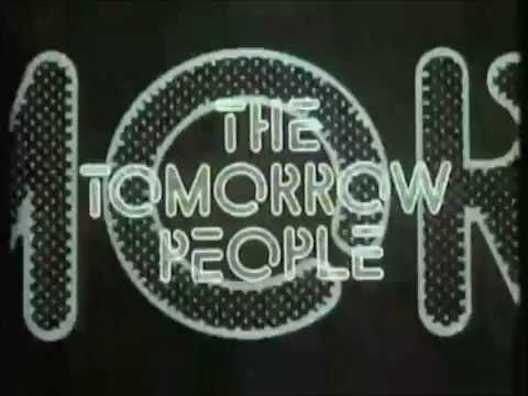
In one fell swoop, ’The Tomorrow People’ effectively named the generation-gap-as-evolution trope, and separated it from the superhero genre. It may be tricky to compare something so Seventies with something equally Sixties. Off duty, the classic X-Men hung around coffee bars where bearded beatnik poets intoned nonsense over bongo drums. While the Tomorrow People sport bouffant hair over wider-than-wide collars or white jumpsuits. So what appear as differences in kind may be merely variations of era. The Tomorrow People are, for example, a pointedly more diverse bunch. But this was also true of the new x-Men, who began in 1975.

Did one influence the other? The X-Men didn’t appear in British Marvel until ’Mighty World of Marvel 49’ (cover date 6/9/73), while ’The Tomorrow People’s’ TV debut was that April. (From when it ran until 1979.) However they had intermittently appeared in Odhams titles in the Sixties and the original American comics were (somewhat haphazardly) distributed over here. So it’s a possibility.

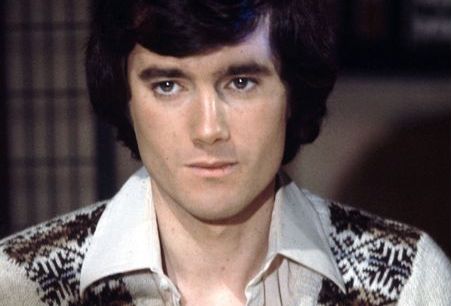
And the underlying concept’s essentially the same - take the concepts ‘mutation’, ’evolution’, ‘generation gap’, ‘brainiac elite’ and blend. Both feature extra-evolved teens, one based in a private school, the other an underground ‘Lab’. Patrician team leader John is essentially Cyclops, and computer Tim a blend of Professor X and Cerebro. (And like Cyclops John was to prove the only continuing character.)


Except I don’t believe there was. If the differences aren’t wide they’re deep, going down to the very heart of the thing. These were undoubtedly different riffs from the same source, arising independently. The more common tale, that they arose from a conversation between Roger Price and David Bowie, seems more on the money. 

Let’s focus on a trivial-sounding detail. While the X-Men’s powers are unique to each character, the Tomorrow People share what they refer to as as the three T’s - telepathy, telekinesis and teleportation. (Plus, judging by the first episode, the ability to triangulate from two points.) When a new recruit ‘breaks out’ into their powers, the others are aware what they’re going through as they’ve gone through it themselves, and can offer expert guidance.

And of those T’s, telepathy furthers this feeling of group identity. (The X-Men could communicate mentally with Prof X, but not directly with one another.) The audience appeal of “mind talk” would have been magnified in an era before mobile phones and hand-held devices, when house phones were closely monitored by parents. We’re told “the Tomorrow People are never alone”, and shown one of the group waking and immediately reaching out for telepathic contact with the others.

All the X-Men’s powers were physical, hardly surprisingly as they were devised as super-powers under another name. Even Marvel Girl’s telekinesis is essentially a way of hitting people from a distance. Powers which only Cyclops has problems controlling needing to keep his eyes forever leashed behind his visor or civvy sunglasses, causing no small amount of fretful thought balloons. And this is presented as something of a character quirk, making him unlike the others. (Though it arguably has a greater significance due to him being the Team Leader.)

Whereas the Tomorrow People have a kind of soft power, not concerned with physical strength. To the nerd mind, super-strength is transforming, whether induced by gamma rays, magic words or Charles Atlas booklets. While mind powers give you more of what you already have, or at least what you see yourself as having. Overall, the sell is different. The X-Men more lean into “you get to become yourself”, the TPs into “you get to join the gang”.

But this also means, by genre standards, they have “girl’s powers”. (Though they’re as similar to Professor X as Marvel Girl.) Which isn’t really shied away from. Unlike comics, the screen has no wiggly motion lines. So an established device to portray telekinesis is the firmly upraised hand, like it’s a kind of remote touching. Which isn’t used here. Instead, you just concentrate.

And once you take the super-strength away, the trope starts to overlap with Victorian spiritualism. The Victorians imagined such abilities (‘powers’ seems the wrong word) lent themselves to women and children, who they saw as removed from the material world of men. (When men had them, they were usually marked out as physically frail in some way.) Abilities which were more to do with mediumistically channelling of messages from beyond, with receiving rather than acting.

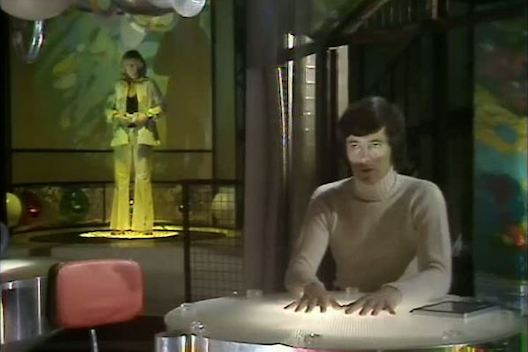
Yet with the Tomorrow People all so young, and with no direct connection being made between ‘breaking out’ and sexuality, with that pure-white aesthetic, the puberty analogy seems at best latent. So the overlap remains. A magnified psychic link is portrayed via hands laid seance-like upon a glowing table.


The Tomorrow People concept was predicated not just on the concept of linear progress but a kind of teleological utopianism - eventually all humans would develop these latent powers. As that also involved losing the 'primitive' ability to kill (described as “the prime barrier”, rationalised as Nature putting a limit on their powers), global peace thereby awaited us. When first describing them, Carol uses the metaphor of the mind as an unclasping fist, which gets incorporated into the credit sequence. In the same year Britain joined the EU (then the EEC), this evolution will allow Earth to join the Galactic Federation.

So, without the bad mutants… without even the prospect of bad mutants, the one thing which prevents these homo superior abusing their powers is their innate niceness. And with the prime barrier that’s not just assumed, it’s made diegetic, hard-wired in. Asked “You see yourselves as Homo Superior then?” John replies genially, “Well, I don't know about superior, but we are undoubtedly the next stage of human evolution.”


Furthermore, the subsuming of Professor X into Cerebro changes the dynamic. Tim can advise, help out and usefully read out plot points. But they’re not in a school with its inevitable adult authority figure, they have a Lab which is really a futuristic den. Tim conjures up food for them, serving whatever they want. It’s the trope of free range children, not just a nerd gang to join but the adult world held at bay.


And perhaps inevitably, alongside that comes a still greater middle class perspective than the X-Men. (Which, let’s not forget, was set in a private school.) When Stephen’s kidnapped we’re told it cannot be for ransom because his parents aren’t well off, absurdly after we’ve seen their rather plush home. (But then in Britain going on about not being well off is virtually a middle class tell.)


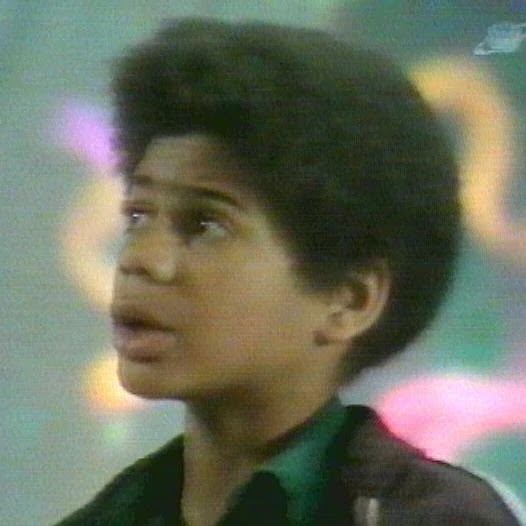
The built-in exception to the rule is Kenny, who seems to have wandered in from ’Grange Hill’. Not just the only black one, he’s presented as more streetwise - seen on first appearance being cheeky to a policeman. We see both his and John’s bedrooms in the same episode, John with astronauts adorning his wall and Kenny footballers. Except… oh my God, they sidelined Kenny. This was mostly to do with the poor performance of the young actor, but still doesn’t help much.

’Tomorrow People’ was broadcast on ITV, Britain’s commercial channel, which at the time many middle class households still stuffily refused to watch. But it was one of ITVs more BBC-ish shows, effectively ’Blue Peter’ with telepathy instead of badges. John could have been a presenter, jaunting from one part of the studio to the next. He just needed a dog. It offered the uncanny on a weekly basis, only to serve up the cosy. (Sample Line: “Some sort of order had to be enforced.”)

You could, however, overstate the differences. There’s a parity of powers among the X-Men, in a way there wasn’t with other super-teams. (From the off, the Avengers featured both the mighty Thor and the winsome Wasp.) And there’s an emphasis on them fighting together, as a team, rather than just alongside one another. As demonstrated in… you guessed it, their first issue when they fight Magneto.

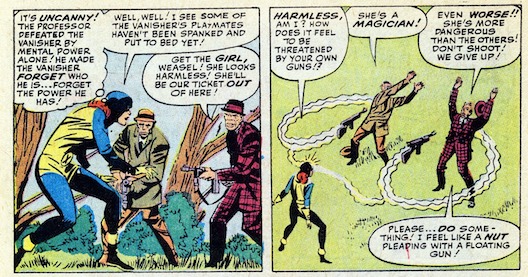
Plus, even if she’s relegated to the back of the first issue cover, Marvel Girl was set up as one of the stronger female characters of the era. The boys’ school reaction to her (essentially “yikes a gal” ) is best consigned to the past, particularly when their spying on her is played for laughs. Yet she’s presented both as powerful and as composed by nature, insisting “I’m not exactly helpless, as you can see.” (Or see the sequence below.) And the Marvel universe often took powers as manifestations of personality. (And she raised the bar. In ’Fantastic Four' 22, Jan ’64, the Invisible Girl’s powers were beefed up essentially by copying Jean’s, just with “psychic” relabelled as “invisible”.)


So, despite their major differences, both series leant heavily into psi powers. And indeed this was part of a general growing interest in such phenomenon through much of the Sixties and Seventies. Both hint heavily these come about through modernity itself. As mentioned last time, ’X-Men’ gestures at atomic radiation. Whereas the opening sequence of ’Tomorrow People’ shows Stephen ‘breaking out’ into his powers via almost breaking down, beset by a cacophony of thought voices in busy central London.

Ostensibly they just trigger, rather than cause, his change. But you can’t imagine the same event in reaction to a Seventeenth century hamlet. There’s the subliminal association of all those voices with mass media broadcasts, reminiscent of the line in the Hawkwind song ’Psi Powers’: “It’s like a radio you can’t switch off.” And the celebrated title sequence, a series of objects flying out at the viewer, could be said to represent the hurtling pace of modernity.


The trope’s often explained by referring to a equally growing interest in anti-materialist New Age claptrap about the Age of Aquarius. And in the first TP story their antagonist Jedikiah poses as a New Age guru. This was a time when the the pseudo-science of parapsychology was taken surprisingly seriously. The interest wasn’t just confined to popular culture but extended to official research. Even the CIA were getting in on it! ’Tomorrow People’, for its part, boasted in its credits of a scientific advisor!

But these all seem not causes but mutually occurring symptoms, coalescing around something else. Unlike the New Agers, we need to find something more material…

The first microchip was made in ’59, though as ever it took a few years to establish its existence. Which signified a wider change, where buttons to press slowly replaced levers to pull. It’s one of the classic transformative devices to be almost entirely unanticipated by the prophecies of science fiction, which carried on blithely believing better always meant bigger.

But once that rule was broken technologically, a ripple effect reached the human. Perhaps future generations might not need biceps to shift the couch or vocal cords to call across rooms, maybe they’d be able to do all it just by thinking hard. It worked in the same way that x-ray and radio technology had in their day stimulated an interest in mediums, by popular association. And it created an era where mind seemed to trump matter.

Conceivably this also lead to the trope of the computer as character. It’s hard to precisely pin this one down as it overlaps so much with the talking computer, which just receives and confirms orders out loud. But Zen in ’Blake’s Seven’ (1978/81) was even made one of the titular band. And the “biological computer” Tim, still more than Zen, is very much a character, one of the gang.

But how, I hear you ask, do these two scenarios play out in terms of stories? Tell you what, let’s look at that next time…

Saturday, 19 February 2022

FROM MONSTERS TO MUTANTS: X-MEN VS. THE FANTASTIC FOUR


In this first part of our new series Mutants Are Our Future, we hold up the first issues of ‘Uncanny X-Men’ and ‘The Fantastic Four’, the better to compare monsters to mutants

”It Ain’t Human!”

Mutants, when did they change? When did they stop being scary distortions of human form, who hung about in forbidden zones with backwards Rs on their signs and especially hankered after half-dressed blondes? In the 1955 film ’This Island Earth’, for example, ‘Mutant’ is really just science fiction for monster. So when did these monsters switch to become the next step in human evolution? Which turned out to be developing super-powers while wearing flashy latex.


A significant part of that shift was Sixties Marvel comics. In fact it started with one title - ‘The Uncanny X-Men’, debuting in 1963. I often find people insisting that this was the point where superhero comics hit on a potent metaphor for racism. But as we’ll see the reverse is closer to the truth.

’X-Men’ 1 came with the cover catchphrase “in the sensational Fantastic Four style”. It was the second Marvel super-team to be cut from whole cloth (‘The Avengers’ having been assembled from existing characters) and unsurprisingly cribbed from its 1961 predecessor. (In at least one account of events, publisher Martin Goodman noted the FF was selling and told his charges “do another one”.) 

Reed Richards is essentially split into two characters, Professor X and Cyclops, the brainiac boss and the sober-minded field leader. While the feuding horseplay between Ben Grimm and the Johnny Storm is transferred to Hank McCoy and Bobby Drake. Bobby, like Johnny, is the youngest team member. The fire-powered one is replaced with Iceman, like that reversal of elements might be enough to conceal the copy. In a similar vein, McCoy’s Beast would later name-defyingly spout thesauruses in his speech balloons. But they hadn’t come up with that yet, so here he even sounds like the Thing. (His first line is “leggo my arm, you blasted walking icicle.”)

And the books start out structurally similar. The Hulk begins with Bruce Banner, and we go on see how he became big and green. Spider-Man starts with Peter Parker in High School, Thor with Dr. Donald Blake and so on. But with both the FF and the X-Men we’re thrown straight into the action. It’s as if we just walked up to Xavier’s school window and peeped in. Characters and concepts don’t get introduced like on your first day at work, they just appear and leave you to catch up.


It’s a more common way to introduce villains than heroes, for them to rear up at us for shock value. In fact it’s just the way Magneto gets introduced, later in this same issue.

Though the reason for this probably differed. The FF were the first Marvel book, with no norms established, so trying to draw in the reader with a baiting opening was a virtue found in a necessity. And the X-Men couldn’t start with their origins because… well, they didn’t have any. As Marvel’s first mutants, their super-powers just manifested. (Lee later confessed he’d chiefly come up with the notion so he didn’t need to concoct a new origin story each time.)

But these similarities just shows up deeper differences between them. We see the FF become the Fantastic Four separately, each individually set against the great American public. We see the X-Men assemble in their school, and go through their motions. In short the first time we see the FF the thing that’s stressed is their effect upon humans. And with the X-Men it’s their team bond. Like the FF the X-Men are an honorary family. Yet as we get to witness, the FF knew each other before the ill-fated rocket expedition. The X-Men come together precisely because of their mutant status.

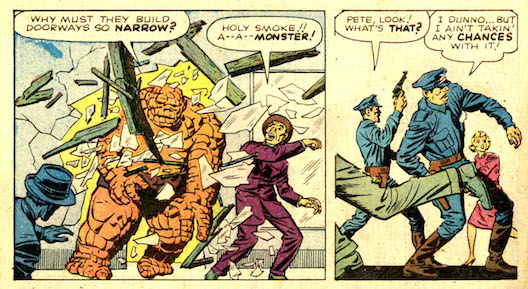
And the first public reaction to the FF is not the admiring public watching Superman perform a fly-by. Its horror and fear, the reaction to monsters. Let’s focus on the Thing who, alongside the Hulk, was the most monstrous Marvel hero. As he smashes his way out of a shop doorway (leaving you wondering how he ever got in), someone cries “Holy smoke!! A - a - monster!” and a cop starts shooting. Later someone adds “It ain’t human!”


Though it’s hard to think back to this now, for the original readership this was their first sight of the Thing. Their reactions would have been much the same as the characters in the story. Not “here’s our hero”, but “a - a - a monster!”

Superheroes might transform their appearance, like Captain Marvel. Essentially Johnny Storm does this with his “flame on!” But Ben Grimm is stuck as this feared monster. Later stories featured Reed’s perpetual attempts to cure him, which (spoilers) always prove short-lived.

In fact the one person the Thing seems to have something in common with here is the villain, the Mole Man. Whose lumpen looks have led to him being shunned by society, hiding out underground with other monsters for companions, like it’s the world’s basement. “Even this loneliness”, he concludes, “is better than the cruelty of my fellow men.” The monsters he (somehow) commands are probably best understood as ‘Forbidden Planet’-style projections of his rage. The story ends with his death (no, honest) and Reed concluding “there was no place for him in our world.” Takes one to know one, you can’t help thinking.


Both comic books were created by Jack Kirby and Stan Lee. (Let’s not get into who did what right now.) Who were but two of many comic artists of their day to be Jewish. Lee was younger but both had been through the Thirties and Forties, so would inevitably have come across a great deal of anti-semitic propaganda - where people like you were effectively monsterised. Just consider that a sec. You’re not just thinking “that’s offensive”. You’re thinking “this is how others see me.”

Then, add the Civil Rights era. It’s true that the racist image of ‘The Jew’ was different, possibly even opposite, to that of ‘The Black’. Associated with usury, ‘The Jew’ is not a real man who lives by honest labour. Kafka’s phrase "damned loathsome thing” perhaps sums this up. Whereas, stemming from slavery and still associated with heavy labour, the problem with ‘The Black’ was that he was *too* manly. He was required for his supposed size and strength, but feared for it in equal measure. But direct experience of racism naturally lent them to sympathise with other such victims.

Next, happenstance. This monsterisation went alongside an industry predilection for monster stories, not least at Marvel. (Thing and Hulk were names both already used for monster stories before their now-better-known versions.) So, feared and shunned for their size and strength, the Thing and Hulk become associated with the ‘super-predator’ fears of anti-black racism.


In some ways between the social groups of white and black, they are able to articulate the white man’s fear of becoming, and being treated as, black. It’s similar to John Howard Griffin’s 1961 book ‘Black like Me’, a white journalist’s account of travelling through the segregated South as black. (Which was filmed in '64, and generated so much hostility he later moved his family to Mexico.) Interestingly this device echoes the earlier film ‘Gentleman’s Agreement’ (1947), where Gregory Peck plays a white journalist who poses as Jewish.

It’s an incomplete metaphor, of course. The most widespread and pernicious form of racism, structural racism, is bypassed to (yet again) individualise the problem. And our modern sensibilities want to ask why, instead of getting a white journalist to essentially black up, to know what being black or Jewish feels like - why not just get someone to tell us who’s… you know… black or Jewish?

But it captures something of how racism feels, from creators who had themselves experienced racism. And it does it juxtapositionally - it’s about having monsterisation thrust upon you.

(And as times went on even white-bread DC comics got in on the act. In 1970, issue 106 of ‘Superman’s Girlfriend Lois Lane’ was titled ‘I am Curious (Black)', where she declares “it’s important that I live the next 24 hours as a black woman.”)


”Got to Make Way” 

So, how do mutants differ? In the first X-Men film, released in 2000, Professor X spells out the concept:

“Mutation, it is the key to our evolution. It is how we have evolved from a single-celled organism into the dominant species on the planet. This process is slow, normally taking thousands and thousands of years. But every few hundred millennia, evolution leaps forward.”

Though back in ’X-Men’ 1, Lee has still not entirely given up on his belief in the transformative properties of radiation. Here the great Professor says “I was born of parents who had worked on the first A bomb project…. I am a mutant… possibly the first.” Lee had previously loaded the Marvel universe with the stuff, springing up like whack-a-mole, always a flying canister or glowing spider for the unfortunate to run into. He now declares it all-pervasive. Functionally, of course, it’s still magic pixie dust mislabelled as science. Yet that upping of the ante makes a difference.

In ’The Creation of Tomorrow: Fifty Years of Magazine Science Fiction’, Paul A Carter points out “the nuclear bombs of 1945 inspired swarms of stories about radiation-induced human mutation, taking place no longer in race isolation... but in populations large enough to constitute substantial colonies. Authors could address themselves to the question of how such societies might function internally.”

And we see a version of that here. The Fantastic Four had stumbled into their super-powers, but by boarding the space rocket they had already chosen adventure. The X-Men, conversely, were simply born into changing times. Innate outsiders, they must build their own world. (Though the outsider schtick was at this point unevenly applied. In the second issue, the Angel’s held up from a mission by a mob of adoring girl fans, as if there was X-Mania afoot.)

Except there’s more… The formula is - radiation catalyses mutation, which in turn catalyses evolution. Evolutionary biologists are most likely sighing loudly at this point. But what concerns us here is the fictional applications. Popular culture tends to assume that evolution is teleological, that it’s essentially creation but without the God bit. Perhaps working more slowly but still towards some end-goal. Mutation then is evolution freed to speed up.

’X-Men’ 1 uses the term ‘homo superior’ once only. But that may have been enough to let the cat out of the bag. Because it goes on to be proclaimed quite openly as the trope advances, and particularly in popular song. There was Bowies ‘Oh! You Pretty Things’ (1971): 

“Homo sapiens have outgrown their use
“Let me make it plain
“You gotta make way for the homo superior.”


Radio Birdman then upped the ante still further with ‘New Race’ (1977):

“There’s gonna be a new race
“Kids are gonna start it up
“We’re all gonna mutate
“Kids are saying yeah hup”


(Everyone got that? “Yeah hup.”)

And what does this do but confirm the obsession of the most hardline racist - the ‘great replacement’ theory? Why are other people black or Jewish? Clearly to conspire against you and me!

Which is what makes mutation the single worst metaphor for racism. In racist conspiracy theories Jewish people are already in essence super-villains - masterful, elaborate schemers, secretly in control of everything. And not just more folk holding down regular jobs, like they actually are. Whether heroes or villains, mutants… well, they quite clearly are different to you and me. The X-Men’s Magneto was retconned as Jewish. Out of the Jewish people I know, not many can bend metal with their mind…

(Perhaps most bizarrely, as the series progressed Professor X’s mind control powers were more and more employed. Though more than once he’s wheeled out as a deus ex machina device, mostly they’re used to re-establish plot stasis; at each issue’s end he’ll wipe the memories of those who’ve learnt of the X-Men’s existence. Which seems to skate remarkably close to anti-semitic tropes about the seemingly physically weak who manipulate their world, conceits about the “Jewish-controlled media” and all the rest.)

But what’s a lie about race is a self-evident truth about age. One generation does replace another. And what was the other great sociological event of the Sixties, alongside the Bomb and Civil Rights, but the generation gap? Which proved perhaps more rupturing. Adults aren’t just party poopers, telling you you can’t use the car cause you didn’t work late. Now, in Dylan’s words, “Your old road is rapidly agin’/ Please get out of the new one if you can’t lend a hand.” When Prof X. says “there are many mutants walking the earth… and more are born each year!” it presages the later hippie saying “there’s more of us being born and more of them dying.”

Most people work out sooner rather than later that ‘breaking out’, as it’s called on the (upcoming) ‘Tomorrow People’, where your powers suddenly manifest unexpected and inexplicable transformation, is a metaphor for puberty. And like mutation puberty feels like evolution speeded up. Physical changes such as growth seem to happen frustratingly slowly to the young child. Then with puberty it’s like you were suddenly zapped.

(Though it’s also possible to overstate the significance of this. I certainly bought into the concept of the Tomorrow People, to the point where I’d keep watching an average-at-best show, long before puberty. And the most puberty-related character of classic Marvel was not a mutant but Spider-Man, again often beloved by young children.)

”The Day of the Mutants”


The opening line, “in the main study of an exclusive private school”, makes the whole thing seem about as cosy as Harry Potter going to Hogwarts. The Angel seems to be identified as the posh one to stop us noticing they’re all the posh one. Yet noticeably, at this stage these teens are very much teens. They’re regular kids who happen to have powers, indulging in horseplay and (not the issue’s most edifying moment) going ga-ga over Marvel Girl’s arrival.

The cerebral nerds and band of outlaws comes later. (And Kirby in particular, having a rough blue-collar upbringing on the Lower East Side, would have had little inclination to identify with them.) Perhaps it’s just hard to unsee. But it still seems inexorable. This is a path that leads to ‘the geeks will inherit the Earth’. As Richard Reynolds has said: “Much of the appeal and draw of the mutants that comprise the X-Men has to do with feeling like an outcast while simultaneously feeling like part of a family.”

Many monster stories throw in a switch by showing us a horrific creature then asking us to identify with it. Mutant stories presuppose that identification. Because we’re primed to see ourselves as the special one. First, to the racist mind, whiteness is considered a form of evolution in itself. Blackness is associated with Africa, with primitivism, whiteness which progress. Science fiction often fetishises whiteness as an aesthetic. To this mentality, whiteness is already a mutation, a signifier of improvement.

Comic fans, commonly white and from comfortable backgrounds, can identify with this more than most. And inasmuch as it works as a form of anti-racism, it’s not one where white folks renege on their privilege. It’s one where we assume we will naturally use our special powers for the greater good, such is our benevolence. Black folks are still held to be not as smart as us but that’s why we should take it on ourselves to look after them anyway. It’s a means by which we can feel simultaneously superior and virtuous.


Perhaps because they’re neither teens nor nerds, Kirby and Lee seem to see this problem. And their solution is to acknowledge it by externalising it. Enter the X-Men’s foe, Magneto, exemplifier of “the evil mutants”. “The human race no longer deserves dominion over the planet earth!” he monologues. “The day of the mutants is upon us!” Unlike the Mole Man, nothing happens within the first story to contextualise his stance or make it even semi-sympathetic. He’s just like that, in the same way the X-Men are just not like that.

The FF’s first reaction to their powers is to get into an acrimonious fight, then place their hands together in a pledge. The X-Men fight too, but in what’s emphasised to be no more than juvenile horseplay. All the negative stuff gets pushed onto Magneto.

But a side effect of this mechanism is to marginalise the regular humans. We’re told the reason for the secrecy round the school is their fear and distrust. But unlike FF 1 we never witness any of this. The only humans we encounter are, briefly, the US Army. Who quickly give this strange-looking team their blessing to take on Magneto.

Furthermore, unlike the Thing all of the X-Men can pass for human when they need to. Even his nearest double, the Beast. The ability of humans, already restricted in scope to fearing and shunning you, gets diminished further. Even the American army is the equivalent of the heroine in a Victorian melodrama, there to be rescued.

And if villains are normally the return of the repressed, the Mole Man was our fault. We were the ones who sent him into the exile from which he burst back out from, monsters in tow. Whereas in this closed loop Magneto exists solely to be the antithesis of their family group, the kid who plays nasty because he’s so used to playing alone. The relationship is quite close to International Rescue versus the Hood in ’Thunderbirds’. All you’d really need for a perfect match would be Magneto engineering the crisis to draw the X-Men out.

Of course you can’t always tell the flower by the roots. The FF had, after all, already changed quite considerably in the intervening couple of years before the X-Men’s first appearance. (Let alone later.) Read the two first issues together and you get such strange sights as the Thing not yet talking like the Thing, while the Beast does talk like the Thing! At one point Magneto skulkingly hides from the X-Men, hardly how he came to be.

Nevertheless, as soon as coined mutants were everywhere. With the aid of retconning. “I??”, asked the SubMariner in issue 6. “A mutant?? Why has that thought never occurred to me before?” Possibly for the same reason it’s never occurred to me. Because I’m not one.

But the clincher comes in issue 3, where the Blob first wobbles in. He’s told he’s a mutant by the X-Men, as they think this will lead him to join them. Instead he uses his new-found powers to fight them. Except… well, it’s not his powers that are new. He’s already using them in his circus act. It’s knowing the word, having the label to stick on himself, which makes the difference. “For years I thought I was just an extra-strong freak! But I found out what I really am! I’m a mutant! Understand? I’m one of homo-superior! And that means I’ll run this show from now on!” To which the only solution is Professor X getting him to forget the word again.

And so us regular folk are forever sidelined, dismissed by the Blob as “rubes”. Except of course we don’t see the humans as us at all. We see them as them, the semi-hysterical rabble in the street scenes, the nameless extras in our lives, but not our special li’l selves.

The X-Men’s introduction emphasises their otherness. But from there, first our interest, then our identification gravitates to the mutants. The fundamental premise, that this stuff is written not for the common herd but special people like you and me, may be less upfront but is there from the start. Issue 15 ended with the payoff “even if you’re not a mutant you mustn’t miss” the next instalment.

Coming Soon! Even if you’re not a mutant you mustn’t miss the next instalment, our comparison of the X-Men to the Tomorrow People…

Saturday, 12 February 2022

THIS IS AMERICA (A PLAYLIST OF 80s/90s AMERICAN PUNK, HARDCORE + ALTERNATIVE)


My latest, and last, themed Spotify playlist… Captain Beefheart once quipped “I play music, too many work it”. Whereas these guys worked it, just in a way which made it work. First, they worked a stage. Music had to be new and original but still built from blood and sinew. And they took a blue-collar build-it mentality to gig circuits and distro channels, creating facts on the ground which the rock stars airily flew over. Even lysergic-spewing reprobates the Butthole Surfers (handily pictured) were harder-working than anyone in showbiz. They did it their way.

All the other playlists had a sample lyric. For this let’s pick NoMeansNo: “If I could choose to believe or not to believe, I’d choose not to… but I can’t choose…”

“This America, man” (sample from TV series ‘The Wire’)
The Avengers: The American In Me
X: Los Angeles
Black Flag: Rise Above
Bad Brains: I Against I
Mission of Burma: The Ballad of Johnny Burma
Dead Kennedys: Pull My Strings
Millions of Dead Cops: I Remember
Big Black: Pavement Saw
Alice Donut: The Song of Disgruntled X-Postal Worker Reflects On His Life While Getting Stoned in the Parking Lot of a Winn Dixie Listening to Metallica
Fugazi: And The Same
Flipper: You Nought Me
Melvins: Goin’ Blind
Minutemen: Do You Want New Wave Or Do You Want the Truth?
King Missile: Take Stuff From Work
Lard: I wanna Be a Drug-Sniffing Dog
Ignition: Anger Means
Girls Against Boys: Bullet Proof Cupid
At the Drive In: Chanbara
Nation of Ulysses: The Kingdom of Heaven Must Be Taken By Storm
NoMeansNo: Rag ’N Bone
Butthole Surfers: 100 Million People Dead

PS Should anyone be bothered about this… yes, of course Neil Young and Joni Mitchell are right. No of course there’s not a ‘right’ to spread dangerous and pernicious misinformation for your personal enrichment, and they people telling you there is don’t really believe it either. And I still say, as Patti Smith once put it, people have the power. But me I’m just a person. And me pulling my little playlists would be gnat’s bite which Spotify might survive.

Saturday, 5 February 2022

“HOME MADE CONNECTIONS”: IN PRAISE OF FAUST


“Another one! What's the matter with everyone, wanting to make a museum piece out of Dada? Dada was a bomb... can you imagine anyone, around half a century after a bomb explodes, wanting to collect the pieces, sticking it together and displaying it?”
-Max Ernst

Burning Rules Fuel Their Fire

Nobody Knows if It Ever Happened’ was the title of one DVD of the great Krautrock band Faust. Which about sums it up for me. For they had long seemed creatures of legend, scarcely less so than the folklore figure they were named after. Had they ever actually happened or were they more like Captain Swing and Ned Ludd, whose influence had been vast but who existed only in the telling? For in my day you couldn’t get hold of their records, and it had taken all my ingenuity to get some stuff taped from friends. And so they seemed not just an inventive band, to my eager mind they came to represent untrammelled creativity itself.

There were sometimes groups of kids at school, always in older years than me, who looked not just cool, not just smart, but ahead. As my classmates bragged and fantasised about fast girls and hot cars I’d gaze at them across the age gap, imagining the places they’d been before me, picturing them casually making conceptual breakthroughs which left others stymied, feeling that they weren’t just sharper than me but more alive. I’d dream of joining them, while knowing I could never keep up. By the time I was a year older, they’d be even further out. And that’s how I came to feel about Faust.

Then, quite out of the blue, 2001 brought my first chance to see them.

I knew nothing at all about their post-reformation existence and was conflicted over going. What if you got to see creativity ltself, only to find it creatively spent? It would be like going out for a drink with Bacchus, only for him to yawn and announce an early night. In fact, as the first old hippy climbed on stage I found myself with a sinking feeling. A few seconds later I was enthralled.

Their attitude seemed to be: “Everything you thought you knew about making music, we shall now tear it to shreds before your eyes.” Burning rules were the fuel of their fire. I walked home through a mighty windstorm, which my over-stimulated brain started to parse as something conjured up by the gig, Prospero-like.

Their third album, ’The Faust Tapes’, was famously compiled from their home studio work tapes, somewhere between a precis, a collage and an aural sketchpad. But, as it flies from one bonkers notion to the next, knowing neither rest nor mercy, in a sense all of Faust is just an extended version of this. It may not necessarily be the best Faust album, but it’s the *most* Faust album. It’s like Faust to the power of Faust. So if it’s the best-known Faust album, that’s probably the thing working as it should.

If Black Sabbath’s power riffing was like a neolithic stone axe, something which worked for centuries without need of improvement, Faust are like a Swiss army knife. Well, whatever the German version is, anyway. Unrelentingly inventive, they can seem to point in every conceivable direction at once; styles and approaches which other bands could have built whole careers from are taken up and discarded again within minutes.

A while back, I talked myself into writing a series on my Top 50 albums. With Can I did have some trouble choosing between ’Monster Movie’ and ’Tago Mago’. (My final choice lies here.) With Faust, like a kiddie in a sweet shop I found the whole deciding business impossible and just had to give up on it. More Faust music just adds to what existed already, like one of those ever-expanding Kurt Schwitters environments that straddle rooms.

At War With Good Taste

Krautrock was the first popular music movement to be influenced by Modernism, and this collage approach was a clear descendent of Dada. Can had their tape-splicing moments too. But reduce them to their essence and you’d have five guys in a room playing together. Whereas Faust live in the edits and splices, the zigzags and joins, the brazenly audacious segue, their spirit residing not in the cloth but the stitch marks. They’re more in the spirit of Raoul Hausmann than the Rolling Stones.

Dada was audacious and iconoclastic, but contained an ambiguity which it held close. It was wilfully negative and ruthlessly destructive, it offered no answers and scorned those who claimed they did. Yet the anti-art they created was more vital, more real, and in many ways more artistic than most so-called art. Bakunin’s celebrated dictum, “the urge to destroy is also a creative urge”, wasn’t coined about Dada, but could have been.

Similarly, when Faust took the history of music as fodder for their shredder, the same ambiguity arose. Was music to be found everywhere, in each and every chance combination of sounds, as John Cage had long insisted? Or was it to be found nowhere, a house of cards that had long needed blowing down? It’s the dichotomy at Dada’s heart which they willing reproduced, deliberately left unresolved, and served up to confound and disorient a whole new generation.

Words are one example. This was the time Rock music was first insisting its lyrics were meaningful, man, and diligently transcribing them on album sleeves for home study. Faust responded with fervent Dada nonsense poetry - “Daddy, ate the banana, tomorrow is Sunday!” - delivered with fervent urgency.

Most German bands sang in English, the lingua franca of rock music. Faust gave main singing duties to Jean-Herve Peron, who was French. And they commonly toured both Britain and France, finding a better reception than back home. But listen to the combination in ’Jai Mai Aux Dents’ - the backing vocals complain in French, alternately of a pain in the teeth and the toes, while the lead vocals make no more sense in English… it feels like something of a mission statement. (Post-reformation Faust would expand the range still further, to Polish, to Japanese and more.)

And multiplying and overlaying languages as a means to reduce the whole thing to a babble was a Dada device, going back to the founding Cabaret Voltaire. The repeated breathless intonation of those backing vocals gets repeated mantra-like until it becomes just part of the music, rinsed clean of meaning, sonic mulch.


On the original ’Faust Tapes’ cover, were the two sides intended as a visual comparison? Between those teeny lines of text and Bridget Riley’s black-and-white Op Art, word reduced to image? No? Just me then…

And, perhaps above all else, Faust inherited Dada’s sense that the driver of everything should be humour, particularly that infectiously irreverent brand of humour. They weren’t doing what they did to create great and lasting works of art, they were doing it because it was fun. And why wouldn’t you want to make what you were doing fun? That live gig where I first saw them involved such pranksterish events as half the band holding down a metronomic grinding noise, where the other half ran around the audience with megaphones, bellowingly advising us not to worry as (in their own words) “this is just a test.” The next gig they held aloft a goldfish bowl while intoning solemnly “listen to the fish”.

Modernism had long passed from cultural threat to heritage industry, something else to stick on tea towels. But Dada was set against making itself so palatable, and while great reassemblers Faust were never citational as so many others had been. What they inherited was the irreverent spirit of Dada, not its detritus. 

Andy Wilson’s ’Faust Stretch Out Time' is in all honesty not a great book. But it does hit on something important: “Not afraid to go the whole hog in their assault on instrumental reason, they share with punk and early rock and roll a love of the purely negative, the primitivism and hooliganism progressive rock wanted to repress as messy and demeaning.”

So, even as Faust assembled crazy sonic collages, they had the insight that Dada and rock music didn’t need stitching together in a shotgun marriage, that they could find the Dada in rock music and vice versa. Both were a visceral assault on the senses, both were at war with good taste. As Hugo Ball said of Dada: “Every word that is spoken and sung here says at least this one thing - that this humiliating age has not succeeded in winning our respect.”

Rock music… even mainstream Rock music was always supposed to have something absurd about it. Mick Jagger’s prancing on stage, the sort of thing they might make into a BBC4 documentary these days, was absurd and was meant to be taken as absurd. The absurdity was beloved to us but also necessary, a skin of prickles to inoculate ourselves against being absorbed into mainstream culture. We didn’t want them to start taking us seriously. We wanted them to stop being able to take themselves seriously. And Faust just upped the ante on all that.

(Look back at that list of characteristics and the band most akin to Faust wouldn’t be Can or even another Krautrock outfit, but Boredoms.)

I would swear to all the above on a stack of Bibles. And yet…

Their Home The Borderlands


And yet Faust were well-known for their innovative album sleeves, almost as much as for their innovative music. Which, despite their Dada debt, weren’t at all collagey and overloaded, but stark, minimal and modernistic. Less akin to Frank Zappa, for all that they were fans, closer to the Velvet Underground.

And there was always that side to Faust musically, where tracks could be just great slabs of sound. They most obviously exulted in the glow of the held-down chord on ’Outside The Dream Syndicate’, the album they made with Tony Conrad, but it’s an element that was always there. When they wanted, they could be as serene as they were deranged. A German Swiss Army knife, remember?

And yet we’re still not done with the “and yets”. Faust weren’t a band to play by anyone’s rules, including their own. Though often portrayed as irrepressible mavericks, who blasted off for lands unknown, it would be more accurate to say that they hit a sweet spot. In something which they do share with Can, they proved remarkably adept at writing great songs packed with catchy hooks, better in fact than most who think of that as their day job. Faust could combine being insanely catchy with being just plain insane. (Presumably how, combined with manager Uwe Nettlebeck’s patter, they were able to sucker Polydor into signing what they sold as “the German Beatles.”)

However influential Krautrock became, individual tracks are rarely covered. Perhaps some Kraftwerk numbers, showing how far from their roots they ranged. Radiohead did Can’s ’Thief’, but they’re dreadful so it doesn’t matter much. Whereas Faust songs have seen covers. Simply because they’re such great songs! ’Baby’ is a swipe at a Sixties pop song and a perfect pop song at one and the same time, much like the Fugs’ ’Crystal Liaison’ or Zappa’s ’Let Me Take You To the Beach’.

It was like they operated from some secret lair which lay between the wild country of free impro and the ordered Kingdom of songwriting, and, innate outlaws, regularly staged bandit raids into both. Their home turf was the borderlands. You learnt you couldn’t expect anything from them, not even the unexpected. Take the opening of ’Rainy Day Sunshine Girl’, where a metronomic industrial grind transforms before your ears into a catchy song, without you ever being sure exactly when or how it does it.

(For that reason I’m less keen than others on their first album, which maxed out on sound collage and minned out on songs. Rush-written to placate an anxious label, it has a faintly homework-done-the-night-before vibe.)

As we’ve seen, and like most music scenes, Krautrock came from a specific time and place. Inevitably, what gave it a birth also gave it a death. Many of those involved went on to other great things, but they were other things. Yet Faust packed up, then picked up again fifteen years later, right from where they’d been. And continue today, undeterred by the blandness and homogeneity of our times. You can’t kill the spirit. At least, not *their* spirit…