googlee7ea825f63edb3f6.html

Saturday, 5 December 2020

‘WILLIAM BLAKE’

Tate Britain, London

“I will not Reason And Compare, my business is to Create"
- Blake


Irreducible Strangeness

The last London Blake show, also at the Tate, was in 2000. In art history terms that’s but a blink. (And woe betide any wag who suggests it’s that earlier show I’m covering here!) Which suggests two things; that he’s now thought of primarily as a visual artist and that he’s become a fixture of the gallery circuit. The first seems unsurprising, those dense epic poems not exactly working for the world of text messaging. But why the second?

As the show says: “He has inspired many creative people, political radicals and independent minds”. And, at least in part, Blake is so totemic because everyone feels free to invent their own Blake. He’s become a human scrying glass, into which people peer in order to see what they want. And what people normally want is validation, the scrying glass to show them that their personal ideology is the fairest of them all.

The previous show I had to queue up behind some berk in a UKIP T-shirt, presumably having his own visions of getting our Albion back from all that foreign Modernism stuff subsidised by the EU. And indeed some see the author of ’Jerusalem’ as a part of “our culture”; which they’re capable of seeing only in terms of heraldry, a shining piece of precious only slightly less lustrous than Shakespeare. 

While to political radicals he’s rebel and visionary. Jim Morrison for example, named the Doors after a Blake line. And Matthew Collings came and saw “a Jeremy Corbyn god roll[ing] a sun along the ground as if he’s rolling away Boris Johnson’s no deal: a British lion laughs.”

And I should know. Delightedly discovering him during my A-Levels, I pictured a combination of proto-rock-star, whose innovative work and unconventional lifestyle shocked and challenged the Establishment; nascent comics creator, who daringly merged words with images; and incisive political thinker of an anarchist bent. In short, John Lennon, Jack Kirby and Kropotkin rolled into one convenient package. I quote-mined Gilchrist’s biography for evidence of this, disregarding the rest. (Which was most of it.)

Blake can be made such a scrying glass because he offers no system of thought of his own, allowing you to impose yours upon him. He can often affect the opposite, making grand and proclamatory statements, swoopingly dismissing widely held orthodoxies as mere folly. And he was notorious for being fulsomely opinionated in conversation. But to assume he is to be decoded, let alone that you alone hold the key to that code, is to miss him altogether. He was not doctrinal but an inchoate visionary, a latterday hedgerow priest living from vision to vision.

In his Blake biography, Peter Ackroyd acknowledges “he was, above anything else, an artist and not an orthodox ‘thinker’: he was attracted to images or phrases as a means of interpretation, and never espoused a complete or coherently organised body or knowledge.”

His philosophy would be better thought of as an anti-philosophy, a distrust of systems which he constantly compared to mere physical mechanisms, machine thought for a machine age. One of his more famous lines was “the bounded is loathed by its possessor”. So why on earth try to bind him? Such a large part of his appeal is his irreducible strangeness, where his works look mystical to their very marrow. Why would you destroy what you love just to have it as a keepsake?

However if there is no Blake in the sense of a body of doctrine, that doesn’t mean there is no Blake. It’s just that trying to ‘get’ Blake isn’t going to get him. Most artists don’t exist in that sense, of being philosophers or political theorists. They’re no better placed to explain what they’re doing than anyone else. But private obsessions drive them, and they look around themselves with a magpie eye for inspiration. In trying to come to terms with them, we’re more analyst than dutiful reader. We do all this with other artists without thinking about it much, and need to do the same for Blake.

Were he to somehow attend this show, it would probably seem to him a strange irony that he was finally appreciated, but in a post-Christian society. Yet he saw the Bible as a fantastical work, stuffed with dreams, apparitions and prophecies, not a repository of instruction designed to instill a shopkeeper morality. (Arguably, much of what he wrote was Bible fanfic.) We should read him the way he read.


The show sticks Blakean lines up on the walls, such as “sudden I beheld The Virgin Ololon and adress’d her as a daughter of Beulah”, above works such as ’Visions of the Daughters of Albion’ (1793, above), then has the common sense to announce it doesn’t intend interpreting any of this. Equally wisely it goes to some lengths to reconstruct the Blake of his time, at times literally - reproducing the whole of his 1809 solo show. (Held in his family house.) And locating him matters.

The Old, Weird Britain

All this claiming of Blake, arguably that started during his life. In all likelihood with Blake himself, as he wasn’t short on self-importance. But the first discernible movement was the Romantics. To who he was so beloved that some habitually kissed the bell-handle on his door. And arguably their imprint on him remains the deepest. Certainly it’s the longest, with the Tate’s page on Romanticism illustrated by a Blake.

True enough, like the Romantics, Blake reacted against the increasingly mechanised and mechanistic world of the Industrial revolution. Yet…

It might seem redundant to criticise the Romantics for romanticising things, but there’s no real way around it. And one of their chief romanticisations was their conception of the true artist, the genius-savant who owes nothing to the society around him, who pursues his own private visions in its face. And Blake was, or seemed, the perfect person to project that figure onto, working in near-isolation, either ignored by critics or dismissed as “an unfortunate lunatic”.

And there is some truth to this. Financially, he was almost entirely dependent on patrons. Which went, in a word, badly. Perhaps there is an inherent tension in the sympathetic commission, where the payment is made as a gesture of support to the artist but also in the expectation of you getting back something you want. If so, it was a tension Blake had an unerring ability to locate and repeatedly prod. He had a private muse he could do no other than pursue, at times against his own best interests.

However the parts which didn’t fit, such as a six-year training at the Academy which seems to have passed without major incident, they went the same way as my reading of Gilchrist. (It should be noted how they also venerated the pre-industrial past and women in the same way, as something mystic and otherly, best worshipped from a respectful distance.)

Then there’s the chronology. Romanticism’s kick-off is usually seen as 1798 with the publication of the ‘Lyrical Ballads’, poems by both Wordsworth and Coleridge. Wordsworth was then twenty-eight and Coleridge two years younger; Blake was already forty-one. Though most imagine him a Victorian he was a Georgian, a contemporary of Gillray. (They’d even studied together at the Academy.) And unlike them his background was not at all bohemian, but artisan.

While we tend to forget this it was self-evident at the time, of course, and so soon fed into the scrying glass. It became evidence of his great originality that he’d been a Romantic before there was even Romanticism, a John the Baptist in the artistic wilderness. His followers called themselves the Ancients, emphasising his age.

But mostly there’s nature. A central tenet of Romanticism was the interest in Nature as subject matter, rather than mere pleasing backdrop. But Blake rarely drew from nature, and while he did draw inspiration from this world it came from his native London more than the countryside. While acknowledging “Wordsworth loves Nature”, he added his own rejoinder - “Nature is the work of the Devil.” As Ackroyd has said: “Blake… regarded Nature as no more than the Mundane Shell or Vegetative Universe that was the vesture of Satan.”

In fact this prophet, this supposed harbinger of future artistic and social trends, spent much of his own time looking back. His troubles with sales were due to with his subject matter and temperament (both difficult), but largely with his style being seen as archaic and anachronistic. His heroes were Raphael and Michelangelo, not the then-fashionable Reubens and Rembrandt, who he disdained. He promised “the grand style of Art restored”. Aesthetically, he seemed less outsider than throwback. If we’re to get Blake, even a little, we need to look where he was looking - and he was looking back.

A Dissenter Among Dissenters

Another among the many groups who have claimed Blake are the Anarchists. Literally the first book I ever read on politics, about the time I was first reading Blake, was George Woodcock’s ’Anarchism’. Which stated in its opening section “mystics and stoics seek not anarchy, but another kingdom. Anarchism, historically speaking, is concerned mainly with man in relation to society.”

Which seemed clear-cut at the time. Yet Blake rides his fiery chariot through the firewall of that distinction. It wasn’t just he wanted social change and another kingdom, he saw the two as inextricable.

If there was a long period where Blake was effectively a prophet in the wilderness, in his younger days he was directly connected to a radical tradition. A tradition arcane to us now, an old weird Britain. You could call it Dissent or Nonconformism, and let’s not concern ourselves about the distinction.

As EP Thompson said in ’The Making of the English Working Class’: “Against the background of London Dissent, with its fringe of deists and earnest mystics, Blake seems no longer the cranky untutored genius [but] the original yet authentic voice of a long popular tradition.”

It’s not quite true to say Dissent originated in the English Revolution, inasmuch as there was a causal relationship it was the other way around. But the Revolution incubated and stirred it up, linked social change to another kingdom. The restoration of the monarchy had arguably settled the question, consolidated in the Church of England, in the way that centuries later the post-War consensus arguably settled political differences. But Nonconformism was by definition those who found this a compromise too far, and stayed outside the established Church.

In practice this was more a milieu than a specific group with Wikipedia listing a somewhat bewildering eighteen groups, including Grindletonians and Muggletonians. (Dissenter groups manage to sound esoteric and provincially English simultaneously.)

Though, rather than being some vow of rebellion, Blake’s Dissenting was originally passed on to him by his parents. In fact, in their quiet independence they were more typical of the breed. Wikipedia points out that “Nonconformists in the 18th and 19th century claimed a devotion to hard work, temperance, frugality, and upward mobility” which made it a natural choice for shopkeepers and tradespeople. Religion was considered a matter of personal morality, rather than political conviction. The world around you was fallen, but you did as best you could. Everything fell back upon the individual.

But the twin events of the American (1765) and French Revolutions (1789) stirred up Dissent once more, rekindling memories of what had happened in England. It’s significant that Blake adapted both Bunyan and Milton, both radical Dissenters of their day. And of course taking this path made him a dissenter among the Dissenters, a nonconformist among Nonconformists.

Yet he went on to live through the time after that, after the Terror and war with France, when revolutionary favour diminished and quietism came to dominate Dissent all over again. The effect was to increasingly mystify the past, even as he still drew from real traditions. He’d said “The Nature of my Work is Visionary or Imaginative; it is an Endeavour to restore what the Ancients called the Golden Age”. And the myth of the Edenic past becomes associated with the notion of a repository of vital but lost knowledge, forgotten but recoverable, perhaps a whole ur-language.

Where Word Meets Image
 
Blake was aesthetically no Romantic, not just in the sense of his approach to nature but also naturalism. Though often dramatic his art is made up of tableaus, in which figures stretch and contort themselves into grand gestures, poses they then hold for our information - much as policemen do when directing traffic. When they’re also called upon to convey urgency they become at once hieratic and histrionic; often with unintentionally comic effect, even if you’re not supposed to say so. See for example ’The Body of Abel Found by Adam and Eve’ (c. 1826/7, below).


And this was the era when all that was starting to be challenged. There’s two versions of a print of Chaucer’s Pilgrimage to Canterbury, one by Blake (1810, below) and another his contemporary Stothard. Blake neatly arranges a linear procession, every horse’s head pointed forwards. You almost await the identifying labels on white scrolls to attach themselves to each figure.


While Stothard naturalises his, filling it with incidental detail. By any criteria Stothard’s is the more modern, all of which led to Blake loudly decrying it. Through a complex set of reasoning, not necessarily involving reason, Blake had come to believe the commission was rightly his. But if that stirred up his anger, his negative comments were consistent with his general views on art. He disliked anything which might distract from the central idea.

Art history would tell us to look to Stothard, as he was at the start of something new, and past Blake. But if Blake was in a tradition he was doing something unique with it…

Trained as an engraver, etching and pressing his own work made a material difference. As he commented “Milton and Shakespeare could not publish their own works”. But it was more than that.

His relief etching (etching in negative image), began in 1788 with ‘The Book of Thel’, and there’s a real sense that Blake as we know him begins only here. Crucially it allowed him to add his handwriting to printing plates. (Accomplished by writing backwards, the reversal them reversing once printed.)

To quote Ackroyd again: “These are not poems… these are discrete works of art in which the words are only one element in a unified design.” They’re often compared to illuminated manuscripts of the Bible, but there’s an important difference. Those “illuminations” might enhance the Bible’s text but it is complete without them. Whereas here we need both to get the complete work.

Further, the connection between text and image is often not direct enough for us to see these as accompanying illustrations. They’re more like two parallel channels which spark off one another like musical lines in an overall composition. Let’s take plate five of ‘America A Prophecy’ (below) as our example.


And we can see what he looks like without this combination, because some of his commissioned work lacks it. For example ‘Elegy Written in a Country Church-Yard’ (1797/8, above) has conventionally typeset text. And the Blakean alchemy immediately dissipates, images transform back into illustrations, servants to the words not their siblings.


Ackroyd says: “It is as if he could not see words without images, and images without words; in that a sense he returns to a much earlier sense of language as imagery.” This is evident in ‘An Allegory of the Bible’ (c. 1780/5, above), based around figures ascending steps. It might seem a timeline of progress from earth to heaven - child to adult to brighter-coloured beings of spirit. Atop the whole thing is the expected radiating figure, but instead of God it’s a book. If spirit is raised above flesh, word is then raised above spirit. (The title was admittedly added later, but it seems to fit.) And it’s notable how book images abound, books often appearing recursively within books.

We perhaps shouldn’t over-emphasise this. Blake often made prints without words, sometimes taking earlier designs and removing the words. Most likely because they looked less daunting, and so sold better. But they can be as Blakean as anything else here, supplying some of my favourite works from the show.

Then again that might simply be because they worked better here. We still don’t have a place for Blake in quite a literal sense, hence we try and stuff him into an art gallery and hope that does. The show manages the best it can, putting up plates in sequence with the text intact. But once they are up there, framed on the wall, you inevitably focus more on the images.

In the rush to examine his text/image combinations, his sense of colour is often overlooked. Vivid, non-naturalistic, they exude much of the mood of his work. Ackroyd again: “these are colours which seem to be not of this earth, but of that imaginative landscape he carried with him everywhere.” His prints have a grainy texture which, when applied universally, de-differentiates the figures from their backgrounds.


We can see this in ’Nebuchadnezzar’ (1795/1805, above) which, as well as turning the title character into a wild animal, with clawed foot and trailing beard, also seems morph him into his own background. Some mythologies make no distinction between their Gods’ bodies and the landscape they inhabit, they didn’t create the world so much as it's composed out of them. And there often seems an echo of that in Blake.

Symbols Raised

Symbolism arrived even later than Romanticism, and so there were none to hang round Blake’s bell-push during his life. But at least in approach they inherit more from him. The Symbolist Manifesto, issued in 1886, declared their interest in “real world phenomena“ only as “perceptible surfaces created to represent their esoteric affinities with the primordial Ideals.”

Then, as so often with Blake, we need to push this notion further, into a kind of Neo-Platonism. And as Matthew Collings points out in the Standard, Blake’s compositions are “only assemblies of signs. It’s nothing like reality… for Blake the only real thing is imagination.” To Blake its the symbols which are the real things; we’re just their imperfect copies. They’re the bright colours, we’re the pallid shadows. (In the sense of where art is in relation to us, Malevich is much more in Blake’s lineage than Constable.)

It might be objected that Blake was not ascetically disengaged from the world, communing only with angels. If nature offered him no inspiration, his native London was full of it. But he took these sights only for their symbolic value; he ‘read’ London as if it were a text, extracting meaning from it. Ackroyd again: “What Blake saw was not the crepuscular and dirty city of the historian’s imagination, but a city filled with angels and prophets. He saw a biblical city.”

Blake wrote in ‘Milton’ “every natural event has a supernatural cause”. Our reality follows from this intense, heightened world. But not in the consequential sense of mainstream Christian doctrine, where Eve ate the apple so now we live in a fallen world. That would make our reality a fait accompli. Though the world he depicts feels in many ways primordial it’s also volatile, its effect upon us not fixed or determined but in a state of eternal flux.

As Ackroyd says: “[in] his Prophetic Books… various faculties and aptitudes are engaged in a constant battle for supremacy.” More than “first this, so then that” it’s the alchemical doctrine of “as above so below.” This heightened world is above, in the sense of more important than, ours. Primal forces clash and re-clash in it, sending their shifting shadows down to us.

As Ackroyd puts it, “his belief that the dimensions of material existence are a prison from which we must escape and that the human senses are a degraded and pitiful residue of eternal power.” The world is not fallen because of events which happened before or above it, it is fallen because it is the world, because it is merely material.


‘Elohim Creating Adam’ (1795, above) is striking because it’s so unlike Michelangelo, despite him being one of Blake’s heroes. God is shown across a supine Adam, holding him down, their eyes not meeting, a snake already wrapped around his leg like bounds. In modern parlance the image is ‘rapey’, suggesting God imposed physical form on Adam as an act of violation. It’s very similar in composition to ‘Satan Exulting Over Eve’ (1795). This is God as the demiurge, trapping man into the confines of physical existence. Though here called Elohim Blake also gave him the name Urizen, thought to be a homonym for “your reason”, as the tyrant creator.


We see Urizen in ‘The Ancient of Days’ (1794, above), a strong enough image to make it onto the poster. His lowered hand seems to expand into the compasses as much as hold them. He’s not just circumscribing what he creates, for him to create is to circumscribe.

Blake wrote in ‘The Everlasting Gospel’ (1918) “Upon his heart with Iron Pen/ He wrote Ye must be born again.” (Though in that case it’s Jesus forewarning a Pharisee he hasn’t got it and so, translated into Buddhist terms, remains trapped to the wheel.) He always claimed that when his brother died he saw his spirit leave, clapping his hands with joy.

All In the Mind

And yet interestingly even in this elevated world, outside our mundane reality, themes and images of confinement predominate. Why should this be? In fact there’s another way of looking at Blake, which runs simultaneously with all the above. Had you told him his cosmologies were merely in his imagination, he’d doubtless not have seen a problem.

Again this is something of a Nonconformist thing. Ackroyd recounts Blake enthusing over an engraving used as a frontspiece for a Dissenting text. It “shows the figures of man and woman: each figure has several flaps which can be opened to reveal fresh images beneath, and these human forms are shown to contain heaven and hell, and all the stars, within themselves. It is a depiction of the ‘One Man’, ‘Universal Man’ or 'Cosmogenic Man’ that was so influential among the mystics and philosophers of the late eighteenth century.”

Urizen can be shown as a tyrant, against who a heroic figure resists. A figure which often seems a surrogate for Blake himself. Yet Urizen, a Blake creation, comes just as much from Blake, and Blake not only knew this but incorporates it. The creation of mere matter, Urizen was often referred to as an artisan-like figure. And Blake was… well, you guessed.

So if Urizen is the rule-giver against which others revolt he is himself a tragic figure, valiantly pursuing his course of action but wrong for the right reasons. In a delicious irony, the begetter of chains is sometimes depicted bound himself, the maker of matter mere matter himself, all suffering under him including himself. All the best villains are misguided social reformers.

Ackroyd comments that “a characteristic Blakean scenario… is that of an isolated figure with upraised arms in an attitude of fear or reverence…. the figures seem to be struggling to liberate themselves from the confines in which they are crushed by paint, and metal, and print.” Not just as a figure within the drama, but by the mechanics of their own making. There’s something almost metafictional about this paradox.

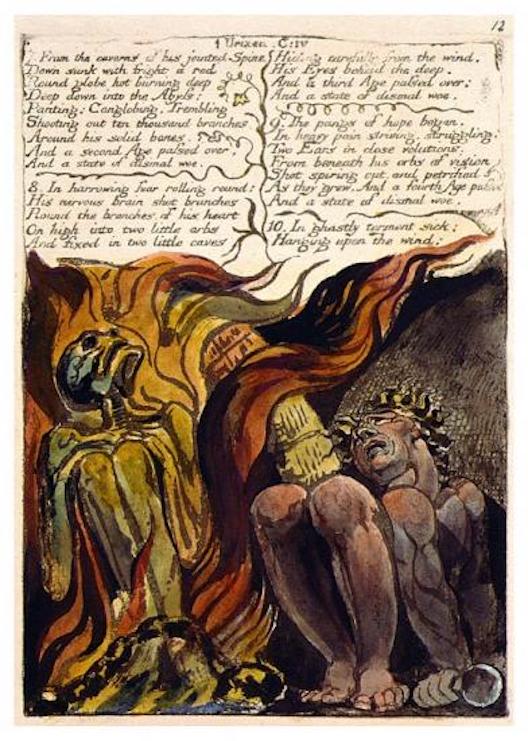


To see how characteristic this is, compare the early ‘The Death of the Wife of the Biblical Prophet Ezekiel’ (c. 1785) and plate ten of ‘The Book of Urizen’ (1794, both above). Compressed, foreshortened bodies set under agonised heads with aloft eyes. Neither are chained, but both look as though to be embodied is to be chained.

The appeal of Blake isn’t that he’s otherworldly, in the sense of accessing a portal you might pass through into some other place. It’s his sense of another world which is already intermingled with ours, which cannot be separated from ours. The angels in the tree were always there, he just saw them where we failed. As someone-or-other once said, “man has closed himself up till he sees all things thro' narrow chinks of his cavern.”

These can appear primal questions, and Blake himself most likely saw them that way. Yet they could not be anything but historically contingent. Blake lived his life amid tumultuous social changes, and his art was inevitably his attempt to make sense of those changes. Inevitably it was more seismograph than map, as he tried to resolve problems he found he could only articulate.

It would be tempting to argue events pushed Blake away from politics to the ‘other kingdom’ of mysticism. Indeed, he did shift in that direction. But to reductively suggest he abandoned one for the other would be to do violence to him.

Thompson later comments “throughout the Industrial revolution we can see this tension between the ‘kingdom without’ and the ‘kingdom within’ in the Dissent of the poor, with Chiliaism at one pole and quietism at the other.” (Chiliaism is in brief the belief that Christ’s coming back, probably soon, so religion needs to get itself involved with worldly affairs again and sharpish.) Blake tries to resolve this question by dragging the two kingdoms together, by placing one above the other, by staging psycho-dramas in his mind or by any other means to hand. But whatever the scenario confinement reappeared, chains re-inscribed themselves on the plate.

Marx famously wrote that religion…

”…is the fantastic realisation of the human essence since the human essence has not acquired any true reality. The struggle against religion is, therefore, indirectly the struggle against that world whose spiritual aroma is religion.

”…Religious suffering is, at one and the same time, the expression of real suffering and a protest against real suffering. Religion is the sigh of the oppressed creature, the heart of a heartless world, and the soul of soulless conditions… Religion is only the illusory Sun which revolves around man as long as he does not revolve around himself.”

This is not, as is commonly supposed, a critique of the con-tricks of Churches. That would be like coming across scam emails from supposed Nigerian benefactors, and assuming the cause of the problem is Nigeria. Marx tries to deal with religion by both encountering it at its best, and by tracing it to its source.

Blake asked two related questions. Is it possible to live an unbound life? And, can there be more to life than mere existence? The lack of a political answer to these pushed him towards a metaphysical, and hence a religious, expression of the questions. If the answer wasn’t here on earth perhaps it was there, up in the sky. But even with his prodigious imagination he could only pose and re-pose the questions, his art an arena across which raged an unresolvable war.

Saturday, 28 November 2020

‘THE ARK’ ( WILLIAM HARTNELL’S DOCTOR WHO)

First broadcast: March 1966

Written by Paul Erickson

(NB Erickson’s wife, Lesley Scott, was co-credited at his request but made no contribution)

Plot spoilers? Giant statue sized ones!


Dodo's cold causes havoc for the last men and their one-eyed monsters.

- from the BBC Episode Guide

In Space Everyone Hears You Sneeze

So the Earth's been destroyed, and a giant generation starship has been launched to re-establish humanity on another planet. This contains all humans (handily miniaturised), two-by-two representatives of all animal species (hence it’s the titular Ark) and the obliging servitude of the mute Monoids. As you might expect, the Tardis crew then show up. Dodo unwittingly unleashes a cold, against which none have any immunity so they all start dropping dead like over-acting flies. Without Dominic Cummings to mess it up the Doctor can rustle up a quick cure, and they’re off again.

One of the least revelatory revelations in Wood and Miles' 'About Time' guide is that the starship was the impetus for the whole thing, rather than just functioning as a setting. (Producer John Wiles envisaged a ship so big you needed transport to get across it. Alas there never was a sequel with a spaceship so big you needed another spaceship to get across it.)

Which is a pretty bizarre reversal of intent. Everything up to now has been built on the presumption that this was SF done on the cheap, sticky back plastic in space. It didn't matter as the whole thing was quite obviously only a poky studio set anyway. So the solution became – let's pretend. Best epitomised when they said “let's pretend a Police box is a time and space machine”.

Also, if ‘Daleks Master Plan’ was where ‘Who’ met up with space opera, this is something quite different. Generation starships were conceived of as a more credible alternative to faster than light travel. They’re a hallmark of Proper Science Fiction, in a series which has up till now tottered between serious drama and bug eyed monsters.


And even more bizarrely they take up the conceit and get away with it. The sequence which introduces the Ark is genuinely impressive. The sense of suddenly bursting into scale is of course enhanced for those of us who've been watching the show unfold so far, and have got used to cupboards doubling as alien planets. But it would stand up on its own terms. Partly because it clearly is a real set, with real plants, real animals and real buggies driving across it, rather than some CGI impossibility. (In this way it‘s almost a forerunner of 'Silent Running'.)

This sudden break into stylishness is, however, undercut by the appearance of the Monoids. With their shuffling gait, mop haircuts and mono vision they certainly are classic – just for all the wrong reasons. They look like Chewbacca had joined the Beatles and the Residents simultaneously, while swearing a solemn vow to be clumsy in all things. 

Normally this wouldn't matter. Because normally the show is auto-innoculated against that sort of complaint. It’s secret weapon is to take its own absurdity and convert it into charm. Get them to shuffle up to any other Hartnell story and they'd be fine. But here they're in a spaceship which really does look like a spaceship! And they start to look like they must be made up for a fancy dress party.

But there's worse. Almost inevitably, having established they actually can do 'proper science fiction' after all they then go and make its most cardinal error. Having established the great big spaceship they don't have an idea big enough to fill it with. The plot we have seems chiefly written to demonstrate that Dodo with a cold is even more annoying than Dodo without one. There's a subplot where the plague she unleashes gets them put on trial for sneeze terrorism, or some such. It helps pass the time, I suppose.

As if to rub it in, its hard to escape the notion that this story was the inspiration for the Earth Ark in Douglas Adams’ ’Hitchhiker’s Guide to the Galaxy’. If he stuffed his ship with hairdressers and project managers while this one is full of RADA types, that doesn’t seem too much of a difference. When Zentos announces he’s first spotted the stowaway travellers, you almost expect the Commander to comment “prisoners? He’s always wanted some.”

So the thing had a great setting but no front story. Never mind, we were only held up for two episodes. And now they're off again...

No Sum Of Two Halves

...except when they land its in the Ark’s future. And the virus had returned to become a plague, with the result the Monoids have gained the power of speech and become top dog. As the Ark prepares to finally land at its destination planet, Refusis, they plot to eliminate the pesky humans once and for all...

The story's central conceit, that the Tardis returns to the same spot several hundred years later with no crossover in cast bar the travellers themselves, is indeed a smart one. (Generally thought to also be Wiles'.) It allows us to see the ramifications of the first set of events through the protagonists’ eyes, in a way that wouldn’t be possible in any other kind of a show. (It also allows for a classic cliffhanger, which for once I won’t reveal.) We should also remember that back then episodes were merely titled individually and so viewers had no way of knowing when one story was about to end. They would likely have believed they were watching the closer of a two-parter, and been totally wrong-footed by the twist.


So, much like the spaceship set, the join looks good. But will it hold?

For one thing, it would have been better if they'd had some other kind of adventure. (Or, if we were in a franker mood, an adventure.) Just as they're saying goodbye, Dodo sneezes. Like people do. Then fast-forward for them to discover that sneeze has unleashed decimation. Not only would we not have to suffer the cure-the-cold plotline, but it would remove the clunky plot twist about the cold being cured then inexplicably coming back. (Okay, in practice viruses can mutate. We're talking dramatic effectiveness here.) As it is, its unclear exactly how the returning virus enables their uprising. First time round the Monoids seemed as vulnerable to it as the humans. And I don't remember bird flu leading to the birds taking over.

Worse, the two halves of the story simply jar - in tone and in content. The second half is so different its like the Monoids seized control not just of the Ark but the scripting. Having only just established we're for once in serious SF territory, the second section jumps back to sci-fi in one genre-busting bound. 

The first episode is called ’The Steel Sky’, which conjures images of Asimov novels. Later episodes should really be called ’Menace of the Monoids’ or the like. Its a melodrama populated with monsters, plots, plotting monsters and bombs. In which the monsters take to loudly telling each other what their plots are, plots which according to tradition don't really make a lot of sense. (“Let us kill off all those who humbly serve us, thereby maintaining our privileged existence.” “Mmm, yesss.”)

The join becomes so jarring, you almost start to wonder whether a directive came down saying the next story had to use the sets and costumes of the last. There is some evidence of foreshadowing. (Including a scene, quite nice in itself, when the Doctor casually comments to a Monoid he’s smarter than anyone thinks.) 

But the story seems unclear whether we should see their revolt as motivated or merely unprovoked malice. It’s absolutely unlike how the treatment of the Ood would come to be played in ’New Who’. Yes they have servant status and are clearly second-class citizens. Yet when a Monoid is first to die from the virus, humans respectfully attend his funeral. It’s even stated it was the humans who gave the Monoids the power of speech through the electronic voice boxes they now sport – a funny sort of tyranny. The structure rather resembles the Monoids - something of a fuzzy hodgepodge of things. Perhaps the Doctor should have invented the devices before leaving, with were then thrown into the mix of history along with Dodo's germs.

Of course watching a series such as this is a little like buying the wares of a colander shop – you’re likely to end up with lots of holes. The solution is not to fix on the holes that don't fill the foreground. It’s never explained, for example, why there needs to be a forest of live animals if the humans can just be miniaturised. But we kind of know why – a forest aboard a spaceship looks cool, and it has little input on the main plot. But if the selling point of ’The Ark’ is that these two halves are joined when they’re not, that’s not something that can be glossed over.

You Are Now Entering Heaven (Please Extinguish All Petty Squabbles)

However, were we to decide to accentuate the positive, ’The Ark’ could be said to make a symbolic kind of sense which part-lifts it from B-movie status. From its Biblical title, it’s clear that – at least in the second half – this is another parable. The dark silhouetted Monoids are our shadows. At first they obediently obey and copy our movements. Later, like the shadow in the Hans Christian Anderson tale, they cut themselves free from us to reflect us at our worst.

Note that their name combines 'id' and 'mono'. Their uni-name and cyclops eye demonstrate monomaniacal vision, a singular lust for power, and a consequent inability to see the depth in things. (Compare to the Daleks' eyestalks.) While the now-shadowless humans have the opposite problem, and are for the most part hopelessly compliant.

Notably, they largely bring themselves down through their own folly. Instead of being named they are hierarchically numbered down from the dictatorial One. Eight Hundred and Seventy Three must not be a happy Monoid at all. This leads to a bid for power from Four, which ends in a self-destructive civil war. Finally, the few survivors give up in disgust. (I like to imagine nominative determinism at work, that by giving themselves those namebers the Monoids were effectively dooming themselves to death by internal strife.)

If their number-identity system combined with their chronic backstabbing syndrome sounds comic-booky, it probably is. It almost exactly duplicates the antics of the Secret Empire who debuted in Marvel's 'Tales to Astonish' only a few months later. (Their internecine squabbles ended with one of the Numbers seizing control by offing all the others. Precisely what was left for him to control by that point was not made terribly clear.)

Nevertheless this epitomises a common way of portraying evil in the Whoniverse, not as some absolute force which counterposes good so much as a deficiency, a failure to perceive the true picture. It can tends to bring about its own downfall,with the Doctor only tangentially involved, like a brute attacker bringing himself down with his own weight. The Daleks were presented quite similarly, particularly in their first outing.

(As we’re being fannish, we might even use this to explain away another plot inconsistency. It’s a combination of Steven’s arrival and the Monoids planting a preemptively retributive bomb which finally galvanizes the humans into action, their malevolence setting up their own undoing.)

Meanwhile, it turns out they could have co-existed with the Refusians all along, who have even preparatorily built dwellings for them all. But one native tells the Doctor only the peaceful might be permitted there, and decrees a day by when the humans and Monoids must be reconciled. This week's allegorical alien name would seem intended to evoke a combination of cosmic order and “if your name's not down, you're not coming in”. 

The Ark had been a spaceship, taking its crew to a planet, and taking a long time about it because space is big-you-see and habitable planets are rare. Now the Ark’s an Ark, and its destination, while ostensibly still a planet, is clearly Heaven - admitting only the good, guarded by disembodied angels. Alan Stevens and Fiona Moore describe them as “sound[ing] like a Shakespearian actor shouting from just off the set”, which is probably how most viewers imagine God works. 

(Strictly speaking, the Refusians are merely invisible. But this gets fuzzily associated with being disembodied. For example, the Doctor tells a Monoid he “won’t be needing his gun now”, when the logical thing to try would be spray-fire.) 

Compare this to the Rill from ‘Galaxy 4' or the ascetic pilgrimage of ‘Keys of Marinus’. The notion of the cosmos as celestial, there to separate the merely worldly from the pure seems a sub-theme rumbling on the background of the Hartnell era.

The two-by-two structure of this story also presents another twist. The traveller’s reappearance on the Ark gives this story a place in fan lore, as it suggests the Tardis intentionally took them back. The Tardis was, of course ascribed with sentience at least as far back as the early ’Edge of Destruction’. But there it safeguarded its crew, literally pulling them back from the edge. It's like the way sailors would inscribe a name and personality to the ship which kept them alive. Now its purpose is pretty much to take them into danger.

But that's not the real significance. At least as important as this being said is who it is said by, and how – its Steven who mentions quite passingly that “the Tardis made the decision”. Had it been said by the Doctor it would inevitably have become more of a pronouncement, Something New to Know About the Tardis. Instead, its treated incidentally, almost as if its something we all already knew.

And, while we've never been specifically given this information before, we did kind of know it. The show has turned enough of a corner that we now see more of the road ahead than behind. Once an exile and a wanderer, the Doctor now has a calling. The places he shows up at are the places the Doctor needs to be. He doesn't like to mention any of this, and has probably said none of it to Steven. But Steven still knows. Its become obvious. 


The other notable feature of ’The Ark’ is that it’s the first complete appearance of the new companion Dodo. Who was devised as a more ‘contemporary’ Swinging Sixties type of character, a plan which went down poorly with the higher echelons of the BBC - who promptly insisted she revert to something nearer ‘proper English’. While this insistence might now seem quite King Canute-ish, after hearing Jackie Lane endlessly repeat “fab”,”gear” and “grotty” and other things the young people say these days.... well, you start to wonder if they didn't have a point. However, the script manages to turn this into a decent running gag where the Doctor insists on her “speaking properly”. (Once a grandfather...)

Not a highly regarded entry in the Hartnell canon, ’The Ark’ is perhaps best compared and contrasted to ’The Web Planet’. Both have some good ideas which ultimately fail to come to fruition. But while ’Web Planet’ made some bold but recklessly wrongheaded development choices, ’The Ark’ is reasonably well directed – it’s at the script level where it fails to deliver. Overall, while it’s certainly more watchable it lacks the deranged invention that made Web Planet’ more interesting.

The Ark’ is at its best when not called upon to function as a story – in the establishing section that kicks off the first episode, and in the join with the second half. Both these work so well they raise the bar, and you find yourself wishing you could like it more. Your focus falls naturally on that central join, leading to a kind of grass-is-greener effect. The first half restricts itself to the quasi-plausible, so we end up with a plot where everyone gets a cold then gets better again. You imagine things are merely being set up and look forward to them kicking off after the break. But when the second section arrives, with its cliché-sprouting monsters, you look back to where you came from almost fondly. Alas you have to say it – The Ark’ is half empty.

Further reading! El Sandifer finds a racist, reactionary message in this story and pulls no punches in pointing it out. (“Revolution is bad. Youth are stupid. Dark-skinned people are savages who cannot be redeemed.”) Mostly, this section is for takes too tangential to mine for me to usefully engage with. But here, frankly, we’re both right. It’s not at all contradictory for the Monoids to be both a parable about our shadow selves and a political anti-black nationalist analogy. Racists are forever projecting their own worst qualities onto others then displaying disgust, and today it’s the turn of lust for power. And it would explain how they’re both slaves and well-treated workers.

But then the “two halves” nature of this particular story accentuates the differences, forks on us and frames the thing as a choice. A political response takes it first-side-up, a parable reading the reverse.

Saturday, 21 November 2020

‘THE MASSACRE’ (WILLIAM HARTNELL’S DOCTOR WHO)

First broadcast: Feb 1966
Written by John Lucarotti & Donald Tosh
Ye olde Plot Spoilers abound!


“I wish I understood what was going on.”

- Steven

The Shadow Land

It’s easy enough to talk about Old and New Who, handily separated as they are by a fifteen year buffer zone. But, as I hope this series of posts has proven, there’s also an Old and New Hartnell. Old Hartnell could have gone out under the alternate title ‘Schoolteachers in Space’, as decent sorts Ian and Barbara grappled post-war concerns with undisguised theatricality. While New Hartnell marked the point even the BBC couldn’t ignore the onset of the Sixties, and could be called ‘Getting Far Out With Time Travelling Grand-dad’. 

And the disappearance of those school teachers at the half-way mark does make a pretty good marker. But only from a high-level view. On an episode-by-episode basis this show is anything but neat and tidy; it advances, reverses and sometimes goes sideways… actually, there’s quite a lot of sideways. Rather than traversing these two poles, its more like it’s in a state of perpetual tension between them. Sometimes it seems to touch both at once. Take that classic credit sequence. Is it a New Music composition for the masses, or early spacey psychedelia?

And really, how could it be otherwise? The first draft of history is always going to be messy, extemporised and even self-contradictory. Too many take a mechanistic approach to popular culture. (“Well of course this is what a popular broadcast media would be producing for the masses in February 1966”.) In general, when you see things as being simple, they’re not actually the simple part of that equation.

So, after ‘The Time Meddler’ should really have broken the mould of the historical and jumped up and down on the bits, after ‘The Myth Makers’ cocked a snook at classism, we get one of the most high-minded historicals of all. It’s even by John Lucarotti, who effectively coined the genre with ‘Marco Polo’ then came up with it’s high-point in ‘The Aztecs’. (At least sort of, more on that coming up.)

In many ways it’s like a return to those years. It covers grand events yet has a very human scale, where details like places to sleep the night assume an importance. The four episodes map neatly to four days. And, unusually, it has no cliffhangers. Episodes end on a dramatic moment but then start up again from somewhere else, like chapters in a novel. (Which isn’t Old Hartnell, as the cliffhangers were a feature from the start. But it feels more Old than New.)

And it has more peculiar features….

- Historicals are normally given unique settings. They’re not quite on the level of those ’Beano’ cartoons which assumed Italy had signs reading ‘Italy’ hammered into every available bit of ground and the leaning tower of Pisa was viewable from every location. But ‘The Romans’ say, has a different setting to ‘The Aztecs’, a difference you can take in at a glance. This is set several hundred years before ‘Reign of Terror’, but the teeming, narrow streets of Paris are essentially the same. (Though admittedly, this being another lost story, we only have a few stills by which to judge this.)

- Added to which, ‘Reign of Terror’ was based around a notable date. Every schoolchild will have heard of the French Revolution. But the Massacre of St. Bartholomew’s Day? True, the Doctor tells us this is a notable date. But that's because we need the Doctor to tell us it’s a notable date.

- This was written by Lucarotti, but then heavily and rather speedily rewritten by Donald Tosh while Script Editor. Which is presumably why the story is so circumlocutory, and riddled with gaps, inconsistencies and blind alleys.

(Braver souls than I have tried to list all these. Let’s pick just one example, the Doctor finds the scientist Preslin in his shop. But when Steven arrives shortly after, we’re told Preslin was arrested two years ago and is presumed dead. You can of course write a handwave for any of this. But you’ll be waving your hands a lot here.)

- This is another story where holidaying Hartnell was absent for a full episode. Quite inexplicably, for a story where he plays two characters! (More of which anon.)

- They’re there to pick up a girl. To keep to the formula line-up, and having carelessly failed to do so in the previous story, they are obliged to find a new female companion.

But like ’Hamlet’… well, a little bit like ’Hamlet’ the story finds ways to turn these necessities and impediments into virtues.

First the setting… ‘Reign of Terror’ was at heart an adventure story in period clothing, which occasionally bumped into a historical figure. ‘The Massacre’ is more a tale of intrigue, weighted with plots, betrayals and code-names. We’re told one character would “cross-question his own shadow,” which would seem wise behaviour around here.

Inside which Steven, separated from the Doctor for almost the entirety, becomes a kind of Hitchcockian protagonist; a befuddled everyman, an innocent abroad, knowing neither the mores nor the geography of Paris, just hoping to blunder on the right thing to do. So while all those strange plot ellipses can frustrate, at the same time they make us feel as Steven does.

Steven falls in with the Protestants as swiftly as Ian and Barbara did with the Royalists. The assumption is clearly that the Church-of-England-attending audience will recognise the Catholics as the bad guys. But while the story holds to this, it also paints everything in shades of grey. The Protestants are more commonly called the Huguenots, a historically accurate but less familiar term, which distances them from us a little.

The Huguenot Gaston first defends Anne, a runaway servant from her Catholic masters, saying she should be free to choose her own destiny. But he soon admits that to him “she’s just a servant, a chance to bait a Catholic.” His compatriot Nicholas admits “many of our followers are just as bad” as the Catholic mobs.

This is realpolitik, with less word actually about religion than ‘The Crusades’. The Huguenot plan is not for religious tolerance but war with Spain. It’s simply assumed countries will war with one another, it’s just a matter of which ones. We’re told “Kings are recognised only by the power they wield” and this King is a playboy, easily distracted while his mother wields real power. At one point she dares him to arrest her, to make him realise he cannot.

The Doctor Doubled


In the story’s best-know element, the Abbot is a double for the Doctor. Which proves to be the story engine. In yet another bizarre feature the Doctor disappears from the drama before the Abbot appears, then doesn’t return until after he’s gone.

Steven quickly assumes the Abbot is the Doctor, working to undermine the Catholic plot from within - so continually attempts to reach him. The story feeds us clues so we might believe he is right, then pulls the rug from us. It would be a neat twist, except it manufactures so many clues you figure something must be up.

And not all this misdirection turns out to be justified. The story lays on the Abbot’s villainous reputation, even making him end the first episode like he’s the monster of the week. Yet he proves a terrible bungler, to the point he arouses his co-conspirator’s suspicions. This would only make sense were he really the Doctor, yet he’s not.

Also, just before he vanishes the Doctor talks of going to see the Abbot, despite Preslin’s warning. Yet this goes unexplained, as - stranger still - does the Doctor’s entire disappearance. He can’t even have spent the time discussing microbes with Preslin, as there’s a short scene showing he left. This leaves a huge Doctor-shaped hole in the story.

Yet if the Doctor's not the Abbot, beyond the plot twist what can be made of this? Both have titles for names. (And this isn’t the first time the Doctor’s been set against a religiously named figure, though the Abbot is not similar to the Monk.) However the Abbot’s is obviously religious, while the Doctor is specified as “a doctor of science”. Here he’s the early Hartnell, taking interest only in scientific questions, staying out of events where he can. While Preslin, seen fleeing Paris prior to the Abbot’s arrival, comments “he hates us all” he seems to mean scientists not Huguenots.

In fact, while the story finds only shades of grey between Catholics and Protestants, science is shown as more important than both. However, that doesn’t make this an anti-religious story as such, where religion is seem as mere superstition in ecclesiastical clothing. The approach to religion is more abstemious, as if it’s medicine. Catholicism is too much religion, as indulged in by hot-headed Latins. Protestantism is for cooler heads. (Historically, to escape persecution the Huguenots often fled here, compounding the narrative they were really honorary Brits.)

When Generations Clash 

Steven’s siding with the Huguenots mostly takes the form of hanging out with other impetuous youths, chiefly in taverns. He flies around Paris, gets in sword fights and flees bloodthirsty mobs, all to no avail. He spends much of his time finding out about an assassination attempt which he rushes to prevent. He then fails, but the attempt itself goes on to fail through sheer happenstance. (Which almost feels like the story in microcosm.)

All this time he assumes the Doctor is equally at work in the story, just at different points to him and more successfully. Yet he’s not. We cut away to older, wiser heads, but the Doctor meets none of them. His counsel is effectively “better not to appear in this one at all”.


And the Doctor’s refusal to help Anne escape the massacre crystallises this and leads to the story’s best-known scene - Steven’s confrontation with him. The Doctor’s stance is almost a reprise of ‘The Aztecs’: “I cannot change the course of history, you know that.” Yet Steven’s response is definitely not Barbara’s. In fact this is the point where Old and New Hartnell clash most clearly in the whole era. She is the dutiful schoolteacher hoping to bring up her charges proper. He is the headstrong Sixties youth, as much as the Xerons in ‘The Space Museum’, what he wanted was his mates to come along. He rails against the remoteness of scientific enquiry while lives hang in the balance. (“If your researches have so little regard for human life then I want no part of it.”)

And much like the Xerons in ‘Space Museum’, I was reminded of my own adolescence. I’d have essentially similar arguments with my parents; them convinced the problems of the world were simply intractable, me that they could be thrown off by sheer strength of personality. (I expect I also stormed off then slunk back.)

But there’s also contrasts to New Who. Another time, I compared conceptions of time in the old and revived show, where the same questions receive opposing answers. And notably this is almost exactly the same debate as the Doctor has with Donna in ‘Fires of Pompeii’. Donna pleads “Just someone. Please. Not the whole town. Just save someone.” Except that time the Doctor concurs.

But the “just someone” defence is actually a form of tokenism, a performative gesture so you can feel better about yourself. Ironically, it was best exposed elsewhere in New Who, in ‘Boom Town’: “You let one go… Every now and then, a little victim’s spared… And that’s how you live with yourself.” Which again suggests the more sophisticated new show is actually more willing to indulge in feelgood sentiment than the old.

Yet we can track this back and find the flaw in Steven’s stance. In a mass killing he’s only really bothered about one person purely because he spent more time with her. The value of a human life can be measured in screen time. Even Nicholas, who gave Steven shelter when he needed it, is forgotten. And we’re implicated in this. An orphan, someone who notices and seeks to repay kindness, if we’ve spotted the signs Anne was being set up as the new companion. We thought we’d see more of her.

If everybody says this is the memorable scene of the story, everybody then complains that it reneges on itself in order to re-establish the series formula. At this point ‘The Massacre’ well and truly massacres itself. With the lucky coincidence of Anne’s descendent Dodo showing up just there and then, there’s only one semi-defence. The Doctor is as reminded of Susan, who she looks and sounds nothing like, as Steven is of Anne. It suggests both men, now at something of a low ebb, are at a point where they see in her what they want.

All true. Yet El Sandifer is just as right to say there was no way out of that but to backtrack. The only other option would be to fade out on the Doctor alone in the Tardis, mumbling to himself, and the series to have ended in 1966. A series formula will always be both motor and straight-jacket, something which will happen in ’Who’ again and again.

‘The Massacre’ is that rare thing, a historical over-rated by fans. Compounded to all those elisions and blind alleys it’s really a story without a core. There’s some literally inconsequential running around, then when it finally seems building up to something the Doctor shows up like the shopkeeper in ‘Mr. Benn’ and they’re off. It’s not really a match for ‘The Aztecs’ or ‘The Crusades’. But there’s something strangely compelling about watching Old and New Hartnell trying to sit on the same chair. The result is another great Hartnell oddity like ‘Web Planet’ or ‘Space Museum’ where unhinged invention not only cohabits with the lacklustre, it makes the two seem inextricable.

Saturday, 14 November 2020

MAX ERNST’S ‘TWO CHILDREN MENACED BY A NIGHTINGALE’


There seems to have been less gallery-going going on lately, for some reason or another. So I thought instead I’d write about individual artworks which… well, which seem to lend themselves to be written about. Which should be briefer, if nothing else.

Max Ernst’s ‘Two Children Menaced by a Nightingale’ (1924) was one of the works which first got me interested in Surrealism. Now, as I suspect I’m always saying, the connection between Surrealism and dreams is over-emphasised. But a connection there is. And in fact one of the appealing aspects of Surrealism is that the connection is genuine.

As I’ve said before “We’ve become so used to dream sequences in films we now picture actual dreams through these cliches, and tend to imagine a dream’s merely a film which projects in your head.” (And those literary dreams, they’re even worse. Don’t get me started on ’Sandman’…)

I don’t think I’ve had a dream in my life where I came across a significant-looking gold key in a forest, which I pondered while a high-pitched note played. At least if I did I slept through it. But I have had dreams where I was in my childhood home except it looked nothing like my actual childhood home, and I had marmalade for shoes and I had to get to next Tuesday to learn to speak Budgerigar from a glockenspiel but something was somehow stopping me…

And over this jumble of associations hangs a mood, the dream’s unifying device. The mood can be completely unassociated with those events, like… I don’t know… a nightingale being inexplicably menacing or something. The elements, even the setting, can switch arbitrarily. But the mood normally remains. Often, even after waking. One reason dreams may feel so impossible to convey is that you tend to recount the events, hoping they will somehow convey this mood. But the association’s only there in the dream.

Yet, extremely unusually, Ernst’s painting seems very much like an actual dream successfully conveyed. The scenario’s not only absurd, there’s not even any attempt to make that bird menacing. It’s not large or centred, it’s little more than a dot in the sky. And who, of all the birds, would pick a nightingale for this? Nightingales just show up to sing in poems. Yet like many absurd things it’s comical and menacing simultaneously.

There’s pictorial space, perspective and a gradated sky. Yet the shed and gate are collaged elements, stuck onto the canvas. The gate in particular seems too large for the perspective and juts out over the frame. Then there’s the extra figure, unmentioned in the title. Maybe he could manage to stand on that ridged shed roof, perhaps even hold a child at the same time. But, impossibly, he’s shown running. And unlike the running girl he reaches for a handle, an inserted object like the gate, as if unlike her he knows he’s in a painting and is looking for the way out.

It doesn’t make sense, but at a more basic level than the imagery. Different sign systems clash and collide, making it literally irresolvable, each undermining the other.

As if the gate intruding over it wasn’t enough, the first section of the frame is painted over and the title handwritten in the lower part. Which makes it reminiscent of votive art, art intended to have a specific purpose, art which employs signs rather than symbols the better to bring about that purpose. Made doubly absurd when applied to this absurd scene.

There’s often a tension in Surrealism over whether it genuinely wants to be Surreal, or if it would rather be (in the broadest sense of the term) symbolist. Should we look at works like psychoanalytic detectives, armed with clues provided by Freud? The second can get reductive pretty quickly. At Surrealists exhibition you can feel that as soon as you find three castration complexes or phallocentric father figures you should get to shout “house!”

So it’s tempting to want Surrealism to go the other way, to be as irreducibly irrational as dreams, despite the burdensome weight of attempts to the contrary. But what works best is something with just enough symbols in it to entice you, just enough breadcrumbs to lead you into the forest but not take you through it.

Which you can do here. Maybe the flying bird represents the untamed Id, the onset of puberty which arrives to kill the child. Maybe the frame represents the closeted world of childhood, the way your back garden did during those years, only the adult male possessing an awareness of the world outside, the doorknob his… well, that one is quite Freudian.

And as you think these things your perpetual underlying feeling is “getting there, keep going”. One Surrealist practice was to navigate around an unknown town using a map to somewhere else, convincing yourself those strange streets would at any minute resolve themselves into those neat little lines on the map. A Surrealist approach to art should be similar.

I must have first seen this painting decades ago, and it’s still going round in my head. That’s the way to do it.

Tuesday, 10 November 2020

TRUMP + THE WHITE RIGHT (OR HOW TO NOT LOSE THE ELECTION YOU JUST LOST)

With Trump refusing to accept the election result, a lot of people are assuming he’s just having a bit of a hissy fit. Which he partly is, most probably. But it also suggests most still haven’t caught on to what Trumpism really is….

The people most loudly proclaiming their disdain for identity politics are, of course, the one most driven by identity politics. And that identity is whiteness. Commentators puzzled endlessly over why women would support a serial sex abuser. But they weren’t identifying as women when they waved those flags, they were identifying as white. Whiteness always over-rides.

People mostly associate this mindset with low social status, and the consequent need for compensatory factors. “My pockets might be empty, but they can’t take away my white face,” and so on. Which makes it seem more understandable.

But the hard-line, rally-attending Trump supporters are mostly middle income. Life to them is one long service encounter, where the white is forever the customer and the non-white the provider. If the election result isn’t to their liking they’re entitled to send it back, just like an on-line order they changed their mind over.

It’s important to recognise they genuinely believe what they’re saying, even when they’re making it up from minute to minute. Because this the way they’ve been conditioned to see the world. Throughout their lives, cops and other authority figures have aligned with them. They’re not in denial of reality, they just presume reality is theirs to make. They’re not deranged, they are privileged.

Which is why attempts at dialogue with them are such non-sequiters. Say to them, for example, “actually I‘m pretty sure election counts do have observers.” Their response is essentially “No, because I say so.” This isn’t an argument to be fact-checked or tossed back and forth, it’s an undeniable assertion. They can’t have lost because winning and losing is defined by them. It's not rights for whites. It's white is right.

But what about when other whites disagree with them? Like, you know, most whites. The short answer is this changes nothing. By choosing to side against them we traitors have forsaken our whiteness, and deserve to be treated no better than the rest. Whiteness transforms in that moment, from a birthright, an immutable characteristic, to a political choice, a club you can be kicked out of.

Well, that’s the half of it. Except there’s also an exacerbating factor without which Trumpism could not have come to exist, where their birthright now seems beleaguered. From civil rights and growing diversity at home, to a more globalised world. So they came to believe that whiteness needs reasserting, needed a movement building around it. Whiteness became something simultaneously self-evident and a thing under threat. So privilege becomes weaponised.

So it follows that Trump has nothing to gain and everything to lose by accepting the result. First try, the Supreme Court might just give the Presidency back to him regardless. Mostly, people are assuming that won’t happen because his case has no legal merit. Normally such naivete would be charming, but there’s quite a lot at stake here.

Let’s be clear… More that most such institutions, the Supreme Court is a political body masquerading as a legal one. It’s entirely composed of political appointees, mostly Republicans, two out of nine directly hired by Trump.

Here in Britain, strike ballots have been struck down by courts due to irregularities. Despite no-one disputing they were accidental, or that they made no difference to the overalll vote. In a similar way, the Supreme Court will be searching for petty errors to seize on and magnify.

And even if they can't get anything to stick… well, then they’ve just proved themselves more traitors, right? Trump fans won’t look at the verdict trying to find their own flaws, they’ll just dismiss it. They’ll busy themselves banding together - and around him - in this difficult time. His personal support might even increase from losing the election.

Reasoning them out of this stuff, that was never going to happen. Now, unsurprisingly, their alpha-winner losing, it being proven mathematically they don’t even speak for white people overall… it isn’t and it never was enough to disavow them. They need to be beaten in a much more direct and immediate way. Their supposed super-power, their whiteness, has to be held in front of them and shown to be ineffective. Which can be done. But it’s not over yet…

Saturday, 7 November 2020

‘BRITISH SURREALISM’

Dulwich Picture Gallery, London

“Have you ever imagined the impossible? You are about to embark on a journey into the Surreal. There are no wrong turnings.”

Opening text


A Kept Id Ain’t No Id


This is probably the first time I’ve reviewed an exhibition I didn’t see. Pretty Surreal, huh? Alright then, no. In fact you can not see it the way I didn’t, via a virtual tour. And as it was forced to close soon after opening, that’s how most will have done it.


First stop, virtually speaking, is Ithell Colquhoun’s ‘The Sunken Cathedral’ (1951/2, above), which portrays an island containing a stone circle half underwater. And the double ring seems designed to demonstrate that water and land represent the unconscious and the conscious, not opposing and contrary states but existing in a dynamic interplay.


The land/water border also features in Edith Rimmington’s ‘The Oneiroscopist’ (1947, above) - this time with a beaky bird about to go deep sea diving. But there’s a stronger similarity - both works aren’t any good. Okay, they’re not bad either. But they’re merely adequate, serviceable, examples of rather than contributions to the genre. Rimmington’s the better of the two, better executed and with the inherent bizarreness of a bird going diving enhanced by that human hand. Bur her title, which translates to the quasi-Freudian ‘Interpreter of Dreams’, states the problem out loud. Works by Grace Pailthorpe then go on to underline it. A psychoanalyst, she explained that Surrealism and Freud were about “the same - the liberation of man.”


The best that can be said is that the fault line is so widespread in Surrealism we shouldn’t be surprised to see it here. They did have a tendency to find in Freud just what they wanted, something he commented on himself. And in-so-doing they never seemed to quite comprehend how anti-liberatory his theories were. Perhaps best explained by Erich Fromm in ‘Fear Of Freedom’:


“Freud accepted the traditional belief in a basic dichotomy between men and society, as well as the traditional doctrine of the evilness of human nature. Man, to him, is fundamentally anti-social. Society must domesticate him… refine and adroitly check man’s basic impulses.”


So it followed that Freud’s attempts to explore the subconscious was a way to control it through mapping. Thinking the id could be tamed, he was as much a coloniser as the British empire was in Africa. Such savage forces had to be subjugated, tamed and put to productive use. The horror film trope of the demon or monster which at first rears up inexplicably, but whose origins are later found to be determined and thus can be dealt with, that surely stems from Freud.


It could be said that the Surrealists intended to reverse this, to not constrain but stir up subconscious forces. They could say this themselves at times, if not entirely consistently. But what’s really required isn’t to reverse but disrupt this system. Anti-colonialism doesn’t mean Africa invading Britain, like in all those far-right guilt-projection fears, it means ending the whole business of domination.


But beyond that, the Surrealism that can be made sense of - that’s not a form of Surrealism at all. Which is why any association of it with therapy culture is so disastrous. It shouldn’t be allying with but actively sabotaging sense. Its credo should be ‘never knowingly understood’, and not just by the know-nothings of the dominant culture. It should be inexplicable even to Surrealists, with artists surprised by what springs from their own hands. You can’t unleash the savage then expect him just to do the things you want. The show includes a splendid quote from Conroy Maddox on this:


“A Surrealist doesn’t know what he is doing. I don’t know what I’m doing. Something happens and it develops, but you don’t analyse it. By doing that you destroy a Surrealist image.”


No Surrealism Please, We’re British?


And in what feels like another attempt to familiarise something whose essence is the very opposite, the show spends time finding examples of proto-Surrealism. None of which seem terribly convincing; Blake is more of a Symbolist, Fuseli is Gothic, Carroll an Absurdist and so on. But more widely lineage seems simply the wrong place to be looking, as if the point was whether you had a Great Uncle already employed at the firm. Rather than hunt hopefully for ancestors and precursors it would be better to search for Surrealism around us. The irrational and inexplicable hasn’t and could never be repressed, but we can be conditioned into not seeing it.


Having previously written posts about both Edward Burra and Paul Nash I’d resolved to fry fresher fish here. But Nash’s incorporation of the seemingly pastoralised English landscape as Surreal is so on point you can’t skip it. As John Stezaker said of him “he brought that strange sense of unreality of the actual encounter with the real word, as opposed to some sort of inner world.” (‘Art Quarterly’, Autumn 2017.) And even Colquhoun, to give her her due, based her work on an island she actually saw.


And this approach overcomes another problem. As soon as this show was announced you knew the critics would chortle. How could Surrealism possibly erupt in somewhere like rainy, deferential Britain?, they scoffed. But the very opposite is true. Just like medicine goes to the sick, the more confined and parochial British life was, the greater the need for the cure. The show is right to describe Britain as “a perfect breeding ground for the surreal.”


Take for example Clive Branson’s ‘Blitz: Plane Flying’ (1940, above). This is very recognisably a regular street, there must be many such places in London and doubtless were more then. And we’re so unused to surreal takes on iconography this British that on first glance we might take it for natural-ness. The way people just carry on under the literal shadow of that huge plane could even be taken as some tribute to the “blitz spirit” and all that. 


But the plane’s not just absurdly oversized, and seemingly skimming the roofs of the buildings. In a remarkable statement to make during wartime, it’s given both Axis and Allied symbols. It doesn’t represent this side or that, but the shadow of war itself. While, with its two roundels echoed in the moon behind the propellor blade, it’s made to seem almost a celestial force.


And the people below, rather than defiantly continuing their regular business, are in a state of transience. This isn’t a cosy England, every front room with curtains to draw and jolly tradesmen filling the street, it’s a world without rest. The woman in the foreground (also oversized) holds a pram, but it contains bundles not babies. A house behind her is being emptied. War could blow them out of this street at any time, forcing them elsewhere - where it might well just do the same thing again.


The Other Light


Less obviously British-based, but a great work for all that is Marion Adnam’s ‘The Lost Infanta’ (1946). These moonlit scenes seem recurrent in Surrealism, for example in Andre Masson’s ‘The Picardy Road’ (1942) as seen in the Tate’s ‘Aftermath’ show. Both are nocturnal, but rather than being about the cover of darkness they evoke the full force of the moon. Objects are quite clearly delineated, just unfamiliar to us daywalkers. And this other form of light has its own energy, the light of the night summoning unreality. I always think of the term ‘moonshine’ to describe this, less for the connotations with booze itself than the sense of the illicit.


The night, the female and the irrational are often brought together like this, witches supposedly drawing their magic from the moon and so on. While here that white curl-adorned head is compared to the haloed moon, with the trees stretching up to meet it. Which, when combined with their bareness, makes them seem a kind of animate un-life.


Herbert Read spoke of Surrealism’s desire “to invest the object with a spirit, a life of its own, and from this point of view Surrealism may be regarded as a return to the animism of our savage ancestors.” Which conflates an animism we never experienced, of our primitive ancestors, with one who did - our own childhoods. With Adnam’s title seemingly reflecting both.


When the critics were doing something more interesting that scoffing, they pointed out how many female artists there were here, and how unusual that was for a movement so often thought of as male dominated. Perhaps, being away from Breton’s overbearing influence, Britain offered opportunities, like he was an ordering sun whose rays you needed to see set before your magic could shine. All of this may well be true. However, it too often makes an unseemly rush from female artist to feminism.


Look back at Adman’s figure. There’s clearly no-one under that billowing ribboned cloth, she’s described by the show as a “paper doll”. The use of ‘Lost’ in the title also alludes to this. And in Surrealist art the male is often seen as a natural presence, going back to “the savage”, while the female is a construction, and often a construction around a central absence. 


To give two further examples from this show alone, Colquhoun’s ‘The Pine Family’ (1940) also parallels the male body to trees. While it recounts an anecdote from the 1936 Surrealist exhibition. While mostly (in)famous for Dali turning up in a diving suit and nearly asphyxiating, it also included a ‘woman with a bouquet of flowers’, which obscured and essentially replaced her face.


The quasi-phallic trees reinforce what the central female figure, in Freudian terms, ‘lacks’. And here Adman is essentially going along with Surrealism’s highly gendered symbolic system. To be clear, it’s a strong work which we should celebrate. But it takes more to make a feminist work than a woman’s hand. And we should find same problems here as we do with so many of the male Surrealist works.


Leonora Carrington’s ’The Old Maids’ (1847, above), with it’s all-female figures, might seem a more likely claim for feminism. Yet it immediately brought to my mind my own childhood. With her long black dress and central placement, the smaller figure seems set against the others. So I took her to be a child, perhaps with the hatless apron-dressed figure behind her the mother and the three gathered, hat-adorned figures the old maids of the title. So she represents a child’s-eye view of an adult work, stuffed with rules and customs which seemed to make no sense. 


Certainly in my childhood domestic spaces always seemed not just female-run but feminised. Men theoretically ruled over them, but as absentee landlords unfamiliar with local customs. Childhood gave me some semi-shamanic status, able to slip between these worlds. Black-headed-and-tailed the birds seem associated with the child, untamed forces in this mannered setting.


This is enhanced by Carrington’s illustrational style. Like Branson’s street we associate it with the comforting, in this case the world of children’s books, while she works to undermines this. But it also suggests narrative while she offers us only ungraspability.


No Fairground Mirror


It’s often assumed that Surrealist art was plausible in style, offering conventional depictions through conventions we’re familiar with, in order to be serve up impossible content. Its game is to hold a fairground mirror to our consensus reality, in which swans morph into elephants. Some argue that proves it to be aesthetically conservative, and therefore not really a Modernist movement at all. This isn’t untrue exactly, we’ve seem before how that was the downward slope Dali slid down. But it scarcely covers the whole of Surrealism.


For example Eileen Agar’s ‘Guardian of Memories’ (1938, above) seems a composite of Modernist styles, mixing up oil, crayon and collage. There are frames within frames, a checker pattern alongside a recognisable profile. It might seem most indebted to Cubism. Yet Cubism’s multi-form images were about the non-singularity of objects, a means to ‘unpack’ their three dimensions onto a flat surface. Particularly given its title, Agar seems more interested in conveying the multiplicity of the self.


You can see the lure of painting “well”, to make the strange stuff seem convincing. But it more works the other way. Slickness came to undermine the surreal, smothering the strangeness in gloss. Whereas what was painted roughly, as if in haste to get down some sight before it left you, just makes the image seem more powerful and urgent. Have you ever tried to keep a dream diary? In which you tried to capture a fleeting, fading memory in words? The effect’s similar.


See for example Cecil Collins’ ‘Obseques of Time’ (1933), which could conceivably have been made from coffee grounds on a napkin. Some of the forms are similar to Henry Moore’s sculpture, but while he was calmly monumental the different style makes these volatile and unsettling. The rougher look means you can’t forget that this was drawn, and so you don’t make the same category divisions between figures, objects and landscape.


But let’s finish with a couple of works which, rather than serve up the standard imagery of hallucinogenic figures artfully arranged on isotropic plains, engage with the less-explored connections between Surrealist and abstract art.


John Tunnard’s ‘Magnetic Field’ (1945, above) has the smoothness of Pop Surrealism, but at the same time possesses huge vibrancy. There’s objects which look solid and static enough, but the whole thing is charged with invisible forces, as if things are no more than temporary repositories of energy. As such it seems almost as much a Futurist work as Surrealist, albeit one which steps away from Futurism’s more direct points of inspiration - machines and urban spaces. And for all the solid blues and ruddy reds the brightest colour seems white, like these other objects are emerging from its scorching furnace. It’s also beguilingly indeterminate whether we are looking at an abstract or a form of pictorial space.


If Tunnard is Surrealist Science, Gordon Onslow Ford’s ‘A Present For the Past’ (1942, above) does the same for nature. With its birds and that central egg form, it doesn’t seem composed so much as grown. Particularly with the simple colour scheme (blues, greens, browns, a touch of pink and purple) it initially looks quite simple, with its richness only gradually emerging. Much in the way that natural objects, such as leaves or pebbles, do. 


The central egg and ellipse shapes at first seem to dominate, but develop all the way into geometric patterns on two of the corners. His ‘point’, if that’s even the term, is that creativity doesn’t work by logical progression but is more akin to morphogenesis. Onslow-Ford himself later recalled:


“I had no pre-existing model from which to work. My approach to the unknown was through numerous automatic drawings that were distilled on to canvas. The painting began with lines and blank space… From this base, the painting slowly grew out of itself. Each part was an invention that did not become clear until it was down on the canvas. I had the impression that, in venturing into the inner worlds, nothing was lost. All was there, but seen in a new way, a merging and interlacing of sky, mountains, plants and creatures.”


Ultimately its the group-show nature of the exhibition which defines it, more than anything spelt out in the title. And like so many other group shows it’s in equal parts frustrating and fascinating. A conceit of the signage invited to to follow your own path, which ironically would have been impossible given the one-way restrictions on shows that did stay open. It’s true that show which promises no wrong turns is full of wrong turns. But if there’s stuff you skip over, there’s other points where you’re left wanting more. It’s a mansion of stairways to nowhere and wardrobe doors which open onto expanses, a myriad of byways and secret passages.


And this is enhanced by its engaging tone, presenting Surrealism not just a dead art movement served up for contemplation, but as something which can still be of use to us. Your head is filled with further questions, even as you know they’re probably unanswerable. Which is just the effect a Surrealist show should have.