googlee7ea825f63edb3f6.html

Saturday, 30 March 2019

“I WANTED A LANGUAGE OF MY OWN”: FUGAZI’S ‘13 SONGS’ (TOP 50 ALBUMS)


The grunge band Pearl Jam were once commended by a Guardian interviewer for their right-minded, if unsuccessful, attempts to challenge corporate price gougers Ticketmaster. But they brushed off the idea. "Bands like Fugazi,” they commented, “make us look like Mariah Carey."

Fugazi’s credo of punk as self-responsibility is effectively summed up on ‘Bad Mouth’: “Time is now, it's running out… /So you better start living the life that you're talking about.” The band formed in ‘87, after the first wave of hardcore punk, when many scene-setting bands had come and gone, and soon became the figureheads for DIY culture. (Own-label releases, no-overheads self-booked tours, lowest prices possible and so on.)

Yet what may have been exemplary also become an encumbrance. Too many responded either with shoulder-shrugging devotion-as-evasion (“if only we could all be like Fugazi”) or nit-pickingly, trying to catch them out over some trivial detail. Which misses the point twice over. First, isn’t that lyric addressed to us? Isn’t the question how we live our lives? Second, and more importantly, none of this would matter… in fact, most likely we wouldn’t even know of it… if Fugazi hadn’t been a great band.

As Andy Kellman of All Music Guide says: “if history is kind to Fugazi, their records won't be overshadowed by their reputation and methods of operation... they will instead be known for their intelligent songwriting and undeniably proficient musicianship.”

In ye olde days there was an endless slew of badly photocopied punk fanzines, full of interviews in five-point type where no-hope bands of interchangeable names. Each one would insist by rote they wouldn’t sell out for a million dollars. To which you always thought “of course you won’t, your band’s shit, mate.” Whereas Fugazi really were offered million-dollar deals by majors. Offers they turned down flat.

Fugazi were formed by Ian MacKaye, already a pioneer of the Washington DC hardcore scene. His previous outfits had been short-lived and beset by differences, with Minor Threat breaking up after band members wanted to - yes, really - sound more like U2. So he resolved to not launch into his next groupuntil everything, musically and ethically, seemed solid. (‘Waiting Room’, the opening track of the first album, is thought to concern this: “I won't make the same mistakes/ Because I know how much time that wastes/ Function is the key”.) Yet if it led to a band with a solid line-up for its sixteen-year history, perhaps it’s most important element came more by chance. Which was Gui Picciotto becoming second frontman.


Picciotto’s original outfit Rites of Spring released a total of one album and one EP, and performed a mere fifteen shows, all bar two in their native DC area. But they were the classic case of the small stone who produced huge ripples.

Simultaneously widening and personalising the subject matter of punk songs, they soon gained the tag ‘emo’. (Not at that point associated with tweeny angst-pop, though Picciotto was even then disdainful of the term. And MacKaye didn’t like it much either.) Introspective while fulsomely expressive, they seemed to recognise no distinction between personal transformation and social change. As their Stravinski-derived name might suggest, they reunited punk energy with the Romantic spirit, perhaps best captured in the lyric “the world is my fuse”

Picciotto later remembered: “The shows were always ‘events’ for us. Back then, a bad show was really crippling. Every show had to be momentous. We put everything into them. We treated them almost like religious occasions. The reaction we got was incredible.”
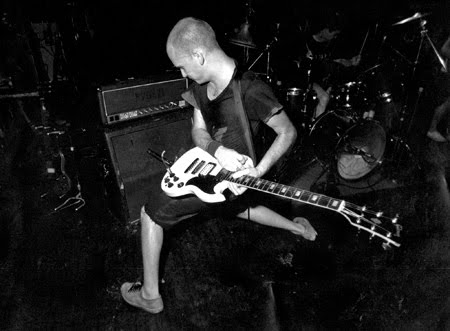

Whereas before Fugazi MacKaye’s main band,Minor Threat, were not just an originating but perhaps the default hardcore band. Notably theirs is the photo adorning Wikipedia’s entry on hardcore punk. Yet he became a keen fan of Rites of Spring,attending all their gigs and producing both their releases. And his next band, the short-lived Embrace, demonstrated their influence.To be frank, I suspect it was Rites of Spring who pushed MacKaye from a decent punk artist to a great one.

Yet Picciotto was not just the last member to join, the band were originally planned as a trio. His involvement slowly grew, from roadying to on-stage dancing, to backing vocals, finally to full member. (He’s later cheerfully admitted that had been his plan all along.)

Significantly, the original plan was for him to be MacKaye’s “foil”. (As Flava Flav had been for Chuck D, or Hanin Elias for Alec Empire.) Beginning with Lennon and McCartney, bands have often thrived off having two distinct but complementary songwriters to spark off one another. MacKaye’s songs were typically driving and relentless, developing an argument, pressing home a point. He retained from his Minor Threat days a love of punchy choruses, and the audience singalongs theyoften promoted. His key ability was to combine measuredness with frenzy. 

While Picciotto’s songs were torrentially emotive and allusive, romantic in the Rousseauian sense of the word. (A typical lyric of his: “He's alone/ His mind is his own town/ Where his thoughts run aground/ They fall all over and down”.)

As Michael Azarrad put it: “MacKaye’s sober athleticism found its polar opposite in Picciotto’s almost hammy sensuality, a formidable yin and yang that powered the band’s galvanic performances.”MacKaye jocularly compared their approaches to the drill sergeant and the mealy mouthed guy.

Azerrad’s also described Picciotto’s performance as “scenery-chewing”, and there is a sense in which he’s a Method actor’s idea of what a punk singer would do. Check out this version of ’Burning’,with his Marlon-Brando-as-dockworker vest and intensity, almost completely disregarding the audience. (The song also gives us our header, “I wanted a language of my own”.)


...now compare to Ian MacKaye on the afore-mentioned ’Bad Mouth’

The band commonly played all-ages shows at non-conventional venues, here the Sacred Heart Church in their native DC. The gig feels like a communalising experience, not just with the absence of a still figure in the house (well at least not anyone not wearing a yellow cap) but the lack of rigid dividing line between band and audience.


MacKaye’s Minor Threat songs had been quite narrow in content as well as style, a magnifying glass held over himself or the hardcore scene he inhabited. A scene that was male dominated, if not actively testosterone laden. So ’Suggestion’, (from the same gig) marked quite a major broadening of his interests. Written (controversially for some) from a women’s perspective, live it was often sung by a female guest vocalist. Here the duties are picked up by DC scene stalwart Amy Pickering.

For their part drummer Brendan Canty (who’d also been in Rites of Spring) and bassist Joe Lally made for an impressive and powerful rhythm section. But, unarguable as that is, it fails to capture their contribution. At the very start, it does seem MacKaye was writing songs then bringing them to the band to learn. But fairly soon compositions went through a group process, often assembled fromkit-partelements all four band members had come up with. (Tracks were always credited to the whole band.)


Which leads onto something else, associated but still more important. In rock music playing well is of marginal importance compared to playing together. Robert Fripp once said “It has nothing to do with self-expression, it has to do with a group mind.” A great band, who achieves that, will move and act as one. Fugazi, as anyone who caught them live could confirm, were a perfect case in point. You’d watch them thinking “I swear these guys must be telepathic or something”.

The art (not just music) that’s most impactful is often the art which achieves seamless integration of form and content, until it’s almost impossible to see the two as separate things. And Fugazi’s style perfectly blended with their stance, self-motivation combined with collective action.

And if any of that sounds like hyperbole, check out the band workout in this version of ’Glue Man’. The final track of the original EP was often used as a set closer as… well, this clip probably gives that away. Someone once sent me this link with the Andre Breton quote “beauty must be convulsive or not at all”. He wasn’t wrong.


The band’s first album ’13 Songs’, (officially a compilation of two earlier EPs), came out in 1989. All the songs linked or referred to above stem from it. Over seven albums the band’s style stretched, with an overall shift away from hardcore towards more of an ‘art rock’ sound. I read a review of one later album (in small type in some badly photocopied fanzine) which wouldn’t even give its title, so outraged were they by it not sounding “punk” any more. As should be needless to say, the most punk thing about Fugazi was that they never bothered about sounding ‘punk’. More importantly, the roots of their developments can already be heard in their first album. They took up a genre already thought standardised if not moribund, and breathed life into it.

MacKaye once said “How about at the end of Fugazi it said, 'they fucking did it their way'? And let's let that be the end.” And by the end the band had played over a thousand gigs around the world, normally all ages, normally for low door prices, always challenging crowd violence when it arose. “Better start living just like you’re talking about”? Pretty damn close.

Quotes and much of the info above from Michael Azerrad’s history of the Eighties American underground ‘Our Band Could Be Your Life’(which has chapters on both Fugazi and Minor Threat) and ‘The Dance of Days’ by Mark Andersen and Mark Jenkins (a history of the Washington DC punk scene, through which the various members of Fugazi thread). Both books recommended. While for essential viewing - ‘Instrument’ is a documentary portrait by Jem Cohen, who used his close relations with the band, to assemble five years’ worth of footage. (‘Glue Man’ above is from the film.)

Saturday, 23 March 2019

JAMES CHANCE + THE CONTORTIONS/ LOST PROPERTY ARTS COLLECTIVE (GIG-GOING ADVENTURES)

JAMES CHANCE + THE CONTORTIONS
The Haunt, Brighton, Sat 16th March


None less than Simon Reynolds claimed that by “combining [James] Brown with Iggy [Pop], [James] Chance invented punk funk.” Legend has it that as the Eighties New York punk scene hated disco with a passion, finding it wishy-washy and platitudinous, his primary motive was simply to wind them up.

Though his take was unique. Talking Heads smartly espoused the very image every other dance outfit tried to suppress, the uptight white salary worker trying to loosen his tie for the weekend. Conversely, Chance took funk’s raw punch and married it to punk’s swift upper cut. Against David Byrne’s bespectacled nerd image, Chance collided punk with showbiz - with slicked back hair and Fifties suits. Band names varied, but tended to the classic Person and the Band formulation. But Chance and Byrne did something in common, both were white folks taking on a black influence their own way, without trying to merely imitate it.

Commercially, of course, one of these worked better than the other. The last time David Byrne played Brighton it was the Dome, I couldn’t afford a ticket and was told afterwards he was rubbish. Chance doesn’t even fill the smaller Haunt. His name seems a little more legendary than known. In fact, it was only spying him honking his horn in a recent BBC documentary on Basquiat, that I realised he was still around.

Truth to tell, it’s an oddly uneven set. I found the frequent cover versions just derailed momentum. Even when they were tracks I liked, such as Gil Scott Heron’s ’Home Is Where The Hated Is’. Chance’s voice doesn’t seem up to them, less in terms of singing ability than diction and phrasing. They seemed the sort of maketime venture you’d embark on if you didn’t have enough of your own material to fill a set. Hardly the case with Chance, which made their inclusion all the more puzzling. At such times I was reminded of seeing Ed Sanders playing with the next generation Fugs, an older star relying on a younger backing band to carry him through.

And yet what was especially odd was that when things worked they really worked. It had the involving dance-floor readiness of funk at the very same time it sounded askew and discombobulated. Though Chance is a free jazz fan, there’s only one total wig-out - right near the end. The sound may well be best summed up by the lyrics to his best-known track, ’Contort Yourself’, “Now is the time to lose all control/ Distort your body, twist your soul.”

The guitarist seemed especially gifted, able to come up with inventive breaks and flourishes, at one point just tapping the neck to shake the strings, while always keeping the beat.

Listen, for example, to ‘Do The Splurge’ and try to tell me this is not a fine thing…


James Chance & The Contortions - "Do the splurge" from Agata Urbaniak on Vimeo.


LOST PROPERTY ARTS COLLECTIVE
Phoenix Gallery, Brighton, Fri 15th March


Lost Property, the folk who put on the famed Fort Process festival, explain this event thusly: “In the spirit of the creative happenings of the Sixties, Brighton Arts Lab is a new bi-monthly event, serving up performances, spoken word, workshops, film and exhibitions. Each event is themed around different aspects of creativity.”

Jobina Tinnemas’ set seemed more effective than the earlier one at the Radio Three Exposure festival. An engaging character, she worked better in the smaller venue. She’d cheerily explain the workings of her kit and sources of her samples, as if we’d all been invited back to hers. I was less keen on her final piece, however, which brought in overly familiar regular dance beats

Unsoundproofed central venues often suffer from street noise. Yet Anti-Pattern (aka Al Strachan) smartly summoned and incorporated it, by placing a microphone outside the window. Playing in the main corridor, essentially one long window, the street outside became effectively one giant visual to his work. You had to keep telling yourself the sounds weren’t inbuilt.

Ed Briggs started out with some fairly regular organ sounds, which could have passed as a stab at Bach, only to then take off into realms unknown. Two players worked one organ. At one point, as one worked keys and the other pedals, it sounded in no way like a single instrument. The set was only marred by an outbreak mid-way of Industrial Satanist vocals, which seemed straight out of Eighties cliche-dom. (You know the sort of thing. “I will tar your very soul. I will scratch your car door up and down, and not even say I’m sorry.”)

Fettucini Spicer improvised while facing off against one another, rival sonic arsenals set before them, like Clint Eastwood and Lee Van Cleef in some Surreal duel.

Stone Cornelius’ miked-up-knitting piece seemed mere gimmickry to me. But overall, the success rate was high and the night had a good feeling to it. The Phoenix Gallery works well, not only taking it away from regular rock venues but, multi-roomed, able to keep the action going. More seems promised, which we can only hope for.

Jobina Tinnemans…


Jobina Tinnemans - "Varesotto" from Agata Urbaniak on Vimeo.


…Ed Briggs, though here called Black Tiger…


Black Tiger from Agata Urbaniak on Vimeo.


…and last, but not least, Antipattern with cameo street sounds…


Antipattern from Agata Urbaniak on Vimeo.

Saturday, 16 March 2019

THE LENS OF LUCID FRENZY LIKES A GOOD STONE CIRCLE...

...and fortunately Orkney is festooned with them! Plus Maes Howe, which is a Neolithic burial chamber rather than a stone circle, but impressive all the same. No villagers chanting "Happy Day" were present at time of visit...

As ever, full set on 500px.


Saturday, 9 March 2019

TOTAL IMMERSION: LIGETI (GIG-GOING ADVENTURES)

Barbican, London, Sat 2nd March


The Hungarian composer Gyorgy Ligeti… you’ve probably heard his music even if you don’t know the daunting-sounding name. For Stanley Kubrick was wont to use it in his films, principally ‘2001’. And his influence remains strong enough for the Barbican to stage a day-long series of concerts, of which I was only able to catch the evening.

Though he was composing earlier, the Sixties saw him hit on his mature style. He’s quoted in the programme as saying “I have always been looking for an alternative to the 12-note temperament”. And he became interested in what we’d now call World music, not to imitate or incorporate it but to find life outside the conventions of Western harmony. Imagine if visual art had not been confined just to subject matter but to colour, with three agreed shades or green and purple unheard of.

Instead, in the pioneering ’Atmospheres’ (1961), he used ‘sound masses’ where instruments cluster together rather than contribute individual lines, producing ‘adjacent’ sounds to one another which need to be heard in combination. Imagine the difference between ballet, where figures dance in synchronisation but stay separate, to circus acrobats climbing and jumping all over each other. And the piece is exhilarating to listen to to this day, particularly to witness regular classical instruments emitting such unearthly sounds.

His mention of “12-note” refers to then fashionable Serialism. And it’s notable that, quite unlike Serialism, the piece has great dynamics. It just achieves them without the normal standards of musical progression. It’s been described by Harold Kaufman as "a magma of evolving sound”.

The next piece, at least chronologically, was ’Clocks and Clouds’ (1972/3). In a nice anecdote, the programme explains the title comes from a Karl Popper lecture he attended. The then-standard notion of physics was that the sub-atomic world, with its quirky quarks and other weirdly behaving particles, was one thing and the clockwork order of the stars and the planets another. Whereas Popper insisted on a continuity between order and chaos, between clocks and clouds.

I’ve often compared contemporary music of this era to experiencing a weather front. And by extension of Popper’s metaphor, much of the appeal comes from perceiving an order to the music which you can’t quite discern. It’s like receiving an alien radio signal which is compelling for hovering on the periphery of decipherability. The voices in ’Clocks and Clouds’ particularly suggest this. And, possibly by co-incidence, as Ligeti grew up in the Eastern block, he first heard contemporary music by illegally tuning into German radio stations.

The programme also included ’San Francisco Polyphony’ (1973/4) and two much later pieces, after Ligeti had returned from a break from composing. In the intervening time his sonic cosmonaut adventures had fallen more into earth’s orbit. As suggested by the tiles of both ’Piano Concerto’ (1985/8) and ’Violin Concerto’ (1989/93) their return to convention even extends to having a lead instrument. There’s quotes from the man to suggest that, once the unexpected is expected from you, the thing to do becomes the expected.

It’s true that ’Atmospheres’ packs more in it’s nine dense minutes than ’Violin Concerto’ does in twenty-eight. And the concertos might have worked better programmed alongside one another, despite their greater length. But their most interesting feature was their lack of interest in, to use a current political term, ‘centrism’. Instead of making their prridge meh they span the dial all the way from the most regular clocks to the most ungraspable clouds. The programme describes ’Violin Concerto’ as “a labyrinth in which some paths were familiar, some weirdly unfamiliar, and one could never guess when the music might flip from one to another.”

And ’Violin Concerto’ in particular is interesting for a return to folk influences of his younger years. At times the lead violin seems to be echoed in a distorting mirror of the ensemble, where they’d mangle his melodies and hand them back to him. Yet at others they’d provide melodies of their own.

Though Liegti knew Stockhausen, one of the other great contemporary composers of the era, he only very briefly dallied with electronic sounds. In fact, though the music’s quite different, there’s more of a parallel in approach to the American Minimalists. Both saw World music as an escape from an impasse Western composition had mired itself in, and so stuck to ‘standard’ instruments. Both eschewed a hierarchy of instruments and musical progression. Both later decided that their own rules now risked becoming restrictions, and tried to reconcile themselves with the Western tradition.

Depending on your whereabouts and whenabouts, you may be able to hear this concert on the BBC iPlayer.

And you’ll know this…

Friday, 1 March 2019

“SOMETHING HAPPENED ON THE DAY HE DIED”: DAVID BOWIE’S ‘BLACKSTAR’


Bowie’s ’Blackstar’… okay, I’m coming a little late to this one. But its very existence is heartening to me. It may have taken someone who hailed from the days from when ‘LPs’ were ‘released’ (instead of ‘items’ being added to ‘feeds’) to rekindle the feeling of an LP being released, but let’s just focus on the fact we got there.

And for me it’s extra sweet. Before the end of the Eighties I’d finally got over my fervent youthful denunciations of his “selling out” and simply stopped thinking about him. Then, slowly and surely, it became the musical equivalent of people’s paths diverging only to come back together later in life. As if he’d become bored of attending award shows and glitzy parties, and decided he was really one of us outsider types after all. Culminating in an album that genuinely bears comparison to his Seventies stuff.

So it seems gloriously old-fashioned the way so many people devoted so much webspace to raking over every utterance and studying the cover for “clues”, even if there was little of quality analysis amid that width. They roved from Norwegian villages to computer code, hoping to overturn so many stones that surely something useful will be stumbled upon. But however absurd the exercise it does hearken back to the days when an album being released was an event, like a monolith being found on the moon, around which the rest of life would have to reorient itself.

And I wonder if, with the title track in particular, it wasn’t preloaded for that response, to both provoke and stymie it. With any piece of music, you’ll hear the sound of the voice before you take in any words, which will inevitably colour the lyrics. And there’s two distinct vocal lines in this song, even if both are provided by Bowie himself. The ceremonial voice which opens the track is like the musical equivalent of a Greek chorus, describing things, setting the scene.

The other voice, sounding more like a regular Bowie vocal, slips between first and second person. But both are concerned with the actions of a character. It behaves like a lead vocal, the ceremonial voice slipping into backing vocals when it’s around. In other words, the first vocal frames the second, both in form (the song being palindromic in structure) and in content. As if the track has its own inbuilt audience. In the video he ‘plays’ the two voices as different characters.


“At the centre of it all” is nothing that radiates but a blackstar, defined as a set of absences (“I’m not a filmstar… a popstar… a marvel star” and so on.) A corpse in a spacesuit. Bowie often demonstrated a Dylanish disdain for pinning songs to ‘meanings’, and here the compound word title brings together ‘centre of attention’ and ‘blank slate’. Maybe his last words to us all were “you try making some sense of this stuff if you want. Me, I have somewhere I need to be…” While at the same time saying, in Lennon’s teasing words, “here’s another clue for you all”. And, to quote him from another track on the same album, “ain’t that just like me?”

So why do that? Bowie had a wry sense of humour. But that’s not the whole of it. Scanning songs for ‘clues’, like they’re puzzle games or detective stories, is clearly not the right way to respond to them. It borders on category error. But in its klunking, gormless way it clutches at something important. Art is not a work email or a note left out for the milkman. It’s not a switchboard for conveying straightforward information. The artist only launches the artwork, lets it loose in the world. From thereon in, it’s up to you, the listener, to make your own sense of it.

Saturday, 23 February 2019

‘CARNIVAL OF SOULS’


As I’m going to be cavalier with PLOT SPOILERS here I’m just going to assume this classic horror film doesn’t need much introduction from me. Besides, it’s become public domain so can be watched on-line by anyone who has a mind to. Here’s the edited highlights… 1962… American independent feature… produced not so much quickly as guerrilla style… no success even as a B feature… director, producer and co-writer Herk Harvey consequently never made another feature… later became cult classic… powerful cinematography… eerie and atmospheric… all of that.

Clearly this is not a film that’s about its plot or even its themes, they’re really just a means by which it might evoke its creepy atmosphere. Something that’s very often true of good films, which will create their own world rather than mimic an existing one, but more true of a film like this. Its mood haunts you as much as it does its chief character. However, as a holder for that mood it does create a mystery.

And there’s a predominant theory for deciphering it. The majority of the film is a dream sequence that, in a pre-echo of ’Inception’, plays outside of clock time, between the crashing car hurtling off the bridge and hitting the water. Which is why we return to the bodies in the car at the end, after the character Mary had initially seemed to somehow escape.


Seen this way the menacing Man who Mary keeps seeing (above) is Death. Self-described as “a person of strong will”, she attempts to impose her own death-defying narrative where she not only defies the crash but starts a new life in a new town. Death, inevitably enough, catches up with her. While, already touched by death, she can’t make any real contact with the living.

And there’s certainly arguments for this. She’s horrified by and runs from him. Yet at the same time she’s drawn to the liminal space of the lakeside Pavilion. At one point at a bus station she can hear nothing save for a distorted tannoy announcement that a bus is leaving. She boards it, to find it full of ghouls welcoming her aboard. In the well-known climactic ballroom scene, the ghouls dance in couples while the Man stretches out his hand to her - as if this is the company in which she belongs. Even as she runs from Death she’s drawn to him, in a sublimated death drive.

There’s also the recurrence of both water and the spectral, swirling organ music. In fact the film seems to associate the two - we first hear that music as the camera moves into close-ups of the river. In Freudian psychology, often beloved of horror films, both bridges and water occupy a liminal space between life and death.

And if there’s two hallucinatory scenes within the main film they’re normally regarded as, in a further pre-echo of ’Inception’, a dream within a dream. (At least one isn’t actually a dream, but that’s how they’re commonly referred to.)


All of which is laid out with rather witless literalism by the poster tagline “she was a stranger among the living” (above). Later reissues came complete with “is there death after life?” and “she escaped death, now it wants her back.” Though all this telegraphing may well not be Harvey’s intent. Distribution rights soon fell outside his control. And with at least one poster which went for the absurdly salacious (below), it seems reasonable not to take them as authorial statements.

But…

‘Invaders From Mars’ (1953) is another American independent production built around a film-long dream sequence. But it’s noted for the “dreamlike Surrealism” of its design. While the majority of ’Carnival Of Souls’ is set in an ostensibly ‘real world’. (Filmed on location in Lawrence, Kansas and Salt Late City.)

For example, the petrol pump attendant who describes the Pavilion to her is assigned the horror movie role of the Harbinger. But his description is simply informative. (And remarkably close to the actual history of the place.)

If the film’s conceit is that this is all a dream or hallucination Mary’s having, which we get to experience, then to include scenes she’s not present in is a strange decision. Admittedly there aren’t many of these, but they occur. In one, almost at the finale, her final footprints are traced by a cop. The ghouls pursuing her, being spectral things, have left no marks - while hers just end, as she’s taken. Which ‘makes sense’, within the narrative logic of horror films, of what’s just happened. Which would be a peculiar scene to insert if Mary was imagining the whole thing, Pavilion setting and all, from inside a car currently striking a lake.

And more importantly, if the main part of the film is a dream sequence, why are the dreams-within-a-dream so distinct from it? They’re as ‘dreamy’, as disruptive of narrative rules, as it is naturalised.

In a famous quote Mary says “I don't belong in the world - that's what it is. Something separates me from other people.” And she’s often shown literally shutting people out, from her room in the boarding house or locking her car doors. You could picture a scenario where she seemingly escapes the crash, yet is heartbreakingly invisible to her friends and family. But that’s not the film we see.

The “something” that separates seems there from the beginning. The film starts with another girl driving the car she’s in, eagerly accepting the boys’ challenge to a race. Yet when we cut to Mary she looks at first detached and then apprehensive.

Her work as a church organist is partly devised to mark her out as alongside but not part of the congregation, turning down a social invitation to meet them. Yet she seems to have the job lined up before the accident, and travels off to it very shortly afterwards. And another character confirms: “She’s always kept pretty much to herself.”

And if it’s not death that prevents her from belonging, that would seem to work better the other way around - it’s this detachment from life which pushes her towards death.

Seen this way, the Man isn’t death so much as… well, man. There’s times he just appears, at the car window or in the boarding house hallway. But he will also displace, and be displaced by, other male characters. This includes, in a bit of a cheesy shock, the Psychiatrist in his office. But she also imagines the Man’s hands grabbing hers over the organ, which then transform into the priest’s. (A moment captured on the film poster.)

Look again at the opening. Boy racing is a staple of films from this era. But they will almost always involve girls as passengers, choruses to the action. Here a car of boys races a car of girls, which more accurately sums up the teen years when the two sexes start to take a sideways interest in one another.

Which seems to conflate the near-universal wish for a place in the world with the desire for a man. Mary claims to have no such desires, and with her work as a musician seems set on financial independence.

This was a time when ‘nice girls’ were supposed to have no sexual yearnings of their own. Yet at the same time a rejection of male desire was medicalised as ‘frigidity’. Which seems something of a Catch 22.


The film would make an interesting compare and contrast to Polanski’s ’Repulsion’ (1965). Which creates a paradox. We watch a woman succumbing to hysteria, where the more she cracks the more thrilling the film becomes, her hysteria equalling our enjoyment. Yet in both films we don’t just take on the protagonist’s perspective, we see the world quite literally through her eyes. (Apart from Mary, it’s only us who see the Man.) So both films are structured in such a way as to invite sympathy for her.


Take for example Mr. Linden (above), who literally sticks his foot in her door and continually tries to ply her with drink, is clearly presented as a louche, predatory creep. It’s not our seeing him that way with hindsight. Yet, rather than responding like a smalltown innocent, Mary’s immediate response is to keep trouble at bay. This is shown less as ‘frigidity’ and more as levelheadedness. She does consent to go out somewhere with him, but that’s an indication that she’s so desperate for human company that even he’ll do. Any louse in a storm.

So despite the archetypal hysterics perhaps we could see her as a pre-feminist heroine. The impossibility of her situation becomes a microcosm of a woman’s place in this era. Alone in a man’s world, effectively deprived of solidarity from other women, she inevitably cracks under the pressure. Yet, a person of strong will, she goes down fighting. Which would be a tempting line to take. It would mean that, while the film may trade in sexist tropes, it also challenges them.

However, there’s multiple problems with this. First, Mr. Linden seems more a detail of the film than a component. It would be relatively easy to edit him out without leaving much of a hole. (One reason he may loom larger in the film than he might is that Sidney Berger’s smarmy, hyperactive portrayal is so effective in a film where wooden acting’s the norm.)

More interestingly, he’s very much the exception to a rule. While almost all the other men in the film are presented as reiterations of a type - someone older and not just unthreatening but relatively kindly. The Man therefore becomes something like their id figures. In short, the Man’s not just the Man, he’s the anti-Father.

There’s one passing suggestion she sees “her folks” before she leaves for the city, to which she gives the evasive reply “No, I can't. I.. I must hurry. I've got to leave.” Partially of course this refers to the classic fool’s errand of trying to outrun death. But why bring her folks into it at all?

That evasion, what if it hints at child abuse? This may sound like a lot of narrative weight to load onto what’s essentially an ellipse, but given the censorship rules at the time its something which could only be referred to obliquely.

Young victims can sometimes form a bifurcated view in which the providing parent and malevolent abuser are conceived as two separate people. Which would perfectly fit the succession of kindly father figures and their recurring ghoul-like shadow. Though, rather than retreat into ‘frigidity’, the abuse victim will more typically fall to the other extreme, failing to maintain non-sexual relationships. However, ‘frigidity’ does more match movie psychology - it takes well to the screen, doesn’t risk censorship and seems more sympathetic.

So is the film really about a woman’s mind trying, and inevitably failing, to rationalise child abuse? Has the real horror happened before the film starts, and Mary’s hallucinations manifest as some kind of post-traumatic stress disorder?

Perhaps. But when rival interpretations of an artwork prove persuasive our first question should be whether they really need to be seen as rivals, whether we have to choose between them. 
Is the Man Death, Man or Anti-Father? Maybe the best answer there is yes.

Saturday, 16 February 2019

‘SOUL OF A NATION: ART IN THE AGE OF BLACK POWER’

Tate Gallery, London


”I mean to tell it like it is. I ain’t subtle and I don’t intend to be subtle, so long as America remains the great white destroyer”
- Dana Chandler

The Body Is Graphic

Ask people to think of a medium associated with Black Power, and they’re not going to come back with visual art. Even this show’s title obliquely alludes to that, while the curators compiled an accompanying playlist. For music was not only a ready form of black expression, it was an open channel by which that expression could disseminate. We saw before, with Pop Art that despite the Sixties being so visual a decade visual art struggled to keep up with other media. Were there visual artists who equalled the Last Poets or Gil Scott-Heron in significance? Let’s see what we can find…

It’s certainly true Black Power was partially about image. Its central tenant was that representation of black people – cultural or political – is a task which might sometimes be undertaken by black people, and in fact that make make for something of a change. And that representation applied to culture as much as politics.

Something more the case than in earlier phases of struggle. Civil Rights often deployed the slogan “I am a man”, establishing a fundamental equivalence between black and white folks.It was at root integrationist. And so its practitioners tended to favour a sober-minded look, formal dress countering the black criminal or delinquent stereotype.Whereas the Black Panthers’ original ten-point programme began with “We want freedom. We want power to determine the destiny of our black community.” It was at root autonomous. So Black Power tried to reclaim the black look from the negative stereotypes it had become associated with.

(Disclaimer:Purely for convenience I’m going to pretend Black Power was one discrete entity. Even though it wasn’t. It didn’t reduce solely to the Black Panthers, who hadt heir own highly virulent debates.)


And the poster image is… well, a good poster image of this. Barkley Hendricks’ self-portrait ’Icon For My Man Superman’ (1969, above) is as the title suggests very much an iconic picture, flatly descriptive, double-framed with a minimal background. It’s not an attempt to convey psychological depth. It’s a statement which comes out intothe world, as bold and direct as any presidentialhead carved into a mountainside.

With his S-logo shirt, folded arms and impassive shades, Hendricks looks cooly assertive without being aggressive. He subtitled the picture with a quote from Bobby Searle, “Superman never saved any black people”. The message, as the Guardian’s Laura Cumming puts it, is “Hendricks has no need of Superman. He saves himself.”

(Slightly later, in 1975, Gil Scott-Heron wrote a very similar message with ’Ain’t No Such Thing as Superman’: “Understand that if we’re gonna win/ We've got to get together, stay together, be together, stick together”.)

The effect of this may be hard to grasp, particularly for those born to a later generation, in a different country and – above and beyond all the others- white.For example, me. But imagine if the only popular images you’d ever seen of people like yourself were savages, criminals and rubber-lipped clowns. Then one day you spy people justlike you butbrimming with pride over the way they are, and insistent you could be too. Black Power quickly became a walking, talking symbol of itself.

It’s significant that the term ‘cool’ originates in black culture, even if it now means little more than owning the latest smartphone. When striving to get a grasp on what’s cool, where else is there to go but Wikipedia? “Cool was once an attitude fostered by rebels and underdogs, such as slaves, prisoners, bikers and political dissidents, etc., for whom open rebellion invited punishment, so it hid defiance behind a wall of ironic detachment, distancing itself from the source of authority rather than directly confronting it.”

As Norman Mailer said: “Any Negro who wishes to live must live with danger from his first day… no Negro can saunter down a street with any real certainty that violence will not visit him on his walk.” And how can you respond to that situation other than making a conscious display of sauntering? When the world ruthlessly shoves its weight on your shoulders, what are you going to do but shrug it off with the most carefree gesture possible?

As the term dates to the jazz scene of the Forties, by the Sixties the association was well-established. So Black Power was able to take elements of cool as it chose (self-confidence, autonomy) and combine them with its apparent opposites – righteous anger, collectivism. It was cool and incendiary simultaneously. You can see those all at work in Hendricks.

Focus just for a minute on Hendricks’ afro. This worked in a very different way to the hippies growing their hair, which for all their talk of “going natural” always involved taking on a new identity. The afro was based around the idea that black identity had up till now been suppressed, that if they wanted to get by black people were expected to make their best impersonation of white folks. As the poet Amiri Baraka wrote in ’In Our Terribleness’ (1970) “our beauty is BAD ‘cause we have something like an inner sublime, no longer conforming to white notions of beauty.”

And one of the many means by which Black Power is treated in an institutionally racist way is that the focus is always on its effect upon white society. Whereas it’s primary catchment was black people. It says so much that you even need to point that out.

As AO Scott of the New York Times points out: “Images of black men in black leather jackets and berets, brandishing firearms and raising their fists are part of the collective memory of the ’60s. At the time, those images inspired a wave of publicity and recruiting… Gifted at political theater… they managed, at least for a time, to be both glamorous and grass-roots… They helped to popularize the slogan ‘black is beautiful’ and to promote an aesthetic of pride and self-sufficiency.”


See for example the cover of the Black Panther newspaper featuring Huey Newton (above), with a gun in one hand and a spear in the other, surrounded by African paraphernalia, described as a “warrior king”. This fuses the raised fist of radicalism and the afro of self-beliefinto one neat and powerful statement. The newspaper’s designer, Emory Douglas, was titled the Panthers’ Minister of Culture. While the black activist Angela Davis famously appeared on an FBI ‘Most Wanted’ list sporting a crowning afro, is seen belowon another Black Panther cover.


In Black and White


Interestingly, having said all that, the show also includes art from the earlier Civil Rights era. This focuses on the Spiral group, who formed in 1963 in the context of Martin Luther King’s march on Washington. Reginald Gammon’s ’Freedom Now’ (1963, above) has the immediacy of a newspaper photo, a punchy, immediate image in stark black and white. Yet what’s interesting about it are the collage elements. The chanting heads are placed beneath the marching feet, the slogans on the banners cropped out. On a second look, the heads themselves aren’t attached to protesting bodies but clustered together and overlaid on the canvas.


Both more interesting and more collage-like is Romare Bearden’s ’Pittsburgh Memory’ (1964, above). Why so much collage? Civil Rights had followed both a mass and a media-centred strategy, taking segregation from being the South’s dirty little secret and projecting it over national newspapers and TV screens. In which it had been successful, perhaps successful enough that there was no need to duplicate those images in art.

Plus there’s often a sense with Dada that it used collage less to manipulate reality than to hold a true reflecting mirror to capitalist society, a society fractured into an incoherent jumble of elements. This combines with the Sixties notion of times too volatile to capture ina single clear image. Instead all the artist can do is compress the elements withina frame, and leave them to fight them out.

Yet, even given all that, perhaps what’s most remarkable about Bearden’s image is that, counter to any standard notion of agit-prop art,there’s no representation of white authoritynor any notion of protest. With the equally collaged background it might be an image of urban alienation, thosefaces reflecting what they see. Or thetwo jumbled-together heads mightbe a roadmap of road jams, representingthe alliance of Civil Rights groups held together more by urgency than commonality. (The indicia tells us Bearden had originally tried to get the whole Spiral group to collaborate on a collage, but been rebuffed.)

Abstraction Versus Agitation?

You could compile a show about the age of black power, or about black art in America during this era. Either would be a valuable thing to do. But this exhibition never quite decides which of these it wants to be. And the result is that any friction on the borderline between the two is magnified.


William T Williams ’Trance’ (1969, above) is a geometric work influenced by Abstract Expressionism, with perhaps the bold colour blocks borrowed from Pop Art. Is there any reason for it to be hanging in a Black Power show? My somewhat cynical response to the abstract artist who bestows his work with an agitational title is that he’s just setting up his response to the guy who asks him how this fancy-schmantzy shit is supposed to be helping the soul brothers. Things aren’t true or effective just because you say they are. 

As previously said of Abstract Expressionism, it exhibited a general existentialism for those who lived in peace and abundance. Hardly the lot of black Americans. You were less to indulge in existential angst while cops were beating you up.

Yet the Smokehouse Associates also favoured geometric abstraction. But they were muralists working in Harlem, and the context of grey housing projects completely transforms their work. As Emory Douglas put it pithily ”the ghetto itself is the gallery for the revolutionary artist”.

But then some jazz wafts in and, as it’s wont to do, screws with this straightforward tune.

Jazz was the default example of something black culture was recognised for. (Even if it had been venerated more in Europe than at home.) And it had previously influenced Abstract Expressionism, its departure from song structure paralelling art’s move away from direct representation. Williams called jazz “abstract music’ and named his piece above after a John Coltraine number. And if I can’t see much of a jazz influence in it’s neat angles and sharp distinctions, I do find something closer in Sam Gilliams’ ‘Apr 4’ (1969, below)


That date refers to the murder of Dr King the previous year. A connection which might well be tenuous, existing nowhere but the title. But, in contrast to Williams, the canvas (achieving by staining) suggests depth and detail rather than asserting it. Which does seem something to do with jazz’s bending and blending of musical rules. Meanwhile, Jeff Donaldson’s ’Study For the Wall of Respect (Miles Davis)’(1967, below)combines a portrait with abstraction by combining Davis with a representation of his music. (The study was done to add Davis to a Chicago mural.)


Another work whose inclusion could be debated, though for separate reasons, is Faith Ringgold’s ‘American People Series#20 Die’ (1967,above).Figures are placed at right angles to one another yet at the same time overlapping, as if they’re trying to occupyseparatespacesand failingly straddling one another.The checker blocks of the background magnify the sense of arepeating pattern. Partly due to the elongated shape of the frame it looks like a street scene, even if no actual detail supports that reading. This punches the horrific image home, making it look more everyday.

It’s certainly a powerful work, but what to make of it? Ringgold has a long history of activism relating to race and feminism, as an upcoming example will prove. And the indicia suggests this was a reaction to the sanitised way riots were reported. But, bizarrely, it looks more like race war phobias of white supremacists such as Charlie Manson than a Black Power statement, allied to the popular phobia (persisting to this day) that riots are a result of mass hysteria.

Yet even this ‘race riot’ reading gets convoluted, with the men and women sporting such gender-coded clothing. (All the women wear the same orange dress, all the men white shirts and ties). While a white boy and black girl huddle together. In fact it’s often ambiguous who is instigator or victim, or even attacking who. Is the women to the left running to safety with that child, or attacking the half-cut-off black figure with the child raised like some kind of weapon?

Perhaps our readiness to read race into the conflict is part of the point it’s making. Michael Rodger described it in the New Statesman as “a scene of slaughter in which everyone is the victim”. This is the war of each against all, an effect enhanced by the either/or of the checker background, in which race difference is but an exacerbating factor. It’s naive look makes it seem like one of those drawings made by children who’ve seen war scenes. (And, equally bizarrely, the artist often worked in children’s books.)

The Subjectivity of Objects

The one thing you hope for with group shows such as this is that they introduce you to artists, or better still scenes of artists, you previously had no idea existed. And this show delivers par excellence with the Los Angeles Black Arts scene. These artists counter any easy distinctions between public and agit art carrying a black power message, and gallery art concerned only with aesthetics. They were gallery-based, but if their message was less in your face than others, it was no less potent.


Their methods were often similar to Rauschenberg’s, employing the potency of found objects. For example Noah Purifoy’s ’Watts Riot’ (1966, above), was made from debris found from the riots in the black neighbourhood of LA the previous year.


Whereas Bettye Saar gathered not trash and detritus but readymade images from commercial objects, focusing on depictions of black people for white consumption. By combining them into assemblages, but partly just by foregrounding them, she exposes the malevolence beneath the folksy reassurance. ’The Liberation of Aunt Jemima’ (1972, above) employs variants of a mascot character for pancake mix, still in use today. 

The main figure has clearly been given both the lips and expression of a clown. She has a maid’s broom in one hand, yet Saar’s given her a liberating rifle for the other. In ’Sambo’s Banjo’ (also 1972), Saar added a lynched ‘sambo’ mascot to a banjo case, plus a photo of an actual lynching.

Such cartoonish images are so disparaging they can seem worse than pointedly racist caricatures. At least, once framed by others as a threat, you’re freer to see yourself as a threat. Particularly given their widespread use, your natural reaction is to want them removed from public show. Which is not necessarily wrong, of course. Yet Saar’s subversion of them seems a more powerful response. It’s as if she treats them as malevolent spells, which can’t be repressed by being hidden but whose orientation must be changed. And if that notion only works metaphorically, then art is metaphorical.


In later works Saar became interested in ritual objects from the history of black culture. The altar-like ’Mti’ (1973) dates from this era. Works of this era have a mystery, as if exuding a powerful magic you can’t define, but there is also something slightly mournful about them. They’re quite unlike the normal New Agey raiding of other cultures.

After The Revolution Wasn’t Televised


Faith Ringgold’s ’United Sates of Attica’ (1971/2, above) is named after a notorious prison where adherence to Black Power was likely to get you sent, leading in part to an inmate riot in 1971. It contains the phrase “this map of American violence is incomplete. Please write in whatever you find lacking.”

Except by now, to misquote ’Jaws’, we’d need a bigger canvas. Not only is there an ongoing debate conducted on the streets of America over whether the lives of black people should matter or not, the prognosis isn’t even looking good. We’re constantly told those resisting oppression must somehow be the cause of it, an argument which might seem to break the most basic rule of causality but which nevertheless gets magnified by repetition. The racist far right are openly exultant over the direction things are taking, which seems less than a good sign.

What help can Black Power give us? It’s reliance on heroised images might seem more problematic today. Even at the time, those images travelled further than their political actions. And many read a programme from their militancy, assuming the Panthers only ever got into armed standoffs with cops, at best a gross distortion. But now those images are all that remains, the picture is still more distorted.

People today tend to imagine Black Power was all a pose, a piece of radical theatre which happened to be conducted on the streets. Afros were grown, guns waved and slogans spouted. A view which, ironically, is true of many other aspects of the Sixties – as captured in George Melly’s phrase “revolt into style”. The debate then gets conduced over whether police repression was an appropriate response, to something which was ‘dangerous’ or merely ‘harmless’.

As ex-Panther Lorenzo Kom'boa Ervin put it: “I think that what you got today is style over substance. You've got a lot of people who talk about militancy and they get the Black Panthers style, but they don't have any programme and they don't do any practical work in the community.”

Equally, the temptation to counter such media spin and distortions by merely championing the achievements of Black Power may be an equal but opposite mistake. It was a movement of young people, who in most cases had little to no prior political experience, who were suddenly catapulted onto a national political stage. Against a hostile media and still-more-hostile cops. Inevitably, mistakes were made. Our aim should be not to criticise those involved, but to avoid making those same mistakes again.

All of which inevitably evokes a debate about the effect of heroic icons, whether they’re enabling or just enthralling, whether they encourage people to become their own Superman or leave the citizens of Metropolis looking to the hopeful sky expecting rescue. The same room that contains Hendricks’ self-portrait, for example, also has a Warhol Pop Art screenprint of Muhammad Ali. In a commodity-based society radical content doesn’t auto-innoculate art against merely being consumed like everything else. The Panthers themselves often complained they could be treated as a resource to call on rather than a group to participate with.

But that’s to blunder into a tangled debate which is never likely to be neatly resolved. The one thing to remember is that even static images do not remain static. As the culture that surrounds them changes, inevitably they change too.

Angela Davis, for example, later came to lament her afro’s ubiquity: “I am remembered as a hairdo…it reduces a politics of liberation to a politics of fashion.” But there’s a crucial point here. For that to happen, first the politics of liberation needed to be smashed, in order for its constituent pieces could be prised apart. Davis’ “hairdo” now appears in lifestyle magazines the way that the culture of defeated colonial subjects appears on plinths in the British Museum, mere objects of contemplation. But once they were functioning forces.

Saturday, 9 February 2019

LOW/ THE RESIDENTS (GIG-GOING ADVENTURES)

LOW
St. George’s Church, Brighton, Thurs 31st Jan


Previous Low gigs, including those held in this very venue, had a campfire intimacy to them. Their sparse, involving music and guitarist Alan Sparhawk’s engaging personality seem to transform large venues into small ones. Though they don’t play what you could call folk music, their gigs can feel more like folk gigs than many folk gigs.

This time however the trio are backlit by banks of neon tubes (one for each member) on which projections play, effectively making them into silhouettes. And Sparkhawk only really chats to the audience for the encore.

For, not unlike Fucked Up - yet in their case more than a quarter century into their career - Low have embarked upon a radical change of direction. With the new album ’Double Negative’ heralded as a career highlight. (Fun fact! ‘Double Negative’ was one of the names I initially toyed with for this blog.)

Though I’m yet to hear the new album properly, initial findings confirm both of these. The old Low, of the haunting melodies and plangent harmonies, is still there. But, to borrow a term from Pitchfork’s review, it’s been “warped’ by studio glitch, tone and effects, until it only occasionally comes into clear view through the haze. 

It has an effective visual metaphor in this video for ‘Quorum', where everything you might expect to see in a Low video appear but in a cut-up fashion. (Another video has an ominous Lynchian poledancer. Not even kidding.) Resident Records have chimed in with “the band are here to question everything we know about them.”

Live, the change is not quite so complete. The old Low are there in front of you, and (insofar as I could tell) the only effects came from pedals. But the change was nonetheless considerable. Particularly with the long drone-like instrumental sections, which created a kind of monochrome psychedelia - sounding somewhat like My Bloody Valentine at their most out-there.

Many reviews pin this change to recent political events in their native America, over which the band have conceded they are not best pleased. (Can’t think what.) That Pitchfork review, for example, compares the title to Trump’s inability to use one over Putin. (Clue, Donny. When it’s a double negative there are two of them.) Etherial as ever, they’re hardly direct protest songs to be filed with Neil Young’s ’Let’s Impeach The President’. But there may be something to that.

I’d tended to think of the classic ’Sunflowers’ as the definitive classic Low track. It’s mood seems to evoke a world which can only ever be inexplicably mysterious to us, so the only thing we can possibly do is surrender ourselves to it. And it’s tempting to say that the always nocturnal band have now got darker. The newer songs evoke that kind of insomnia paranoia, where something preys on your mind without ever revealing to you precisely what it is.

Except that’s more neat than accurate. Low always were a blend of numinous and ominous, it’s just the balance of those elements which has shifted. Something made clear when they play ’Sunflower’ to conclude the gig.

There was one disappointment to the night, which was all my own fault. I’d seen Richard Youngs just over two years ago, where he’d obligingly offered the audience a choice between sets. I’d plumped for what he described as “one long piece about Winter” but been outvoted. Not knowing he was supporting, and having foolishly taken a short cut to the venue which proved anything but, I arrived to find him in the midst of what sounded very much like one long piece about Winter. While we were in the depths of the bleak mid-winter ourselves, snow falling at the windows as he sang. Alas, missing the first half proved to be like missing the first half of a film, there wasn’t really any catching up. Perhaps another Winter…

’Always Up’, from Glasgow…


Then back to the same venue a week later for…

THE RESIDENTS
St. George’s Church, Brighton, Thurs 7th Feb


The last time I saw the Residents, on their Fortieth anniversary tour, I confess I had been more intrigued than enthralled. It didn’t really dispel the notion that the point of them was to be obscure and legendary, with the musical component somewhat ancillary. At times they seemed to be going out of their way to be concept and performance artists posing as a band.

And not only had more than five years elapsed since then, but Hardy Fox had sadly died - leaving then with just one founder member. (Who I won’t name here due to their pseudonymous-till-death policy.) So I tried to keep a lid on my expectations…

As it turned out, they were much better than the previous time. There was no in-character audience banter, in fact no-one spoke to the audience at all. They remained masked, strange and remote. They were back to doing what they do best, a sinister twist on showbiz, flipping America onto its dark underbelly. Keys were minor and malevolent, rhythms irregular, and the rough-voiced singer sounding like a movie matinee villain inexplicably handed a crooner’s role. It’s quite often melodic, but melodies which would seem to have been left out to go sour.

Luke Turner’s Guardian review comments how it “treads “a fine line between terrifying and unselfconsciously daft”. And having watched a grown man in a cow costume sawing on a harmonica the way John Cale sawed on a viola, I can confirm.

There were a couple of classic covers given the glass darkly treatment, including a particularly unsettling ’It’s a Man’s World’, with the singer creepily eulogising “a woman… or a girl”. Though it was harder to tell the covers from the originals than you’d think… in fact, than would seem possible. The song I now know to be called ’From The Plains to Mexico’ had such classic lyrics (a knife fight over a girl followed by a lifetime of regret), I assumed had to be a classic I just didn’t know yet, but apparently not.

This tour, billed as ’In Between Dreams’, is self-described as “focusing on dreamlike material from the group's vast catalog.” And the set was interspersed with animated films, where dreams were purportedly recounted by celebrities such as John Wayne and Mother Theresa. In one Richard Nixon dreamt of becoming a blues singer, with Kissinger on keyboards and Al Haig on guitar.

…which might sum up the mood better than anything else. Providing the nightmare side to the American dream may seem all-too-obvious on paper, but they slip into the role like a comfy cow suit. They’re American/anti-American in the way Dada was art/anti-art. Belonging to their target just allows them to strike it all the harder.

The only downside is that, however successfully the menacing mood is conveyed, it is one mood. So while the gig is given variety and momentum, in mood terms it does hammer and hammer down on a single nail.

The main set ends with the looped phrase “there is no more to say now,” as one by one the band exit the stage. But the opposite may be true. Perusing the merch stall shortly later, I asked what the closest CD to the gig was. This standard-seeming question seemed to bemuse, but the chap finally tapped one. Yet ’Intruders’ has it’s own quite different theme - “Ghosts, angels, ex-lovers, doppelgangers... Intruders are seen as alternate beings stalking the corners of our consciousness… unseen and the uncontrollable spirits stuck in the seams of our minds.” Precisely one track from that album made the set list, ’Voodoo Doll’.

It seems this tour began last March, yet the album was released that October, mid-run. The CD advises us to “watch for DOUBLE TROUBLE coming soon to a theater or drive-in near you!”, suggesting some sort of live iteration of the album. Which is perhaps still to come. But the fact both new concepts could be thrown up near-simultaneously suggests that, forty-five years in, the Residents are very much not a spent force.

That cover of ’Man’s World’, but from the French leg…

Friday, 1 February 2019

FUCKED UP/ MESSTHETICS (GIG-GOING ADVENTURES)

FUCKED UP
Patterns, Brighton, Thurs 24th Jan


You don’t necessarily expect a band chiefly thought of as hardcore punk to start their set with wah-wah guitar. And things gets stranger when the guitarist then pitches in some Madchester vocals, with the main mike left unattended. Finally frontman Damian Abraham (aka Prink Eyes) erupts, in about every sense of the word, his Gruffalo roar a gratification finer for being delayed.

And there seems a story behind that. The last-but-one album, ’Glass Boys’, had featured the lyrics “Life turns a page/ When we turn away/ The kids just aren’t the same/ New ways to vibrate/ I can’t hear, I can’t relate/ I can’t change again”. Leading to the suggestion its theme was “growing old in the punk scene while trying to stay true to one's youthful ideals”. (Though to listen to it was as musically impassioned and inspired as ever.)

Whereas the new album, ’Dose Your Dreams’, arriving four years later, opens with the lines “I came the way I always do/ But the things here all seem somehow new.” There’s some suggestion the band had come to regard Abraham’s distinctive voice as a bit of an albatross. Which would be like Sabbath saying that about Ozzy’s voice. But perhaps it’s so distinctive, so dominant it’s like having an obelisk in the centre of your lounge. You’ll end up arranging everything else around it.

The gig gives almost a visual metaphor for that. The previous times I’ve seen the band were in the larger Haunt, which gave Abraham more scope for stage - and often off-stage - antics. Much of what makes him such a great front-man is his ability to engage with the audience, often at quite a literal level, without getting lost in it. He is, at heart, a free range chicken. Here the smaller venue, complete with crash barrier before the stage, pens him in. Even if he continually presses ragingly against it, he’s like a battery hen pecking its cage.

Those vintage Fucked Up gigs did for your ears what spinach did for Popeye’s arms. They were all-pistons-firing shots of energy, with those added catchy tunes ringing in your ears. Here the new songs scatter like corn - some catch alight, some sound merely mainstream rock, a few like some kind of in-joke. At times all they do is disrupt the momentum. While, when they get back to the songs of the days of yore, Abraham passes around the mike, sure all assembled know those words.

Buying the album at the gig, and discovering it to be a double CD, my first thought was “okay, they’ve gone and done their ’Sandinista’.” Which, for the youngsters among you, means a band no longer sure what to do and so spreading out into trying anything. Seen that way, ’Glass Boys’ wasn’t their mid-life crisis moment at all - that’s actually happening now.

And, on first listen, I was somewhat befuddled. Even with ’Glass Boys’ effectively walling off the more-of-the-same option, it’s less a departure than a set of departures of each track from the last. It sounded like Abraham’s voice being put through a series of musical blind dates. But, it does coalesce more.

The conceit, insofar as its decipherable, seems to be that the Neo-like central character drops out of his workaday life, falls into the bigger picture and embarks on some kind of shamanic journey. Hence Abraham’s voice appearing in a series of strange encounters. (He’s called David, making this a nominal sequel to ’David Comes To Life’. Though rather than recording ’What David Did Next’ they’re really just recycling the name they hit on as a signifier for the everyman.) 


It seems entirely possible this concept was born from necessity, a thread to run through what would otherwise be a highly disparate album. (The band have said it arose some while into recording.) Still, it’s fun for all that.

I’m still not sure I’m quite ready to agree with the Guardian’s five-star review and claim it’s “an extraordinary palette of sound… the best songs of the band’s career”. There are tracks best filed under ‘fought and lost’. There’s numbers you wouldn’t recognise as Fucked Up tracks until Abraham starts signing. There’s numbers you wouldn’t recognise as Fucked Up tracks because he doesn’t sing.

This new direction seems to have come about through guitarist Mike Haliechuk and drummer Jonah Falco’s newfound dominance. They both sing at points (both on album and during gig) and, it cannot be avoided, don’t have particularly memorable voices.

But the highlights are high indeed, worthy additions to the band’s canon without being merely more of the same. It contains brilliantly bonkers moments, such as a boy’s choir joining in the final chorus of a spiky punk song. It closes with ’Joy Stops Time’, a worthy addition to their catalogue despite sounding like nothing before it.

In a genre particularly beset with bands who couldn’t keep things going, in an industry that seems to more and more favour crowd-pleasing predictability, that seems a particular accomplishment. Perhaps there’s simply too much of it to ever come to a final judgement about.

The main problem, with an album heavily dependent on guest artists, may be the band beinhg challenged by ways to perform it live. Though even given that the set list is full of eccentric choices even by the band’s eccentric standards. ’None of Your Business Man’ kicks off the album with some very high kicking indeed but, despite no obvious impediments, doesn’t make the gig. Whereas the really-not-even-bad-in-a-good-way ’Love Is An Island In the Sea’ inexplicably does.

That wah-wah opening, which in police parlance I now know to be the title tack ’Dose Your Dreams’, segueing into the classic ’Son The Father’


MESSTHETICS
The Hope + Ruin, Brighton, Sun 27th Jan


During the support slot, I suspect it was not my eyes alone alighting on the king-size cowbell at the back of the stage. An icon which signifies the drum kit of Brendan Canty. For Messthetics regroup one of the greatest rhythm sections in modern music - Canty and bassist Joe Lally, ex of legendary post-hardcore band Fugazi.

Yet, though they may be the ‘names’ of this all-instrumental trio, the outfit’s dominated by the guitar playing of Anthony Pirog. Armed with an array of pedals, he’s able to make his guitar sound ever-changing. He’ll go from soaring arpeggiating, which verges on prog, to the most thumping heavy riffing. More than once, he seemed to be playing two lines at once. (I couldn’t tell you whether that was done through looping or sheer dexterity.)

Canty effectively duets with him, playing far more expansively than in Fugazi but always rhythmically. (The nearest comparison spied on these shores in recent months would be Jim White.) Whereas Lally tends to be the one holding it together. In fact, while Canty does something new to our ears, even amid the sonic assaults Lally looks as calm and measured as he ever did in Fugazi.

The challenge in describing Messthetics may be in not making them sound merely musoish, when the effect of watching them isn’t chinstroking so much as exhilarating. It’s not a series of guitar solos, it’s very much a trio and very much not a guitarist with a backing band. But it manages to retain that let-loose, all-holds-off feeling guitar solos can convey as they’re launched into. Only it keeps that feeling for pretty much the whole gig.

Amid the overall furious pace there’s a couple of slower, more serene numbers. One’s played mid-set, like a pastoral valley between jagged peaks. Canty plays brushes during it, surely a sight never before beheld.

Though there’s CDs for sale by the door, it’s very much a live experience. The thrill lies in seeing it all unfold in front of you. Catch ‘em if you can.

Same tour, but Newcastle. And with some cowbell action…


Coming soon! More gig-going adventures...