googlee7ea825f63edb3f6.html

Friday, 6 February 2015

ANSELM KIEFER

Royal Academy, London
(Yes, yet another art exhibition reviewed long after it's over!)


“Kiefer fights against our illusory belief that we live in the present moment.”

The Indelible Stain

If the acclaimed German artist Anselm Kiefer has had a post-war career, then perhaps that simply fitted with a post-war life. He was born, briefly before the end of hostilities, in a small town in the ruralised, conservative south. Yet while its true all those things would inform his work, and arguably continue to do so, its possible to allow this frame to limit our understanding of his quite expansive art with its near-universal concerns. Nevertheless, let's start at the beginning...

Even today he is perhaps most widely known, if not notorious, for his 'Occupations' series, where he'd be photographed before known European landmarks giving a fascist salute. As Martin Grayford puts it “the point... was of course not to extol Nazism but to force Kiefer and his fellow Germans to confront it”. This act was not just challenging, it would even have been illegal under German law. Part of an attitude Kiefer (and many of his generation) saw as an air-brushing of history, a masking of a bad smell rather than a stemming of its source.

Despite their infamy the show rather sidelines this series, which is probably a wise step. While they're not simply rude gestures, outstretched arm as two raised fingers, they are more provocation than anything else. Kiefer seems influenced by Dadaism at this point; elsewhere in this room are some of his sketchbooks with one page loudly proclaiming “Nothing!” And here he seems indebted to its shock tactics. In this way 'Occupations' also seems strangely prescient of British punk's appropriation of the swastika as a goading implement. They're the work of a young artist, impatiently shouting at the world around him, full of furious and immediate references - and ultimately they're little more than juvenilia.

Moreover, they're not just culturally specific but in a way that doesn't aid us - and certainly doesn't flatter us. Its probably not coincidental that Kiefer began this series in 1969, when the German Student movement was still strong. Though some did misread these photos even then, most would have implicitly understood that a young man taking up such a pose would not be demonstrating Nazi sympathies - so must be making an accusation of some kind. Yet not a decade later British punk's armband-sporting tactics, riffing on a similar theme, would be undermined by a swell in support for the far right. And today similar, sometimes openly fascist, groups operate across Europe, a trend to which Germany is alas not immune. Ironically, when we look at a photo of a man sporting a Nazi uniform we see more liberal times.

However, contemporaneous pieces contain more of the seeds of his mature work. The army uniform he wore in the 'Occupations' photos came from his father, and the series was perhaps aimed at his father's generation. However his artworks are less outward-aimed and less full of certainties. Kiefer has questioned our blithe assumptions that had we been there at that time we would have resisted becoming Nazis, while there's no way we can really know this. In short he reintroduces doubt into what might seem one of life's most certain questions, and as Mark Hudson puts it “expressed a sense of ambiguous unease about [his] country’s past.”


The forest landscape is a frequent setting, which of course doubles as references to Nazi iconography and to Kiefer's own childhood. 'Ice and Blood' (1971, above) seems titled to deliberately reference their slogan “blood and soil”. Again a lone figure gives the infamous salute, only this time over a frozen wintry environment. Though (as we'll come onto) Kiefer would find his medium in oils, here he uses watercolour powerfully to almost saturate the painting with bloodstains. Its as if this is the setting of some Nazi atrocity, the blood from which would never wash away, leaving some barren world behind. The lone soldier returns, or perhaps never left, to obsessively commemorate the bloody scene. (He's placed centrally, but so far back he seems more a reaction to the scene than an instigator of it.) Nazism is shown here not as an aberration, but an indelible stain upon history.


'Man Lying With Branch' (1971, above) is perhaps more ambiguous still. With those jutting angles the branch could be said to be shaped like a swastika. There's no way to tell whether it has somehow stabbed the human figure or is redemptively rising from him. (Though some interpret the dabs of black beneath the stem as blood.) The branch could be murder weapon, headstone-like commemoration or symbol of rebirth. We'll come back to the teasing ambiguity of this later...

Of course these works use much of the imagery and symbolism of German Romanticism. Others refer specifically to Norse mythology such as 'Odin – Ygdraissal' and 'Ragnorak' (both 1976). And throughout this show we'll find that, for an artist working in the modern era, Kiefer was highly influenced by Romanticism. A movement of course often seen as soured by the later Nazi era, any original innocence to it now despoiled. Leading many to fence such symbolism off with the cultural equivalent of police crime scene tape.

Yet Kiefer takes the opposite approach, takes the whole thing head-on. He asks, as Daniel Arasse puts it, “how can anyone be an artist in the tradition of German art and culture after Auschwitz?” And the ambiguity of 'Man Lying With Branch' acts as a microcosm for this. While continually re-raising the question, Kiefer continually avoids easy answers. We all live upon that bloodstained earth, and none of know whether we will ever clean it. For this reason Michael Gayford described Kiefer's art as Post-Cataclysmic Romanticism. Perhaps not a catchy term, but an effective one...

Out Of the Attic:

And Kiefer's style leaps ahead with his Attic series ('71-'73) as he both takes to oils and to the grander scale which would mark his more developed work. Despite their size they also mark his tendency to work in series form, each individual work however gargantuan a mere piece of a grander plan. Motifs and images recur across and even beyond series. Which gives us a problem, for to pull away one work from all this feels wrenching and diminishing, like isolating a phrase from a piece of music. Like themes within a symphony, you need to let them recur at different times in different combinations. But let's do what we can...

The attics he paints are the actual attic of his then studio, a former schoolhouse. They're not the 'Freudian attics' so beloved of horror films, cluttered crawl spaces stacked with ambush objects, as if teeming with a thousand petty repressions. If we had to give them a name they'd be 'Jungian attics', expansive spaces, the grain of every plank carefully delineated. And that space is made a surround for some great glaring symbol. The lid is lifted on the collective psyche and it turns out to contain one big gleaming thing. The solitary objects gleam white against all those shades of brown, like dream objects or apparitions. Take, for example, 'Parsifal III' (1973, below).


Wagner, of course, wrote an opera around the Parsifal legends so Kiefer is once more taking head on the darker associations of Romanticism. The beams of the attic make it resemble an Anglo-Saxon hall, further rooting the paintings in legend. While the focus on symbols at the expense of human figures make the whole thing seem a set of power objects. This with-holding of the human figure is recurrent in Kiefer's work. It serves to strip away human agency, giving the images an eerie, ominous fatalism.

However, the focus on Parsifal's youth ('Parsifal 1', 1973 displays his cot) also suggests at a more autobiographical reading. After Parsifal's father dies his mother attempts to keep him from war, but he defies this and goes in search for the Grail. It suggests Kiefer finding post-war Germany not just hypocritical but stifling, and striking out on his own.


'Father, Son, Holy Ghost' (1973, above) shows Kiefer's habit of conjoining two works into one. Beneath the now-familiar attic, there's a forest of the trees that make up those planks and chairs. (And if the trees look like pines, then that's the literal meaning of Kiefer's family name.) The three chairs, only sketched in, seat three fires - labelled the Father, the Son and the Holy Ghost. The pink of the pines seems to set up the glow of these fires. The flames sit in chairs, like monarchs on thrones, rather than consume them. It recalls the Bible myth of Moses and the burning bush, a symbol for an eternal force. And let's not forget an earlier work was titled 'Ygdraissal', the trees also represent the one tree which unites all realms. The trinity becomes associated with the more ancient notion of the three realms, our earth between the upper and lower worlds.

Which makes the work a diptych depicting a triptych. What's significant is what's absent – like the human figure earlier, now the main part of the house is cut out like a segment missing from a tree. Remember the old posters “What's missing from this ch**ch? UR!” It suggests we are oblivious to such celestial matters, we've pushed them to the periphery of our vision even as they continue to influence us.

The Muck of Ages:


If in the last room Kiefer switches to his main medium of oils, it's with what follows where his mature style truly emerges. 'Iconoclastic Controversy (Bilderstreit)' (1980) could work as a general title for the next section – perhaps of the whole show. In this period Kiefer became interested in the architecture of the Nazi past, the grand buildings of Speer and Kreis, and in what has become of them now. Let's focus on 'Ash-Flower' (1983/7, above, though its vastness makes it one of those works you really do need to see to get a sense of).

Its of a dwarfing size, more than seven meters across, with what Fisun Güner calls a “theatrical grandiosity”. With its receding perspective you feel yourself almost tumbling into it. (Ben Luke has commented “these are not so much paintings as total environments — they swallow you up.”) Unlike the dwarfed human figures, so commonly used by Romantic artists to evoke scale, there's no human element whatsoever. And somehow that just makes it vaster. That far wall could be a country mile away. The post-apocalyptic in his post-apocalyptic romanticism was never stronger than here. It's almost like seeing a generation starship crashed.

An actual sunflower is hung, withered and upside-down, before it in a manner than recalls crucifixion. (Hanging actual objects off his paintings is a trademark feature of Kiefler. In so doing, we are sometimes told, “he invents a compelling third space between painting and sculpture”. Which may be laying it on a bit thick, but it does add an intriguing new element to his works.)

There's little tonal variety, the way painting is supposed to work, it's greys and browns containing only the odd flecks of white. Instead there's textural variety, we tell the ceiling from the walls partly because the paint is less worked there. It's, to quote Alastair Sooke, “more in the manner of relief sculpture than painting”.

It's so encrusted you imagine that rather than be painted into place by the guiding hand of an artist it accrued, built itself up in layers. Crucially, it looks less like a painting of a ruin, like those neatly detailed Victorian Gothic depictions of ruined follies, than it does a ruined painting. It looks like it might have been painted when those halls were gleaming new, then left there facing them. To rot alongside the place it depicted, the portrait of Dorian Grey which failed to fulfil its promise. (I later read Kiefer does sometimes deliberately weather works.) And this evocation of temporal scale is what really matters. In the Guardian, Jonathan Jones comments:

“For all it’s vast physical scale, [it's] just as vast on the scale of time. It feels almost impossible to look into it and think back to when that building was gleaming new. The painting seems to span epochs. It is ancient. Kiefer includes time in his art ... His tangled, archaeological surfaces... are mirrors of time itself.”

The indicia mentions Hitler's delusionally hubristic command for buildings to be made from stone, not just to evoke the necessary Classicism but “so as to make beautiful ruins”. An attitude described by Owen Hatherley as “the psychotic, suicidal notion of building with the ruins already in mind: a death-driven architecture... the corpse has been designed before the living body”. Kiefer is partly depicting this, the theory that inside the Nazi lust to conquer lay the death drive, domination as a route to submission.

Alternately we could be looking at the ashes of Modernism. Perhaps those greys were once the purest whites, but all those high hopes for a transformed world turned into this wreck of a Corbusian palace. And of course this allows us to combine the two notions, like Modernist idealism could never truly be uncoupled from those fevered fascist dreams. What they had in common was the hubris, the assumption they'd remake rather than be remade, and the results were gross in every sense of the word.

Yet Ozymandian notions, however applied, seem inadequate. I'm tempted to say its both those things and more, however much like luvvie speak that sounds. The work seems so vast that any such explanation virtually shrivels before it, seems too parochial, too human in scale. It's clearly not an allegorical painting, there to be pinned to a single meaning. But at the same time I'm temped to argue the scale is its meaning. Culture always becomes nature in the end. We live in the residue of the past even as we live outside its context. It becomes as strange to and imposing upon us as any lake or mountain range.
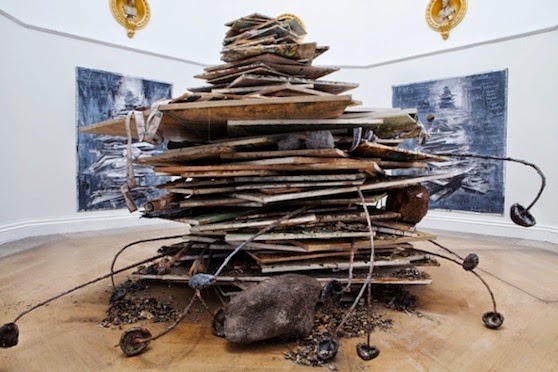

This notion recurs in an instillation piece Kiefer created specially for this show, 'Ages of the World' (2014, above). It's composed of a teetering pile of discarded canvases, littered with rubble and detritus, dead sunflower heads emerging from the mulch as if still valiantly hoping to sprout. It's messy, haphazard, seemingly thrown together. Yet wall posters give it a key, as if its a cross-section of the earth. The indicia describe it as “speak[ing] of a geological time frame so long it is almost beyond our comprehension – part totem, part funeral pyre”. It's not, truth to tell, one of Kiefer's best works. It feels like a bit of a meta-text, a key to his work rather than a work in itself. Yet if we're being handed a key, let's use it.

In Marx's famous quote, society requires revolution in “ridding itself of the muck of ages”. Countless artists of Kiefer's generation set themselves the task of capturing and defining that revolution. It might even be argued as the very definition of Modernism, the impetus to break tradition, the desire to begin again. Whereas Kiefer contrarily but quite definitely chose to depict the muck of ages, his huge canvases weighted down by layered agglomerations of thick paint. Representing, in the show's words, “the weight of human history” - history as sediment.

The Alchemy of Materials:

Kiefer is wont to use not just non-standard paints such as emulsion but incorporate non-art materials - straw, clay, ash, earth, polystyrene, cardboard, silver leaf, plaster and what the indicia described as “scorch marks”. (I have most likely missed some from that list.) Which is when he isn't hanging discrete objects from the front of his paintings, such as the afore-mentioned sunflower. Rather than merely being gimmicky there is something alchemical, almost animistic about this.

He comments "for me ideas aren’t up in the sky and materials down in the earth. Materials have a spirit that is evoked by the physical presence, which can be accessed and opened up. In the Romantic tradition everything is connected in a kind of universal underground."

But while talking about the symbolic function of materials, we need to note Kiefer very frequently uses a literal one. Rather than depict objects in paint wood can be used to represent wood, clay stand for clay and sand sand. With Kiefer, contrary to everything semiotics tried to tell us about language, the signifier very often is the signified. Almost entirely self-taught, Kiefer in many ways resembles an outsider artist – the grand scale, the obsessiveness, the recurring private image bank, and this literal use of materials suggests at naïve art. And yet, as ever with Kiefer, it's double-edged. We're so used to seeing painted branches that to come across actual wood placed inside a picture frame becomes almost jarring. Paradoxically, this adds to Ann Christopher's comments that “Kiefer's works, even his paintings, exude a strong feeling of being made”.

Yet, while Kiefer is happy to use straw as straw, he'll use lead in the most counter-intuitive ways. He makes books from lead, pages curling like they've been read in some furnace-hot bath. In vitrines in the courtyard outside, lead submarines lie like beached fish on cracked earth. Kiefer has commented that lead is the only material heavy enough to carry the weight of human history, and yet at the same time for a metal it is highly malleable. Lead's the metal that can bend, the solid that can become a liquid and, perhaps above all, the earthly substance that can alchemically become gold - and thereby heavenly. Lead is always something transformed or in the act of transformation with Kiefer, to the point where you start to assume it represents transformation to him. And he has said “what interests me is the transformation, not the monument”.

And all of this seems to go hand-in-hand with his willingness to weather works, or transform them after completion via electrolysis. The dubstep artist Burial once said his first attempts to make music sounded too limited, too circumscribed, too much like something he had done. But when he started to mix in natural sounds such as rainfall, the uncontrollable, unpredictable new element recast everything around it and created something more compelling. Kiefer seems to be doing something similar with these practises - ensuring he doesn't have the final say in how his own works look.

To the Architecture of Antiquity


In 1992, Kiefer chose to make France his centre of operations. This seems to have underlined an already present shift in his subject matter from an interest in German history to more universal concerns. In particular he progressed from a fascination with Speer's ruined megalomania to the architecture of antiquity. If his paintings of ruins themselves looked like ruins, his paintings of ancient monuments look like... well, I expect you're ahead of me. They loom out of the canvas, inscrutably strange yet inescapable. And the depictions of an indelible past come to be replaced by his much-heralded “cyclic view of time”, in works such as 'Osiris & Isis' (1985/7, above).

Broken pieces of pottery are scattered around the base of pyramid (needless to say with Kiefer, these are actual bits of pottery), as if hurled from its apex. These are joined by wires, attached to a strange and somewhat incongruous block. (Actually part of an old TV set.) The pieces are numbered, as if found and catalogued by an archeologist. The title suggests the legend of Isis literally re-membering Osiris, gathering his body parts from the corners of the realm where there'd been thrown and bringing them back to life. Its a myth is associated with the inter-relationship between life and death, order and disorder. That dashed pot will reassemble, re-climb the steps of the pyramid, only to be dashed again and then again. As the indicia put it: “In Kiefer's cosmology the universe is an immense alchemical oven in which spirit and matter find themselves in a continuous process of creation and destruction.”

Notably, the pyramid shape was also seen in 'Ages of the World', as a metaphor for the weight of history. And those narrowing, hierarchical levels make the pyramid the ultimate power symbol, appearing even on dollar bills. If pot is Osiris, and the block hauling him back is Isis, perhaps Set, his murderer, is the pyramid itself.

From Words to Stubble


Next, Kiefer revisits both the landscape setting and themes of his earlier watercolours such as 'Ice and Blood', but now in oil and at his characteristically huge scale. In 'Black Flakes' (2006, above) the furrowed field is the size of some nations, pulling to some impossibly distant vanishing point, the raised horizon allowing only for a grey slither of sky.

As earlier the field is barren but ploughed, never primeval, never de-cultured. The blackened stubble (actually protruding wood) resembles war graves, as if nature's one vast cemetery. In Paul Celan's post-holocaust poetry, always an influence on Kiefer, the veiling presence of snow is a frequent metaphor for forgetting. And yet a lead book is set on the painting. With this extra element the snow-white field starts to resemble a giant page, the stubble fragments of letters. Lines of poetry by Celan are written in the receding furrows of the field. And let's note from an early point Kiefer has been writing on his artworks. (He once made a series based on the letters of the Kabbalah, not included in this exhibition.) And books are a common metaphor for remembering. (A companion work, 'For Paul Celan – Ash Flower', 2006, features burnt books.)

So are we looking at a barren field doubling as a war grave, or at a visual metaphor for a book? That's probably the point. If 'Ice and Blood' portrayed an indelible past seeping through to the present and 'Isis and Osiris' time in a perpetual cycle, this work hints at a transformation without delivering it. Books are like seeds, planting ideas. Will even the immense bleakness of this scene yield to Spring, the embryonic letters assert themselves through the snow? For all it's size, the painting's like a coin about to be tossed. It could bloom. Or it could as easily fall back into frozen tails again.

Beyond Human Scale

There's a rough but noticeable increase in scale to Kiefer's work throughout this exhibition, from attics to grand ruins to cosmological scenes. But while the gargantuan buildings were on the edge of human scale, these constellations and cosmic pieces perhaps tip over into a place beyond it. They don't dizzify you in the same way, for they don't engage you to the same degree. The all important (to quote the show) “link between the celestial and the earthly” becomes stretched if not broken. Notably, in 'The Secret Life Of Plants, For Robert Fludd' (1987/2014), the proportions of 'Black Flakes' are inverted; there's a caking of earth right at the painting's base, like the ground barely clinging on.


The best work in this series is best explored by comparison to an earlier piece - 'For Paul Celan: Stalks of the Night' (1998/2013) to 'The Orders of the Night' (1996, both above). Though, as is typical with Kiefer, the earlier picture itself recalls the afore-mentioned 'Man Lying With Branch'. Though 'Orders' is still more a funereal picture, the single branch replaced by the multiple black 'faces' of the sunflowers bearing down on the recumbent figure like anti-suns. We saw earlier how Kiefer used the image of the one tree uniting the realms, from its lofty leaves in the upperworld to its roots digging into the underworld. Replacing the branch with sunflowers suggests they can represent the same unifying concept in his work. But Kiefer is also interested in the Seventeenth century cosmologist Robert Fludd, as we've seen dedicating another work in this room to him. And one of Fludd's conceptions was that every plant on the earth had a parallel star. So those sunflower heads are also associated with stars.

In 'Stalks of the Night' the piercing branch is back, and the sunflowers fallen away to reveal an almost abstract blackened canvas. The human figure is less individuated than before, slashing downward strokes making up his ribcage. We tend to use the term 'diagramatic' critically in art, for works which are merely schematic. But with Kiefer these negative connotations seem to drop away. This is almost like the cosmological maps of the Medieval era; gold leaf adheres to the top of the work as if representing heaven, while below tree and torso are reunited. The domed line performs a similar function as the join in his earlier conjoined paintings, a formal separation standing for an actual connection. Notably, while heaven is gold, the line is in silver. Though only barely realised, the figure is thought to be a self-portrait. Mortality may rule in our middleworld, but this does not stop it being connected to grander realms.

The Earth Breaks All Teeth

As if not overwhelming enough, this exhibition came with something of a scoop – the first British showing of Kiefer's most recent series, Morgenthau. These works are given a room of their own, like an instillation piece. And with their break from the the sombre muted palettes of the wintry landscapes, with their copper greens, aqua blues and golds, they become an arresting sight. After the waning of interest in the cosmological scenes, they kick the show back into life.

Their title comes from the Morgenthau Plan, an American proposal for the “industrial disarmament” of post-war Germany. In this almost 'Hunger Games' scenario of calculated impoverishment she would have been stripped of her capacity to wage further wars by being stripped of her capacity to do very much of anything. She would have become a “pastoral state”, essentially a nation of farmers. Though of course never implemented, it was for a while seriously considered at high levels.

One way of framing this aesthetically would be to see Germany as taken home again, reduced to resembling one of its own old Romantic paintings. German Romanticism has always liked to imagine life sprang from some timeless country idyll and always kept its heart there. And these rural works are once more indebted to Romanticism, particularly Van Gogh. (Let's not quibble over whether he was late Romantic or early Modern, Kiefer's interest seems precisely in this interchange point.) But we perhaps get to their essence quicker by not comparing but contrasting them. Wheat is about as kitsch a subject in art as sunflowers. We see it on cereal packets or in Soviet Realist posters – arranged in neat yellow rectangles, obligingly awaiting felling by armies of jolly peasants, so harvestable you can even sing a song while you're doing it (see below).


Whereas Kiefer transforms wheat as much as he did sunflowers. (See 'Morgenthau Plan', 2012, above). He paints a nature, cultivated in theory, yet untamed. They're no neat lines but a thicket, an impenetrable mass of jutting angles. Hung before them are farming implements, archaic and rusty, traps tooth-broken on heavy rocks. One contains an actual pair of muddy boots, as if defeated by the clogging earth and discarded there like a solider lost to battle. You'll struggle to feed your impoverished belly by dragging your blunted plough across these pitiless stones. If the Romantics found the overpowering force of nature in mountains and mighty rivers, Kiefer finds it in a farmer's field.

Kiefer could conceivably have grown up in this alternate history, where it was the Marshall Plan which was the footnote and Kraftwerk were an acoustic folk act. And perhaps this series stems from him envisaging such a fate. But that seems to describe the works' inception rather than their nature. As ever there's a political dimension to Kiefer, but to reduce his work to a narrow capital-P political would be to unecessarily diminish it.

The most common theory of the prevalence of hunting scenes in cave paintings is that they worked as a form of sympathetic magic – by spearing an auroch in symbolic form you empowered yourself against the actual auroch. The tangled crops of the Morgenthau series seem the farming equivalent of those hunting scenes, humanity locked in a symbiotic war with nature.

From Ashes to Diamonds:

Kiefer seems to divide opinion into enthralled devotees and those who find it all just ostentation, prog rock for the eyes. I am normally suspicious of vast canvases and grand statements in art. Artists often get big and lofty when they run out of things to actually say, the equivalent of shouting instead of speaking. Yet seeing this show has firmly made me into another of Kiefer's devotees.

Perhaps the ideal way to view is work would be to visit the two environments he's built for his artwork, as featured in the recent BBC 'Arena' special. Part studio part instillation piece, they seem less a place to look at his work than a way to climb inside it. But alas they're not open to the public. (Perhaps because of what seems a somewhat permissive approach to health and safety.) But this show's a decent substitute. I suspect it will be one of those memorable events people later claim to have attended, whether they did or not.

And perhaps we even need someone like Kiefer right now... As our culture as a whole becomes more visually oriented (interactive web sites replacing magazines, comics becoming more accepted as a medium and so on), this has led to an irony - rather than enhancing visual art itself it seems to have stripped it of its special status. A century ago, Modernism seemed the very tip of the cutting edge. While contemporary art now can often feel mired in post-modernism, a burnt-out fire with all the illumination coming from elsewhere - in Dubuffet’s description “like a dead language that no longer has anything in common with the language of the street”. The artists who remain well known often feel like celebrities and scandal-mongers, sometimes dabbling in a bit of art to perpetuate the figleaf for their fame.

Yet, as the Telegraph's Mark Hudson puts it: “At a time when most art is only about itself and its relationship to the market, his work challenges the past and his own role and, by extension, our role within it”. Kiefer is invigorating, enthralling and overwhelming – but not necessarily in that order. You come across his works the way you would ruins in the desert; they look unforgettable at the very same time they look beyond any scale or context, gargantuan new facts to rearrange everything else around. I've probably only scratched at those rich thick surfaces, traced the faintest of paths through those dense forests. Several sections I've simply skipped over. But it will have to do for now.

Except its even more than this. Perhaps befitting an artist with such a cyclic view of time, this exhibition is less retrospective than summary to date. It demonstrates not an artist able to keep doing it, but one embarking on directions quite new for him. Its not even that he’s still at the top of his game. Its more like his star is still in ascent.

Here's some sample pictures at a more fitting scale.

Friday, 30 January 2015

ENCASED IN SOUND (HOW PUNK MET METAL - AND BOTH BEGAT DRONE): 4. “THE EARTH BREATHING FIRE...”


Our punk/metal/drone comparison timeline concludes. And as the young people say, dude, where ya been? You've missed sections taking us up to the Sixties, the Seventies and, logically enough, the Eighties. But it's here where the dial really goes up to eleven...

Kyuss: 'Thumb' (1992)


The Doors may have gone to the desert to find their mojo, but Kyuss essentially came from there. Long-haired freaks from Palm Desert, California, they started out playing generator parties in some sandy stretch of nowhere, or anywhere else where the authorities weren't. As guitarist Josh Homme commented “there's no clubs here, so you can only play for free”. If Homme's successor band, Queens of the Stone Age, came to be better known, to me its Kyuss who had the edge.

Kyuss made the music of giants, but laid-back cool-guy giants. (As if to prove the point, Homme was 6' 4”.) Even with the diss tracks, of which this is one, I still picture them boldly toasting one another with beer flagons the size of barrels. They mostly remind me of the Frank Quitely cover to 'All-Star Superman', (below) which shows the mighty-muscled man of steel not in some heroic pose but relaxing nonchalantly.


This is the opening track off 'Blue For the Red Sun', and if Sabbath were the soundtrack of blackest night Kyuss wrote paeans to the brightest day. For the day can be pretty mighty too. It doesn't start up so much as shimmer in, as if arriving through a heat haze. If Sabbath were the soundtrack to a breakdown, Kyuss always came across as assured. For all the heaviness, the weightiness of the band there always seemed space for... well space in their sound. Which is pretty much the definition of the term 'stoner rock' the band became so associated with. (Presumably because, out in the desert, they encountered a lot of stones. I expect that was it...)


Meanwhile, across the water in Liverpool, four mop-haired youths were about to change the course of popular music as we know it...

...whoops, sorry, wrong list...

Sleep: 'Holy Mountain' (1992)


Even when you make up apparent micro-genres like 'stoner rock' it always ends up not precise enough. It's like isolating the atom, you only end up having to split it anyway. While Kyuss were a rock band assured enough to stretch out riffs, Sleep simply dealt in riffs. They play music so metronomic you think you'll never wake up.

Alas, record company indifference caused the band to split early. The rhythm section went on to form Om. Whose direction, as the name might suggest, was less metal influenced and still-more trancy. With sleeves and lyrics that reflected religious mysticism, they make the music all those New Age fakers seem to imagine they are making. Their defining moment might well be playing a five-hour gig in Jerusalem.

Probably the finest Sleep album is the follow-up to this, 'Jerusalem' (aka 'Dopesmoker', but its one long track which makes it a little unwieldy for our format. So I've gone for 'Holy Mountain'. Given the music we're talking about, it surely must refer to the cult film by Jodorowski.


Electric Wizard: 'Funeralopolis' (2000)


The one exception to the West Coast rule mentioned earlier and – as I expect you've already guessed – they're from Dorset. If other bands combined Black Sabbath with all sorts of then-unexpected things, Electric Wizard's mission statement was almost to sound more like Black Sabbath than Black Sabbath did. Their name came from combining the Sabbath song titles 'The Wizard' and 'Electric Funeral'. But a better name still might have been just to condense the name Black Sabbath – Blabbath or Blasab.


Sunn O))): 'Hunting & Gathering (Cydonia)' (2009)


I would be the last to suggest that this list, or any other aspect of musical development, makes for some kind of linear progression. As the diligent reader will already have discovered, all that's here is more journey than destination. Nevertheless, somehow I feel like it had to end like this. Music comes from the drone, the single held note, the way all the land masses we live on know came from the original super-continent Pangea. Those thudding riffs were like the first breakaway continents, separate but still grand and massive. So it kind of stands to reason music will revert to the drone from time to time. In music, you can go home again. And it sounds something like this...

This track was named the Heaviest Song of All Time on The Jason Ellis Show. You'll see why. If you could get any more encased in sound, I simply can't imagine it. As you might expect from a band named after a brand of amplifier, there's also an abundance of feedback and electronically generated sounds. They make music from the equipment you make music from, and make no bones about it. Live, they are wont to hold their instruments aloft like religious artefacts (see up top). One of the many things about the band which might sound ludicrously ostentatious, but works in context.

Yet, in effect if not always in source, they can also approximate music concrete – weaving together natural sounds. The guitar line here is so primal and such a force of nature that it barely sounds human-made enough for you to imagine it being composed, its more akin to rockslides or earthquakes. And other sounds on the album, 'Monoliths and Dimensions', do seem to have natural sources – such as the tightening of the rigging of a ship. Perhaps the genius of the thing is the way it stops you even noticing.

Similarly, rather than black, Satanic, nihilistic or any other of those terms that are so often slung at them, Sunn O))) seem more the perfect pitch-point between crushing force and transcendence. However pulverising the riff or guttural the lead vocals, put it with the choral singing and the two just fit together. Drone and ambient music is often divided into 'light' and 'dark', whereas as is probably obvious by this point I prefer 'weighty' and 'weightless'. ('Light' works best in terms of 'lightness', absence of weight.)

Yet the advantage of the light/dark analogy is that they're part of a spectrum. It can suggest our natural state is twilight. I love the way the official heaviest track of all time is followed on the album by an ambient piece dedicated to Alice Coltraine. Not content with just sounding like punk and metal coming together, Sunn O))) are like the soundtrack to the marriage of heaven and hell. The whole myth of Lucifer the fallen angel effectively plays in reverse in my mind whenever I listen to this. I could happily have it played at my funeral.

(More from me on Sunn 0))) here.)


Okay, who's missing from the list? Many people will cry Discharge, but to me they're a bit like rock'n'roll - they demonstrate how something can be influential without actually being particularly good. I can hear the metal crossover in them of course, but overall they still sound just like another ranting crusty band. (I came of age in the Eighties, gentle reader, where we had no shortage of such a thing.) I have of course also missed out the 'big four' of thrash. With Slayer and Anthrax, it may well be they're decent bands who just aren't to my taste. While Megadeath were just rubbish. And Metallica were not only rubbish, but rubbish produced by a bunch of arrogant self-important arses who I would cheerfully wish the pox upon.

On the other hand, I've probably missed out much good stuff through sheer ignorance. My listening prejudices have most likely resulted in a list that details punk meeting metal more than the other way round, and I'd welcome any suggestions for a companion metal list. (Tool should be in there? Faith No More? Helmet? Or Celtic Frost?) Reader, please don't be backward in coming forward...

Saturday, 24 January 2015

ENCASED IN SOUND (HOW PUNK MET METAL - AND BOTH BEGAT DRONE): 3. DESTROY! ANNIHILATE! INCINERATE!


Our punk/metal/drone comparison timeline reaches the Eighties and even touches on the Nineties. (First part covers the Sixties here while the second recounts the Seventies over here.)

Black Flag: 'My War' (1984)


Black Flag were our man at the crossroads, this is the the point where the streams cross. People argue over who first hit on the phrase “like a cross between Black Flag and Black Sabbath”. But there's no real debate over the first band to do it – and that band was Black Flag themselves. Which makes the crossover more significant. Black Flag hasn't been a hardcore band, they'd virtually been the hardcore band. They were the one who defined the sound – angry, direct, assertive, uncompromising, and above all over inside of two and a half minutes.

Moreover, legal problems had prevented the workaholic and once-prolific band releasing anything for the past three years. (Once off the leash, they released two further albums before '84 was even up.) And in the intervening time their sound had shifted massively, shaving off the punk spikiness for something much more sludgy, more glowering, more ominous – more (you guessed it) Black Sabbath. All of which accentuated the sense that they were not just now slow but anti-fast, like a calculated rebuke to the jock slamdancers. (In that way it also weirdly seems to match the mood of some of the more primal-screamy stuff off Lennon's 'Plastic Ono Band', such as 'God'.)

If it sounds unbelievably bleak, hold it up against their earlier output - it just gets darker. Earlier lyrics slipped into the united third person as easily as the Doors track from the first part (“We are tired of your abuse/Try to stop us, its no use”), this time its all first person versus third. It's like Sartre's 'No Exit' in song form. “You say that you're my friend/But you're one of them” is like the end-point of existentialism, an accusation hitched on the back of an tautology. Notably, Rollins sings as if facing down his audience rather than performing to them. This confrontational interview with him, simultaneously hilarious and excruciating, dates from the same era.

“Destroy! Annihilate! Incinerate!” You have now reached utter nihilism. All change please...


Bad Brains: 'I Against I' (1986)


Followers of Rastafarianism, the band would have been familiar with and probably used the Rasta expression “I and I”. (Used in daily speech, such as “I and I need to sign on next Tuesday”, but to signify spiritual connection - “Jah and I”.) Except of course they invert it to depict modern America as in the most ungodly of states – the war of each against all, which can only serve to bring us all down. In that sense, despite their outward similarities, it's almost the counter to 'My War' - it rails against a situation in which its companion virtually revels. (“I said whose gonna tell the youth about...the rotten stinkin' rackets and the fantasies around the nation.”) Not for the first time HR sounds almost like a preacher as he cries “I tell you the truth is looking straight at you!”

As I often like to point out, great bands are able to straddle apparent contradictions, and Bad Brains could sound heavy at the same time they sounded lithe and nimble. Their roots were as a jazz fusion band and those roots never quite went away.

This was about the point where I'd first left home and was going to see bands. While at school there'd been a virtual Berlin wall between the punks and the headbangers, by then it simply never occurred to me to try and divide up the bands I was seeing into punk and metal categories. Slightly earlier than that other wall, the barriers had been busted down.


More than usual, this next one ain't for the fainthearted...

Swans: 'Coward' (1986)


This is Swans from their early brutal noise era, described by the uploader as “cathartic performance, mountains of sound without melody”. I went a little back and forward about including this, as it could be said to really belong in another timeline. Despite strong similarities to Black Flag's unremitting bleakness, the band came more from the New York noise and art punk scene than from hardcore. Hardcore fundamentalists often nursed an antipathy to 'bohemian' New York, and it may be notable that every subsequent name on this list (with one exception) will be West Coast. For his part frontman Gira despised metal so much he was known to attack audience members for headbanging. (I shall leave it to the reader's judgement whether he himself is headbanging in this clip.)

All of which might go some way to explaining my wondering whether this band actually belong here. But they were perhaps the ultimate in boiling music down to a blunt instrument. Why go for more when you can just have less? The pummelling force denies any concept of release, rock without the roll. (Try imagining dancing to this.) Like the Stooges, its stripped back to such a degree you can't tell any more whether its regressive or avant garde. There's the lyrical parallels between themes of annihilation and transcendence, as can be found in many other places round here. Plus Gira even dedicated a later track ('Just a Little Boy' from 'To Be Kind') to Chester Burnett, real name of Howling Wolf. So the similarities are there, if not the direct links.

(I've written about the current incarnation of Swans not once but twice.)


Nomeansno: 'The Tower' (1989)


The Peanuts character Pigpen was always depicted carrying a cloud of dust around with him. Similarly, Nomeansno always seemed to be wading waist-deep in thick, thick bass. To look at Eighties hardcore and decide what it needed was to be more bass-driven and rhythmic, I'm not sure whether that took an excess of guts or a deficiency of reason. The band have since confirmed that they arrived at that sound simply because in the early days they didn't have anyone to play guitar.


Though perhaps their killer app was to stretch out songs from the standard abrupt hardcore length, and their Bad Brains-like ability to bend the music without breaking the heavy riffing. It was a style described as "Devo on a jazz trip, Motörhead after art school, or Wire on psychotic steroids”. In a scene which too quickly became identikit they were immediately recognisable as hardcore and completely unique at the same time.

I partly picked this track because of the uncanny ease with which they lyrically match punk existentialism to hard rock's dark romanticism. The human figure who narrates and the Tower/black obelisk he encounters are the ultimate irresistible force and immovable object combination. And “The sword is truth is just another weapon/ Let me live for one more second” must be one of the great opening couplets.


The Melvins: 'Boris' (1991)


Though the Melvins formed back in '83, and were important from early on, this may be the point they hit their lumbering epitome. (Even if it officially pushes us into the Nineties.) It sounds like a hardcore punk song stretched out and slowed down, like a single played on '33 with the bottom end of the sound turned up all the way. Rather than sluggish, the result is something remorseless. The way the distortion becomes part of the track is very similar to the Stooges or Motorhead. If Swans were like blows repeatedly pummelling you, the Melvins sound like a landslide slowly but surely tearing up everything in it's path. 

By going for weight not speed they allowed hardcore punk to escape from it's louder/faster corner, gave it a way to hook up with hard rock that bypassed all the then-trendy hair metal bollocks and piledrove a road that led to grunge. Though Flipper were also an important band, they were too arch, too bohemian, too native of San Francisco to truly embrace metal. Whereas the Melvins hailed from Washington state.

If Swans don't quite fit the family tree, the Melvins couldn't be any more in the DNA. Dale Crover drummed for an early version of Nirvana, while Buzz Osborne later introduced Dave Grohl to the rest of the band. Ex-bassist Matt Lukin went on to form Mudhoney. They've made albums with Jello Biafra, and legendary Japanese band Boris are named after this very track. The Melvins are one of those foundations bands, who most people haven't heard of but they made so much possible. (More by me on the Melvins here.)


Mudhoney: 'Touch me I'm Sick' (1988)


There's no doubting grunge rescued punk, ended its self-imposed cornering from the rest of the room and got it back into talking with other genres. (Something it had always done before all that dead-end harder-than-hardcore malarkey.) But while grunge did take up from the Melvins, that band had a definite metal influence while grunge was much more focused on classic rock. (Plus, though no-one ever seems to want to mention it, the fuzztoned Sixties garage punk of those fabled Nuggets and Pebbles compilations. Try playing this against the earlier Electric Prunes track.)

The title, simultaneously engaging and threatening, is pretty typical of punk's agitational engagement of the audience, and the band's black sense of humour. Mudhoney were, as an flue kno, the definitive grunge band, even if they weren't the best-known one. (More by me on Mudhoney here.)


Coming soon! The Nineties to the present day...

Wednesday, 21 January 2015

ENCASED IN SOUND (HOW PUNK MET METAL - AND BOTH BEGAT DRONE): 2. “TIME SEEMS LIKE IT'LL NEVER BEGIN”


The second instalment in this chronological playlist recounting how punk, metal and drone crashed into one another. The first part, set in the Sixties, can be found here. This time we turn to the Seventies...

Black Sabbath: 'Black Sabbath' (1970)


The riff to 'Black Sabbath' is the riff that launched a thousand bands, the riff that quite conceivably created a new style of music. I

Brian Eno once said he thought the appeal of metal was the feeling of being “encased in sound”. (A quote you may even remember from the title.) And that was never more clearly in evidence than here. Of the 'big three' bands that inaugurated hard rock (with Led Zeppelin and Deep Purple), Sabbath were the most proto-metal. It's all here in this track from their first album. Depending on who you talk to, they either renamed the band after it or named the track after the band's freshly minted new name. (They were previously a more bluesy outfit called Earth.) So even Sabbath themselves were effectively launched on the back of this.
The whole sound of the genre is there in that inaugural moment - the nightmarish intensity, the dirgey pace, the ominous guitar riff piling resonance onto dissonance until its notes never seem to end. Yes, the lyrics are typically endearingly goofy (“Satan’s coming ’round the bend/People running ’cause they’re scared”), but they work within the context of the music - which is all they need to do. (They were normally written last, and as chief word-writer Geezer Butler commented “You wanted to capture lyrically what [guitarist] Tony [Iommi] was doing musically”.) This track was one of those game-changer moments in music and continues to thrill the listener even today.
Yet in a sense it looked back as much as forward. That Doors trick of letting the drums fill out as the guitar's confined to the riff? Listen on... Yet there's important differences, which are what pushes Sabbath deeper into that sound. Even when the Sixties underground prophesied conflict and conflagration there was an underlying optimism to it all, perhaps summed up in the afore-mentioned Doors line “they got the guns but we got the numbers”. Whereas, Seventies working class Brummie lads, born to be factory fodder rather than frolic in fields, Sabbath were less convinced peace and love lay within arms reach. They would have probably replied, “yeah, but they've got the guns”. The Doors were inflammatory, and fire implies light. Whereas Sabbath were dark.
Faust: 'Party 2/ J'ai Mal Aux Dents' (1973)

Krautrock band Faust had a Dadaistic anti-music approach, typified here in the way the riff is chiefly provided by the insistently repeating backing vocals. They variously claim to have a pain in the teeth and in the feet, imparting this information in French despite the lead vocals being in English and the band being German. While the lead vocal reassures “you can hear it without shoes”. To Faust language is just a broken object you keep around for aesthetic reasons.
It's ridiculously simple, to the point of being metronomic, yet when you combine those simple elements the whole feels so much more like a sum of its parts. The way the keyboards float freely above the riff kind of reminds me of Wolf's howling in 'Smokestack Lightning'. It's neither cacophonous nor ordered, but somehow both at the same time. It's like the mental sparks struck by splicing together sewing machines and umbrellas in Surrealist poetry. I must have listened to it hundreds of times and I still have no idea whether its absolute genius or total wind-up.
But I guess what gives it its place in this timeline is that backing-vocal-as-riff motif. The rest of Sabbath used to marvel at guitarist Tommy Iommi's ability to keep coming up with great riffs, which they then just had to wrap a song around. But Faust aren't finding something they like so much they want to repeat it. They're starting with a nonsense phrase most probably chosen at random – the point comes from the repetition.
Perhaps befitting the art pranksters, I'm not even sure what date to put in this timeline. A version appeared on the early tape-collage LP 'The Faust Tapes', which in its first release at least eschewed a track listing. Different versions have since appeared under both titles under different compilations. (With the link below I've gone for a less fractured later version.) Which was all part of the band's plan to make releases into 'official bootlegs', designed to look more like bulletins than contemplative art objects, and never create a definitive version of anything. And they're still at it today...
Pere Ubu: '30 Seconds Over Tokyo' (1975)

The first ever single released by legendary Cleveland art-punkers Pere Ubu was split between the difficult, challenging B-side and the even-more difficult and challenging B-side. Both were written by Pete Laughner, then the mainstay of the band. I've gone for the B-side here. Simon Reynolds describes the track as “some loping, rhythmically sprained hybrid of Black Sabbath and reggae... lurches into a sort of doomladen canter, then expires in a spasm of blistered feedback”. (He goes on, including the phrase “scrofulous with twisted virtuosity”, in a description almost as enthralling as the track itself.)  
Indeed there’s the same sense of primarily sonic adventuring as we saw with Sabbath - rather than the music illustrating the words, the words exist to describe the ominous, ponderous music. There’s two separate references to the flow of time being arrested. (For example “This dream won't ever seem to end/ And time seems like it'll never begin.”) Notably it has a similar structure to 'Black Sabbath', deathly slow with sudden bursts of speed. (Though while Sabbath go for remorselessness, the artier Ubu throw in sudden and unexpected twists.) The imagery is often of the fantastical nature you expect more from hard rock than punk songs – strange gods, metal dragons. Overall, its probably punk-discovers-mogadon-riffs rather than punk-meets-metal. But its on the path.
The track draws both its title and scenario from a book and subsequent film of the bombing of Tokyo. The song then throws the later nuclear bomb into the mix. But all of that is only to describe the song’s inception. It takes an already indescribably horrific event, an upturned nail in world history and reflects it through a nightmarish distorting mirror. (“Some kind of dream world fantasy.”) The death-dealing American bomber is symbolically fused with the solitary Japanese kamikaze pilot. (“No place to run, no place to hide/ No turning back on a suicide ride.”)

But none of that is what the song is really about. Instead the lone destructive mission becomes a metaphor for the isolated artist, trapped in an antagonistic relationship with society. Thematically the nearest track to it would be This Heat’s ‘Not Waving But Drowning’, a song whose release was virtual career suicide and whose subject was career suicide. The payload the song drops on the “toy city” is in many ways the song itself. Unleashing it will most likely destroy everybody present. It’s plane as garret, studio as missile.

The history of Pere Ubu is uncannily similar to the story of Joy Division and New Order, the dark visionary character who created their early sound but whose early death necessitated a sudden change in approach. (Though in Laughner’s case there’s dispute over whether his was suicide.) David Thomas then took the lead, with an Ubu closer to the Alfred Jarry character that gave the band its name, grotesque and absurd. Thomas whinnied and raged like a devil clown inflamed and inflated by a cocktail of helium and hallucinogens. He would probably take great umbrage at the idea the band has anything in common with metal. He takes great umbrage at most things, after all. I went to see them not so long ago, and deranged they remain. But that’s a story for another time…

Motorhead: 'Motorhead' (1977)


Here we go with another band named after a song. As with Black Sabbath, this is 'Motorhead' appearing on 'Motorhead' by Motorhead. Sometimes you need to reinforce a point. Lemmy had written the song in '75 while still in Hawkwind, though they only used it for a B-side. He then re-used it two years later on Motorhead's eponymous first LP. And, as with Black Sabbath, it's the moment when he hit on his own sound. Of the three tracks he'd written during his Hawkwind stint to be used by Motorhead, it's the only one to sound better this way. The Hawkwind version is slightly too sedate to capture the reckless, restless mind of a speedfreak (“I should be tired/All I am is wired”), with the more relentless Motorhead version capturing the symbiosis of epiphany and psychosis. And, as with Black Sabbath, it was used to open the album. However the band didn't break through until later, and the version most remember - and linked to below - is a live rendition released in 1981. Lemmy later exulted he'd written the only hard rock song to contain the word 'parallelogram'.

Given that Motorhead's first gig was in '75 and even the classic Lemmy/Clarke/Taylor line-up was in place by March '76, I don't think the oft-cited line that the band were influenced by Brit punk really fits. True, Lemmy has said his original idea was a band “just like the MC5”. But their sound was essentially set before punk really broke over here. They and punk were fellow travellers, true, but they sprang from different starting blocks.

Yet when they did break through they became fantastically popular not just with metalheads or even with punks, but (perhaps most surprising of all) with the general record-buying public. A string of hit singles ('Motorhead' itself reaching number six) led their gnarly faces to incongruously appear alongside prettified pop stars on the likes of 'Top Of the Pops'.


Given such success, it might in retrospect seem odd how few doors the band knocked down, especially as their revved-up sound seemed custom-built for the purpose. Yet at the time they were somehow more beloved than influential.

Of course their main innovation, formally speaking, was to strip the blues base from under hard rock and so sharpen it into metal. But like the MC5 or the Stooges, their stripped-down sound was impossible to separate from their songs and made them something of an entity. They were to metal what 'Lord of the Rings' was to fantasy novels. They were so good at it they kind of defined the sound, creating a genre and taking command of it in one fell swoop.

And while they were the metal band loved by punks, they didn't influence punk music all that much. By the standards of their day, Motorhead were incredibly fast. But, particularly by the time it came to hardcore, punk's recipe was pretty much loud/fast already. At least initially, hardcore needed to assert its identity by upstaging punk – which meant being still-louder, still-faster and lightweights can leave if they like. It didn't need any lessons in being fast. Metal often sounded chugging and plodding by comparison, heavy but like a heavy truck – something to overtake on the motorway. 

What punk needed to be told was that it didn't have to be fast, that it could be released from that ever-accelerating trajectory, that fast can just be an obstacle to being heavy. (The 'fast-over-all' trajectory ended with grindcore bands such as Napalm Death performing tracks only a few seconds long.) Ultimately, Sabbath were probably more of an actual influence than Motorhead.


And speaking of which...

Well, stay tuned, kids!

Friday, 16 January 2015

ENCASED IN SOUND (HOW PUNK MET METAL - AND BOTH BEGAT DRONE): 1. 'NOT READY TO FACE THE LIGHT'


Muddy Waters famously sang “the blues had a baby and they called it rock'n'roll”. (Though perhaps both gospel and country should have been subject to a paternity test.) In a similar fashion, this post could be called something like “how punk and metal had a longstanding love/hate relationship, which somewhere along the way begat something new which mixed drone with more popular music styles”. Yep, I can just imagine Muddy singing something snappy like that.

It kind of outgrew my following – and making frequent nuisance calls to – Mike Taylor's heavy metal timeline. As Mike's list reached an era I confess to finding bog-standard and plodding, my mind started to refocus on a strand of music which may be less-trodden but which matters more to me. Anyone who followed Mike's timeline may find some of my comments here to evoke a sense of deja vu. Then again, arguably that's appropriate - for repetition becomes something of a theme. It also takes something of a scenic route, so please expect detours and digressions. In fact hesitation is about the only 'Just a Minute' rule that won't be broken.

(Disclaimer: drone music of course has its own history, with the Theatre of Eternal Music already performing in New York in the mid-Sixties. But that was really a scene of its own. We're talking about a separate history here, in which drone intermingles and crossbreeds with other, more 'popular' genres.)

We'll start with the pioneers, the prototypes and precursors and get on to the rest in future instalments. (Of which there'll be four.) And let's start the start by looking into the blues when it was first stretching its trousers and eating for two…

Howling Wolf: 'Smokestack Lightning' (1956)


This is one of my favourite tracks by my favourite blues artist, describedby Robert Palmer as “a hypnotic one-chord drone piece". Art can be like a dish, find it the right ingredients and you don't really need that many. 

But, particularly when adorned with Wolf's (there is no other word) howling, this sounds elegant as much as raw. It belies the listener with its simplicity. It's not deep or low or rumbling, it kind of floats. Plus, and not unassociatedly, as was often the case with Wolf's music there is something spectral, some taste of the unearthly to it. It sounds like music which could pass through walls. Which will be a bit of a theme here. Heaviness can be powerful. But lightness has its own effect.

Which kind of fits. Even today, some remain who try to pigeonhole blues as rural and primitive music – a basic crop waiting for smarter white people to come along and innovate cleverer stuff which incorporated it. But by this point, blues had become urban and urbane. Successful acts such as Wolf (and he was a huge hit among black audiences), sported smart suits. They only put on the dungarees and straw hats for white audiences.


Reader, the decade-long gap between this and the next selection, you will have to decide whether that describes the way it was or merely reflects the author's prejudices. But for my money rock'n'roll wasn't an advance on blues, any more than it was on gospel or country. There's rock'n'roll I like, of course. But it was like the arrival of Indian or Carribbean food in Britain, it was a watered-down product calculatedly softened to suit the more straightened pallettes of mainstream white society. Rock'n'roll was of course massively culturally important - in introducing black music to white people it broke a divide and completely changed music. We're still riding those shockwaves today. But to make that cultural impact it had to regress the actual music.

The Rolling Stones: 'The Last Time' (1965)


When talking of the precursors of heavy, riff-bases music it's normally the early Kinks or Who whose names get rolled out. But for our potted history this Stones track is much more important. The main difference between it and, say, ‘You Really Got Me’ lies in the riff itself. ‘Really Got Me’ has a propulsive riff. It’s a musical motif with a beginning, middle and end, even if its set to repeat. It’s effect is like the singer reciting the same words over and over. It’s a riff to power a song.

Whereas ‘The Last Time’ has a riff that’s still-more basic, to the point where it takes on a life of its own. The riff has it's own separate existence, merely framed by the song. It doesn’t really have a beginning or end. It just cycles, it oscillates. You can wrap a song around it, and they do. But it’s like wrapping a sock around a cosh. The cosh is it’s own thing. Particularly after this track, when making music the riff was out of the bag. (Is that mixing my metaphors? Well, you know what I mean!)
One time I saw Julian Cope line he deliberately failed to finish a song, reasoning that it was launched without being landed it would carry on in perpetuity. Similarly, there's something timeless about 'The Last Time'...
The Electric Prunes: 'I Had Too Much to Dream (Last Night)' (1966)

It's quite hilarious to discover that such a garage rock classic wasn't thrown onto tape by angsty, agitated youth but provided to order by a professional songwriting team (Annette Tucker and lyricist Nancie Mantz). Though quite consciously influenced by the Stones, and though the track's built round a classic riff, the riff isn't played perpetually in the same way. (That would be truer of the follow-up, 'Get Me To The World On Time'.) But for a good reason...
As we'll often find, the music and lyrics don't so much go together, like they've been allocated one another from some dating agency's database, as morph into one another. Though it approximates a love song, the lyrics are actually quite ambiguous whether the golden-haired girl was real or imaginary. Instead elements come and go, clash against one another, melodies become subsumed by riffs; it's deliberately discordant in order to convey a semi-psychotic state of mind. It was a theme familiar to garage rock; there was, for example the Swinging Medallion's 'Double Shot of My Baby's Love'. But the Electric Prunes were more... well... electric.
It's easy to imagine Sixties music started as sunny and blissed out, and soured as things wore on. But the hangover couldn't be any more present here. In many ways it sounds like the band are genuinely trying to perform a prettier, cheerier number but the weight of the truth comes crashing in. That fuzziness to the sound is important. Its that woozy, disorientating feeling you get when you look at the world through a fish-eye lens, captured in sound.
The Doors: 'Five To One' (1968)

A long-haired Californian band best known for love songs, whose sound prominently featured a swirling, melodic organ. And yet even at the height of punk's Year Zero rhetoric, where admission to liking Led Zeppelin was a worse sin than sporting a swastika, no-one was ever quite able to consign the Doors to history. A track like 'Five To One' might go some way to explain that.
Like 'The Last Time', it's a song wrapped around a crunching riff. The organ this time round doesn't get much chance to swirl. The doors of perception aren't so much cleansed as booted in. However, its chief significance is the way that crunching riff is so unhurried. Listening to it you can feel a little like the deer dazzled by the headlights of the lumbering juggernaut; theoretically you have time to move, but you can't. It just all feels too inevitable, somehow. There's a section where, with the guitar reduced to the riff, the drums fill out to occupy the space – watch out for that one.
And matching that riff is the confrontational nature of the lyrics. Dylan may have already written songs which dissed “you” in such a declammatory fashion, yet it gains a new impact when wedded to music of such thudding force. It was during a performance of this track where, in an infamous on-stage incident in Miami, a drug-addled Morrison derided the audience as “all slaves” and was nearly prosecuted for inciting a riot.
Yet despite that anecdote and despite the track being released in that most historic of years, the lyrics are most likely not as agitational as they appear. In the Sixties the situation was often seen as a generational war, leading to the popular saying “there's more of us being born and there's more of them dying”. (Of course hippies were only ever a minority even amongst the youth, so the idea was nonsense even as it was being uttered. But we're talking here about a perception.) “No-one here gets out alive” means we all go sometime, but they'll be first. “We've got the numbers” means, at some point or other, we're just going to replace them. “Five To One” doesn't match any actual social ratio that anyone's ever managed to come up with, and is a reference perhaps best understood by Morrison and his drug dealer. But it fuzzily fits inside this perception of it all being a matter of evening up the odds.
But that perception is what counts, for the song feels a whole new level of confrontational. Crucially, its not asking for anything. It's not a protest song or even a resistance song so much as a victory speech. (“We're going to Win/ Yeah, we're taking over/ Come on!”) Come to that, it's not even a particularly graceful victory speech, its more exultant and triumphalist. It's self-confident swaggar less resembles Jefferson Airplane's incendiary call to arms 'Volunteers' and is perhaps closer to something like Free's 'All Right Now', albeit with political victory replacing sexual conquest. It's stripped-down quality creates the same sense of space, like a drawing might creatively employ white space. Morrison part-slurs, part-proclaims the lyrics. (Some accounts claim he was drunk during the recording.) Notably, the hippie hopefully but hopelessly holding a flower is effectively likened to the wage slave “trading your hours of a handful of dimes”, both objects of derision. Turning up holding a flower for a track like this was just asking for trouble.
The Stooges: 'I'm Loose' (1970)

It can be as interesting who doesn't make a list like this as who does. The Velvets were influenced by the Stones' 'Last Time' and had the most clearly drone-based sound of all, even recruiting John Cale from the Theatre of Eternal Music. (Who took his scraping viola when he moved.) But they weren't really proto-metal in any way. Even as they were unhinged they were always somehow cerebral, like they were overdosing on street drugs and modern literature simultaneously. If they'd unleash the power of the drone in their music, it was in the way Prospero would conjure up storms.
It was the Stooges who were the Caliban-like creatures inside the drone.
Early on the Stooges had a more experimetal/drone sound, using extemporised instruments such as oil cans for drums or a vacuum cleaner to... well, most likely to create a vacuum cleaner sound. Iggy said later: “It was entirely instrumental at this time, like jazz gone wild. It was very north African, a very tribal sound: very electronic. We would play like that for about ten minutes. Then everrybody would have to get really stoned again... But what we put into those ten minutes was so total and so very savage - the earth shook, then cracked.” And even if that side of their sound later yielded to something closer to regular rock music, it never quite went away. It hung around like a ghost whose business on earth was not yet done.
In it's glorying in its own fucked-up-ness 'I'm Loose' is very much more proto-punk than proto-metal. But its significance is in the distortion not being trimmings, not there to enhance the song but very much part of the song. As with the Electric Prunes, it's not a song with a sound attached to it, the two can't be separated.
Punk had now shaken its six. Qualifier terms like 'proto punk' or 'garage punk' were no longer required. While with metal..

Friday, 9 January 2015

'COLOURS I'D NEVER SEEN' (ANOTHER SPOTIFY PLAYLIST)


Ladies and gentlemen, the latest Lucid Frenzy playlist is now available for your delicatation and pleasure. Mostly consisting of folk, blues and country but with some of that post-punk shennaigans thrown in for good measure. Just click the header...

The Waterboys: 'Malediction'
Jeffrey Lewis: 'The Gasman Cometh'
Arcade Fire: 'Windowsill'
Califone: 'Salt'
The Rolling Stones: 'I Got The Blues'
Hank Williams: 'I'm So Lonesome I Could Cry'
Odetta: 'Make Me a Pallet on the Floor'
Pentangle: 'Train Song'
Fotheringay: 'The Ballad Of Ned Kelly'
Sandy Denny: 'John The Gun'
June Tabor: 'She Moves Among Men (The Bar Maid's Song)'
Richard Thompson: 'King Of Bohemia'
Current 93: 'Kings and Things'
Tunng: 'King'
Mission Of Burma: 'Trem Two'
The Fall: 'Riddler!'
Gillian Welch: 'Wrecking Ball'

”I met a lovesick daughter of the San Joaquin
She showed me colours I'd never seen
Drank the bottom out of my canteen
Then left me in the fall
Like a wrecking ball"