googlee7ea825f63edb3f6.html

Wednesday, 2 September 2009

SPOTLIGHTING SPOTIFY, OR ‘OUR ONLINE PLAYER COULD BE YOUR LIFE’

The first of a two-part series in which an old man discovers new media and a lucid frenzy ensues. (Disclaimer: The Spotify player is currently only available in Western Europe. But I expect that it will expand, that similar products arise elsewhere or possibly even both at once.)


Back somewhere in the mists of time, so long ago that Doctor Who was still on the telly, I borrowed the NME Book of Rock from my school library. Lacking access even to something so simple as a photocopier, I’d diligently copy any interesting-sounding entries out on my Mum’s manual typewriter. I had that red folder full of badly typewritten sheets for years afterwards, as precious a document as any pirate’s treasure map. I knew it would take me years of solid and valiant effort, but eventually I would track down each band it referred to...

...which is pretty much the way it turned out. Over fifteen years might have gone by between my hearing of Pere Ubu and my actually hearing anything by them. Music was like that, you see, or at least the real and vital music. While the radio played the same ‘top’ forty tracks on rotation, real music was something arcane and transgressive and inherently underground - something to devote yourself to. (This was a particular feature of music, a fact most borne out by adult fears. To their minds, comics merely encouraged illiteracy. Music led to delinquency.)

These days a mate e-mails me about seeing a band, and ten seconds later I’m checking them out on Spotify. Being somewhat technologically backward, I missed out on a lot of the intervening steps, so maybe that only seems particularly weird to me. But maybe that’s precisely why you need me to tell you just how weird all that is.

That is, if I can tune out of Spotify long enough to type it up, for of late my music system has been taking a rare rest. But it’s not just that I’ve turned to listen to more music on Spotify, since Spotify’s been around I’ve been listening to more music. In fact I’ve been plugged into it’s player like something out of Videodrome. Truly it is almost an embarrassment of riches. If it hasn’t got all of everything, it’s got pretty much a taster of everything. Yes, Pere Ubu are on there. As are Nurse With Wound, Agitation Free or Jackie O Motherfucker. Brother, it ain’t just Coldplay!

Sometimes I’ve tried my damnedest to out-obscure it, only for it to come up with not only the desired result but suggestions for still-more obscure acts to hear out. I even finally heard the Minutemen, whose classic ‘History Lesson Part Two’ inspired this piece’s header. What’s more, they’re committed enough to keep adding acts. The Mekons drew a blank when I first searched for them, now they’re up and running.

It would be like smacking a gift horse in the mouth to criticise it for its few lapses and limitations. Copyright compliant as they are, there’s pretty much nothing they can do about stuff of disputed ownership. (Will I ever hear Captain Beefheart’s Lick My Decals Off Baby without paying absurd ‘rarity’ prices I can’t afford?) My inner nerd recoils when albums are dated wrongly or bands with similar names get confused, presumably because those functions are automated. (The writeup on Camera Obscura starts “not to be confused with the Scottish twee pop outfit with the same name”, when in fact that Scottish twee poppers are the only outfit featured. Ah well, some of us quite liked them!)

It might be more on the money to criticise Spotify from the opposite angle, as too much of a good thing. In an earlier entry, I half-seriously argued for the rationing of art. Spotify, meanwhile, is more like one of those magic dishes in folk-tales which refills as soon as you’ve eaten from it. Even when I really get into a track, I still don’t listen to it as much as when I’ve invested in the CD. (While I never listened to the CD as much as I did the LP back in my youth, when I knew by rote each precious note.) And there are inherent distractions involved in music-by-computer. Even if you can focus your mind enough not to think “I’ll just check my e-mail or tomorrow’s weather” it’s an extra effort not to think “would Wikipedia have an entry for this band?” or similar.

But I also found I got better. With no Ministry of Rationing around any more, I learnt to ration myself. At first I was like those scenes of Homer Simpson snacking, reaching out with more hands than I had ears, unable to listen to any one track all the way through... oh look, they’ve got this... ooh, and that too... let’s just check to see if there’s also... Once I finally had it in my head that they had it all and that they didn’t shut at 5pm like a shop, I finally managed to take my time.

Certainly, it’s one more nail in the identity politics of music I was describing earlier. But that old music wasn’t willfully obscure, for the most part they tried to distribute it as well as they could. They weren’t making treasure chests to be buried, but music to be heard. Even if you know not everybody’s going to get what you’re doing, the easiest way to get it to those who will is to make it available to everyone.

Besides which, knowing you’re never going to hear it all is a salutary life lesson. It may even mark the distinction between my obsessive compulsiveness and fully fledged Aspergers. I’d already learnt that my red folder didn’t contain the complete canon as I’d once innocently assumed, that tracking down the good music is like pinning down a hydra. The more of it you get to, the more you become aware of that’s still out there. And isn’t that a good feeling? Like any artform, most music is made by grunts devoid of imagination and devoted to greenbacks. But there’s a whole host of people out there who don’t think that way...

But the question I’m really interested in is whether Spotify will change the way we listen to music. (Rather than just the place I plug my headphones into.) I’ve found I use it as either a personal radio station and a jukebox. When I’m working, I can just ask it to cycle through the entire catalogue of an artist (or even label) where even the longest CD required changing. At the same time I’m normally working at my computer, so should I choose I can change the channel without even getting up. When I stop working, I can cruse it’s byways for the stuff my ears have previously missed out on. In short, I have all but abandoned my music system for a hybrid of things – but none of those things is another music system.

The key to the whole thing for me is the playlists. Now in one sense, playlists are just the modern equivalent of mixtapes. And the old way of making mixtapes now seems to be so laborious as to be hilarious; trying to time tracklengths on your watch then inevitably getting the sums wrong and having the tape conk out twenty seconds before your grand finale; deciding to reverse the order of tracks two and three then realising that meant the tedious business of going through the whole process again from the beginning. Moreover, every copy you made took quality down a generation and surrendered more territory to the ever-encroaching menace of tape hiss, a perpetual nemesis whose entropic force could at best be held off. For me it was like writing letters with a quill pen and tying them to the leg of a passing pigeon, then a mate tapping you on the shoulder to tell you everyone else is using e-mail.

But that’s the very point – playlists are now so easy to assemble that they cannot help but rise to dominance. I’ve found a strange reversal of function come upon me when aboard Spotify, in which I hunt out tracks which might conceivably work on my latest playlist. Albums are no longer inviolate, their borders became porous. Those more modern than me probably already own i-Pods or shopped from download sites which have served to cut into their integrity (and quite possibly gone on to do some of that ‘texting’ on the subject). Perhaps it even started with CD players and their ‘random’ button which blew apart sequencing.

Of course some might see a Darwinian effect here, allowing the weaker tracks to be weeded out now they can no longer herd in with the stronger. All artists have to do is to provide filler-free releases, and listeners will have no need to slice and dice their output. And it’s true, when CDs ran longer than LPs there was a corresponding increase in filler which could now be cut down.

But I’d suggest we’re also losing something. Ironically there’s a parallel loss of power. I suspect a large part of the appeal of playlists lies in being enabled to create something yourself, you are not merely passively consuming. (This may be why the ads always feel more insidious during playlists, they’re intruding into something of yours.) With the mixtape everything was editable. You could cut from one song to another, or edit in snippets from the radio, a DVD or even your mates talking. While playlists erode the boundaries of the album, the track has simultaneously become irreducible. You can’t do anything even as simple as cut out that intro you don’t like. With playlists you are never creating a collage, but merely ordering menu items.

But there’s a greater loss. I can remember people celebrating the i-Pod’s ‘shuffle’ feature as a liberation, and my pointing out that it was only comparatively recently when (most evidently through Sergeant Pepper) the album-as-entity was presented as an advance. Before that, albums were merely handy carrier-bags for bunches of songs. (Even the early Beatles albums were ruthlessly reordered when released in America.)

Think of the subtle but decisive distinction between album and playlist. There are lots of similarities, after all. With both you sequence the songs in an aesthetically pleasing way. You might choose to save your best number for last. You may even give the assortment some vague sort of theme, maybe ‘music-hall-like’ or ‘northern’. (Certainly the Beatles did little more than that for Pepper.) But each song’s a part of a mindset, created by a set group of people within a set time. Consequently, each song becomes like a facet of some overall object, bigger than the sum of those parts but only visible through them. The term ‘concept album’ now has lots of negative associations, of interminable rock operas about stoned pixies. But in a sense any half-decent album is a concept album, virtually by definition.

Any fool knows the final track on Pepper, ‘A Day in the Life’, to also be it’s finest. But listening to the rest of the album first (even the filler tracks) sets it in a context which enriches it. Otherwise it’s like skipping to the final movement of a symphony. Appreciating an artist involves trusting them, giving up time to them, even taking a little bit of rough with the smooth. It approximates aspects of a personal relationship, over and above a service encounter. Spotify hands us the tools not to surrender to that trust, to break down the walls of the album unit and plunder from what’s inside. But like anything broken it’ll be harder to put back together.

Now if you’ll excuse me, there’s still a couple of old Robert Wyatt albums I haven’t heard. If there’s anything particularly good I might use it for that playlist I’m working on...

Fellow West Europeans can download the Spotify player from here, all for free. Everyone else... we are laughing at you.

Friday, 21 August 2009

SHOWS OF FUTURE PAST

A comparison of two Tate Modern exhibitions from this year: ‘Futurism’, 12th June to 20th September, and ‘Rodchenko and Popova: Defining Constructivism,’ 12th Feb to 17th May.


“The windows of railway carriages, and the wind-shields of automobiles, added to the new speed, have changed the habitual appearance of things.”
– Leger
“We break with the past because we don’t believe in it any more, because its premises are not acceptable, and we will create new ones.” - Popova

Just Look At What The Future Started:

Let’s assume for a moment that Italian Futurism, Russian Cubo-Futurism and Constructivism can all be subsumed under the general heading ‘Futurism’. After all, these sprang from the same question. The clue is in the title of Carra’s 1911 painting ‘What The Tram Told Me.’ Now that technology has pushed daily life so far forward, how can art catch up? How can you paint a racing car or railway station the way you would a pond of water lillies? Boccioni’s twice-painted tryptch ‘States of Mind’ (also from 1911) ostensibly contrasts those climbing aboard a train against the waving platform-ticketers. Yet you sense straight away that it’s actually the modern world which is disembarking from the past, and that art does not want to be among those left behind.

Note that is the tram who is doing the talking, and that Leger prioritises a shift in perception above the more-often-noted ramping-up of “speed”. The train and car do not simply set a new pace of life, or arrive as new objects to push their way onto our canvases. They have remade the world. Just as waterfalls and fields of flowers were to the Romantics, they are themselves both subject matter and inspiration.

The idea that the racing car is already in itself a kind of art object is important, even if they still confined themselves to celebrating it in art. If there’s a science they’re venerating it’s a mad science, where it’s mechanisms not elegantly economical but carreringly unchecked. Their city scenes are tumultuous, crazy free jazz symphonies.

Caught up in gridlock, choked by pollution, we might find it hard to think our way back into this mindset. As Arthur Dent said, “I’ve gone off progress. It’s over-rated.” Even when more contemporary movements borrowed from Futurism there was always an element of irony, such as Industrial music arising at the end of the industrial era. This jaded perception is compounded by a black joke of history, where the Italy fell into Fascism and Russia Stalinism – the two great tar pits of the Twentieth Century. (You can hardly hear a world like ‘Pravda’ now without an Orwellian filter, while at the time it still meant simply “truth”.) Yet once was the time when the radical was the road-builder, not the Crusty occupying the tree.

Italian Futurism burnt briefly but fiercely, between 1909 and 1915. Consequently it lacks the width to fill an exhibition and the middle of the show makes other scenes into points of comparison. While some of these are merely Futurism-lite (particularly Orphism) others are illustrative. However, it’s telling that only the Russians took up the term (albeit modified into ‘Cubo-Futurism’) and, with one possible exception, it is only they who can really give the Italians a run for their money. You’d know that from the room given to them here, even if you hadn’t already seen their earlier dedicated show.

Why should this be? Why not Futurism from France, main exporter of revolution and already a mecca for modernist arts? (Much photographic technology, for example, was devised in France.) As any schoolboy knows the First Futurist mainifesto was on the cover of Le Figaro –a French newspaper. Or why not in Britain, as the show reminds us home to the world’s then most populous city and harbourer of Blake’s great Satanic mills? (In fact British Vorticism is the next-nearest contender. While it was still-more shortlived that Italian Futurism and not quite as innovative, it was largely buried under the self-fulfilling prophecy that Britain was never a centre of modernism.)

But to get our answer, we have to ask the most leading question of all –why not in the New World? If you couldn’t find the future among the skyscrapers of New York, where could you? And yet, while American artists clearly took to Modernism, it was always primarily a European export. In fact for Futurism to ring out it needed to erupt from the old world, like a volcano bursting between two tectonic plates. Significantly, Futurism was centred in industrial Milan while much of Italy was still rural. That “beautiful” racing car they venerated was enhanced in their eyes when seen racing past a peasant’s hay-laden cart. Moreover Italy had been the centre of so much classicism in art, whether Roman or Renaissance, which could be used to keep your hatred sharp. Their infamous First Manifesto made this clear:

“We want to free this land from its smelly gangrene of professors, archaeologists, and antiquarians... We mean to free her from the numberless museums that cover her like so many graveyards.”

Yet paradoxically, as a country Italy was young – only unified in 1870. It could therefore be portrayed as embodying a new way of life. Hence Marinetti’s typically euphoric exclamation “born as we are from electricity”, as if she and her citizens were Frankenstein children. Predating the Yippies, the Manifesto brags “the oldest of us is Thirty.” He even conjured up a symbolic rebirth for himself, claiming that following a car crash he emerged anew.

In short, while they were not mere passengers on the tram, the Italian Futurists were still hitched along to it. The future was an inevitability, bursting in like a rushing canal. In Russia it was more of a political question. While even under Tzardom it had both industrial centres and modernist artists, its vast size slowed its pace against its rivals, leaving it mired in the past. The revolution had broken through such barriers, in an instant throwing everything up for grabs. However, the revolution was not seen as complete, conversely it’s occurrence just accentuated the urgency for further action. (The two quotes at the had of this piece hopefully demonstrate this distinction. ‘Knock off the crowns of the last Tzars’ was also a slogan.) Hence, in a quintessentially Marxist notion, the Russian future could only be brought about through conflict. The future, technology and the soviet model all came to be seen as interchangeable.


“True pictorial dynamism”:

So with the Italian notion that its all happening already, that the canals were themselves changing course to flood the accursed museums, perhaps its unsurprising that their main artistic goal was finding a means to capture movement. In too many ways to count, the past was associated with the static, and the futuristic, the scientific, the technocratic with motion. Life was “no longer a fixed moment [but] dynamic sensation.” “With our pictorial dynamism,” they insisted, “true painting is born.”

Of course, like all self-styled innovators they over-exaggerated the gulf they leapt – for painting had never been entirely frozen. Degas was not deluded to depict dancing girls, he merely attempted to suggest the possibility of movement through his brushwork. You can often see the thread from Impressionism running through this show, in much of its subject matter (the street, the cafe, the cabaret; Carra even mimicking Degas’ ‘Absinthe’ of 1870) and it’s dappled strokes (such as in Carra’s 1910 ‘Leaving the Theatre’.)

Yet there was a distinct shift. The Impressionists implied motion to give a sense of veritie to their figures. The Futurists depicted motion as expressed through figures and machines, not snapshots which strove to capture events but diagrams of time designed to convey the motion itself. They insisted “the picture must be a synthesis of what one remembers and what one sees.” In Boccioni’s already-mentioned ‘States of Mind’, it is those who stay behind who are rendered in the more Impressionist strokes – the art of yesterday employed to represent it.

In this they were something more akin to Cubism, with its rejection of the single fixed view. But any formal links are overwhelmed by the different way these two schools feel, as soon as set alongside one another. Early Cubism (later dubbed ‘Analytic Cubism’) dissected the integrity of objects, while Futurism exploded the static moment. Cubism’s subject matter for the most part remained traditional still lives, Futurism always turns to action scenes. This is reflected in Marinetti’s language, as rendingly violent as the Surrealists would later be. “Art can be nothing but violence, cruelty and injustice”, he proclaimed. It would take the Russians, watching from further afield, to synthesise the two into ‘Cubo-Futurism’.


Down Into Line, Down Into Colour:

Whilst there was not one single way in which Futurism tried to break out of the static frame, this show still doesn’t leave you distinguishing between its artists too much. You emerge with an image of them as one flailing, multi-armed mechanism with Marinetti as its mighty-mouthed head. (Their movement’s shorter lifespan might have contributed to this.) Ironically Rodchenko and Popova strained to be seen as part of a movement, forever joining collectives with ever-more egalitarian aims and bewildering acronyms. In the ‘5x5 =25’ exhibition no artist headlined and every participant drew a cover variant for the catalogue. But while they might decry such ‘bourgeois individualism’ as to give them their own show, aesthetic differences between them means this works very well indeed.

This is in fact visible from the first room, where they occupy opposite walls. Rodchenko’s focus is on the line, which he claims “has revolutionised our view of the pictorial surface by changing the idea that form is no more than a patch of colour.” Even his preparatory sketches look to be made with rulers and set-squares. Painting normally obscures the line, often quite literally painting it out. To Rodchenko it was the one vital element, with everything else mere decoration and hence disposable. In this he couldn’t have been more at odds with Futurist convulsiveness. Meander was to him the most counter-revolutionary sin of all. With Popova it is colour, her lino-cuts in particular look almost like Platonic pieces of ‘pure’ colour. Significantly, when they went on to teach art Rodchenko’s subject was ‘construction’ while Popova’s was ‘colour’.

Nevertheless, influenced by Cubo-Futurism even as they moved beyond it, they were at this stage more interested in formal qualities – not focused on getting a changed world down on canvas so much as changing painting itself. The importance of the surface texture of their works is demonstrated by the “preparatory sketches” for one of Popova’s linocuts, realised in watercolour they look almost nothing like the vibrant finished article.

Rodchenko and Balla both suggested their sculpture was an advance, and out of similar-sounding reasoning. Rodchenko claimed it moved beyond painting into “real space”, Balla that “the single plane of the canvas did not permit the suggestion of the dynamic volume of speed in depth.” However, Rodchenko’s sculptures look an advance, the Futurists’ a dead end. His retain the linearity of his artwork, and hence an important sense of “see-through-ness.” Ironically, his nearest neighbour in sculpture might well be Duchamp. (Though this in some ways mitigates the works’ reality, we remain aware that they are in some ways still ideas, diagrams and plans.)


But Boccioni’s ‘Development of a Bottle in Space’ (1912), for example, can only be seen as a failure. The ‘flow of energy’ supposedly radiating from the bottle, once set in bronze, does not give off a charged hum but stands rigidly. Rather than break down the bottle’s solidity, it works the other way round. It’s like looking at a circuit diagram carved into a stone tablet.


”The streets are our brushes...”

Whether we see the scarcely new discipline of sculpture as a stepping stone or not, it has to be said the Russians went a step further - beyond painting -while the Italians did not. Perhaps, having invented “new painting”, they saw no reason to go beyond it. While they railed against “museums, libraries and academies” galleries were notably left from the list. The teeming street became a common enough Futurist subject to get a room to itself here (“we will sing of great crowds”), but subject it stayed. Conversely the Russian Futurist poet Mayakovsky proclaimed “the streets are our brushes, the squares our palettes.”

Accordingly, in September 1921, as part of the 5x5 exhibition, both Rodchenko and Popova signed a formal renunciation of fine art - much as you’d sign a political petition. Rodchenko now found even his own paintings “as useless as a Church. They serve no purpose whatsoever.” Instead the slogan became “art into life” as they threw their weight into a mission to totally transform everyday life. The ‘work’ in ‘artwork’ becomes dominant. At this point, where their art leaps of the canvas, the exhibition becomes truly alive, everything from architecture down to cups and saucers falling under their eager gaze. Some of this work was overtly agitprop, some had no specific or explicit political content at all. Some was even nakedly advertising! (By then limited private enterprise had become unavoidable so the state brands needed pushing. Ironically, much of Rodchenko’s best work is here – in the marketplace he so despised!)


Many of these new media we now think of as less expressive than painting or sculpture, and more documentary, for example Rodchenko’s turn to photography. Yet their art continued to be declarative, never merely reflective of reality. Rodchenko’s photos see the world for a ceaseless succession of new angles and viewpoints, never flat or neutral, never something self-evidently ‘real’ which merely required recording.

Perhaps the whole thing is summed up in the final room, with Rodchenko’s life-size model for a Workers’ Club. A chess board fuses in design with the table and chairs intended for those playing the game, with their echoing both its squares and black-and-red motif. The concepts contained in both game and room are intended to seep out into the world surrounding them. Art is but a vehicle for the ideas it contains, a means to inject them into the world whereby they might transform it. Anything which is not essential to express those ideas, in the most succinct method possible, is jetsam. (This was consequently a quick exhibition to get through, even for a chin-stroking ponderer like me.)

Perhaps not altogether surprisingly, it’s not clear how well these bold plans made it into practice. It may have become a means for the artists to work more collaboratively with a wider range of creators, with writers, theatre directors and film-makers. The desired erosion of the boundary between art and reality did not occur, they merely sprung the trap of one medium to land in a slightly wider one. As the catalogue notes “the Constructivist dream of reshaping social space could only be realised within the limited parameters of the stage or cinema screen.” Nevertheless, the work is by turns compelling and tantalysingly suggestive of what might have been.

One interesting aspect of these photos and posters is the utilisation of art for reproduction, an interest of Popova since her linocut days. Perhaps this makes for the biggest division from the Italian Futurists of all. Outside the exhibiton, before we even see the first of their works, is a wall-size photo-reproduction of the Futurists themselves. Belying the modernist dynamism of their works, they are dressed in the style of their day – strangulating collars under sober ties, shoulders weighted down under heavy coats. Yet look among the gallery-goers and every T-shirt is an artwork!

However, deficiencies in the Futurist exhibition do not so much magnify this division as turn it to caricature. While they might have never gone beyond painting, they mixed it with other media as thoroughly as any other modernist movement. As Norbert Lynton has commented “Futurism embraced poetry, novels and plays, painting and sculputure, music, photography, film, typography and architecture.” (’’The Story Of Modern Art’, Phaildon) Well, not here they didn’t.

Their “disruptive performances” are alluded to (“crazy electric storms... with their corollary of scuffles in streets and squares”), but only in the notation. Similarly we are told that Russolo swapped art for music (okay, noise) but are never treated to any of his works. There are filmshows but only as special events on certain dates (with booking advised), not as part of the regular exhibition. Futurist architecture, surely the nearest neighbour to the Constructivists’ “art into life”, is nowhere to be seen. Should regular readers of my exhibition reviews exist, they would know this to be a common bugbear of mine. However, things had seemed to be getting better in recent years. Which makes the throw-back deficiencies of this show all the more disappointing.


The Word is Image Too:

However, it could be argued one moment of parity on display is the word. The Futurist exhibition starts with Marinetti’s First Manifesto, just as many would have encountered them at the time. Indeed he always insisted his proclamations didn’t merely describe or announce Futurism – but were themselves Futurist works. Indeed, if you thrill to the heady rush of his ceaseless hyperbolic assertions you’ll probably find you like the paintings, and vice versa.

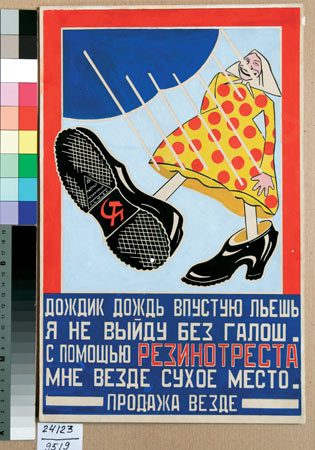
However word and image are rarely fused. Words and letters stray into paintings, in a trick picked up from the Cubists. But mostly they follow parallel courses, as if cut into different channels. – separate canals set against separate museums. Again, the Constructivists stole ahead. It is not just that, for example, Rodchenko frequently collaborated with the Futurist poet Mayakovsky. Their works incorporated the iconography of type, where text was incorporated in the design and its shape taken to be as important as any other element. Popova’s ‘slogan posters’ often incorporated nothing but type, yet are visually compelling.

Instead, as the exhibition alludes without quite saying, Marinetti pioneered perhaps the biggest innovation of Futurism – hype. He wrote not reasoned treatises but pithy sound-bites, calculated to provoke not thought but outrage, which he got not into scholarly journals but onto the cover of Le Figaro. He was not the vacuous celebrity of today, for his biting words still resound over the years. But he was a celebrity, the self-made poster boy of shock. Marinetti was the Stan Lee of modernism.


War As Art By Other Means:

But perhaps the ultimate reason to prize Constructivism over Italian Futurism is not artistic but political. While we might think of Fascist Italy and Stalinist Russia equally dimly, we tend to make different allowances for their adherents. In Russia there may have been a genuine desire for egalitarianism, however hopelessly misplaced – while the fascists proclaimed their noxiousness from the start. This website perhaps sums up the popular view of Italian Futurism, listing their accomplishments then adding “too bad they were all fascists.”

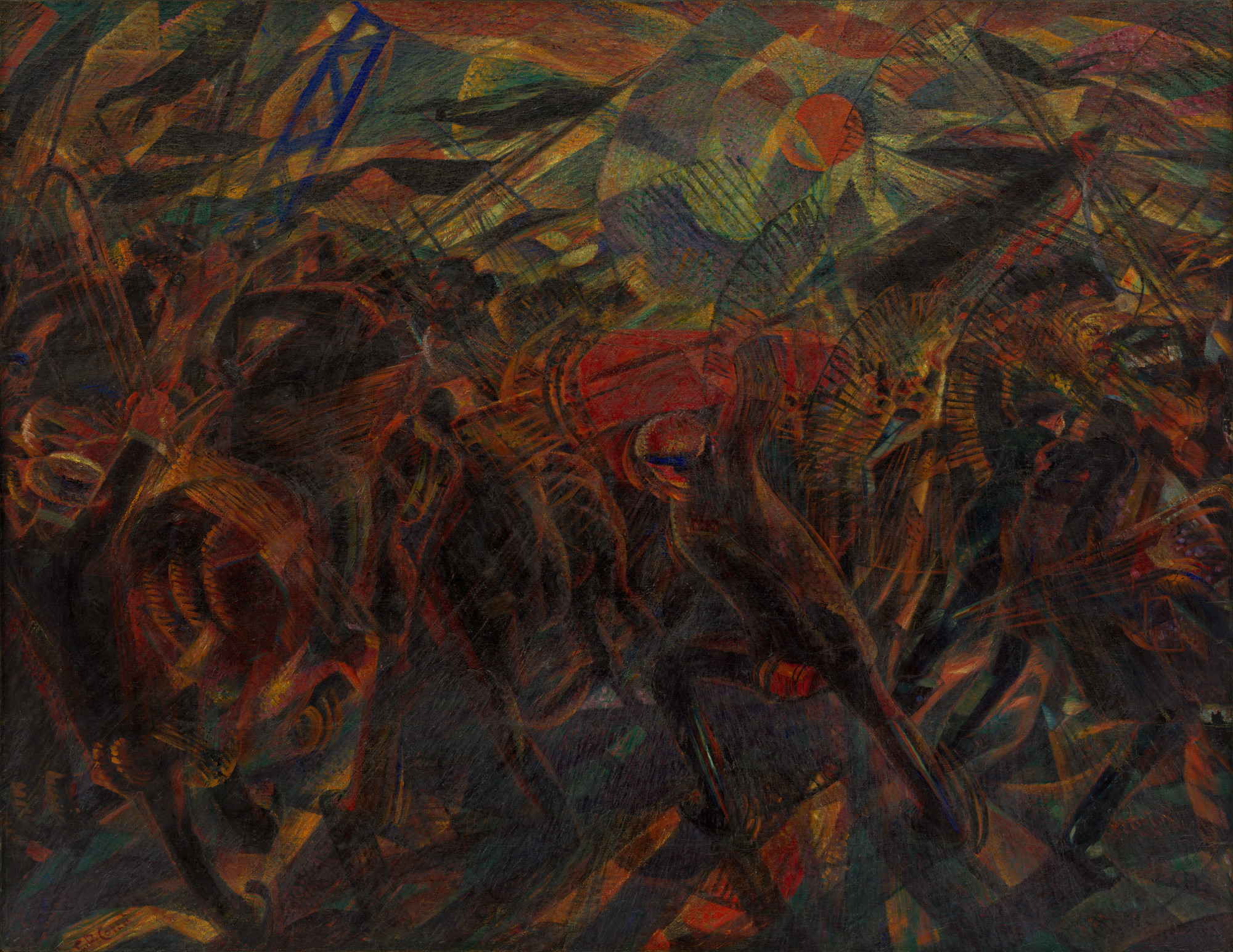
Yet Stewart Home has argued “to dismiss Futurist politics as fascist is as common as it is incorrect.” (The Assault On Culture, Unpopular Books) Indeed, perhaps they were even anarchists! The First Manifesto celebrates anarchism, while in 1911 Carra painted ‘The Funeral of the Anarchist Galli’ (above). Galli had been killed by police during a general strike, who then attempting to prevent his funeral becoming a rallying point. Carra had been present at the ensuing riot.

Yet however powerful the painting, we should not mistake present for involved. The show later notes how Russolo’s ‘The Rebellion’ (1911, see up top) presents “revolutionary violence in a somewhat abstracted form, removed from any specific, social or political context” – comments which could equally apply to Carra. Similarly, the First Manifesto celebrates “the destructive gestures of the anarchists” alongside ““militarism, patriotism” as “the beautiful ideas which kill.” It later asserts “except in struggle, there is no more beauty.”

In short, what is being celebrated about the anarchists is that they’re good for a punch-up. This is the cartoon anarchism of brazen bomb-hurling. Marinetti was a political magpie, chasing any colour provided it was gaudy. While I could find nothing online about Galli, given the era was a high-point for Italian anarchist movements, it seems unlikely he’d welcome such a ‘celebration’ of his politics.

The Futurists’ infamous amour for war came out of a similarly boyish excitement for action. Peace is boring, but a still life while war is an action painting! Even their buzzword ‘avant garde’ was itself appropriated from military terminology. This naiveté was extended, for when Italy didn’t at first join the war they joyously depicted it anyway. Marinetti told his brethren “try to live the war pictorially, studying it in all its mechanical forms.” He personifies the juvenile rush to enlist we read of in history books but struggle to understand.

Perhaps fittingly, the paintings here become almost abstract, writhing forms welling up into shape. (Balla’s 1915 ‘Forms Crying Out Long Live Italy’ is as tellingly titled as Carra’s ‘Tram’.) Artistically these works are splendid, an astonishing development in so few years. But their lack of anything even representing the figure suggests the price of human life had been forgotten along the way.

A year after the war ended Marinetti notoriously joined the National Fascist Party, though it’s sometimes forgotten he walked out again the following year. (Admittedly as Mussolini obstinately remained in power he seems to have regretted this rash gesture, and sought ways to re-gratiate himself.) As we now see Fascism and modernism as implacable foes, this might seem as inexplicable as it is indefensible. If Fascism now appears as something monolithic and contemptuous of artistic experiment, so it became. But in order to gain power in this era it had to become a spoiler product for other, more genuinely revolutionary movements. Hence it tried to keep a foot in both classical and modernist camps. (Being named after a symbol of the Roman Empire.) Marinetti was far from the only sucker. Once in power, it strengthened its ties to classicism – provoking his walkout. (Needless to say, his motives were aesthetic not humanitarian.) Yet only much later did Italy import Nazi Germany’s hostility to “degenerate” art.


The Future – No Place For Girls?

A Russian contrast to Carra, on show in the same exhibition, might be Natalya Goncharova’s cubo-futurist ‘The Cyclist’ (1913). While the Italians celebrated the self-powered mechanism of the tram or the indivisible nature of the urban crowd, Goncharova depicts an individual human figure fused with his machine, in a kind of partnership. Later this focus would sour into the heroised workers of Soviet ‘realism’, but here the political statement is genuine. As Gil Scott Heron would later put it, “the revolution will put you in the driving seat!”

How significant might it be that this work is by a woman? Futurism is in general open to the charge of being phallocentric, mechanistically mindless, boys playing with their toys. This was a charge Marinetti was keen to take on, with his “scorn for women” and clarion calls to “fight feminism”. Yet three-fifths of the ‘5X5’ exhibition had been women, while an old Royal Academy show had focused on six Russian women artists (‘Amazons of the Avant-Garde’, 1999/2000). Even the boys had championed their cause, one of Rodchenko’s propaganda posters proclaiming ‘The Trade Union is a blow to women’s enslavement, and a defender of female labour’!

Yet if they were present, if they were even encouraged, were these women artists really painting on an even easel? It would be a simplification to suggest that Rodchenko designed buildings and Popova cups and saucers – but not that much of a simplification! For example, both designed fabrics yet Rodchenko always worked for men’s clothing. As you walk through their exhibition, you don’t entirely shake the feeling that women’s art was a variant of women’s work.

This view is compounded by a clip from Kuleshov’s 1927 film ‘The Female Journalist’, on which Rodchenko worked. Not only were few films of the time titled ‘The Male Journalist’, the title character is a neurotic ‘female’ juxtaposed against the productive activity of some male workers. (‘Neurotic’ of course being associated with ‘petit-bourgeois’ in the culture of the time.)

Of course when even these advances were later rolled back by Stalinism, it feels almost like carping to mention them. Nevertheless, a limited advance should be labelled as such.

My Future Is Finer Than Yours:

In case it’s not yet been made obvious, we here proclaim the Russians as the more progressive force. It’s rather like the difference between punk and post-punk. Vibrant, powerful and recklessly audacious, punk may grab your attention first. But after a while this swagger subsides. It then comes to feel not just one-note but beset by its own contradictions, it can shout and proclaim but rarely actually argue. Post-punk creeps up upon you more slowly, but you eventually realise that while it may be less gesticulatory it’s actually the more audacious one.

Of course the Constructivists came later, at most only five years later, but those years had been busy ones. Perhaps the Italians’ greatest defence is that they had always set themselves up for such a fall, never claiming their revolution to be complete. “When we are forty”, they insisted, “let younger and stronger men than we throw us in the waste paper basket like useless manuscripts!” Their succession by the Constructivists might have come more quickly than even they thought, but they only considered themselves one station in an ever-speeding journey.

However, is it possible to over-accentuate the differences? Both exhibitions place Cubo-Futurism at their periphery, while a focus on it might emphasise their linkage and continuity> Moreover, do both actually share the same failings and it’s merely that the Constructivists fail a little better? After all, they share the reductive functionalism we’ve now come to see as dehumanising. Even when human forms are incorporated, it’s only ever to epitomise some bigger idea or wider force. Figures often morph into their clothes, machines or just the overall composition. Men don’t express ideas, so much as ideas express themselves through the medium of men. Rodchenko in particular seems almost to define idealism in a literal sense, using art as a blueprint to build a better world from the noblest of diagrams. As such idealism beached against war and dictatorship, this gives us pause to reflect on uncritical optimism.

But more importantly, to quote Marinetti one last time, perhaps we also react this way because we do not remember even being alive. We fear the loss of an ‘individualism’ defined by brand-name consumption, while shying away from seeing ourselves as active forces in the world. We’re no longer Futurephilic, and assuming we can hasten its arrival, but Futurephobic yet assuming we can do nothing to prevent its advance. The Aphex Twin summed up our view, “the future is a registered trademark.” Unlike Popova, we accept the world as it is, without even asking whether we believe in it.

More on ‘Futurism’ (including booking info) here.
Archived info from ‘Defining Constructivism’
here.

Tuesday, 18 August 2009

AWAY WITH THE FAIRIES IN THE CITY OF DREAMING SPIRES

My report on Caption 2009


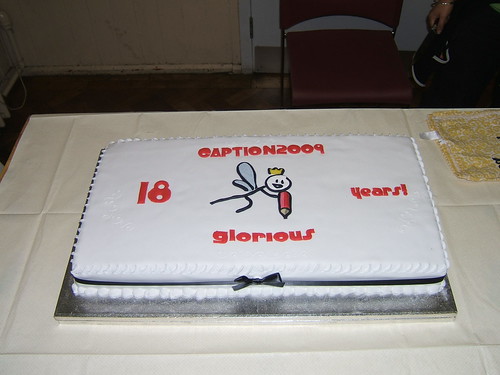
The cake, it does not lie. For Oxford’s Caption comics convention really was eighteen years old last weekend! As I’m yet to miss a year, mathematics would at this point seem to suggest that I have been to eighteen of them. But whenever I try to think about that it makes my head spin, so let’s talk about something else...

Rich Johnston’s report perhaps sums up best the unique atmosphere of Caption, with his gamely attempt to compare it to America’s largest con in San Diego. (Rather reminding me of the Attila the Stockbroker poem ‘Southwick is Like Amsterdam, Only Smaller’.) He closes events with a shot of cartoonist Terry Wiley nipping out for more loo roll, as the centre has run out. For the sake of the gag, I’d like to tell you there that Terry was a guest. But, as Caption makes so little distinction between guests and attendees, that sort of thing is tricky. Terry has been a guest in previous years, but as even I’ve been a guest before now I suspect that counts for little.

Way back in 1992 Caption was started by a clutch of cartoonists, who figured no-one was putting on the sort of convention they wanted to go to - so they might as well do it themselves. In the process they somehow engendered some monster, forever re-replicating itself on a duplicating machine, that lumbers on to this day. At a time where everyone in the small press scene wanted to talk about distribution (mostly complaining at the lack of it), their event completely ignored the whole question. You just dumped your wares at one central stall, then forgot all about them until it was time to pick them up again at the end. Caption was a kind of extended front room, where those who made comics could meet up, drink, draw and do a whole lot of hanging out.

Though things didn’t always run in that order, for Caption is absolutely littered with pens and pads. (Something I don’t think I’ve seen at any other convention.) The pads are always full and the pens driven to their dried-up death before the weekend ends. Drawing games normally spring up spontaneously, at a roughly equivalent rate to people’s alcohol consumption. One panel was titled ‘You Should Totally Run Your Own Con, Dude’. But that’s pretty much what happens here anyway. Like the kids from Fame, the attendees put on a show right here. Caption is a magnet and a playpen for people as mad as you. Then times by nineteen.

To return to our baking theme, the talks and events are therefore merely the icing upon a cake which bakes itself. But they’re easier to talk about so let’s home in on them...

Every year has a theme, this time ‘away with the fairies’. Always somewhat voluntary, some themes seem to ‘stick’ better than others. This time the fairies didn’t seem to transpire much at all, barely mentioned even during the final panel featuring Mark Stafford’s ’Cherubs’ and Jaime McKelive’s fairy-friendly ’Suburban Glamour’. This was perhaps a bit of a wasted opportunity, as one of the articles in the programme (by co-organiser Selina Lock) had already made the necessary expansion from fairies to folk tales. It seems to me that comic have a more natural inheritance from folk tales than they do from film, painting, literature or any of those other things they all-too-easily get bundled in with. Maybe next year, people will believe in them better.


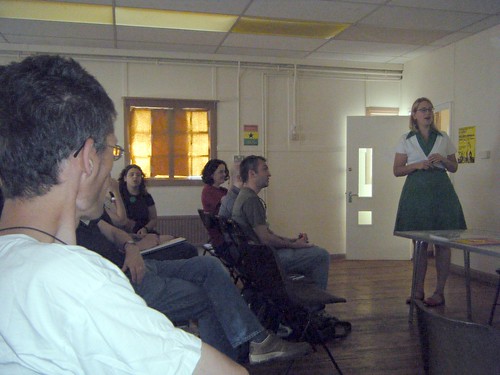
Instead we swapped fairies for the internet - focusing on the impending Longbox which (McKelvie informed us) will be like iTunes only for comics. Which is an exciting enough prospect. However, I’d earlier been to Sarah McIntyre’s eye-popping talk on children’s picture books. (That’s me on the left, looking like her scary stalker.) One of McIntyre’s points had been the greater relative size of books for children, and how that made it easier for them to get immersed in what they were reading – leading her to fantasise about an ‘instillation book’ big enough for adults to step inside. In fact one of the few criticisms I could make of her talk was the fact that it was mere slides, when it would have been so much sweeter to pick up those enticing-looking books and thumb through them. As it was, it was like looking at pictures of a decorated cake you couldn't actually taste... oh, wait I already did that...

Emboldened by this thought, I asked if there wasn’t something vital being lost when a physical comic gets replaced by pixels on a screen. A CD might come in nice packaging, but with a comic there’s no such separation between the object and its content – the two are one. McKelvie agreed readily that they were “different experiences”, but made two replies. First, that “young people” didn’t necessarily see things the same way as us. (Which fair made me chuckle, because he must have been one of the youngest of folk I’ve spoken to in ages!) Second, people can end up buying both, ‘trying’ with the download before ‘buying’ the object. (And indeed our concept of ‘ownership’ does seem to be becoming more conceptual, CDs coming with download codes for MP3s etc.)

We also discussed the idea that home printers might reach the level of sophistication where they could serve you up a collated colour comic just the way that shops used to sell them, essentially eliminating the question. Matt Brooker (aka D’Israeli) also pointed out a paradox that the download button was reasserting the authority of the flat page, taking the animations, sound effects and interactions back out of web comics in order to make them printable again. To think that, at the first Caption, I’d barely heard of the internet!

With fairies on the wane, robots seemed to mount a takeover for the year’s theme. (Come to think of it, Fairies vs. Robots would have made for a great convention T-shirt!) This was perhaps down to ‘Titanic’ Tony Hitchman’s quiz, now a Saturday night regular. He left us with two bits of useful advice, robots are best dealt with by a sharp kick to the head, guaranteed to set cogs a-spilling and save the day. And evil sentient computers are defeated by unplugging them at the back. Though steeped in those deliriously wacky DC comics of yore, Hitchman’s quiz belongs at Caption. Just because comics are primarily a sophisticated medium for tackling adult issues, doesn’t mean they can’t be stupid, goofy and juvenile as well.

We’re told Caption will return next year, but as yet no word on the theme. Me, I’m still canvassing for The Evil UnCaption. This comes from the old Star Trek episode, where the crew encounter their evil dopplegangers in a parallel universe. Everyone would be issued with false moustaches and goatees (the pan-galactic symbol for the sinister) and instead of sharing one big comics stall, vigorously defend their own whilst trying malevolent schemes to topple all the others. The Evilest Of Them All would be issued a prize at the weekend’s end, though of course that would probably just be a front for an assassination attempt. Or Caption could swap personalities with San Diego for a year, which might just be a different means towards the same end...

Anyway, whatever theme is finally hit on, I hope to see you there!

These photos and more from the Caption2009 Flickr group.

Wednesday, 12 August 2009

SO WHO STAYED WATCHING ANDREW RILSTONE?


Stop me if you’ve heard this one already, but it does deserve a non-bloodied smiley face...

After being silent since March, Andrew Rilstone has bounded back into blogging with nothing less than a sixty page PDF zine! This is like when Marcel Duchamp claimed to have retired from art, just to work on his biggest piece yet! In the circumstances I’m even willing to forgive him for calling My Chemical Romance a “punk band.” Though I’d already embarked on The Olde Print Days of Lucid Frenzy, it was a Bugpowder link to Andrew’s writings which encouraged me to start blogging. And he’s remained one of my favourite writers on matters comics and filmic.

Though having said that, he has at times reduced me to a state of teeth-gnashing envy. Sometimes he has said things I wish I could have said first, or even as well. (For example he points out that many of the moments of synchronicity in Watchmen aren’t there to make any specific point, so much as create a world of synchronicity which the story needs to marinate in.) At others, he says things which soon as said seem so bonecrushingly self-evident I feel a fool for never noticing them. (Stan Lee introduced an element of ‘realism’ to the superhero genre, but at the same time filled it with metafictional conceits by making “Smilin’ Stan” an audible presence in his own comics – of course he did!) It’s like I study every line, every damned line, only for Andrew to come along and point out some fresh angle of perspective that has been there all along. “But you were looking so hard at the trees, old bean. What about the wood?”

Such a perspective (and I use the word advisedly) is particularly welcome when comics like Watchmen and internet criticism combine into truly virulent nerdism. I’ve lost count of the websites I’ve seen which have gone through some comic, annotating it panel by panel, in their ceaseless search for ‘clues’. All the while oblivious to the fact that the medium of comics lies in, like, connecting the panels, dude. It’s like studying music by examining each note in turn. The technical term is “missing the point.”

One of the interesting features of Andrew’s zine is that it is just that – a zine. Partly this is a metafictional joke, a comment on the grubby things we read and wrote back when Watchmen first appeared. (Hence the use of retro fonts.) But its more than that, the various pieces at first seem to be about separate subjects (Watchmen, Supergirl, the comics you read as a kid). But you soon realise that these components all slot together into one overall argument, a single subject studied from different perspectives. (I got all carried away on his comments board and called this “argumentative origami”!) A series of blog entries, posted however closely together, would not have the same sense of simultaneity.

Of course there’s an irony here in that our actual back-in-the-day zines rarely did this, at least not at any conscious level. We merely tapped them out on typewriters or (for the fancy) word processors until we had enough words to release. (When you start to follow a writer everything they say becomes a piece in an overall puzzle you assemble of them in your mind. But each piece is standalone.) But like a modernist painting it demonstrates something zines can do which blogs can’t.

I left some (very) cursory comments on Andrew’s blog. But one of these days I really will write my own perspective on Watchmen...

Thursday, 30 July 2009

BABYLON'S BURNING (BABY, CAN'T YOU SEE..?)


For those who've found proceedings here to have been too proggy of late, here's a link to my review of Clinton Heylin's 'Babylon's Burning: From Punk To Grunge', as published on the recently refurbished Last Hours site.

Sunday, 26 July 2009

"SOME OF YOU ARE GOING TO DIE..."

As part of an occasional series of reviews of things for no better reason than they happen to be lying about- an appreciation (yes, really!) of Genesis’ ‘The Knife’


Absently thumbing through the shelf of old records left in our living room, the detritus of past tenants unknown, I realise I’ve never actually heard ‘The Knife’ by Genesis. I’ve not listened to anything off their second album Trespass for that matter, but it’s ‘The Knife’ which was supposedly their inaugural moment - the point where they threw a six to start and hit upon their classic sound. A story I’ve heard so many times, without ever actually hearing the track it centres round. So I take it for a spin and discover, over a quarter-century after I foreswore off all things prog, that it’s actually pretty good!

Perhaps that’s not quite as surprising as it sounds. Genesis had a plus point their contemporaries lacked – negativity. While ELP were the soundtrack of the techno-fix culture and Yes indulged in New Age platitudes, Genesis sought to disturb and unsettle. (Hence the famous story that William Friedkin, director of The Exorcist, headhunted frontman Peter Gabriel to write for horror films.) And better still, they exuded English menace, homing in on pastoral garden suburbs until they revealed the snake in the grass.

But all of that starts here so part of ‘The Knife’s’ appeal inevitably becomes the contrast between it and the album it closes, like a switchblade suddenly pulled at the end of a dinner party. As Wikipedia put it, “The song was unusually aggressive for Genesis at the time, as most of their work consisted of soft, pastoral acoustic textures and poetic lyrics.” The album cover reflects this concept. (And if that’s all tantamount to saying it wakes you up after a dreary album, I have to admit to quite liking a couple of the earlier songs, such as ‘Visions of Angels’... I must be getting old!)

Ultimately, though, it’s the contrasts within ‘The Knife’ that truly make it work. For once the inevitable suite of parts really do fit together into a greater whole, and some of them are even (gasp!) catchy. Check out the segue from the flute-and-keyboard-wash sequence into the clashing guitars, a mighty riff that would have done credit to Black Sabbath.

But perhaps the classic contrast, the one which really sums up the song, is between the slow measured chant (“we are on-ly wan-ting free-dom”) and the more manic delivery of the verses. Satire will often ape the voice of its targets in order to ridicule them, but when delivered by a singer this age-old trick gains an extra resonance. The song draws much of its sinister feel from the way the malevolent, self-serving leader is speaking directly at us, as if hypnotising us – “some of you are going to die...” Oratory is raised to the level of a malevolent spell. (For a very different piece of music which pulls exactly the same trick, try The Dead Kennedys’ ‘California Uber Alles’. As singer Jello Biafra explained “I like to slip in behind villains and expose them that way.”

It’s notable that Gabriel would return to this character of the charismatic charlatan (albeit with more humour to alleviate the blackness) with ‘The Guaranteed Eternal Sanctuary Man’ from their later magnum opus ‘Supper’s Ready’. (“Look, look into my mouth he cries, I bet my life you’ll walk inside”.) An explanation for this fascination might lie buried in the bands’ history. Most school-based bands are formed out of a desire to grab attention, and scrabble a set together in order to justify getting up on stage. But with Genesis it was the reverse. They had set out as a team of songwriters, who first made recordings simply to demo their songs and only reluctantly took to performance. And as the front-man, Gabriel would have been thrust further into the limelight than the others.

Perhaps, given the task of working out quite consciously what a performer needs to do, he became aware of how manipulative the exercise can actually be. Perhaps in working out how to gain a crowd’s attention he also grew aware of how dangerous such a power could be in the wrong hands. Consequently he took on the persona of an anti-messiah who will whip up his followers, but lead them only from behind.

However, before we start calling the song’s distrust-your-leaders message ‘proto-punk’ or some such, it could easily be argued that it is in many ways quite a reactionary song. The masses are a bewildered herd, hoodwinked by a few fine-sounding phrases. (Gabriel had something of a predilection for comic commoners, not the nicest notion for a public schoolboy to adopt.) The claim that an event like the Russian Revolution was derailed by sanctimonious but self-serving leaders seems less than controversial. But to go on to claim that they were able to cause such an event by sheer skill in rhetoric seems absurd. It could also be argued that the true horror of messianic leaders is their ability to convince even themselves of the rightness of their cause, something missing from the song. But one song can only tell us so much, and its effectiveness should above all be judged as a piece of music. And not for little reason did this rattling number remain a live favourite for years...

And before I’m accused of going soft, I also tried to listen to the final offering from classic-era Genesis, the double concept album The Lamb Lies Down On Broadway. Which I found to be pretty much the way you expect double concept albums to sound, overheated, babblingly incoherent and ultimately unendurable. Most likely, what makes ‘The Knife’ palatable now isn’t that it was forward-looking but precisely the opposite. It was created when prog was still nascent, when lots of funny time changes weren’t supposed to rend killer riffs redundant. So perhaps the prog revival doesn’t start here after all...

NB The video clip below starts part-way through the song, but you can hear the whole thing via the ever-reliable Spotify.


Coming soon! More records from that old shelf...

Thursday, 16 July 2009

SEVEN (MORE) SONGS: Part Two

These three songs complete my description of “seven songs which have been shaping my spirit lately." Part One here.

Spotify Playlist here


‘AIRSCAPE’ by Robyn Hitchcock and the Egyptians

Inevitably for me, I tend to prefer the darker more menacing side to psychedelia. The softer stuff tends to the fey and twee, rich kids prancing about in parks and frilly shirts whilst rejoicing under names liked the Crocheted Donut Holes. Perhaps we more readily recognise the existence of bad drugs nowadays, but my favourite Hitchcock tends to be from his early, punk-era outfit The Soft Boys. But as his later work often demonstrates there is an upside, a light psychedelia that isn’t just psychedelia-lite. In fact ‘Airscape’ would be a strong contender for my favourite Hitchcock track of all. (And, according to Wikipedia, Hitchcock himself concurs.)

This song isn’t named for nothing. It infuses the sound of psychedelia with the feeling of weightlessness, for the pealing guitar and wind-chimes don’t sound like they possibly could have come from any earth-bound instruments. (The album was titled after the line “element of light.”) Hitchcock uses this sense to conjure up the perfect summer song. (“And in the element of summer/ The cliffs suspended in the heat/ The air in columns.”)

It’s the observation that in the haze of summer objects seem to lose their substance and become nothing but forms of light, then fed into the poetic fancy that an eternal summer would bring with it the end of all physical separation –we’d become just floating elements of light. (“Where angels hover, I’ll hover too.”)

(For the importance of those psychedelic sounds in conveying this sense, check out this live version from YouTube. Without them the song keeps something of it’s beauty, but more narrowly escapes being another post-Byrds jangle. With them comes the lift-off.)

And like much psychedelic music, there’s something indefinably English about the whole thing. “The tiny figures of the world are walking/ Underneath your feet” makes me think of another supernatural world, existing in parallel to our own yet passing us by. In today’s bid for Pseud’s Corner, it could be said to be reminiscent of Shakespeare’s Midsummer Night’s Dream:

“Over hill, over dale,
Thorough bush, thorough briar,
Over park, over pale,
Thorough flood, thorough fire,
I do wander everywhere,
Swifter than the moon's sphere;
And I serve the fairy queen,
To dew her orbs upon the green.”


Of course such conceits have a purpose beyond mere fancy. The supernatural world is really nothing but the natural world, ceaselessly trodden by us but in our daily bustle never noticed. The music’s a means to reacquaint us with it. In fact, in the finest tradition of romantic poetry, the song was written about Hitchcock’s favourite beach, as featured on the cover art.

’RISE ABOVE’ by Black Flag

In in an e-mail group to which I belong, a recent exchange awarded Black Flag’s ‘Police Story’ the coveted prize for dumbest punk lyrics of all time. (With special points awarded for the opening: “This fucking city/ Is run by pigs/ They take the rights away/ From all the kids.”) But a close contender might be ‘Rise Above’, also from their debut album 'Damaged' (released in 1981).

In fact this virtually became their signature song, normally opening their notoriously confrontational live shows. Lyrically its a debunking anaylsis of the capitalist mode of accumulation... no of course it isn’t. It’s a great two-and-a-half-minute fuck-you to the in-crowd kids who disdained them. ”We are tired of your abuse/ Try to stop us, its no use!” is made into a band chant. (There’s even the line “think they’re smart”!) As original singer Keith Morris (gone by this recording) put it: “We were going to make as large a racket, piss as many people off, go apeshit as we could, and we had no choice but to play to please ourselves and a handful of friends.” (Quote from Clinton Heylin’s 'Babylon’s Burning'.)

Its dedication to defiance is juvenile but awe-inspiring, risible but brilliant, cheesy but coruscating, petty but life-changing. All of which is completely punk. Punk’s blanket insistence that “you can do it” led to some pretty terrible efforts, if also some good stuff. But the truly great punk is good and terrible simultaneously. I laugh whenever I hear it, both at it and with it, and I wouldn’t want it any other way. “We are born with a chance/ I am going to have my chance.” What better messaged could you hope to hear in your teens?

MEMO FROM TURNER by Mick Jagger


I normally dislike posting a video link when the subject of enquiry is actually the song (remember them?), but this time there’s a method to my madness. Before music video was established, this song was stuck surrealistically in the middle of the cult film 'Performance' (in which Jagger starred). It fits the film so well it’s astonishing to hear it was an old demo, only utililised by Jagger after he failed to come up with anything new. Both compare and contrast the world of the rock star with the gangster in myriad ways, but let’s home in here on one more specific to the song.

It’s a sleazy blues number, typically sneered through and smeared with slide guitar. (Courtesy of Ry Cooder, this isn’t a Stones song.) Richie Unterberger describes it accurately enough as “spinning bizarre mini-snapshots of decadent, cruel gangster behavior...” However it also sets up a chronology, beginning with lowlife tussles “eating eggs in Sammy's... on a hot and dusty night” before leading up to grey executives “at the Coke convention, back in nineteen sixty-five.” (Then just three years ago.) Moreover, the personalised and conversationally familiar speech (“Didn't I see you down in San Antone..?”) is also juxtaposed with the more formal choruses (the repeated “Come now gentlemen...”).

Rock stars had once been outsiders, doing little more than providing a soundtrack to delinquency. No-one had been a better poster boy for bad-guy status than the young Stones. But by ’68 (when the first demo version of this song was laid down), the Beatles’ 'Sergeant Pepper' had happened and rock music was now relabelled Art. (It was reviewed in the Village Voice under the header ‘The Album As Art Form’.) Perhaps consequently, the Stones remained keen to play Altamont against the Beatles’ Woodstock.

Hence Jagger delivers the song suited from behind a desk, reminding his contemporaries (and quite likely himself) their roots lay in dives like Sammys rather than Coke conventions.

”Come now, gentlemen,
I know there's some mistake.
How forgetful I'm becoming,
now you fixed your business...
...straight.”


Less-than-PC lines like “you drowned that Jew in Rampton” would be the equivalent of reminding the Beatles of when, broke in Hamburg, they attempted to mug a sailor. There’s even a coded reference to the idea they might all be getting on a little - “When the old men do the fighting/ And the young men all look on”. (Which compounds with James Fox’s line to him in the film, “You’ll look funny when you’re forty.”)

Of course these days that’s hard to remember. There’s (to put it mildly) something of an irony in hearing Jagger warn about the corporatisation of rock music. (Or for that matter the redefining of rock music as art whilst starring in an art movie.) But perhaps we should treat it less as warning and more prediction.

"So, remember who you say you are,
and keep your noses clean...
"The baby's dead," my lady said.
You gentlemen, why, you all work for...
...me!"


Admission: With the above write-ups I seem to have taken the term ‘song’ quite prescriptively. Descriptions either don’t mention the music much at all, or explain how it illustrates the lyrics – like it lacked its own motivation. Its analogous to the way criticism about comics homes in on the writing, with the art just some kind of side-order. Like goes to like, and words go to words. Ah well...

Thursday, 9 July 2009

SEVEN (MORE) SONGS: Part One


Following a previous experiment, here’s seven more songs that have been “shaping my spirit” lately. (Or at least four of them, Part Two will follow... um... sometime.) You can listen to them via the Spotify link below. (If you don’t already have Spotify, you’ll have to download the player from here - don’t worry, it’s free!)

Lucid Frenzy Playlist


‘SURROUNDED BY THE STARS’ by Amon Düül II

I sometimes think there must have been something in the water in Seventies Germany, enabling the bands to take the standard American rock influences and make them their own. Take for example this track by the kozmische (don’t call them krautrock!) outfit Amon Duul II, opening their 1972 album Wolf City. In terms of lyrics and tone it’s clearly stealing a page from Dylan’s ‘Ballad of a Thin Man’, throwing a ‘straight’ into a world of weirdness then poking a stick at his struggling with some second-person denunciation. Like Jospeh K, you’re not quite sure what you’ve done to incite such disdain - which somehow makes it all the worse. It has both Dylan’s Carnivalesque Medievalism and his fixation with encountering archetypal figures (a streetsweeper, a clown, a cop, even his patented Napoleon)!

However, Dylan’s song harangued the unhip. (“Something is happening here but you don’t know what it is/ Do you, Mr. Jones?”) AD II (as their fans call them) up the stakes by upping the scale, contrasting the puny human ego against the immensity of the universe. The song warrants its ‘kosmische’ tag, building things up with a cosmic sweep and majesty - dwarfing sunrises and unheeding “gates of night”. The title itself is a perfect reversal of the standard Science Fiction fixation with escape; here an unfamiliar universe is pressing in upon you.

As much as anything from American rock music, I associate it’s imagery with the new-look comics of this era, such as Metal Hurlant - with it’s “complex graphics, cinematic imagery and surreal storylines.” Though, typically, this comic magazine was French it may well have been available in neighbouring Germany. Both use science fiction as a springboard to the cosmic, with a hefty side-order of surrealism. (The song provides only one actual SF device, the ‘are-you-tired machine.’)

Renate Knaup-Krötenschwanz’s cold-as-Nico vocals are the icing on this grandest of gateaux; while Dylan still sounds part-combative there’s not a trace of antagonism in her serene and lofty disdain. She’s as aloof as the stars themselves, peering pitilessly down on our petty hubris. In particular, the musical surges around her declammatory cries of “sunrise” have an exquisitely epic feel.

This marks the band in their classic era, advancing from their original free-form jams (check out the title track of their first album Phallus Dei) to something more closely resembling structured songs. In his Krautrocksampler, Julian Cope called this a “transitional group, but somehow in a state of very inspiring flux.” Not that such a free-form spirit had departed, for instrumental breaks continually thrust themselves into proceedings as if vying with the vocals. But, rather than disrupt the song, the tension between the two actually makes it. The sudden leaping from one to the other not only adds to the disorienting unpredictability, the instrumentals erupting also creates a cosmic soundscape. (Singing about “the gates of night” is fairly ineffective if you don’t feel it from the music. Here I’m driven to imagine gargantuan King Kong doors, big enough to hold back the sun.)

Later, and sadly, this unhinged element would disappear and the perfect balance would be lost. You can see it even on the covers, which would abandon psychedelic freakshows for (yes really) airbrushed cars.

This review describes it well, as “Amon Düül II's tightest, most economical performance yet... For the first time, ADII seemed to base the songs around the vocal melodies instead of just working the vocals into instrumental passages... later albums would have slicker, more modern production values and the music itself would be more easily traceable to its influences.” (Let’s not get factional that those words come from a prog site!)

Finally, wasn’t that guitar opening ripped off for Here & Now’s ‘This Time’?

‘THE BALLAD OF THE SOLDIER’S WIFE’ by PJ Harvey

Songs aren’t heirlooms; you’re not obliged to sing them in the style they were recorded. To do a Brecht and Weill number, for example, you don’t need to put on a dodgy German accent or duplicate the original cabaret-style instrumentation. In fact a cover should always strike off in a new direction, or else it’s just a pale photocopy. But what you do need is to understand the spirit of the original, know where the song was in order to take it somewhere else where it’ll fit in.

Maria Friedman’s version for The Proms (back in September ’98) was jaunty & celebratory, the soldier’s wife receiving gift after gift as her husband travels and despoils Europe. Only in the last verse do things take a desultory tone, as the song draws towards its weighty conclusion. Conversely, Harvey sings the song almost emotionlessly, reciting the words in a near-monotone with the remorselessness of a ticking clock, against the sparest of backings.

Though the pared-down sound fits well after the grandeur of the AD II track, there’s more to it than segueing. The simple truth is that Harvey has it right and Friedman wrong. It’s not that the ‘twist’ is really quite obvious, that the final ‘gift’ is going to be the soldier’s body delivered back from the Russian front. It’s that the ‘twist’ is intended to be obvious, a conclusion foregone from the start. Like a public information film about playing with matches, there is no other way the song could possibly end. The point of the song is that it has a point, with everything else clearly designed around expressing that function. (At times Brecht even took this so far as to tell audiences the end of his plays at the very beginning, feeling anything else might lead to distraction.) Luvvie frills do not add, they distract from such a purpose.

Harvey’s version is from a tribute album to Weill. Like most of these things, its pretty patchy and uncohesive overall but has its highpoints. (William Burroughs’ closer is a joy!)

‘TIMES SQUARE’ by Marianne Faithfull

Of course this is one of those alcohol songs that isn’t actually about alcohol. However, how much it is about Faithfull’s own years as a heroin addict is at most marginally important. For one thing, she spent those years in London and addiction doesn’t lend itself to jet-setting. For another, the song’s not written by her but guitarist (and long-time collaborator) Barry Reynolds. At the most, it gives things an extra piquancy.

“Take a walk around Times Square
With a pistol in my suitcase
And my eyes on the TV.”


The song sums up a junkie’s life with successions of juxtaposed images - combining the constant feeling of danger with the perpetual sense of being on the periphery of things (“in a car taking a back seat”). Removed from society, at the mercy of both habit and dealer, you’re never actually in charge of your life. Times Square is both the notorious lowlife hangout in New York and a metaphor for the repetitiveness of the addict lifestyle – “take a walk around Times Square”, “standing in a circle”, reinforced by the repeated references to minutes and hours.

Yet unlike the Velvets’ ‘Heroin’, the circle may be unbroken in ways other than death. Like many songs the end is actually found in the beginning, for “watch 'Don't Walk' to 'Walk'” prefigures the detoxing. The last line, “staring at the ceiling” contrasts with the movie screen and the car window. This time you are share the space with what you see. But instead of the chorus returning the song ends suddenly and openly, less a triumph than an ellipse...

The ambiguity of this un-Hollywood non-ending is something of a masterstroke. Addictions are commonly described as never beaten, at most contained. Indeed, though we shouldn’t read the song too much as biography, Wikipedia suggests that her addiction hadn’t been entirely contained even at this point in her comeback.

This song first appeared on Faithfull’s 1983 album A Child’s Adventure, but this is a live version from the 1990 Blazing Away.

‘POOR OLD TOM’ by Richard Buckner

As I’ve argued before, the purpose of country music isn’t to galvanise you against the injustices of the world. It’s to induce in you the requisite resignation until you’re able endure this world as it is. Its like the slug of whiskey before the kitchen-table amputation.

Peter Case’s ‘Poor Old Tom’ would be a good case in point. Tom’s predicament is presented as a fait accompli; he’s broken before the song begins, the song’s built around learning how he got that way. One line mentions “typhoons and calms on the great Pacific”. I can’t help but think of the typhoons as Tom’s fractured fallibility (“at the drop of a coin he starts to ramble/ and the whole damn thing becomes a mystery”) and the calms as the points where the clouds start to part and we get to see what’s been going on. Some lines are so flatly descriptive they become almost comic – “he worked hard on board and got promoted/ he got VD but it went away.” The oft-repeated “poor old’ title becomes a perfect microcosm of this, in every instance hinting at a terrible problem yet at the same time reinforcing the diminutive term.

However, while not changing a word of this, Richard Buckner’s cover adds a whole new dimension. His delivery is the very opposite of insistent, each couplet closing with a descending tempo, like the song’s perpetually on the edge of ending. This is a tale that’s already done.

At the same time, to pursue the song’s nautical metaphor, the arrangement carries something of an undertow, swelling back up whenever the couplet seems closed. The song’s bookended with an agitated guitar sound, which would seem to suggest something far more expressive without it ever actually appearing. Buckner’s voice is also befitting – weary and mumbling, but with a touch of tremulousness. Between them these suggest an inchoate rage lurking under the surface of the song, threatening to break the surface but never quite coming forward.

Both versions deny this rage expression. But while Case demonstrates a rage-shaped hole which he defies us to fill, Buckner allows us to glimpse its shadow. Ironically this suggestion of rage makes it linger in the mind more than its actual expression would, we can’t help but wonder what have happened if it had reared itself above the waterline. (Case’s own version is on Spotify too, if you want to check this comparison out.)

“Poor old Tom, his story’s true
He’s got nothing to show
No-one to show it to
The word for him is nevertheless
He fought for freedom
Never took a free breath.”


Coming Up Next!: Something completely different. (Well three somethings, to be precise...)

Monday, 29 June 2009

ICONS OF OUR TIME: THE LION OF WALMINGTON-ON-SEA


The rest of the internet can discuss Michael Jackson if it wants to. If its all the same with the rest of you, I’d rather talk about a true icon of the Sixties and Seventies – Dad’s Army’s Captain Mainwaring.

Swisstone may be laying it on a little to call him “a pompous, incompetent buffoon with the courage of a lion”, but with that combination he’s essentially right. Contrast Mainwaring against another rank-wielding character from a great British sitcom, General Melchett from Blackadder Goes Forth. Melchett is perhaps best summed up in the final episode where he rails against the fact he’s unable to join his men in battle but must instead sit down to a sumptuous dinner. (“Curse this bottle of Chateau Dom Perignon!”)

Conversely, I must have seen the majority of the eighty-odd episodes of Dad’s Army and I can’t think of a time when Mainwaring orders a man to do something he wouldn’t do himself. In fact, when push comes to shove the portly twit will pull rank precisely to volunteer himself. (Swisstone and his commenters cite a couple of these.)

...which creates a juxtaposition which enriches the character. We’re abundantly aware that he donned his Captain’s pips for salutes, to gain a status he feels has been deprived him in his civilian life. Yet, from time to time we’re reminded that his opposition to fascism is also quite genuine, that he’d willingly fight for a world in which ‘fair play’ endures.

...which in turn enriches the comedy. (It’s hard to imagine that writers Perry and Croft did much without the comedy in mind.) Mainwaring’s bids for status-in-uniform of course work about as well as when he was in civvies, the series’ formula virtually revolves around robbing him of dignity. (Plotlines, it must be said, were rather rationed in Dad’s Army.) It remains funny, despite all the repetition, partly because actor Arthur Lowe conveys pompous umbrage as effectively as Oliver Hardy. Lowe could have bridled for England. (Which, come to think of it, he pretty much did.)

Yet allowing the character positive features, granting him some dignity to lose, gains such moments a resonance. As JB Priestley put it: “Good clowns never try to be funny, but are hopeful creatures, lost in a hostile world.” Krusty the Clown was more succinct: “First rule of comedy, kid. The sap’s gotta have dignity!”

Let’s sum up our tubby icon with a culinary metaphor he would doubtless have appreciated. Most characters in sitcoms are like sweeties, bought from the shop when you have some loose change. You taste on your tongue their saccharine rush, then they’re dissolved. Mainwaring’s more like a cake ordered from a master baker, someone who knows that throwing in a few tangy tastes will enrich the sweetness. Both are confections, but one is there to savour.

Coming Soon! My explanation of how the Village Hall stands for the Means of Production...