googlee7ea825f63edb3f6.html

Tuesday, 18 August 2009

AWAY WITH THE FAIRIES IN THE CITY OF DREAMING SPIRES

My report on Caption 2009


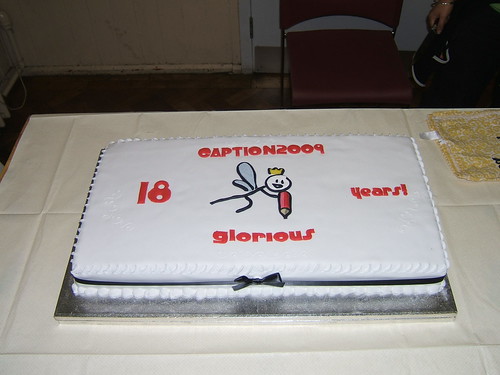
The cake, it does not lie. For Oxford’s Caption comics convention really was eighteen years old last weekend! As I’m yet to miss a year, mathematics would at this point seem to suggest that I have been to eighteen of them. But whenever I try to think about that it makes my head spin, so let’s talk about something else...

Rich Johnston’s report perhaps sums up best the unique atmosphere of Caption, with his gamely attempt to compare it to America’s largest con in San Diego. (Rather reminding me of the Attila the Stockbroker poem ‘Southwick is Like Amsterdam, Only Smaller’.) He closes events with a shot of cartoonist Terry Wiley nipping out for more loo roll, as the centre has run out. For the sake of the gag, I’d like to tell you there that Terry was a guest. But, as Caption makes so little distinction between guests and attendees, that sort of thing is tricky. Terry has been a guest in previous years, but as even I’ve been a guest before now I suspect that counts for little.

Way back in 1992 Caption was started by a clutch of cartoonists, who figured no-one was putting on the sort of convention they wanted to go to - so they might as well do it themselves. In the process they somehow engendered some monster, forever re-replicating itself on a duplicating machine, that lumbers on to this day. At a time where everyone in the small press scene wanted to talk about distribution (mostly complaining at the lack of it), their event completely ignored the whole question. You just dumped your wares at one central stall, then forgot all about them until it was time to pick them up again at the end. Caption was a kind of extended front room, where those who made comics could meet up, drink, draw and do a whole lot of hanging out.

Though things didn’t always run in that order, for Caption is absolutely littered with pens and pads. (Something I don’t think I’ve seen at any other convention.) The pads are always full and the pens driven to their dried-up death before the weekend ends. Drawing games normally spring up spontaneously, at a roughly equivalent rate to people’s alcohol consumption. One panel was titled ‘You Should Totally Run Your Own Con, Dude’. But that’s pretty much what happens here anyway. Like the kids from Fame, the attendees put on a show right here. Caption is a magnet and a playpen for people as mad as you. Then times by nineteen.

To return to our baking theme, the talks and events are therefore merely the icing upon a cake which bakes itself. But they’re easier to talk about so let’s home in on them...

Every year has a theme, this time ‘away with the fairies’. Always somewhat voluntary, some themes seem to ‘stick’ better than others. This time the fairies didn’t seem to transpire much at all, barely mentioned even during the final panel featuring Mark Stafford’s ’Cherubs’ and Jaime McKelive’s fairy-friendly ’Suburban Glamour’. This was perhaps a bit of a wasted opportunity, as one of the articles in the programme (by co-organiser Selina Lock) had already made the necessary expansion from fairies to folk tales. It seems to me that comic have a more natural inheritance from folk tales than they do from film, painting, literature or any of those other things they all-too-easily get bundled in with. Maybe next year, people will believe in them better.
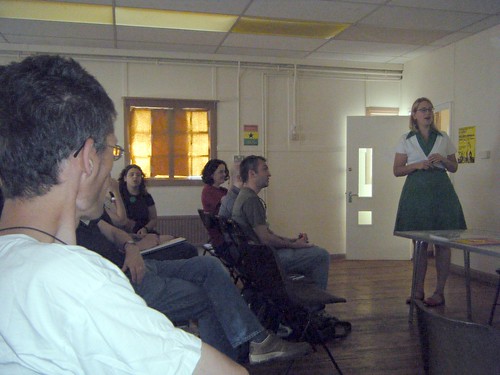


Instead we swapped fairies for the internet - focusing on the impending Longbox which (McKelvie informed us) will be like iTunes only for comics. Which is an exciting enough prospect. However, I’d earlier been to Sarah McIntyre’s eye-popping talk on children’s picture books. (That’s me on the left, looking like her scary stalker.) One of McIntyre’s points had been the greater relative size of books for children, and how that made it easier for them to get immersed in what they were reading – leading her to fantasise about an ‘instillation book’ big enough for adults to step inside. In fact one of the few criticisms I could make of her talk was the fact that it was mere slides, when it would have been so much sweeter to pick up those enticing-looking books and thumb through them. As it was, it was like looking at pictures of a decorated cake you couldn't actually taste... oh, wait I already did that...

Emboldened by this thought, I asked if there wasn’t something vital being lost when a physical comic gets replaced by pixels on a screen. A CD might come in nice packaging, but with a comic there’s no such separation between the object and its content – the two are one. McKelvie agreed readily that they were “different experiences”, but made two replies. First, that “young people” didn’t necessarily see things the same way as us. (Which fair made me chuckle, because he must have been one of the youngest of folk I’ve spoken to in ages!) Second, people can end up buying both, ‘trying’ with the download before ‘buying’ the object. (And indeed our concept of ‘ownership’ does seem to be becoming more conceptual, CDs coming with download codes for MP3s etc.)

We also discussed the idea that home printers might reach the level of sophistication where they could serve you up a collated colour comic just the way that shops used to sell them, essentially eliminating the question. Matt Brooker (aka D’Israeli) also pointed out a paradox that the download button was reasserting the authority of the flat page, taking the animations, sound effects and interactions back out of web comics in order to make them printable again. To think that, at the first Caption, I’d barely heard of the internet!

With fairies on the wane, robots seemed to mount a takeover for the year’s theme. (Come to think of it, Fairies vs. Robots would have made for a great convention T-shirt!) This was perhaps down to ‘Titanic’ Tony Hitchman’s quiz, now a Saturday night regular. He left us with two bits of useful advice, robots are best dealt with by a sharp kick to the head, guaranteed to set cogs a-spilling and save the day. And evil sentient computers are defeated by unplugging them at the back. Though steeped in those deliriously wacky DC comics of yore, Hitchman’s quiz belongs at Caption. Just because comics are primarily a sophisticated medium for tackling adult issues, doesn’t mean they can’t be stupid, goofy and juvenile as well.

We’re told Caption will return next year, but as yet no word on the theme. Me, I’m still canvassing for The Evil UnCaption. This comes from the old Star Trek episode, where the crew encounter their evil dopplegangers in a parallel universe. Everyone would be issued with false moustaches and goatees (the pan-galactic symbol for the sinister) and instead of sharing one big comics stall, vigorously defend their own whilst trying malevolent schemes to topple all the others. The Evilest Of Them All would be issued a prize at the weekend’s end, though of course that would probably just be a front for an assassination attempt. Or Caption could swap personalities with San Diego for a year, which might just be a different means towards the same end...

Anyway, whatever theme is finally hit on, I hope to see you there!

These photos and more from the Caption2009 Flickr group.

Wednesday, 12 August 2009

SO WHO STAYED WATCHING ANDREW RILSTONE?


Stop me if you’ve heard this one already, but it does deserve a non-bloodied smiley face...

After being silent since March, Andrew Rilstone has bounded back into blogging with nothing less than a sixty page PDF zine! This is like when Marcel Duchamp claimed to have retired from art, just to work on his biggest piece yet! In the circumstances I’m even willing to forgive him for calling My Chemical Romance a “punk band.” Though I’d already embarked on The Olde Print Days of Lucid Frenzy, it was a Bugpowder link to Andrew’s writings which encouraged me to start blogging. And he’s remained one of my favourite writers on matters comics and filmic.

Though having said that, he has at times reduced me to a state of teeth-gnashing envy. Sometimes he has said things I wish I could have said first, or even as well. (For example he points out that many of the moments of synchronicity in Watchmen aren’t there to make any specific point, so much as create a world of synchronicity which the story needs to marinate in.) At others, he says things which soon as said seem so bonecrushingly self-evident I feel a fool for never noticing them. (Stan Lee introduced an element of ‘realism’ to the superhero genre, but at the same time filled it with metafictional conceits by making “Smilin’ Stan” an audible presence in his own comics – of course he did!) It’s like I study every line, every damned line, only for Andrew to come along and point out some fresh angle of perspective that has been there all along. “But you were looking so hard at the trees, old bean. What about the wood?”

Such a perspective (and I use the word advisedly) is particularly welcome when comics like Watchmen and internet criticism combine into truly virulent nerdism. I’ve lost count of the websites I’ve seen which have gone through some comic, annotating it panel by panel, in their ceaseless search for ‘clues’. All the while oblivious to the fact that the medium of comics lies in, like, connecting the panels, dude. It’s like studying music by examining each note in turn. The technical term is “missing the point.”

One of the interesting features of Andrew’s zine is that it is just that – a zine. Partly this is a metafictional joke, a comment on the grubby things we read and wrote back when Watchmen first appeared. (Hence the use of retro fonts.) But its more than that, the various pieces at first seem to be about separate subjects (Watchmen, Supergirl, the comics you read as a kid). But you soon realise that these components all slot together into one overall argument, a single subject studied from different perspectives. (I got all carried away on his comments board and called this “argumentative origami”!) A series of blog entries, posted however closely together, would not have the same sense of simultaneity.

Of course there’s an irony here in that our actual back-in-the-day zines rarely did this, at least not at any conscious level. We merely tapped them out on typewriters or (for the fancy) word processors until we had enough words to release. (When you start to follow a writer everything they say becomes a piece in an overall puzzle you assemble of them in your mind. But each piece is standalone.) But like a modernist painting it demonstrates something zines can do which blogs can’t.

I left some (very) cursory comments on Andrew’s blog. But one of these days I really will write my own perspective on Watchmen...

Thursday, 30 July 2009

BABYLON'S BURNING (BABY, CAN'T YOU SEE..?)


For those who've found proceedings here to have been too proggy of late, here's a link to my review of Clinton Heylin's 'Babylon's Burning: From Punk To Grunge', as published on the recently refurbished Last Hours site.

Sunday, 26 July 2009

"SOME OF YOU ARE GOING TO DIE..."

As part of an occasional series of reviews of things for no better reason than they happen to be lying about- an appreciation (yes, really!) of Genesis’ ‘The Knife’


Absently thumbing through the shelf of old records left in our living room, the detritus of past tenants unknown, I realise I’ve never actually heard ‘The Knife’ by Genesis. I’ve not listened to anything off their second album Trespass for that matter, but it’s ‘The Knife’ which was supposedly their inaugural moment - the point where they threw a six to start and hit upon their classic sound. A story I’ve heard so many times, without ever actually hearing the track it centres round. So I take it for a spin and discover, over a quarter-century after I foreswore off all things prog, that it’s actually pretty good!

Perhaps that’s not quite as surprising as it sounds. Genesis had a plus point their contemporaries lacked – negativity. While ELP were the soundtrack of the techno-fix culture and Yes indulged in New Age platitudes, Genesis sought to disturb and unsettle. (Hence the famous story that William Friedkin, director of The Exorcist, headhunted frontman Peter Gabriel to write for horror films.) And better still, they exuded English menace, homing in on pastoral garden suburbs until they revealed the snake in the grass.

But all of that starts here so part of ‘The Knife’s’ appeal inevitably becomes the contrast between it and the album it closes, like a switchblade suddenly pulled at the end of a dinner party. As Wikipedia put it, “The song was unusually aggressive for Genesis at the time, as most of their work consisted of soft, pastoral acoustic textures and poetic lyrics.” The album cover reflects this concept. (And if that’s all tantamount to saying it wakes you up after a dreary album, I have to admit to quite liking a couple of the earlier songs, such as ‘Visions of Angels’... I must be getting old!)

Ultimately, though, it’s the contrasts within ‘The Knife’ that truly make it work. For once the inevitable suite of parts really do fit together into a greater whole, and some of them are even (gasp!) catchy. Check out the segue from the flute-and-keyboard-wash sequence into the clashing guitars, a mighty riff that would have done credit to Black Sabbath.

But perhaps the classic contrast, the one which really sums up the song, is between the slow measured chant (“we are on-ly wan-ting free-dom”) and the more manic delivery of the verses. Satire will often ape the voice of its targets in order to ridicule them, but when delivered by a singer this age-old trick gains an extra resonance. The song draws much of its sinister feel from the way the malevolent, self-serving leader is speaking directly at us, as if hypnotising us – “some of you are going to die...” Oratory is raised to the level of a malevolent spell. (For a very different piece of music which pulls exactly the same trick, try The Dead Kennedys’ ‘California Uber Alles’. As singer Jello Biafra explained “I like to slip in behind villains and expose them that way.”

It’s notable that Gabriel would return to this character of the charismatic charlatan (albeit with more humour to alleviate the blackness) with ‘The Guaranteed Eternal Sanctuary Man’ from their later magnum opus ‘Supper’s Ready’. (“Look, look into my mouth he cries, I bet my life you’ll walk inside”.) An explanation for this fascination might lie buried in the bands’ history. Most school-based bands are formed out of a desire to grab attention, and scrabble a set together in order to justify getting up on stage. But with Genesis it was the reverse. They had set out as a team of songwriters, who first made recordings simply to demo their songs and only reluctantly took to performance. And as the front-man, Gabriel would have been thrust further into the limelight than the others.

Perhaps, given the task of working out quite consciously what a performer needs to do, he became aware of how manipulative the exercise can actually be. Perhaps in working out how to gain a crowd’s attention he also grew aware of how dangerous such a power could be in the wrong hands. Consequently he took on the persona of an anti-messiah who will whip up his followers, but lead them only from behind.

However, before we start calling the song’s distrust-your-leaders message ‘proto-punk’ or some such, it could easily be argued that it is in many ways quite a reactionary song. The masses are a bewildered herd, hoodwinked by a few fine-sounding phrases. (Gabriel had something of a predilection for comic commoners, not the nicest notion for a public schoolboy to adopt.) The claim that an event like the Russian Revolution was derailed by sanctimonious but self-serving leaders seems less than controversial. But to go on to claim that they were able to cause such an event by sheer skill in rhetoric seems absurd. It could also be argued that the true horror of messianic leaders is their ability to convince even themselves of the rightness of their cause, something missing from the song. But one song can only tell us so much, and its effectiveness should above all be judged as a piece of music. And not for little reason did this rattling number remain a live favourite for years...

And before I’m accused of going soft, I also tried to listen to the final offering from classic-era Genesis, the double concept album The Lamb Lies Down On Broadway. Which I found to be pretty much the way you expect double concept albums to sound, overheated, babblingly incoherent and ultimately unendurable. Most likely, what makes ‘The Knife’ palatable now isn’t that it was forward-looking but precisely the opposite. It was created when prog was still nascent, when lots of funny time changes weren’t supposed to rend killer riffs redundant. So perhaps the prog revival doesn’t start here after all...

NB The video clip below starts part-way through the song, but you can hear the whole thing via the ever-reliable Spotify.


Coming soon! More records from that old shelf...

Thursday, 16 July 2009

SEVEN (MORE) SONGS: Part Two

These three songs complete my description of “seven songs which have been shaping my spirit lately." Part One here.

Spotify Playlist here


‘AIRSCAPE’ by Robyn Hitchcock and the Egyptians

Inevitably for me, I tend to prefer the darker more menacing side to psychedelia. The softer stuff tends to the fey and twee, rich kids prancing about in parks and frilly shirts whilst rejoicing under names liked the Crocheted Donut Holes. Perhaps we more readily recognise the existence of bad drugs nowadays, but my favourite Hitchcock tends to be from his early, punk-era outfit The Soft Boys. But as his later work often demonstrates there is an upside, a light psychedelia that isn’t just psychedelia-lite. In fact ‘Airscape’ would be a strong contender for my favourite Hitchcock track of all. (And, according to Wikipedia, Hitchcock himself concurs.)

This song isn’t named for nothing. It infuses the sound of psychedelia with the feeling of weightlessness, for the pealing guitar and wind-chimes don’t sound like they possibly could have come from any earth-bound instruments. (The album was titled after the line “element of light.”) Hitchcock uses this sense to conjure up the perfect summer song. (“And in the element of summer/ The cliffs suspended in the heat/ The air in columns.”)

It’s the observation that in the haze of summer objects seem to lose their substance and become nothing but forms of light, then fed into the poetic fancy that an eternal summer would bring with it the end of all physical separation –we’d become just floating elements of light. (“Where angels hover, I’ll hover too.”)

(For the importance of those psychedelic sounds in conveying this sense, check out this live version from YouTube. Without them the song keeps something of it’s beauty, but more narrowly escapes being another post-Byrds jangle. With them comes the lift-off.)

And like much psychedelic music, there’s something indefinably English about the whole thing. “The tiny figures of the world are walking/ Underneath your feet” makes me think of another supernatural world, existing in parallel to our own yet passing us by. In today’s bid for Pseud’s Corner, it could be said to be reminiscent of Shakespeare’s Midsummer Night’s Dream:

“Over hill, over dale,
Thorough bush, thorough briar,
Over park, over pale,
Thorough flood, thorough fire,
I do wander everywhere,
Swifter than the moon's sphere;
And I serve the fairy queen,
To dew her orbs upon the green.”


Of course such conceits have a purpose beyond mere fancy. The supernatural world is really nothing but the natural world, ceaselessly trodden by us but in our daily bustle never noticed. The music’s a means to reacquaint us with it. In fact, in the finest tradition of romantic poetry, the song was written about Hitchcock’s favourite beach, as featured on the cover art.

’RISE ABOVE’ by Black Flag

In in an e-mail group to which I belong, a recent exchange awarded Black Flag’s ‘Police Story’ the coveted prize for dumbest punk lyrics of all time. (With special points awarded for the opening: “This fucking city/ Is run by pigs/ They take the rights away/ From all the kids.”) But a close contender might be ‘Rise Above’, also from their debut album 'Damaged' (released in 1981).

In fact this virtually became their signature song, normally opening their notoriously confrontational live shows. Lyrically its a debunking anaylsis of the capitalist mode of accumulation... no of course it isn’t. It’s a great two-and-a-half-minute fuck-you to the in-crowd kids who disdained them. ”We are tired of your abuse/ Try to stop us, its no use!” is made into a band chant. (There’s even the line “think they’re smart”!) As original singer Keith Morris (gone by this recording) put it: “We were going to make as large a racket, piss as many people off, go apeshit as we could, and we had no choice but to play to please ourselves and a handful of friends.” (Quote from Clinton Heylin’s 'Babylon’s Burning'.)

Its dedication to defiance is juvenile but awe-inspiring, risible but brilliant, cheesy but coruscating, petty but life-changing. All of which is completely punk. Punk’s blanket insistence that “you can do it” led to some pretty terrible efforts, if also some good stuff. But the truly great punk is good and terrible simultaneously. I laugh whenever I hear it, both at it and with it, and I wouldn’t want it any other way. “We are born with a chance/ I am going to have my chance.” What better messaged could you hope to hear in your teens?

MEMO FROM TURNER by Mick Jagger


I normally dislike posting a video link when the subject of enquiry is actually the song (remember them?), but this time there’s a method to my madness. Before music video was established, this song was stuck surrealistically in the middle of the cult film 'Performance' (in which Jagger starred). It fits the film so well it’s astonishing to hear it was an old demo, only utililised by Jagger after he failed to come up with anything new. Both compare and contrast the world of the rock star with the gangster in myriad ways, but let’s home in here on one more specific to the song.

It’s a sleazy blues number, typically sneered through and smeared with slide guitar. (Courtesy of Ry Cooder, this isn’t a Stones song.) Richie Unterberger describes it accurately enough as “spinning bizarre mini-snapshots of decadent, cruel gangster behavior...” However it also sets up a chronology, beginning with lowlife tussles “eating eggs in Sammy's... on a hot and dusty night” before leading up to grey executives “at the Coke convention, back in nineteen sixty-five.” (Then just three years ago.) Moreover, the personalised and conversationally familiar speech (“Didn't I see you down in San Antone..?”) is also juxtaposed with the more formal choruses (the repeated “Come now gentlemen...”).

Rock stars had once been outsiders, doing little more than providing a soundtrack to delinquency. No-one had been a better poster boy for bad-guy status than the young Stones. But by ’68 (when the first demo version of this song was laid down), the Beatles’ 'Sergeant Pepper' had happened and rock music was now relabelled Art. (It was reviewed in the Village Voice under the header ‘The Album As Art Form’.) Perhaps consequently, the Stones remained keen to play Altamont against the Beatles’ Woodstock.

Hence Jagger delivers the song suited from behind a desk, reminding his contemporaries (and quite likely himself) their roots lay in dives like Sammys rather than Coke conventions.

”Come now, gentlemen,
I know there's some mistake.
How forgetful I'm becoming,
now you fixed your business...
...straight.”


Less-than-PC lines like “you drowned that Jew in Rampton” would be the equivalent of reminding the Beatles of when, broke in Hamburg, they attempted to mug a sailor. There’s even a coded reference to the idea they might all be getting on a little - “When the old men do the fighting/ And the young men all look on”. (Which compounds with James Fox’s line to him in the film, “You’ll look funny when you’re forty.”)

Of course these days that’s hard to remember. There’s (to put it mildly) something of an irony in hearing Jagger warn about the corporatisation of rock music. (Or for that matter the redefining of rock music as art whilst starring in an art movie.) But perhaps we should treat it less as warning and more prediction.

"So, remember who you say you are,
and keep your noses clean...
"The baby's dead," my lady said.
You gentlemen, why, you all work for...
...me!"


Admission: With the above write-ups I seem to have taken the term ‘song’ quite prescriptively. Descriptions either don’t mention the music much at all, or explain how it illustrates the lyrics – like it lacked its own motivation. Its analogous to the way criticism about comics homes in on the writing, with the art just some kind of side-order. Like goes to like, and words go to words. Ah well...

Thursday, 9 July 2009

SEVEN (MORE) SONGS: Part One


Following a previous experiment, here’s seven more songs that have been “shaping my spirit” lately. (Or at least four of them, Part Two will follow... um... sometime.) You can listen to them via the Spotify link below. (If you don’t already have Spotify, you’ll have to download the player from here - don’t worry, it’s free!)

Lucid Frenzy Playlist


‘SURROUNDED BY THE STARS’ by Amon Düül II

I sometimes think there must have been something in the water in Seventies Germany, enabling the bands to take the standard American rock influences and make them their own. Take for example this track by the kozmische (don’t call them krautrock!) outfit Amon Duul II, opening their 1972 album Wolf City. In terms of lyrics and tone it’s clearly stealing a page from Dylan’s ‘Ballad of a Thin Man’, throwing a ‘straight’ into a world of weirdness then poking a stick at his struggling with some second-person denunciation. Like Jospeh K, you’re not quite sure what you’ve done to incite such disdain - which somehow makes it all the worse. It has both Dylan’s Carnivalesque Medievalism and his fixation with encountering archetypal figures (a streetsweeper, a clown, a cop, even his patented Napoleon)!

However, Dylan’s song harangued the unhip. (“Something is happening here but you don’t know what it is/ Do you, Mr. Jones?”) AD II (as their fans call them) up the stakes by upping the scale, contrasting the puny human ego against the immensity of the universe. The song warrants its ‘kosmische’ tag, building things up with a cosmic sweep and majesty - dwarfing sunrises and unheeding “gates of night”. The title itself is a perfect reversal of the standard Science Fiction fixation with escape; here an unfamiliar universe is pressing in upon you.

As much as anything from American rock music, I associate it’s imagery with the new-look comics of this era, such as Metal Hurlant - with it’s “complex graphics, cinematic imagery and surreal storylines.” Though, typically, this comic magazine was French it may well have been available in neighbouring Germany. Both use science fiction as a springboard to the cosmic, with a hefty side-order of surrealism. (The song provides only one actual SF device, the ‘are-you-tired machine.’)

Renate Knaup-Krötenschwanz’s cold-as-Nico vocals are the icing on this grandest of gateaux; while Dylan still sounds part-combative there’s not a trace of antagonism in her serene and lofty disdain. She’s as aloof as the stars themselves, peering pitilessly down on our petty hubris. In particular, the musical surges around her declammatory cries of “sunrise” have an exquisitely epic feel.

This marks the band in their classic era, advancing from their original free-form jams (check out the title track of their first album Phallus Dei) to something more closely resembling structured songs. In his Krautrocksampler, Julian Cope called this a “transitional group, but somehow in a state of very inspiring flux.” Not that such a free-form spirit had departed, for instrumental breaks continually thrust themselves into proceedings as if vying with the vocals. But, rather than disrupt the song, the tension between the two actually makes it. The sudden leaping from one to the other not only adds to the disorienting unpredictability, the instrumentals erupting also creates a cosmic soundscape. (Singing about “the gates of night” is fairly ineffective if you don’t feel it from the music. Here I’m driven to imagine gargantuan King Kong doors, big enough to hold back the sun.)

Later, and sadly, this unhinged element would disappear and the perfect balance would be lost. You can see it even on the covers, which would abandon psychedelic freakshows for (yes really) airbrushed cars.

This review describes it well, as “Amon Düül II's tightest, most economical performance yet... For the first time, ADII seemed to base the songs around the vocal melodies instead of just working the vocals into instrumental passages... later albums would have slicker, more modern production values and the music itself would be more easily traceable to its influences.” (Let’s not get factional that those words come from a prog site!)

Finally, wasn’t that guitar opening ripped off for Here & Now’s ‘This Time’?

‘THE BALLAD OF THE SOLDIER’S WIFE’ by PJ Harvey

Songs aren’t heirlooms; you’re not obliged to sing them in the style they were recorded. To do a Brecht and Weill number, for example, you don’t need to put on a dodgy German accent or duplicate the original cabaret-style instrumentation. In fact a cover should always strike off in a new direction, or else it’s just a pale photocopy. But what you do need is to understand the spirit of the original, know where the song was in order to take it somewhere else where it’ll fit in.

Maria Friedman’s version for The Proms (back in September ’98) was jaunty & celebratory, the soldier’s wife receiving gift after gift as her husband travels and despoils Europe. Only in the last verse do things take a desultory tone, as the song draws towards its weighty conclusion. Conversely, Harvey sings the song almost emotionlessly, reciting the words in a near-monotone with the remorselessness of a ticking clock, against the sparest of backings.

Though the pared-down sound fits well after the grandeur of the AD II track, there’s more to it than segueing. The simple truth is that Harvey has it right and Friedman wrong. It’s not that the ‘twist’ is really quite obvious, that the final ‘gift’ is going to be the soldier’s body delivered back from the Russian front. It’s that the ‘twist’ is intended to be obvious, a conclusion foregone from the start. Like a public information film about playing with matches, there is no other way the song could possibly end. The point of the song is that it has a point, with everything else clearly designed around expressing that function. (At times Brecht even took this so far as to tell audiences the end of his plays at the very beginning, feeling anything else might lead to distraction.) Luvvie frills do not add, they distract from such a purpose.

Harvey’s version is from a tribute album to Weill. Like most of these things, its pretty patchy and uncohesive overall but has its highpoints. (William Burroughs’ closer is a joy!)

‘TIMES SQUARE’ by Marianne Faithfull

Of course this is one of those alcohol songs that isn’t actually about alcohol. However, how much it is about Faithfull’s own years as a heroin addict is at most marginally important. For one thing, she spent those years in London and addiction doesn’t lend itself to jet-setting. For another, the song’s not written by her but guitarist (and long-time collaborator) Barry Reynolds. At the most, it gives things an extra piquancy.

“Take a walk around Times Square
With a pistol in my suitcase
And my eyes on the TV.”


The song sums up a junkie’s life with successions of juxtaposed images - combining the constant feeling of danger with the perpetual sense of being on the periphery of things (“in a car taking a back seat”). Removed from society, at the mercy of both habit and dealer, you’re never actually in charge of your life. Times Square is both the notorious lowlife hangout in New York and a metaphor for the repetitiveness of the addict lifestyle – “take a walk around Times Square”, “standing in a circle”, reinforced by the repeated references to minutes and hours.

Yet unlike the Velvets’ ‘Heroin’, the circle may be unbroken in ways other than death. Like many songs the end is actually found in the beginning, for “watch 'Don't Walk' to 'Walk'” prefigures the detoxing. The last line, “staring at the ceiling” contrasts with the movie screen and the car window. This time you are share the space with what you see. But instead of the chorus returning the song ends suddenly and openly, less a triumph than an ellipse...

The ambiguity of this un-Hollywood non-ending is something of a masterstroke. Addictions are commonly described as never beaten, at most contained. Indeed, though we shouldn’t read the song too much as biography, Wikipedia suggests that her addiction hadn’t been entirely contained even at this point in her comeback.

This song first appeared on Faithfull’s 1983 album A Child’s Adventure, but this is a live version from the 1990 Blazing Away.

‘POOR OLD TOM’ by Richard Buckner

As I’ve argued before, the purpose of country music isn’t to galvanise you against the injustices of the world. It’s to induce in you the requisite resignation until you’re able endure this world as it is. Its like the slug of whiskey before the kitchen-table amputation.

Peter Case’s ‘Poor Old Tom’ would be a good case in point. Tom’s predicament is presented as a fait accompli; he’s broken before the song begins, the song’s built around learning how he got that way. One line mentions “typhoons and calms on the great Pacific”. I can’t help but think of the typhoons as Tom’s fractured fallibility (“at the drop of a coin he starts to ramble/ and the whole damn thing becomes a mystery”) and the calms as the points where the clouds start to part and we get to see what’s been going on. Some lines are so flatly descriptive they become almost comic – “he worked hard on board and got promoted/ he got VD but it went away.” The oft-repeated “poor old’ title becomes a perfect microcosm of this, in every instance hinting at a terrible problem yet at the same time reinforcing the diminutive term.

However, while not changing a word of this, Richard Buckner’s cover adds a whole new dimension. His delivery is the very opposite of insistent, each couplet closing with a descending tempo, like the song’s perpetually on the edge of ending. This is a tale that’s already done.

At the same time, to pursue the song’s nautical metaphor, the arrangement carries something of an undertow, swelling back up whenever the couplet seems closed. The song’s bookended with an agitated guitar sound, which would seem to suggest something far more expressive without it ever actually appearing. Buckner’s voice is also befitting – weary and mumbling, but with a touch of tremulousness. Between them these suggest an inchoate rage lurking under the surface of the song, threatening to break the surface but never quite coming forward.

Both versions deny this rage expression. But while Case demonstrates a rage-shaped hole which he defies us to fill, Buckner allows us to glimpse its shadow. Ironically this suggestion of rage makes it linger in the mind more than its actual expression would, we can’t help but wonder what have happened if it had reared itself above the waterline. (Case’s own version is on Spotify too, if you want to check this comparison out.)

“Poor old Tom, his story’s true
He’s got nothing to show
No-one to show it to
The word for him is nevertheless
He fought for freedom
Never took a free breath.”


Coming Up Next!: Something completely different. (Well three somethings, to be precise...)

Monday, 29 June 2009

ICONS OF OUR TIME: THE LION OF WALMINGTON-ON-SEA


The rest of the internet can discuss Michael Jackson if it wants to. If its all the same with the rest of you, I’d rather talk about a true icon of the Sixties and Seventies – Dad’s Army’s Captain Mainwaring.

Swisstone may be laying it on a little to call him “a pompous, incompetent buffoon with the courage of a lion”, but with that combination he’s essentially right. Contrast Mainwaring against another rank-wielding character from a great British sitcom, General Melchett from Blackadder Goes Forth. Melchett is perhaps best summed up in the final episode where he rails against the fact he’s unable to join his men in battle but must instead sit down to a sumptuous dinner. (“Curse this bottle of Chateau Dom Perignon!”)

Conversely, I must have seen the majority of the eighty-odd episodes of Dad’s Army and I can’t think of a time when Mainwaring orders a man to do something he wouldn’t do himself. In fact, when push comes to shove the portly twit will pull rank precisely to volunteer himself. (Swisstone and his commenters cite a couple of these.)

...which creates a juxtaposition which enriches the character. We’re abundantly aware that he donned his Captain’s pips for salutes, to gain a status he feels has been deprived him in his civilian life. Yet, from time to time we’re reminded that his opposition to fascism is also quite genuine, that he’d willingly fight for a world in which ‘fair play’ endures.

...which in turn enriches the comedy. (It’s hard to imagine that writers Perry and Croft did much without the comedy in mind.) Mainwaring’s bids for status-in-uniform of course work about as well as when he was in civvies, the series’ formula virtually revolves around robbing him of dignity. (Plotlines, it must be said, were rather rationed in Dad’s Army.) It remains funny, despite all the repetition, partly because actor Arthur Lowe conveys pompous umbrage as effectively as Oliver Hardy. Lowe could have bridled for England. (Which, come to think of it, he pretty much did.)

Yet allowing the character positive features, granting him some dignity to lose, gains such moments a resonance. As JB Priestley put it: “Good clowns never try to be funny, but are hopeful creatures, lost in a hostile world.” Krusty the Clown was more succinct: “First rule of comedy, kid. The sap’s gotta have dignity!”

Let’s sum up our tubby icon with a culinary metaphor he would doubtless have appreciated. Most characters in sitcoms are like sweeties, bought from the shop when you have some loose change. You taste on your tongue their saccharine rush, then they’re dissolved. Mainwaring’s more like a cake ordered from a master baker, someone who knows that throwing in a few tangy tastes will enrich the sweetness. Both are confections, but one is there to savour.

Coming Soon! My explanation of how the Village Hall stands for the Means of Production...

Monday, 22 June 2009

THE CLASSIC SUPERMAN CARTOONS

(Part Two: The Paramount Years 1942/3)


“Faster than a streak of lightning! More powerful than the pounding surf! Mightier than a roaring hurricane!”

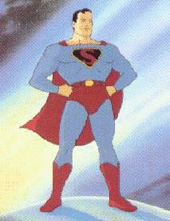
Keen and attentive readers might notice something about the breathless narration above, which opened the Superman cartoons from September 1942 onwards. The cartoons were no longer produced by the Fleischer Brothers but by Paramount, trading under the name Famous Studios. Yet that change alone would create the opportunity to amend the opening, but not the motive. No longer contrasted against machines (“a speeding bullet”) but the natural world (“a roaring hurricane”) it of course comes as no surprise that Superman is now more earthly and political. It was time for him to take on human foes. By the time this round of cartoons were made, Pearl Harbour had happened (in December ’41) and Superman became enlisted in the war effort.

Jim Steranko has suggested an Elvis-in-reverse scenario, that this enlistment was the act which made Superman into a legend: “[He] never really had anything to flex his muscles over until the war... He had come to save the world and was put to work breaking up fist fights.” Yet, contra to Steranko, Frank Miller once argued it didn’t matter what changes the publishers brought to Superman - for the right character would always live on in the popular mind. We clearly remember “speeding bullet” more than we do “raging hurricane”, it lodges in our brains like it belongs there. In fact the DVD collection I possess of these cartoons even cites that variant loudly on its case, crying it as the definitive version. But why should that be, why should the speeding bullet be the thing which gets lodged in our heads? Why should the Famous Studios formulation be so un-famous? The episodes certainly feature some fairly shrill anti-Japanese (and in one case anti-African) racism, which might lead to their being less well-remembered today, though that alone would scarcely account for it.

Previously, Supes stood for a grand concept. As we saw in Part One, if he symbolised a heroised worker that wasn’t exactly the same thing as being a worker. Superman has to represent the worker, but always with enough of a distinction to allow him to make that representation to other groups. Consequently, there was the simultaneous sense of something quite unique about him. To reduce his concerns to the earthly and political, even over an issue as big as the fate of the earth, diminishes him, turns him from a tableau into a propaganda poster. Superheros-at-war stories tend to resemble those opening scenes where they round up some bank robbers, musing all the while what a quiet night it seems. The reader sits through these merely human conflicts, expecting something more exceptional to come along in a minute.


There’s also something of a lapse in logic, if he’s so all-powerful why doesn’t he just fly over and duff up Hirohito himself? (In fact in his second ever comics appearance he does pretty much that, albeit in a bid to keep America out of the war! He then even repeats the image on the cover of Superman 17.) Or he could at least fly into battle to bring down ‘Jap’ planes... Yet, were he to do something like this, it would risk trivialising the problem. Imagine him scuppering Auschwitz and rescuing the Jews... It might also undermine efforts to present the troops heroically, his super-strength elevating him above them rather than representing them.

Paramount dodge this question by selecting carefully what kind of war stories they’re telling. These aren’t battlefield capers but espionage tales. This is made clear in the opening episode – telling titled ’Japoteurs’. It doesn’t make much sense when you stop to think about it. Why does Superman have to wait for the cover of night? Why does he even have to be over there as Clerk Kent in the first place, now he can finally fly why can’t he just nip over every night? But these problems only come up when you do stop to think about it. There is a dramatic association between the super-secret-identity and the undercover spy, which allows our brains to file them alongside each other. So, by coding the stories this way, they introduce narrative conventions which make it much easier for them to plug a super-being into a war scenario.


However, an alert reader might have already spotted a small flaw in this schema. If the new Paramount Superman is a war character, what does that have to do with changing the opening? Having already been faster than a speeding bullet, why not now speedier than a Japanese fighter plane? Or able to hold his breath longer than a Nazi U-boat?

In fact, the changed opening is not primarily to do with the war stories at all; for a good half of the episodes are quite different in nature. The comparison point would no longer be John Henry, the man as strong as any machine, but his predecessors - the ‘big man’ folk tales of the American frontier, such as the lumberjack Paul Bunyan.

Unlike Henry, Bunyan’s stories almost always pit him against nature - for he’s a man big enough to match the American frontier for size. A minority of stories in the Fleischer era would match this description, such as ’The Arctic Giant’ (effectively a Godzilla story), ’Terror on the Midway’ (a King Kong-a-like) or the self-explanatory ’Volcano!’ Yet, while the credit sequence may seem to set us up for something similar, that’s not quite what appears here.

Just as he had with the Fleischers, Superman still represents modernity. This is now manifested by his battling menaces from the ancient world. What was war with nature for Paul Bunyan becomes war with the primitive, as Superman is set against Mummies (‘The Mummy Strikes’), or lost kingdoms of bird people (‘The Underground World’). This gets tied in with the war stories, with their focus on the ‘regressive’ nature of the Japanese, epitomised by foregrounding their ‘old-world’ architecture to tell us we’re no longer in modernist, democratic New York. With the one story to prominently feature Nazis (’Jungle Drums’), presenting Germany as old-time is less credible so they are shown to be in hock with an African tribe. They become the hurricane and lightning of the credit sequence. (The irony here of course being that fascism was always keen to portray itself as modernistic and technocratic!)


While these episodes are more resonant than the espionage tales it’s the one episode which can’t be filed alongside any of the others, ’Showdown’, which becomes the only rival to the Fleischer era.

There’s plenty of superhero stories which follow the same premise, a villain disguises himself as the hero who then has to go on the run. Except here being thought guilty seems to present few problems for Superman, his challenge is just the intellectual one of figuring out who’s behind it. Instead the emphasis is on how the bad guy exposes the limits of the concept of clothes-maketh-man - he lacks Superman’s heroic physique and even smokes! (We discover he’s not even the scheme’s deviser, just a dumb henchman.)

The episode includes the iconic moment where the imposter pulls a gun, but the bullets just empty on the big S emblazoned on that heroic chest. This image may well not start with the cartoons (for all I know), but it epitomises what the cartoons really do. This may be partly down to the medium - it simply works better with animations’ continual flow than divided into panels, the at-first cocky crook toting the gun, then expending all his bullets with growing fear and finally throwing it uselessly away.

But above all, even in the later Paramount years, these cartoons simply had style! There’s a thin line between classic and cliché, and sometimes pulling off a standard trope with sufficient style is enough to make the difference. It’s like hearing a pub band wheeze their way through a blues standard, then hearing the Muddy Waters original – formally they’re the same song, but as listening experiences they’re a world apart. These cartoons feel right, almost reassuring, in that they give us the Superman we expect to see. But they tell us something we already know so well that it’s as if it’s the first time we ever heard it. Through this combination these cartoons earn their classic status.

Postscript:Now public domain, these cartoons can consequently be picked up cheaply on DVD or (in our recessionated times) are even downloadable from here.

Or check out this sampler...

Friday, 12 June 2009

THE CLASSIC SUPERMAN CARTOONS

(Part One: The Fleischer Years 1941/2)


“Up in the sky, look!” “It's a bird!” “It's a plane!” “It's Superman!”
“Faster than a speeding bullet! More powerful than a locomotive! Able to leap tall buildings in a single bound!”
“This looks like a job... for Superman!”


We fans must be the world’s biggest primarologists. When it comes to getting to the source of things, Doctor Livingstone has got nothing on us. To us, the best view is always from the ground floor. My Spider-Man stops dead the day Ditko left; even the Romita issues are a dream, a hoax, an imaginary story. And don’t ever try telling me about the Slits’ first album. I’ll counter immediately with their earlier Peel sessions and an air of smug superiority.

So when it comes to secondary media, we are tolerant at best. I went to see all three Sam Raimi Spider-Man movies, and even found good things to say about them. But try telling me they rival those classic Ditko comics and them’s fighting words. Silver can be shiny, silver can be precious, but it can’t ever be gold.

But our obsession with origination doesn’t always strike gold. Take those three quotes above, now so integral to our appreciation of Superman. Not one of these came from the original comic strips, all originated with the later cinema cartoons. And I for one find this significant, for I claim Superman found his finest classic-era depiction in the Forties Fleischer cartoons.

(Note to pedants: Some claim these phrases come from the radio series. This may simply be because that started a year earlier, in 1940. But this site not only insists they came from the cartoons but names their author, Jay Morton, and states they were only later incorporated into the radio shows. The picture is perhaps fuzzy because the two overlapped a lot in practise, even using a lot of the same voice actors. But little matter, for our point here is that these totemic phrases didn’t start with the comics.)

The real early comic-book Superman, far from being a pure Platonic thing who then slowly faded, was only semi-recognisable as the figure we now think of. Likened to “some occult, avenging demon”, called by one character “the Devil himself”, there is something Loki-like, manipulative and mischevous about him. In virtually every early story he dons a disguise - the better to put some dupe through the mill. True, the dupes are always villains (a corrupt arms dealer, a decadent mine owner) who he teaches the error of their ways. But he does seem to take an almost sadistic glee in his work. He threatens one that he’ll “tear out your cruel heart with my bare hands!” (Kent Worcester wrote a good piece on the ideology of early Superman back in Comics Forum 6, to which I replied in the following issue’s lettercol. Unfortunately, this doesn’t seem to have made it on-line anywhere and may be difficult to purchase.)

But perhaps the main drawback to these early strips is their perfunctory quality, which often verges on crudity. This is true of Siegel’s scripts but particularly of Shuster’s art, which can lack drama or dynamism. The Superman we know is here merely nascent, a rough sketch still awaiting life to be blown into him.

Perhaps the key to these cartoons can again be found in that classic credit sequence. The second episode, ’The Mechanical Monsters’, describes the big S as “empowered with X-ray vision”, and we get one demonstration of this power. But in all subsequent episodes it is gone, leaving him (at least as listed) with but one power – “possessing remarkable physical strength.”

This shift is telling, for here Supes is pretty much defined by his physical strength. The opening monologue pits him favourably against machinery or its makings – speeding bullets, locomotives, tall buildings. From the first episode his foes tend to be mad scientists, pitting rays, robots or some other technocratic force against him. In weeks when mad scientists are in short supply, he goes up against gadget-assisted gangs (as in ’Billion Dollar Limited’). Sometimes we just get a fusion of the two, ’The Bulleteers’ for example are something like a mad scientist cloned into a gang.

Throughout this Superman never outsmarts his enemies, he merely draws on his reserves of strength and resolution. As Jim Steranko has put it, “Superman could punch his way out of anything; he didn’t have to think!” Yet it’s important to note that the man of steel is not stainless – it’s vital that to use his strength Superman has to strain.The scene where he first falls, only to pick himself up again, is virtually compulsory. My favourite image of this is in the very first episode, where he is hit by the mad scientist’s Electrothanesia Ray (yes really!). First struck down, he gets up again and advances against the ray by (I kid not) punching it repeatedly in the jaw.


(The Fleischers having made their name with the comic surrealism of Popeye and Betty Boop, this jaw-sporting ray is but one instance of a bizarre cartoon logic. A skyscraper topples so curvaceously it must surely be made of rubber, and has never heard of foundations. The Mad Scientist has a pet bird, so anthropomorphic it even copies his movements. Yet even during such absurd, if charming, moments, the Brothers always attempted to use Rotoscoping to give the Superman figure a sense of realism. The more-than man needs to keep his roots in the human.)

In fact the extent of Superman’s strength flies all over the place according to script necessities, one minute carrying a whole train aloft, the next getting tangled up tackling two guys. But the idea his strength has limits is important. (Kryptonite was not introduced to the radio show until ’43, after the cartoons. But perhaps it was never needed here, for Achilles was not yet so all-powerful as to need his heel.)

A good contrast might be the most recent film, Superman Returns, where he doesn’t overcome badness so much as transcend it – never raising a fist throughout the film’s running time. A crucial distinction is in the way he flies. In the Fleischer cartoons he’s still super-leaping. Even in the later cartoons (which we’ll come onto), he flies Newtonially – by thrusting himself off the ground. In the film he simply floats, with serene disdain for earthly forces. But in gaining this Zen crown, he loses his blue collar.

Typically, the scientist lives away from the city, in a remote and spacious tower. According to a note he sends, his main motivation seems to be revenge against “those who laughed at me”. This is perhaps at its clearest in ’The Magnetic Telescope’, where this time a telescope stands for Frankenstein’s castle and the Police the torch-bearing villagers who smash up his lab for “tampering with nature.” (While at the same time too polite to point out if you have a telescope you don’t actually need to draw the celestial objects nearer in, as it will magnify their appearance.)

So it follows that the world’s first superhero had antecedents. For example, there’s John Henry (the “steel drivin’ man”) from the blues and folk songs where a railroad worker who races his muscle against his boss’ new-fangled steam hammer. (Though dying of exhaustion at the moment of victory.) The songs may well date back to the 1870s, but became standards and a musical version starring Paul Robeson was staged in 1940.

Then, perhaps slightly more obliquely, there’s Houdini. Rogan Taylor comments upon the appeal of Houdini’s escapology for poor audiences: “The vision of this working class man bursting out of the best chains the capitalists could produce would not have been lost on the proletariat that watched him... The audiences identified with him totally and shared every minute of his ordeal. When Houdini got free, everybody got free. They had witnessed not so much a variety turn as a celebration of the human spirit triumphing over every obstacle.” While of course watching a mere cartoon is not so visceral an experience, contemporary audiences may have felt something similar when they saw (for example) Superman freeing himself from a frazzling tangle of electrical wires.

However, it may be that the later cartoon audience were able to wring an extra frisson from the sight. For theirs was the era of Fordist mass production, described by Wikipedia as “the moving, or continuous, assembly line, in which each assembler performed a single, repetitive task.” While the replacement of car workers by robots was still some way off, workers may have felt that it had already become them who were ancillary to the machines.

So Superman, with his endless reserves of strength, bounds in to reverse that. Even in this age of machines, he’s here to remind us that the worker is still the most powerful thing – the man of steel more resolute than the steel. It’s perhaps notable that the very indicator of Fordism, the motor car, appears on the cover of Action Comics 1 as the mere plaything of a man. Superman is an idealisation of the notion that Forties America is still borne on the shoulders of the blue-collar worker. It’s notable his scientist adversaries are literally white-collar, while Superman’s red-white-and-blue predominates with blue. Moreover, ’The Mechanical Monsters’ are the obverse of the worker, plundering wealth rather than creating it.


And yet isn’t there something inherently science fictional about our extraterrestrial star? If the mad scientist lives apart from other men, Superman is only among them due to a cosmic accident. Isn’t making him a heroised worker dragging him down to the Earthbound? The show’s opening, the very thing which calls us to notice his all-important strength, also reminds us he’s an “amazing stranger from the planet Krypton.” Of course, as has often been noted, his alien status fits a nation founded on immigration. Yet there is surely more to it...


A key to this lies in another image, as striking as the death-ray-thumping, yet in many ways the opposite of it. In the afore-mentioned ’Magnetic Telescope’ it is not the Scientist’s recklessness that endangers the city so much as the conflict between him and the Police. When they smash up his lab, he becomes unable to dispel the meteorite his telescope is already drawing towards us. Superman solves this partly by picking up two cables and using his body to conduct the current. Here the worker unites with the machine, completes it. Unlike John Henry the two are not intrinsically at odds, but the technocrats might need reminding from time to time that they need both.

The idea that there is something retrogressive about these cartoons would in any case only survive in a study of plot summaries – for in their look and feel they almost crackle with modernist urgency. Everything is sleek and gleamingly futuristic (in the most retro valve-addled way imaginable). Sets are the spacious side of gargantuan, when they’re not actually cavernous. Shadows and silhouettes abound while colour schemes are limited and controlled, never gaudy like so many comics of the era. (Supes’ red cape is often made to dominate the frame.) This look is most likely the killer app which makes the cartoons so classic, for it is not just aesthetically appealing but supremely fitting. Forties art was typically about simplification and idealisation – and what better subject for that than the idealised worker himself - Superman? A man with a jaw so square it was surely sculpted.

(Scott Bukatman takes this further to suggest that Superman represents “a kind of Corbusierian ideal...Through his benign, controlled authority, Superman renders the city open, modernist and democratic; he furthers a sense that Le Corbusier described in 1925, namely, that 'Everything is known to us'.”)

They are also remarkably fast-paced, particularly considered against the sedentary standards of their era. Stories fairly roar by! Newspapers (at least modern, photo-led newspapers) are often used as a totem of modernity, not just recording events but racing to record the modern pace of life. You’ll lose count of the number of times a shot of a newspaper photo dissolves into the real object, or vice versa. In this the cartoons are almost reminiscent of the way newspapers were used in a film released the same year - Citizen Kane. (Disclaimer: Before anyone starts, this is not to suggest that there are multiple points of comparison between these cartoons and Citizen Kane.)

In this way Superman has a double identity which allows him to fulfill his double role in these cartoons. He is the ultimate worker, defined by his labours just as is a plumber or a mechanic, yet the very fact that he is ‘super’ simultaneously means he is more than a worker. His alien-ness becomes associated with his status as a symbol, and makes him a credible force to bring worker and technocrat together.

Coming Soon! Where the Superman cartoons went after the Fleischers left...

Postscript: These cartoons are now public domain and can consequently be picked up cheaply on DVD or (in our current recessionated times) are even downloadable from here.

Or check out this sampler...

Tuesday, 2 June 2009

OI! YOU!: PUNK & THE SLAG-OFF SONG


“I’m in love with myself, there’s nothing else but me.”
“Sex cracked its eyes at me and I’m feeling something – and it’s living inside me.”


We’ll be getting to (and identifying) those opening quotes later, Meantime I’ve been thinking recently about the slag-off song, about how much of a punk style it is and finally reached the point where I’ve come to think of it as the very definition of punk. (Or certainly closer to the bone than post-Situationism, Bakhuninism, the Medieval Free Spirit movement or any of that Greil Marcus bollocks.)

The point of the slag-off song is that it’s not against politicians or parents or anything so vague as “the system” but ups the snot quota by slagging your own friends... or better still your very best friend. It appears little in hippy songs which tend to the unifying, either me-and-you love songs or us vs. them rallying calls. Think of Morrison’s “They’ve got the guns but we’ve got the numbers.” The slag-off never knocks “them” over there but “you” right here, but that alone isn’t enough to identify it. The normal first clue is to hear how the “you” is pronounced, which is often conveniently made the first word anyway. If it’s pulled into a drawn-out sneer of a word (“Ye-e-e-ew!”) it’s probably a slag-off you’re in for.

The godfather to the slag-off song was probably Bob Dylan. I remember as a nipper being actually shocked to hear him start a song with the snotty line “Y-e-e-w’ve got a lot of nerve to say you are my friend”, and then dismantle the fakery of a friendship from there. Nevertheless, it was with punk that the slag-off came into its own.

As a youth I heard Attila the Stockbroker claim punk exemplified Jean-Paul Sartre’s philosophy of existentialism. It stuck in my head precisely because I didn’t get it at the time. Punk, I thought with crude linearity, surely that’s about anarchy. But, as the opening quotes from the Jesus and Mary Chain show, Attila was right. Mark E Smith sang there were only twelve real people in the world (“the rest are paste”), but he must have been in a generous mood that day. To punk’s distorting lens the only real people are you and me, and frankly I’m having my doubts about you. To punk’s accounting, two’s a crowd. To punk’s ideologising you’re always best off by yourself, free to stand in front of the bedroom mirror perfecting your own self-image. (The other face to the slag-off song is the self-song, epitomized by the Pistols’ ‘I Wanna Be Me’, whose tautology-masked-as-profundity sums up this narcissism. Punk took much from Glam, including an almost fanatical devotion to personal self-transformation.)

When other people come in they get between you and that mirror, they try to reshape you and remake you and that’s where the problems start. Cops, teachers and parents are at least open about it. Friends and fellows, they’ll just try the same thing covertly. As the Psychedelic Furs put it, “they just wanna suck you in to being one of them.” From this comes many outwardly odd punk stances, such as glorifying sex but denigrating any form of intimacy.

Psychologically, this is perfectly adolescent of course. In trying to escape your parents’ influence you charge out their front door and then turn everyone else you see around you back into them. Anything to mask the one thing you could never accept, the person around you who’s most like your parents is you. (Or an even simpler explanation would be that the painfully self-aware adolescent is grateful for any excuse to escape the demanding company of others, particularly the –shock! – opposite sex, and such a hardcore-sounding excuse works all the better.)

It’s as easy to dismiss ideologically too. You can quote Jon Savage and paint it as proto-Thatcherite in its denial of any form of collectivity and society. You could even see its emphasis on the self as a constructed identity, where you make yourself as much as you find yourself, as something postmodern.

All of that may well be true, and its juvenilia is quite appealing in an amusing sort of way. After all, so much of punk’s so great because it’s so bad. But is that the whole story? All such movements are by nature contradictory and, beneath the rhetoric of self, even year-of-’77 Brit-punk exhibited plenty signs of collectivity. Bands would forever lend each other equipment, play endless benefits, walk off tours in solidarity with each other at exactly the same time as they’d snidely slag off each other to the NME.

But that alone would be to suggest slag-off songs were some decoy to punk, whereas actually some of my favourite punk songs are slag-offs. There’s a golden rule to punk, more than almost any other musical genre. Some punk was good, while much of it was so bad it was great. Yet the really memorable punk managed to be both bad-good and good-good simultaneously, and it often chose the slag-off song to accomplish this. Mostly it did this by exploiting the ambiguity inside that apparently direct sneering “ye-e-e-ew!” Who was the “you”? Was it a them, an otherwise anonymous subject denounced in public then left to clammily recognize themself in private?

Or was the “you” us – the audience? Didn’t those gormlessly clapping hands, the ones that fed the band deserve a biting? Alternative culture turns too quickly to complacency and a perverse desire to upturn its self-righteous applecart is often just what the doctor ordered. When, for example, the Furs sneered at parties of people “who put on wigs and stuff so they can be themselves”, they were sneering at their and their peers’ attempt to find themselves inside a manufactured image – and rightly so.

Or was the “you” really me, the singer? Was using the “you” a device for the singer to do their laundry, to criticise themselves in public with no-one knowing? I’m thinking particularly of Lydon’s perpetual post-Pistols assaults on the “bourgeoisie anarchist”, but maybe the genuine outward-directed slag-off is but the tip to a whole iceberg of self-criticism.

Other songs stoked up the mystery by making the “you” a deliberately ambiguous figure – maybe a little bit of me, you and them all stuck together with spittle. To quote again from the Furs, I always liked the line about Caroline who “lives in a place in the side of our lives where nothing is ever put straight”. (Maybe the deflected third-person slag is a sub-genre in itself, the semi-slag or something.) Caroline lives in some kind of shadow realm, populated by our fears. Peering in, we can learn from her mistakes. But she lives inside the same three minutes, she can’t change her tune. No matter how many times you play her song she ain’t gonna smarten up. Maybe that’s the place all songs should visit.