googlee7ea825f63edb3f6.html

Monday, 22 June 2009

THE CLASSIC SUPERMAN CARTOONS

(Part Two: The Paramount Years 1942/3)


“Faster than a streak of lightning! More powerful than the pounding surf! Mightier than a roaring hurricane!”

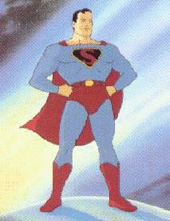
Keen and attentive readers might notice something about the breathless narration above, which opened the Superman cartoons from September 1942 onwards. The cartoons were no longer produced by the Fleischer Brothers but by Paramount, trading under the name Famous Studios. Yet that change alone would create the opportunity to amend the opening, but not the motive. No longer contrasted against machines (“a speeding bullet”) but the natural world (“a roaring hurricane”) it of course comes as no surprise that Superman is now more earthly and political. It was time for him to take on human foes. By the time this round of cartoons were made, Pearl Harbour had happened (in December ’41) and Superman became enlisted in the war effort.

Jim Steranko has suggested an Elvis-in-reverse scenario, that this enlistment was the act which made Superman into a legend: “[He] never really had anything to flex his muscles over until the war... He had come to save the world and was put to work breaking up fist fights.” Yet, contra to Steranko, Frank Miller once argued it didn’t matter what changes the publishers brought to Superman - for the right character would always live on in the popular mind. We clearly remember “speeding bullet” more than we do “raging hurricane”, it lodges in our brains like it belongs there. In fact the DVD collection I possess of these cartoons even cites that variant loudly on its case, crying it as the definitive version. But why should that be, why should the speeding bullet be the thing which gets lodged in our heads? Why should the Famous Studios formulation be so un-famous? The episodes certainly feature some fairly shrill anti-Japanese (and in one case anti-African) racism, which might lead to their being less well-remembered today, though that alone would scarcely account for it.

Previously, Supes stood for a grand concept. As we saw in Part One, if he symbolised a heroised worker that wasn’t exactly the same thing as being a worker. Superman has to represent the worker, but always with enough of a distinction to allow him to make that representation to other groups. Consequently, there was the simultaneous sense of something quite unique about him. To reduce his concerns to the earthly and political, even over an issue as big as the fate of the earth, diminishes him, turns him from a tableau into a propaganda poster. Superheros-at-war stories tend to resemble those opening scenes where they round up some bank robbers, musing all the while what a quiet night it seems. The reader sits through these merely human conflicts, expecting something more exceptional to come along in a minute.


There’s also something of a lapse in logic, if he’s so all-powerful why doesn’t he just fly over and duff up Hirohito himself? (In fact in his second ever comics appearance he does pretty much that, albeit in a bid to keep America out of the war! He then even repeats the image on the cover of Superman 17.) Or he could at least fly into battle to bring down ‘Jap’ planes... Yet, were he to do something like this, it would risk trivialising the problem. Imagine him scuppering Auschwitz and rescuing the Jews... It might also undermine efforts to present the troops heroically, his super-strength elevating him above them rather than representing them.

Paramount dodge this question by selecting carefully what kind of war stories they’re telling. These aren’t battlefield capers but espionage tales. This is made clear in the opening episode – telling titled ’Japoteurs’. It doesn’t make much sense when you stop to think about it. Why does Superman have to wait for the cover of night? Why does he even have to be over there as Clerk Kent in the first place, now he can finally fly why can’t he just nip over every night? But these problems only come up when you do stop to think about it. There is a dramatic association between the super-secret-identity and the undercover spy, which allows our brains to file them alongside each other. So, by coding the stories this way, they introduce narrative conventions which make it much easier for them to plug a super-being into a war scenario.


However, an alert reader might have already spotted a small flaw in this schema. If the new Paramount Superman is a war character, what does that have to do with changing the opening? Having already been faster than a speeding bullet, why not now speedier than a Japanese fighter plane? Or able to hold his breath longer than a Nazi U-boat?

In fact, the changed opening is not primarily to do with the war stories at all; for a good half of the episodes are quite different in nature. The comparison point would no longer be John Henry, the man as strong as any machine, but his predecessors - the ‘big man’ folk tales of the American frontier, such as the lumberjack Paul Bunyan.

Unlike Henry, Bunyan’s stories almost always pit him against nature - for he’s a man big enough to match the American frontier for size. A minority of stories in the Fleischer era would match this description, such as ’The Arctic Giant’ (effectively a Godzilla story), ’Terror on the Midway’ (a King Kong-a-like) or the self-explanatory ’Volcano!’ Yet, while the credit sequence may seem to set us up for something similar, that’s not quite what appears here.

Just as he had with the Fleischers, Superman still represents modernity. This is now manifested by his battling menaces from the ancient world. What was war with nature for Paul Bunyan becomes war with the primitive, as Superman is set against Mummies (‘The Mummy Strikes’), or lost kingdoms of bird people (‘The Underground World’). This gets tied in with the war stories, with their focus on the ‘regressive’ nature of the Japanese, epitomised by foregrounding their ‘old-world’ architecture to tell us we’re no longer in modernist, democratic New York. With the one story to prominently feature Nazis (’Jungle Drums’), presenting Germany as old-time is less credible so they are shown to be in hock with an African tribe. They become the hurricane and lightning of the credit sequence. (The irony here of course being that fascism was always keen to portray itself as modernistic and technocratic!)


While these episodes are more resonant than the espionage tales it’s the one episode which can’t be filed alongside any of the others, ’Showdown’, which becomes the only rival to the Fleischer era.

There’s plenty of superhero stories which follow the same premise, a villain disguises himself as the hero who then has to go on the run. Except here being thought guilty seems to present few problems for Superman, his challenge is just the intellectual one of figuring out who’s behind it. Instead the emphasis is on how the bad guy exposes the limits of the concept of clothes-maketh-man - he lacks Superman’s heroic physique and even smokes! (We discover he’s not even the scheme’s deviser, just a dumb henchman.)

The episode includes the iconic moment where the imposter pulls a gun, but the bullets just empty on the big S emblazoned on that heroic chest. This image may well not start with the cartoons (for all I know), but it epitomises what the cartoons really do. This may be partly down to the medium - it simply works better with animations’ continual flow than divided into panels, the at-first cocky crook toting the gun, then expending all his bullets with growing fear and finally throwing it uselessly away.

But above all, even in the later Paramount years, these cartoons simply had style! There’s a thin line between classic and cliché, and sometimes pulling off a standard trope with sufficient style is enough to make the difference. It’s like hearing a pub band wheeze their way through a blues standard, then hearing the Muddy Waters original – formally they’re the same song, but as listening experiences they’re a world apart. These cartoons feel right, almost reassuring, in that they give us the Superman we expect to see. But they tell us something we already know so well that it’s as if it’s the first time we ever heard it. Through this combination these cartoons earn their classic status.

Postscript:Now public domain, these cartoons can consequently be picked up cheaply on DVD or (in our recessionated times) are even downloadable from here.

Or check out this sampler...

Friday, 12 June 2009

THE CLASSIC SUPERMAN CARTOONS

(Part One: The Fleischer Years 1941/2)


“Up in the sky, look!” “It's a bird!” “It's a plane!” “It's Superman!”
“Faster than a speeding bullet! More powerful than a locomotive! Able to leap tall buildings in a single bound!”
“This looks like a job... for Superman!”


We fans must be the world’s biggest primarologists. When it comes to getting to the source of things, Doctor Livingstone has got nothing on us. To us, the best view is always from the ground floor. My Spider-Man stops dead the day Ditko left; even the Romita issues are a dream, a hoax, an imaginary story. And don’t ever try telling me about the Slits’ first album. I’ll counter immediately with their earlier Peel sessions and an air of smug superiority.

So when it comes to secondary media, we are tolerant at best. I went to see all three Sam Raimi Spider-Man movies, and even found good things to say about them. But try telling me they rival those classic Ditko comics and them’s fighting words. Silver can be shiny, silver can be precious, but it can’t ever be gold.

But our obsession with origination doesn’t always strike gold. Take those three quotes above, now so integral to our appreciation of Superman. Not one of these came from the original comic strips, all originated with the later cinema cartoons. And I for one find this significant, for I claim Superman found his finest classic-era depiction in the Forties Fleischer cartoons.

(Note to pedants: Some claim these phrases come from the radio series. This may simply be because that started a year earlier, in 1940. But this site not only insists they came from the cartoons but names their author, Jay Morton, and states they were only later incorporated into the radio shows. The picture is perhaps fuzzy because the two overlapped a lot in practise, even using a lot of the same voice actors. But little matter, for our point here is that these totemic phrases didn’t start with the comics.)

The real early comic-book Superman, far from being a pure Platonic thing who then slowly faded, was only semi-recognisable as the figure we now think of. Likened to “some occult, avenging demon”, called by one character “the Devil himself”, there is something Loki-like, manipulative and mischevous about him. In virtually every early story he dons a disguise - the better to put some dupe through the mill. True, the dupes are always villains (a corrupt arms dealer, a decadent mine owner) who he teaches the error of their ways. But he does seem to take an almost sadistic glee in his work. He threatens one that he’ll “tear out your cruel heart with my bare hands!” (Kent Worcester wrote a good piece on the ideology of early Superman back in Comics Forum 6, to which I replied in the following issue’s lettercol. Unfortunately, this doesn’t seem to have made it on-line anywhere and may be difficult to purchase.)

But perhaps the main drawback to these early strips is their perfunctory quality, which often verges on crudity. This is true of Siegel’s scripts but particularly of Shuster’s art, which can lack drama or dynamism. The Superman we know is here merely nascent, a rough sketch still awaiting life to be blown into him.

Perhaps the key to these cartoons can again be found in that classic credit sequence. The second episode, ’The Mechanical Monsters’, describes the big S as “empowered with X-ray vision”, and we get one demonstration of this power. But in all subsequent episodes it is gone, leaving him (at least as listed) with but one power – “possessing remarkable physical strength.”

This shift is telling, for here Supes is pretty much defined by his physical strength. The opening monologue pits him favourably against machinery or its makings – speeding bullets, locomotives, tall buildings. From the first episode his foes tend to be mad scientists, pitting rays, robots or some other technocratic force against him. In weeks when mad scientists are in short supply, he goes up against gadget-assisted gangs (as in ’Billion Dollar Limited’). Sometimes we just get a fusion of the two, ’The Bulleteers’ for example are something like a mad scientist cloned into a gang.

Throughout this Superman never outsmarts his enemies, he merely draws on his reserves of strength and resolution. As Jim Steranko has put it, “Superman could punch his way out of anything; he didn’t have to think!” Yet it’s important to note that the man of steel is not stainless – it’s vital that to use his strength Superman has to strain.The scene where he first falls, only to pick himself up again, is virtually compulsory. My favourite image of this is in the very first episode, where he is hit by the mad scientist’s Electrothanesia Ray (yes really!). First struck down, he gets up again and advances against the ray by (I kid not) punching it repeatedly in the jaw.


(The Fleischers having made their name with the comic surrealism of Popeye and Betty Boop, this jaw-sporting ray is but one instance of a bizarre cartoon logic. A skyscraper topples so curvaceously it must surely be made of rubber, and has never heard of foundations. The Mad Scientist has a pet bird, so anthropomorphic it even copies his movements. Yet even during such absurd, if charming, moments, the Brothers always attempted to use Rotoscoping to give the Superman figure a sense of realism. The more-than man needs to keep his roots in the human.)

In fact the extent of Superman’s strength flies all over the place according to script necessities, one minute carrying a whole train aloft, the next getting tangled up tackling two guys. But the idea his strength has limits is important. (Kryptonite was not introduced to the radio show until ’43, after the cartoons. But perhaps it was never needed here, for Achilles was not yet so all-powerful as to need his heel.)

A good contrast might be the most recent film, Superman Returns, where he doesn’t overcome badness so much as transcend it – never raising a fist throughout the film’s running time. A crucial distinction is in the way he flies. In the Fleischer cartoons he’s still super-leaping. Even in the later cartoons (which we’ll come onto), he flies Newtonially – by thrusting himself off the ground. In the film he simply floats, with serene disdain for earthly forces. But in gaining this Zen crown, he loses his blue collar.

Typically, the scientist lives away from the city, in a remote and spacious tower. According to a note he sends, his main motivation seems to be revenge against “those who laughed at me”. This is perhaps at its clearest in ’The Magnetic Telescope’, where this time a telescope stands for Frankenstein’s castle and the Police the torch-bearing villagers who smash up his lab for “tampering with nature.” (While at the same time too polite to point out if you have a telescope you don’t actually need to draw the celestial objects nearer in, as it will magnify their appearance.)

So it follows that the world’s first superhero had antecedents. For example, there’s John Henry (the “steel drivin’ man”) from the blues and folk songs where a railroad worker who races his muscle against his boss’ new-fangled steam hammer. (Though dying of exhaustion at the moment of victory.) The songs may well date back to the 1870s, but became standards and a musical version starring Paul Robeson was staged in 1940.

Then, perhaps slightly more obliquely, there’s Houdini. Rogan Taylor comments upon the appeal of Houdini’s escapology for poor audiences: “The vision of this working class man bursting out of the best chains the capitalists could produce would not have been lost on the proletariat that watched him... The audiences identified with him totally and shared every minute of his ordeal. When Houdini got free, everybody got free. They had witnessed not so much a variety turn as a celebration of the human spirit triumphing over every obstacle.” While of course watching a mere cartoon is not so visceral an experience, contemporary audiences may have felt something similar when they saw (for example) Superman freeing himself from a frazzling tangle of electrical wires.

However, it may be that the later cartoon audience were able to wring an extra frisson from the sight. For theirs was the era of Fordist mass production, described by Wikipedia as “the moving, or continuous, assembly line, in which each assembler performed a single, repetitive task.” While the replacement of car workers by robots was still some way off, workers may have felt that it had already become them who were ancillary to the machines.

So Superman, with his endless reserves of strength, bounds in to reverse that. Even in this age of machines, he’s here to remind us that the worker is still the most powerful thing – the man of steel more resolute than the steel. It’s perhaps notable that the very indicator of Fordism, the motor car, appears on the cover of Action Comics 1 as the mere plaything of a man. Superman is an idealisation of the notion that Forties America is still borne on the shoulders of the blue-collar worker. It’s notable his scientist adversaries are literally white-collar, while Superman’s red-white-and-blue predominates with blue. Moreover, ’The Mechanical Monsters’ are the obverse of the worker, plundering wealth rather than creating it.


And yet isn’t there something inherently science fictional about our extraterrestrial star? If the mad scientist lives apart from other men, Superman is only among them due to a cosmic accident. Isn’t making him a heroised worker dragging him down to the Earthbound? The show’s opening, the very thing which calls us to notice his all-important strength, also reminds us he’s an “amazing stranger from the planet Krypton.” Of course, as has often been noted, his alien status fits a nation founded on immigration. Yet there is surely more to it...


A key to this lies in another image, as striking as the death-ray-thumping, yet in many ways the opposite of it. In the afore-mentioned ’Magnetic Telescope’ it is not the Scientist’s recklessness that endangers the city so much as the conflict between him and the Police. When they smash up his lab, he becomes unable to dispel the meteorite his telescope is already drawing towards us. Superman solves this partly by picking up two cables and using his body to conduct the current. Here the worker unites with the machine, completes it. Unlike John Henry the two are not intrinsically at odds, but the technocrats might need reminding from time to time that they need both.

The idea that there is something retrogressive about these cartoons would in any case only survive in a study of plot summaries – for in their look and feel they almost crackle with modernist urgency. Everything is sleek and gleamingly futuristic (in the most retro valve-addled way imaginable). Sets are the spacious side of gargantuan, when they’re not actually cavernous. Shadows and silhouettes abound while colour schemes are limited and controlled, never gaudy like so many comics of the era. (Supes’ red cape is often made to dominate the frame.) This look is most likely the killer app which makes the cartoons so classic, for it is not just aesthetically appealing but supremely fitting. Forties art was typically about simplification and idealisation – and what better subject for that than the idealised worker himself - Superman? A man with a jaw so square it was surely sculpted.

(Scott Bukatman takes this further to suggest that Superman represents “a kind of Corbusierian ideal...Through his benign, controlled authority, Superman renders the city open, modernist and democratic; he furthers a sense that Le Corbusier described in 1925, namely, that 'Everything is known to us'.”)

They are also remarkably fast-paced, particularly considered against the sedentary standards of their era. Stories fairly roar by! Newspapers (at least modern, photo-led newspapers) are often used as a totem of modernity, not just recording events but racing to record the modern pace of life. You’ll lose count of the number of times a shot of a newspaper photo dissolves into the real object, or vice versa. In this the cartoons are almost reminiscent of the way newspapers were used in a film released the same year - Citizen Kane. (Disclaimer: Before anyone starts, this is not to suggest that there are multiple points of comparison between these cartoons and Citizen Kane.)

In this way Superman has a double identity which allows him to fulfill his double role in these cartoons. He is the ultimate worker, defined by his labours just as is a plumber or a mechanic, yet the very fact that he is ‘super’ simultaneously means he is more than a worker. His alien-ness becomes associated with his status as a symbol, and makes him a credible force to bring worker and technocrat together.

Coming Soon! Where the Superman cartoons went after the Fleischers left...

Postscript: These cartoons are now public domain and can consequently be picked up cheaply on DVD or (in our current recessionated times) are even downloadable from here.

Or check out this sampler...

Tuesday, 2 June 2009

OI! YOU!: PUNK & THE SLAG-OFF SONG


“I’m in love with myself, there’s nothing else but me.”
“Sex cracked its eyes at me and I’m feeling something – and it’s living inside me.”


We’ll be getting to (and identifying) those opening quotes later, Meantime I’ve been thinking recently about the slag-off song, about how much of a punk style it is and finally reached the point where I’ve come to think of it as the very definition of punk. (Or certainly closer to the bone than post-Situationism, Bakhuninism, the Medieval Free Spirit movement or any of that Greil Marcus bollocks.)

The point of the slag-off song is that it’s not against politicians or parents or anything so vague as “the system” but ups the snot quota by slagging your own friends... or better still your very best friend. It appears little in hippy songs which tend to the unifying, either me-and-you love songs or us vs. them rallying calls. Think of Morrison’s “They’ve got the guns but we’ve got the numbers.” The slag-off never knocks “them” over there but “you” right here, but that alone isn’t enough to identify it. The normal first clue is to hear how the “you” is pronounced, which is often conveniently made the first word anyway. If it’s pulled into a drawn-out sneer of a word (“Ye-e-e-ew!”) it’s probably a slag-off you’re in for.

The godfather to the slag-off song was probably Bob Dylan. I remember as a nipper being actually shocked to hear him start a song with the snotty line “Y-e-e-w’ve got a lot of nerve to say you are my friend”, and then dismantle the fakery of a friendship from there. Nevertheless, it was with punk that the slag-off came into its own.

As a youth I heard Attila the Stockbroker claim punk exemplified Jean-Paul Sartre’s philosophy of existentialism. It stuck in my head precisely because I didn’t get it at the time. Punk, I thought with crude linearity, surely that’s about anarchy. But, as the opening quotes from the Jesus and Mary Chain show, Attila was right. Mark E Smith sang there were only twelve real people in the world (“the rest are paste”), but he must have been in a generous mood that day. To punk’s distorting lens the only real people are you and me, and frankly I’m having my doubts about you. To punk’s accounting, two’s a crowd. To punk’s ideologising you’re always best off by yourself, free to stand in front of the bedroom mirror perfecting your own self-image. (The other face to the slag-off song is the self-song, epitomized by the Pistols’ ‘I Wanna Be Me’, whose tautology-masked-as-profundity sums up this narcissism. Punk took much from Glam, including an almost fanatical devotion to personal self-transformation.)

When other people come in they get between you and that mirror, they try to reshape you and remake you and that’s where the problems start. Cops, teachers and parents are at least open about it. Friends and fellows, they’ll just try the same thing covertly. As the Psychedelic Furs put it, “they just wanna suck you in to being one of them.” From this comes many outwardly odd punk stances, such as glorifying sex but denigrating any form of intimacy.

Psychologically, this is perfectly adolescent of course. In trying to escape your parents’ influence you charge out their front door and then turn everyone else you see around you back into them. Anything to mask the one thing you could never accept, the person around you who’s most like your parents is you. (Or an even simpler explanation would be that the painfully self-aware adolescent is grateful for any excuse to escape the demanding company of others, particularly the –shock! – opposite sex, and such a hardcore-sounding excuse works all the better.)

It’s as easy to dismiss ideologically too. You can quote Jon Savage and paint it as proto-Thatcherite in its denial of any form of collectivity and society. You could even see its emphasis on the self as a constructed identity, where you make yourself as much as you find yourself, as something postmodern.

All of that may well be true, and its juvenilia is quite appealing in an amusing sort of way. After all, so much of punk’s so great because it’s so bad. But is that the whole story? All such movements are by nature contradictory and, beneath the rhetoric of self, even year-of-’77 Brit-punk exhibited plenty signs of collectivity. Bands would forever lend each other equipment, play endless benefits, walk off tours in solidarity with each other at exactly the same time as they’d snidely slag off each other to the NME.

But that alone would be to suggest slag-off songs were some decoy to punk, whereas actually some of my favourite punk songs are slag-offs. There’s a golden rule to punk, more than almost any other musical genre. Some punk was good, while much of it was so bad it was great. Yet the really memorable punk managed to be both bad-good and good-good simultaneously, and it often chose the slag-off song to accomplish this. Mostly it did this by exploiting the ambiguity inside that apparently direct sneering “ye-e-e-ew!” Who was the “you”? Was it a them, an otherwise anonymous subject denounced in public then left to clammily recognize themself in private?

Or was the “you” us – the audience? Didn’t those gormlessly clapping hands, the ones that fed the band deserve a biting? Alternative culture turns too quickly to complacency and a perverse desire to upturn its self-righteous applecart is often just what the doctor ordered. When, for example, the Furs sneered at parties of people “who put on wigs and stuff so they can be themselves”, they were sneering at their and their peers’ attempt to find themselves inside a manufactured image – and rightly so.

Or was the “you” really me, the singer? Was using the “you” a device for the singer to do their laundry, to criticise themselves in public with no-one knowing? I’m thinking particularly of Lydon’s perpetual post-Pistols assaults on the “bourgeoisie anarchist”, but maybe the genuine outward-directed slag-off is but the tip to a whole iceberg of self-criticism.

Other songs stoked up the mystery by making the “you” a deliberately ambiguous figure – maybe a little bit of me, you and them all stuck together with spittle. To quote again from the Furs, I always liked the line about Caroline who “lives in a place in the side of our lives where nothing is ever put straight”. (Maybe the deflected third-person slag is a sub-genre in itself, the semi-slag or something.) Caroline lives in some kind of shadow realm, populated by our fears. Peering in, we can learn from her mistakes. But she lives inside the same three minutes, she can’t change her tune. No matter how many times you play her song she ain’t gonna smarten up. Maybe that’s the place all songs should visit.

Saturday, 23 May 2009

JUNE TABOR LIVE

Brighton Corn Exchange, 20th May


I have to admit being initially befuddled by the programme notes, and their mention of the 1651 album Cast A Bell. I mean, I know Tabor’s been singing folk a while now – but surely not that long! It turns out 1651 is the name of her current backing band in their own right. But like many misreadings, perhaps my mistake was telling. Throughout her career, Tabor largely eschewed the ‘electric folk’ fusion favoured by so many of her Sixties contemporaries for something more traditionalist. 1651, for example, consist of an all-acoustic accordian, double bass and alternately a piano or violin. Those there only to shout “Judas!” must be sorely disappointed.

Of course the retro approach often feels like a fool’s errand. You feel some try so hard to preserve folk music they stick it behind glass, put it where it’s unable to breathe. But Tabor thankfully avoids the traps of reverentialism. Like a compass driven through the pages of a book, she seems able to transcend the divisions of time or chronology. She speaks of an acquaintance coming across an old ballad, and enthusing it may have been as early as Napoleonic – only to find it to be Norman. At the same time she’s quite willing to sing contemporary songs, even closing the night with Save The Last Dance For Me.

There’s more to it, however, than simply choice of material. In an unusually perceptive mood, Wikipedia commented “June tends to be adventurous in a way that avoids modernism.” It might be illuminating to compare her to Sandy Denny, the other great contender for great British female folk singer, against whose voice Tabor’s is as different as night from day. On Fairport’s Come All Ye, for example, Denny throws herself into the song; warm, effusive, unreserved. The opening number here, though also about a Saturday night dance, is stately rather than stomping, reflective rather than euphoric.

Perhaps the secret of Tabor’s success is in combining folk with the chanteuse tradition, and finding it a closer fit than might be supposed. Like Lotte Lenya you sense not emotion expressed so much as held back, creeping through the cracks like light around a closed door. This sense of seeing only the emotion’s shadow paradoxically makes its expression all the more powerful – as if you saw the full light you’d be blinded. What you glean of Tabor’s personality from the gig would seem to confirm this, a combination of doomed romanticism with no-nonsense Northern-ness.

Tabor also excels in finding subject matter to suit her voice. While everyone thinks of folk as something communitarian, her tastes are much more solitary; with stark black ballads her stock-in-trade. (She didn’t even join in the closing singalong to the Daughters of Albion night at last year’s Festival.) The fact that she seems tapped into an almost limitless supply of such songs, both traditional and contemporary, suggests such perceptions of folk, however widespread, may be no more than stereotypes. People in times past may have liked to cut a rug, but their worldview also included a fatalism that we tend to overlook.

1651 (the band, not the year) gave her a suitably sparse backing, allowing her voice the space to linger. In the evening’s undoubted highlight, a medley of gypsy songs, there were points when they were hardly playing at all. As ever, a true artist will recognise when the best thing to do is nothing.

Perhaps the evening’s only flaw was Tabor falling into the folk habit of talking too much between (or even during) songs. Some kind of context and explanation is of course desirable, especially for the songs sung in foreign languages. But you also wondered at points if she was trying to counter the often sombre tone of her music with some more uplifting chat, something about it felt compensatory. There’s a point where the songs really have to be left to speak for themselves.

I suspect this in-concert film (recent but with a larger backing band and different set-list) might not be on YouTube long, so if the screen below is blank you’ve already missed it. If it’s still there, however, note there are also further instalments.

Sunday, 17 May 2009

BEING WICKED IN THE LORD’S SIGHT

TWO GODS IN THE BOOK OF GENESIS?

God is here and there and everywhere
And his eyes, his eyes are watching you
- Junior Byles

It’s been a while since we had a Bible Study Class around here. So let’s get this story straight from the start...

“In the beginning God created the heaven and the earth. And the earth was without form and void... and the Spirit of God moved on the face of the waters.” (Genesis 1, 1-3)

We all got that? In Genesis, God pre-exists form and substance, a pretty strong hint that what we’re talking about here is an insubstantial deity. The reference to “the Spirit of God” could of course mean God sends out his Spirit, not necessarily that he is one, but it still creates an association. Looking back at the Old Testament through the prism of the New (or for that matter all those old school assemblies), this is the sort of God we expect to encounter by opening the Bible.

Except of course for that other famous line from Genesis, so good they tell us twice; “God created man in his own image; in the image of God he created him.” (Genesis 1, 27-28) A pedant might wonder, if man (a creature of form) is in God’s image how can God precede form? Perhaps by ‘image’ something less literal is meant, ‘God created something unlike the birds, something more akin to himself, complete with consciousness and free will’. Perhaps its that we’re supposed to be born with immortal souls.But from there things get slipperier...

“The man and his wife heard the sound of The Lord God walking in the garden... and hid from the Lord God among the trees of the garden. But the Lord God called to the man and said to him, ‘Where are you?’” (Genesis 3, 8-10)

Excuse me, walking in the garden? Unable to see someone because they’re hiding behind a tree? Has our all-knowing deity somehow become a Park Keeper, who can be avoiding by expediently ducking into the shrubbery? In fact the story of man’s disobedience relies upon God not being an omnipotent spirit. During creation, God knows exactly what he is doing – he says what he will make and then he makes it. (A theologian would probably insist his words cause it to be made, but the effect is the same.) But if God has foreknowledge of man’s disobedience, or (more strongly still) if he in any way makes man in order for him to disobey, things change quite fundamentally. If grabbing the apple isn’t a cosmic accident, if it stops being man’s fault but becomes God’s wish, the very point of the story of the Fall collapses. Whether God goes form Sunday strolls or not, here he needs to lack omnipotence. So are we talking about two separate conceptions of God, sandwiched between one set of covers? And, assuming the Good Book ain’t big enough for the both of them, when does the God-of-Spirit finally expel the anthropomorphised big guy?


The short answers are ‘yes’ and ‘awhile’. In fact the Spiritual Father all but vanishes for a good chunk of Genesis. In the Babel story for example, “the Lord came down to see the city and tower which mortal men had built” (11, 5-6) There’s also Genesis 18, where Abraham pleads to God for Sodom. Of course God may merely be taking on physical form to appear to Abraham. (He appears, after all, as a stranger). But he is not only characterised, at times we’re even told what he’s thinking! (17-18) As Abraham presses his case for the circumstances in which Sodom might be saved, the implication is that he is not teasing out God’s intention so much as plea-bargaining with him. God here is not all-knowing and inscrutable, but subject to being swayed by oratory. Here he has been made in man’s image, he weighs up options just as we would. (None of which makes any practical difference. The angels merely let Abraham’s in-laws go before smiting the rest of Sodom, rendering the whole argument redundant. But it still signifies a perception of God.)


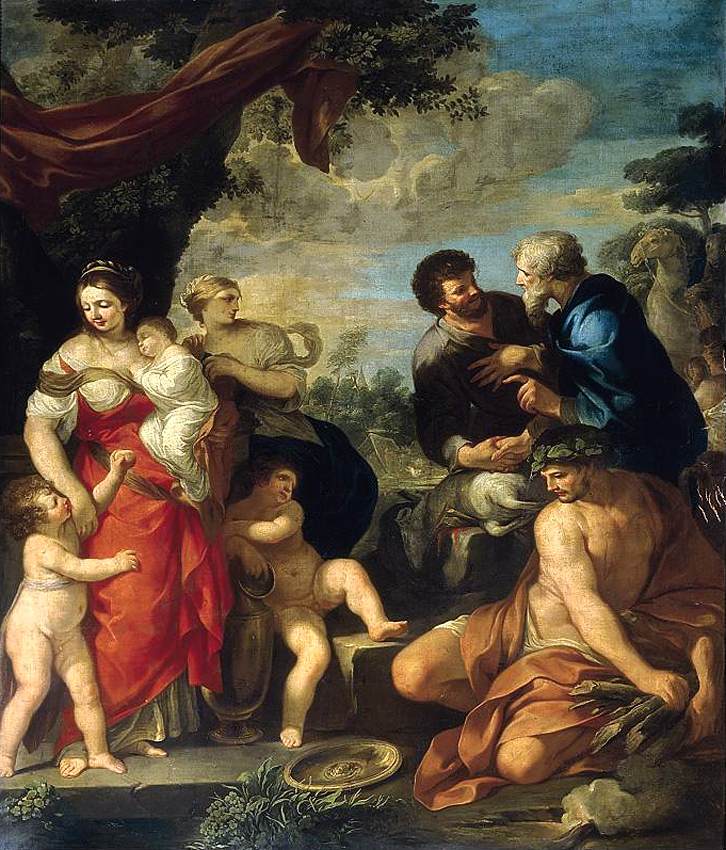
The pivot-point comes at an inauspicious moment, during the itself-inauspicious story of Jacob. If Jacob is considered much at all, it tends to be either for his vision of the ladder to heaven (28, 10-12) or his wrestling match with God (32, 22-32) – two scenes which seem incidental to the main thrust of his story. (The Ciro Ferri painting above does depict the moment I'll go on to describe, but fails to capture its signifcance.) Indeed, when we first read of him he seems a throwback even compared to the rest of Genesis. Born ‘smooth’, a classic trickster figure, he cheats his brother Esau out of his inheritance not even at the Lord’s instigation but at his mother’s. (Genesis 27) Fleering Esau, he then encounters Laban who proves much more his match.

But all changes when Jacob makes his agreement with Laban in Genesis 31/32, 43-2. (Which even Wikpedia’s summary refers to only as “a pact to preserve the peace between them.”) Up to now their relations have been highly ambiguous, alternating between a warm family relationship and trying to trick one another. It occurs to both that their common interest lies in suing for peace, but how can this agreement be kept when one is no longer in the other’s sight. Their answer is to build a cairn, which they call Witness or Watch-Tower.

“This cairn is witness and the pillar is witness: I for my part will not pass beyond this cairn to your side, and you for your part will not pass beyond this cairn and this pillar to my side and do an injury, otherwise the God of Abraham and the God of Nahor will judge between us.” (31, 51-53)

So far everything has been an action replay of an earlier oath sworn between Jacob’s father Isaac and Abimelech, in Genesis 26. But there his foes back off after recognising that the strength of the Lord is behind him. (“Swear that you will do us no harm, now that the Lord has blessed you.” 26, 29) Even with Jacob, ‘you stay your side, I stay mine’ is part of the resolution. But what about that second clause? Here God does not weigh in on one side, but acts as an arbiter over the affairs of men. (“May the Lord watch between you and me, when we are parted from each other’s sight.” 31, 49) He is specifically called upon to do what man cannot, act as an invisible omnipotent judge. You cannot cheat on your deal because you cannot hide yourself from him – no matter how thick the shrubbery. All this is invoked in the image of the cairn as a watchtower. After here the phrase “wicked in the Lord’s sight” will enter proceedings (for example 38, 7), and draw it’s meaning from this image.

It might even be possible to argue that it is not just the Spiritual God of the Old Testament who arrives fully here, perhaps the roots of the New Testament are being placed too. In the Old Testament, God is tribal – forever looking out for the interests of the Hebrews. In a book fixated with paternity he is not literally the All-Father, the patriarch who came even before Noah and Abraham, for he is specified as the creator of all there is (Hebrew and others alike). But the distinction between the two is fuzzy at best, and often entirely obscured. What he promises to Jacob during the vision of the ladder is typical:

“I am the Lord, the God of your father Abraham and the God of Isaac. The land on which you are lying I will give to you and your descendents. They shall be countless as the dust upon the earth, and you shall spread far and wide, to north and south, to east and west. All the families of the earth shall pray to be blessed as you and your descendants are blessed.” (28, 13-14)
(In other words: “I am the creator of all there is. But, out of all the world, I favour your tribe above all others. Because I say so.”)

He even warns Jacob to flee Laban, while warning Laban off harming him. Yet significantly it is Laban not Jacob who suggests the pact given above, while the Cairn of Witness is specifically named in both Hebrew and Aramaic. (31, 46) (Despite God “confounding” our language earlier in Genesis, references to actual language barriers are about as rare as in any fantasy novel – something which makes this detail stand out.) The fact that Laban is already established as much nearer Joseph’s match, in contrast to the gullible Esau, would seem to come into force here.

There’s perhaps a remorselessness to the logic. There’s a natural conceptual link between an insubstantial deity and an ominipotent one, and from there a universalised one. Unlike the rest of us, God is not trapped in one place at one time. So, as soon as God ceases to become a Tribal Father, as soon as it becones necessary for him to be invoked in bargains between the Hebrew and other races, the conception of him as the property of the Hebrews becomes eroded. He’s no longer the symbolic head of a warrior nation, whose neighbours are ‘others’, fodder for conquest or at best potential trespassers who need warning off. For they have now become potential trading partners, with whom we need concepts in common and mutually agreed sets of rules. Our relations with them are now by necessity ongoing.

Perhaps the root of this has already been laid. JM Roberts calls the Covenant between Hebrew and God (Genesis 15) “a master idea. Israel was assured that if it did something, then something desirable would follow.” Traditionally in myth, such covenants are made to be broken and lead to a Fall. (They ‘explain’ why we face death, disease and all the rest of it.) Of course this happens in the Pentateuch all the time. But it is not the only thing that happens, in Moses’ Exodus in particular punishment for the errant is often contrasted with reward for the devout. And once man’s relationship with God has become a contract, how long before that becomes the defining model in his relations with other men? The road would not be straight or even. But these are the first footfalls upon the path where he will become both omnipotent and universal – the God not of warring tribes but the great trading powers.

Postscript 1:
I’ve thrown up this theory without considering much how it sits with historical Bible study. In the widely recognised Documentary Hypothesis, researchers into Genesis usually distinguish between the two primary sources ‘J’ (for God-known-as-Jahweh) and ‘E’ (God-as-Elohim), with one of the signifiers whether God appears directly (‘J’) or via dreams and signs (‘E’). (Other sources, who were incorporated later and whose impact upon Genesis is more minor, need not concern us here.) In which case Jacob switches from a ‘J’ (trickster) to an ‘E’ (pact-maker.) (See this site for a breakdown which would confirm this.)

But the Documentary Hypothesis rests upon the two sources being stitched together as a pact in itself, between the then-separate Hebrew kingdoms of Israel (‘E’) and Judea (‘J’). Differences between the two sources, though as fundamental as the very name of God, are therefore glossed over. (This can even lead to formal redundancy. We get the story of creation twice, in Genesis 1 and 2, so neither group need miss out.) The aim was to smooth things over, not draw attention to the cracks and joins. But my argument rests upon a change which occurs within Jacob, an intentional juxtaposition, a new concept which is introduced in order to finalise a storyline. This isn’t something the Documentary Hypothesis conventionally allows.

PostScript 2:
It seems obvious that, in Britain at least, we now live in a post-Christian society. Of course people, groups and even Prime Ministers might choose to remain Christians, but we are no longer institutionally Christian. So perhaps it’s time we started taking that ‘post’ as something other than a synonym for ‘anti’. It’s like we’ve become locked in a debate where both sides see the Bible as an arms dump, which they rummage through for ammunition. (One context-free quote makes the whole thing sound a warlike cult, another all peace and love. As the saying goes ‘text without context is pretext’.) We need to start reading it as we would any other historical document, historically and holistically.

Christians might want to consider these two conceptions of God moralistically, which they are fully entitled to do. (Though frankly, it all sounds more like celestial CCTV to me.) But I tend to regard moralism as a means to avoid asking material questions, and so am more concerned with how things work historically. If man makes God in his image, it must surely follow that as society changes it will update him.

Wednesday, 15 April 2009

WATCHMEN (THE MOVIE)

Warning! Giant Squid-like Spoilers Descend Before the End of this Review!


So now even the last laggard has seen the Watchmen movie, and his eagerly awaited belated response is to agree with everybody else. Yes it’s true, the one Alan Moore comic we were all convinced would never be successfully made into a film, made by a director no-one really cared for (Zack Snyder), is actually surprisingly good. To call it ‘the best Alan Moore adaptation yet’ might sound like faint praise given it’s company. But suffice it to say it’s the first of these I have bothered to comment upon!

Perhaps we had cause for our cynicism. While From Hell systematically removed almost every element from the comic that made it singular, let alone memorable, V For Vendetta was made by fans of the comic - but this seeming advantage only served it slightly better. Unable to capture its nuances on the screen, they instead served up another slo-mo kung fu ballet. (Of the two, I was expecting the second for Watchmen.) So for many years our stance on a Watchmen film echoed Samuel Johnson’s to being told a violin part was difficult – “Sir, I wish it was impossible.”

It was even arguable the comic was particularly innoculated against filmability. As Alan Moore has so often said, the original “was designed to show off the things that comics could do that cinema and literature couldn't." It was as much detective story than superhero romp, which involved you spotting details about the murder enquiry (or the surrounding parallel world). Those details would then be combined and contrasted in ever-more-creative ways as the storyline moved along. But the juxtapositional page of a comic is not the same thing as the linear strip of a film. Surely, any attempt at adaption would be lose/lose.Try to capture that detail and it would just become bewildering eyeball agony. Try to prune it and you risk losing the essence...

In fact, Snyder not only gives us a whole slew of those references but even tosses a few more in! But mostly he succeeds by giving us the sense of a world teeming with clues. Each scene, each shot, is stuffed with incident until it becomes an impressionist blur. When Dan and Laurie do nothing more than meet for coffee there’s a world going on outside the window. Even at Ozymandias’ eyrie-like headquarters, we see a barrage balloon sail uncommented past the window. (Advertising Gunga Diner, if I remember?)

(Some have concerns this approach may make the film hard to follow for those who haven’t read the comic. But here I won’t try to second-guess someone else’s response. More interestingly, others have countered that DVD technology has changed the way we watch films to make our response more contemplative and hence responsive to this sort of approach. While there may be some truth to this, I believe it contains a basic misconception. We may re-watch films more often, but each instance of viewing experience isn’t formally altered. That’s like saying CD technology has liberated us from hearing symphonies in a linear way.)


Though loyal to his source, Snyder smartly knows when not to be scrupulous. The now-iconic comic opening may resemble a pull-back shot, but it would never actually work slotted into a film - it relies on a ‘time-dissonance’ between what we’re reading and what we’re seeing. Sometimes he slips up over this. When two characters are about to break into a remote base, Moore quotes Dylan’s line “two riders were approaching.” (Maintaining a motif where each chapter ends in such a quote.) It’s a little literal even for the comic, but when the song is actually played over the film it becomes clod-hoppingly ‘significant’ and tips the balance into plain naff. (In general, I’d agree with World OfAgwu that the soundtrack frequently mars the film. The term ‘song placement’ really sums it up, those songs are used as crass triggers in a way you’d expect from an advert.) But such moments are more exception than rule.

True, at times we do get just the same slo-mo kung fu ballets as the V film. Such moments now seem so ubiquitous in Hollywood they’d probably stick them in a Tolstoy adaptation. And there’s other points where gonzo ‘movie dumb’ strikes. (The smartest man in the world getting his computer password from a book left out on his desk.) It’s ironic that both films ironically have ‘comic booky’ moments which aren’t actually in the originals at all. But the trouble with them in V is that they break the tone, and stop us feeling we’re watching a psychological mystery. There are times they do the same here. It’s important, for example, that the Comedian didn’t die because he lost a fight, we need to feel we’re in a world where his death was inevitable as soon as it was determined. The characters are following the developments of the ‘plot’ as much as we readers are. Hence the comic starts with his death, and flashes back only for brief fait-accompli snapshots of the fight.

For all that the comic itself is much more genre-based than some fans like to imagine, elevating it in order to cut a stick to whack the film. Snyder might amplify the fight scenes up to 11, but rarely does he invent them. In fact the process sometimes works better the other way round. The comic was simultaneously suspicious of vigilante-glam and seduced by it, an attack on superhero comics and a celebration of them - a piece of double-think most evident in Rorschach. He calls his mask his ‘face’ and reacts pathologically to it being removed, as if his very identity was violated. Yet once in prison he’s somehow able not only to keep up his ‘cool psycho’ shtick, but even survives revenge attacks against overwhelming odds. He then obsessively struggles to get it back like a man who’s been fighting for oxygen all this while. Rorschach is simultaneously sad outsider and elevated loner, something the film (perhaps unwittingly) emphasises.

Against quite overwhelming odds himself, Snyder even does a reasonably good job of cutting the tangle of plot threads down to a more manageable size. Rather than missing the death of the first Night Owl, I found I’d forgotten all about this until I read about it’s removal on the net. However his general rule is to condense rather than excise. The first Night Owl appears, for example, even if he doesn’t get his death scene. This can lead to an odd tendency to include scenes, but remove their clincher. Snyder may have been trying to adhere to the ‘show not tell’ rule here, and its true expository dialogue shows up more when spoken rather than written. Hence, contrary to Only The Cinema, I’d be willing to defend the exclusion of some dialogue from Dan and Laurie’s make-out scene because I feel it’s point is implicit enough – particularly in their response to an earlier fight scene. (Though of course I’d already ‘heard’ the dialogue from reading the comic.) But the refusal to supply us with the pay-off line between Rorschach and the Psychiatrist looks to me more eccentric, especially when a) a non-comic confrontation seems devised to set it up, and b) it seems to me almost the key to the whole comic. (If you haven’t read it yet, I shan’t spoil it here!)

NB Just in case you missed the WARNING above, from here we get PLOT SPOILERS relating to the ending...

But perhaps Snyder’s most audacious change is over the ending. For us comic readers, this had a powerful yet most likely unintentional effect. After over two hours of almost total faithfulness to the original, we’re suddenly thrown a curve ball; just as the film seems to be closing down, all bets are suddenly off... Snyder even puts in a cheeky in-joke on the original ending, with a reference to the old SF TV show The Outer Limits. (The original bore a resemblance to one of its episodes, though Moore stresses coincidence.)

Unlike earlier (thankfully aborted) drafts, the ending does not attempt to graft on anything feelgood. In fact in some ways its similar to the way Blade Runner amended the ending to Dick’s novel, both made for something more sensical and more satisfying. In the original, Ozymandias fakes an alien invasion (with a genuinely devastated New York) to bring the warring Cold War sides together – a sacrifice of millions intended to save further billions. The film keeps this Cold War scenario (it’s setting is very much alt-Eighties), but has Dr. Manhattan set up for the crime. This takes away much of the deus-est-machina sense of the original, where aliens (even fake ones) suddenly sort of arrive, and has an added weight when he even persuades Manhattan to go along with the deception.

Even at the time, the original ending had been controversial, and attacked for dramatic reasons in some quarters. (See for example Tony Keen’s comments.) But two quotes from Wikipedia might suggest why this particular ending was introduced now...

"[Watchmen] was considered too dark, too complex, too 'smart'. But the world has changed [after the September 11 attacks]. I think that the new global climate has finally caught up with the vision that Alan Moore had in 1986. It is the perfect time to make this movie."
—screenwriter David Hayter, in October 2001

“If you update this and make it about the war on terror, you're now asking me to make a comment of how I feel about the war on terror. This way, it's up to you how you decide to feel about it."
—Zack Snyder

Hayter is of course right that the September 11th attacks put armageddon back on the agenda, and ended post-modernist speculation that we had reached ‘the end of history’. Yet the quote from Snyder is simultaneously more disingenuous and more telling – for the film’s ending explicitly connects the Cold War and the War On Terror. The parallels to Adam Curtis’ Power Of Nightmares documentary are striking, with its references to Leo Strauss’ doctrine of ‘noble lies and deadly truths’. Ozymandias is rewritten as an almost stereotypical neo-con, a former liberal turned corporate head - now convinced the people need a phantom enemy to keep them united, and the money and (apparant) smarts to bring that about.

However, there are two big problems with this new denouement - one dramatic upon the back of another political. Preferring, as we’ve seen, to condense than excise Snyder has given us the collection of characters who gather around a streetcorner news-stand - but so briefly he is more quoting them than incorporating. Though we see the consequent devastation, without knowing these characters it becomes contextless and mere movie spectacle. As Thoughts On Stuff point out: “The absence of the peripheral supporting cast basically kills the emotional impact of the ending... The moral conundrum is entirely intellectual.” (It’s rumoured more scenes were filmed and will appear on the director’s cut. If so, it’ll be interesting to see how that changes things.)

And consequently, one big advantage of Moore’s original ending is lost. Moore paints Ozymandias’ plot as at best highly ambiguous, is it necessary evil or megalomaniac delusion ultimately fated to fail? Snyder’s version stacks the deck, pushing it towards the ‘peace in our time’ reading at the very same time that he codes Ozymandias more clearly as a villain. In both versions Ozymandias claims to feel the weight of what he has done. In one version we believe him, for we feel that weight insufficiently ourselves. Manhattan’s quite vital parting line to him (“nothing ever ends”), surely vying with the Psychiatrist’s missing line as the keystone to the whole thing, is also inexplicably absent. (Though Laurie quotes it as something he would say, the effect is muted into ineffectuability.) Particularly at a time when the neo-con ‘project’ has crashed disastrously, it’s doubtful that this was Snyder’s intention. But it is what happens on the screen – New York ends with a bang but not a whimper.

Interestingly, and as argued previously, Nolan’s recent Dark Knight tackled similar themes of ‘noble lies’ and similarly got tangled up in them. Legend has it Strauss got the concept from the black-and-white world of genre fiction, particularly the TV Western Gunsmoke. Does this suggest genre fiction is inherently tainted by these limitations, and so an ineffective medium to use in critiquing Strauss’ cronies? Or is the problem more specific to the Hollywood process? It would be interesting to compare the two films, both named after the key ‘mature superhero’ comics of the Eighties, in more detail...

For those who don’t have the time for a two-and-a-half hour film...

Wednesday, 8 April 2009

ANOTHER YEAR, ANOTHER WEB & MINI COMICS HAUL


As part of a longstanding annual ritual, now in it’s second successful year, I’m mini-reviewing some of the comics I picked up at this year’s Web & Mini Comics Thing. Please note that this list offers no pretensions to completeness or even comprehensibility, that the management’s decision is final and that cash alternatives are not offered.

Those wanting to read Part Two of ‘On Toppling Towers’ (aka ‘How Do I Tie All This Stuff Up Anyway?’) probably exist only in my imagination, but it will appear at some point or other.


4TH 4TH BRIDGE & 2 STORIES (BACK TO THE FUTURE 2 & THE ENTERTAINER AND THE STUDENT AND THE MAN WITH A PURPLE FACE) by Malcy Duff

Though Malcy Duff is certainly one of my favourite British small press creators, please don’t expect anything smart or clever to be spelt out here. For most of the time, I’m in sheer dumbstruck awe about just what he’s up to most of the time – all I can tell you is that I like it! One of the few things I could suggest is that Duff uses the comics page the way surrealist directors such as Bunel or Dulac used the medium of film – with a seizing of the form that involves complete disregard for the medium’s conventions. Duff’s layouts in particular are audacious, frequently setting up a series of almost-static shots with excruciatingly slow progression, then suddenly throwing in an unexpected juxtaposition. A double spread of 4th 4th Bridge shows a sequence of shallow landscape panels of the eponymous bridge in various states of paintedness, a tiny tiny figure scuttling back and forth across it to keep that paint a-flowin’. As the existential tedium of such a task seeps into your brain, you flip the page to find the following spread has just two words – “etc. etc.” Repeat until dead.

His fixation upon form, and consequent almost total lack of interest in words, leads to a minimalism that’s almost abstract. Characters are distilled into a few key motifs, objects frequently reduced into the simplest of symbols, or (when even that starts to feel too illustrational) mere boxes with the object’s name stuffed in them. Frequently a single panel would be meaningless if held isolation, you need the narrative context to make the simplest sort of sense from the codes.

Simultaneously, Duff has a loose and rubbery approach to cartooning that counterbalances the often-sinister tone. There’s a restless playfulness, even a sense of Vaudeville, about his comics which always prevents them becoming some academic ‘avant-garde’ exercise. An earlier release was even called ‘The Banana Skin Joke’! The purchases above perhaps don’t quite rival my favourite ever Duff comic, The Blackest Gnome, but they’re splendid stuff all the same. As Homer Simpson liked to say, can’t get enough of that Duff!

(Disclaimer: I was hoping to meet Duff at the event, but in fact failed to! He left early, presumably returning to Scotland the same day. Which makes the second time I’ve missed him, since I failed to catch his band at the recent Colour Out Of Space festival. (Blogged about here.)The comics reviewed here actually came from Gosh, but they were on sale at the Web & Mini so it’s not too much of a cheat!)

You can also read one of Duff’s strips on the Top Shelf site, or an older onevia Bugpowder

THE CATTLE RAID OF COOLEY No. 1 by Patrick Brown


This one I can honestly say I’ve been waiting for! Like those young people are wont to, Patrick Brown has been serialising this comic online, but us geriatric old-schoolers prefer sit it out until we get the feel of paper in our hands instead of scrollbars. (And decent chunks of episodes over bite-size snippets.)

Brown seemed to wince when I mentioned his earlier comic A Virtual Cricle (all the way from ’94!), as if he saw it as mere juvenalia. I would still rate it, but I also believe Brown has now found his niche and simultaneously hit his stride with this adaption of an old Ulster myth.

One of Brown’s main intentions seems to be authenticity, with one common section excised because he believes it to be mere retconning. In footnotes he mentions his endeavours to get the details (settlements, chariots etc) as accurate as possible. However, this is perhaps mostly achieved in his art style which avoids all the fantasy art clichés. (There is not, I am glad to report, a single Celtic knot in sight while the sole featured Druid looks not one whit like Getafix.) Instead his drawing style is sketchily naturalistic, with Brown particularly excelling at the nature scenes themselves. It also gives the story a sense of versimilitude, like everything is happening in the moment, against the all-too-standard pontificating poses of the Frazetta clones. (Check out his account of his drawing method – you won’t believe it!)

The supernatural moments, when they arrive, are therefore presented completely straightfaced. We’re used to modern horror fantasy where the supernatural arrives to disrupt normality. Yet such legends are more similar to magical realism, where to its characters the supernatural merely occupies a world adjacent to ours, like a neighbouring country whose inhabitants sometimes drop by. A cart arrives pulled by a skeleton crew of horses, but no-one so much as comments on this. When a character’s revealed to be a shape-shifter, the actual transformation occurs off-panel – we merely see the before and after pictures.

The only fault I could find with this comic is some of the dialogue. Brown adopts the Shakesperian trick of giving the chiefs more formalised speech while the commoners talk colloquially. While I doubt that to be historically accurate for the Iron Age, it serves a dramatic purpose and avoids the dreaded faux-poeticism of fantasy writing. Yet he gives his commoners far too modern expressions – “hold on a minute”, “big style” and even at one point “that was mental!” (I also got a little on my high horse over “yeah”, a corruption of the Germanic “jah” which would never have sprung from a Celtic throat.) For a series otherwise so insistent on authenticity, I found these moments could throw you out of the story.

But for all that, this could be a major new series which Brown certainly seems highly committed to. I now also intend to check out the ‘pre-quel’ Ness.

THE RULE OF DEATH (No’s 1 + 2) by Daniel Merlin Goodbrey & Douglas Noble


”Pete Colby doesn't want to die. So he doesn't. And that's where the problems begin.”

Daniel Merlin Goodbrey, I can attest to be splendid both as a convention panellist and bar-table raconteur, with an endlessly inventive mind only matched by an unabayed enthusiasm. Whisper it, then, but I have at times been a little lukewarm about some of his actual comics. They can read like the only thing that made it to the page was his inventive mind, like they’re mere diagrams of his ideas masquerading as storylines.

But this series, a collaboration with the ever-excellent Douglas Noble, is involving enough a read to bat away all such reservations. The conceit is that Pete Colby has returned from the dead, but rather than embark on any zombie rampage his mission is simply to take up where he left off. (“I’ve given it some thought. I don’t want to die.”) The story’s told at a suitably languid and unhurried pace, with some sharp black-tongued dialogue. (“Joseph, go fetch Doc Jackson,” Colby asks dryly. “Tell him I’m going to be wanting a second opinion.”) The Wild West setting pitches everything at just the right point, instead of the standard Western borderline between the wild and the civilised we’re placed on the shifting point between science and superstition. (Though the town name, Bethany, is almost Biblical.) Similarly, the comic’s tone balances the blackly comic with the darkly macabre.

As I’d previously regarded Noble as a writer who merely happens to draw (see my review of his Strip For Me here), I’m surprised how well his artwork works on this. This is mostly down to his layouts and storytelling, his main source of strength, though he also serves up some deft characterisations. Colby is mostly shown in silhouette or semi-shade, more echo of man than ghoul.

Two issues in, I find the theme to be social ostracisation. Colby’s shack is placed outside of town before the story even begins and his troubles really start when he tries to venture there. The emphasis on his not needing sustenance stands for his defiance against his non-person status; if he’s treated like a dead man then dammit he’ll be one - merely one that doesn’t obligingly lie down. (However, the ending of No. 2 may suggest new directions emerging.)

For some reason I didn’t avail myself of the following two issues, despite their being on the stall. And those who don’t mind reading comics on-line can follow the weekly updates (for free and in colour) at Serializer.

TOZO THE PUBLIC SERVANT No. 2 by David O’Connell


In this new full-colour fantasy series, you can’t help but first be struck by this series by David O’Connell’s Herge-influenced art. Though interestingly O’Connell says on his website he considers Moebius more of an influence, he even duplicates some of Herge’s eccentricities (such as having characters walk upon the panel’s baseline). A classic of the less-is-more axiom, Herge’s simple-looking ‘clear line’ style is actually a tough trick to pull off – it denies you the chance to cover up any deficiencies in design or drawing and forces you to get everything exactly right. Though I might quibble over the flatness of one or two of the faces, mostly O’Connell is able to pull this style off very well, and it will doubtless turn into a selling-point for his series.

O’Connell’s storyline, however, owes little to either Herge or Moebius. Instead, it’s a palatial intrigue/ detective storyline, too involved for Herge, too sensical for Moebius. This is generally the sort of thing I advise against people starting off with! Alan Moore has often said he was only able to achieve his mega-multi-issue storylines by starting out with four-page minis and working up, yet O’Connell has plunged in straight away with his magnum opus. So it’s with a mixture of envy and frustration that I admit O’Connell manages to pull this off as well! However I still maintain this comic should go out with a Man From Atlantis-style warning – don’t try to swim like it yourself!

O’Connell’s approach to storytelling is perhaps epitomised by his approach to panel composition, focusing on foreground events while suggesting enough clues and murky goings-on round the edges to keep us reading. We’re neither swamped by the background detail, nor ever allowed to forget it. Tap his world and it feels substantiated, yet step back from it and your eyes don’t wash over with bewilderment. If O’Connell manages to keep delivering on the promise of these two issues this will be something to get in on the ground floor for.

(This interview gives a good insight into O’Connell’s mindset and working methods.)

AIRSHIP by Sarah McIntyre & David O’Connell

I was concerned my report on last year’s Web & Mini Comics haul might have given the impression that everything in the scene fell under the heading ‘slight but charming’. This year I’m worried about the opposite, making everything look loftily ambitious and collection-ready. So I’m pleased to report this jam between O’Connell and Sarah McIntyre (creator of ’Vern and Lettuce’ for the late lamented DFC comic) not only wears its ‘slight but charming’ status on its sleeve, it probably wouldn’t work in anything other than small press format. That hand-stitched cover is like a badge of intent!

O’Connell and McIntyre take it in turns to jam a daft story about an airship which kept appearing over London. It was a real sighting, and at first the story could be a documentary account – yet as it carries on, it introduces and then joyfully piles bizarreness upon bizarreness! That said though, one of my favourite pages is an early one – where the shadow of the airship gradually fills up McIntyre’s flat.

You can read the whole thing online, but in addition to my usual warnings note you need to read the tiers from bottom up!

BROWNER KNOWLE no. 3 by Paul Ashley Brown


Let’s start with an admission. These are clearly sketchbook pages masquerading as a comic (even if there’s some run-on between the pictures), and frankly the least interesting element is the text Paul Ashley Brown adds to his drawings to obscure this fact. But the comic’s a must-buy because they’re such good sketchbook drawings. There’s something about his discursive, free-flowing line which might get lost in the transition to finished composition, they have a faint air of flux to them which helps the characters come alive.

Perhaps the highlight for me is the double-spread drunken crowd scene, which reminds me of no less a talent than George Grosz! There’s the same weird mixture of misanthropy and humanism, every figure is grotesque and yet so realised, so individualised, they never look like a pawn pressed into service of a point but a person. These characters don’t need the little storylines Ashley Brown pins them to, each one tells a thousand better stories by the power of suggestion.

(Just when you thought the days of sending self-addressed envelopes were done and gone, it looks like there’s no on-line way to order this! In fact, such is the web quietude that even the illo above is from issue 1 – ah well, it’s all good stuff! Send £4 to Paul Ashley Brown, 15 Wedmore Vale, Bedminster, Bristol, BS3 5HQ, Bristol, England...but presumably more for P&P if you’re not in the UK!)

...there was plenty more good stuff out there but outta time and energy! See you at the next one...

Sunday, 15 March 2009

ON TOPPLING TOWERS

A polemic disguised as a review of the recent ‘Babylon: Myth and Reality’ exhibition at the British Museum


When they say ‘Myth and Reality’, they mean things in that order. This recent exhibition is bookended by others’ views of Babylon, with the actual historical evidence the jam in the sandwich. But what follows shan’t dwell on the difference twixt those two, which was covered well enough by the show itself, but instead delve into those popular conceptions in order to probe their workings.


Right up to the Nineteenth Century Babylon was only known indirectly, and mostly through the eyes of its Hebrew enemies. As the Bible held a totemic influence in Western thought, Babylon couldn’t help but become a bogey in our minds. Yet the Greeks also knew of, and wrote about, the place without having any axe to grind, even owning up to what they owed their predecessors. Besides, Jewish antipathy alone merely gives us the opportunity to paint Babylon black, not in itself the motive. Moreover, as we’ll see, popular images may have been based on the Bible, but were not confined to it, and would often add their own motifs and embellishments.


I’m going to go on to argue here that Babylon is central to a number of interlocking myths which maintain a through-line down the centuries, and which we still hold in some ways today. Moreover, these myths are used to articulate something we feel about the nature of civilization itself.


Of course (Hanging Gardens notwithstanding) the most popular image of Babylon is the Tower of Babel and this is the very thing which occupies those bookends – starting with a blow-up of Breugel’s painting, then moving to more modern depictions. Even the exhibition’s logo alludes to this, incorporating the outline of a ziggurat inside the A. And, unlike the Hanging Gardens, it seems the Tower legends did have a base in Babylonian reality. Herodotus and other historical accounts describe the giant ziggurat Etemakani (“the foundation platform of heaven and earth"), built as a single point for all around to look up to. Though no part of this building remains, we can locate it (and even know it’s size) through mapping its foundations. There’s even a scale model of it on show, presumably extrapolating from what we knew of similar buildings.


“Artists”, we’re told, “developed strong conventions for the Tower’s appearance”. While of course they’re selecting examples to suit their argument, their case does seem to be borne out. Take for example Escher’s woodcut Tower of Babel (1928). While this looks little like the squat model of Etemakani, it’s remarkably congruent with the Bible accounts. Though it appears to be built from stone, not the bricks specified in Genesis, it’s appropriately geometric in appearance. Moreover the crest of the Tower is looked down upon, an impossible angle for any human which suggests God’s perspective. God is not just the only named character in the Genesis passage, there’s even the suggestion he one day comes across the Tower. (“Then the Lord came down to see the city and tower which mortal men had built.” His omnipotence is actually quite sketchy in Genesis, with him frequently taken by surprise by things.)


But most important of all, there is no mighty smiting to behold. The Tower merely lies unfinished, the workers confused, the topmost figure throwing up his arms. For in Genesis God’s response is to ‘”confound their language, that they may not understand one another's speech”, thereby making any more co-ordinated building effort impossible. Hence we get both ‘Babylon’ and ‘babble’ from the Hebrew word ‘balal’, to confuse or confound. (Escher characterised some of his befuddled workers black and some white, to signify this division.) We’re told “from that place the Lord scattered men all over the face of the earth”, though the inference is this is the result of the loss of a common tongue, not the likes of a mighty wind. Escher’s etching could therefore be of the moment in Genesis where God spies the Tower and, in a mixture of outrage and alarm, sabotages its builders by tying their tongues.


Yet Escher’s Bible-based depiction is in many ways the exception to the rule on display here. Let’s look at some of the features which were characteristic enough to become traditional, without any scriptural derivation, then speculate (no more) on their basis.


The first thing to go is the square, geometric look, an inherent feature of a ziggurat. Having nothing much to go on with Babylonian architecture, artists based it instead on the round Colosseum. (Rome was not just depicted in the Bible as equally oppressive and decadent, but the Colosseum was seen as the ostensible centre of Christian persecution.) Of course this is just substituting a model which did exist for one which then didn’t. But there’s also points of departure from the Colosseum, and it’s with these that things get more interesting...


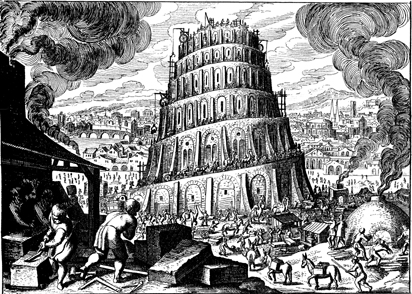
Unlike the Colosseum, the Tower not just starts to taper but becomes segmented, bisected at intervals by a narrow path like a screw thread. (As shown in Durer’s 1865 engraving above.) Let’s remember how early this passage comes in Genesis, these are intended as among the first people. With this motif the Tower comes to stand for a new conception of time, which arrives through the cultivation of surpluses which allowed for urban life. Linear time arrives, in which life is no longer a continuum or daily scrabble but we become consciously aware of our own past and future. The upper levels, always depicted as incomplete, stand for the more nebulous future. (Indeed Babylon had an eye on its own posterity, inscribing names into bricks and even burying clay barrels like Blue Peter time capsules.) The image of the Hanging Gardens also reflects this, suspending nature, displacing it to the sky.


However, as we’ll find happens often, this image may have antecedents in other parts of the Bible. For one thing, this curved and tapered tower contrasts with the squarer and squatter Jerusalem Temple. There is also Babylonian King Nebuchadnezzar’s dream of a statue in Daniel, divided into sections which stand for different periods of rule. The only difference here is that the image is the other way up, though representing the future it is the statue’s feet which are weak and unstable. Though the term ‘feet of clay’ has now become commonplace, this part-obscures the original meaning. The statue’s feet were weak because they were an amalgam, “part potter’s clay and part iron... so shall men mix with each other by intermarriage, but such alliances shall not be stable; iron does not mix with clay.” Like the apex of the Tower, they represent the impermanence of alliances between men.


It could also be argued that the successive levels also stand for calculation or accountancy, again something which would have grown in importance with the growth of urban life. This is enhanced by the way all the images portray the Tower as under construction, and so display the mechanisms of measurement as well as construction. (See the anonymous Bible illustration above, from Thirteenth Century Germany.) This is again echoed in Daniel. Consider the terminology used in the Writing On the Wall: “God has numbered the days of your kingdom and brought it to an end. You have been weighed in the balance and found wanting.” The very methods man was using to measure the world, to divide it up as it suited him, are now used by God upon man.


And of course the pyramid shape, with successful smaller levels, stands for the emergence of human hierarchy. This leads to a notable change. The Bible accounts mention no despot, name no King and it’s even emphasised the Tower is built by collective effort. (‘”Come’, they said, ‘let us build ourselves a city and a tower with its top in the heavens, and make a name for ourselves.’”) But the paintings commonly not only give the story a villain (normally Nimrod), but push him into the foreground. (See the anonymous French woodcut above, from 1670.)


With its fixation with lineage, the Bible seems inherently distrustful of cities. The first city is built by Cain, while Lot’s wife gets turned into a pillar of salt for just looking at one! But their problem seems to be their status as centres of teeming life, which tends to lead to mobs, loss of self-identity and makes them centres of collective sin. (“Abram settled in the land of Canaan; but Lot settled among the cities of the Plain and pitched his tents near Sodom. Now the men of Sodom were wicked, great sinners against the Lord.”) Perhaps, more used to city life, we throw the emphasis onto a conjured-up wicked despot.


But most striking of all, the Tower starts to topple (as seen spectacularly in Cornelis Anthonisz’s 1547 image above) Sometimes the surrounding city is shown on fire. (Already conflated by God looking upon “the city and tower.”) As with all the examples given above, exceptions can be found to this rule. Breughel the Elder makes his Tower an architectural folly, an impossible hodepodge of styles and angles, the physical embodiment of a failed attempt to speak Franglais. But there’s enough adherents to call it a rule.


It’s also notable how similar the image then becomes to the harshest card in the Tarot deck, the Tower. In fact, early versions of the Tarot (as shown below) can show a nude man and woman fleeing the door of a burning building, tying the image to the Bibles’ other great Fall myth - the expulsion from Eden. (Though of course we don’t have to assume the direct influence of one on the other. It could be the two images arose separately and later became conflated.)


Once we have the struck Tower, we also get the accompanying motif of attendant figures fleeing. These figures seem suddenly stripped of their hubris, reduced from architects and engineers to a terrified speechless horde. Again this is reflected in Daniel, with its tale of Nebuchadnezzer reduced by God to a bestial state: “He was banished from the society of men and ate grass like oxen; his body was drenched by the dew of heaven, until his hair grew long like goat’s hair and his nails like eagles’ talons.” (As shown in Blake’s 1805 print below.) It is hard not to associate the look of these hunched, fleeing figures with the description given above.


More Tower art for your perusal here