googlee7ea825f63edb3f6.html

Saturday, 23 May 2009

JUNE TABOR LIVE

Brighton Corn Exchange, 20th May


I have to admit being initially befuddled by the programme notes, and their mention of the 1651 album Cast A Bell. I mean, I know Tabor’s been singing folk a while now – but surely not that long! It turns out 1651 is the name of her current backing band in their own right. But like many misreadings, perhaps my mistake was telling. Throughout her career, Tabor largely eschewed the ‘electric folk’ fusion favoured by so many of her Sixties contemporaries for something more traditionalist. 1651, for example, consist of an all-acoustic accordian, double bass and alternately a piano or violin. Those there only to shout “Judas!” must be sorely disappointed.

Of course the retro approach often feels like a fool’s errand. You feel some try so hard to preserve folk music they stick it behind glass, put it where it’s unable to breathe. But Tabor thankfully avoids the traps of reverentialism. Like a compass driven through the pages of a book, she seems able to transcend the divisions of time or chronology. She speaks of an acquaintance coming across an old ballad, and enthusing it may have been as early as Napoleonic – only to find it to be Norman. At the same time she’s quite willing to sing contemporary songs, even closing the night with Save The Last Dance For Me.

There’s more to it, however, than simply choice of material. In an unusually perceptive mood, Wikipedia commented “June tends to be adventurous in a way that avoids modernism.” It might be illuminating to compare her to Sandy Denny, the other great contender for great British female folk singer, against whose voice Tabor’s is as different as night from day. On Fairport’s Come All Ye, for example, Denny throws herself into the song; warm, effusive, unreserved. The opening number here, though also about a Saturday night dance, is stately rather than stomping, reflective rather than euphoric.

Perhaps the secret of Tabor’s success is in combining folk with the chanteuse tradition, and finding it a closer fit than might be supposed. Like Lotte Lenya you sense not emotion expressed so much as held back, creeping through the cracks like light around a closed door. This sense of seeing only the emotion’s shadow paradoxically makes its expression all the more powerful – as if you saw the full light you’d be blinded. What you glean of Tabor’s personality from the gig would seem to confirm this, a combination of doomed romanticism with no-nonsense Northern-ness.

Tabor also excels in finding subject matter to suit her voice. While everyone thinks of folk as something communitarian, her tastes are much more solitary; with stark black ballads her stock-in-trade. (She didn’t even join in the closing singalong to the Daughters of Albion night at last year’s Festival.) The fact that she seems tapped into an almost limitless supply of such songs, both traditional and contemporary, suggests such perceptions of folk, however widespread, may be no more than stereotypes. People in times past may have liked to cut a rug, but their worldview also included a fatalism that we tend to overlook.

1651 (the band, not the year) gave her a suitably sparse backing, allowing her voice the space to linger. In the evening’s undoubted highlight, a medley of gypsy songs, there were points when they were hardly playing at all. As ever, a true artist will recognise when the best thing to do is nothing.

Perhaps the evening’s only flaw was Tabor falling into the folk habit of talking too much between (or even during) songs. Some kind of context and explanation is of course desirable, especially for the songs sung in foreign languages. But you also wondered at points if she was trying to counter the often sombre tone of her music with some more uplifting chat, something about it felt compensatory. There’s a point where the songs really have to be left to speak for themselves.

I suspect this in-concert film (recent but with a larger backing band and different set-list) might not be on YouTube long, so if the screen below is blank you’ve already missed it. If it’s still there, however, note there are also further instalments.

Sunday, 17 May 2009

BEING WICKED IN THE LORD’S SIGHT

TWO GODS IN THE BOOK OF GENESIS?

God is here and there and everywhere
And his eyes, his eyes are watching you
- Junior Byles

It’s been a while since we had a Bible Study Class around here. So let’s get this story straight from the start...

“In the beginning God created the heaven and the earth. And the earth was without form and void... and the Spirit of God moved on the face of the waters.” (Genesis 1, 1-3)

We all got that? In Genesis, God pre-exists form and substance, a pretty strong hint that what we’re talking about here is an insubstantial deity. The reference to “the Spirit of God” could of course mean God sends out his Spirit, not necessarily that he is one, but it still creates an association. Looking back at the Old Testament through the prism of the New (or for that matter all those old school assemblies), this is the sort of God we expect to encounter by opening the Bible.

Except of course for that other famous line from Genesis, so good they tell us twice; “God created man in his own image; in the image of God he created him.” (Genesis 1, 27-28) A pedant might wonder, if man (a creature of form) is in God’s image how can God precede form? Perhaps by ‘image’ something less literal is meant, ‘God created something unlike the birds, something more akin to himself, complete with consciousness and free will’. Perhaps its that we’re supposed to be born with immortal souls.But from there things get slipperier...

“The man and his wife heard the sound of The Lord God walking in the garden... and hid from the Lord God among the trees of the garden. But the Lord God called to the man and said to him, ‘Where are you?’” (Genesis 3, 8-10)

Excuse me, walking in the garden? Unable to see someone because they’re hiding behind a tree? Has our all-knowing deity somehow become a Park Keeper, who can be avoiding by expediently ducking into the shrubbery? In fact the story of man’s disobedience relies upon God not being an omnipotent spirit. During creation, God knows exactly what he is doing – he says what he will make and then he makes it. (A theologian would probably insist his words cause it to be made, but the effect is the same.) But if God has foreknowledge of man’s disobedience, or (more strongly still) if he in any way makes man in order for him to disobey, things change quite fundamentally. If grabbing the apple isn’t a cosmic accident, if it stops being man’s fault but becomes God’s wish, the very point of the story of the Fall collapses. Whether God goes form Sunday strolls or not, here he needs to lack omnipotence. So are we talking about two separate conceptions of God, sandwiched between one set of covers? And, assuming the Good Book ain’t big enough for the both of them, when does the God-of-Spirit finally expel the anthropomorphised big guy?


The short answers are ‘yes’ and ‘awhile’. In fact the Spiritual Father all but vanishes for a good chunk of Genesis. In the Babel story for example, “the Lord came down to see the city and tower which mortal men had built” (11, 5-6) There’s also Genesis 18, where Abraham pleads to God for Sodom. Of course God may merely be taking on physical form to appear to Abraham. (He appears, after all, as a stranger). But he is not only characterised, at times we’re even told what he’s thinking! (17-18) As Abraham presses his case for the circumstances in which Sodom might be saved, the implication is that he is not teasing out God’s intention so much as plea-bargaining with him. God here is not all-knowing and inscrutable, but subject to being swayed by oratory. Here he has been made in man’s image, he weighs up options just as we would. (None of which makes any practical difference. The angels merely let Abraham’s in-laws go before smiting the rest of Sodom, rendering the whole argument redundant. But it still signifies a perception of God.)


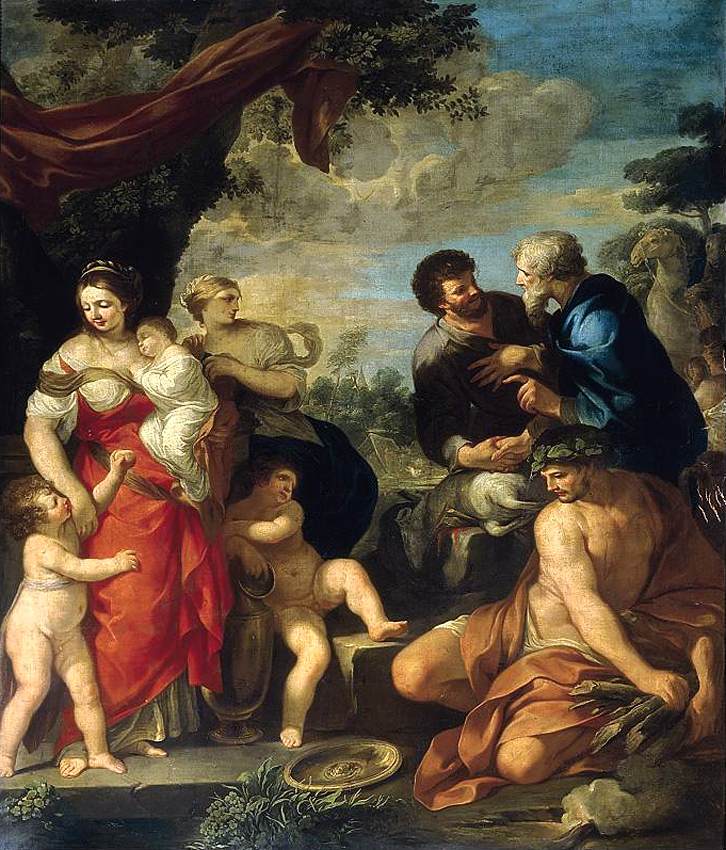
The pivot-point comes at an inauspicious moment, during the itself-inauspicious story of Jacob. If Jacob is considered much at all, it tends to be either for his vision of the ladder to heaven (28, 10-12) or his wrestling match with God (32, 22-32) – two scenes which seem incidental to the main thrust of his story. (The Ciro Ferri painting above does depict the moment I'll go on to describe, but fails to capture its signifcance.) Indeed, when we first read of him he seems a throwback even compared to the rest of Genesis. Born ‘smooth’, a classic trickster figure, he cheats his brother Esau out of his inheritance not even at the Lord’s instigation but at his mother’s. (Genesis 27) Fleering Esau, he then encounters Laban who proves much more his match.

But all changes when Jacob makes his agreement with Laban in Genesis 31/32, 43-2. (Which even Wikpedia’s summary refers to only as “a pact to preserve the peace between them.”) Up to now their relations have been highly ambiguous, alternating between a warm family relationship and trying to trick one another. It occurs to both that their common interest lies in suing for peace, but how can this agreement be kept when one is no longer in the other’s sight. Their answer is to build a cairn, which they call Witness or Watch-Tower.

“This cairn is witness and the pillar is witness: I for my part will not pass beyond this cairn to your side, and you for your part will not pass beyond this cairn and this pillar to my side and do an injury, otherwise the God of Abraham and the God of Nahor will judge between us.” (31, 51-53)

So far everything has been an action replay of an earlier oath sworn between Jacob’s father Isaac and Abimelech, in Genesis 26. But there his foes back off after recognising that the strength of the Lord is behind him. (“Swear that you will do us no harm, now that the Lord has blessed you.” 26, 29) Even with Jacob, ‘you stay your side, I stay mine’ is part of the resolution. But what about that second clause? Here God does not weigh in on one side, but acts as an arbiter over the affairs of men. (“May the Lord watch between you and me, when we are parted from each other’s sight.” 31, 49) He is specifically called upon to do what man cannot, act as an invisible omnipotent judge. You cannot cheat on your deal because you cannot hide yourself from him – no matter how thick the shrubbery. All this is invoked in the image of the cairn as a watchtower. After here the phrase “wicked in the Lord’s sight” will enter proceedings (for example 38, 7), and draw it’s meaning from this image.

It might even be possible to argue that it is not just the Spiritual God of the Old Testament who arrives fully here, perhaps the roots of the New Testament are being placed too. In the Old Testament, God is tribal – forever looking out for the interests of the Hebrews. In a book fixated with paternity he is not literally the All-Father, the patriarch who came even before Noah and Abraham, for he is specified as the creator of all there is (Hebrew and others alike). But the distinction between the two is fuzzy at best, and often entirely obscured. What he promises to Jacob during the vision of the ladder is typical:

“I am the Lord, the God of your father Abraham and the God of Isaac. The land on which you are lying I will give to you and your descendents. They shall be countless as the dust upon the earth, and you shall spread far and wide, to north and south, to east and west. All the families of the earth shall pray to be blessed as you and your descendants are blessed.” (28, 13-14)
(In other words: “I am the creator of all there is. But, out of all the world, I favour your tribe above all others. Because I say so.”)

He even warns Jacob to flee Laban, while warning Laban off harming him. Yet significantly it is Laban not Jacob who suggests the pact given above, while the Cairn of Witness is specifically named in both Hebrew and Aramaic. (31, 46) (Despite God “confounding” our language earlier in Genesis, references to actual language barriers are about as rare as in any fantasy novel – something which makes this detail stand out.) The fact that Laban is already established as much nearer Joseph’s match, in contrast to the gullible Esau, would seem to come into force here.

There’s perhaps a remorselessness to the logic. There’s a natural conceptual link between an insubstantial deity and an ominipotent one, and from there a universalised one. Unlike the rest of us, God is not trapped in one place at one time. So, as soon as God ceases to become a Tribal Father, as soon as it becones necessary for him to be invoked in bargains between the Hebrew and other races, the conception of him as the property of the Hebrews becomes eroded. He’s no longer the symbolic head of a warrior nation, whose neighbours are ‘others’, fodder for conquest or at best potential trespassers who need warning off. For they have now become potential trading partners, with whom we need concepts in common and mutually agreed sets of rules. Our relations with them are now by necessity ongoing.

Perhaps the root of this has already been laid. JM Roberts calls the Covenant between Hebrew and God (Genesis 15) “a master idea. Israel was assured that if it did something, then something desirable would follow.” Traditionally in myth, such covenants are made to be broken and lead to a Fall. (They ‘explain’ why we face death, disease and all the rest of it.) Of course this happens in the Pentateuch all the time. But it is not the only thing that happens, in Moses’ Exodus in particular punishment for the errant is often contrasted with reward for the devout. And once man’s relationship with God has become a contract, how long before that becomes the defining model in his relations with other men? The road would not be straight or even. But these are the first footfalls upon the path where he will become both omnipotent and universal – the God not of warring tribes but the great trading powers.

Postscript 1:
I’ve thrown up this theory without considering much how it sits with historical Bible study. In the widely recognised Documentary Hypothesis, researchers into Genesis usually distinguish between the two primary sources ‘J’ (for God-known-as-Jahweh) and ‘E’ (God-as-Elohim), with one of the signifiers whether God appears directly (‘J’) or via dreams and signs (‘E’). (Other sources, who were incorporated later and whose impact upon Genesis is more minor, need not concern us here.) In which case Jacob switches from a ‘J’ (trickster) to an ‘E’ (pact-maker.) (See this site for a breakdown which would confirm this.)

But the Documentary Hypothesis rests upon the two sources being stitched together as a pact in itself, between the then-separate Hebrew kingdoms of Israel (‘E’) and Judea (‘J’). Differences between the two sources, though as fundamental as the very name of God, are therefore glossed over. (This can even lead to formal redundancy. We get the story of creation twice, in Genesis 1 and 2, so neither group need miss out.) The aim was to smooth things over, not draw attention to the cracks and joins. But my argument rests upon a change which occurs within Jacob, an intentional juxtaposition, a new concept which is introduced in order to finalise a storyline. This isn’t something the Documentary Hypothesis conventionally allows.

PostScript 2:
It seems obvious that, in Britain at least, we now live in a post-Christian society. Of course people, groups and even Prime Ministers might choose to remain Christians, but we are no longer institutionally Christian. So perhaps it’s time we started taking that ‘post’ as something other than a synonym for ‘anti’. It’s like we’ve become locked in a debate where both sides see the Bible as an arms dump, which they rummage through for ammunition. (One context-free quote makes the whole thing sound a warlike cult, another all peace and love. As the saying goes ‘text without context is pretext’.) We need to start reading it as we would any other historical document, historically and holistically.

Christians might want to consider these two conceptions of God moralistically, which they are fully entitled to do. (Though frankly, it all sounds more like celestial CCTV to me.) But I tend to regard moralism as a means to avoid asking material questions, and so am more concerned with how things work historically. If man makes God in his image, it must surely follow that as society changes it will update him.

Wednesday, 15 April 2009

WATCHMEN (THE MOVIE)

Warning! Giant Squid-like Spoilers Descend Before the End of this Review!


So now even the last laggard has seen the Watchmen movie, and his eagerly awaited belated response is to agree with everybody else. Yes it’s true, the one Alan Moore comic we were all convinced would never be successfully made into a film, made by a director no-one really cared for (Zack Snyder), is actually surprisingly good. To call it ‘the best Alan Moore adaptation yet’ might sound like faint praise given it’s company. But suffice it to say it’s the first of these I have bothered to comment upon!

Perhaps we had cause for our cynicism. While From Hell systematically removed almost every element from the comic that made it singular, let alone memorable, V For Vendetta was made by fans of the comic - but this seeming advantage only served it slightly better. Unable to capture its nuances on the screen, they instead served up another slo-mo kung fu ballet. (Of the two, I was expecting the second for Watchmen.) So for many years our stance on a Watchmen film echoed Samuel Johnson’s to being told a violin part was difficult – “Sir, I wish it was impossible.”

It was even arguable the comic was particularly innoculated against filmability. As Alan Moore has so often said, the original “was designed to show off the things that comics could do that cinema and literature couldn't." It was as much detective story than superhero romp, which involved you spotting details about the murder enquiry (or the surrounding parallel world). Those details would then be combined and contrasted in ever-more-creative ways as the storyline moved along. But the juxtapositional page of a comic is not the same thing as the linear strip of a film. Surely, any attempt at adaption would be lose/lose.Try to capture that detail and it would just become bewildering eyeball agony. Try to prune it and you risk losing the essence...

In fact, Snyder not only gives us a whole slew of those references but even tosses a few more in! But mostly he succeeds by giving us the sense of a world teeming with clues. Each scene, each shot, is stuffed with incident until it becomes an impressionist blur. When Dan and Laurie do nothing more than meet for coffee there’s a world going on outside the window. Even at Ozymandias’ eyrie-like headquarters, we see a barrage balloon sail uncommented past the window. (Advertising Gunga Diner, if I remember?)

(Some have concerns this approach may make the film hard to follow for those who haven’t read the comic. But here I won’t try to second-guess someone else’s response. More interestingly, others have countered that DVD technology has changed the way we watch films to make our response more contemplative and hence responsive to this sort of approach. While there may be some truth to this, I believe it contains a basic misconception. We may re-watch films more often, but each instance of viewing experience isn’t formally altered. That’s like saying CD technology has liberated us from hearing symphonies in a linear way.)


Though loyal to his source, Snyder smartly knows when not to be scrupulous. The now-iconic comic opening may resemble a pull-back shot, but it would never actually work slotted into a film - it relies on a ‘time-dissonance’ between what we’re reading and what we’re seeing. Sometimes he slips up over this. When two characters are about to break into a remote base, Moore quotes Dylan’s line “two riders were approaching.” (Maintaining a motif where each chapter ends in such a quote.) It’s a little literal even for the comic, but when the song is actually played over the film it becomes clod-hoppingly ‘significant’ and tips the balance into plain naff. (In general, I’d agree with World OfAgwu that the soundtrack frequently mars the film. The term ‘song placement’ really sums it up, those songs are used as crass triggers in a way you’d expect from an advert.) But such moments are more exception than rule.

True, at times we do get just the same slo-mo kung fu ballets as the V film. Such moments now seem so ubiquitous in Hollywood they’d probably stick them in a Tolstoy adaptation. And there’s other points where gonzo ‘movie dumb’ strikes. (The smartest man in the world getting his computer password from a book left out on his desk.) It’s ironic that both films ironically have ‘comic booky’ moments which aren’t actually in the originals at all. But the trouble with them in V is that they break the tone, and stop us feeling we’re watching a psychological mystery. There are times they do the same here. It’s important, for example, that the Comedian didn’t die because he lost a fight, we need to feel we’re in a world where his death was inevitable as soon as it was determined. The characters are following the developments of the ‘plot’ as much as we readers are. Hence the comic starts with his death, and flashes back only for brief fait-accompli snapshots of the fight.

For all that the comic itself is much more genre-based than some fans like to imagine, elevating it in order to cut a stick to whack the film. Snyder might amplify the fight scenes up to 11, but rarely does he invent them. In fact the process sometimes works better the other way round. The comic was simultaneously suspicious of vigilante-glam and seduced by it, an attack on superhero comics and a celebration of them - a piece of double-think most evident in Rorschach. He calls his mask his ‘face’ and reacts pathologically to it being removed, as if his very identity was violated. Yet once in prison he’s somehow able not only to keep up his ‘cool psycho’ shtick, but even survives revenge attacks against overwhelming odds. He then obsessively struggles to get it back like a man who’s been fighting for oxygen all this while. Rorschach is simultaneously sad outsider and elevated loner, something the film (perhaps unwittingly) emphasises.

Against quite overwhelming odds himself, Snyder even does a reasonably good job of cutting the tangle of plot threads down to a more manageable size. Rather than missing the death of the first Night Owl, I found I’d forgotten all about this until I read about it’s removal on the net. However his general rule is to condense rather than excise. The first Night Owl appears, for example, even if he doesn’t get his death scene. This can lead to an odd tendency to include scenes, but remove their clincher. Snyder may have been trying to adhere to the ‘show not tell’ rule here, and its true expository dialogue shows up more when spoken rather than written. Hence, contrary to Only The Cinema, I’d be willing to defend the exclusion of some dialogue from Dan and Laurie’s make-out scene because I feel it’s point is implicit enough – particularly in their response to an earlier fight scene. (Though of course I’d already ‘heard’ the dialogue from reading the comic.) But the refusal to supply us with the pay-off line between Rorschach and the Psychiatrist looks to me more eccentric, especially when a) a non-comic confrontation seems devised to set it up, and b) it seems to me almost the key to the whole comic. (If you haven’t read it yet, I shan’t spoil it here!)

NB Just in case you missed the WARNING above, from here we get PLOT SPOILERS relating to the ending...

But perhaps Snyder’s most audacious change is over the ending. For us comic readers, this had a powerful yet most likely unintentional effect. After over two hours of almost total faithfulness to the original, we’re suddenly thrown a curve ball; just as the film seems to be closing down, all bets are suddenly off... Snyder even puts in a cheeky in-joke on the original ending, with a reference to the old SF TV show The Outer Limits. (The original bore a resemblance to one of its episodes, though Moore stresses coincidence.)

Unlike earlier (thankfully aborted) drafts, the ending does not attempt to graft on anything feelgood. In fact in some ways its similar to the way Blade Runner amended the ending to Dick’s novel, both made for something more sensical and more satisfying. In the original, Ozymandias fakes an alien invasion (with a genuinely devastated New York) to bring the warring Cold War sides together – a sacrifice of millions intended to save further billions. The film keeps this Cold War scenario (it’s setting is very much alt-Eighties), but has Dr. Manhattan set up for the crime. This takes away much of the deus-est-machina sense of the original, where aliens (even fake ones) suddenly sort of arrive, and has an added weight when he even persuades Manhattan to go along with the deception.

Even at the time, the original ending had been controversial, and attacked for dramatic reasons in some quarters. (See for example Tony Keen’s comments.) But two quotes from Wikipedia might suggest why this particular ending was introduced now...

"[Watchmen] was considered too dark, too complex, too 'smart'. But the world has changed [after the September 11 attacks]. I think that the new global climate has finally caught up with the vision that Alan Moore had in 1986. It is the perfect time to make this movie."
—screenwriter David Hayter, in October 2001

“If you update this and make it about the war on terror, you're now asking me to make a comment of how I feel about the war on terror. This way, it's up to you how you decide to feel about it."
—Zack Snyder

Hayter is of course right that the September 11th attacks put armageddon back on the agenda, and ended post-modernist speculation that we had reached ‘the end of history’. Yet the quote from Snyder is simultaneously more disingenuous and more telling – for the film’s ending explicitly connects the Cold War and the War On Terror. The parallels to Adam Curtis’ Power Of Nightmares documentary are striking, with its references to Leo Strauss’ doctrine of ‘noble lies and deadly truths’. Ozymandias is rewritten as an almost stereotypical neo-con, a former liberal turned corporate head - now convinced the people need a phantom enemy to keep them united, and the money and (apparant) smarts to bring that about.

However, there are two big problems with this new denouement - one dramatic upon the back of another political. Preferring, as we’ve seen, to condense than excise Snyder has given us the collection of characters who gather around a streetcorner news-stand - but so briefly he is more quoting them than incorporating. Though we see the consequent devastation, without knowing these characters it becomes contextless and mere movie spectacle. As Thoughts On Stuff point out: “The absence of the peripheral supporting cast basically kills the emotional impact of the ending... The moral conundrum is entirely intellectual.” (It’s rumoured more scenes were filmed and will appear on the director’s cut. If so, it’ll be interesting to see how that changes things.)

And consequently, one big advantage of Moore’s original ending is lost. Moore paints Ozymandias’ plot as at best highly ambiguous, is it necessary evil or megalomaniac delusion ultimately fated to fail? Snyder’s version stacks the deck, pushing it towards the ‘peace in our time’ reading at the very same time that he codes Ozymandias more clearly as a villain. In both versions Ozymandias claims to feel the weight of what he has done. In one version we believe him, for we feel that weight insufficiently ourselves. Manhattan’s quite vital parting line to him (“nothing ever ends”), surely vying with the Psychiatrist’s missing line as the keystone to the whole thing, is also inexplicably absent. (Though Laurie quotes it as something he would say, the effect is muted into ineffectuability.) Particularly at a time when the neo-con ‘project’ has crashed disastrously, it’s doubtful that this was Snyder’s intention. But it is what happens on the screen – New York ends with a bang but not a whimper.

Interestingly, and as argued previously, Nolan’s recent Dark Knight tackled similar themes of ‘noble lies’ and similarly got tangled up in them. Legend has it Strauss got the concept from the black-and-white world of genre fiction, particularly the TV Western Gunsmoke. Does this suggest genre fiction is inherently tainted by these limitations, and so an ineffective medium to use in critiquing Strauss’ cronies? Or is the problem more specific to the Hollywood process? It would be interesting to compare the two films, both named after the key ‘mature superhero’ comics of the Eighties, in more detail...

For those who don’t have the time for a two-and-a-half hour film...

Wednesday, 8 April 2009

ANOTHER YEAR, ANOTHER WEB & MINI COMICS HAUL


As part of a longstanding annual ritual, now in it’s second successful year, I’m mini-reviewing some of the comics I picked up at this year’s Web & Mini Comics Thing. Please note that this list offers no pretensions to completeness or even comprehensibility, that the management’s decision is final and that cash alternatives are not offered.

Those wanting to read Part Two of ‘On Toppling Towers’ (aka ‘How Do I Tie All This Stuff Up Anyway?’) probably exist only in my imagination, but it will appear at some point or other.


4TH 4TH BRIDGE & 2 STORIES (BACK TO THE FUTURE 2 & THE ENTERTAINER AND THE STUDENT AND THE MAN WITH A PURPLE FACE) by Malcy Duff

Though Malcy Duff is certainly one of my favourite British small press creators, please don’t expect anything smart or clever to be spelt out here. For most of the time, I’m in sheer dumbstruck awe about just what he’s up to most of the time – all I can tell you is that I like it! One of the few things I could suggest is that Duff uses the comics page the way surrealist directors such as Bunel or Dulac used the medium of film – with a seizing of the form that involves complete disregard for the medium’s conventions. Duff’s layouts in particular are audacious, frequently setting up a series of almost-static shots with excruciatingly slow progression, then suddenly throwing in an unexpected juxtaposition. A double spread of 4th 4th Bridge shows a sequence of shallow landscape panels of the eponymous bridge in various states of paintedness, a tiny tiny figure scuttling back and forth across it to keep that paint a-flowin’. As the existential tedium of such a task seeps into your brain, you flip the page to find the following spread has just two words – “etc. etc.” Repeat until dead.

His fixation upon form, and consequent almost total lack of interest in words, leads to a minimalism that’s almost abstract. Characters are distilled into a few key motifs, objects frequently reduced into the simplest of symbols, or (when even that starts to feel too illustrational) mere boxes with the object’s name stuffed in them. Frequently a single panel would be meaningless if held isolation, you need the narrative context to make the simplest sort of sense from the codes.

Simultaneously, Duff has a loose and rubbery approach to cartooning that counterbalances the often-sinister tone. There’s a restless playfulness, even a sense of Vaudeville, about his comics which always prevents them becoming some academic ‘avant-garde’ exercise. An earlier release was even called ‘The Banana Skin Joke’! The purchases above perhaps don’t quite rival my favourite ever Duff comic, The Blackest Gnome, but they’re splendid stuff all the same. As Homer Simpson liked to say, can’t get enough of that Duff!

(Disclaimer: I was hoping to meet Duff at the event, but in fact failed to! He left early, presumably returning to Scotland the same day. Which makes the second time I’ve missed him, since I failed to catch his band at the recent Colour Out Of Space festival. (Blogged about here.)The comics reviewed here actually came from Gosh, but they were on sale at the Web & Mini so it’s not too much of a cheat!)

You can also read one of Duff’s strips on the Top Shelf site, or an older onevia Bugpowder

THE CATTLE RAID OF COOLEY No. 1 by Patrick Brown


This one I can honestly say I’ve been waiting for! Like those young people are wont to, Patrick Brown has been serialising this comic online, but us geriatric old-schoolers prefer sit it out until we get the feel of paper in our hands instead of scrollbars. (And decent chunks of episodes over bite-size snippets.)

Brown seemed to wince when I mentioned his earlier comic A Virtual Cricle (all the way from ’94!), as if he saw it as mere juvenalia. I would still rate it, but I also believe Brown has now found his niche and simultaneously hit his stride with this adaption of an old Ulster myth.

One of Brown’s main intentions seems to be authenticity, with one common section excised because he believes it to be mere retconning. In footnotes he mentions his endeavours to get the details (settlements, chariots etc) as accurate as possible. However, this is perhaps mostly achieved in his art style which avoids all the fantasy art clichés. (There is not, I am glad to report, a single Celtic knot in sight while the sole featured Druid looks not one whit like Getafix.) Instead his drawing style is sketchily naturalistic, with Brown particularly excelling at the nature scenes themselves. It also gives the story a sense of versimilitude, like everything is happening in the moment, against the all-too-standard pontificating poses of the Frazetta clones. (Check out his account of his drawing method – you won’t believe it!)

The supernatural moments, when they arrive, are therefore presented completely straightfaced. We’re used to modern horror fantasy where the supernatural arrives to disrupt normality. Yet such legends are more similar to magical realism, where to its characters the supernatural merely occupies a world adjacent to ours, like a neighbouring country whose inhabitants sometimes drop by. A cart arrives pulled by a skeleton crew of horses, but no-one so much as comments on this. When a character’s revealed to be a shape-shifter, the actual transformation occurs off-panel – we merely see the before and after pictures.

The only fault I could find with this comic is some of the dialogue. Brown adopts the Shakesperian trick of giving the chiefs more formalised speech while the commoners talk colloquially. While I doubt that to be historically accurate for the Iron Age, it serves a dramatic purpose and avoids the dreaded faux-poeticism of fantasy writing. Yet he gives his commoners far too modern expressions – “hold on a minute”, “big style” and even at one point “that was mental!” (I also got a little on my high horse over “yeah”, a corruption of the Germanic “jah” which would never have sprung from a Celtic throat.) For a series otherwise so insistent on authenticity, I found these moments could throw you out of the story.

But for all that, this could be a major new series which Brown certainly seems highly committed to. I now also intend to check out the ‘pre-quel’ Ness.

THE RULE OF DEATH (No’s 1 + 2) by Daniel Merlin Goodbrey & Douglas Noble


”Pete Colby doesn't want to die. So he doesn't. And that's where the problems begin.”

Daniel Merlin Goodbrey, I can attest to be splendid both as a convention panellist and bar-table raconteur, with an endlessly inventive mind only matched by an unabayed enthusiasm. Whisper it, then, but I have at times been a little lukewarm about some of his actual comics. They can read like the only thing that made it to the page was his inventive mind, like they’re mere diagrams of his ideas masquerading as storylines.

But this series, a collaboration with the ever-excellent Douglas Noble, is involving enough a read to bat away all such reservations. The conceit is that Pete Colby has returned from the dead, but rather than embark on any zombie rampage his mission is simply to take up where he left off. (“I’ve given it some thought. I don’t want to die.”) The story’s told at a suitably languid and unhurried pace, with some sharp black-tongued dialogue. (“Joseph, go fetch Doc Jackson,” Colby asks dryly. “Tell him I’m going to be wanting a second opinion.”) The Wild West setting pitches everything at just the right point, instead of the standard Western borderline between the wild and the civilised we’re placed on the shifting point between science and superstition. (Though the town name, Bethany, is almost Biblical.) Similarly, the comic’s tone balances the blackly comic with the darkly macabre.

As I’d previously regarded Noble as a writer who merely happens to draw (see my review of his Strip For Me here), I’m surprised how well his artwork works on this. This is mostly down to his layouts and storytelling, his main source of strength, though he also serves up some deft characterisations. Colby is mostly shown in silhouette or semi-shade, more echo of man than ghoul.

Two issues in, I find the theme to be social ostracisation. Colby’s shack is placed outside of town before the story even begins and his troubles really start when he tries to venture there. The emphasis on his not needing sustenance stands for his defiance against his non-person status; if he’s treated like a dead man then dammit he’ll be one - merely one that doesn’t obligingly lie down. (However, the ending of No. 2 may suggest new directions emerging.)

For some reason I didn’t avail myself of the following two issues, despite their being on the stall. And those who don’t mind reading comics on-line can follow the weekly updates (for free and in colour) at Serializer.

TOZO THE PUBLIC SERVANT No. 2 by David O’Connell


In this new full-colour fantasy series, you can’t help but first be struck by this series by David O’Connell’s Herge-influenced art. Though interestingly O’Connell says on his website he considers Moebius more of an influence, he even duplicates some of Herge’s eccentricities (such as having characters walk upon the panel’s baseline). A classic of the less-is-more axiom, Herge’s simple-looking ‘clear line’ style is actually a tough trick to pull off – it denies you the chance to cover up any deficiencies in design or drawing and forces you to get everything exactly right. Though I might quibble over the flatness of one or two of the faces, mostly O’Connell is able to pull this style off very well, and it will doubtless turn into a selling-point for his series.

O’Connell’s storyline, however, owes little to either Herge or Moebius. Instead, it’s a palatial intrigue/ detective storyline, too involved for Herge, too sensical for Moebius. This is generally the sort of thing I advise against people starting off with! Alan Moore has often said he was only able to achieve his mega-multi-issue storylines by starting out with four-page minis and working up, yet O’Connell has plunged in straight away with his magnum opus. So it’s with a mixture of envy and frustration that I admit O’Connell manages to pull this off as well! However I still maintain this comic should go out with a Man From Atlantis-style warning – don’t try to swim like it yourself!

O’Connell’s approach to storytelling is perhaps epitomised by his approach to panel composition, focusing on foreground events while suggesting enough clues and murky goings-on round the edges to keep us reading. We’re neither swamped by the background detail, nor ever allowed to forget it. Tap his world and it feels substantiated, yet step back from it and your eyes don’t wash over with bewilderment. If O’Connell manages to keep delivering on the promise of these two issues this will be something to get in on the ground floor for.

(This interview gives a good insight into O’Connell’s mindset and working methods.)

AIRSHIP by Sarah McIntyre & David O’Connell

I was concerned my report on last year’s Web & Mini Comics haul might have given the impression that everything in the scene fell under the heading ‘slight but charming’. This year I’m worried about the opposite, making everything look loftily ambitious and collection-ready. So I’m pleased to report this jam between O’Connell and Sarah McIntyre (creator of ’Vern and Lettuce’ for the late lamented DFC comic) not only wears its ‘slight but charming’ status on its sleeve, it probably wouldn’t work in anything other than small press format. That hand-stitched cover is like a badge of intent!

O’Connell and McIntyre take it in turns to jam a daft story about an airship which kept appearing over London. It was a real sighting, and at first the story could be a documentary account – yet as it carries on, it introduces and then joyfully piles bizarreness upon bizarreness! That said though, one of my favourite pages is an early one – where the shadow of the airship gradually fills up McIntyre’s flat.

You can read the whole thing online, but in addition to my usual warnings note you need to read the tiers from bottom up!

BROWNER KNOWLE no. 3 by Paul Ashley Brown


Let’s start with an admission. These are clearly sketchbook pages masquerading as a comic (even if there’s some run-on between the pictures), and frankly the least interesting element is the text Paul Ashley Brown adds to his drawings to obscure this fact. But the comic’s a must-buy because they’re such good sketchbook drawings. There’s something about his discursive, free-flowing line which might get lost in the transition to finished composition, they have a faint air of flux to them which helps the characters come alive.

Perhaps the highlight for me is the double-spread drunken crowd scene, which reminds me of no less a talent than George Grosz! There’s the same weird mixture of misanthropy and humanism, every figure is grotesque and yet so realised, so individualised, they never look like a pawn pressed into service of a point but a person. These characters don’t need the little storylines Ashley Brown pins them to, each one tells a thousand better stories by the power of suggestion.

(Just when you thought the days of sending self-addressed envelopes were done and gone, it looks like there’s no on-line way to order this! In fact, such is the web quietude that even the illo above is from issue 1 – ah well, it’s all good stuff! Send £4 to Paul Ashley Brown, 15 Wedmore Vale, Bedminster, Bristol, BS3 5HQ, Bristol, England...but presumably more for P&P if you’re not in the UK!)

...there was plenty more good stuff out there but outta time and energy! See you at the next one...

Sunday, 15 March 2009

ON TOPPLING TOWERS

A polemic disguised as a review of the recent ‘Babylon: Myth and Reality’ exhibition at the British Museum


When they say ‘Myth and Reality’, they mean things in that order. This recent exhibition is bookended by others’ views of Babylon, with the actual historical evidence the jam in the sandwich. But what follows shan’t dwell on the difference twixt those two, which was covered well enough by the show itself, but instead delve into those popular conceptions in order to probe their workings.


Right up to the Nineteenth Century Babylon was only known indirectly, and mostly through the eyes of its Hebrew enemies. As the Bible held a totemic influence in Western thought, Babylon couldn’t help but become a bogey in our minds. Yet the Greeks also knew of, and wrote about, the place without having any axe to grind, even owning up to what they owed their predecessors. Besides, Jewish antipathy alone merely gives us the opportunity to paint Babylon black, not in itself the motive. Moreover, as we’ll see, popular images may have been based on the Bible, but were not confined to it, and would often add their own motifs and embellishments.


I’m going to go on to argue here that Babylon is central to a number of interlocking myths which maintain a through-line down the centuries, and which we still hold in some ways today. Moreover, these myths are used to articulate something we feel about the nature of civilization itself.


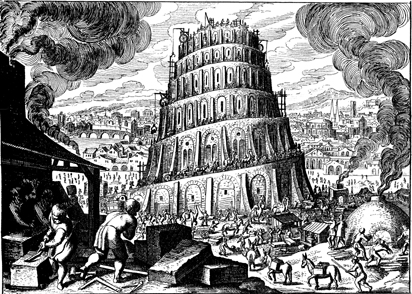
Of course (Hanging Gardens notwithstanding) the most popular image of Babylon is the Tower of Babel and this is the very thing which occupies those bookends – starting with a blow-up of Breugel’s painting, then moving to more modern depictions. Even the exhibition’s logo alludes to this, incorporating the outline of a ziggurat inside the A. And, unlike the Hanging Gardens, it seems the Tower legends did have a base in Babylonian reality. Herodotus and other historical accounts describe the giant ziggurat Etemakani (“the foundation platform of heaven and earth"), built as a single point for all around to look up to. Though no part of this building remains, we can locate it (and even know it’s size) through mapping its foundations. There’s even a scale model of it on show, presumably extrapolating from what we knew of similar buildings.


“Artists”, we’re told, “developed strong conventions for the Tower’s appearance”. While of course they’re selecting examples to suit their argument, their case does seem to be borne out. Take for example Escher’s woodcut Tower of Babel (1928). While this looks little like the squat model of Etemakani, it’s remarkably congruent with the Bible accounts. Though it appears to be built from stone, not the bricks specified in Genesis, it’s appropriately geometric in appearance. Moreover the crest of the Tower is looked down upon, an impossible angle for any human which suggests God’s perspective. God is not just the only named character in the Genesis passage, there’s even the suggestion he one day comes across the Tower. (“Then the Lord came down to see the city and tower which mortal men had built.” His omnipotence is actually quite sketchy in Genesis, with him frequently taken by surprise by things.)


But most important of all, there is no mighty smiting to behold. The Tower merely lies unfinished, the workers confused, the topmost figure throwing up his arms. For in Genesis God’s response is to ‘”confound their language, that they may not understand one another's speech”, thereby making any more co-ordinated building effort impossible. Hence we get both ‘Babylon’ and ‘babble’ from the Hebrew word ‘balal’, to confuse or confound. (Escher characterised some of his befuddled workers black and some white, to signify this division.) We’re told “from that place the Lord scattered men all over the face of the earth”, though the inference is this is the result of the loss of a common tongue, not the likes of a mighty wind. Escher’s etching could therefore be of the moment in Genesis where God spies the Tower and, in a mixture of outrage and alarm, sabotages its builders by tying their tongues.


Yet Escher’s Bible-based depiction is in many ways the exception to the rule on display here. Let’s look at some of the features which were characteristic enough to become traditional, without any scriptural derivation, then speculate (no more) on their basis.


The first thing to go is the square, geometric look, an inherent feature of a ziggurat. Having nothing much to go on with Babylonian architecture, artists based it instead on the round Colosseum. (Rome was not just depicted in the Bible as equally oppressive and decadent, but the Colosseum was seen as the ostensible centre of Christian persecution.) Of course this is just substituting a model which did exist for one which then didn’t. But there’s also points of departure from the Colosseum, and it’s with these that things get more interesting...


Unlike the Colosseum, the Tower not just starts to taper but becomes segmented, bisected at intervals by a narrow path like a screw thread. (As shown in Durer’s 1865 engraving above.) Let’s remember how early this passage comes in Genesis, these are intended as among the first people. With this motif the Tower comes to stand for a new conception of time, which arrives through the cultivation of surpluses which allowed for urban life. Linear time arrives, in which life is no longer a continuum or daily scrabble but we become consciously aware of our own past and future. The upper levels, always depicted as incomplete, stand for the more nebulous future. (Indeed Babylon had an eye on its own posterity, inscribing names into bricks and even burying clay barrels like Blue Peter time capsules.) The image of the Hanging Gardens also reflects this, suspending nature, displacing it to the sky.


However, as we’ll find happens often, this image may have antecedents in other parts of the Bible. For one thing, this curved and tapered tower contrasts with the squarer and squatter Jerusalem Temple. There is also Babylonian King Nebuchadnezzar’s dream of a statue in Daniel, divided into sections which stand for different periods of rule. The only difference here is that the image is the other way up, though representing the future it is the statue’s feet which are weak and unstable. Though the term ‘feet of clay’ has now become commonplace, this part-obscures the original meaning. The statue’s feet were weak because they were an amalgam, “part potter’s clay and part iron... so shall men mix with each other by intermarriage, but such alliances shall not be stable; iron does not mix with clay.” Like the apex of the Tower, they represent the impermanence of alliances between men.


It could also be argued that the successive levels also stand for calculation or accountancy, again something which would have grown in importance with the growth of urban life. This is enhanced by the way all the images portray the Tower as under construction, and so display the mechanisms of measurement as well as construction. (See the anonymous Bible illustration above, from Thirteenth Century Germany.) This is again echoed in Daniel. Consider the terminology used in the Writing On the Wall: “God has numbered the days of your kingdom and brought it to an end. You have been weighed in the balance and found wanting.” The very methods man was using to measure the world, to divide it up as it suited him, are now used by God upon man.


And of course the pyramid shape, with successful smaller levels, stands for the emergence of human hierarchy. This leads to a notable change. The Bible accounts mention no despot, name no King and it’s even emphasised the Tower is built by collective effort. (‘”Come’, they said, ‘let us build ourselves a city and a tower with its top in the heavens, and make a name for ourselves.’”) But the paintings commonly not only give the story a villain (normally Nimrod), but push him into the foreground. (See the anonymous French woodcut above, from 1670.)


With its fixation with lineage, the Bible seems inherently distrustful of cities. The first city is built by Cain, while Lot’s wife gets turned into a pillar of salt for just looking at one! But their problem seems to be their status as centres of teeming life, which tends to lead to mobs, loss of self-identity and makes them centres of collective sin. (“Abram settled in the land of Canaan; but Lot settled among the cities of the Plain and pitched his tents near Sodom. Now the men of Sodom were wicked, great sinners against the Lord.”) Perhaps, more used to city life, we throw the emphasis onto a conjured-up wicked despot.


But most striking of all, the Tower starts to topple (as seen spectacularly in Cornelis Anthonisz’s 1547 image above) Sometimes the surrounding city is shown on fire. (Already conflated by God looking upon “the city and tower.”) As with all the examples given above, exceptions can be found to this rule. Breughel the Elder makes his Tower an architectural folly, an impossible hodepodge of styles and angles, the physical embodiment of a failed attempt to speak Franglais. But there’s enough adherents to call it a rule.


It’s also notable how similar the image then becomes to the harshest card in the Tarot deck, the Tower. In fact, early versions of the Tarot (as shown below) can show a nude man and woman fleeing the door of a burning building, tying the image to the Bibles’ other great Fall myth - the expulsion from Eden. (Though of course we don’t have to assume the direct influence of one on the other. It could be the two images arose separately and later became conflated.)


Once we have the struck Tower, we also get the accompanying motif of attendant figures fleeing. These figures seem suddenly stripped of their hubris, reduced from architects and engineers to a terrified speechless horde. Again this is reflected in Daniel, with its tale of Nebuchadnezzer reduced by God to a bestial state: “He was banished from the society of men and ate grass like oxen; his body was drenched by the dew of heaven, until his hair grew long like goat’s hair and his nails like eagles’ talons.” (As shown in Blake’s 1805 print below.) It is hard not to associate the look of these hunched, fleeing figures with the description given above.


More Tower art for your perusal here

Wednesday, 11 February 2009

SO WHAT EXACTLY IS IT WHICH MAKES A HERO SO SUPER?


“I swear by the spirit of my parents to avenge their deaths by spending the rest of my life warring on all criminals.”

One of my more recent musings has been upon what actually defines a ‘superhero’. Before coming up with my own thoughts, I first consider some more typical suggestions. The list below is drawn partly from Wikipedia’s list of ‘common traits’ and partly from a private mailing group to which I belong. I have tried to pare things down from what was common to what might seem essential, the quicker to get to the nub of it.

A moral code
It is as tempting to say “yes” here as it is difficult to say it without sarcasm. Recent research has shown that heroes in general tend to have something resembling this. The guy who uses his super-vision to peer in the back of the girls’ changing rooms is often considered more of a super-heel. (Unless of course he doesn’t get caught.)

A secret identity
This one sounds straightforward. After all, everybody knows who Clerk Kent or Bruce Wayne are, and their role in their respective stories. The glasses are as central as that big S. And of course it’s from here we get the idea the superhero has to wear a mask, otherwise his secret identity wouldn’t be very secret any more. (Except with Superman, where it was Clerk Kent who wore a mask cunningly disguised as those glasses.) It’s certainly true that threats to this secret identity are a common source of tension in superhero stories. (Spider-man was particularly susceptible to it.)

But in fact not all superheroes have secret identities. The Fantastic Four don’t. Captain America started with one in his wartime days, but when he got fast-forwarded to the present he left poor Steve Rogers behind. (I sometimes wondered what he did in Avengers mansion, the nights the others were out living their civilian lives.) And with The Spirit, Denny Colt was supposed to be dead, not living some other life away from crimefighting.

A Costume/ codename/ motif
From my mailing group Martin Skidmore was keen to point out: “this has to include a superhero codename, not like ‘my real name is Bill Smith but I will pretend to be... Jeff Williams!’”

Wikipedia elaborates this point into: “An underlying motif or theme that affects the hero's name, costume, personal effects, and other aspects of his or her character (e.g., Batman resembles a large bat.)”

Once uncoupled from the secret identity, this does, I admit, come to feel important. There is a huge element of ‘clothes maketh man’ about the superhero. The Fantastic Four started without their costumes, but when they got them it felt like a sign of things kicking into gear. Even the Spirit’s piddling little domino mask feels important, even if (as said earlier) he had no real secret identity for it to protect. His artist Will Eisner later admitted disliking the thing, but could never bring himself to dispense with it. This is true of even more peripheral and even less identity-concealing accessories, such as Luke Cage’s ever-present tiara. (You were probably not supposed to think of it as a tiara.)

But if those costumes and codenames are important, are they actually essential? Recent dramas such as the film Unbreakable or TV series Heroes have dispensed with them. Of course, this argument is double-edged, you’re supposed to see that act as audacious. Yet it’s an audacious thing to do to superheroes. Superhero characters they remain. It’s like the way a King is signified by a Crown. The Crown doesn’t make him the King, in a way that would work if anybody else tried sporting it.

An Origin
A film about a guy who works as an insurance clerk doesn’t need an origin, where we flashback to him taking the job just for a while as he looks into college courses. But of course a superhero needs some explanation for how he got here. We think of the origin as an explanation for how he got his super powers, but it’s notable how it also commonly throws in how he got his codename, accessories and motifs. And its also notable how non-super-heroes need an origin to explain how they got those things. This is true even when they’re not particularly otherworldly. For example, the Indiana Jones films give us an explanation of how he first picked up his hat and bullwhip.

However, do we really need an origin? Batman didn’t get one for the first six months. (Which, when it finally arrived, lasted a whole two pages.) Unlike the Fantastic Fours’ costumes, I can imagine him continuing without one. Perhaps a superhero could be a perpetual man of mystery, in stories told through the eyes of secondary characters. Or perhaps he could perpetuate a civilian identity without any explanation of his origin. I’m not denying the origin makes the character more enduring, perhaps even better. I’m simply saying a superhero without an origin is conceivable. Like the secret identity, the origin is desirable but not necessary.

To these elements I would add one other, which I’m surprised nobody else has listed...

A spirit of independence
Like the private eye, the superhero is an independent operator, a sole trader against crime. It’s surprisingly common to have a superhero thought of as criminal within his own story, such as Spider-Man. Of course some superheroes do work for the authorities. But for this to work properly the relationship must be distant and frequently problematic (where not actually explosive), as in the recent Hellboy films. Superheroes can at times act with other superheroes (The Avengers), and perhaps even accomplish this without arguing all the time (The Justice League). But with penpushers and bureaucrats? They’d rather choke in their cowls!

The underlying point is that the superhero’s activities must be a calling first and a job second, if at all. Secret service operatives like James Bond inhabit another kind of story.

For this reason superheroes often have an alternative source of wealth (Batman and Iron Man being but two of many millionaires.) Spider-man’s problems with earning a living were, at the time, a major twist in the genre.

Superpowers
This one sounds like such a no-brainer, we must surely have arrived at our clincher. Superheroes = superpowers, comprendez? There’s a preponderance of stories where they lose those powers (Kryptonite being invented for this sole purpose), but these paradoxically underline their importance – by showing the size of the gap if they’re removed.

But what about the heroes whose powers were never intrinsic? Who gained them from a magic object (Green Lantern), technology (Iron Man) or even never really had them to start with? Batman for example has nothing actually super about him, and should more rightly be classed alongside Zorro, The Lone Ranger or The Green Hornet. (A type I’m going to go on to call the ‘emblematic hero.’) We know this, and yet it feels as meaningful to say he isn’t a superhero as to say a tomato’s not a vegetable. Our brains reject the information as pedantry, something of no real significance.

Probably the main dividing point, as much as there is one, is the origin. Batman “trains his body to physical perfection until he is able to perform amazing athletic feats.” Okay, we got that? ”Train his body.” No getting bitten by a power ring or handed a hammer by some cosmic rays. But how does that simple-sounding distinction work out in the wash?

If you’ve read this pulpy sort of stuff you’ll probably be familiar with passages such as this: “To escape the fiery pit, the hero had to leap...leap!...leap further than even he had before, further perhaps than had any man. He steadied himself... and leapt for all he was worth!” (NB If you haven’t read this sort of stuff, the hero generally tends to make it.) The inherent hyperbole of pulp, the heat that powers the pot-boiler are always pushing and prodding at the limits of human endurance, and with it eroding the distinction between the possible and the plain unlikely. Start with a hero who can run for the bus okay, and pretty soon he’ll be doing marathons on one leg.

”I swear to devote my life to the destruction of piracy, greed, cruelty and injustice in all their forms.”

It's for these reasons and more I think we need to accept there's a fuzzy line
between the superhero and the emblematic hero. The boundary between the two is not the one between North and South Korea, rigidly delineated and abundantly policed. It’s more akin to the border between North and South Ireland, a vaguely conceived concept buried beneath a criss-cross of tracks, where you’d have trouble offering up your identifying passport if you wanted to.

My theory is that the superhero is at most a subset of the emblematic hero, and that it’s the distinction between the emblematic hero and the rest that’s the significant thing. My theory is that this distinguishing feature of the emblematic hero is that he becomes a symbol for a general struggle (against crime, oppression, nasty stuff etc.) rather than goes on some singular mission or holds a private grudge.

Just as ‘super’ literally means ‘more than’, managing to collect one enemy doesn’t allow you to join the emblematic club. Tales of revenge and private vendettas are out. Perhaps the classic example of the character who isn’t emblematic but might look it from a distance is The Bride in Kill Bill. She has a code-name and enhanced powers, and even a (kind-of) costume. But she is solely motivated by revenge, not to do general good. Once she’s offed her tick-box list of antagonists, her story’s done.

“To avenge the helpless, to punish cruel politicians, to aid the oppressed.”

The epitome of the emblematic hero is therefore the Vow. This doesn’t have to be explicit, but it has to underlie everything else. Tarzan or Sherlock Holmes, for all their surface similarities, aren’t emblematic by this token - because they never made such a Vow. Nor does it have to be as general as ‘crime’, ‘injustice’ or ‘misdeeds’. The Scarlet Pimpernel wars against the guillotining French, and Zorro the Spanish presence in California. But this was still a general enemy, no solitary mischief-maker like Moriaty. A story can start with vengeance, such as the Lone Ranger running down the bandits who killed his buddies, but must quickly expand out. Spider-Man’s origin takes this at its most explicit, by demonstrating acts of personal revenge to be insufficient.

After the Vow, everything else falls into place. Paradoxically, this is often achieved through the cutting of immediate ties to society. This happens most spectacularly in Superman, where he loses his whole home planet. But Batman, the Phantom and the Lone Ranger are among many who lose their friends and family. There’s a common motif where the pre-hero is believed dead, for example in the Lone Ranger or the Spirit (who even locates his base in a cemetery). The Phantom is ‘the ghost who walks.’ The mask and costume therefore don’t just disguise the old identity but replace it – depersonalise the figure, make it into a symbol. Hence the current usage of motifs and symbols – Zorro’s Z, Superman’s S, Batman’s bat.

”My only desire is to see that the oppressed are assisted, and that the evil pay for their crimes.”

It’s perhaps for this reason that emblematic heroes don’t really exist before the Twentieth Century, and achieve a kind of critical mass around the Thirties. The original Scarlet Pimpernel play, by Baroness Orczy, was first performed in 1903. The first Zorro pulp novel, by Johnston McCulley, appeared in 1919. But after that we get The Lone Ranger (radio series, 1933), Doc Savage (pulp magazine, 1933), the Green Hornet (radio series, 1936) and The Phantom (newspaper strip, 1936). (Where Superman, the first superhero, inserts himself into this chain of cause-and-effect, is debatable. His first comic-book appearance was in 1938, but Jerry Seigal had conceived of him as far back as 1932. But the separate origins of social production seem more credible than mere copyism, so perhaps it doesn’t matter all that much.)

Perhaps this is because, along with everything else, urbanism and the rise of the mass society make crime start to feel anonymous. If somebody vandalizes something of yours you become less likely to wonder who might have something against you, and more likely to put it down to that darn riff-raff you read about in the paper. But what depersonalises crime also pushes it further beyond your control. If it’s most likely your neighbour who broke your window, you always can try (in some form) having it out with them. If it’s committed by purely anonymous forces, you can never be reconciled to them because they were never really against you in the first place. Furthermore, what renders crime anonymous can easily also make it appear endemic. What is unknown is by definition unquantified, so can easily lead into fears of a sinister unknown multitude. It’s widely documented how people commonly have a fear of crime wildly out of proportion to any crime statistics.

“Let me strive every moment of my life to make myself better and better, to the best of my ability, that all may profit by it. Let me think of the right and lend all my assistance to those who need it, with no regard for anything but justice. Let me take what comes with a smile, without loss of courage. Let me be considerate of my country, of my fellow citizens and my associates in everything I...”... oh you get the idea!

This is why, as Andrew Rilstone has pointed out, it changes everything when the recent crop of superhero blockbuster films make the hero’s nemesis ever-present. (Now done by Batman, Daredevil, twice in Spider-Man and counting.)

“In the comic, Daredevil's father is killed by a relatively anonymous gangster, which motivates him to pursue vigilante justice for the rest of his life. In the movie, the anonymous gangster turns out to have been the guy who grows up to become Kingpin of Crime, giving a personal twist to the final minutes of the movie.”

...which, of course, is switching things back – turning Batman into the Bride. It’s as if we’ve hit some kind of event horizon in mass society, where we can’t actually face the sheer anonymity of it anymore and need to take refuge in the pretence that everything has become personalised all over again. (I’m also of the impression that superhero comics have become much more obsessed with personal revenge, perhaps in a bid to make things more ‘gritty’. But as I rarely if ever read them nowadays I will concur if told better.) It’s similar to the way in which Thirties art commonly simplified and boiled down form into general geometric shapes, in a way that looks foreign to us today. The emblematic hero is fact becoming a casualty of our ‘me’ society, which finds its heroes journeys more often in winning reality TV shows. Perhaps today’s Spider-Man would simply have stayed a celebrity wrestler.

”And a lean silent figure slowly fades into the gathering darkness, aware at last that in this world, with great power there must also come great responsibility.”

Monday, 2 February 2009

WE COME TO BURY HIGH CULTURE, NOT TO PRAISE IT


This is the text of a piece I read out at the recent Alternative Press Fair in London. It’s something of an ‘oldie’, I wrote it to celebrate the launch of my first ever small press comic Scrawl!,and it went into the Caption newsletter in November 1992.(This is an edited and slightly amended version. But the first line is still an outright lie.)


For those who do not know, Scrawl! Is the product of two years of solid and relentless effort. Leaflets were handed out at comics, small press and alternative events, with a humourous, graphic and above all inept style encouraging people to participate. (This was usually achieved in the bar while others pursued fruitless dry-throated discussions as to how many angels could balance on the arm of a long-arm stapler.) Much to my own surprise, contributions of wit and brilliance flooded into my HQ.

People who played ranged from semi-pros to people who had never drawn a comic strip before in their life and just fancied the idea. As requested, all were in the form of a monologue or duologue.

The aims of Scrawl! were two-fold: a) to reclaim art from the Artists, eliminate Art as a bourgeois concept and destroy the money-commodity system; and b) to have a good laugh.

Luckily these aims proved to be highly compatible (indeed almost interchangeable). Let’s face it, we live in a lifeless society where creativity is fetishised as static museum-pieces to gape at, and where ‘I can do that!’ becomes a cry not of inspiration but criticism. Capitalism of course transforms everything into a commodity, but Art has the dubious and vacuous honour of being prized for its very uselessness! The moneyed classes need some way to show off their ‘taste’ (ie wealth) by how many ‘aesthetic’ (ie useless and expensive) objects they can adorn their homes with. As George Grosz so wisely said, “there is art so the rich have something to hang in front of their wall safes.”

Of course this has the added effect of manacling something empowering and ultimately uncontrollable – human creativity. Making or doing something yourself is bags more exciting than passively consuming, but the loaded concepts of ‘high’ and ‘low’ culture lead people to regard their own efforts as worthless.

Comics are a very good example of this. It’s noticeable how ‘adult comics’ had to lose almost all of comics’ intrinsic good qualities. Instead of the life and vigour of the line drawing, murky painting was in. Instead of easy and accessible language, long captions full of literary references became the rage. Instead of a cheap and affordable product, fancy paper provided a ‘quality’ product.

Scrawl! emerged from a contempt for the mainstream comics world, which has always prized slick and fancy rendering over content – but was now completely vanishing up its own arsehole. With an accessible style and the method of monologue or direct address to the audience, its aim was to cut the crap and defuse comics down to their basic form.

Once you actually reach it, it’s remarkable how – of all the arts – the comics form is so accessible. Unlike music, you don’t need to form chords to make noise into sound, you just draw a stick figure onto paper and everyone recognizes it. Unlike performance, theatre or ranting poetry you don’t have to stand up in front of a crowd worrying about making a tit of yourself. You just sit in your own room drawing, and rejecting anything you don’t like. Unlike literature there are no impeding high culture notions of ‘proper writing’ – you can WHOK!, ERK! and KER-SPLAT! to your heart’s content and be speaking a common tongue. You don’t even have to draw if you don’t want to, just cut panels out of existing comics or magazines and scrawl in your own scathing comments.

It’s also remarkable how easily the form lends itself to laughter, particularly of the pretension-pricking variety. Scratch someone into a box with a word balloon sticking our their mouth and see how long they keep their lofty dignity. For this reason, the scurrilous political cartoon has a long and glorious (and above all effective) history.

In short Scrawl! comes because we want to bury high culture not to praise it, because we want to destroy the comics industry and wrest our form back off it, because it seems a good excuse for a party; - and the marker pen, the nicked photocopy paper, the unfair and insulting caricature, the uneven panel border, and the word balloon stuffed with cheap and nasty humour are our weapons in this war.

Home creativity is killing the comics industry – and it’s fun too!

Friday, 2 January 2009

THE BAADER MEINHOF COMPLEX


Perhaps unsurprisingly, a film on the Baader Meinhoffs (aka Red Army Faction) proved controversial in its native Germany. Ignes Ponto, widow of one of their victims, even returned her Federal Cross in outrage over what she saw as a glamourisation of their brutality. But of course you hear that its based upon a book by a mainstream journalist (Stefan Aust’s ‘The Baader Meinhof Group’) and imagine the reverse, a smear campaign against anyone who ever questioned an orthodoxy. In fact it neither whitewashes nor pillories the group’s often-murderous acts, so much as lays them bare. But, lacking anything very insightful or imaginative to say on the subject, its attention falls almost by default to the photogenic business of shootouts and bombings. After all, mainstream cinema will happily glamourise poverty, so how is it likely to cope with an gunfight? In short, it sidesteps radical chic to end up in heist-movie cliché.

Even when much of the furniture is placed scrupulously in place, it fails to perform its function and just sits there inertly on the screen. The RAF were the sharp end of a wave of radicalism unleashed when the police attacked an anti-Shah demonstration in ’67, and murdered Benno Onhnesorg. But as played here the scene is so hackneyed and overblown you get little sense of verisimilitude – you simply feel like you’re watching a scene from a film. Not a particularly good film.

“The filmmakers can also hardly be blamed for the fact that quite a few of Germany's most wanted were ridiculously good looking in real life,” claims Channel 4’s reviewer Ali Catterall, “and they've cast accordingly.” But it’s instructive to examine the exception to this rule. Martina Gedeck’s is actually made up to be more dowdy than Ulrike Meinhof in real life, in order to provide her with a ‘journey’ that threads together the first section.

Though lipservice is paid to Vietnam and all the usual suspects, the makers’ main thesis is that the gang were really a generation gap writ large. As a middle-aged radical, Meinhof therefore starts the film stuck upon a fence from where she must decide which way to jump. (A metaphor given a somewhat gormless literalisation.) In an early conversation with Gudrun Ensslin, she states she couldn’t take to a life underground as it would mean leaving her kids behind. Ensslin states flatly she never sees hers. In a later scene, a pram is but a disguise for a gun. The ‘radicals’ must abandon their children to be the children –Germany’s children, middle class youths groomed for good careers, now in revolt against her.

As Catterall later puts it: “Substitute those guns for guitars and this could almost be the biopic of a rock band, from early hits to mid-period mismanagement and fatal fall-outs over direction and differences.” There’s a point in the Stammheim trials, where they all take turns to call the Judge an “asshole”, which can’t fail to remind you of the Pistols on the Grundy show. Only without the politics.

Of course, the film is correct to suggest they are encouraged into their infantilisation by their times. Their parents’ generation were what every adolescent years for – a bunch of Nazis to rebel against. Many Nazis had escaped punishment and continued to hold prominent positions, at a time when a law explicitly excluded leftists from official employment. When echoed through the shrill RAF mindset, these genuine criticisms turned into the rhetoric that post-war Germany was still a Nazi state. Ensslin was forever saying things like “This is the Auschwitz generation, they aim to kill us all!”

But if the film’s line is correct, that doesn’t make it adequate. It merely rehashes what has by now become an orthodox view. ‘The Baader Meinhof Simple” may have been a more fitting film name. Jillian Becker’s book on the RAF, tellingly titled Hitler’s Children had even been published in 1977! Even if the RAF leadership themselves were merely proffering adolescence as ideology what of their widespread support among the young? (Frequently reflected in contemporary opinion polls.) Or the fact that, as soon as they were caught, another ‘generation’ arose after them? And how did they relate to the wider youth movements?

But for all their tubthumping and hissy fits perhaps the most absurd figure in the film isn’t a RAF member at all but a Police Chief – Horst Herold (Bruno Ganz.) Herold isn’t so much a character as a white flag flown to appease those who might otherwise take the Ignes Ponto view. A chest-thumping liberal, he is forever reminding his knuckle-dragging staff of things like “the horrors of the Third World” which have led to the protest movement. Let us suppose, just for the sake of conjecture, that he was the walking cliché as portrayed here – so what? Did his men take up his theme, jump in their squad cars and duff up the IMF? Perhaps they even put a collection box for the Third World by the till in the police canteen. Herold, in fact, achieves precisely nothing, even within the distorted world of this film. We are supposed to look at him and respect the way mainstream society could embrace self-critique. Whereas his presence actually proves quite the opposite.

However, unlike most of the gang’s actions, the film’s not a dead loss. It has one quite distinct, if presumably unintended, advantage. If its is quite ludicrous most of the time, then so were the people it has been made about. If it’s not sure whether the RAF were a revolutionary militia or just defiant posers, neither were they. There are several points where it is genuinely and quite deliberately funny. For example, there’s the scene where they have their car stolen. As Baader rages, the others have to remind him they’d stolen it themselves in the first place. (There you’re reminded of Student Grant from Viz Comics.) Yet it’s often hard to tell such times from when it’s merely being kitsch, such as the innumerable scenes where they shout sloganistically at each other inside their hovelly hideouts, or go for long speeding drives like in some shitty juvenile delinquent movie. Unlike Ignes Ponto, you find yourself wishing they had merely gone all-out for the absurdist black comedy angle – The Comic Strip Presents The Anti-Imperialist Movement At Home In Deutschland, Ja?

As mentioned earlier, much of the big units of the furniture in this story are in place. However, this does not mean it’s accurate – in fact even my passing knowledge of the subject found major flaws. (Disclaimer: Having never read Aust’s book, I have no way of knowing whether these mistakes are theirs or his.) The RAF are perpetually called ‘anarchists’ whereas they were really subscribed to Leninist anit-imperialism filtered through a gang mentality. Meanwhile, student leader Rudi Dutschke does get called an communist where he was really an anarchist! (Though he later drifted towards liberalism.) When the Stammheim inmates die, the surviving members call it murder. Brigitte Monhaupf then defiantly proclaims it suicide, as a story better fitting the RAF’s own mythology. (“They were not victims” etc.) We’re supposed to chill at her propogandist shiftings. Except, as Robert Gerald Livingstone has said in the New York Times: “It remains an article of faith on the left that their keepers killed the prisoners.” The notion that it was group suicide has always belonged with the authorities.

But worst of all is when we’re shown the ‘second generation’ plotting the kidnapping of Schleyer. It is never mentioned why he was chosen – he was an ex-SS member who had gone entirely unpunished after the War. Are the makers worried that, should we be given this dangerous piece of evidence, we’d leave the cinema to buy ourselves AK47s or something?

Even though it gives itself the liberty to play with the facts, the film still manages to lack dramatic structure. The later ‘second generation’ section in particular is incoherent and hard to follow, with characters hanging around as if waiting to see what the script wants from them. Meinhof is given us as the linking thread, but with her death this thread which snaps well before the film’s end. At times this incoherence seems to be played up; for example, we’re given rapid crosscutting or voiceovers which swap so fast they virtually overlap. But there is never anything so sophisticated as the presenting of multiple points of view, there is merely incoherence masquerading as statement. We’re watching neither decent docu nor well-crafted drama. In a particularly risible line, Baader proclaims “it’s more fun with a gun.” But he’s proved wrong. The film allows itself to play with the guns, then still fumbles with them.

Had I made a film on this subject, I would have thrown the audience straight into a situation of carnage – say the kidnapping of Schleyer or the murder of Jurgen Poto. I’d then have snapped back to the idealism of the mid-Sixties to show the same people initially acting quite sympathetically, to demonstrate how such social movements soured into terrorist gangs. And, if we are to have a parallel story for the Police, perhaps a young officer caught up in the anti-Shah demonstrations who vows to change things from the inside. If we need a Herold, he should at least feel a genuine frustration. The ‘second generation’ section would need to go one way or the other – either providing us with a new Meinhof or deliberately keeping them shadowy. And while, as we’ve seen, the RAF’s fascist fixations were present, this film sorely lacks any sense of the international context. The astonishing feature of this era was the global spread of radical movements.

While this film is often entertaining (in the sense of laughable), it’s tragedy is that a good film on this subject still lies waiting to be made. The Spectacular Times’ slogan “terrorism is always counter-revolutionary” is of course accurate, but it is also necessary to understand how such mistakes came to be made. The nearest we have is Reinhard Hauff’s Stammheim, a narrower but more successful reconstruction of the trials from their transcripts. Other decent films on similar subjects are Good Morning Night (on the Italian Red Brigade) or the documentary The Weather Underground (on the American group.)