googlee7ea825f63edb3f6.html

Thursday, 25 December 2008

CINECITY 4: THE QUAY BROTHERS – QUITE DEFINITELY THROUGH THE LOOKING GLASS


Yes, I am not exactly being timely here, finishing my posts on a festival which actually ended two weeks ago. However, I am due extra nerd points for posting this on Christmas Day!

One of the most exciting things for me about this years’ Cine-City festival was the programme dedicated to the Quay Brothers, whose work I’d only ever caught snatches of before. Here we had three showings of shorts, one full-length film (Institute Benjamenta), a Q&A session plus an exhibition! Though Americans living in London, the Brothers are celebrated for their films and animations in the fantastical East European style of Svankmayer and Borowczyk. (NB All direct quotes below are from the programme notes or this interview –a site which looks worth bookmarking in it’s own right.)

They comment “we want to make a world that is seen through a dirty pane of glass. You can’t exactly get at it because it is elusive.” What’s crucial to their work is the distance between a puzzle and a mystery. With a puzzle, the pleasure lies in the working out – the cutting through the convolutions to arrive at a solution. With a mystery the pleasure lies in the precise opposite, embracing the inscrutability, tasting the strangenes. To clear away that pane of glass would be a violation, not a clarification. However, giving the game away on these compelling films is not our biggest worry here! What follows is instead a few hasty scrawls upon that dirty pane.

As with Svankmayer, what’s vital to their aesthetic is the fetishification of everyday objects. Screws, combs, pencil tips, all the little things which lie almost beneath our vision are suddenly rendered animate. This gives rise, to drop a Freudian term, to the all-important sense of the unheimliche, or strange familiarity. As they put it, “what we’re trying to do is release the strangeness.” We peer into this other-world, but it is not grandiloquent and distant - for sheer freakishness is unengaging. We peer into it with the vertiginous sense that we could topple into it at any time. (As much as I will venture any ‘explanation’ for anything here, I’ll suggest the primary puppet in Street of Crocodiles somehow represents the man who starts the machine up.)

Perhaps paradoxically, this sense is enhanced by the Brothers’ refusal to play up the dramatic illusion. Street Of Crocodiles starts with an old man looking into a peep-show, effectively reminding us of our status as audience. Similarly the Optical Boxes in the exhibition often contain viewing slots, or distorting lenses which enlarge the insides once looked through. In the catalogue they speak of the importance of seeing their work on a large screen, where puppets are no longer smaller than us but suddenly blown up to giant-size.

This “extraordinary power of the camera to ‘make strange’ “ is central to their fetishism, but of course they are merely magnifying something cinema does already. Hitchcock, for example, is full off innocuous objects fixated upon by the camera and plot. Even a film as apparantly at variance to the Quays as Bicycle Thieves does this. At one point we see the bicycle large upon the kitchen table, attended to by the son. Later we see it ridden off stolen, growing tinier and tinier against a teeming Rome.

Unfortunately, some of their later shorts abandon animation for pixellation, rusty screws for computerisation. The Comb, for example, loses some of this object-fetishism by creating an all-too-obviously virtual world. It was vital that their animations looked unreal but hand-crafted, with even the credits often hand-written or even carved. Alas, in their Q&A the Brothers explained that this change was not a creative choice but a financial necessity, a response to the more difficult funding situation we now live in. Perhaps their more live-action films such as Benjamenta provide the best hope for them now.

The Brothers also spoke of the importance of music to their work, sometimes even commissioning scores first and working their animation around them. “We much prefer to obey musical laws because they’re not logical,” they explained. You can’t print logic on music, it’s outside of that.” Without having read Schulz’s Street Of Crocodiles, I assume their animation is ‘based’ upon the book the way a musical piece would – elaborating on themes and moods, with scant interest in reproducing the string of events. After watching it I found sequences and images were set to loop in my memory, just as if they were snatches of music.

It’s notable that even when their work isn’t specifically based upon novels or operas, their references tend to be to other artists – composers, authors, even other animators. After all their whole approach stems from accidentally coming across an exhibition of Polish film posters while still students. This can often be a bad sign, creating work which (even when not merely imitative) is is nothing but referential – at it’s worst even post-modern. But perhaps the Quays bend this hermetic quality to work for them. Their references become like their peep-shows and cabinets, creating spaces of strangeness to fall into and get lost. The clusters of allusions almost knot, adding to their works’ sense of ponderousness and claustrophobia.

However, I did at times experience a niggling doubt – that the Quays could pull off this style superbly, but not themselves inhabit it with anything. Are they reliant on outside sources for their substance? Or are they even a superior cousin to those award-winning rock videos, the ones which recycle the tropes of art cinema but never any more? (The Quays made rock videos, for His Name Is Alive, but not in a dumbed-down fashion and anyway that alone should not be considered damning proof.) The question is difficult to answer because you’re not looking for anything discernable in terms of content, more an idiosyncratic spirit. However, it’s most likely to reveal itself in their full-length films, where style alone won’t maintain interest over the duration. I suspect if I could see more of their films, or even these films again, this doubt would either grow or be dispelled.

Watching the films, you can’t but wonder how they are able to realize these works of strange familiarity. Perhaps part of the answer is the fact that they’re identical twins. Their working methods are clearly as interchangeable as their conversation, casually using phrases like “we were reading” or even “our left hand.” The interview transcript I linked to above merely quotes them together, and they even sign their correspondence with a single ‘Q’. They emphasised both their intuitive methods of working (storyboarding to satisfy the backers, then throwing the boards away) and the pitfalls of working with an ensemble to which everything must be explained. (“You just have to sense it, you don't have to think it too much.”)

Perhaps as identical twins they developed a kind of conjoined psyche – sharing their perceptions from the very beginning, in a way siblings born even a short distance apart never would. It’s scarcely innovative to see something child-like in their enclosed worlds of object-fetishism; to children, all objects are infused with character and life. It’s even possible to argue that it’s the very development of communicative skills which banishes such perceptions; as soon as you able to speak of it, you lose your sense of what was so sublime. But for these twins the unspoken remained preserved and, not through words but the manipulation of space and objects, they have effected a means to transmit it to the rest of us. (Disclaimer: As an only child, I am the very opposite of the Quays in this respect.)

Sunday, 14 December 2008

CINE CITY 3: ANDRZEJ WAJDA


I must admit to having a fair bit of catching up to do with legendary Polish director Andrzej Wajda, having only seen the early (if widely considered seminal) Ashes And Diamonds and A Generation. (No, I wasn’t starting with the A’s.) So when Brighton’s Cine-City Festival announced this year would include of two of his films, I was suitably attentive.

However, though keen to see his most recent film Katyn, I was in some ways wary. Directors often try to achieve the summation of their career near its end, and this had many of the signs. Aged 82, Wajda is putting on the screen the Soviet wartime massacre which not only set the tone for their subsequent occupation but also claimed the life of his own father. (As the Guardian commented: “In many ways, Katyn is the film that Wajda has been building up to throughout his career.”)

Does this sound bad? Perhaps counterintuitively, it can be. Such portentousness can crush the life from a film, leaving something sumptuous but stately – perhaps even stodgy. (Kurosawa is a classic example, compare Yojimbo to Kagemusha.) And despite their wartime settings, his early Films had a contemporary Fifties feel. The young lead Zbigniew Cybulski agonized so pensively over how he fitted into society, all the time sporting a pair of sunglasses (the era’s symbol for alienated cool), that he earnt the nickname “the Polish James Dean.”

SPOILERS IN NEXT PARAGRAPH!

In some ways Katyn takes this heritage head-on, introducing a headstrong and impulsive young nephew. He’s not exactly Cybulski reborn, in fact he’s quite precisely committed where Cybulski was conflicted. But the film first follows and indulges his swingheeled romanticism, seeing the world from his elevated rooftop perspective, only to swat him.

SPOILERS END!

However, it would be more accurate to say that Wajda’s concerns have now shifted to the adult generation. His characters are less concerned with where to place their idealism, and more burdened with balancing their consciences against the encumbering business of survival. At one point the authorities smash a tombstone for bearing the wrong date. (Suggesting it was carried out during the Soviet, not the Nazi, occupation.)

But the film is not the celluloid equivalent of that tombstone, proclaiming something which no reasonable person now rejects. Instead his focus is not so much the moment of the massacre as it’s aftermath, not those who died from it but those who have to live with it. As he himself said: “While Stalin’s crime deprived my father of life, my mother was touched by the lies and the hoping in vain for the return of her husband.” Living with such knowledge becomes a microcosm of Soviet occupation, where the unbearable must daily be borne. No easy solutions are offered for this, and the collaborators are given their say as much as the rebels. This gives the film a tension which prevents it from falling into heritage status.

Of course, all of this could not be further from the Hollywood treatment of political events as a backdrop to a ‘personal journey’, like a yuppie backpacking through Nepal to “find himself.” Wajda’s famous deep field photography comes in here. Characters never look like lead actors, posing potogenically in front of some neatly arranged backdrop. They always seem to spring from and inhabit the space around them.

MORE SPOILERS COMING!

Only in the final scene, shifting back in time, do we see the actual massacre. The horror here is that it’s shot neither through the eyes or the victims nor the perpetrators – instead it merely follows their hands. As corpses are repeatedly piled onto slides to enhance disposal, the killers work in a detached a way as workers in a slaughterhouse. Such behaviour has become normalised.

SPOILERS END!

But if Katyn is the summation of Wajda’s career, Man of Iron is the departure. Made at great speed during the first wave of Solidarity strikes in 1981, it trades in much of Wajda’s reflectiveness and becomes much more of a bulletin. Often shot on location and incorporating real news footage, it has an almost Sixties cinema verite style. Like such films as Medium Cool, the process of film-making is often foregrounded. The film starts with a woman making a passionate and poetic speech about freedom, who then stops to ask the radio engineer for another take. It’s protagonist, Winkel, is a journalist ordered to perform a hatchet job on the strike leaders. Wajda commented afterwards “we were learning to understand this new reality and to show it on the screen at the same time, which was not easy.” (Notably, while Western films of this style seek to dispel the chimera of ‘journalistic objectivity’, here the question never even comes up. Winkel must choose one side or the other, no third options.)

However the film also has a reflective half – with the frequent flashbacks, which set the current strike (and the main characters’ behaviour) into context. Here Wajda’s patented style comes back – muted colours, deep field photography and poetic composition. (These refer back to an earlier film, Man Of Marble, which was presumably shot in that style.)

Functionally, this is effective – the two distinct styles never leaving us in doubt which era we are in. But the two tones can at times jar. You naturally indulge Wajda’s more poetic instincts when they take on a poetic form, less so when they are inserted into a news report. One example would be Winkel’s symbolic pilgrimage towards the worker-occupied Shipyard. (Which he is only able to enter at the very end of the film.) We seem supposed to infer that this swapping sides has cured him of the alcoholism which has plagued him up until then. There is also a subplot, involving a striker’s father, which drops a smart expectation-denying twist, but then one which simply seems to get forgotten. More pettily but still notably, whilst Katyn has a score by Pendereski, the music here is mostly Eighties synth stuff!


However, Wajda is keen as ever to keep matters nuanced. The provisional nature of the worker’s victory is stressed, and even Winkel’s side-swapping is not altogether welcomed. This cautious optimism was validated, when the authorities later imposed martial law. Wajda later commented he’d earlier asked the military to borrow their tanks as props for the film – but been denied. A year later, those tanks were on the streets for real...

Monday, 8 December 2008

CINE-CITY 2: SQUARING THE CIRCLE


Tom Stoppard’s account of the birth of Poland’s free trade union Solidarity was, according to the Cine-City site, “broadcast in the ‘golden age’ of Channel 4...never released on DVD and its last transmission 20 years ago”. Indeed, the film has almost fallen through the cracks of history - with the most perfunctory IMDB page and no Wikipedia entry at all. And yet, as Mike Hodges mentioned in his Q&A after the showing, about the last thing it could be accused of is being a period piece.

The film makes no attempt approximate Polish accents (Lech Walesa speaks Scouse throughout), or even pretend it’s not being shot in a studio. Mike Hodges revealed this Brechtian style was originally budgetary, but he soon came to see the aesthetic advantages of it. By the end he insisted beach scenes be mocked up in the studio, which ironically it would have been cheaper to just film on an actual beach.

Of course such effects tend to universalise the story, no bad thing when a British press was insistent free unions were great for Poland yet somehow all wrong for Britain. Yet it’s interesting to note that Brecht himself strayed most from his patented ‘distancing effect’ when recounting contemporary events, notably in Senora Carrar’s Rifles and Private Lives of The Master Race. When your story’s so close to the headlines, wouldn’t a verite effect have worked better?

In fact, Hodges’ choice has specific advantages. There’s a point where a party dignitary gives a TV speech in a cosy-looking Library. Transmission over, he slides his chair back with promptly knocks over the ‘bookcases’ – mocked-up studio flats. If everything in the film is a facade then so is the Polish regime, in their pretence either to hold independence within the Soviet block or to have the workers’ interests at heart. Hodges also revealed that the only non-studio shot was of a rising helicopter, used to suppress a strike. This is also fitting, for the subsequent repression was no doubt real enough.

It also induces an appropriately hermetic effect. The dignitaries and bureaucrats live in a rarified world where they are constantly discussing real-world events in the abstract, talking steel production while never visiting a steelyard.

The film’s also quite courageously willing to present Solidarity warts and all; arguing amongst themselves, making tactical errors. Walesa comments near the end that they started marching together, but the road they were on forked and then forked again. Though this might have risked criticism, with several Solidarity members imprisoned when it was transmitted, it makes for a stronger, more interesting and more nuanced film.

Throughout the film is dense with information and ideas, without ever falling into polemicism. Some scenes are played more than once, in varying permutations of what might have happened. The narrator is himself frequently interrupted by passing Poles, challenging his assumptions.

Despite such courage and these many strengths, it perhaps has two weaknesses. First, we have the role of narrator itself. As Hodges admitted, this role was intended to be played by Stoppard himself, but an American presence was forced upon him by the backers. (Though he praised Richard Crenna’s actual performance.) It’s not a problem that the authorial voice takes on an American accent; as mentioned, the Narrator is continually perceived by locals as a clueless outsider who needs correcting. But had we seen the scriptwriter having his own script corrected, as Stoppard intended, the effect would have been stronger. Also, at a point in the film American bankers appear. This is the first time ‘natural’ accents have been used, for the ‘Poles’ have all been English. This jarring is presumably deliberate, to emphasise the bankers as outsiders. Yet the accent already given the Narrator dilutes this effect.

Also, though the work is clearly well-researched and Stoppard doubtless has a keen brain, his politics are somewhat liberal. (He’s described himself as “a timid libertarian”.) This shows through mostly over Walesa. It’s as though, just by placing characters to Walesa’s ‘left’, he is immediately made a ‘moderate’ and is therefore correct in all he says. This takes us to strange places. The Wikipedia article on Solidarity mentions how their “example was in various ways repeated by opposition groups throughout the Eastern Bloc, eventually leading to the Eastern Bloc's effectual dismantling.” Yet at one point, Walesa rules out links emerging in other Eastern Bloc countries, because as Poles they should concern themselves with Polish affairs. As in other places, the film seems to side with this petty-nationalism rather blithely. Similarly, his personality cult and its effect on collective decision-making is repeatedly brought up, but never particularly closely examined. It might even be possible to argue this film enhanced such a cult, by making him so central a character. (Though of course Stoppard couldn’t have known at this point of Walesa’s later career as a rather free-market-oriented Polish President.)

But for all such criticisms, this was a bold and intelligent piece of film-making that honoured rather than trivialised the seriousness of its subject. Hodges quite casually remarked that it would be impossible to make such a film for British TV today. (The decline of Channel Four was also noted by the Quay Brothers in their own Q&A session, though more of that anon.) ‘Squaring the Circle’ refers to a mathematically impossible act. Yet for a few short years such a thing was possible. Switch on Channel Four now, and you will see with which substance they have replaced their Golden Age. Alas, that was one kind of freedom that didn’t need helicopters or troops to be brought down. Look out for this when it’s shown again. Only another twenty years to wait...

Monday, 1 December 2008

CINE-CITY 2008 PART 1: BICYCLE THIEVES


NB If you’re worried about plot spoilers for a 1948 film, they follow! And yes there is more to spoil than ‘someone’s bike gets nicked.’

The Cine-City Festival is back in Brighton for another year, and (among other delights) has given me the chance to finally see De Sica’s acclaimed drama Bicycle Thieves. As it turns out, this film is just as good as everyone has always said it is!

Of course, as a totem of Italian post-war neo-realism, it’s also a magnet for brickbats. It’s been criticised by some for not being ‘realist’ at all, with accusations that it’s even “manipulative.” But these are arguments against some absurd caricature of neo-realism rather than the style itself. (Though it doesn’t help that the genres defenders, such as Bazin, often made almost as foolish claims.) It’s abundantly clear that De Sica isn’t concerned with finding something ‘real’ and pointing a camera at it. ‘Realism’ is an artistic genre, and hence a form of artifice, as much as any other. To turn his sense of cinema into a criticism is the height of ludicrousness. A measure of the film’s success is that, even when you know it’s based upon a novel (by Luigi Bartolini) you find it almost impossible to imagine it as such – so pure is the sense of cinema it exudes. Similarly it’s sometimes claimed that the storyline is not as casual and free-flowing as it looks but actually conforms to a narrative structure. Again, this is not a criticism but a compliment with an identity crisis.

De Sica’s talent is not to dispel cinema’s devices but know which ones to keep in. Cross-cutting, for example, is rarely used here – the focus is almost all upon our protagonist Ricci. When he pawns his own bedclothes we see the pile of linen in the brokers, testament to how many have come to the same step. But we see the size of this pile via a reaction shot - through his eyes. Similarly, we learn almost nothing of the actual thief – where he’s put the bicycle, his relationship to the old man. We don’t even know if his fit is fake or not. We only know of him what Ricci does. Cross-cutting is minimised not because it’s not ‘real’ but because it would mitigate against seeing this world through Ricci’s eyes. The weaving camera shots give us the feeling the film is being shot in long takes in real time, even though this isn’t actually the case.

The Forties Rome we see feels almost like another planet, not only the palpable poverty but also the astonishing labour-intensiveness of life –fleets and flurries of workers continually pass us by, such as the army of street-sweepers that descend upon the morning. It adds weight to my hypothesis that, as a modernist art form, cinema has some inimical connection to the urban environment. (Alas, the Cine-City festival has now almost given up honouring its name as a festival of city films.)

It’s perhaps interesting to note that, upon release, the film was often criticised from the left. (Though the scriptwriter Cesare Zavattini was a Communist Party member, De Sica was not.) “As a form of social criticism,” claims Aristides Gazetas, “[it] never attempts to examine the root causes behind the poverty, nor criticize the ‘system’ that creates the injustices and inequalities.” Tomasulo even insists that "at best, the film is reformist; at worst, it legitimizes the ideology of bourgeois liberalism." De Sica was accused of propounding nothing but empty humanism, eight reels of weepy sympathy rather than an ounce of constructive suggestion.

To this charge, that the film’s chief deficiency lay in offering no ‘solutions’, it’s tempting to reply facetiously. Perhaps Ricci should have caught his thief, then united with him against a system which exploits us all. They could then have refused to put up their Rita Hayworth posters until the capitalist edifice crumbled around them. However, this criticism does illuminate what the film is doing to a greater extent than those who simply complain it’s not ‘really real’.

It’s true that, while Ricci faces problems which are typical of his time, he is still individualised. He is different from the types which inhabit Eisenstein films, who often feel as if they’ve stepped down from the geometric forms of Soviet propaganda posters. And this emphasis on him as a man, like you and me, is vital. Compare the plot to an outwardly similar story, Will Eisner’s acclaimed newspaper strip Ten Minutes, published the following year. (A semi-accurate summary of it is here.) Like Ricci, Freddy is hard pressed by life and in a moment of weakness resorts to crime. Both acts are presented as out of character, and neither ends well.

But Eisner emphasises this moment, closing in on the point where Freddy finally gives in to his weaknesses. He’s like a bridge which breaks the first time a heavy truck passes over it. The truck may have precipitated the break, but the problem was a structural flaw in the bridge. De Sica and Zavattini, conversely, contextualise the moment. Because we have inhabited Ricci’s reality up to this point, we understand his temptations. The very causes of his hesitation cause us a sense of dread, as it is all too credible to us that he’ll try to steal the bike. As Zavattini said, “that man is bearing what I myself should bear in the same circumstances.” To use Tomasulo’s terminology, it is Eisner’s work which “legitimises the ideology of bourgeois liberalism” (an abstract ‘morality’ devoid of context), De Sico and Zavattini have other fish to fry.

The whole of the film expands from the agony of that moment, including Ricci’s subsequent capture. (Which by then feels fated.) We are invited to consider what we would have done in the same situation. Any ‘solutions’ then offered would not only by necessity feel pat, but would crush the poignancy of this moment. As it stands the film is not closed and didactic, but open and troubling. It’s emphasis is not on the possibility or otherwise of living any other way, but the impossibility of the way we live now. As Zavattini said: “It is not the concern of an artist to propound solutions. It is enough to make an audience feel the need, the urgency, for them.”

It’s also arguable that the film is making a concrete point, albeit a harsher but more worldly one – that to survive in this world a poor man needs to be part of a gang. The fleets of uniformed workers come in here. Workplaces in Italy then were normally associated not only with a union but a political grouping, all who worked there were expected to join the grouping to enhance collective strength. A smart worker whose political inclinations lay elsewhere would learn to shut his mouth.

We first see Ricci sitting apart from his peers, having to be called over to hear about the job he’s won. Later he catches the titular bicycle thief but is unable to confront him when the lad’s neighbourhood comes together to defend him. Even his final desperate attempt to steal a bicycle himself come to naught from, unlike the original thief, having no accomplice to throw pursuers off the scent. (Admittedly he does at one point raise a posse in search of the stolen bicycle, who even seem to represent Leftism as much as anything does here. But this withers away.) Ricci suffers, what Bosley Crowther called “the isolation and loneliness of the little man in this complex social world”. He is a man with only his own determination, which he finds to be not enough. Perhaps such savage honesty is more productive than abstract calls for class unity.

More Cine-City reports to follow...

Tuesday, 25 November 2008

"TOLD BUT THESE FEW WORDS": JOHN WESLEY HARDING (TOP 50 ALBUMS)

Bob Dylan, 1967


Despite being another reprint from Ye Olde Print Days, this is also part of an occasional series where I eulogize some of my favourite albums. (Or, for younger readers, CDs.) Content may therefore be more celebratory and less analytical than usual. Despite this being the first entry labelled as such, I really started the series here without knowing it.

I‘m currently in the habit of borrowing my flatmate’s CDs to take into work. Thing is, I can only ever fit one in my jacket pocket. Marooned for a day with a single CD, I’ve learnt the wisdom of choosing wisely. But this is an album I’ve always liked which I haven’t heard in a while, so I should be okay.

As it turns out, listening to it again serves to confirm my view that the highpoint of Dylan’s career is either this or Basement Tapes. (Though admittedly you do have to mentally edit out the lesser Band tracks from Basement Tapes.) This was a realization that came over me slowly. I spent many angry teenage years playing the electrified hallucinogenic grotesquery of Highway 61 Revisited as loud as the volume dial would let me, until my Dad would rush in and accuse me of damaging my hearing. Admittedly, the more subdued sound on display here doesn’t generate that instantaneous antagonistic reaction in Dads, but that just obscures its true worth.

I wonder if the switch had a strange disconcerting effect on the rock audience, who had assumed Dylan was now their mascot after plugging in and turning off his original folk followers. The songs from those albums have been the subject of many a rocked-up cover, from Hendrix’s almost instantaneous cover of Watchtower to Patti Smith’s more recent Wicked Messenger - like they wanted to drown out and extinguish the unamped originals.

Though Highway 61 may have marked a step away from the literalism of the original protest songs, this era makes for even more of a sideways leap – into the allusive land of parable. Much of the appeal lies in the way the songs take place inside some mythic past, what Greil Marcus called “the old, weird America”. After the frenetic modernity of Highway 61, John Wesley follows more leisurely trails. Telephones that don’t ring become telegraphs and steamboat whistles, passports become messengers and horsebacked strangers, cars become churches and Napoleon in Rags transforms into St. Augustine.

Alongside the old, weird West we also have the old, weird Victorian England and no shortage of the old, weird Bible either. John Wesley Harding, Tom Paine and St. Augustine all inhabit the same imaginary neighbourhood. Befitting Dylan’s new quietism, all this is assumed rather than paraded, there’s no “long-time-ago-in-galaxy-far-away” style bookends.

(Though of course Dylan’s just foregrounding tendencies he had earlier. Back in ’65 he was already enthusing how folk music was “just based on myth and the Bible and plague and famine and nothing but mystery. Roses growing right up out of people’s hearts and seven years of this and eight years of that and it’s all something that nobody can really touch”.)

The music’s similarly unassuming, a pick-up band of Nashville session men just clock in and do their job. His voice itself is almost unrecognizable from the nasally whine set to wind up Dads, instead it’s deep, gruff and gospelly. He sings distrustingly of the Wicked Messenger “whose mind it multiplied the smallest matter”.

His language is effective through being unassuming, a line like “all across the telegraph his name it did resound” resounds more for its apparent lack of effort. Such simple, direct language is more redolent of folksong than the bogus “these” and “yees” that make most such attempts sound like a bad issue of the Mighty Thor. Writing is about building up a picture gradually through accumulating small and seemingly innocuous words, not painting broad and grandiose flourishes that just flake off in the memory.

But what really makes the album linger in the mind is its beguiling quality. Underneath the simple surface lie pithy parables you never quite get to the bottom of; “nothing was revealed” as he deadpans at the end of Frankie Lee. I was surprised to see so many of these allusion-stuffed songs clocking in on the CD display at under the three-minute mark. Dylan apparently complained at the time that simple was harder to write, but the extra effort was worth it.

There’s a distinction between the gospelly first-person songs which mostly inhabit the second side, which seem to feed from Basement Tapes, and the symbolist character encounters which open and eventually dominate the album. The two final tracks stand out by being as simple and direct as they appear. After the “too much confusion” of all the cryptic allusions, I’ll Be Your Baby Tonight is a song about being your baby tonight. These songs offer the “way out of here” longed for on Watchtower, a redemptive coda to send us home happy and satisfied. But ahead lay Nashville Skyline and Self Portrait where, extended to album length they wouldn’t maintain interest. Dylan dipped and, while he rose again eventually, he’d never recapture what he manages so effortlessly here.

Postscript: When first writing this piece I seem to have somehow overlooked Blonde On Blonde entirely. Not sure why, as between them those four albums are surely Dylan’s most essential.

Sunday, 16 November 2008

PLEASE SIR, THE DOG ATE MY HOMEWORK

Alas, a surfeit of stuff has stopped me blogging anything new for a while – and may well stay that way into the near future. Some of that stuff is fun stuff. Most isn’t.

So superlative gigs by Acid Mothers Temple, Lightning Bolt, The Hanson Brothers and Jackie-O Mothefucker shall pass unrecorded here.

As will the equally superlative films Gomorrah and Hunger and the not-bad-at-all Linhade Passe.

When all these wrongs right themselves again, offerings currently stalled in the works will appear. Including (but not limited to) the much-promised screeds on Quatermass and Doctor Who. If you’re absolutely desperate to read something I wrote lately and have an abiding interest in the Marxist theory of light bulbs (I kid not), try here then scroll down. Quite a long way down...

...further...

...further...

...there.

Tuesday, 4 November 2008

ZOMBIES DON’T RUN. COMMUTERS RUN FOR TRAINS. ZOMBIES AREN’T COMMUTERS.


In today’s G2, Simon Pegg may come off like an obsessive purist whingeing about the rule-bending in more recent zombie flicks. (“I know it is absurd to debate the rules of a reality that does not exist but this genuinely irks me. ZOMBIES DON’T RUN!”) But he’s right to be irked! He’s right to point out that, when George Romero set the zombie template to lumbering mode, he knew just what he was doing.

By co-incidence, I’d just been reading the zombie-themed issue of the horror comics fanzine From The Tomb, and noted how often Romero’s name came up as the recognised father of the zombie mythos. And this despite the fact, as semi-acknowledged by contributor Alan Richardson, comics adaptions of his films are generally ill-suited and fall flat!

Now parents of horror genres are supposed to hail from the Gothic era – Bram Stoker, Mary Shelley and the like. Yet Romero’s first zombie film was made in 1969! Zombies had existed before then, but almost always as drones – labouring for a mastermind. Despite this division between mental and manual labour, they were really concerned not with wage-labour but slavery. Horror became a symptom of the old world, a nightmare which scared us through reminding us of times past.

Romero first of all got rid of the controlling brain, and let his zombies lumber loose in the world. Then he let them loose in a deliberately contemporary world. Perhaps part of his films’ standing comes from spacing them a decade apart, giving each a new set of contemporary trends to pick up on. Made back to back, they would have risked repetition. (As it is they rise above the schematic by sheer iconoclasm and effort of will.)

In these films we are not just given all the advantages, we’re tauntingly given all the ones that we imagine make us so modern and special – we’re smart, we’re quick, we’re adaptable. These are then slowly trampled and revealed to us as useless by a remorseless horde. But the films’ real triumph is to appear as though they’re just telling us something we really knew all along. The best monsters are always those we stare into and see first the other but then ourselves.

The thing which separates us from these lumpen masses of motor functions, the thing in which we invest so much, turns out to be merely a flicker – something so faint and fragile it can be snuffed out in an instant. Perhaps we only ever imagined it was there, to feel better about ourselves. Perhaps the zombies are really just us stripped of our pretences. (Hence the dangling accoutrements of humanity with which Romero always decorates his zombies.)

One of the chief gags in Pegg’s Shaun of the Dead, that he doesn’t notice when the world gets zombie-hit, is therefore double-jointed. First, it’s telling us as a character he’s somewhat dumb. But at the same time is there really all that much to notice? Our world could reach this state in but a flicker. Yet Pegg can only have this gag through slow-moving zombies, lunging clumsily at him as he passes by obliviously. He’s right to compare quicker zombies to fast food – their only advantage is that they’re over quicker.

More by me on Romero’s zombie films here and here

Sunday, 19 October 2008

DO YOU SCREAM IN COLOUR?

Francis Bacon, Tate Britain, 11 Sept 08-4 Jan 09


”An Old War, Not Even a Cold War...”

Starter for ten – Think of all the post-war British figurative artists who are likely to receive retrospectives at the Tate. Then look down at the piece of paper upon which you’ve written ‘Francis Bacon’ and wonder why.

Bacon himself sought to keep the answer mystical. He infamously refused any political or philosophical interpretation of his work, denying any influence from expressionism or existentialsm or congruence with current events. Well, he also denied ever making preparatory sketches and then a slew of them turned up after his death. Now he seems so emblematic of an era he’s practically marinaded in it.

This exhibition takes the opposite tack, even providing a timeline to set events of his life alongside the Cuban Missile crisis, the death of Stalin and so on. (It’s also notable that, though Bacon was painting before the War, none of those works are shown here. Traditionally, exhibitions show one or two early works – even when they’re just juvenalia.)

Now if your main image of the Cold War reflected in popular culture is Frankie Goes to Hollywood videos, you may not at first recognise the connection here. A few paintings do feature two figures tussling, with the viewer never sure whether they’re fighting or fucking. (Something which literally put Bacon on trial on one occasion.) But most feature figures in isolation. (Not single figures, but figures in isolation.) Where do they fit into these post-war climes?

A key feature is that almost all the works are interiors. (Even Two Figures in the Grass, despite that titular grass!) Of course the interior stands for the psychological. Bacon is trying to capture not real rooms he has seen but something far more conceptual. The handouts describe the figures as “trapped within the composition,” and indeed its ambiguous whether we are looking at a frame or a cage. It’s reminiscent of Sartre’s 1944 drama No Exit, where Hell is presented as a giant hotel. It’s not so much inescapable as there’s simply nothing else outside of it. Crucially, these figures are not so much at war with themselves as with their very existence. If you were to distill Bacon down to a simple phrase it would be ‘flesh is a trap’. “Well of course,” he’s quoted as saying, “we are meat.” (Oh the irony he took the name of a cut of meat!)

It probably is hard for the young folk of today to understand how all-pervasive the Cold War felt at that time. It was a war for which we must all stand ready to fight, which could never actually be fought. It came to feel not merely political but existential, as if Berlin Walls inevitably imposed themsevles not just between nations but between (and within) individuals. Separation came to feel so much the natural state of things that it transcended the unique conditions which created it and it inscribed itself back through history - even into pre-history. Bacon’s animal paintings mirror the cod-Freudian pseudo-science of Desmond Morris and Robert Ardrey, whose books filled the era - usually adorned with a snarling baboon transforming into a businessman, or something similar. (The handouts locate these paintings in a post-Darwinian condition, yet that alone would not explain the preponderance of these books in the post-war era.)

The result is a paradox in Bacon that is perhaps true of existentialism in general. Its concerns are universal, it seeks to present immutable truths about the human condition. But at the same time it’s profoundly of an era. Intriguingly, Bacon chooses to play up this paradox until it turns round to his advantage. Adrian Searle notes how many of his incidental details are contemporary – “modern furniture, men in suits, plumbing, fitted carpets.” In Trevor Griffiths’ Comedians a character who sees Buchenwald finds the horror not in the slaughter but in its combination with the mundane accoutrements of everyday life – coat pegs next to gas taps. (“This was a place like any other!”) Bacon puts in his plumbing for the same reason.

But even without that element, none of the above would necessarily dismiss Bacon as a period piece. Some of his fixations now seem outdated, it’s true, such as the anti-clericalism. (There does now feel something shock-by-numbers about all those bestial Popes.) But art does not die when taken out of its era, any more than it gets taken to a place where it can be catalogued objectively. Its journey through each subsequent era redefines it: like a man on an expedition encountering new worlds and cultures, until he is no longer the man who first set out.


Hail the Drab Screams!

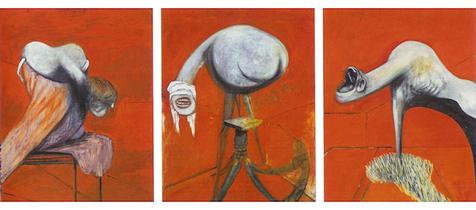
The crucifixion paintings are made the centrepiece here, granted a room all of their own. This breaks with the chronology and puts Forties and Sixties works alongside each other, providing us with the chance to compare them. If you want it in a soundbite, the Forties Bacon is the guy Ralph Steadman got it from and the Sixties Bacon Gerald Scarfe.

Traditionally paintings depict a timeless space or else embrace some form of narrative, but neither belongs here. The Forties paintings are not just rougher in execution, but have a writhing quality, a feeling of flux, as if the paint has almost not quite managed to pin down the struggling figure and place it in it’s cage. Perhaps this effect came partly from Bacon’s habit of working from photographs, they often have the sense of blurry motion photographs without attempting to reproduce the outward blur. This gives them the tension that propels them, as if the war of being was waging before our eyes with no hope of resolution. They’re given a dark and muted palette, reminiscent of a world of post-war austerity. Some are so dark you peer into them like caves, your eyes attempting to adjust to the gloom. These are the drab screams.

Later works are both bigger in scale and more detailed, but in a different sense are starker. More plastic, they have a forensic quality, like joints of meat trapped inside shrink-wrap at the supermarket. They sometimes depict wounds but often look more as if the skin surface had somehow been rendered transparent, becoming a mere bag of bones and organs. (Eliot’s “skull beneath the skin.”) The figures are less often monstrously ambiguous and more often ‘distorted human’, with faces in particular looking like a cross between Picasso’s Demoiselles d'Avignon and a fairground hall of mirrors. Palettes become more vivid, in fact just plain louder.

The exhibition offers an explanation for this change in style, which it saves for a later room. It transpires that, on visits to Tangiers, Bacon had found the light a revelation and reacquainted himself with van Gogh. There’s even an imitation van Gough of his on show (dated ’57), which is poor in itself but arguably significant in spite of that.

But is there another explanation? Could it be that in the Sixties society went into colour and Bacon, not wanting to get left behind, abandoned his drab screams with their rationing-era hues? This suggestion isn’t necessarily as cynical as it may sound. As we’re already seen, he was but one of many artists who subscribed to the myth he stood outside his time – and a myth was all it ever was. Having previously been so influenced by the preceding era, why would the next one not have a similar effect upon him? The zeitgeist is something bigger and more compelling than mere fashion, and even the strongest of steerers can find himself caught up in its sway.

Then again, let’s add a cynical twist. Though there are changes of imagery visible here, they are not huge. Many visitors might not even notice them. Bacon was literally an obsessive artist, painting and repainting the same images over and over. Perhaps the only thing left to him to vary was the style, the size and the colour the screams came in.

Of course the clincher is the value of the later works. Some are good, but overall the trade-off is a familiar one. Ultimately, they become plastic in the second sense of the word. They’re more polished, but the same time they polish over something of the vital force. They lose the sense of claustrophobia and convulsiveness that makes the earlier works so memorable. If the earlier figures were fascinating for never quite being pinned down, here they’re caught in a gaudy spotlight like failed jail escapees. Bacon was simply better when he was messier. The drab screams win out over the technicolour ones.

As things descend through the Eighties and Nineties the canvases grow bigger still – and the figures correspondingly smaller. A charitable soul might call these minimal, though semi-empty might be a more accurate term. Large geometric shapes start to appear and vie with the figures. Adrian Searle comments: “feel the disengagement – yours as well as his – setting in.” The busy gallery-goer can speed-visit rooms Nine (‘Epic’) and Ten (‘Late’) here, and not worry about missing much.


“A Gust of Cheap Magazines...”

How would Bacon compare to Philip Guston, whose own retrospective went on show a mere four years ago? (As covered in Ye Olde Printe Days of Lucid Frenzy!) There are striking similarities. They were not only defiantly figurative artists in an era of abstraction, but had similar themes and obsessions. At times they even share motifs, such as the dangling lightbulb. They can even seem to swap them, pointy red arrows hovering around details of interest might feel like a Guston device but actually its Bacon. However, the chronologies differ markedly - by the time Guston reverted to representation (the late 60s) Bacon was over twenty-five years into his game. And of course Bacon never turned against abstraction, he merely decried it from the start. But perhaps the real difference between them is something else, which we’ll approach sideways.

The Telegraph’s Richard Dorment sniffs “his attempt to symbolise the human condition might appeal to an adolescent or a fan of science fiction.” But this snide comment actually brings up an interesting point. Bacon’s influence on popular art feels huge, you see echoes all around you in Scarfe, Giger, Clive Barker and many others. But for someone so influential, Bacon himself seems to have been paradoxically uninterested in popular culture. While you can’t miss the Bud Fisher in Guston (to the point where he’s been accused of plagiarism), Bacon’s corresponding totem would have to Velazquez. He may have used photos of low culture events (such as boxing), but his work transformed them out of recognition. Dorment typifies the art establishment ‘s disdain for Bacon, as someone they saw as a showman and cheap populist. But, from his insistence on his works being shown behind glass to his retrogressive disdain for abstract art, Bacon saw himself as a Proper Artist. He may have tried to escape the cage of flesh, but never the snare of capital-A Art.

Guston’s dallying with low culture game him a vibrancy and a shot of humour which (however black) is missing from Bacon. The handouts claim “he faced death with a defiant concentration of the exquisiteness of the lived moment”, but that’s merely auto-luvvie-seak. This show ends with a figure stepping away from the viewer into a black square. It’s like Malevich upside-down, the geometric shape representing not eternity but nothingness – the end of a struggle which could never be won. Bacon might have opened the door to so many followers, but could only close his own.

The Tate's on-line guide has a nifty interactive 'explore' function for following the show virtually. This may be handy if you don't think you'll make the show. However, it's so thorough, if you are thinking of going in person, you're probably better off not clicking on it until afterwards.