googlee7ea825f63edb3f6.html

Saturday, 29 January 2022

“THE VOICES OF THE STRICKEN”: CAMUS’ ‘THE PLAGUE’


Continuing my extremely irregular series on Existentialist novels, I somehow had the bright idea that Albert Camus’ ‘The Plague’ might be a good way to take my mind off contemporary events…

”It was undoubtedly the feeling of exile – that sensation of a void within which never left us, that irrational longing to hark back to the past or else to speed up the march of time.”

Published in 1947, Camus’ account of the bubonic plague striking the (sort of) French town of Oran is normally taken as a metaphor for the recently concluded War. Which was spanned in the Road To Freedom trilogy written by his (sort of) compatriot Jean-Paul Sartre. (Looked at here, here and here.) And, like Sartre, Camus had been involved in the Resistance.

But this reading is one of those fine-sounding ideas which falls apart on inspection. It seems to come down to one passage:

“He knew what those jubilant crowds did not know but could have learned from books: that the plague bacillus never dies or disappears for good; that it can lie dormant for years and years in furniture and linen chests; that it bides its time in bedrooms, cellars, trunks, and bookshelves; and that perhaps the day would come when, for the bane and the enlightening of men, it would rouse up its rats again and send them forth to die in a happy city.”

Which does bear a resemblance to something we know to be about fascism, Brecht’s epilogue to ’The Resistible Rise of Arturo Ui’:

“The world was almost won by such an ape!
“The nations put him where his kind belong
“But don’t rejoice too soon at your escape
“The womb he crawled from still is going strong”


But there are obvious reasons why Brecht would dress the Nazis up as Chicago gangsters, just as there were for Arthur Miller to relocate McCarthyism into the past. What benefit lies in dressing Nazis up as a disease? Doesn’t it sound, if anything, like a metaphor a Nazi would use? Moreover, Sartre was happy to talk about them directly. Why wouldn’t Camus do the same?

Fascism is political, historically contingent. As Camus knew, it can fall. As we now know, it can rise again. Plague - at least as portrayed here - is a recurring inevitability, part of the fabric of things which you adjust yourself around.

In fact, Sartre presents Nazis but is not especially interested in them. He is not writing historical novels, even if they have a historical setting. Instead, both writers use a destabilising external event (whether plague or war) solely to provoke their characters into reaction. Their interest lies in that reaction, not so much in the cause.

There are, however, important differences between the two. Sartre strives as hard as he can to get inside individual heads, showing events only through their eyes. Whereas Camus has written a character study of a town more than any of its inhabitants, which characters introduced largely so there can be someone there to describe it to us. While Sartre kicks off with his author surrogate Matthias, for his first chapter Camus doesn’t even feature an individual character. And he frequently returns to a wide-angle view of the town. Significantly, two of his cast are outsiders. When we first encounter Tarrou we’re told nothing other than his observations of the townspeople, as if he’s going to be our camera.

Not, Camus is at pains to tell us, there is much to see in Oran. The portrait is more unsparing than flattering. It’s distinguished by “ordinariness” and “banality”, a featureless landscape without even trees to break up the endless white. And its population are equally distinguished by habit. A Jesuit priest sermonises that the plague is due to insufficiently devout behaviour, a theory treated much as you’d expect. But the suggestion the townsfolk had the plague coming in some way or other is persistent, mostly remaining a lurking suggestion but sometimes breaking cover:

“It was as if the earth on which our houses stood was being purged of its secreted humours - thrusting up to the surface of the abscesses and pus-clots that had been forming in its entrails. You must picture the consternation of our little town, hitherto so tranquil, and now, out of the blue, shaken to its core, like a quite healthy man who all of a sudden feels his temperature shoot up and the blood seething like wildfire in his veins.”

(It’s not my main interest to compare Camus’ fictional plague with our actual one. But this does seem reminiscent of Benjamin Zephaniah’s recent comment about our returning to normal - “normal is what got us here.”)

Further, it’s well known that Camus rejected the commonly applied Existentialist tag, preferring Absurdist. We tend to imagine Absurdist literature as outwardly fantastical, as in Kafka’s transforming beetles, or at least making no attempt to set itself in a plausibly real world, as with Beckett’s tramps. Absurdist becomes inevitably intermingled with absurd in the more colloquial sense. Martin Esslin, in ’Theatre of the Absurd’, defined it as “the open abandonment of rational devices and discursive thought.”

Whereas this is a series of quite plausible events set in a real town. For example, Rambert’s trying to break out of quarantine because he wants to see his girlfriend in Paris, a motive which seems almost too petty to make up. The book also cleaves to a strict chronology, chapters effectively crossing off the months of the calendar, April to February.

But Camus wilfully smears the the edges of this of this realist picture. How are we to parse, for example, Grand’s attempts to write a novel, a hopelessly Sisyphean task in which over endless attempts he only ever writes and re-writes his first sentence? It’s hard to accept this grand folly as realist. Yet it isn’t treated any differently to any of the other events, the text as dispassionate in describing it as the responses of the other characters. Such tastes of the Absurd aren’t common but they are present, a spice sprinkled into the overall grey flavour.

Tarrou and Cottard have their attitudes transformed by the plague, so suddenly in the latter case that I initially thought I was getting characters confused. Cottard gains a new lease of life from being thrown back in the community of men, while Tarrou shifts from observer to participant. And even though the effectiveness of his actions are questioned, this is something which seems close to the novel’s heart. Ed Vulliamy has argued in the Guardian that “the group of men gathered around the narrative represent, it feels, all human response to calamity. Each takes his turn to tell it.”

“Thus week by week the prisoners of plague put up what fight they could. Some even contrived to fancy they were still behaving as free men and had the power of choice. But actually it would have been truer to say that by this time the plague had swallowed up everything and everyone. No longer were there individual destinies; only a collective destiny, made of plague and the emotions shared by all.”

(Not a paragraph you can picture Sartre writing.)
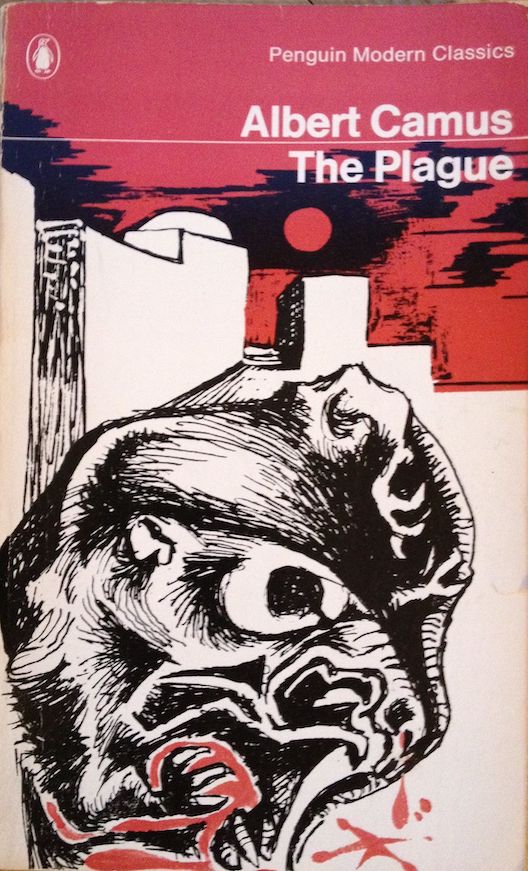

But there’s an ill-fitting piece in this picture, in fact a sizeable one. For nothing similar happens with the main character - Doctor Rieux. Less dramatically heroic than resilient, he trudges solidly from the book’s start to end, with an almost permanently affixed air of focused calm. And he becomes the thread. You soon come to feel that any character could come down with plague and be offed at any point, with the sole exception of Rieux.

His “severance from his wife”, who leaves town just before the plague hits, suggests that his personal connections went with her, leaving him permanently on duty. Quite late in the day there’s a scene where Tarrou opens up to him. But the event is noticeably one-way.

He insists “there’s no question of heroism in all this. It’s a matter of common decency…. the only means of fighting a plague is common decency.” And he must be this unfailing to match and counter his remorseless opponent.

“The narrator is well aware how regrettable is his inability to record at this point something of a really spectacular order; some heroic feat, or memorable deed like those that thrill us in the chronicles of the past. The truth is that nothing is less sensational than pestilence, and by reason of their very duration great misfortunes are monotonous. In the memories of those who lived through them the grim days of plague do not stand out like livid flame, ravenous and inextinguishable, beaconing a troubled sky, but rather like the slow, deliberate progress of some monstrous thing crushing out all upon its path… it was a shrewd, unflagging adversary, a skilled organiser, doing his work thoroughly and well.”

In what will seem a segue, let’s turn to Camus’ strange quirk of slipping between quoted and reported speech in dialogue, such as…

“Is it true” asked Character A, “that even though I am speaking to you directly you will respond in reported speech?”

Character B replied that they were indeed responding in reported speech.

He does this often, and often without any apparent rhyme or reason - but the most with Rieux. And he tends to do it most when Rieux is giving out some generalised pleasantry, or being placatory. For example:

”Do you think, Doctor Rieux, that the epidemic will get worse?”

Rieux replied that one could only hope it wouldn’t.


Rather than voicing his own thoughts, it’s a more widely applied version of the Doctor’s bedside manner. Which leaves us with a terse and private character, even from us.

As a quote above shows the Narrator repeatedly establishes their presence on the page. The Blog Post Author found this odd for a novel written after 1790. By this point the conventions of the novel had been well established, and could be taken for granted. Yet both Sartre and Camus, in this sense very much Modernists, accept none of this, and insist on rethinking things from first principles. One of which is the novel’s very existence. Someone must have witnessed these events, after all, for us to be told of them.

There’s a brief early reference to the narrator’s identity being revealed, and another at the end confirming this is Rieux. Which doesn’t exactly count as a spoiler. It’s more like one of those plot twists which has you responding “I didn’t know I wasn’t supposed to know that”. We may be glad that Camus didn’t go in for whodunnits. But, however eccentric, we may be better off focusing on how fitting this is. It’s less about giving us a diegetic reason for the novel’s existence than the role of that reason in establishing its tone.

….which is evocative and yet dispassionate. Rather than indulging in flourishes it captures images as sharply as defining legal clauses. (For example, the phrase “clubs where large sums change hands on the fall of a card.”) We’re told…

”The narrator has aimed at objectivity. He has made hardly any changes for the sake of artistic effect, except those elementary adjustments needed to preserve his narrative in a more or less coherent form.”

…while we’re also told of Rieux:

“The language he used was that of a man who was sick and tired of the world he lived in - though he had much liking for his fellow-men - and had resolved, for his part, to have no truck with injustice and compromises with the truth.”

Then later:

”This self-imposed reticence cost him little effort. Whenever tempted to add his personal note to the myriad voices of the plague-stricken, he was deterred by the thought that not one of his sufferings but was common to all the others, and that in a world where sorrow is so often lonely this was an advantage. Thus, decidedly, it was up to him to speak for all.”

In short, if Rieux is sometimes quoted through reported speech, the whole novel is a kind of reported speech. But if he often functions simply as a lens through which we might see the town, we get hints as to more…

Though set in occupied Algeria, this seems largely a convenience based on where Camus himself was based. (Though he didn’t live in Oran itself, most likely picked due to a more historic outbreak of plague.) The town needs only to be provincial to Paris, and could be shifted to southern France with little effort. 

However an exchange between Rieux and the journalist Rambert hinges on one word. Rieux asks if a proposed article on living conditions in the Arab quarter could be an “unqualified condemnation”. And when Rambert baulks at “unqualified”, Rieux’s reticence returns and he refuses further co-operation. The implication is that, there being no-one who wants to hear of this, it is pointless to say it.

Yet what is strong writing when considering the character of Rieux is pretty weaksauce as far as the locals go. If Sartre did not always present his minority characters terribly well, the lack of Algerians in a book set in Algeria is a little troubling. You sometimes wonder if the Spanish characters are introduced as a kind of half-way house, of twilight morality but still a slightly more respectable substitute for the natives.

There is a reference to quarantine driving up food prices…

“The result was that the poor were in great straits, while the rich went short of practically nothing. Thus, whereas plague by its impartial ministrations should have promoted equality amongst our townsfolk, it now had the opposite effect and, thanks to the habitual conflict of cupidities, exacerbated the sense of injustice rankling in men’s hearts.” 

…but who would most of “the poor” have been in occupied Algeria? It’s not hard to guess. But it’s not said aloud.

And while we’re at it, female characters do worse than with Sartre, in number or importance, which wasn’t a high bar to start with. “Self-effacement” is specified as a feminine virtue, one in which the gals here seem to excel. Rambert’s off-page girlfriend does appear briefly at the end, but is given neither a name nor any dialogue. (Though she is Parisian, so she may just be too snooty to talk to the locals.)

Here, then, Camus has Rambert’s fault and has not written an unqualified condemnation. Like Rieux, we shouldn’t fail to notice this. But unlike Rieux, we don’t necessarily need to cut off all co-operation. Within the parameters it sets itself, perhaps as provincial as the town setting, the novel’s a success.

Saturday, 22 January 2022

INTENSIFY THE CONTRADICTIONS (A POST-PUNK PLAYLIST)


My latest themed Spotify playlist, upping the ante on classic punk! British Post-Punk, a heady stew of off-kilter funk, dub and Dada, was probably the popular music movement most ruthlessly devoted to ripping itself to bits and rebuilding in a different order. Punk traded in instinctive outrage and slogan-sized certainties, Post-Punk sought to confound and intensify the contradictions. “I don’t know either” sang This Heat, “what is the answer?” (The apt title phrase is from Simon Reynolds’ ‘Rip It Up And Start Again.’)

New Age Steppers: Fade Away
The Raincoats: The Void
The Pop Group: Thief Of Fire
Orange Juice: Blue Boy
Josef K: Heads Watch
Wire: Practice Made Perfect
Gang Of Four: Return the Gift
Heaven 17: (We Don’t Need This) Fascist Groove Thing
23 Skidoo: F.U.G.I.
Fad Gadget: Back To Nature
This Heat: A New Kind of Water
…and The Native Hipsters: Ten Small Men With Buckets
Alternative TV: Release the Natives (live)
The Fall: Neighbourhood of Infinity (live)
Test Dept: Jerusalem
Public Image Ltd.: Another
Scritti Politti: Skank Bloc Bologne

...and more still to come, pop punters!

Saturday, 15 January 2022

THIS ERIC GILL STATUE AFFAIR AIN’T LIKE COLSTON (NOPE, NOT AT ALL)


For those who haven’t heard yet, this week a man attacked a statue outside the BBC’s Broadcasting House. At least ostensibly as a protest against the artist’s child abuse. And it’s true that Eric Gill abused his own daughters. Among others.

So soon after the Colston verdict, the tabloids lost no time in making comparsions. The Mail referred to him as an “activist” in their headline, one of their favoured smear terms. It is possible, I suppose, that the guy embarked on this after reading their reports, and assumed it really was open season on statues. If so, he’s soon to be disabused. But it will be the Mail and their ilk to blame for feeding him that disinformation, not the Colston jury.

It’s conceivable this was a far right stunt, a tit for tat. Should that prove true, provoking a prosecution would be the point. So they could say “see how the law favours the woke mob over us,” and all of that. They have a near-obsession with pedophilia which reeks of guilty conscience, they like to stick it to the BBC, and they have tried to put the two together before now. Some reports say the man graffiti’d ‘Noose all pedos’, and seemed especially exercised about chopping off the child’s penis, like that was the main cause of offence. If this is correct, we’ll most likely find out.

But either way, comparisons to Colston’s overdue bath are bogus. There’d been longstanding opposition to that statue in Bristol, a multi-racial city. And it came down in the midst of a large anti-racist demo, at a time Black Lives Matter events were going round the world. The cops picked out four people from the crowd because that’s what they always do, not because that’s a reflection of what happened. And when you live in a society as atomised as ours, building human community has its own value. While the Gill statue was attacked by precisely one man, plus an accomplice. You don’t get to chant “whose streets, our streets” when there’s two of you.

Furthermore, the whole idea of the Colston statue was that you’d look up at it and see a great benefactor, a man whose sharp mind and industrious nature had won him wealth, which he’d kindly bestowed on the people of Bristol. The fact that this stash of cash was based on slavery, on the wages he didn’t pay people, was figleafed. I reckon even I could get rich if I had a whole bunch of people working for me for bugger all. That statue was there to obscure history, which pulling it down revealed.

Gill’s work was often eroticised, and he used his daughters as models while still children. There’s no neat dividing line to be drawn between his art and sorry life. But, crucially, he was not a sculptor because he was an abuser, the way Colston was a bigwig because he was a slaver.

And there’s no public debate over Gill the way there is Colston. no-one is saying “child abuse may be bad by today’s standards, but that was back then”. I mean, if they wanted to be consistent, they would be. But they’re not.

Now me, I’m interested in British Modernism and the awkward truth is that Gill was a great artist. If a London gallery gave a show to him, provided his abuse wasn’t shield away from, I think I’d probably go. And it most likely wouldn’t be shied away from. Two recent(ish) London shows on Gauguin, at the Tate and National respectively, highlighted his sex tourism. (Art appreciation is a thorn bush of this stuff. The recent death of Ronnie Spector has reminded us just what a complete creep Phil was. While there’s no denying the value of the music he made.)

But when a statue’s outside a public building, there’s little opportunity for context. Art, some of us like it. But that doesn’t mean aesthetic quality trumps political concerns. Art isn’t above life, but part of it.

So, you may be asking, do I think it should come down?

The question is misconceived.

These things get framed the same way that dodgy police behaviour does, as bad apples, exceptions to the rule which must be weeded out. But Britain’s current wealth stems from the British Empire, which was built on slavery and colonialism. The only forms of brutality it didn’t use were the ones that hand’t been invented yet. For example, female slaves were commonly raped with impunity by their ‘owners’. The notion of assembling a shopping list of statues and artworks that need coming down, in strict preference order, fails to comprehend this. The problem is structural and endemic.

And ultimately I agree with Gary Younge, the right answer to the question of who should get a statue is no-one. Even people I admire. It smacks of heroism, of the discredited Great Man theory of history. We don’t just have different Heroes Galleries to them. We don’t think like them at all.

If there was a groundswell of local support to this statue going, I guess I’d go along with that. As someone-or-other said recently, solidarity is a verb. But without that… well, it’s not exactly a priority, is it? Aren’t living, breathing people more important than lumps of stone and bronze? Tory cuts have closed women’s refuges and denied legal aid to domestic violence victims. Cops have attacked women’s vigils. We all know this. Opposing all that somehow seems more important right now. Something to try next time, two shouty blokes with a ladder?

Saturday, 8 January 2022

IN THE EIGHTIES WE WERE EDGELORDS (SADLY BUT TRULY)

For the three or four people who might still care about Eighties subculture, and how it led to things now. Hopefully not too late for New Years Resolutions.


Back in October Steve Albini, ex-frontman of the somewhat infamous punk band Big Black, posted a series of Tweets which included the phrase: “I'm overdue for a conversation about my role in inspiring ‘edgelord’ shit.”

I’m a Big Black fan from back then. In fact I’m a big Big Black fan. So let’s ask the question out loud, just why did we think it was so punk to listen to those lyrics? “I would like to wrap your hair around your neck like a noose.” Or “she's wearing his bootprint on her forehead”?

At the time, I knew the answer. Misogyny was rife, domestic violence not just widespread but unstated. (The police then had an openly stated policy of not involving themselves in “domestic” cases.) And the saccharine cutie-pie world of pop songs, with all that “I love you true” and “moon in June” business, seemed just a pretty painted screen being unfurled in front of a pretty ugly reality. Providing everything stayed shiny on the surface, things were supposedly fine. We wanted to kick that screen down, in its feelgood hypocrisy, to make ugly music for ugly times.

More widely the nature of our society effectively determined stuff like that was going to happen. This wasn’t just something to oppose, it was a signifier of all that was wrong. We lived in a society based around violence, which encouraged you to use that violence, expending yourself anywhere that wasn’t against the powers that be.

Albini himself said: “If things like this remain unspoken, the thinking doesn’t die, it spreads sub-cutaneous like a fungus, making everything sick. To exorcise this kind of thinking it has to be stated plainly.” Thomas Hardy had said many years earlier, “if a way to the better there be, it exacts a full look at the worst.” And I still think both are right.

Big Black songs often employed the old Velvet Underground device of using a first-person protagonist, throwing the listener into an extreme situation with no guides or hand-holds as to how they’re supposed to be reacting. Which inevitably led to many not getting it, of thinking these songs encouraged such behaviour.

And if questioned, we would respond with derision. The same derision you’d use for a clueless know-nothing who didn’t know who the Velvet Underground were.

And in one way, it did all make more sense back then. Back then, subcultures more occupied their own spheres, like conceptual neighbourhoods whose bounds you stayed within. Which meant you weren’t likely to encounter Big Black without encountering Punk subculture, which gave the content a context. It wasn’t the situation where, for example, the lyrics would get pinned up on the internet divorced from the music. And it was partly the context of music, which made it clear those words were supposed to sound not triumphalist but fucked up.

Let’s look at this from another angle, just for a second. At the time, I was equally involved in comics fandom. A subculture which had little-to-no interest in shock and provocation, which if anything was rather desperate to ingratiate its chosen medium into respectability as an artistic form.

At one point I wrote a piece for the fanzine ’Vicious’ in which I recounted my reading my first Marvel comic. The villain, a Fu Manchu knock-off called the Mandarin, I described as a “scheming oriental”. Something I couldn’t have meant any less as a swastika armband. I was assuming two things; that even if I didn’t know personally everyone who would read it I knew comic fans, knew the sort of people they were, knew they were (broadly speaking) my sort of people. And that the whole Yellow Peril trope was, when stood up in the modern world, patently absurd. To the degree that shining a light on it was clearly enough to knock it down. And no-one ever questioned me about that at the time.

And that’s the thing. We were… ahem… somewhat over-optimisitic about a marginal music movement’s capacity to deliver social change. But in many ways I’m the person I am today largely because of the person I was then. What I question in retrospect… partly, it’s the certainty.

Back then, I blithely assumed that as soon as the sign was hung on the squat centre door, the one which decried racism, sexism and homophobia, it exuded a talismanic power to banish those things. I noted that I’d never experienced any of them, not thinking there may have been a rather obvious reason for that. I was young and excited to find myself amidst this radical counter-culture. It was a gift horse to me, and I wasn’t keen to start poking it about in the mouth. So those provocative songs, designed to make people stop and think, didn’t actually make us stop and think very much. We just figured they had messages for other people, even as they played to our scene.

And that unquestioning seems in retrospect a little too reminiscent of the over-familiar cry “but I’m a nice guy”. The problem with which is obvious – everyone likes to imagine they’re a nice guy rather than a horrific monster, and cognitive dissonance usually aids them in believing it. Harvey Weinstein still seems to believe a short stay in a de luxe clinic gives him the right to a “second chance”. Harvey... guys... you want a handy hint? You really want to know if you’re a ”nice guy”? Maybe ask those who have to interact with you.

But, and this is both the bigger and the bitterer part of the picture… Those people who would freak out at my listening to Big Black, sure I’d argue back at them. But at the same time they were giving me precisely what I wanted. There are lots of things driving you when you’re young, but the drive to not be understood is some way out in front.

When others don’t get you, that must mean you are smarter than them, ahead of them, brimming over with fascinating depth. Our scene was outwardly aggressive and nihilistic, wearing it’s positivity very much on the inside. I doubt that was entirely co-incidental.

Which brings us to politics…

Big Black might not be the best example, but radical subculture frequently spilt over into radical politics. Back then, truth to tell, for many of us it was the one path there was to follow. Like Henry Ford’s cars, you could have any politics you wanted provided they were black. Labour were the Tories’ mini-me, Trot groups like the Socialist Workers Party a cross between a cadet force and a cult, marching in line to a gulag. Anarchism was the only show in town you could bear to sit through.

And central to politics, surely, is winning others over to your point of view. It may not matter much if not everyone gets the record you put out, you may even want them not to. Whereas you might think a political magazine would work differently. Not so, it seemed. In fact it was the very the opposite – our politics was more tied to shock tactics than our subculture.

True, it was less about exposing domestic abuse than stressing the necessity of political violence. But the same game was being played. Anarchist magazines paraded titles such as ’Boot ‘em’, ‘Attack’ or – our local example – ’Brighton Bomber’, and traded in confrontational imagery often with the thinnest of ties to any context. To the point that today edgelordery is often seen as central to Anarchism, if not the very essence of it. Whereas for much of Anarchist history it wasn’t a significant feature at all.

After seeing Shellac, Albini’s current band, I commented on the difference twixt then and now: “Big Black were rooted in their Eighties era, holding a truth-telling mirror to Reagan America’s dark underbelly. Whereas Trump’s America wears that dark underbelly on its face, and the last thing it needs is further exposure.”

And Albini himself tweeted: “For myself and many of my peers, we miscalculated. We thought the major battles over equality and inclusiveness had been won, and society would eventually express that, so we were not harming anything with contrarianism, shock, sarcasm or irony.”

Whereas these days, there might as well be ‘How’s My Edgelording?’ bumper stickers. In the famous saying, in our times it’s now the bourgeoisie who shock the avant-garde. When someone as mainstream as a Guardian art critic, that total fuckwit Jonathan Jones, goes in for it you’d think folk would finally wise up that edgelordery isn’t really that edgy any more. But it seems not.

Now it would be nice to be able to argue that once the alt.right started using our tricks, we wised up. But that wouldn’t really be true. Certainly when I was still at school my classmates (using the term in the loosest definition) included fascism-fanciers. And part of its appeal to them was clearly that it seemed thrillingly too cool for school. Their edgelordery always mirrored ours, theirs has just gone more mainstream now.

So here we are, with Gamergate, Comicsgate and those other similarly festering piles of shit. I simply can’t imagine writing a line like “scheming Oriental” on the internet today, and blithely expecting it to be seen as an expose of racism. Not because the world has moved on. But precisely because it has moved backwards.

Significantly, back in those days we didn’t even have a term for edgelordery. Just as the Ancient Greeks didn’t have one for religion, because they assumed it to be all-pervasive. Spotting and defining the disease is normally part of the cure.

It may scarcely need saying that now is not the time for these antics. It may be more important to explain how it ever was. But just in case - now is not the time for these antics. From now on, we can be pinning our own colours to our own mast. How about we say we don’t think that society should be run to further enrich a few billionaires? That probably counts as edgy nowadays.

Post-Script: The role of edgelordery in the Industrial music scene is still more entangled, with some bands becoming direct precursors of the alt.right. But, less involved in that scene, I’d have less to say. This piece by John Eden is interesting…

Sunday, 2 January 2022

‘BLOOD ON SATAN’S CLAW’

Townsfolk, beware! For both PLOT SPOILERS and discussions of sexual violence reside below


“Doctor, witchcraft is dead and discredited. Are you bent on reviving forgotten horrors?”


It seems we are.

’Blood On Satan’s Claw’ (1971) bombed on release but has come to be seen as a classic of British folk horror, forming an unholy trinity with ’Witchfinder General’ (1968) and ’Wicker Man’ (1973). But, for a moment, let’s compare it to something else, which we’ve already looked at here. ’Suspiria’ (1977) has completely the opposite aesthetic - lavish interiors in rainy nights versus the Spring light and verdant great outdoors. But however much their aesthetic varies they’re equally dominated by their aesthetic.

In fact, both can feel that the ‘plot’ is little more than a succession of images, a washing line over which that aesthetic can be draped. And both can feel like exploitation flicks inexplicably filmed in the style of an art movie, as if in some admin error the script got posted to the wrong director. (Try imagining a more garish film title than this, it isn’t exactly ’The Innocents’ or ’Dead of Night’.) This strange friction creates something rather giddyingly unique, leading to films that can’t be pinned to categorisation any more than they can be reduced to sense.

Dreams can involve an air of unease and foreboding, almost unattached to the images and incidents. Translate that into waking life, and the unease seems… well, uneasier for having no apparent focus, and thereby seeming so all-pervasive. Again, this is true of both films. But possibly truer here, where that air of dread attaches itself to - of all things - bucolic country settings.


But perhaps above all, that exploitation flick basis leads to problematic stuff which can’t just be wished away, industriously snipped out by virtuous censors to spare our sensibilities. That stuff’s built in, we’re kind of stuck with it.

Which doesn’t mean that the bad stuff isn’t bad. Dodgiest Depiction of Rape in Seventies Cinema is a much-coveted cup, but the infamous scene here is in the running with ’Straw Dogs’ and ’Clockwork Orange’. As this company might suggest the problem isn’t that its a rape scene, but how it’s a rape scene. Like all genuinely troubling things it seems unaware how troubling it is, rather it thinks it’s being racy and enticing.

Even if ‘fridging’ wasn’t a formal term yet, the interest is clearly not in the victim but the perpetrators. Officially, we may be supposed to disprove of them so getting off on it. But that hardly fits with the scene being so exultantly extended. It’s known that, originally unscripted, it was essentially improvised. And it feels like the crew were as carried away, as indulgent of their worst impulses, as much as the coven within the story. (Director Piers Haggard has subsequently conceded the scene goes too far.)

Then there’s the context, where it’s stuck in the same film as two voyeuristic nude scenes. (Even if, small mercies, there’s no explicit nudity in the scene itself.) Plus the bizarre combination of it and the scene of a man being falsely accused of rape, and immediately presumed guilty, like something out of Men’s Rights Advocate propaganda.

But as always with this taboo-busting stuff, the telling thing isn’t what’s told but what remains unthinkable. It less breaks new territory than shows up where the limits are. While women are raped and murdered to please the Devil, men are just murdered, and notably less lingeringly. Yes, he’s the Prince of Evil but that doesn’t mean he’s… you know… funny or anything.

Just like this troubling scene, the film both gains and loses from its eccentric narrative, so full of leaps and gaps its effectively comprised of them. This is partially because it was originally planed as a portmanteau of three short stories, with the decision to fold them in together made late. In Horrified Magazine, David Evans-Powell sums this up well:

“There is something of the country tale about the slightly meandering structure, the hint of a folktale told rather than history written… The looser plotting and structure also complement the sense of unease and foreboding…. while the focus of action shifts abruptly, hinting at a threat that is genuinely unknowable.”

Imposing order on it feels like something the Judge would do, an act of violence in its own right. (More of which anon.) But we need to cobble together some sort of narrative to fix on, or the film will simply slip through our fingers. Of the three tales, it’s the thing-in-the-attic tale which most shows up its original anthology origins and is effectively encapsulated - over and done with while the main plotline is still getting going. You could imagine it edited out reasonably easily, so let’s disregard it here. Which leaves us with…

Ralph, a stout-hearted farming lad stumbles upon some remains while ploughing. He’s alarmed to find they look non-human, he describes them as of “a fiend”. The skull is bare bones, but somehow still with an intact eyeball. Which, in a grisly affectation, has a worm crawling over it. (An image which I don’t think will ever leave my head.)


But when he shows them to the Judge, as is the way of these things, they’re gone. Except this isn’t some supernatural disappearing act. Other youths of the village have found them, and study their treasure when they should be paying attention in Bible class. (The bits of bone they have don’t seem to resemble anything Ralph found. But we’ll need to get used to that sort of thing.)

They then become rapturously possessed by dem bones, starting a cult under the charismatic and comely leadership of the ironically named Angel. While the ‘fiend’ is shown to have claws, there’s a a moment where Angel lasciviously sniffs the blood on a pointy murder weapon. My fan canon reading of which is that though this it’s her which is the Satan’s claw of the title, his implement, enacting his will.

Linda Hayden perfectly captures the combination of innocent maiden and alluring temptress. It’s unarguable she needs her looks to carry the role, but it’s her performance which sells it. There’s no point you question why she’d have followers. (She’s so good I looked up what other film she’s been in. Mostly it was ’Confessions Of a Window Cleaner’ and its sequels. Guess that was the Seventies…)


It’s suggested at points that this contagion is physical, like a werewolf’s scratch, and at others that it’s social and based around her anti-preacher charisma. She attempts to seduce the Reverend, and when he doesn’t succumb then has him arrested by claiming he molested her, both plans to disable the rival flock-gatherer.

Initiates soon become victim or perpetrator, in seemingly random order. Rape and murder gives the Devil (let’s assume it is the Devil) the power to re-constitute himself. Again this seems fuzzy. They have to be murdered. But also the victims have grown a patch of hair, referred to as “Satan’s skin”, which has to be flayed off them and (presumably) handed to him as if stitching someone together like a patchwork. “He had the Devil in him”, Angel tauntingly explains, “so we cut it out”. (The film has the sense to keep the Devil figure largely off-screen, implying such stuff while not inviting us to worry about the logistics.)

Like ’Suspiria’ the young people seem to be of some indeterminate, ever-shifting age, attending class, playing child games, yet old enough for betrothal. There’s not much point wondering what Linda Hayden’s full-frontal nude scene is all about, it’s about the ticket-buying public getting to see Linda Hayden nude. But it also shows us just how close this “Satan’s skin” is to female pubic hair. Its arrival is associated with bodily pains, like PMT.

Evil and puberty are essentially conflated, Angel sensualising and sexualising her subjects. Disciple Betty has her Devil’s skin cut from her in an attempt to make her goodly and innocent again, but it’s like shaving an adolescent’s nether regions hoping the child will come back. And this parable gains extra resonance in these fecund rural surroundings.

Angel’s antagonist is the Judge, who formally occupies the same role as Van Helsing in Dracula, bringing learning and authority to the problem. He first accepts the Devil’s existence not from the evidence of his own eyes but the authoritative pages of a book. But there’s little attempt to portray him sympathetically, in fact there’s every attempt to treat him as stern, authoritarian and indifferent to the suffering of others. We first see him denying the newly betrothed the chance to get together. And his followers can seem as bad as Angel’s, willing to drown an innocent woman in their search for a witch.


And he says this:

“You must have patience, even while people die. Only thus can the whole evil be destroyed. You must let it grow."

…after which he pops off to London for a while. As they say in film criticism, “you wot mate?” True he rustles up a pious posse while there, but that would hardly take long for a toff with the money to pay them. The standard interpretation of this seems to be: “I am heading off-stage now, the better to effect a dramatic entrance a bit later.” Which seems hard to argue with. But let’s try and engage with it a little.

Partly, it suggests the Devil has to take on some semblance of form to make himself a target to be aimed at. But perhaps the Judge goes to London for the same reason Angel takes to the fields, because that’s his place - the centre of his psychic energy. (His temporary residence in rural life is contrasted to the local Squire.)

Since industrialisation popular culture has tended to see the City as Babylonian, the centre of sin, while small towns and the country are the repository of good homespun values. If Haggard takes precisely the opposite tack, he’s said

“I grew up on a farm and it's natural for me to use the countryside as symbols or as imagery. As this was a story about people subject to superstitions about living in the woods, the dark poetry of that appealed to me.”


He’s also spoken of “the sense of the soil”, of how the film crew were forever digging pits to place the camera as low as possible. As if the Devil wasn’t just found in the raw earth, but generated by it, his buried remains simultaneously a seed. As Sparks in Electrical Jelly say: “It lends the impression that the surface of the world is provisional, a thin skin with deep, accreted layers, both geological and temporal, lying beneath. Forces long-buried and all-but forgotten spirits may worm their way to the surface and re-emerge.” Evil isn’t the losing force in some climatic conflagration but cyclical, like the soil which begat it, so can never be finally defeated.

Instead the characters your sympathies you go to are the villagers, like civilian casualties caught in a Manichean war, who inevitably end up shot by both sides. Ralph becomes our protagonist by default, even if he fails about every test of a hero - precisely none of his actions are successful. But perhaps the clearest example is Betty, unwillingly shorn of her devil’s skin, who ends up with a home in neither camp.

Which makes a good point. It’s often said that this film couldn’t have been made at any other time than the post-Manson-killings era, after Sixties optimism soured. But what about us, now? We hardly need be told over again that hippie thinking was over-romanticised. And if we limit ourselves to this as an explanation, as if it ‘solves’ the film… then, well, we’re limiting ourselves, aren’t we?

The provincial rural location in a pre-industrial time, the endless references to the earth, at the same time specify a time period and create a sense of timelessness. Perhaps it was always like this, life as a perpetual clash between id and ego, with regular folk such as you and I trapped betwixt and between.

This was not just a folk horror film, but the one whose release gave the name to the genre. And isn’t this the essence of folk horror? That the past, folk customs and nature (inasmuch as they’re separable things) are both incomprehensible and inescapable? It’s not Gothic castles in distant lands where the darkness lies, it’s the woods and fields which surround our semis.

Perhaps that’s why the ending feels so inconclusive, for wars without end don’t lend themselves to ending. Which of course raises the question “how would you have done it then, smart arse?” There are various answers, all of which fall under the heading ‘openly’. How about this? We see the melee between coven and pious heavies, which seems to be raging fiercely but inconclusively. Then the camera slowly starts to pan away, across open country, the battle cries subsiding, and finally focuses on a bird catching a worm. The eternal struggle.

Saturday, 18 December 2021

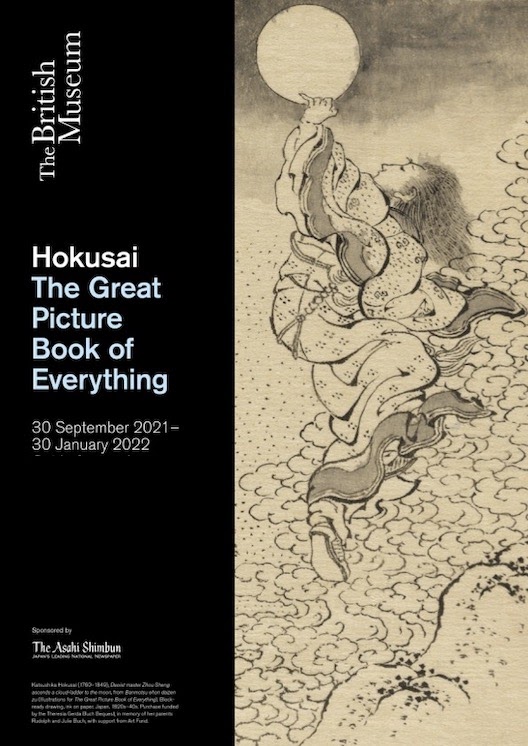
‘HOKUSAI: THE GREAT PICTURE BOOK OF EVERYTHING’

British Museum, London


“Hokusai has produced everything from Daoist immortals, Buddhist Gods, scholar-officials and women, to birds, beasts, plants and trees. Nothing is lacking. He captures deities with a wave of his brush.”
- From the preface to ‘Hokusai’s Sketches’, 1814

So the British Museum is back with the great Japanese print artist Hokusai, just three years after dedicating a large show to him. Which, in exhibition time, is no time at all. All due to a trove of original art, which recently turned up. And that’s more remarkable than it sounds…

From my days in comics fandom, folk were ever-keen to see original art. It could offer valuable insights into a creator’s intentions and working methods. This is a rare chance to do the same for Hokusai. In fact, exceedingly rare. The working method for prints back then was for the engraver to trace over the artist’s linework when carving into the block - creating an accurate reproduction but destroying the original. ’The Great Picture Book of Everything,’ thought to have been created between the 1820s and 40s, only survived because it was never published. We get to see this stuff precisely because his contemporaries didn’t.

You inevitably miss his use of colour, so bold and expressive. And it is a surprise to discover the size of his originals, or rather the lack of it - they’re smaller than your hand. It’s a little like imagining you’re going to see a film in cinemascopic technicolour, only to find it’s showing on an old black-and-white TV. A few are blown up onto banners, and the show even makes a point of telling us “the composition would retain its integrity on almost any scale”, but there really should be more.

As the name might suggest, this seems to have been somewhere between an encyclopedia and a Boy’s Own annual. Charmingly, it seems to make no distinction between scientific observation and myth, but bounces readily between them.

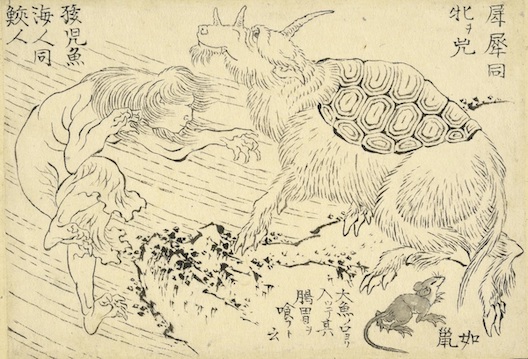
Unusually for Hokusai, but presumably because of the brief, the drawings are of figures rather than environments. Some you can even picture in an encyclopedia, ’Various Minerals and Shells’ for example is diagrammatically functional, with each individual element carefully labelled. While many are pairings so bizarre you’d think you’d wandered into some Surrealist show - ’Donkey and Seahorses’, ‘Phoenix and Peacock’, ‘Rhinoceros and Merperson’ (below), and so on.


Foreign travel was then banned in Japan, and it’s thought Hokusai never even visited its outlying islands. So when he draws things he knew to be real but wouldn’t have seen next to the entirely mythical, it’s hard to know how to respond. We’re told, for example, camels had been brought to Edo (Tokyo’s historic name). But when he depicts a rhinoceros with a shell on its back? Popular misconception, perhaps based on the notion they were related to dinosaurs? Personal artistic metaphor? Pure guesswork? Most likely, we’ll never know.

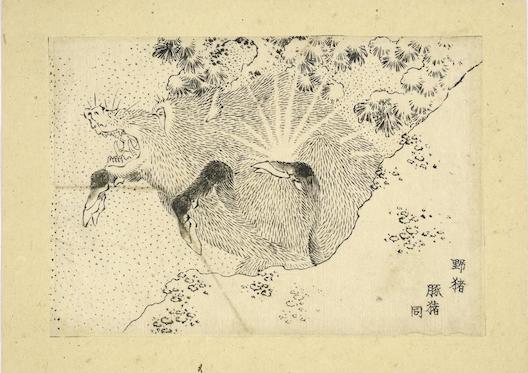
Some drawings seem executed almost like cave art, seeking more to convey the essence of its subject than place it anywhere. While others are more captured moments, such as ’Wild Boar Hunted And Shot in the Snow’ (below).


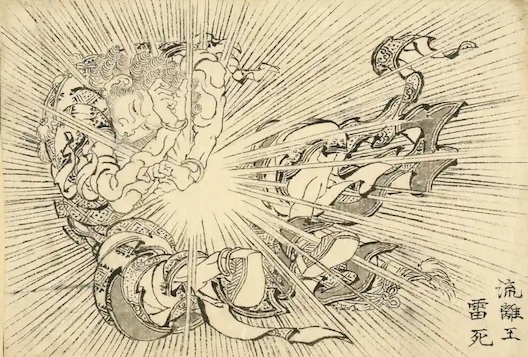
The show makes much of Hokusai’s ability to portray motion, pointing out ’A Bolt Of Lightning Strikes Virudhaka Dead’ (below) “prefigures modern manga by about a century”. Motion lines probably arose in Western comic art independently. But here they were normally used more sparingly - as flourishes, embellishments to an otherwise integral piece of artwork, like accents can only exist around letters. Whereas in Manga, they can - and do - dominate the artwork. Here, we see the radiating blast lines almost before the figure. We’re also told Hokusai distinguished between three speeds of brush stroke - formal, informal and rapid. (With ‘formal’ meaning something like ‘deliberative’.)


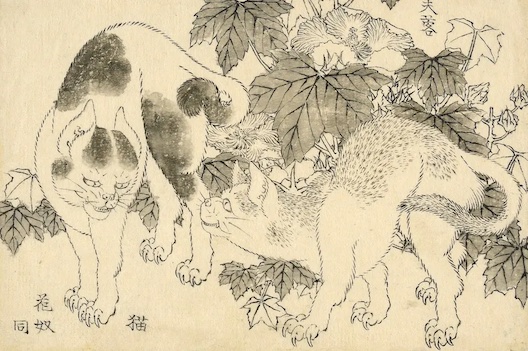
But there’s a twist to this. First he displays poise as well as he does movement. For example ’Two Cats By Hibiscus’ (below) accurately captures an arch-backed feline stand-off. Action scenes normally scrimp on detailing incidental objects, fearing they might distract, pushing them to the periphery of attention or eliminating them entirely. Whereas here the leaves of the bush are given as much detail as the two protagonists, as if Hokusai has no hierarchy of interests, his scrutinising eye being all-expansive.


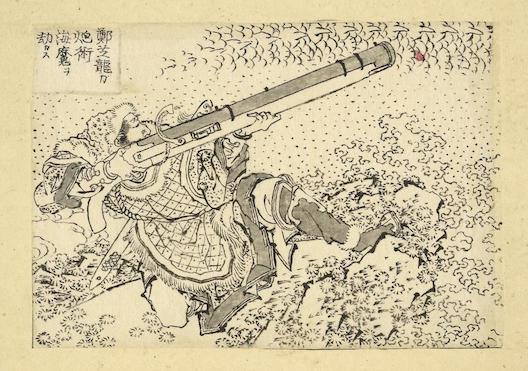
And at times Hokusai isn’t just comic art but out-and-out comical. In ’Zheng Zhilong Threatens A Sea Monster With A Gun’ (below) our hero struggles with the weight of an impossibly massive blunderbuss, which straddles most of the frame and leaves no room for the sea monster he’s theoretically threatening.


Given the brief, the show potentially tells us as much about the culture of the time as the brushwork. Though how much that culture we’re getting raw and how much is being filtered through Hokusai’s sensibilities is anybody’s guess.

And so what’s absent can as interesting as what’s present. And what’s most obviously absent? That would be us. Japan was by this point trading with the West, but holding it at arm’s length. Instead China and India appear aplenty.

Now the smartarse kids of my schooldays were keen to tell you that the popular Japanese shows ’The Water Margin’ and ’Monkey’ were actually based on Chinese legends. Which, given the subject matter here, seems pretty typical.

It’s an arguable point that civilisation effectively spread from China to Japan. (Tea and rice, for example now seem staples of Japan but originated in China.) Just as is spread to Britain from the continent. And Britain has been permeated by Greek myths and culture, in a way it hasn’t by, say, Egypt. The British Museum building itself is evidence of this, with its iconic columns and all. 

Yet Japan seems much more preoccupied by China, as if it were the home of mythic time. An English-language Boy’s Own book would doubtless retell Greek myths, between gung-ho accounts of Trafalgar, taxidermies of birds and so on. But it would be understood those myths were not literal truth. This book of everything does seem much more a book of everything.

Why might this be? I’d honestly tell you if I knew! Perhaps some clue is the strong association of China with Daoism. Perhaps ancient wisdom always has to come from somewhere else, not the workaday world we inhabit.

And the India drawings have if anything a still-heavier emphasis on religion, this time Buddhism. (It’s thought both religions reached Japan before the development of Shintoism, despite the latter being native. We know Hokusai had his own Buddhist shrine.) And in the West Buddhism is associated with peaceful meditation, with looking inward not worldly change. It’s sometimes even used as an interchangeable term with pacifist.

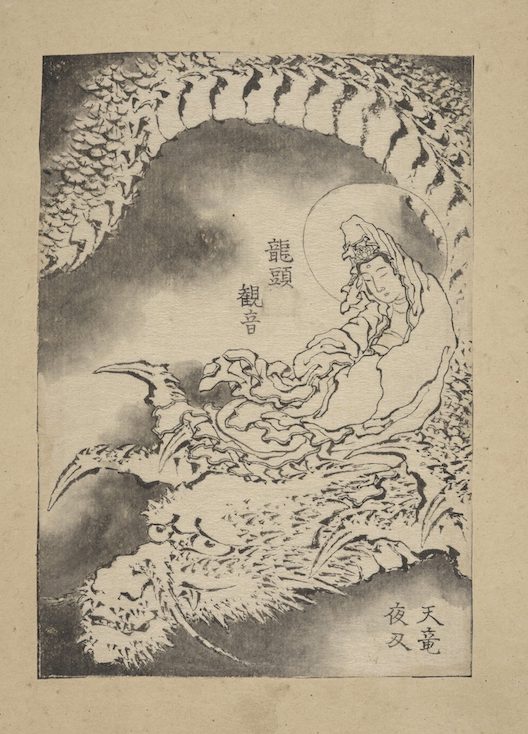
Whereas these drawings are often of warriors! ’Buddhist Guards With Buddhist Sayings’ displays the sayings with some weapon-toting guards. Whereas AvalokiteÅ›vara is shown in the eyes-closed meditation pose so familiar to us, but seated above a flying dragon (below).


The small number of finished prints prevents this from being a good introduction to Hokusai. Apologies to those hearing this now, but that was really the earlier show. But for those of us who saw that, this is a worthy sequel which does expand your knowledge of a great artist important not just to Japanese, not just to Eastern but to world art history. 

There’s a companion mini-exhibition of, I kid not, Hokusai NFTs. I tried to not let that dampen my mood too much…

Saturday, 11 December 2021

“THEY WANNA MAKE AN OUTLAW OUT OF YOUR NEEDS” (A PLAYLIST OF CLASSIC PUNK!)


After looking at it’s Seventies East Coast roots, we reach that Punk kind of Punk! As Spotify provides us with seventy minutes of sonic reduction, bad attitude and sick humour. (Because punk had humour, so-o-o much more humour than official accounts made out.) From the time when a song seemed your three-minute chance to change the world. Like the man says, don't need no-one to tell me what I don't already know.

(The illo’s of the ever-awesome Guerilla Girls, who may not make music but are more punk in attitude than most mohawked no-hopers.)

Eddie & the Hot Rods: Do Anything You Wanna Do
The Saints: This Perfect Day
John Cale: Leaving It Up To You
Stiff Little Fingers: 78 RPM
Flux of Pink Indians: Tube Disasters
Mekons: Where Were You
Half Man Half Biscuit: The Trumpton Riots
Alternative TV: How Much Longer?
Television Personalities: Part Time Punks
Huggy Bear: Teen Tightens
The Ex: White Liberals
Siouxsie and the Banshees: Suburban Relapse
Sex Pistols: No Fun
The Snivelling Shits: I Can’t Come
The Cravats: Who’s In Here With Me?
Pere Ubu: Life Stinks
Melt-Banana: Picnic With Panic (Long Version)
Atari Teenage Riot: Sick To Death
The Damned: Smash It Up (Pts. 1 & 2)


Coming soon! And after Punk, then what?

Saturday, 4 December 2021

PIGS PIGS PIGS PIGS PIGS PIGS PIGS (GIG-GOING ADVENTURES)

Concorde 2, Brighton, Sat 27th Nov

Pigs x7 (an officially approved abbreviation) are a metal/psych rock band from Newcastle. Contents are: a guitarist who seems to have stepped straight from Steppenwolf circa 1972; a singer who cheerfully if a little self-depreciatingly describes himself as “a pound-shop Freddie Mercury”, whose highly theatrical and equally eccentric stage moves often look like his morning exercises; and three other more anonymous members. (Shouldn’t that make them Pigs x5?)

It starts ably enough, with a strong rhythm section laying down some thumping riffs. Though the singer has a more declamatory bellow than Ozzy’s wails, there’s a strong Black Sabbath influence, which is often a healthy sign. It’s good. Just not great.

Then a few numbers in they start up a much more meditative beat, over which the guitarists lays sharp bursts of sonic scrawl, like graffiti on a wall. Then from there things go… well into *more* of a Sabbath direction. With Ozzy and his associates, it would be hard to miss those riffs. But equally important was their sense of dynamics. Tracks would take changes in direction which seemed unguessable in advance, yet perfectly natural as soon as they were on them. 

Pigs can at times achieve similar dynamics, but with added free-from elements. They’re kind of post-Sabbath, in the way people talk about ‘post rock’. But it’s only at times. The singer abandoning his keep-fit and shifting side-stage to take up the electronics becomes a sign that’s what’s coming up will be something good.

A reliable source of gossip states: “Earlier releases tended toward longer, drawn out tracks while the more recent releases… are predominantly shorter works.” And somewhat limited on-line listening seems to bear this out. So my hypothesis is that the band were originally like free-flowing lava, which over timed ossified into something more fixed and regular. And the tracks that stand out in their set-list are now the oldies. I’d tried to see them a few times before, but life has a habit of intervening. It may be that those were the days were Pigs were flying, and I was simply not there to see.

Could we start an on-line debate over the best way to pronounce their name? I think I favour “Piiiiiigs!!! Pigspigspigspigspigspiiiiigs!!!” You?

From Sunderland, for those of you watching in black and white. Nearly two years ago, before the singer got that Freddie tash.  (Yeah, two years ago. You lot know there was a bit of an impasse as to gig-going, right?)


Saturday, 27 November 2021

‘PAULA REGO’

Tate Britain, London


“I like to channel naturalist, abstract, ornamental, fetishist and childish images” 

- Paula Rego

Fighting Fascist Realism

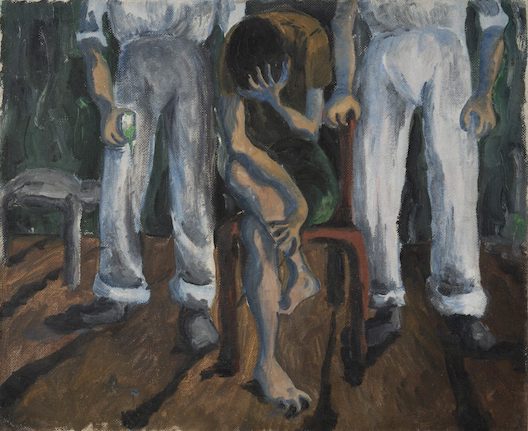
Paula Rego was born in 1935, in a Portugal still under fascism. Remarkably, she painted ’Interrogation’ (1950, below) while just fifteen. The - for want of a better word - purity of those interrogator bodies is emphasised by the echoing whiteness of their symmetry, and by their headlessness throwing emphasis onto their puffed-up torsos. Which contrasts with the poor figure in the chair, so twisted and contorted. It’s a remarkably assured work for someone so young. But if you were to pin it to a label you’d pick Expressionism.


Whereas ’Salazar Vomiting the Homeland’ (1960, below) is more indicative of her future direction. Its wild reductions and distortions of the human figure, its colours so vivid it almost looks like the work vomited itself into being, these are more reminiscent of Surrealism - particularly Miro. And, not unlike Miro, at the same time it keeps up the political themes. Salazar was Portugal’s dictator.


Surrealism, we should remember, emerged in opposition to fascism - aesthetically as much as politically. Propaganda art typically aims to appeal by making easy sense out of complex subjects. So, against its neat and tidy imagery of heroic male figures rendered in almost geometric anatomy, Surrealism twisted and stretched the human body until it was barely recognisable. And fascism, let’s remember, was perfectly able to recognise this in its enemy.

By 1951 Rego had been moved by her liberal-minded parents to England, the following year enrolling at the Slade. So it’s entirely possible that, with home censorship, the Portuguese artist only saw the work of the Spanish after arriving here. And there’s no denying her most impressionable years were spent under Salazar’s controlling maw.

Nevertheless, the show perhaps makes too much of these early years. It talks about the restrictive roles fascism forced women into, accurately and understandably. But it seems needlessly narrowing to confine her art into a response to this. If patriarchy was your prison, a move to Fifties England was a sure-fire way to discover its bars didn’t end at Portugal’s borders. In fact in ’57 she moved back there to have a baby out of marriage, after undergoing several abortions. And if we’re to take abortion as a barometer of women’s freedom it wasn’t legalised in England until 1968, then Portugal in 2007. Some while after Salazar had ceased vomiting.

Besides, that was scarcely the limits of it. One exhibition refused to display ’Salazar’, not in fascist Portugal but supposedly liberal London.


Added to which, if fascism held sway in her homeland until the shockingly late date of 1974, Rego was there to witness its end. The later work ’Madame Lupscu Has Her Fortune Told’ (2004, above) features the widow of the would-be dictator of Romania, who’d fled there. She’s pictured beside a seig-heiling statuette while attempting to get a blank palm read, fascism reduced to no more than a sick form of nostalgia for atrocity. (Oh to be back in the days when it seemed something consigned to the past!)

More widely, it risks mislabelling her art at agitprop. If ’Interrogation’ could have illustrated an Amnesty leaflet, ’Salazar Vomiting The Homeland’ requires you to read the title to get the context. And this is the vein in which she continues. In the accompanying filmshow she comments art should be as much about what’s inside you as what’s outside.


We see this in her collage works, which ran through the Sixties and much of the Seventies. (Though the term’s a little misleading here, as she chiefly collaged her own drawings.) ’The Firemen of Alijo’ (1966, above) was based on a sight she witnessed, the Portuguese poor barefoot in the show and huddled around a fire. But the finished work is so far from this that it’s more impetus than basis. In Rego’s hands, the scene becomes a phantasmagoria.

That green stripe is a horizon line, or perhaps the base of a wall. And the left-most figures do stand barefoot upon it. But from there they’re arranged in a grand sweep across the canvas, which trails out just before reconnecting to the ground. And the colour scheme becomes bolder and more varied as that sweep progresses. The result is such an accumulation it becomes an assault on the senses, which takes some while to resolve. Other works follow this arrangement, such as ’Manifesto for A Lost Cause’ (1966).

The ground-as-base is reminiscent of children’s art. But it also seems employed as a thin thread to perspective, and with it the naturalistic conventions of art. It’s there largely to show what is being left behind, try to stand on that seeming solid base and you’ll soon be yanked off our feet.

Painting With Children + Animals 

In 1974, for the first time, Rego illustrated some Portuguese folk tales. And there were not just more works to come in this vein, the themes would creep into her art more generally. (Yes this was the year the dictatorship fell, for those who like to make something of such things.) Perhaps the main thing is how little she has to change them to make them hers. It’s like she isn’t twisting or making use of them, they really were this sinister all along, just without us noticing. Take for example the print of ’Baa Baa Black Sheep’ (1989), below.


Slightly earlier, but in what seems a related move, she began making what she called ‘dollies’ - soft-form creations, something like home-made children’s toys. Though the show calls them ‘sculptures’, and though no article on her is complete without a photo of her studio festooned with them (see Wikipedia for an example) unlike Dorothea Tanning she doesn’t seem to have seen then as art objects in themselves, but as props to incorporate into her artwork. They were something like a Commedia Dell’arte troupe she could have on standby. From this point on her art is regularly rooted in the ‘types’ of folk tales, fables and fairy stories.


In the early Eighties she began a series of bold, thick-lined acrylic works, often on paper, largely featuring animals. Take for example ’Red Monkey Offers Bear a Poisoned Dove’ (1981, above). It looks so stark and bold, with everything handily labelled by that descriptive title, it must surely have a straightforward meaning. A poisoned dove is admittedly an easy enough image to read. But why a monkey, why a bear? We realise we’ve been looking at it for a while, waiting for this straightforward meaning to emerge, then a little later that it won’t.

A bunch of responses suggest themselves (countries in the Cold War?, characters in Rego’s life?, psychological archetypes?), yet none stick. And in this way it reflects the simple, direct prose which fables and folk tales are told in. In a Guardian interview she confirmed: “I always need a story. Without a story, I can’t get going.” But the story is often like the witnessed scene in the earlier collages, not something to illustrate but break off from.


Other works in this era are large-scale, and built up from the baseline like the earlier collages. However now they’re more mural than collage, a series of smaller pictures with linking devices. Some you even read by following a series of ‘lines’ across, like a piece of text. ’The Raft’ (1985, above) is the only one to be arranged around a central motif. And, while that blue dragon seems to personify the sea, the girl on a raft seems more adrift amid a sea of images. And she sits dispassionately through it all, a solid central block amid the pandemonium.


And this Girl character recurs frequently, as in ’Girl And Dog’ (1986) where she shown absurdly shaving the dog’s throat. There’s a biographical reading here, this was the year in which her husband Victor got Multiple Sclerosis and she inevitably became his carer. (Something we’ll see in other works.) But more important may be that impassive expression.

The show takes her as a feminist heroine. Perhaps partly, but she never seems wild and free. More accurately, as Laura Cummings pointed out in the Guardian: “The dogs have a whole range of expressions, but the girl… has only one. She is a vision of fixed determination.” She seems what we aren’t, calmly accepting of this absurd world. We should remember a child doesn’t have the same relationship to animals as an adult. And this Girl is shown either living in a world of animals, or morphing into one herself.


She comes closest to an expression with ’The Little Murderess’ (1987, above) where a trace of a smirk crosses her face. The standard reading seems to be that this is again about her Victor, perhaps the return of the repressed part of her psyche that could do without the constraints of caring for him. The Pelican, we’re told, can be a symbol of self-sacrifice.

But could it not also be a metaphor for growing up, the adult ‘murdering’ the child by replacing her? Look at the way she’s virtually emerging out of the picture frame, leaving her old world behind. The objects behind her, the toy cart and brightly coloured chair, look like something from a child’s room, a room she’s leaving. And we see a spectrum as if it’s a timeline. The most vivid red is in the chair to the very right, the most vivid green in the stretched-out ribbon to the left.

Into Tableaus 

But we’re getting ahead of ourselves, because in the late Eighties Rego pulls another switch. She embarks upon large-scape acrylics, which are set in recognisable pictorial space. Colours, once almost impossibly vivid, become more muted. And while animals still appear, in this era there’s less of the human-animal hybrids.

Yet at the same time as perspective opens there’s neither movement to the work nor naturalism to the figures. They’re beyond realist, in their smoothness they’re idealised, almost hyper-real, paintings with the sharpness of line drawings. They’re tableaus, as arranged as in any diorama, their poses and gestures feel weighted with meaning. Even when we’ve no real notion what that meaning might be. They can be like looking at a nativity scene with no knowledge of the Bible.


Take for example ’The Policeman’s Daughter’ (1987, above). There’s no reason why you couldn’t re-enact the scene in real life. But that pure white dress, for example, is too pristine to exist in the real world, let alone for the messy task of boot polishing.

The title gives away whose boot is being so dutifully shone, recalling the ever on-stage synechdocheal boot in Strindberg’s play 'Miss Julie’. And the arch-backed black cat, who we can safely assume is a Tom, effectively rhymes with the boot.

Just as the wilder, free-form style went with agitational content, so this aesthetic plugs into a politics. But quite a different politics. It’s an illustration of patriarchy more than an assault on it. It seems simply too ordered to allow for change. The style dictates the tone - “this is just how it is”. And perhaps the world feels more like that as we grow older, the things we once assumed we could mould have instead moulded us.

And it should also be said that folk tales and fables, inherently common property, are inherently subversive - but they’re also fatalistic. They’re not concerned with politics, with events in the world, but with the essential state of things. Their animal figures suggest we are simply born to live out our nature.


Except, as you may have guessed, things aren’t quite as neat as they look. In ’The Family’ (1988, above) a male figure is attended by two females - this time dressing him. But he’s both obscured by and sandwiched between the two. And as they exchange a glance a third looks on with clasped hands raised, like the criminal mastermind of the enterprise.

Unsurprisingly this is another Victor picture, illustrating the way care work determines an intimacy that’s inherently not between equals. But like the Portuguese poor this is more impetus for than meaning of the work. It’s based in the ironic relationship of the servant to the master, as they make him up they simultaneously wipe him out. Look to the diorama on the chest of drawers.


And ’The Maids’ (1988, above) follows along the same lines, based on a Genet play about servants who murder their mistresses. A Maid isn’t just the central figure, her extended limbs dominate the frame, shadows splaying out from her, while her Mistress is closed up on herself. There’s still a kind of fatalism here. But it’s a fatalism in reverse to the existing order, in which the servant will inevitably rise and the master fall.

There’s also… um.. a wild boar in the room. In fact a motif of Rego’s in this period is to incorporate such an element, nromally in the lower right foreground. In the two examples above, these are entirely explicable. But it’s as often jarringly incongruous, out of scale or - as here - something of both. Earlier, her base lines kept her work semi-anchored in realism. Now it’s the reverse, she stays linked to her Surrealist roots.

To quote Laura Cummings again: “The Tate wants to make an activist of Rego… But the artist is ill-served by this reductive brief. Her gift is for the exact opposite: for the deeply ambiguous and morally disturbing scenario.”


The ink-and-watercolour work ’Island of The Light’ (1996) is part of a general return both to mural style and fable-based content. It’s based on a scene from ’Pinocchio’ where children are stolen and forced into labour, causing their transformation into donkeys. (Nicely, Rego was inspired by watching the Disney film while a child herself, rather than researching folk tales at the British Library or some such. It suggests both a personal connection to the material, and that something in these tales survives even Disneyfication.)

Rego slips between every variant of this motif: two-legged donkeys, humans riding donkeys, humans riding humans, humans with donkey heads, even a donkey mounting and biting a horse. It suggests something compelling but irresolvable about the central image.

It’s a classic child fantasy, to transform into an animal in order to roam free, unbridled by the social conventions adults try to impose on you. But the concept is double-edged, for at the same time the child’s aware that animals themselves can be made beats of burden. So what should be a means of escape here becomes a form of capture. And the jumbled nature of the composition suggests no way out.


’War’ (2003, above) is again based on something Rego witnessed, though this time at one remove. It’s based on a newspaper photo of the invasion of Iraq, which featured a screaming girl in a white dress. It’s a starker image than 'Island of the Light’, but still elusive when you try to pin it down. It’s partly inverting the folksy kid-lit image of cutesy anthropomorphised figures, with the bloodied rabbit masks. But there’s more…

There are almost as many variations as ’Island of the Light', just within two figures. The main figure has a rabbit mask, but human hands and feet, while the child she carries sports paws. The adult’s ‘mask’, dead-eyed, could equally be an enlarged rabbit skull. (And the death figure with animal skull appears elsewhere in Rego’s work, for example ‘Scarecrow and the Pig', 2005.) Yet the child’s looks bent from shape, as if papier-mache. You can’t see this as actual rabbits. But neither as people figleafed by anthropomorphism, or actors in rabbit masks. You need some combination of all of them at once.

With all the twists and turns, ’The Raft’ may well be the central image, itself depicting being at sea amid a flood of images. Rego is simultaneously compelling and inscrutable. But perhaps best of all, this is not just a retrospective of a living and working artist but one whose more recent works are still well worth seeing. And, while the content of Rego’s art may often seem less than uplifting, that seems a reason for optimism…